Introduction
Although the consumption of alcohol and illicit substances decline with age, the higher rates of alcohol and substance misuse in the ageing baby boomer cohort, along with overall population ageing, is resulting in an increased need to address alcohol and substance misuse in older people (Working Group, Royal College of Psychiatrists, 2011; the Australian Institute of Health and Welfare, 2011a). High rates of physical and mental health comorbidity in older people, along with the use of pharmaceutical medications for non-medical indications (Australian Institute of Health and Welfare, 2011a), can result in contact with geriatric medical and mental health services. Additionally, older people often supplement prescription medication with over the counter medications or alcohol in an attempt to control side effects, increasing the overall risk of adverse drug interactions and the likelihood of hospital presentations (Poole et al., Reference Poole, Jones and Veitch1999; Moore et al., Reference Moore, Whiteman and Ward2007).
There are few contemporary studies that have recorded the rates of substance use disorders in hospital and community geriatric medical and mental health services. Earlier studies found much higher rates of alcohol use disorders in hospital and psychiatric in-patients compared with community-dwelling prevalence rates (Schonfeld, et al., Reference Schonfeld, Rohrer, Zima and Spiegel1993; Goldstein, et al., Reference Goldstein, Pataki and Webb1996). Historically, the number of older illicit drug users has been minimal, and this is likely to be a reflection of cohort and period effects, along with early mortality, but there is an evidence that this is changing (Shah and Fountain, Reference Shah and Fountain2008; Beynon, Reference Beynon2009; Satre et al., Reference Satre, Sterling, Mackin and Weisner2011).
The two main classes of medications that present a concern for abuse are the benzodiazepine sedative-hypnotics and the opioid analgesics. Amongst depressed patients in an old age psychiatry outpatient clinic in the US, 16% of men and 9% of women reported misusing sedatives (Satre et al., Reference Satre, Sterling, Mackin and Weisner2011). Benzodiazepines are associated with an increased risk of depression, deliberate self-harm, cognitive impairment and falls (Paton, Reference Paton2002; Chan et al., Reference Chan, Draper and Banerjee2007; van Vliet et al., Reference van Vliet, van der Mast, van den Broek, Westendorp and de Craen2009; Voyer et al., Reference Voyer, Preville, Roussel, Berbiche and Beland2009). Opioid medication misuse is associated with increased pain and depressive symptoms (Park and Lavin, Reference Park and Lavin2010) and the percentage of Australians who are aged over 60 years receiving pharmacotherapy for opioid dependence increased from 0.3% in 2006 to 1% in 2010 (Australian Institute of Health and Welfare, 2011b).
There are few studies that have examined the identification and treatment of substance use disorders in older people. A UK study found that only 15% of cases diagnosed with an alcohol use disorder were referred to rehabilitation programs (Mulinga, Reference Mulinga1999). Physicians are less likely to discuss alcohol use with their older patients, even when they have psychiatric or physical health issues or are being treated with medications that could interact with alcohol (Duru et al., Reference Duru2010). Late life onset of alcohol use disorders may also occur, often in the context of retirement and bereavement (Working Group Royal College of Psychiatrists, 2011), and this may hinder identification.
Screening instruments for alcohol consumption have largely been designed for younger populations but some recent studies have indicated utility in older populations. The Alcohol Use Disorders Identification Test (AUDIT) was originally developed to screen for heavy drinking, with the first three questions (known as the AUDIT-C) measuring alcohol consumption (Saunders et al., Reference Saunders, Aasland, Babor, de la Fuente and Grant1993; Bush et al., Reference Bush, Kivlahan, McDonell, Fihn and Bradley1998). A community study of 65–74 years old from Finland found that the AUDIT and AUDIT-C were accurate in alcohol screening in this older population when the cut-points were tailored to the age (Aalto et al., Reference Aalto, Alho, Halm and Seppa2011). However, beyond screening there are limited specialist options available, with few designated specialist drug and alcohol treatment services catering to the needs of older people.
This project aimed to determine the substance use patterns of patients admitted to geriatric medical and psychiatric wards of a Sydney teaching hospital and associated community health services. Furthermore, we aimed to compare the performance of selected screening instruments for alcohol and substance use including comparisons by gender and level of substance use, and to determine how frequently screening, identification and referral of substance use problems were conducted by the treating team.
Method
Eligibility and recruitment
Participants were recruited from five settings – acute geriatric, orthogeriatric, geriatric rehabilitation wards, the integrated aged care psychiatry service and the community health assessment and treatment team at the Prince of Wales Hospital, Sydney, Australia in 2011/12. Any English-speaking patient aged 60 years or above admitted to the selected services was potentially eligible. Exclusion criteria were: clinical diagnoses of dementia or delirium by the treating team; Mini Mental State Exam (MMSE) score < 24 (Folstein et al., Reference Folstein, Folstein and McHugh1975), too ill to participate or level of English not sufficient at a conversational level. Patients with delirium were re-assessed for eligibility after the acute phase had subsided. Participants recruited via the community specialist mental health service were eligible if they had been on-service for at least three months.
Materials and procedure
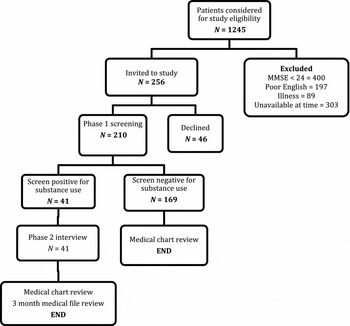
Participants were approached by the research assistant (RA) subsequent to referral from clinicians who identified patients as meeting the inclusion criteria. Consenting participants completed a face-to-face interview designed to identify those using substances at risky levels. Those that screened positive for risky substance use (‘Screen Positives’) completed additional questionnaires; see flow chart in Figure 1.
Study flow.

Screening interview
All participants completed the screening interview and were asked about their general health history, with a checklist of current or previous medical conditions, including those that might be a consequence of substance misuse (for example, liver disease) and medications as reported by the patient, which was augmented with information from their medical file. The 15-item Geriatric Depression Scale (GDS), a widely used screening instrument for depressive symptoms in the elderly, was administered (Sheik and Yesavage, Reference Sheik, Yesavage and Brink1986). Scores range from 0–15 with scores ≥6 indicating significant depressive symptoms. A two-item measure of psychological resilience, and the Connor–Davidson Resilience Scale-II (scores range 0–8 with higher scores indicating greater resilience) (Vaishnavi et al., Reference Vaishnavi, Connor and Davidson2007) were also obtained. A three-item rating of subjective quality of life (S-QOL) (How would you rate your quality of life? How satisfied are you with your health? In general, would you say that your health is. . .?), each item ranging 1–5 with higher scores indicating higher perceived quality of life, was obtained. Demographic data and use of formal and informal support services was also collected.
Alcohol use was screened using the AUDIT, with the first three questions (a briefer measure known as the AUDIT-C) measuring alcohol consumption (Saunders et al., Reference Saunders, Aasland, Babor, de la Fuente and Grant1993; Bush et al., Reference Bush, Kivlahan, McDonell, Fihn and Bradley1998). The AUDIT and AUDIT-C were found to be valid screening tools in an older community population when the cut-points were lowered and tailored to the age (Aalto et al., Reference Aalto, Alho, Halm and Seppa2011). A positive screen for using alcohol at harmful or at-risk level levels was defined as total AUDIT-C ≥5 for men and ≥3 for women.
Substance use was screened using the first two questions of the Alcohol, Smoking and Substance Involvement Screening Test (ASSIST 3.1) that is validated in older people (Humeniuk et al., Reference Humeniuk2008; Khan et al., Reference Khan2012). ASSIST Q2 >0 (‘In the past month, how often have you used the substances you mentioned’, where 0 = never) was used as screen positive for other substances (excluding tobacco and alcohol). Participants that scored >0 for prescription drug use were not considered positive screens if they described use of substances consistent with medical recommendations. Current tobacco use was not considered a positive screen.
Screen positive interviews
For the screen positive sample, additional information on alcohol use was obtained using the full AUDIT and the CAGE Questionnaire, a four-question yes–no screening tool that assesses for self-reported problems related to alcohol use, with a cut-off score of 2 for identifying alcohol use disorder (Ewing, Reference Ewing1984; Dhalla and Kopec, Reference Dhalla and Kopec2007). Additional information on substance use was assessed using the full ASSIST. For alcohol, a total score of 0–10 on ASSIST questions 2–7 represented lower risk, 11–26 moderate risk and 27+ higher risk. For all other substances, a total score of 0–3 on ASSIST questions 2–7 represented lower risk, 4–26 moderate risk and 27+ higher risk (Humeniuk et al., Reference Humeniuk, Henry-Edwards, Ali, Poznyak, Monterio and Maristela2010).
The following were also administered: the Addenbrooke's Cognitive Examination – Revised (ACE-R) to provide more detailed information on cognitive status particularly relating to executive function (Mioshi et al., Reference Mioshi, Dawson, Mitchell, Arnold and Hodges2006); the Functional Activities Questionnaire to assess functional ability (range 0–30, with higher scores representing lower functional ability) (Pfeffer et al., Reference Pfeffer, Kurosaki, Harrah, Chance and Filos1982); and satisfaction with social activities and satisfaction with friendships, each of which were assessed on a five-point Likert scale.
A medical file review was undertaken at three months for the screen positive sample to determine how often screening of substance use was documented, if it was identified as a problem, and any management or referral plan that was implemented.
Ethics and statistics
We followed the STROBE guidelines for reporting cross-sectional studies (Von Elm et al., Reference Von Elm, Altman, Egger, Pocock, Gøtzsche and Vandenbroucke2007). The study was approved by the South Eastern Sydney Local Health District Human Research Ethics Committee – Northern Sector and the University of NSW Human Research Ethics Committee. We used IBM SPSS Version 21.0 for data analysis (IBM, 2012). Group comparisons were conducted for gender comparisons, between screen positive and screen negative groups, as well as between high-risk and low-risk groups for those who screened positive. The Benjamin–Hochberg procedure was used to adjust for multiple comparisons, with the false discovery rate set at 0.05. For continuous dependent variables, a one-way analysis of variance (ANOVA) was used for group comparisons; the assumptions of normal distribution and outliers were checked by visual inspection. Pearson's chi-squared test was used for categorical dependent variables that met assumptions of normal distribution; Fisher's exact test was alternatively used in cases of small sample sizes (where expected values of any cell were <5). The Wilcoxon Mann–Whitney was utilized for non-parametric group comparisons. Correlation analyses were also undertaken between measures of quantity and frequency of alcohol consumption (AUDIT-C) and reported dependence symptoms and adverse health and social effects (AUDIT Questions 4–10, ASSIST 3–7, CAGE). Pearson's technique was used for correlation analyses. For those who screened positive for alcohol use, sensitivity and specificity scores were calculated for progressive cut-points on the AUDIT-C by groupings of risk (1 = medium-high risk) on the AUDIT-full and by the ASSIST Q2–7 (alcohol) and an ROC analysis was generated for these two questionnaire measures. Missing data were excluded from individual analyses.
Results
Participants
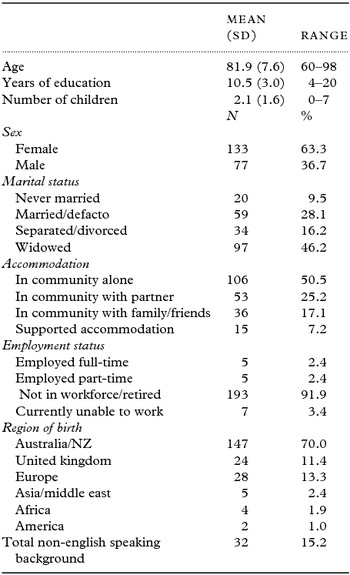
There were 210 participants in Phase 1 screening (82% of eligible participants) from geriatric rehabilitation (n = 63), community health assessment and treatment team (n = 40), aged care psychiatry (n = 39), acute geriatrics (n = 38) and orthogeriatrics (n = 30). Demographic details are summarized in Table 1.
Demographic information for total sample (N = 210)

Medical conditions
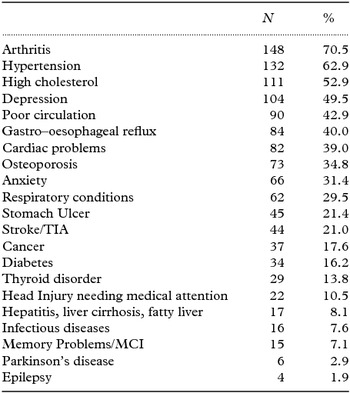
The majority were admitted to hospital or were being managed in community health for physical health reasons (80.5%). The mean number of hospitalizations in the previous year was 1.6 (range 0–8, SD 1.1). The most common health conditions identified are listed in Table 2. Falls in the previous year occurred in 51.9%, with 45.2% resulting in an injury. The mean number of falls was 1.2 (range 0–6, SD = 1.6).
Frequency of health conditions in total sample (N = 210)

The mean MMSE score was 27.4 (range 24–30; SD 1.8) and the mean GDS score was 4.6 (range 0–15; SD 3.4), with 35.7% having significant depressive symptoms with scores ≥6. On the CDRS, the mean score for resilience was 5.9 (range 0–8; SD 2.0) and the median score on the subjective quality of life rating was 4. Subjective QOL was rated as good or very good by 114 (54.3%) and poor or very poor by 25 (11.9%). Informal support was received by 147 (70.0%) and formal support by 117 (55.7%) which was mainly cleaning (n = 97, 46.2%), transport (n = 41, 19.5%), meals (n = 31, 14.8%) and personal care (n = 27, 12.9%).
Substance use
Medical charts were available for 205 participants; these documented that 50 participants were currently prescribed benzodiazepines (23.9%), 49 were prescribed antidepressants (23.9%) and 42 (20.5%) were prescribed opioids.
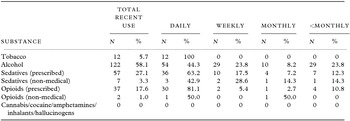
Recent use of alcohol and other substances as rated on the ASSIST is recorded in Table 3. Lifetime use of alcohol and other substances was relatively high; 83.8% reported having used alcohol, 59.0% tobacco, 63.3% sedatives as prescribed, 5.2% sedatives for non-medical use, 60.5% opioids as prescribed and 2.4% opioids for non-medical use, 7.1% had used cannabis in their lifetime but none reported ever having used cocaine, amphetamines, hallucinogens or inhalants.
Self-reported frequency of alcohol and other substance use on the ASSIST: recent use (last three months)

Screen positive sample
There were 41 (19.5%) screen positive participants; 36 (17.1%) for alcohol misuse (23 female, 13 male), seven (3.3%) for benzodiazepines (six female, one male) and two (1.0%) for opioids (one female, one male). Four female participants were screen positives for alcohol and benzodiazepines. All of the females that screened positive for alcohol scored 3–5 (median = 4) on the AUDIT C. In contrast, the 13 screen positive males scored 5–12 (median = 10) on the AUDIT C. Only males (n = 9) reported consuming >4 standard drinks on a single occasion.
Only three of the screen positive benzodiazepine users were taking extra tablets daily and one once or twice per week while the rest took extra tablets weekly or less. One screen positive opioid user was taking four extra tablets per day; the other took an extra tablet monthly for pain.
Group differences: screen positives versus screen negatives
We compared screen positive and screen negative participants on socio–demographic variables and there were no differences with respect to sex, age, marital status, education and whether they lived alone. However, screen positive participants were significantly less likely to have a non-English speaking background (χ2(1, N = 210) = 6.5; p = 0.01). On general health measures as listed in Table 2, there were no significant differences between screen positive and screen negative participants. There were also no significant differences in cognition as measured by the MMSE, or on self-reported ratings of mood, resilience or quality of life.
Screen positives: levels of risk
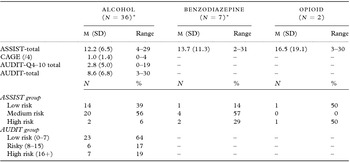
The ASSIST was used to rate screen positives for risk of harm allowing comparisons across substances (see Table 4). Overall, 15 (37%) of the screen positives were rated as low risk, 21 (51%) as medium risk and five (12%) as high risk of any alcohol or substance misuse. Thus, 26 (12.4% of the total sample, 63.4% of screen positives) were rated as medium to high-level risk for substance related harm.
Screen positives: level of risky alcohol and substance use (ASSIST and AUDIT)

*Individuals scoring positive for multiple substances were scored independently for each substance.
We compared the low-risk group with the medium/high risk group on measures of cognition (ACE-R), function (FAQ), mood (GDS), quality of life, resilience (CDRS), satisfaction with social activities, satisfaction with friendships, falls and hospitalizations in the previous year, living alone, and formal and informal social support. The only significant difference was that the medium/high risk group were more likely to be receiving formal community support (Χ 2 = 8.3; p < 0.01).
Screen positives: comparison of alcohol use screens
Thirty nine percent of individuals that screened positive for alcohol were in the ‘lower risk’ category defined by the ASSIST. Comparatively, the risk categories defined by the AUDIT Full (total 0–7 = low risk for alcohol-related problems) placed 64% in the ‘low-risk’ level (Babor et al., Reference Babor, Higgins-Biddle, Saunders and Monteiro2001). Twenty-eight percent scored 2 or higher on the CAGE.
We undertook an ROC analysis to determine what cut-score on the AUDIT-C would provide best sensitivity and specificity to differentiate ‘low-risk’ individuals from ‘medium’ or ‘high-risk’ (as defined by ASSIST) as well as ‘risky’ or ‘high-risk’ as rated by the full AUDIT. The AUDIT-C had weak discriminatory power in its ability to differentiate ASSIST groupings (AUC = 0.67). A score of 5 or above achieved a specificity of 0.72 and a sensitivity of 0.68. The AUDIT-C had good discriminatory power (AUC = 0.97) in determining risk groupings on the full AUDIT. Best sensitivity (1.0) and specificity (0.72) was achieved at an AUDIT-C score of 5 for both sexes.
Screen positives: reported symptoms related to substance use
The relationship of drinking frequency and quantity (AUDIT-C) to alcohol use outcomes (symptoms of alcohol dependence and adverse outcomes) was examined. The reported amount and frequency of drinking combined (AUDIT-C) was strongly associated with dependence symptoms, as well as adverse health and social effects on both the AUDIT and ASSIST questionnaires (AUDIT Questions 4–10 (r = 0.52, p = 0.01), ASSIST 3–7 (r = 0.42, p = 0.01). Responses to the CAGE had a weaker association with drinking amounts (AUDIT-C; r = 0.34, p = 0.04). There was a strong correlation between total scores for alcohol on the AUDIT and on the ASSIST (r = 0.75, p = 0.01).
For alcohol, the most frequently reported symptoms of problematic use included craving for alcohol (61.1%) and concerns by their relatives or friends regarding their use (33%). For benzodiazepines, most (n = 5) responded that they had a craving to use the substance in the last three months and almost half (n = 3) reported that they had unsuccessful attempts to cut down use in their lifetime.
Identification and management of substance use problems
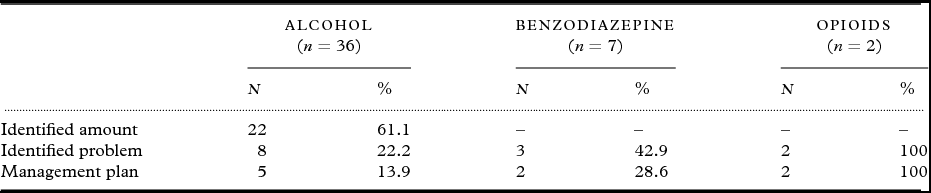
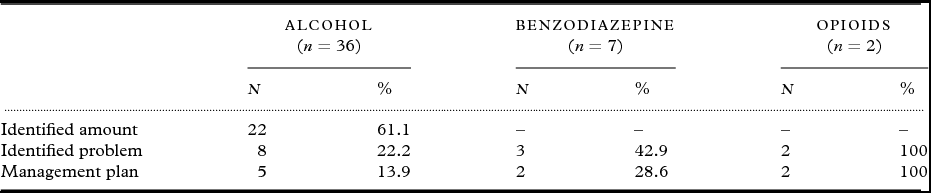
The results of the medical file review of the screen positive sample are reported in Table 5.
Medical record audit of identification and management of alcohol and substance use for screen positive participants
We excluded the ‘low risk’ group from the screen positives and this did not change these findings, with a similar proportion having the amount of alcohol consumed documented by medical staff (73%), having the consumption patterns identified as a problem (23%) and having a management plan devised (14%).
For those that screened positive for alcohol, the identification of an alcohol use problem was not associated with self-reported drinking quantity and frequency in isolation on the AUDIT-C (F(1,34) = 2.7, p = 0.11); however, this was more likely to occur when the individual rated higher on the ASSIST Q3–7; F(1,34) = 5.9, p = 0.02) or the AUDIT (Q4–10; F(1,34) = 21.6, p < 0.01) for alcohol-related problems or dependence symptoms.
There was one false screen negative participant who denied drinking but the medical file review at the time of interview documented an admission due to falling while intoxicated and a significant history of alcohol use with previous referral to the drug and alcohol service. The two users that screened positive for opioid use were noted as having a history of chronic pain with chronic opioid use and were referred to the pain clinic.
Discussion
The levels of alcohol and other substance misuse detected in this geriatric hospital and community health service study are consistent with those reported by community-dwelling older people in the 2010 National Drug Strategy Household Survey (AIHW, 2011a). Nearly 20% of the sample screened positive for risky substance use (mainly alcohol and also prescription drug misuse) while over 12% of the sample had medium to high-risk alcohol or substance use. The study also identified high levels (over 20%) of patients that were prescribed benzodiazepines and/or opioids.
With an average age of nearly 82 years, being predominantly female and living alone, our study participants were representatives of older people attending geriatric hospital and community health services. Participants who screened positive for harmful substance use were almost indistinguishable on demographic, health and social variables from those that screened negative. The only demographic variable that was significantly different was the lower rate of substance misuse in migrants from a non-English speaking background. This is a finding previously noted in Australian community surveys (AIHW, 2011a).
While there were no significant differences on measures of mood and cognition, it is important to note that over a third of the entire sample had significant depressive symptoms on the GDS-15. Older people in hospital have high rates of depression irrespective of their substance use. The medium/high risk screen positive group reported increased use of formal care services which may indicate a decreased ability to maintain independence without additional support in this group.
Our finding that there were no physical health differences between the screen positives and screen negatives is perhaps a reflection on the high rates of physical health comorbidities that occur in the very old within geriatric hospital and community health settings. In this context, alcohol and substance use is not adding significantly to the complexity of health presentations.
As there were few clinical health indicators to alert a clinician to the possibility of alcohol or substance misuse in this sample, a routine screen may be required to detect potential concerns. Recording of alcohol and substance consumption only occurred in around 60% of participants, hence there is a need to improve routine substance use screening in this population. This rate is similar to previous outpatient findings (Sharp and Vacha-Haase, Reference Sharp and Vacha-Haase2011). It is likely that there are a variety of practical and psychological factors that contribute to these rates of screening, including limited practitioner time and resources. This is especially true in the context of often complex medical problems, stereotypical ideas about the likelihood of substance use problems in older adults, and limited awareness about the impact of ageing on substance use. As found in this study, self-report of problematic drinking is insufficient for accurate identification of problem drinkers, given a tendency to under-report usage, and further questions about frequency and quantity of drinking should form a key part of the clinical screening process (Bradley et al., Reference Bradley, Kivlahan, Bush, McDonell and Fihn2001).
The AUDIT-C performed adequately as a screening tool for alcohol misuse, with a cut-point score of 5 being the most accurate for distinguishing between high- and low-risk users. This differs from the Finnish community study that found the optimal cut-point to be 4 (Aalto et al., Reference Aalto, Alho, Halm and Seppa2011). We did use a lower cut-off of 3 for women in this sample but on the whole this resulted in too many false positives (low-risk users). Using a cut-score of five on the AUDIT-C, seven women (19.4% of screen positives for alcohol) that were rated as medium risk on the ASSIST were false negatives however these same individuals were all rated as low-risk on the full AUDIT. Given these slight differences between risk ratings, the ASSIST may be a more appropriate measure to use if a conservative approach to screening is needed although this needs further investigation.
The use of the ASSIST as a substance use screen requires some interpretation when applied to prescription drugs. We excluded those using the drugs ‘consistent with medical recommendations’ and it could be argued that this resulted in an underestimate of benzodiazepine and opioid misuse, as nearly a quarter of the sample was prescribed benzodiazepines and over 20% were prescribed opioids. However, the vast majority were using them as prescribed. The extent to which these drugs should be prescribed in a geriatric population over the long term is debatable but the general view, particularly with benzodiazepines, is for minimal use (Voyer et al., Reference Voyer, Cappeliez, Perodeau and Preville2005). As a screen, the ASSIST used in this way was very specific for benzodiazepine misuse. Given the complexities involved with the prescription of benzodiazepine and opioid medications, the potential for iatrogenic substance misuse is important for future research to consider. The absence of any screen positives for illicit drugs such as cannabis, cocaine and amphetamines may reflect the age of this population. There were few baby boomers in the sample and there are expectations that as this cohort increases we may see a change in substance use habits (Jeste and Palmer, Reference Jeste and Palmer2013).
There are a number of limitations in interpreting the results of this study. We purposefully excluded patients with dementia, delirium or significant cognitive impairment, which accounted for nearly a third of potential participants. While this increased the accuracy of self-report and improved study feasibility, it did mean that an important geriatric population was omitted, one that in previous work has shown high rates of alcohol use disorders (Draper et al., Reference Draper, Karmel, Gibson, Peut and Anderson2011). We also were unable to interview potential participants that did not speak adequate English, which was over 15% of the patients considered by clinicians. We were also unable to contact nearly a quarter of the potential sample, mainly because they were discharged before the RA could see them. As with any survey of alcohol and substance use, we were reliant on the accuracy of self-reported data although from our review of medical records this appeared to have acceptable accuracy in this study. The sample size was moderate and so we had few who were misusing substances other than alcohol. Finally, although in this cross sectional survey we could identify few harmful impacts of medium/high risk levels, this might not be the case with a longitudinal study.
In conclusion, we have found that nearly 20% of patients in geriatric hospital and community services screen positive for alcohol or substance misuse and that over 12% are using substances at medium/high risk levels. Clinicians need to consider the use of routine screens for alcohol use given this population is otherwise difficult to distinguish on clinical parameters.
Conflicts of interest
None.
Description of author roles
B. Draper designed the study, obtained research funding, supervised data collection and analysis, and wrote the paper. N. Ridley collected data, performed analyses and contributed to writing the paper. C. Johnco collected data and contributed to analyses and writing the paper. A. Withall contributed to study design, obtained research funding and assisted in supervision of data collection, analyses and writing the paper. W. Sim was involved in designing the study, obtaining funding, collecting data and writing the paper. M. Freeman was involved in designing the study, obtaining funding, collecting data and writing the paper. E. Contini collected data, assisted in analyses and writing the paper. N. Lintzeris was involved in designing the study, obtaining funding and writing the paper.
Acknowledgments
This study was funded by Primary Dementia Collaborative Research Centre – Assessment and Better Care, University of NSW, Sydney, Australia and the NSW Mental Health Drug & Alcohol Office Drug and Alcohol Drugs Research Program. We would like to thank the staff and patients who assisted with this study.