Introduction
Usnea Adans. is a fruticose lichen genus of the family Parmeliaceae (Lecanoromycetes), comprising nearly 450 currently accepted species (Lücking et al. Reference Lücking, Nadel, Araujo and Gerlach2020), widely distributed in polar, temperate and tropical regions. The genus is readily distinguished by the shrubby to pendulous thallus, branches with an elastic central axis, and the presence of usnic acid in the cortex. The genus Usnea in the broad sense forms a strongly supported clade with groupings that have variously been recognized at the generic or infrageneric level (Usnea s. str., Eumitria Stirt., Dolichousnea (Y. Ohmura) Articus and Neuropogon Nees & Flot). The subclades Usnea s. str., Eumitria and Dolichousnea occur in the Philippines. Eumitria is characterized by the presence of a tubular central axis (with the exception of U. pectinata with a partially fistulose axis). It has a wide distribution, with taxa occurring in Africa (Swinscow & Krog Reference Swinscow and Krog1974; Temu et al. Reference Temu, Clerc, Tibell, Tibuhwa and Tibell2019), Asia (Ohmura Reference Ohmura2001, Reference Ohmura2012), Australia (Stevens Reference Stevens1999) and South America (Truong & Clerc Reference Truong and Clerc2013). Its morphological circumscription is diffuse since species without a central tubular axis (but with a partially fistulose axis) might cluster together in a molecular phylogeny (within a strongly supported clade) with species having a central tubular axis (Truong et al. Reference Truong, Divakar, Yahr, Crespo and Clerc2013a). Dolichousnea is a smaller subclade with only three species, including U. longissima, reported for the Philippines by Herre (Reference Herre1946) but not found in this study. This subclade is characterized by annular pseudocyphellae and an amyloid central axis (Ohmura Reference Ohmura2001). Given the fact that, in the molecular phylogeny, Usnea s. lat. forms a strongly supported monophyletic group and that morphological and anatomical features are not fully consistent with subclades recognized within it, here we follow previous workers (Ohmura Reference Ohmura2002; Ohmura & Kanda Reference Ohmura and Kanda2004; Wirtz et al. Reference Wirtz, Printzen, Sancho and Lumbsch2006; Truong & Clerc Reference Truong and Clerc2013; Truong et al. Reference Truong, Divakar, Yahr, Crespo and Clerc2013a; Ohmura & Kashiwadani Reference Ohmura and Kashiwadani2018; Temu et al. Reference Temu, Clerc, Tibell, Tibuhwa and Tibell2019) in considering these subgroups at the infrageneric level in our taxonomic treatment of the species found in the Philippines.
The two most comprehensive taxonomic treatments of Usnea for the Philippines were published by E. A. Vainio (Vainio Reference Vainio1909), with 11 species and six varieties or forms, among them six new species (Eumitria endochroa Vain., E. endorhodina Vain., Usnea furcata Vain., U. philippina Vain., U. pycnoclada Vain. and U. squarrosa Vain.) and five new varieties (Eumitria endochroa var. farinosa Vain., E. endochroa var. papillata Vain., Usnea furcata var. marivelensis Vain., U. longissima var. misamisensis Vain. and U. philippina var. mearnsii Vain.), and by Herre (Reference Herre1963), with 25 taxa described, among them three new species (Usnea elmeri Herre, U. humilis Herre and U. ramosi Herre), with a key for their identification. Further taxonomic studies were carried out by Asahina (Reference Asahina1967, Reference Asahina1968, Reference Asahina1969a, Reference Asahinab) who reported six taxa from the region including five new taxa (U. neoguineensis var. gracilior Asahina, Usnea neoguineensis Asahina var. neoguineensis, U. ogatae Asahina, U. pseudorientalis Asahina, and U. pseudorubescens Asahina var. anaemica Asahina).
The studies more recently published on the genus Usnea in the country were made in the northern Philippines, with a strong focus on chemistry (Sevilla-Santos & Mondragon Reference Sevilla-Santos and Mondragon1972; Santiago et al. Reference Santiago, Borricano, Canal, Marcelo, Perez and dela Cruz2010, Reference Santiago, Sangvichien, Boonpragob and dela Cruz2013; Timbreza et al. Reference Timbreza, Delos Reyes, Flores, Perez, Stockel and Santiago2017). Galinato et al. (Reference Galinato, Baguino and Santiago2018), in their review of Usnea in the Philippines, recorded 81 species, highlighting that the genus is poorly known in the country despite its high diversity.
A recently published checklist (Paguirigan et al. Reference Paguirigan, dela Cruz, Santiago, Gerlach and Aptroot2020) recorded 71 accepted names. However, some of these occur only in continental-temperate areas of the Northern Hemisphere and their superficial similarity with species that occur in the Philippines may have led to incorrect identifications. These include taxa such as Usnea barbata (L.) F. H. Wigg., U. cavernosa Tuck., U. hirta (L.) F. H. Wigg., U. intermedia (A. Massal.) Jatta, U. perplexans Stirt., U. substerilis Motyka and U. trichodea Ach. If we consider names treated as accepted taxa in the checklist but actually considered synonyms of other species, such as U. ciliata (Müll. Arg.) Vain., U. himantodes Stirt. and U. lapponica Vain., we are closer to 55–60 species of Usnea in this large, biodiversity-rich archipelago.
The Philippines is considered one of the 25 global biodiversity hotspots designated for priority conservation, based on their high endemicity and richness of flora and fauna (Myers et al. Reference Myers, Mittermeier, Mittermeier, da Fonseca and Kent2000). Despite this rich endemism, only 3% of the original vegetation is preserved. The Philippines is subdivided into four major groups of islands, corresponding roughly to the western island of Palawan, the northern island of Luzon, the central islands of the Visayas and the southern island of Mindanao. The latter two areas, as defined here, encompass the southern Philippines. This region lies fully in the tropical zone between 5°22ʹ–12°40ʹN latitude, and 121°47ʹ–126°36ʹE longitude. The major islands of the Visayas, from more or less west to east, are Panay, Negros, Cebu, Masbate, Bohol, Leyte and Samar, with numerous smaller islands interspersed throughout. Mindanao dominates the extreme south and is fringed by smaller islands such as Basilan, Camiguin and Dinagat.
This study is part of the NSF-funded Project ‘Plant discovery in the southern Philippines’ led by the Fort Worth Botanic Garden (the Botanical Research Institute of Texas, BRIT) and it reports the first results of lichens from the expedition made to Mindanao and Negros in 2019. This is the first study on the genus Usnea in the Philippines that takes into account molecular, morphological, anatomical and chemical data for the majority of the species analyzed.
Materials and Methods
Fieldwork
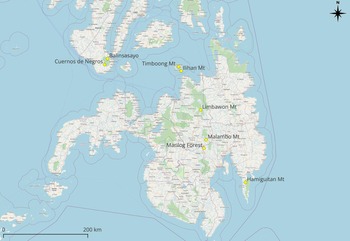
Two expeditions were conducted in the southern Philippines during June and December 2019, on three islands: Mindanao (Bukidnon Province (Mt Malambo and Mt Limbawon), Davao del Sul (Marilog Forest Reserve) and Davao Oriental (Mt Hamiguitan Range Wildlife Sanctuary)); Camiguin Island (Mt Timboong, Mt Ilihan, Manbajao); Negros (Negros Oriental: Balinsasayao Twin Lakes Natural Park and Cuernos de Negros) (Fig. 1). To our knowledge, this is the first study on the genus Usnea to include samples from Negros (Balinsasayao Twin Lakes Natural Park).
Study sites in the Philippines (marked with yellow filled circles) where collections were made during the two expeditions in 2019. Source: http://qgis.osgeo.org. In colour online.

In 2019, AG and MDF collected a total of 1728 specimens of lichenized fungi (belonging to c. 36 families and 88 genera), more than 300 of which belong to the genus Usnea s. lat. This first paper is the result of the study of 107 specimens now collected for the genus within this project. Specimens not yet studied are housed in FWBG (part of the herbarium in the Botanical Research Institute of Texas, BRIT) and will be analyzed in a forthcoming paper.
Field trips were conducted in tropical rainforest and in low to upper montane forest in collaboration with Central Mindanao University (CMU). All specimens were corticolous (growing on tree bark or branches) and were collected above 700 m altitude (782–1582 m above sea level). The specimens analyzed here were largely collected in open areas, mainly in secondary forest or anthropized environments with crops or planted trees (e.g. coconut palms), more rarely on the ground on fallen branches in mossy forest. We did not find any Usnea growing on rocks. Approximately 29 additional specimens previously collected in the Philippines and housed in ZE Botanischer Garten und Botanisches Museum, Freie Universität Berlin (B) were integrated in this study. All analyzed specimens are detailed in Supplementary Material File S1 (available online) in order to avoid long lists of citations. Voucher specimens will be deposited according to the following priority order: Philippine National Herbarium (PNH) and/or Central Mindanao University (CMUH) (as required by Philippine national law), with duplicates in BRIT, and the Conservatoire et Jardin botaniques de la Ville de Genève (G).
DNA extraction, PCR and sequencing
The DNA extraction and PCR were performed at the Sumner Laboratory at the Botanical Research Institute of Texas. The procedures outlined in Dal Forno et al. (Reference Dal Forno, Lawrey, Sikaroodi, Bhattarai, Gillevet, Sulzbacher and Lücking2013) were followed, except that the ITS primers used were Usnea-specific as proposed by Truong et al. (Reference Truong, Divakar, Yahr, Crespo and Clerc2013a), namely USITS3-F (50-GTA GGT GAA CCT GCG GAA G-30) and USITS4-R (50-CGC TTC ACT CGC CGT TAC T-30). Three additional sequences were obtained at the Botanic Garden of Berlin, using the Sigma REDExtract-N-Amp Plant PCR Kit (St Louis, Missouri, USA) for DNA isolation following the manufacturer's instructions, except that 30 μl of extraction buffer and 30 μl dilution buffer were used. DNA dilutions 1:10 were used in PCR reactions. PCR reactions contained 14.4 μl of NuFree H2O, 2.5 μl 10× Standard Taq Reaction Buffer, 1 μl 25 mM MgCl2, 3 μl dNTP (1.25 mM), 1 μl of each primer (10 pm/μl) and 2 μl (dilution 1:10) genomic DNA extract for a total of 25 μl. Thermal cycling parameters were: initial denaturation for 5 min at 94 °C, followed by 39 cycles of 30 s at 94 °C, 30 s at 48 °C, 1 min 30 s at 72 °C, and a final elongation for 5 min at 72 °C. PCR samples were visualized on a 1.5% agarose gel under UV light and PCR products of homogeneous size were treated enzymatically using ExoSAP-IT Express PCR Product Cleanup Reagent, following the manufacturer's instructions (Thermo Fisher Scientific). DNA concentrations were measured with QubitTM dsDNA Broad Range Assay Kit (values available in Supplementary Material File S2, available online). Samples were sent to Psomagen/Macrogen (USA) for sequencing.
Sequence alignment and phylogenetic reconstructions
The DNA sequences obtained were aligned using MAFFT v. 7 (Katoh & Standley Reference Katoh and Standley2013) with the G-INS-I alignment algorithm, a scoring matrix of 20 PAM/K = 2, 0.1 as offset value and the remaining parameters set to default. To reconstruct the phylogeny, we used a total of 178 ITS sequences (see Supplementary Material File S2), 102 of which were obtained from GenBank, plus 76 newly generated sequences (54 from the Philippines (Table 1), 21 from Japan and Taiwan and one from Portugal) obtained for this study (Supplementary Material File S2). Almost all available sequences from Asia were added (Lücking et al. Reference Lücking, Nadel, Araujo and Gerlach2020), except those not identified or with dubious identification (U. nidifica_Li207c and U. nidifica_Li190c). Since we putatively found Usnea dasaea in the Philippine material, we also added a sequence for this species obtained from Portugal (type country). Usnea longissima was chosen as outgroup following Lücking et al. (Reference Lücking, Nadel, Araujo and Gerlach2020).
Voucher information and GenBank Accession numbers for the 54 Philippine samples of the genus Usnea used for this study. Newly proposed species are in bold. Voucher number: AG = A. Gerlach; MDF = M. Dal Forno. Main chemistry column: BAR = barbatic acid; CST = constictic acid; DIF = difractaic acid; GAL = galbinic acid; LOB = lobaric acid; NOR = norstictic acid; PRO = protocetraric acid; PSO = psoromic acid; SAL = salazinic acid; STI = stictic acid; ZEO = zeorin.

To build the data matrix, we first added all newly obtained sequences (Table 1 and Supplementary Material File S2) to the global ITS dataset generated by Lücking et al. (Reference Lücking, Nadel, Araujo and Gerlach2020; see their supplementary information S1). A best-scoring maximum likelihood (ML) tree was reconstructed in RAxML v. 8.2.12 (Stamatakis Reference Stamatakis2014), with RAxML-HPC Blackbox v. 8.2.12 on the CIPRES Science Gateway (Miller et al. Reference Miller, Pfeiffer and Schwartz2010). We used the universal GTR-Gamma model with 1000 bootstrap replicates (locally) using a saturation criterion (CIPRES). After reconstructing an initial tree, we subsequently removed terminals of less interest as they were only distantly related to the Philippine species. Usnea (Dolichousnea) longissima was chosen as outgroup due to its close relationship with Usnea s. str. and its occurrence in the archipelago (Paguirigan et al. Reference Paguirigan, dela Cruz, Santiago, Gerlach and Aptroot2020). Partitions above 70% are considered well supported (ML bootstrap (BS) >70%). The final data matrix contained 178 total sequences representing 62 Usnea taxa (Supplementary Material File S2) (Fig. 2).
Molecular phylogeny of Usnea focusing on the species from the Philippines. The phylogeny is based on ITS rDNA sequence data and analyzed using maximum likelihood (RAxML) inference. The thickest bold branches represent ML bootstrap values > 75%, with branch values only shown of >70%. ‘NEW’ indicates sequences newly acquired for this study. Specimens collected in the Philippines are in grey; the species name is given with the DNA-code and concatenated codes for the main chemistry (BAR = barbatic acid; CST = constictic acid; DIF = difractaic acid; GAL = galbinic acid; LOB = lobaric acid; NOR = norstictic acid; PRO = protocetraric acid; PSO = psoromic acid; SAL = salazinic acid; STI = stictic acid; ZEO = zeorin) (see Table 1). Usnea (Dolichousnea) longissima is the outgroup. Details of branching, represented in this tree by filled triangles, are given in Figs 2A–E.

Morphological, anatomical and chemical studies
The following account is based on field studies and on specimens deposited in herbaria B and G. Type material of the majority of species discussed here (except U. baileyi) was studied; types housed at the University of Turku (TUR-V) were specifically examined for this study in November 2021.
The morphology of specimens was examined using a Leica MS5 stereomicroscope, with measurements taken using a Leica DM2000 microscope (Switzerland). The phenotypic species concept used in this study follows Clerc (Reference Clerc1998) and Ohmura (Reference Ohmura2001). Anatomical measurements of cortex, medulla and central axis were carried out in longitudinal sections of branches at ×40 magnification. The percentage thickness of cortex/medulla/axis of the total branch diameter (%C/M/A) and the ratio of axis/medulla (A/M) of all the cited specimens were calculated according to Clerc (Reference Clerc1984, Reference Clerc1987) and Clerc & Naciri (Reference Clerc and Naciri2021). Additionally, for the eumitrioid species (Usnea baileyi), the tubular part of the axis (%TBA) was measured according to Truong & Clerc (Reference Truong and Clerc2013). The measurement ranges for each layer are indicated as follows: (min–mean–max), or (min–)-sd mean +sd(–max). %C/M/A categories follow Clerc (Reference Clerc, Thell and Moberg2011). Analyses of the anatomical structure of the cortex were made according to Ohmura (Reference Ohmura2001), on thin hand-cut sections and observed at ×400 magnification with a Leica DM2000 microscope.
Chemical analyses were performed on all cited specimens using thin-layer chromatography (TLC) following Culberson & Ammann (Reference Culberson and Ammann1979), with solvent B modified according to Culberson & Johnson (Reference Culberson and Johnson1982). K, C and P spot tests, according to Hale (Reference Hale1979), were directly applied to the medulla in longitudinal sections of branches. The unidentified substances US1 and US2 found in some of the species treated here were characterized by Ohmura (Reference Ohmura2001). Short descriptions are given for previously described species based on all the above information from a given number of samples (n).
Results
This study revealed 20 species or species complexes among the investigated material: Usnea angulata s. lat., U. baileyi s. lat., U. bismolliuscula, U. brasiliensis s. lat., U. confusa, U. croceorubescens, U. dasaea, U. himalayana, U. krogiana, U. longissima, U. nidifica, U. norsticornuta sp. nov., U. paleograndisora sp. nov., U. pectinata s. lat., U. pygmoidea s. lat., U. rubicunda s. lat., U. rubrotincta, U. spinulifera, U. subscabrosa and U. yoshihitoi sp. nov. Usnea brasiliensis, U. confusa, U. croceorubescens and U. krogiana are new records for the Philippines. Usnea baileyi, U. bismolliuscula, U. confusa and U. rubicunda are new records for Negros.
Molecular data and analysis
Fifty-one ITS sequences out of 54 samples of Usnea from the Philippines (Table 1) were generated for this study. The final ITS alignment comprised 178 sequences with 554 columns, 331 distinct patterns, 188 parsimony-informative, 102 singleton sites and 264 constant sites.
A modified ITS tree from Lücking et al. (Reference Lücking, Nadel, Araujo and Gerlach2020) is presented here distributed in two supported clades (BS ≥ 70, Eumitria and Usnea s. str.; Fig. 2 and 2A–E). The relationships among lineages within the Usnea s. str. clade (BS = 81) remain mostly unresolved (Fig. 2), with the exception of two subclades: one subclade (BS = 99) with two species, U. glabrescens and U. fulvoreagens, and another one (BS = 100) containing Asian specimens of U. himalayana, U. nidifica and U. norsticornuta. The specimens from the Philippines fall inside the Eumitria clade (Fig. 2A) and Usnea s. str. (18 clades). Most taxa from the Philippines clustered into well-supported clades: U. bismolliuscula (BS = 99), U. croceorubescens (BS = 99), U. krogiana (BS = 100), U. nidifica (BS = 99), U. norsticornuta (BS = 1 00), U. paleograndisora (BS = 100), U. rubicunda (BS = 94), U. rubrotincta (BS = 98), U. spinulifera (BS = 99) and U. yoshihitoi (BS = 100). Five specimens appear in the phylogeny as singletons (PU04 and PU43 in Fig. 2B; PU40, PU41 and PU52 in Fig. 2E) and their species identity is not conclusive.
Two clades Eumitria and Usnea s. str. The triangle symbols indicate taxa belonging to the Usnea cornuta aggregate. Taxa in grey are from the southern Philippines. Further details are given in the Fig. 2 caption.

Taxa belonging to the Usnea s. str. The triangle symbols indicate taxa belonging to the Usnea cornuta aggregate; the circle symbols indicate singletons. Taxa in grey are from the southern Philippines. A new species is indicated in the box. Further details are given in the Fig. 2 caption.

Taxa belonging to the Usnea s. str. The triangle symbols indicate taxa belonging to the Usnea cornuta aggregate. Taxa in grey are from the southern Philippines. Further details are given in the Fig. 2 caption.

Taxa belonging to the Usnea s. str. Taxa in grey are from the southern Philippines. A new species is indicated in the box. Further details are given in the Fig. 2 caption.

Taxa belonging to the Usnea s. str. The triangle symbols indicate taxa belonging to the Usnea cornuta aggregate; the circle symbols indicate singletons. Taxa in grey are from the southern Philippines. A new species is indicated. Further details are given in the Fig. 2 caption.

Taxa recently described by Ohmura & Clerc (Reference Ohmura and Clerc2019) and Gerlach et al. (Reference Gerlach, Borges da Silveira, Rojas and Clerc2020) from the Usnea cornuta and U. brasiliensis aggregates appear across the tree in multiples lineages and are indicated by triangles (Figs 2A–C & E). From these, we found only two species belonging to the U. cornuta aggr., namely, U. confusa and the newly proposed species U. norsticornuta. Furthermore, two undescribed taxa belonging to the U. brasiliensis aggr. were detected; however, there is not enough material to describe them at this time.
Taxonomy
Usnea angulata Ach.
Synops. Lich.: 307 (1814); type: America septentrionalis, Muhlenberg 22-2 (H-ACH 1880A—lectotype). %C/M/A: 8/45/74. Chemistry: usnic and norstictic acids (Herrera-Campos et al. Reference Herrera-Campos, Clerc and Nash1998).
For a detailed description of this taxon, see Herrera-Campos et al. (Reference Herrera-Campos, Clerc and Nash1998), Ohmura (Reference Ohmura2001) and Truong et al. (Reference Truong, Rodriguez and Clerc2013b).
Thallus pendulous; trunk single, concolorous; lateral branches cylindrical at ramification point; cracks irregular, numerous, flaking off areolae with schizidia; depressions, maculae, pseudocyphellae absent; fibrils slender, numerous; papillae inconspicuous; tubercles absent; soralia minute circular, present mainly on fibrils; isidiomorphs present; cortex moderately thin and shiny; medulla moderately thin and compact; central axis moderately thick (%C/M/A = 7.5/22/41, with an A/M = 1.8); irregular cracks numerous; (n = 1).
Chemistry
Medulla K+ yellow turning red. TLC: norstictic acid (n = 1).
Taxonomic notes
The specimen considered here does not present the typical alate branches of U. angulata with trapezoidal segments. Instead, we observed the upper areolate surface splitting off as scale-like propagules (schizidia) (Fig. 8F). According to Truong et al. (Reference Truong, Rodriguez and Clerc2013b), U. angulata presents a wide range of variability regarding the shape of the branches (alate, ridged or squamulose). The sequenced specimen (Truong id-85) is similar to the specimen analyzed here; both share the pendulous thallus with ridged branches and the presence of norstictic acid in the medulla, but they differ in geographic distribution (Peru vs the Philippines) and their ITS sequences (see under Phylogenetic notes). The specimen from Peru corresponds to a young thallus without schizidia. More sequenced specimens of U. angulata need to be analyzed to better understand its variability.
Regarding the chemistry, although caperatic acid is reported for this species (Ohmura Reference Ohmura2012, Reference Ohmura2020), we did not find that compound in the specimen analyzed here. Ohmura (Reference Ohmura2020) suggested that this fatty acid is always present in this species (worldwide material, although the amount varies from major to trace) and recommended using a microcrystal test and TLC to detect its presence.
Usnea transitoria Motyka is a similar neotropical species, in having terete to slightly ridged segments and conspicuous bands of eroded cortex with areas of regeneration along main branches (Truong et al. Reference Truong, Rodriguez and Clerc2013b). It differs from the specimen analyzed here mainly by the chemistry (norstictic acid instead of stictic acid found in U. transitoria). Other differences include the absence of tubercles (present in U. transitoria) and the geographical distribution, neotropical versus pantropical.
Phylogenetic notes
Despite being a relatively common and widespread species, there is only one ITS sequence for U. angulata published in GenBank (Truong id-85). The specimen PU04 is morphologically and phylogenetically close (but not supported and as a long branch, pairwise similarity = 0.95) to Usnea angulata from Peru (Truong id-85) (Fig. 2B). Usnea angulata is also closely related to U. nipparensis Asahina, despite being morphologically very different (for more details see Ohmura (Reference Ohmura2020)). Given the morphological, chemical and molecular differences, it is possible that the Philippine material is not U. angulata s. str. but represents a separate taxon; however, more material needs to be sequenced to test this hypothesis.
Distribution
Usnea angulata is widely distributed in temperate to subtropical regions in East Asia (Ohmura Reference Ohmura2001). This is the first record for the Philippines.
Specimen examined
Philippines: Mindanao: Davao del Sur, Marilog District, Davao City, Baganihan, Marilog Forest Reserve, 1131 m, 7.45462°N, 125.23664°E, beginning of trail to Epol Waterfall, part way down, on fallen branch, 2019, A. Gerlach (with M. Dal Forno & J. Nobleza) AG 2019/954 (G), DNA-code: PU04.
Usnea baileyi (Stirt.) Zahlbr.
Denkschr. Kaiserl. Akad. Wiss., Math.-Naturwiss. Kl. 83, 182 (1909); type: Australia, Queensland, near Brisbane, Bailey 164 (BM—lectotype). %C/M/A/TBA: 3.5/3/87/85 (Truong & Clerc Reference Truong and Clerc2013). Chemistry: usnic acid, eumitrins A2 and B, zeorin, salazinic and norstictic acids (Ohmura Reference Ohmura2001).
Usnea chrysopoda Stein, Abh. Schles. Ges. Vaterl. Kult., Abth. Naturw. Med., 4 (1882); type: Philippines, Mindanao, in ascensu ad Apo, in Lauraceis, c. 2000 m, 1882, Schadenberg (SLO).
Usnea endorhodina (Vain.) Zahlbr., Cat. Lich. Univers. 6, 564 (1930); type: Philippines, Luzon, Benguet Province, Pauai, Bur. Sci. 4543 p.p. Mearns, 2100 m, ad corticem Pini insularis Endl. Ster. (W).
(Fig. 3)
Variation found in the tubular section of the sequenced Usnea baileyi. A–C, clade Usnea baileyi-1; tubular section loosely arachnoid and white or orange-yellow (even in same branch), and the subcortical/medullary pigment is salmon-coloured (A = PU26, B = PU01, C = PU37). D–F, clade Usnea baileyi-2; tubular section denser and more spongy, white to pale yellow or cream-coloured, and the subcortical/medullary pigment is pale yellow-orange (D = PU24, E = PU44, F = Ohmura 4488a). Scales: A–F = 0.5 mm. In colour online.

For a detailed description of this taxon, see Swinscow & Krog (Reference Swinscow and Krog1974), Stevens (Reference Stevens1999), Ohmura (Reference Ohmura2001), Clerc (Reference Clerc, Nash, Gries and Bungartz2007), Truong & Clerc (Reference Truong and Clerc2013) and Temu et al. (Reference Temu, Clerc, Tibell, Tibuhwa and Tibell2019).
Thallus erect-shrubby to mostly subpendulous; trunk usually concolorous, rarely irregularly blackened, rarely partially decorticated, single; lateral branches not constricted; branches tapering or cylindrical in longitudinal section and terete in transversal section; fibrils slender, irregularly distributed, sometimes as fish-bone pattern; fibercles often present; soralia minute, distinct; isidiomorphs few to numerous; cortex thin to moderately thin; medulla thin and compact; axis thick, tubular; tubular section often filled with loose hyphae, white, rarely with a yellow pigment to sometimes cottony and whitish, mostly with a thin pink layer just below the cortex, sometimes also with a yellow pigment. %C/M/A/TBA = 3–5.8–8/2.5–4.5–8/68–79.5–86/29.5–50–68.5; (n = 18).
Chemistry
Medulla K+ yellow turning red. TLC (n = 15): norstictic and ±salazinic acids, ±zeorin, ±protocetraric acid (trace).
Taxonomic notes
Usnea baileyi is easily recognized by the hollow and thick (>50%) central axis, by the pink-pigmented narrow medulla and by the punctiform soralia. The density of ramifications, fibrils and isidiomorphs varies among individuals, as also indicated in Truong & Clerc (Reference Truong and Clerc2013).
Phylogenetic notes
Usnea baileyi most probably represents a complex of several species, as evidenced by the presence of a geographical signal and supported phylogenetic structure, even within a single area (Temu et al. Reference Temu, Clerc, Tibell, Tibuhwa and Tibell2019; Lücking et al. Reference Lücking, Nadel, Araujo and Gerlach2020). Although U. baileyi is reported as subcosmopolitan (https://www.gbif.org/species/7247545) and known from the Americas (e.g. Osorio Reference Osorio1992; Truong & Clerc Reference Truong and Clerc2013; Herrera-Campos Reference Herrera-Campos2016), sequenced specimens are available only from Africa (Temu et al. Reference Temu, Clerc, Tibell, Tibuhwa and Tibell2019; Nadel & Clerc Reference Nadel and Clerc2022), Asia, Hawaii (Ohmura Reference Ohmura2002) and now from the Philippines. Unfortunately, no sequence from the type region (Australia) is yet available. The sequenced specimens from the Philippines clustered into two different clades: one entirely with specimens from the Philippines (baileyi-1: PU01, PU26, PU37) and one (baileyi-2) with five Asian specimens (Ohmura 4488A, Id-Li 314, PU24, PU44) together with one from Hawaii as a long branch (Ohmura 4516) and with a different morphology (Fig. 2A).
In the ‘baileyi-1’ clade, the tubular section is filled with very loose, arachnoid, white or orange-yellow hyphae (the colour might vary in the same branch), and the subcortical/medullary pigment is salmon-coloured. In contrast, in the Philippines specimens of the ‘baileyi-2’ clade, the tubular part is denser and more spongy, white to pale yellow or cream-coloured, and the subcortical/medullary pigment is pale yellow-orange. However, the specimen Ohmura 4488a belonging to ‘baileyi-2’ has a ‘baileyi-1’ type of tubular section. The thin pigmented section of the medulla is often pink but sometimes also yellow to ochraceous. Only one specimen from the Philippines (PU44) does not have the pink pigment but a yellow pigmentation. The analysis of more specimens with molecular tools is necessary to possibly find morphological differences between these two clades (Fig. 3).
The chemistry of the Philippine specimens is rather uniform, with norstictic acid accompanied or not by salazinic acid and zeorin (see Chemistry above). Sequenced specimens from Tanzania and São Tomé also have salazinic and norstictic acids (Temu et al. Reference Temu, Clerc, Tibell, Tibuhwa and Tibell2019; Nadel & Clerc Reference Nadel and Clerc2022) but apparently without zeorin. In addition to norstictic acid and zeorin, eumitrins (red pigment present in the medulla) were found in specimens from Japan and Taiwan (Ohmura Reference Ohmura2001, Reference Ohmura2012). Eumitrins and zeorin were also reported from South American specimens (Truong & Clerc Reference Truong and Clerc2013). The presence of many chemotypes, the large distribution area and the morphological variation are good indications that U. baileyi is a complex of species, as shown recently (Temu et al. Reference Temu, Clerc, Tibell, Tibuhwa and Tibell2019; Lücking et al. Reference Lücking, Nadel, Araujo and Gerlach2020). At least two names are good candidates for one or both of these two clades found in the Philippines: U. chrysopoda and U. endorhodina. Further studies of these different types are necessary before reaching any taxonomic conclusion. A more in depth study, taking into account all the distribution range and chemistry variation, with the help of molecular tools is necessary to better understand this aggregate.
Distribution
Usnea baileyi has been reported from Luzon, Mindanao and Palawan Islands (Santiago et al. Reference Santiago, Borricano, Canal, Marcelo, Perez and dela Cruz2010, Reference Santiago, Sangvichien, Boonpragob and dela Cruz2013; Sipman et al. Reference Sipman, Diederich and Aptroot2013; Galinato et al. Reference Galinato, Mangubat, Leonor, Cababa, Cipriano and Santiago2017, Reference Galinato, Baguino and Santiago2018; Timbreza et al. Reference Timbreza, Delos Reyes, Flores, Perez, Stockel and Santiago2017). In the present study, it was also found in Mindanao (Marilog Forest Reserve) and Negros (Balinsasayao Twin Lakes Natural Park). This is the first record for Negros.
Selected specimens examined
Philippines: Mindanao: Davao del Sur, Marilog District, Davao City, Baganihan, Marilog Forest Reserve, 1202 m, 7.45392°N, 125.24509°E, anthropized area, corticolous on Pinus sp., 2019, A. Gerlach (with M. Dal Forno & J. Nobleza) AG 2019/897a (BRIT), DNA-code: PU01; ibid., 1227 m, 7.45938°N, 125.25106°E, 2019, A. Gerlach (with M. Dal Forno & J. Nobleza) AG 2019/893a (BRIT), DNA-code: PU37; ibid., 1279 m, 7.48936°N, 125.25365°E, 2019, A. Gerlach (with M. Dal Forno & J. Nobleza) AG 2019/981b (G), DNA-code: PU24; ibid., 1184 m, trail with native plants, 2019, A. Gerlach (with M. Dal Forno & J. Nobleza) AG 1012a (G), DNA-code: PU44. Negros: Negros Oriental, Dumaguete City, Taclobo, Larena Drive, Balinsasayao Twin Lakes Natural Park, fernery behind restaurant, 909 m, 9.36083°N, 123.17846°E, planted edible ferns and coconut palms, on coconut tree, 2019, M. Dal Forno (with A. Gerlach & A. D. Nietes) 3493 (BRIT), DNA-code: PU26.
Usnea bismolliuscula Zahlbr.
Cat. Lich. Univ. 6, 542 (1923); type: Japan, Prov. Harima, on Pinus densiflora, 19.11.1916, A. Yasuda 232 (TUR-V—holotype!). %C/M/A = 2.5/38/19; A/M = 0.5; A/C = 8.1; M/C = 16.3 (TUR-V 879—isotype!). Chemistry: usnic, norstictic, menegazziaic, stictic and constictic acids (Ohmura Reference Ohmura2001).
For a detailed description and figures of this taxon, see Ohmura (Reference Ohmura2001, Reference Ohmura2012).
Thallus erect-shrubby to subpendulous; trunk concolorous; lateral branches constricted; annular cracks absent to few, rarely with medulla in between; branches irregular in longitudinal section, terete in transversal section; foveolae and transversal furrow absent to sometimes present; cortical perforation always present, few to numerous; maculae often present; fibrils slender, irregularly distributed; papillae inconspicuous; tubercles absent; soralia minute to large, circular to becoming irregular when confluent, often even to the cortex, (AG 1007e) sometimes slightly stipitate, plane, cortical margin thin to indistinct, few to numerous, often forming consoralia (?) to sometimes aggregating and becoming large at terminal branches; isidiomorphs few to numerous. Cortex thin to moderately thin, shiny; medulla thick, lax heterogeneous with conglutinated hyphae; central axis thin. %C/M/A = 2.5–4.5–8/31–35.5–41/12–19.5–30 with an A/M = 0.3–0.5–0.7, M/C = 12.5–7.5–5, A/C = 3.5–4.5–5; (n = 29).
Apothecia often absent.
Chemistry
Medulla K+ yellow. TLC: 1) stictic, constictic (trace), ±menegazziaic (trace), ±cryptostictic (trace), ±norstictic (trace) and ±lobaric acids (n = 18); 2) barbatic, ±stictic and ±salazinic acids, ±US1, US2 (n = 4); 3) stictic and salazinic acids, ±US1, US2 (n = 2); 4) norstictic, ±salazinic and ±protocetraric acids (trace) (n = 2).
Taxonomic notes
Usnea bismolliuscula is easily recognized by the erect to subpendent thallus with constricted lateral branches, ±inflated segments, a glossy and smooth cortex surface with perforations, soralia that are circular to irregular in shape and even with the cortex surface, a thick and lax medulla and by the presence of stictic acid as the main medullary compound. The lax medulla with conglutinated hyphae and the large soralia at terminal branches (Fig. 9F & G) are good characters to separate this species from U. yoshihitoi. In the southern Philippines, U. bismolliuscula displays four chemotypes. In addition to the stictic acid chemotype (n = 18), we found four specimens with barbatic acid, two specimens with stictic and salazinic acids and two specimens with norstictic acid as the main medullary substance. Ohmura (Reference Ohmura2001) mentioned the presence of only two chemotypes in Japan: stictic acid (98%) with squamatic acid as accessory and thamnolic acid (2%).
Phylogenetic notes
The six sequences from the Philippines (PU02, PU12, PU22, PU50, PU67, PU68) cluster into a fully supported clade (BP = 100) with three U. bismolliuscula specimens from Taiwan (Li251, Li322, Li261); the identity of one specimen (Li261), stictic acid-deficient, should, however, be checked. Twenty sequences from Japan and Taiwan were added to this study, often with stictic acid as the main medullary compound (except YO4840). One sequenced specimen (PU67) also contains barbatic acid with stictic acid. This sequence, however, is of low quality and appears as a long branch in the phylogeny (Fig. 2D).
Our phylogenetic analysis shows that in the Philippines there are two distinct lineages within the Usnea bismolliuscula morphotype (perforations of the cortex); one is described here as a new species, U. yoshihitoi (Figs 2 & 9; see under this taxon for differences with U. bismolliuscula). This is the first phylogenetic evidence that perforation of the cortex may have evolved several times within the genus.
Distribution
Usnea bismolliuscula is known from India (Awasthi Reference Awasthi1986), Australia (Stevens Reference Stevens1999), Japan and Taiwan (Ohmura Reference Ohmura2001, Reference Ohmura2012). It was reported for the first time in the Philippines, in Bukidnon (Mindanao), by Timbreza et al. (Reference Timbreza, Delos Reyes, Flores, Perez, Stockel and Santiago2017). Our study shows that it is a common species found in Mindanao (Marilog Forest Reserve) and Negros (Balinsasayao Twin Lakes Natural Park, Cuernos de Negros) where it occurs on tree trunks (e.g. Pinus sp., coconut palm) and on thin branches of shrubs (e.g. Medinilla sp.). It can also be found in anthropized habitats. It is reported here for the first time from the island of Negros.
Selected specimens examined
Philippines: Mindanao: Davao del Sur, Marilog District, Davao City, Baganihan, Marilog Forest Reserve, 1227 m, 7.45938°N, 125.25106°E, on Pinus sp., 2019, A. Gerlach (with M. Dal Forno & J. Nobleza) AG 2019/897b (BRIT), DNA-code: PU02, AG 2019/950d (dupl. G, PNH, CMHU, BRIT), DNA-code: PU50, AG 2019/951 (G), DNA-code: PU22, AG 2019/957a (G), DNA-code: PU12. Negros: Negros Oriental, Dumaguete City, Balinsasayao Twin Lakes Natural Park, 893 m, 9.35281°N, 123.18253°E, on branches on the ground, 2019, A. Gerlach (with A. D. Nietes) AG 2019/627b (BRIT).
Usnea brasiliensis (Zahlbr.) Motyka
Lich. Gen. Usnea, Stud. Monogr. (Leopoli) 2: 486 (1937); type: Brazil, São Paulo, near Lagoas, Exp. Acad. Vindobon., 1901, Schiffner (W—holotype!). %C/M/A = 6.5/38.5/10; A/M = 0.3; M/C = 6.4. Chemistry: usnic, protocetraric and psoromic acids (chemistry by Clerc in 1996).
For a detailed description and figures of Usnea brasiliensis, see Gerlach et al. (Reference Gerlach, Borges da Silveira, Rojas and Clerc2020).
Thallus erect-shrubby; trunk concolorous with the branches; branches irregular in longitudinal and transversal sections; lateral branches constricted at ramification point, annular cracks few to numerous, with medullar regeneration; fibrils slender; papillae verrucose; soralia minute, circular to irregularly shaped, even with cortex to slightly stipitate, slightly convex, cortical medulla thin, sparse, distinct; isidiomorphs rare to numerous, lying horizontally on the branches; cortex thin to moderately thin, shiny; medulla thick, lax to dense; central axis thin. %C/M/A: 5.5–7/33–35.5/18–20; A/M = 0.5–0.6; A/C = 2.8–3.2; M/C = 6.4; (n = 2).
Chemistry
Medulla K−, P+ yellow turning red. TLC: protocetraric and ±psoromic acids (n = 2).
Taxonomic notes
Usnea brasiliensis can be recognized by the shrubby thallus with constricted lateral branches, by the minute consoralia ±even with cortex, by the shiny, thin to moderately thick cortex, ((5–)5.4–6.8%–8.2(–10.5)), the thick medulla ((26.5–)30.5–33.3%–36.1(–37.5)) with an M/C ratio smaller than 7, highlighting a relatively thick cortex and a not too large medulla (Gerlach et al. Reference Gerlach, Borges da Silveira, Rojas and Clerc2020), and the presence of protocetraric, ±psoromic acids in the medulla. The two specimens collected in the Philippines share the characteristics mentioned above except that their soralia remain well delimited, apparently not forming consoralia.
We found a herbarium specimen collected in Luzon and apparently belonging to U. brasiliensis s. lat. (B 56256). It has a CMA of the tenuicorticata-type (ratio medulla/cortex higher than 7) and an interesting chemistry with protocetraric acid and lobaric acid; the soralia are punctiform, with a thin cortical margin, with many isidiomorphs, fusing together to form consoralia as in U. cornuta Körb. This specimen could be a new chemotype of U. tenuicorticata P. Clerc & A. Gerlach. Molecular analysis of this chemotype is necessary to confirm whether U. tenuicorticata is present in the Philippines.
Phylogenetic notes
Sequences were obtained for two specimens belonging to the U. brasiliensis aggregate (PU41, PU52) (Fig. 2E). PU41 clustered together with U. brasiliensis s. str. but on a long branch (similarity between Usnea brasiliensis epitype and PU41 = 0.91 [below 98.5%]), which indicates that they probably do not correspond to the same lineage. Since PU41 is phylogenetically closely related to and shares a similar phenotype with U. brasiliensis s. str., only diverging in their geography, we could consider it as a potentially unnamed allo-cryptic species (Lücking et al. Reference Lücking, Leavitt and Hawksworth2021). Our results indicate that what we consider morphologically and chemically as U. brasiliensis s. lat. in the Philippines seems to be a phylogenetically highly heterogeneous complex that needs further study.
Distribution
Usnea brasiliensis is known for South and North America, Macaronesia, Japan and Taiwan (see Gerlach et al. (Reference Gerlach, Borges da Silveira, Rojas and Clerc2020) for more details). This is the first evidence that the U. brasiliensis aggregate occurs in the Philippines (Mindanao and Luzon Islands).
Selected specimens examined
Philippines: Mindanao: Davao del Sur, Marilog District, Davao City, Baganihan, Marilog Forest Reserve, 1258 m, 7.48853°N, 125.25288°E, Mt Malambo, base, by the road, right in front of Royal Mandala forest farm, anthropized environment, 2019, A. Gerlach (with M. Dal Forno & J. Nobleza) AG 2019/995b (BRIT), DNA-code: PU41; ibid., 1188 m, 7.45960°N, 125.24522°E, disturbed forest with Pinus, abandoned house, 2019, A. Gerlach (with M. Dal Forno & J. Nobleza) AG 2019/950c (G), DNA-code: PU52.
Usnea confusa Asahina
Lich. Jpn. 3, 97 (1956); type: Japan, Honshu, Prov. Suruga, Subashiri-guchi, Mt Fuji, 7 July 1952, Y. Asahina 5277, thallus C (TNS—lectotype!). %C/M/A = 4.6/38.2/14.5. Chemistry: usnic, constictic, salazinic and protocetraric (trace) acids (Ohmura Reference Ohmura2001; Ohmura & Clerc Reference Ohmura and Clerc2019).
For figures, see Ohmura & Clerc (Reference Ohmura and Clerc2019).
Thallus shrubby, 2.5–7(–9) cm long, with anisotomic-dichotomous ramifications; basal part often concolorous with main branches, sometimes paler or blackish near the holdfast, sometimes with annular cracks; main branches slightly irregular in longitudinal section, terete in transversal section, ±distinctly segmented; segments cylindrical to often ±swollen; lateral branches distinctly constricted at attachment points; foveolae, maculae and pseudocyphellae absent; papillae often numerous, ±densely covering the branches; tubercles absent; fibrils slender, never densely arranged but scattered and unevenly distributed in the whole thallus; fibercles scattered in whole thallus; soralia minute, a) when numerous fusing together to form larger consoralia, sometimes completely covering terminal branches, b) irregular, c) ±even with cortex, d) plane, e) without a well-delimited cortical rim, f) numerous in mature specimens, g) forming consoralia, h) mainly located in terminal branches; isidiomorphs few to numerous, sometimes densely covering the branches; isidiofibrils often present, few to numerous, sometimes densely covering the branches; cortex thin to moderately thick (5–7%–10), shiny; medulla thick (29–32%–36), dense to lax; axis thin to moderately thin (13–22%–32). CMA of the cornuta-type; (n = 13).
Apothecia absent.
Chemistry
Medulla K+ yellow turning red. TLC: constictic , salazinic and ±protocetraric acids (n = 13).
Taxonomic notes
Usnea confusa belongs to the U. cornuta aggregate. It was considered as a synonym of U. cornuta by Clerc (Reference Clerc2004) and recently lectotypified by Ohmura & Clerc (Reference Ohmura and Clerc2019). Morphologically it is difficult to find any differences between these two taxa. Both can be recognized by the erect-shrubby thallus, the minute soralia, the numerous papillae covering the branches, the presence of isidiofibrils, and the presence of salazinic and constictic acids in the medulla. Usnea confusa and U. cornuta can be considered allo-(phylo-) cryptic taxa sensu Dal Forno et al. (Reference Dal Forno, Lawrey, Moncada, Bungartz, Grube, Schuettpelz and Lücking2022), meaning they have the same phenotype and are phylogenetically closely related but differ mainly in their geographical distribution (Asia vs Europe).
Phylogenetic notes
We sequenced four specimens (PU03, PU10, PU18, PU38) that clustered together with the Japanese specimens identified as Usnea confusa-1 by Ohmura & Clerc (Reference Ohmura and Clerc2019) in a supported clade (Fig. 2C). Usnea confusa is phylogenetically close to Usnea cornuta s. str. and whether both species are separate or not is controversial.
The U. cornuta aggregate was studied by Gerlach et al. (Reference Gerlach, Toprak, Naciri, Caviró, Borges da Silveira and Clerc2019), who reconstructed a phylogenetic tree based on a coalescence approach with three molecular markers. They found 14 lineages and suggested that lineage 5 (more specifically the subclade 5A) corresponds to U. cornuta s. str. In this multilocus study, sequences from U. confusa were not included. Later, the phylogenetic position of U. confusa was investigated and two clades were found, both in the vicinity of U. cornuta s. str. (Ohmura & Clerc Reference Ohmura and Clerc2019). According to these authors, their results based on ITS sequences do not allow the confirmation or rejection of the conspecificity of both taxa.
Lücking et al. (Reference Lücking, Nadel, Araujo and Gerlach2020), with an expanded ITS dataset, agreed that lineage 5 (Gerlach et al. Reference Gerlach, Toprak, Naciri, Caviró, Borges da Silveira and Clerc2019) corresponds to Usnea cornuta s. str. but also identified many other, possibly unnamed lineages (U. aff. cornuta 1–10). Gerlach et al. (Reference Gerlach, Toprak, Naciri, Caviró, Borges da Silveira and Clerc2019) pointed out that even lineage 5 includes smaller subgroups whose relationships are poorly understood. Whether these putative unnamed subgroups can be considered as separate species or not should be carefully analyzed case by case, especially when only ITS data are available. Here we propose to accept U. confusa as a separate species based on genetic distance (between U. confusa and U. cornuta = 98.7–99%; see Fig. 4), and because all specimens of U. confusa form a coherent unit within a well-supported clade with only Asian specimens. Although the genetic distance is minor, barcode evidence from other taxa shows that closely related species in Usnea display a genetic distance of 99–99.5% (Lücking et al. Reference Lücking, Nadel, Araujo and Gerlach2020). It is important to note, however, that a definitive decision regarding the conspecificity of Usnea cornuta s. str. and Usnea confusa will only be possible if based on multilocus analyses and the study of type material.
Alignment of the three clades of the Usnea cornuta aggregate showing the variable columns diagnostic for the clades: U. confusa vs U. cornuta (small clade: rows 5–7), 5 substitutions, including 2 transversions; U. confusa vs U. cornuta (large clade: rows 8–26), 8 substitutions, including 5 transversions; U. cornuta (small vs large clade): 5 substitutions, all transversions. In colour online.

Distribution
Usnea confusa was previously known only from Japan (Ohmura & Clerc Reference Ohmura and Clerc2019). This is the first record for the Philippines (Mindanao and Negros).
Selected specimens examined
Philippines: Mindanao: Davao del Sur, Marilog District, Davao City, Baganihan, Marilog Forest Reserve, 1227 m, 7.45938°N, 125.25106°E, on the new Baganinhan road, 2019, A. Gerlach (with M. Dal Forno & J. Nobleza) AG 2019/893b (BRIT, PNH), DNA-code: PU38; ibid., on Pinus sp., 2019, A. Gerlach (with M. Dal Forno & J. Nobleza) AG 2019/897c (G), DNA-code: PU03, AG 2019/995c (G), DNA-code: PU10, AG 2019/996b (BRIT), DNA-code: PU18. Negros: Negros Oriental, Dumaguete City, Taclobo, Larena Drive, Balinsasayao Twin Lakes Natural Park, highest point reached, 1040 m, 9.35947°N, 123.17361°E, on tree trunk, 2019, M. Dal Forno (with J. Shevock & D. Salas) 3471a (BRIT).
Usnea croceorubescens Vain.
Bot. Mag., Tokyo 35, 46 (1921); type: Japan, Prov. Kushiro, in arbore, 21.8.1918, A. Yasuda 234 (TUR-V—holotype!; TNS—isotype!). %C/M/A = 10/19.5/42; A/M = 2.1; A/C = 4.3; M/C = 2.0. Chemistry: usnic, barbatic, 4-O-demethylbarbatic, salazinic acids and protocetraric acid (trace) (= Usnea pangiana sensu Ohmura (Reference Ohmura2001) non Stirt.).
For a detailed description of this taxon, see Ohmura (Reference Ohmura2001; under U. pangiana); for figures see Clerc (Reference Clerc2016).
Thallus erect-shrubby to sometimes subpendulous (B 73551); trunk concolorous with main branches, rarely black-reddish only on the first mm above the first ramification, with numerous annular cracks; lateral branches not constricted at attachment point; annular cracks numerous on the whole thallus; branches cylindrical to tapered in longitudinal section, terete in transversal section; fibrils slender, irregular distributed, few to numerous; soralia minute, circular, slightly stipitate, plane to capitate, cortical margin indistinct, few to numerous; isidiomorphs few; cortex moderately thick to thick, matt; medulla thin to moderately thick, dense to compact; central axis thin to thick. %C/M/A = 9.5–11–14.5/7–16.5–27.5/25–44.5–63; A/M = 2–2.5–3.5; M/C = 0.7–1.5–2; A/C = 2.5–4–4.5; (n = 12).
Chemistry
Medulla K+ yellow turning red. TLC: barbatic and salazinic and ±norstictic acids (n = 12).
Nomenclatural note
This taxon was named U. pangiana Stirt. by Ohmura (Reference Ohmura2001). However, as Clerc (Reference Clerc2016) pointed out, the holotype of U. pangiana has much larger and stipitate soralia, not cornuta-like in morphology, that are probably growing out of fibercles or tubercles. Although Clerc (Reference Clerc2016) treated this taxon as U. hondoensis Asahina, the name U. croceorubescens Vain. should be applied since it was published earlier (in 1956 and 1921 respectively). The morphology and chemistry of the type specimens of U. croceorubescens, including the ratios of cortex, medulla and axis, coincide well with the range of description provided by Ohmura (Reference Ohmura2001). However, as described in the protologue of U. croceorubescens (‘Stratum myelohyphicum crebre contextum, partim croceo-rubescens’), the medulla is partly yellow-red in colour while it is white in most parts. This colour finds its origin in the deposition of salazinic acid crystals, which might be caused by withering of the thallus in old parts. Such rusty coloration by withering is also common in many lichens that contain salazinic acid. Although the epithet ‘croceorubescens’ is not representative of the features of this taxon, the earliest legitimate name should be applied according to ICN 11.3 (Shenzhen Code).
Taxonomic notes
Usnea croceorubescens is characterized by the erect-shrubby to subpendent sorediate thallus, with non-constricted lateral branches, by the presence of numerous thin annular cracks (sometimes best seen in transversal section) especially near the base, by the punctiform soralia that are even to slightly stipitate and often regularly distributed in the whole thallus, rarely with isidiomorphs, by the matt, moderately thick to thick cortex and by the presence of barbatic and salazinic acids as main secondary metabolites.
Usnea aciculifera Vain. has a different %C/M/A, soralia that are more or less aggregated in small groups and stictic acid in the medulla. Usnea setulosa Motyka, a South American species, is morphologically similar (soralia and %C/M/A). However, this species has a black base and salazinic acid in the medulla. Several other species are known to produce barbatic acid in the medulla: Usnea dendritica Stirt. seems to be the most similar species due to the presence of annular cracks and the similar chemistry; however, it is richly apotheciate and differs mainly by the shape of the rare soralia developed from the top of eroded papillae, which are distinctly stipitate in thicker branches (Ohmura Reference Ohmura2001).
Phylogenetic notes
Four sequenced specimens (PU23, PU31, PU34, PU46) form a well-supported subclade (BP = 98) within the Usnea croceorubescens clade from Japan (Fig. 2C).
Distribution
Usnea croceorubescens is known from Japan and Taiwan (Ohmura Reference Ohmura2001, Reference Ohmura2012; as U. pangiana). This is the first record for the Philippines where it is relatively common (Luzon, Mindanao and Negros).
Selected specimens examined
Philippines: Mindanao: Davao del Sur, Marilog District, Davao City, Baganihan, Marilog Forest Reserve, 1279 m, 7.48936°N, 125.25365°E, 2019, Mt Malambo, open area with Pinus sp., A. Gerlach (with M. Dal Forno & J. Nobleza) AG 2019/992b (BRIT), DNA-code: PU23. Negros: Negros Oriental, Dumaguete City, Taclobo, Larena Drive, Balinsasayao Twin Lakes Natural Park, highest point reached, 1040 m, 9.35947°N, 123.17361°E, on tree trunk, 2019, M. Dal Forno (with J. Shevock & D. Salas) 3471b (BRIT), DNA-code: PU31; Dumaguete City, Santa Catalina, San Pedro, Cuernos de Negros, 1324 m, 9.24092°N, 123.11626°E, mid elevation, forest edge (Cyphellostereum, Crocynia, Cryptothecia), 2019, A. Gerlach (with M. Dal Forno, A. D. Nietes) AG 2019/852a-b (BRIT, dupl. PNH), DNA-code: PU34, AG 2019/850a (G), DNA-code: PU46.
Usnea dasaea Stirt.
Scott. Natural. 6, 104 (1881); type: Madeira, Funchal, Payne (BM—holotype!). %C/M/A = 9.5/26.5/28. Chemistry: usnic, norstictic, galbinic and salazinic acids.
For a detailed description of this taxon, see Clerc & Herrera-Campos (Reference Clerc and Herrera-Campos1997), Ohmura (Reference Ohmura2001) and Clerc (Reference Clerc, Nash, Gries and Bungartz2007); for figures see Clerc & Herrera-Campos (Reference Clerc and Herrera-Campos1997) and Ohmura (Reference Ohmura2012).
Thallus erect-shrubby to subpendulous; trunk often concolorous, sometimes reddish; lateral branches ±constricted at ramification point; branches irregular in longitudinal section, terete in transversal section; foveolae rarely present; fibrils spinulose, usually densely covering some parts of the branches; papillae inconspicuous; soralia minute, irregular, even with cortex, plane, cortical margin indistinct, few to numerous, distinct to confluent; isidiofibrils few to numerous; cortex thin, shiny; medulla thin to moderately thick, often dense (rarely lax); central axis thin to moderately thin. %C/M/A = 4–6.5–8/26.5–30–36.5/19–28–32; A/M = 0.7–0.8–0.9; M/C = 4.5–4.6–6.5; A/C = 4–4.5–4.7; (n = 9).
Chemistry
Medulla K+ yellow turning red. TLC: salazinic, norstictic and galbinic acids (n = 9).
Taxonomic notes
Usnea dasaea is characterized by the irregular branches in longitudinal section, terete in transversal section, often partly densely covered by spinulose fibrils, the C/M/A of cornuta-type, the minute, plane and often irregular soralia and the presence of galbinic acid in the medulla. For differences with U. paleograndisora and U. spinulifera, see under these taxa.
Phylogenetic notes
Two specimens from the Philippines (PU09, PU21) clustered with one specimen from Japan (AB051056). The specimen from Portugal (DN121) is in their vicinity but their relationship is not supported (Fig. 2A). According to Gerlach et al. (Reference Gerlach, Toprak, Naciri, Caviró, Borges da Silveira and Clerc2019), Usnea dasaea (from Brazil) appears to form two separate lineages (lineage 1: 35BR; lineage 2: 34BR, 37BR, 128BR), although they were poorly supported. These lineages are not closely related to the lineage from Asia which suggests that Usnea dasaea is polyphyletic (Fig. 2A).
Distribution
Usnea dasaea is known from Europe, North America, South America, Africa, Asia (Clerc & Herrera-Campos Reference Clerc and Herrera-Campos1997) and Australasia (Stevens Reference Stevens1999 (as U. undulata); Bannister et al. Reference Bannister, Harrold and Blanchon2020). However, since it is a polyphyletic complex (Gerlach et al. Reference Gerlach, Toprak, Naciri, Caviró, Borges da Silveira and Clerc2019), it is difficult to have an exact idea of its distribution. For the Philippines, it has been reported for Luzon (Galinato et al. Reference Galinato, Mangubat, Leonor, Cababa, Cipriano and Santiago2017, Reference Galinato, Baguino and Santiago2018). It is recorded here for the first time from the southern Philippines, specifically Mindanao.
Selected specimens examined
Philippines: Mindanao: Davao del Sur, Marilog District, Davao City, Baganihan, Marilog Forest Reserve, 7.45672°N, 125.23962°E, 1095 m, open road, disturbed, close to the main road near Lawi Lawi Resort, 2019, A. Gerlach (with M. Dal Forno & J. Nobleza) AG 2019/969c (BRIT), DNA-code: PU09; Mt Malambo, open area with Pinus sp., 1279 m, 2019, A. Gerlach (with M. Dal Forno & J. Nobleza) AG 2019/980b (BRIT), DNA-code: PU21.
Usnea himalayana C. Bab.
Hook. J. Bot. 4, 243 (1852); lectotype (fide Awasthi Reference Awasthi1986): Himalaya (India, Uttar Pradesh), Kumaon, Binsar, c. 2300 m, R. Strachey & J E. Winterbottom s. n. (H-NYL 36377—lectotype; BM—isolectotype). Chemistry: usnic and salazinic acids.
For a detailed description and figures of this taxon, see Ohmura (Reference Ohmura2001, Reference Ohmura2012).
Thallus pendulous, often entangled with many attachment points; trunk concolorous; lateral branches distinctly constricted at ramification point; branches irregular in longitudinal section, terete in transversal section; segments ±sausage-like; foveolae and transversal furrow often present, sometimes numerous; pseudocyphellae often present, linear; soralia minute, circular, distinct, few, present mainly on fibrils; cortex thin, shiny; medulla wide, lax; central axis thin. %C/M/A (n = 8) = (1.5–)2.4–3.6–4.8(–5.5)/(35–)36.5–39.6–42.7/(7–)8.9–13.5–18.1(–20); A/M = (0.2–)0.3–0.4–0.5(–0.6); M/C = (6.5–)6.1–12.3–18.5(–26.8); A/C = (2.4–)2.5–3.8–6.2(–6.6); (n = 4).
Chemistry
1) Medulla K+ yellow turning red; TLC: salazinic, ±norstictic and ±protocetraric (trace) acids (n = 3). 2) Medulla K+ yellow (n = 1); TLC: constictic acid (n = 1).
Taxonomic notes
Morphologically, what is called here U. himalayana is similar to U. articulata (L.) Hoffm. Both taxa have sausage-like inflated branches with or without pseudocyphellae, a thin (1.5–5.5%) and glossy cortex, a lax and wide (35–45%) medulla, a thin (7–20%) central axis, a low A/M ratio (0.2–0.6), a fairly large M/C ratio (6.5–26.8) and thus a tenuicorticata-type of C/M/A (Ohmura Reference Ohmura2001, Reference Ohmura2012; Nadel & Clerc Reference Nadel and Clerc2022). The type of Usnea himalayana (collected in India, Himalaya) produces salazinic acid in the medulla whereas the type of U. articulata (collected in the UK) has protocetraric acid. The diffractaic acid chemotype of U. articulata was found in Taiwan (Ohmura Reference Ohmura2012); the salazinic, diffractaic and protocetraric acid chemotypes were found in Africa (Swinscow & Krog Reference Swinscow and Krog1976; Nadel & Clerc Reference Nadel and Clerc2022). Despite this similar morphology and anatomy, our ITS phylogeny (Fig. 2E) shows that both species are not closely related. See below for differences with Usnea nidifica, another pendulous species occurring in the Philippines.
Phylogenetic notes
Unfortunately, no ITS data from specimens of U. himalayana collected in the Philippines are available. We used ITS data from three specimens collected in Malaysia and Taiwan. These specimens are closely related to U. nidifica (Fig. 2E).
Distribution
Known from the Himalayan region (India, Nepal, Sikkim) (Motyka Reference Motyka1936–38 (as U. dichotoma); Awasthi Reference Awasthi1986; Ohmura Reference Ohmura2001), from Malaysia, the Philippines and Taiwan (Ohmura Reference Ohmura2012). Recently reported for the Philippines from Mindanao (Bukidnon Province) by Timbreza et al. (Reference Timbreza, Delos Reyes, Flores, Perez, Stockel and Santiago2017). In our study, only herbarium specimens were analyzed (Mindanao and Luzon). The species is recorded here for the first time from Luzon. Also new to Papua New Guinea.
Selected specimens examined
Philippines: Luzon: Benguet Province, Mt Santo Tomas, S of Baguio, along road from telecommunication station to Baguio, 2100 m, 16°18ʹN, 120°35ʹE, 1987, H. Sipman 21744 (B 73258).—Papua New Guinea: Simbu: Bismarck Range, Mt Wilhelm, Pindaunde Valley, SE of Lake Aunde, 1966, D. J. Hill 12578 (G 262519).
Usnea krogiana P. Clerc
Lichenologist 38, 199 (2006); type: Spain, Canary Islands, La Gomera, Alajero, Lomo de la Mulata, 1320–1340 m, on Erica arborea, 23-Sept-1986, P. Clerc (G—holotype!; BM, UPS—isotypes). %C/M/A = 11/9/60 (holotype). Chemistry: stictic, constictic (trace), cryptostictic, menegazziaic (trace), and norstictic (trace) acids (holotype).
For a detailed description and figures of this taxon, see Clerc (Reference Clerc2006).
Thallus erect-shrubby; trunk with a sharply delimited jet black pigmentation, with thin annular cracks; lateral branches not constricted at ramification point; annular cracks sometimes present in the whole thallus; branches tapering to cylindrical in longitudinal section, terete in transversal section; soralia minute, circular, even to slightly stipitate; cortex thick, matt; medulla thin, dense to compact; central axis moderately thick to thick. %C/M/A = 10–15–20/10.5–11.7–13/39–46.5–54; A/M = 3.7–3.9–4.1; M/C = 0.5–0.9–1.3; A/C = 2–3.5–5.5; (n = 3).
Chemistry
Medulla K+ yellow. TLC: stictic, constictic, cryptostictic, menegazziaic and norstictic acids.
Taxonomic notes
Usnea krogiana is characterized by the shrubby-sorediate thallus with lateral branches not constricted at attachment points, the black base with a sharply delimited pigmentation, the thick axis that gives the distinct rigidity to the thallus, the matt cortex, the numerous minute soralia with conspicuous isidiomorphs and by the presence of the stictic acid group in the medulla (Clerc Reference Clerc2006). The only sequenced specimen (PU35) corresponds well with U. krogiana with the exception of the axis that is moderately thick (43%) (axis thickness in Clerc (Reference Clerc2016): (44–)53.6–62.5%–71.4(–79)) and by the chemistry (salazinic acid instead of stictic acid). The presence of salazinic acid in U. krogiana was reported for the first time as a new chemotype from the islands of Sao Tomé and Principe by Nadel & Clerc (Reference Nadel and Clerc2022), based on a sequenced specimen.
Phylogenetic notes
The only sequenced specimen (PU35) clustered with strong support with a specimen recently identified as U. krogiana from São Tome and Principe (Nadel & Clerc Reference Nadel and Clerc2022) (Fig. 2C).
Distribution
Usnea krogiana occurs in Macaronesia and the West Indies (Clerc Reference Clerc2006), and in Africa (Nadel & Clerc Reference Nadel and Clerc2022). It is reported here for the first time for Asia in the Philippines (Negros and Mindanao).
Selected specimens examined
Philippines: Negros: Negros Oriental, Dumaguete City, Santa Catalina, San Pedro, Cuernos de Negros, forest going up the ridge to peak Hapon Hapon, 1368 m, 9.24245°N, 123.11779°E, 2019, M. Dal Forno, A. Gerlach & A. D. Nietes 3635a (G), DNA-code: PU35.
Usnea longissima Ach.
Lichenogr. Universalis, 626 (1810); type: [actually Poland], Lausitz Region (Lusatia), Mosig (H-ACH 1893—holotype). Chemistry: usnic and diffractaic acids (P. M. Jørgensen, 1975).
For a detailed description of this taxon, see Halonen et al. (Reference Halonen, Clerc, Goward, Brodo and Wulff1998), Ohmura (Reference Ohmura2001) and Clerc (Reference Clerc, Thell and Moberg2011).
Thallus pendulous, entangled, sparsely branching with ramifications of the filamentous type; main branches cylindrical in longitudinal section and terete in transversal section, with cortex scaling off, leaving a dull, rough, whitish, ecorticate surface, with many perpendicular secondary branches resembling long fibrils that are not constricted at ramification points; maculae numerous, spirally arranged close to the basal part of the lateral branches; soralia occasional, minute, ≤ 1/2 branch diameter; isidiomorphs few to absent; cortex thin when present (2–3.5%); medulla thin (6–12%), compact, non-pigmented; axis thick (69–86%), non-pigmented; (n = 1).
Chemistry
Medulla K−. TLC (n = 1): diffractaic acid.
Taxonomic notes
Usnea longissima can be easily confused with specimens belonging to the U. pectinata aggr., especially when the latter have an eroded cortex and a non-pigmented central axis. Moreover, both taxa might produce diffractaic acid in the medulla. In that case, the presence of the spirally arranged maculae in the lateral branches is a diagnostic character of U. longissima. Usnea pectinata might also have maculae but these are ±elongated, of irregular shape, and never spirally arranged. The specimen found in the TUR herbarium has the characteristic pseudocyphellae and diffractaic acid in the medulla.
Phylogenetic notes
DNA from the TUR herbarium specimen was not extracted. Usnea longissima belongs to the subgenus Dolichousnea Y. Ohmura (Ohmura Reference Ohmura2001, Reference Ohmura2002).
Distribution
Usnea longissima is a circumpolar, Northern Hemisphere species, found in Europe, North America and Asia. In the Philippines, Vainio (Reference Vainio1909), Herre (Reference Herre1963) and Galinato et al. (Reference Galinato, Mangubat, Leonor, Cababa, Cipriano and Santiago2017, Reference Galinato, Baguino and Santiago2018) have reported it for Luzon at higher elevations.
Specimen examined
Philippines: Luzon: Benguet Province, Pauai, 2134 m, Vainio (TUR-V 591).
Usnea nidifica Taylor
London J. Bot. 6, 191 (1847); holotype: Norfolk Island, C. Babington & Thomas s. n. (FH). Chemistry: usnic, norstictic, protocetraric and salazinic acids (Ohmura Reference Ohmura2001).
For a detailed description and figures of this taxon, see Ohmura (Reference Ohmura2001, Reference Ohmura2012).
Thallus pendulous, entangled with several attachment points; trunk concolorous with main branches; lateral branches not constricted but most likely slightly to distinctly enlarged at ramification point; branches irregular in longitudinal section, terete on transversal section with annular to irregular longitudinal cracks; segments cylindrical to slightly swollen, not sausage-like; pseudocyphellae absent; fibrils slender, irregularly distributed; soralia minute to enlarged, circular to irregular, even on the crack edges when well developed (MDF 3554, B 83619); isidiomorphs present, sometimes numerous; cortex thin to moderately thin, matt; medulla dense, moderately thick to thick; central axis thin to moderately thin. %C/M/A (n = 10) = (4–)4.3–5.7–7.1(–8)/(21.5–)23.2–28.3–33.4(–42)/(20–)23.3–30.3–37.3(–42); A/M = (0.6–)0.7–1.1–1.5(–1.9); M/C = (3.2–)3.4–5.6–7.8(–8.8); A/C = (3.7–)4.5–5.5–6.5; (n = 6).
Chemistry
Medulla K+ yellow turning red. TLC: 1) salazinic, norstictic and protocetraric (trace) acids (n = 5); 2) salazinic and constictic acids (n = 1).
Taxonomic notes
The analyzed specimens have pendulous thalli with irregular branches and ±inflated segments, irregularly shaped soralia developing from cracks or directly from the cortex, partially aggregating to form irregular masses of soralia, a thin to moderately thin cortex (4–6–8%) and salazinic and norstictic acids as main medullary substances.
The herbarium specimen B 60 0073552 collected in Luzon by H. Sipman with short pendulous thalli (6 cm long) has rounded and slightly stipitate soralia which are somewhat atypical for this species. However, the irregular branches which are more or less inflated in some parts, the glossy surface of the cortex, the chemistry, and the %C/M/A (6/34/20) correspond well with U. nidifica. Another specimen (B 60 0073550 collected in 1987 in Luzon by Sipman) has the same rounded soralia and a different chemistry (constictic acid instead of salazinic).
As commented by Stevens (Reference Stevens and Galloway1991, Reference Stevens1999) and Ohmura (Reference Ohmura2001), U. nidifica seems to be a highly variable species. Indeed, Stevens (Reference Stevens1999) mentioned seven taxa as possible synonyms and Ohmura (Reference Ohmura2001) synonymized eight taxa under this species. A taxonomic revision based on molecular data analyzed from specimens collected in the whole Indo-Pacific area will be necessary to better understand this taxon.
In our phylogeny, U. himalayana is a sister clade to U. nidifica. However, the former species does not produce soralia and has an U. articulata-type of morphology, with swollen and distinctly articulate branches, a thinner cortex (1.5–5.5%), a much larger and lax medulla (35–43%), a much thinner axis (7–20%) and consequently a lower A/M (0.2–0.6). Usnea bismolliuscula is another similar species. It differs, however, in the presence of perforations in the cortex, in the conglutinated medullary hyphae and in the chemistry (stictic acid group).
Phylogenetic notes
Four sequenced specimens from the Philippines (PU28, PU30, PU33, PU54) cluster into a supported clade (PP = 69) sister to U. himalayana (see above) (Fig. 2E).
Distribution
Usnea nidifica is known from Asia (Japan, Java, India, Malaysia, Sulawesi and Taiwan), Africa (Comoro Islands, Mauritius, the Seychelles, Socotra), Australasia (Australia, New Caledonia, New Zealand, Papua New Guinea, Philippines) and the Pacific Islands (Fiji, Mariana Islands, Norfolk Island, Tahiti) (Motyka Reference Motyka1936–38; Stevens Reference Stevens and Galloway1991, Reference Stevens1999; Ohmura Reference Ohmura2001, Reference Ohmura2012; Galloway Reference Galloway2007). Usnea nidifica was recently reported for the Philippines from Mindanao (Bukidnon Province) by Timbreza et al. (Reference Timbreza, Delos Reyes, Flores, Perez, Stockel and Santiago2017). One specimen is recorded for Palawan (GBIF), but its identification needs to be confirmed. It is reported here for the first time from Negros (Balinsasayao Twin Lakes Natural Park).
Selected specimens examined
Philippines: Negros: Negros Oriental, Dumaguete City, Taclobo, Larena Drive, Balinsasayao Twin Lakes Natural Park, fernery behind restaurant, 909 m, 9.36083°N, 123.17846°E, planted edible ferns and coconut palms, on coconut tree, 2019, M. Dal Forno (with A. Gerlach & A. D. Nietes) 3483 (BRIT), DNA-code: PU33; ibid., on coconut palm, 2019, A. Gerlach (with A. D. Nietes) AG 2019/636c (G), DNA-code: PU54; ibid., 2019, M. Dal Forno 3496 (G), DNA-code: PU28; ibid., road before the park entrance, trees by the road, 782 m, 9.36707°N, 123.18211°E, anthropized area, on fallen branch, 2019, M. Dal Forno 3554 (G), DNA-code: PU30. Palawan Island: Distr. Brooke's Point, along trail from Macagua, at E-foot, to summit of Mt Mantalingahan, 900 m, 26 iv 1991, H. Sipman & B. Tan (B 60 0083619).
Usnea norsticornuta A. Gerlach & P. Clerc sp. nov.
MycoBank No.: MB 848355
Differs from U. cornuta by the thicker cortex (6.5–8.2%–10) on average and a larger ratio axis/medulla (0.6–1.2–1.8(–2)), the presence of norstictic acid as the main medullary substance and by its phylogenetic position.
Type: Philippines, Mindanao, Davao del Sur, Marilog District, Davao City: Baganihan, Marilog Forest Reserve, 7.48936°N, 125.25365°E, 1279 m, 29 December 2019, Mt Malambo, open area with Pinus sp., A. Gerlach (with M. Dal Forno & J. Nobleza) AG 2019/1005 (G—holotype). %C/M/A = 10/28.5/24; A/M = 0.8; M/C = 2.9; A/C = 2.4. Chemistry: usnic, salazinic, norstictic and protocetraric (trace) acids. GenBank Accession no.: OQ591858, DNA-code: PU11.
(Fig. 5)
Usnea norsticornuta (PU11). A, trunk concolorous with the branches. B, section of branch. C, soralia punctiform, even with cortex to slightly stipitate, sometimes aggregating. D, branch segments slightly inflated and lateral branches slightly constricted. Scales: A = 0.5 mm; B–D = 1 mm. In colour online.

Thallus erect-shrubby, up to 8 cm long; ramifications anisotomic-dichotomous; trunk concolorous with the branches; branches 0.9–1.5 mm diam., irregular; segments terete, sometimes slightly inflated; lateral branches slightly but distinctly constricted at the attachment point; foveoles, maculae and pseudocyphellae absent; papillae rare, inconspicuous (early stages of fibrils?); fibrils slender, irregularly distributed; fibercles numerous especially on main branches; soralia small, punctiform, sometimes enlarging but remaining < 1/2 branch diameter, originating from small and young fibercles, irregularly shaped to ±circular when mature (top view), even with cortex to slightly stipitate (side view), surface ±plane to ±convex, without a cortical margin, usually numerous (9–16/0.25 mm2) but sometimes fewer to almost absent, sometimes aggregating but without losing their individuality; isidiomorphs few to numerous; cortex shiny, moderately thin to moderately thick (6.5–8.2%–10); medulla dense, moderately thin to thick, (21–)21.9–27.1%–32.3(–33.5); central axis thin to moderately thin (20–)21–29.8%–38.6(–42); A/M = 0.6–1.2–1.8(–2); M/C = 2.3–3.5–4.7(–5); A/C = (2.3–)2.4–3.5–4.6(–5); (n = 6).
Apothecia and pycnidia not seen.
Chemistry
Medulla K+ yellow turning red. TLC: salazinic, norstictic and ±protocetraric (trace) acids (n = 6).
Etymology
This name refers to the similarity with Usnea cornuta and the presence of norstictic acid in the medulla.
Taxonomic notes
Usnea norsticornuta belongs to the Usnea cornuta aggregate; it has an erect-shrubby sorediate thallus with slightly constricted lateral branches, minute soralia that are even with the cortex surface (Fig. 5) and a soft cortex when cut with a razor blade. It differs from U. cornuta s. str. by the thicker cortex ((3.0–)5.0–6.4%–7.8(–11.5), n = 93 in U. cornuta s. str.), a larger ratio A/M ((0.3–)0.5–0.8–1.1(–2.1) in U. cornuta) and a smaller ratio M/C ((2.2–)3.7–5.3–6.9(–10.5) in U. cornuta s. str.). It differs from all other species of the U. cornuta aggr. by the presence of norstictic acid as the main medullary substance (Gerlach et al. Reference Gerlach, Borges da Silveira, Rojas and Clerc2020).
Usnea pygmoidea (Asahina) Ohmura, another species belonging to the U. cornuta aggr. found in the Philippines, differs from U. norsticornuta mainly by the absence of norstictic acid and by the thinner, on average, cortex (3–8%). In eastern Asia, several species have norstictic acid (±salazinic acid, ±protocetraric acid) as the sole main medullary substance (Ohmura Reference Ohmura2001): U. dendritica, U. masudana Asahina, U. pseudogatae Asahina and U. sinensis Motyka have numerous apothecia and no soralia; U. rubicunda Stirt. and U. rubrotincta Stirt. have a red-pigmented cortex; Usnea baileyi has a tubular cortex; U. angulata is a pendulous species with trapezoidal segments; U. dasaea has parts of branches with numerous and densely distributed spinulose fibrils; U. glabrescens s. lat. has larger soralia and a jet black-pigmented basal part; U. praetervisa (Asahina) P. Clerc has a jet black-pigmented basal part and a different type of C/M/A; U. nidifica has irregular soralia originating in ±longitudinal, irregular cracks in the cortex (see under that species).
Phylogenetic notes
The specimen PU11 is a singleton phylogenetically close to U. himalayana and U. nidifica. It is not related to any other species of the Usnea cornuta aggregate distinguished by Gerlach et al. (Reference Gerlach, Borges da Silveira, Rojas and Clerc2020) (Fig. 2E).
Distribution
Known so far only in the Philippines archipelago: Mindanao (Marilog Forest Reserve), Negros (Cuernos de Negros) and Luzon.
Selected paratypes
Philippines: Negros: Negros Oriental, Dumaguete City, Santa Catalina, San Pedro, Cuernos de Negros, 1523 m, 9.24918°N, 123.12500°E, forest going down past peak Hapon Hapon to Kanaway, fallen Usnea, close to mossy fern forest, 2019, A. Gerlach (with M. Dal Forno & A. D. Nietes) AG 2019/817 (BRIT). Luzon: Pampanga Province, Camp Stotsenburg (Mt Pinatubo) 1927, A. D. E. Elmer 22062 (B 56256, B 37149).
Usnea paleograndisora A. Gerlach & P. Clerc sp. nov.
MycoBank No.: MB 848357
Usnea paleograndisora is characterized by an orange subcortical pigmentation not continuous in the whole thallus, in combination with enlarging and excavate soralia and the presence of galbinic acid. It has a moderately thick (on average) and shiny cortex.
Type: Philippines, Mindanao, Davao del Sur, Marilog District, Davao City, Baganihan, Marilog Forest Reserve, 1215 m, 7.46423°N, 125.25430°E, 30 December 2019, trail with native plants close to a new road, on branches, A. Gerlach (with M. Dal Forno & J. Nobleza) AG 2019/1008b (G—holotype). Chemistry: usnic, salazinic, galbinic and norstictic acids. %C/M/A = 8/26.5/31; A/M = 1.1; A/C = 3.8; M/C = 3.3. GenBank Accession no.: OQ591859, DNA-code: PU42.
(Fig. 6)
Usnea paleograndisora (PU42). A, branch covered by spinulose fibrils, with a faint red pigmentation and slightly constricted lateral branches. B, section of branch. C, soralia with a distinct cortical margin. D, large consoralia at terminal branches. E, excavate soralia at terminal fibrils with isidiomorphs. Scales: A & D = 1 mm; B, C & E = 0.5 mm. In colour online.

Thallus shrubby entangled, up to 8 cm long; ramifications anisotomic-dichotomous; trunk concolorous with the branches; branches 0.5–1.4 mm diam., tapering to slightly irregular; segments terete, not inflated; lateral branches not to slightly constricted at the attachment point; foveoles and maculae absent; papillae rare, inconspicuous (early stages of fibrils?); fibrils usually spinulose (to 3 mm), often densely covering the branches, often present on the whole thallus or more rarely covering only some branches; soralia large (≥ 1/2 branch diameter) on terminal branches; circular to sometimes encircling the branches exposing the central axis; even with cortex to ±excavate; concave to plane, when circular and ±plane then with a thin but distinct cortical margin, dense on the terminal branches and on the apices of fibrils; aggregating to form large consoralia at terminal branches and fibrils; isidiomorphs few to abundant, remaining short within the soralia; isidiofibrils present (?), inconspicuous; cortex moderately thin to moderately thick (7.5–8%–8.5), shiny, sometimes with faint orange patches due to the subcortical pigmentation; medulla moderately thick (25.5–26.6%–28), dense, with a weak to strong orange, thin subcortical pigmentation continuously or irregularly distributed along the branches; axis moderately thin, (30–31%–32); (n = 8).
Apothecia and pycnidia not seen.
Chemistry
Medulla K+ yellow turning red. TLC: usnic, salazinic, norstictic and galbinic acids (n = 7).
Etymology
The name refers to the morphological similarity with Usnea grandisora Truong & P. Clerc and their geographical distribution in the Palaeotropics.
Taxonomic notes
Usnea paleograndisora is characterized by the shrubby entangled thallus with more than one attachment point to the substratum, by the presence of a thin orange subcortical pigmentation (sometimes not continuous), by the lateral branches not- to slightly constricted (Fig. 6), and by the presence of galbinic acid as main medullary chemistry. The soralia are large, circular to irregular, covering the terminal branches and fibrils, concave to plane and ±excavate, never stipitate. In addition, the cortex is moderately thick (on average) to thick, shiny in longitudinal section. The density of spinulose fibrils can vary greatly among specimens from few to numerous, as can the disposition from regular to irregular.
Usnea grandisora has the same type of soralia, but without a distinct cortical rim when circular and plane. The subcortical pigment is much stronger in this species and thus visible through the cortex, giving a distinct reddish colour to the thallus. Furthermore, and this is the most important and significant difference, U. grandisora has a much thinner medulla ((9.5–)13.7–18.1%–22.5(–26), n = 15), a thicker cortex ((8.5–)9.2–11.2%–13.2(16)) and central axis ((29–) 31.9–41.3%–50.7(–58)), with a higher A/M ((1.1–)1.2–2.5–3.8(–6)) and lower M/C ((0.9–)1.2–1.7–2.3(–2.7)). The presence of U. grandisora in the Philippines (Paguirigan et al. Reference Paguirigan, dela Cruz, Santiago, Gerlach and Aptroot2020) needs to be checked.
Usnea subdasaea Truong & P. Clerc, another neotropical species (widely distributed in South America), shares with U. paleograndisora the subcortical pigmentation and the same chemistry, but differs by having a thinner cortex ((3–)4.6–6.4%–8.2(–9.5), n = 14), by the more constricted lateral branches and by the minute, plane to stipitate soralia, rarely enlarging or fusing in irregular patches (Truong et al. Reference Truong, Bungartz and Clerc2011). The presence of U. subdasaea in the Philippines (Paguirigan et al. Reference Paguirigan, dela Cruz, Santiago, Gerlach and Aptroot2020) is dubious and needs to be checked.
Usnea sorediosula Motyka, an African species, also with a shrubby-sorediate thallus, with a red-orange subcortical pigment, differs from U. paleograndisora mainly by the absence of galbinic acid (protocetraric acid instead). Moreover, the lateral branches are not constricted, the soralia are punctiform (not large as in U. paleograndisora) and the cortex and central axis are thicker (8–10% and 40–50% respectively) (Nadel & Clerc Reference Nadel and Clerc2022). According to these authors, the occurrence of this species in the Philippines (Galinato et al. Reference Galinato, Baguino and Santiago2018) is dubious and should be checked. Furthermore, U. sorediosula is phylogenetically unrelated to U. paleograndisora (Fig. 2B & C).
Usnea bicolorata Motyka, another African species with a subcortical orange pigment, differs from U. paleograndisora mainly by the jet black-pigment and by the cornuta-tenuicorticata type of C/M/A (M/C = 4.4–6–7.8(–8)) (Nadel & Clerc Reference Nadel and Clerc2022).
Usnea dorogawensis Asahina differs from U. paleograndisora by the inflated branches, the concave soralia with granular soredia and few isidiomorphs, and by the presence of stictic and lobaric acids (Ohmura Reference Ohmura2001). For differences with U. spinulifera, see under that taxon.
Phylogenetic notes
There are three sequenced specimens from the Philippines (PU42, PU47, PU48) in a highly supported clade (BP = 100) (Fig. 2B). At first glance, U. paleograndisora is closely related to U. subdasaea, U. spinulifera and U. dasaea. However, their relationship is not supported by ITS phylogeny. The relationship with Usnea grandisora remains unknown until the type of this species is sequenced using NGS sequencing methodology.
Distribution
Usnea paleograndisora is known only from the Philippines, specifically from Mindanao (Marilog Forest Reserve). The species occurs on branches of trees (e.g. Medinilla sp., Pinus sp.).
Selected paratypes
Philippines: Mindanao: Davao del Sur, Marilog District, Davao City, Baganihan, Marilog Forest Reserve, 1200 m, 7.46245°N, 125.25488°E, on upwards trail, on thin branches, 2019, A. Gerlach (with M. Dal Forno & J. Nobleza) AG 2019/1018b (G), DNA-code: PU48; ibid., 1186 m, close to Mt Malambo, CMU nursery, anthropized environment, 2019, A. Gerlach (with M. Dal Forno & J. Nobleza) AG 2019/998b (BRIT), DNA-code: PU47.
Usnea pectinata Taylor
London J. Bot. 6, 191 (1847); type: Bangladesh, Sylhet, Wallich s. n. (FH—holotype; M—isotype!). Chemistry: usnic, norstictic, menegazziaic, stictic and constictic acids (isotype).
U. schadenbergiana Göpp. & Stein. Jahresber. Schles. Gesellsch. f. Vaterl. Kultur 60, 228 (1882); type: Philippines, Siriban in Mindanao, an Laurineen-Aesten im Aufstieg zum Vulkan Apo bei etwa 1600 m, Schadenberg s. n. (G, S—isotypes!). %C/M/A = 7/6/74; A/M = 12.5; A/C = 10.5; M/C = 0.8 (isotype—G). Chemistry: usnic, norstictic, menegazziaic, cryptostictic, stictic and constictic acids.
Usnea squarrosa Vain. Philipp. J. Sci., C, Bot. 4(5), 654 (1909); type: Philippines, Mindanao, Castra Keithley prope lacum Lanao, Mary Strong Clemens 1308: Prov. Zamboanga, Port. Banga, For. Bur. 9396 Whitford & Hutchinson (TUR-V—syntypes!). %C/M/A (573) = 8/11/63; A/M = 5.8; A/C = 8; M/C = 1.4. %C/M/A (574) = 3/9.5/74; A/M = 7.7; M/C = 3; A/C = 24.6. %C/M/A (572) = 4/15.5/62; A/M = 4; M/C = 4; A/C = 15.8. Chemistry: diffractaic, salazinic and protocetraric (trace) acids.
U. misamisensis (Vain.) Motyka, Lich. Gen. Usnea Stud. Monogr. Pars Syst. 2, 418 (1938). —Usnea longissima Ach. var. misamisensis Vain. Philipp. J. Sci. 4, 655 (1909); type: Philippines, Mindanao, Prov. Misamis, Mt Malindang, 5.1906, E. A. Mearns & W T Hutchinson 4807 (TUR-V 599—holotype!). %C/M/A = 9.5/20/42; A/M = 2.1; A/C = 4.5; M/C = 2.1 (holotype). Chemistry: usnic, norstictic, menegazziaic, stictic and constictic acids.
Usnea hossei Vain. Ann. Soc. Zool. Bot. Fenn. Vanamo I, 34 (1921); type: Thailand, Siam, Dio Sutep, 1675 m, 1904, C. C. Hosseus s. n. (TUR-V 475—holotype!). %C/M/A = 6.5/12.5/62; A/M = 5; A/C = 9.5; M/C = 2 (TUR-V 477); %C/M/A = 6.5/13.5/60; A/M = 4.5; A/C = 9; M/C = 2 (TUR-V 475). Chemistry: usnic, norstictic, menegazziaic, stictic and constictic acids.
For a complete description and figures, see Ohmura (Reference Ohmura2001, Reference Ohmura2012) and Nadel & Clerc (Reference Nadel and Clerc2022).
Thallus pendulous, often entangled with the substratum; trunk concolorous with the main branches, sometimes with a reddish tinge in the first mm below the first ramifications, with several attachment points to the substratum; lateral branches often slightly broadened at ramification point; cracks often inconspicuous, usually present and annular, few to numerous, sometimes with cortex regeneration areas between the segments, sometimes irregular giving a decorticate appearance in some branches (B 600146192); branches irregular (longitudinal section) and often terete (transversal section), rarely with papillae giving an angular aspect to some main branches (B 600143608); maculae often faint, punctiform to irregular, to distinct (salazinic strain); pseudocyphellae often absent, linear when present; fibrils long and slender, few to numerous, irregularly distributed; soralia minute, circular to irregular at edges of cracks, stipitate, capitate, cortical rim indistinct, few to numerous, distinct; cortex thin to thick (4–9%–16), shiny to matt; medulla thin to moderately thin (8–12%–19), dense to compact; central axis moderately thick to thick on average (38.5–57.5%–71), often fistulous at least in part of the axis, often with a brown-yellowish pigmentation (B 600146192, AG 1004). %C/M/A = 7–10.5–16/8–14–19/38.5–54–71; (n = 19).
Chemistry
1) Medulla K+ yellow; TLC: stictic, cryptostictic, menegazziaic, constictic and norstictic acids, ±fatty acid (n = 10). 2) Medulla K−, P+ red; TLC: protocetraric acid, ±fatty acid (n = 3). 3) Medulla K+ yellow turning red; TLC: salazinic, norstictic and ±protocetraric (trace) acids (n = 2). 4) Medulla K+ yellow turning red; TLC: salazinic and constictic acids (n = 1). 5) Medulla K+ yellow turning red; TLC: salazinic and diffractaic acid (n = 1). 6) Medulla K+ yellow turning red; TLC: barbatic, salazinic and 4-O-demethylbarbatic acids (n = 1).
Taxonomic notes
Usnea pectinata is treated in the broad sense; all specimens studied here shared a pendulous thallus with an almost solid, brown- to yellow-pigmented axis that only partially becomes fistulate. The lateral branches are often slightly broadened at the base, the cortex is moderately thick to thick on average (>9%), the medulla is thin to moderately thin (8–12%–19), and the axis is ±thick to thick (38.5–57.5%–71). The base is sometimes reddish tinged. The main branches can be decorticated like those in the type of U. pectinata (B 45057, B 56989 thallus number one) or more or less smooth, when irregular cracks are few or absent (B 56989 thallus number two). The presence of maculae on the cortex surface is often faint, being strong and punctiform in only one specimen (AG 627a). One herbarium specimen identified as Usnea angulata (B 600143608) corresponds to the extreme variability found in the Usnea pectinata aggr. in the Philippines: it is a coarse morphotype with numerous papillae occurring in ridges that develop longitudinally or at angles along the main branches, forming more or less angulate plates, and stictic acid as main medullary chemistry.
The Usnea pectinata aggr. is extremely variable in morphology (even if we looked at different branches in the same thallus) and also in chemistry; for this reason, this group should be reviewed using molecular techniques to verify the taxonomic value of the chemotypes and better understand the variation found in this species. Many names may be resurrected in the future and some cryptic species may be revealed.
Phylogenetic notes
Five sequenced specimens from the Philippines (PU15, PU17, PU29, PU32, PU49) clustered into a well-supported clade named Usnea pectinata aggregate (or Eumitria pectinata aggregate) (Fig. 2A). The sequenced specimens (YO 2989, YO 4373) correspond well to the type and Ohmura (Reference Ohmura2012) also mentioned decorticate main branches for Taiwan specimens. The five sequenced specimens from the Philippines do not have really decorticated main branches as shown by Ohmura (Reference Ohmura2012, fig. 24C) but annular cracks in the main branches which can present medullary tissue in between when well developed (very visible in PU49). These specimens clustered within a small ‘Asian subclade’. Moreover, the sequenced specimens do not contain stictic acid as is present in U. pectinata. Instead, the chemistry of this ‘small Asian clade’ is also surprising: protocetraric (with or without diffractaic) and salazinic plus diffractaic acids.
From all specimens with stictic acid analyzed from the Philippines, we obtained only one sequence (PU17). Its position is not phylogenetically close to the Asian specimens of U. pectinata (YO 2989, YO 4373 and Li308). The long branches and a lack of support indicate that it is not conspecific with these Asian specimens or those from Africa (Fig. 2A). It could represent Usnea schadenbergiana, the older name for the stictic acid chemotype. However, we refrain from using this name here due to the fact that morphologically we cannot separate the samples of the stictic acid chemotype found in the Philippines from those found in Japan and Taiwan. The phylogeny of the U. pectinata clade is quite complicated, with several lineages in Africa and Asia (Temu et al. Reference Temu, Clerc, Tibell, Tibuhwa and Tibell2019; Lücking et al. Reference Lücking, Nadel, Araujo and Gerlach2020; Nadel & Clerc Reference Nadel and Clerc2022; Temu et al. Reference Temu, Clerc, Nadel, Tibell, Tibuhwa and Tibell2022), and we may be facing a complex of cryptic species here but more studies are required before making a decision. A deeper study with molecular tools and taking into account all the species and geographical range is necessary to understand the taxonomic boundaries in this complex aggregate.
Distribution
Usnea pectinata is widely found in the Philippines. It has been reported from the islands of Luzon and Mindanao (Bukidnon Province) by Herre (Reference Herre1963), Gruezo (Reference Gruezo1979), Sipman et al. (Reference Sipman, Diederich and Aptroot2013) and Timbreza et al. (Reference Timbreza, Delos Reyes, Flores, Perez, Stockel and Santiago2017). It is recorded here for the first time from Negros and Palawan. The specimens analyzed here occur mainly in secondary forest, planted edible ferns and coconut palms, over coconut palm bark.
Selected specimens examined
Philippines: Mindanao: Davao del Sur, Marilog District, Davao City, Baganihan, Marilog Forest Reserve, 1227 m, 7.45938°N, 125.25106°E, anthropized environment, on Pinus, 2019, A. Gerlach (with M. Dal Forno & J. Nobleza) AG 2019/996c (G), DNA-code: PU17; ibid., 1095 m, open road, disturbed, close to the main road near Lawi Lawi Resort, 2019, A. Gerlach (with Dal Forno & J. Nobleza) AG 2019/979 (BRIT), DNA-code: PU15. Negros: Negros Oriental, Dumaguete City, Balinsasayao Twin Lakes Natural Park, 893 m, 9.35281°N, 123.18253°E, on fallen branches, 2019, A. Gerlach (with A. D. Nietes) AG 2019/627 (BRIT); Negros Oriental, Dumaguete City, Taclobo, Larena Drive, Balinsasayao Twin Lakes Natural Park, fernery behind restaurant, 909 m, 9.36083°N, 123.17846°E, on coconut tree, 2019, M. Dal Forno (with A. Gerlach & A. D. Nietes) 3482 (BRIT), DNA-code: PU32, 3497 (G), DNA-code: PU29; ibid., on coconut palm, 2019, A. Gerlach (with A. D. Nietes) AG 2019/636a (G), DNA-code: PU49. Palawan: Distr. Brooke's Point, along trail from Macagua, at E-foot, to summit of Mt Mantalingahan, 1100 m, in mossy primary forest on ridge, 1991, H. Sipman & B. Tan 29976 (B 83618).
Usnea cf. pygmoidea (Asahina) Y. Ohmura
J. Jpn. Bot. 43, 130 (1968).—Usnea confusa Asahina subsp. pygmoidea Asahina; type: Japan, Honshu, Prov. Kai, Yoshida-guchi 1-gome, Mt Fuji, 10.8.1952, M. Togashi s. n. (TNS—holotype!). Chemistry: usnic, norstictic, menegazziaic, stictic and constictic acids (Ohmura Reference Ohmura2001).
Taxonomic notes
Usnea pygmoidea belongs to the U. cornuta aggregate; for a full description of U. pygmoidea, see Ohmura (Reference Ohmura2001, Reference Ohmura2012). It is recognized by the inflated branches which are glossy on the surface, the stipitate and irregularly elongated soralia, the presence of granular soredia together with isidiomorphs (Fig. 7B–D), and the presence of salazinic or stictic acids as major substances (Ohmura Reference Ohmura2001). The cortex is thin to moderately thin (3–8%), the medulla lax, moderately thick to thick (26–40%), and the central axis thin (13–33%) (Ohmura Reference Ohmura2001). The specimen analyzed here has a similar morphology, anatomy (%C/M/A: 4.5/34.5/22) and chemistry (stictic acid as main medullary compound), differing from U. pygmoidea by its black base (Fig. 7A) and by its ITS sequence. Usnea pygmoidea (sorediate) is considered as the secondary species of U. orientalis Motyka (apothecia) in the species pair concept (Shen et al. Reference Shen, Hsieh, Yeh and Hung2012). In our phylogenetic analysis, their relationship is unresolved (Fig. 2C).
Usnea cf. pygmoidea (PU40). A, black base. B, section of branch. C, general aspect of the thallus showing many soralia, isidiomorphs and isidiofibrils. D, stipitate and irregular elongated soralia. Scales: A & D = 0.5 mm; B & C = 1 mm. In colour online.

Phylogenetic notes
The specimen PU40 is a singleton close to Usnea articulata (BP = 89; Fig. 2E), and not related to U. pygmoidea from Japan (YO 3144c, YO 2736) (Fig. 2C). The specimen studied here probably belongs to a new taxon, despite its aforementioned phenotypic similarities.
Distribution
Usnea pygmoidea occurs in Japan and Taiwan (Ohmura Reference Ohmura2001). It was reported for the Philippines in Mindanao by Timbreza et al. (Reference Timbreza, Delos Reyes, Flores, Perez, Stockel and Santiago2017) and Galinato et al. (Reference Galinato, Baguino and Santiago2018).
Specimen examined
Philippines: Mindanao: Davao del Sur, Marilog District, Davao City, Baganihan, Marilog Forest Reserve, 1202 m, 7.45392°N, 125.24509°E, close to the main road to the Lawi Lawi Resort, 2019, A. Gerlach (with M. Dal Forno & J. Nobleza) AG 2019/909 (G), DNA-code: PU40.
Usnea rubicunda Stirt.
Scott. Natural. 6, 102 (1881); type: England, 1879, Holmes (BM—holotype). Chemistry: usnic, stictic, constictic, menegazziaic and norstictic acids (Ohmura Reference Ohmura2001).
For a complete description and figures, see Ohmura (Reference Ohmura2001, Reference Ohmura2008).
Thallus erect-shrubby to subpendulous; trunk concolorous with the thallus, often single, sometimes with several attachment points to the substratum; lateral branches cylindrical at ramification point; branches cylindrical and terete; soralia minute, circular, stipitate, without distinct cortical margin, few to numerous, with few to numerous isidiomorphs, present on main branches and sometimes also on the fibrils; cortex with a red pigmentation on the cortex surface, often homogeneous and diffuse in the whole thallus, or rarely with spots of red pigmentation, moderately thick to thick (8–12%–15), shiny, sometimes vitreous; medulla thin to moderately thick (13–20%–29), dense to compact; central axis moderately thin on average (26–35.5%–54). %C/M/A = 8–12–15/13–20–29/26–35.5–54 with an A/M = (0.8–2–4); A/C = 1–1.7–3.6; M/C = 2.2–3–5.4; (n = 5).
Chemistry
Medulla K+ yellow. TLC: stictic, cryptostictic, menegazziaic, constictic and norstictic acids (n = 5).
Taxonomic notes
Usnea rubicunda can be easily recognized by the erect-shrubby to subpendulous thallus, with lateral branches cylindrical at ramification point, by the thick and shiny cortex, with a red pigment which is often diffuse (homogeneous) in the whole thallus, the stipitate and rounded soralia with many isidiomorphs, and by the presence of stictic acid. Usnea rubrotincta is a similar species, also red-pigmented in the cortex. It differs mainly by the morphology of the soralia and the subterminal and terminal branches (Ohmura Reference Ohmura2008) and by the chemistry (salazinic acid instead of stictic), although this last character might not have the same value in different parts of the world. In Japan, for instance, it clearly separates both species but not in Taiwan (Y. Ohmura, personal communication). The pattern of pigmentation in this species is also quite different from the one in U. rubrotincta (see under U. rubrotincta for more details).
Phylogenetic notes
Three ITS sequences from the Philippines (PU27, PU51, PU53) clustered into two phylogenetically close clades: rubicunda-1, with one specimen from Taiwan and rubicunda-2 with one specimen from Japan (Fig. 2E). Usnea rubicunda is a polyphyletic taxon (Truong et al. Reference Truong, Divakar, Yahr, Crespo and Clerc2013a; Lücking et al. Reference Lücking, Nadel, Araujo and Gerlach2020). Given that the type of U. rubicunda is from Great Britain (Stirton Reference Stirton1881), we follow Lücking et al. (Reference Lücking, Nadel, Araujo and Gerlach2020) and consider the cluster including all specimens from Great Britain and several from South America as U. rubicunda s. str. (Fig. 2E).
Distribution
Usnea rubicunda was reported from the Philippines for Luzon (Benguet, Ifugao, Kalinga, Nueva Vizcaya) and Mindanao (Bukidnon) Islands by Herre (Reference Herre1963), Gruezo (Reference Gruezo1979), Bawingan et al. (Reference Bawingan, Flores, Lardizabal and Rosuman2000), Santiago et al. (Reference Santiago, Sangvichien, Boonpragob and dela Cruz2013) and Galinato et al. (Reference Galinato, Mangubat, Leonor, Cababa, Cipriano and Santiago2017). It is the first record for Negros.
Selected specimens examined
Philippines: Mindanao: Davao del Sur, Marilog District, Davao City, Baganihan, Marilog Forest Reserve, 1188 m, 7.45960°N, 125.24522°E, disturbed forest, abandoned house, on Pinus sp., 2019, A. Gerlach (with M. Dal Forno & J. Nobleza) AG 2019/950b (G), DNA-code: PU53. Negros: Negros Oriental, Dumaguete City, Santa Catalina, San Pedro, Cuernos de Negros, 1337 m, 9.24099°N, 123.11667°E, open area close to camping site, from the canopy of trees, 2019, A. Gerlach (with M. Dal Forno & A. D. Nietes) AG 2019/847 (BRIT, PNH), DNA-code: PU51; Dumaguete City, Taclobo, Larena Drive, Balinsasayao Twin Lakes Natural Park, fernery behind restaurant, 909 m, 9.36083°N, 123.17846°E, planted edible ferns and coconut palms, on coconut tree, 2019, M. Dal Forno (with A. Gerlach & A. D. Nietes) 3494 (BRIT), DNA-code: PU27.
Usnea rubrotincta Stirt.
Scott. Natural. 6, 103 (1881).—Usnea rubescens var. rubrotincta (Stirt.) Motyka, Lich. Gen. Usnea Stud. Monogr. Pars Syst. 2, 348 (1937); type: Madeira, Funchal, J. Payne s. n. (BM—holotype!). Chemistry: usnic, norstictic, protocetraric and salazinic acids (Ohmura Reference Ohmura2001).
For a complete description and figures, see Ohmura (Reference Ohmura2001).
Thallus erect-shrubby to subpendulous; trunk concolorous with the thallus, single; lateral branches cylindrical at ramification point; branches cylindrical and terete; soralia minute, circular, stipitate, without distinct cortical margin, few to numerous, with few to numerous isidiomorphs, present mainly in fibrils; cortex with a red pigmentation on the cortex surface, often in spotted pattern, thick (10–11%–12), shiny; medulla thin (15–20%–30), compact; central axis moderately thick (20–37.5%–47); (n = 3).
Chemistry
Medulla K+ yellow turning red. TLC: salazinic, norstictic and protocetraric (trace) acids (n = 3).
Taxonomic notes
Usnea rubrotincta can be recognized by the shiny and thick cortex (10–12%), the moderately thick central axis (20–47%), the spotted red pigmentation pattern at the cortex surface, and by the soralia that occur mainly in the fibrils.
Phylogenetic notes
We have only one sequenced specimen (PU06) that clustered within an Usnea rubrotincta clade from Japan and Taiwan with good support (BP = 96) (Fig. 2E). Lücking et al. (Reference Lücking, Nadel, Araujo and Gerlach2020), with an expanded ITS global tree, suggested that Usnea rubrotincta (type from Madeira) could represent two different species. Again, to clarify the position of Usnea rubrotincta the type should be sequenced and further analyses using multilocus data should be performed.
Distribution
The species was reported for the Philippines from the islands of Luzon and Mindanao (Bukidnon) by Herre (Reference Herre1963), Gruezo (Reference Gruezo1979) and Timbreza et al. (Reference Timbreza, Delos Reyes, Flores, Perez, Stockel and Santiago2017).
Specimen examined
Philippines: Mindanao: Davao del Sur, Marilog District, Davao City, Baganihan, Marilog Forest Reserve, after the first cave, edge of a forest close to the river, 1169 m, 7.46024°N, 125.25790°E, 2019, A. Gerlach (with M. Dal Forno & J. Nobleza) AG 2019/891b (BRIT), DNA-code: PU06.
Usnea spinulifera (Vain.) Motyka
MycoBank No.: 10013630
Lichenum Generis Usnea, Pars systematica 518 (1936–38).—Usnea florida var. perplexans f. spinulifera Vain.; type: Brasilia, Minas, Lafayette, 1000 m, ad ramulos arborum, 1885, E. Vainio (TUR-V 828—lectotype designated here, MBT10013630). Chemistry: usnic, salazinic, norstictic and galbinic acids. %C/M/A = 6/30.5/27; A/M = 0.9; A/C = 4.4; M/C = 5.1.
(Fig. 8)
Usnea spinulifera (A–D, PU20; E, TUR-V—lectotype). A, basal part short, branching off just above the holdfast, concolorous with main branches. B, section of branch. C, soralia fuse together with many isidiomorphs at end of fibril; D, branch covered with spinulose fibrils and slightly constricted lateral branches; E, general aspect of thallus showing whitish club-like bulk of soralia at curved apices of fibrils. Usnea angulata (PU04). F, branch covered with schizidia. Scales: A, D & E = 1 mm; B, C & F = 0.5 mm. In colour online.

(Typus). Thallus shrubby and ±soft, up to 6 cm long, with mainly anisotomic-dichotomous ramifications; basal part short, branching off just above the holdfast, concolorous with main branches; main branches 0.6–1.2 mm thick, irregular in longitudinal section, terete in transversal section, not distinctly segmented; segments cylindrical to slightly swollen, terete in cross-section; lateral branches slightly constricted at attachment point; terminal branches moderately thin with few ramifications; foveolae and transverse furrows rare; maculae and pseudocyphellae absent; papillae absent; tubercles absent; fibrils spinulose, up to 1 mm long (most of them) to longer (up to 2 mm) and ±slender, densely arranged on main and secondary branches; fibercles few on main and secondary branches, numerous in terminal parts, turning into soralia; soralia large when mature, 120–200 μm, larger than half the diameter of the branch, ±circular in top view, even with the cortex in side view, surface plane to slightly convex, cortical rim indistinct, spaced, 5–8 soralia/0.25 mm2, except at the extremities of branches where they typically fuse together building a thick and ±curved, whitish club-like bulk of soredia and isidiomorphs (consoralia) with the axis left naked at the extremity of the terminal branch when all the soredia are shed, localized mostly at the apices of the thallus; isidiomorphs short and frequent, in young and mature soralia; isidiofibrils not rare. Cortex shiny, thin, of the merrillii-type plectenchyma ((6–)6.6–8.5%–10.4(–12)) (n = 18); medulla thick, dense, often orange-pigmented close to the central axis ((15.5–)22.4–26.6%–30.8(33.5)); axis thin ((20–)24–29.7%–35.4(–44)); A/M = (0.6–)0.7–1.2–1.7(–2.8); A/C = (2.2–)2.8–3.6–4.4(–5.5); M/C = (1.3–)2.2–3.4–4.6(–5.8). C/M/A of the cornuta-type.
Apothecia and pycnidia not seen.
Chemistry
Medulla K+ yellow turning dark red, P+ orange-red. TLC (n = 1): salazinic, norstictic and galbinic acids.
Taxonomic notes
Based mainly on the galbinic acid chemistry and the presence of densely distributed spinulose fibrils, Usnea spinulifera was synonymized with U. dasaea Stirt. by Clerc & Herrera-Campos (Reference Clerc and Herrera-Campos1997). However, phylogenetic evidence (Fig. 2B) coupled with detailed morphological and anatomical investigations make the clear separation of both taxa possible. Usnea spinulifera differs from U. dasaea mainly by the soralia that become enlarged, especially at the apices of branches where they fuse and build whitish club-like thick and sometimes spinulose (isidiomorphs) consoralia ending abruptly at the branches. Specimens from the Philippines have an inconspicuous, irregularly distributed light orangish subcortical pigmentation. However, the type specimen from Brazil and all specimens collected in Brazil and identified as U. spinulifera lack an orange subcortical pigmentation. This variability supports the observation that in the U. dasaea aggr. the subcortical pigment might not be a constant character (Gerlach et al. Reference Gerlach, Toprak, Naciri, Caviró, Borges da Silveira and Clerc2019).
Phylogenetic notes
Four specimens from the Philippines (PU20, PU05, PU08, PU39) clustered in a well-supported clade (BP = 100) with two specimens from Brazil (39BR, 33BR). Usnea dasaea (type from Portugal) presents a wide list of synonyms, including U. spinulifera (Clerc & Herrera-Campos (Reference Clerc and Herrera-Campos1997). Gerlach et al. (Reference Gerlach, Toprak, Naciri, Caviró, Borges da Silveira and Clerc2019) suggested for the first time that U. dasaea is polyphyletic and only two ITS sequences (JN086283 and JN086284) would indicate the phylogenetic position of U. dasaea; however, the low quality of these sequences make the topology unreliable (Lücking et al. Reference Lücking, Nadel, Araujo and Gerlach2020). Recently a new ITS sequence from Portugal was generated, indicating the probable identity of Usnea dasaea s. str. Based on the chemistry, the morphology of soralia and the presence of Brazilian specimens (Fig. 2B), we decided to name this clade, containing the four specimens from the Philippines, U. spinulifera (Fig. 8).
Distribution
So far, Usnea spinulifera is found to occur only in Brazil, Costa Rica and the Philippines.
Selected specimens examined
Philippines: Mindanao: Davao del Sur, Marilog District, Davao City, Baganihan, Marilog Forest Reserve, 1169 m, 7.46024°N, 125.25790°E, after the first cave, edge of a forest close to the river, 2019, A. Gerlach (with M. Dal Forno & J. Nobleza) AG 2019/891a (G), DNA-code: PU05; ibid., 1227 m, on the new Baganinhan road, 2019, A. Gerlach (with M. Dal Forno & J. Nobleza) AG 2019/893c (BRIT), DNA-code: PU39; ibid., 1095 m, 7.45788°N, 125.23925°E, open road, disturbed, close to the main road near Lawi Lawi Resort, 2019, A. Gerlach (with M. Dal Forno & J. Nobleza) AG 2019/969a, b (BRIT, G), DNA-code: PU08; Lawi Lawi Resort, Arakan, Datu Ladayon, Mt Malambo surroundings, close to CMU nursery and private property near Bussay Waterfall, 1185 m, 7.4815°N, 125.26204°E, 2019, A. Gerlach (with M. Dal Forno & J. Nobleza) AG19/1003 (G), DNA-code: PU20.
Usnea cf. subflammea P. Clerc
Lichenologist 38, 206 (2006); type: Portugal, Azores, Pico, 700 m, 1993, Purvis & James 5166 (BM!—holotype; G!—isotype). %C/M/A = 13.5/13.5/47. Chemistry: usnic, stictic, constictic and menegazziaic acids, with traces of norstictic acid (Clerc Reference Clerc2006).
Taxonomic notes
The specimen identified is similar to Usnea subflammea, meaning it has an erect-shrubby sorediate thallus with a thick (12.5%), matt cortex and pruinose appearance, a thin and compact medulla (17%) and ±thin axis (40%), with tubercles; lateral branches not constricted, main branches cylindrical and terete. The base is brownish and annulated. Soralia are mainly minute, sometimes large. We found only one juvenile thallus with these morphological characters, which is not enough to describe it as new to science.
Phylogenetic notes
We obtained one sequence (PU43) which clustered with Usnea subflammea from Brazil (65BR, 66BR) but without support (Fig. 2B). One ITS sequence of Usnea subflammea from the Canary Islands (type locality; Clerc Reference Clerc2006) clustered outside this group which suggests that the lineage found in the Philippines and Brazil could be a different, unnamed species (Gerlach et al. Reference Gerlach, Toprak, Naciri, Caviró, Borges da Silveira and Clerc2019, fig. 1: black stars).
Specimen examined
Philippines: Mindanao: Davao del Sur, Marilog District, Davao City, Baganihan, Marilog Forest Reserve, 1215 m, 7.46423°N, 125.25430°E, trail with native plants close to a new road, 2019, A. Gerlach (with M. Dal Forno & J. Nobleza) AG 2019/1008c (BRIT), DNA-code: PU43.
Usnea subscabrosa Motyka
Lich. Gen. Usnea Stud. Monogr. Pars Syst. 2, 313 (1937); type: Portugal, 1877, Newton (H—holotype!). %C/M/A = 14/13.5/45; A/M = 3.3; A/C = 3.2; M/C = 1. Chemistry: usnic and protocetraric acids (Clerc Reference Clerc1992).
For a detailed description of this taxon, see Clerc (Reference Clerc1992), Herrera-Campos et al. (Reference Herrera-Campos, Clerc and Nash1998), Clerc (Reference Clerc, Nash, Gries and Bungartz2007) and Truong et al. (Reference Truong, Rodriguez and Clerc2013b).
Thallus erect-shrubby, 5 cm long; trunk concolorous with main branches; main branches tapering to cylindrical in longitudinal section and terete in transversal section; lateral branches not constricted at ramification points; fibrils few, irregularly distributed; fibercles numerous; soralia minute, < 1/2 branch diameter, irregular (top view), even with cortex (side view), plane without cortical rim, dense (6–12/0.25 mm2), well distinct, remaining isolated, in subterminal and terminal branches; isidiomorphs few and short; cortex thick, vitreous; medulla thick; axis thin. %C/M/A = 11.5/29/19; A/M = 0.7; A/C = 1.7; M/C = 2.5; (n = 1).
Chemistry
Medulla K−, Pd+ red. TLC (n = 1): protocetraric acid.
Taxonomic notes
The specimen collected in the Philippines is damaged and necrotic (collected on a fallen tree). However, the presence of protocetraric acid in the medulla, the vitreous and thick cortex, the unpigmented basal part and the morphology of soralia leave no doubt about its identity.
Phylogenetic notes
DNA from the small collected specimen was not extracted. In Gerlach et al. (Reference Gerlach, Toprak, Naciri, Caviró, Borges da Silveira and Clerc2019), U. subscabrosa was part of clade Usnea-1, as sister species to an unknown Brazilian species (Usnea sp. 4, with galbinic acid).
Distribution
Until now, Usnea subscabrosa was found to occur in south-western Europe, Macaronesia, and Northeastern America (Clerc Reference Clerc1992, fig. 5), Mexico (Herrera-Campos et al. Reference Herrera-Campos, Clerc and Nash1998; Clerc Reference Clerc, Nash, Gries and Bungartz2007) and South America (Truong et al. Reference Truong, Rodriguez and Clerc2013b). In Asia, it was reported for the north Philippines (Luzon) for the first time by Bawingan et al. (Reference Bawingan, Flores, Lardizabal and Rosuman2000). This is the first record for the southern Philippines.
Specimen examined
Philippines: Negros: Negros Oriental, Dumaguete City, Taclobo, Larena Drive, Balinsasayao Twin Lakes Natural Park, fallen Agathis tree, 1058 m, 9.36111°N, 123.175°E, on fallen tree trunk, 2019, M. Dal Forno (with J. Shevock & D. Salas) 3438b (BRIT).
Usnea yoshihitoi P. Clerc & A. Gerlach sp. nov.
MycoBank No.: MB 848356
Differs from Usnea bismolliuscula by the dense medulla with non-conglutinated hyphae, minute soralia remaining distinct, not forming consoralia, and by its phylogenetic position.
Type: Philippines, Mindanao, Davao del Sur, Marilog District, Davao City, Baganihan, Marilog Forest Reserve, 1227 m, 7.45392°N, 125.24509°E, tropical lowland rainforest, disturbed habitat, on Pinus sp., 27 December 2019, A. Gerlach (with M. Dal Forno & J. Nobleza) AG 2019/908a (G—holotype). Chemistry: usnic, stictic, constictic, cryptostictic, menegazziaic and norstictic acids. %C/M/A = 4.5/35/20; A/M = 0.6; A/C = 4.3; M/C = 7.5. GenBank Accession no.: OQ591873, DNA-code: PU25.
(Fig. 9)
Usnea yoshihitoi (PU25). A, short, whitish basal part. B, branches strongly irregular in longitudinal section. C, characteristic perforated foveolae on the cortex surface. D, section of branch showing medulla with hyphae evenly arranged, not conglutinated. E, punctiform and stipitate soralia. Usnea bismolliuscula (PU02). F, section of branch showing medulla with conglutinated hyphae. G, large soralia at terminal branch. Scales: A–G = 1 mm. In colour online.

Thallus shrubby and ±soft, up to 12 cm long, with mainly anisotomic-dichotomous ramifications; basal part short, up to 2 mm, usually whitish, more rarely pale brownish or barely blackened close to the holdfast; main branches 1.0–1.6 mm thick, strongly irregular in longitudinal section, terete in transversal section, distinctly segmented; segments cylindrical to irregularly swollen, terete to strongly flattened in cross-section; lateral branches distinctly constricted at attachment point; terminal branches moderately thin with few ramifications; foveolae and transverse furrows frequent, foveolae sometimes perforated and source of the appearance and development of small characteristic holes in the cortex; maculae and pseudocyphellae absent; papillae absent; tubercles absent; fibrils a) thin and slender, often frequent and unevenly distributed, b) tiny young fibrils looking like isidiofibrils but densely present in some parts of branches; fibercles frequent in most of the branches, looking like small pseudocyphellae; soralia punctiform, 50–200 μm, smaller than half the diameter of the branch, shape irregular to ±circular in top view, slightly but distinctly stipitate in side view, surface plane to slightly convex, cortical rim indistinct, spaced, 4–8 soralia/0.25 mm2, well distinct, not aggregating or fusing together, localized mostly in the upper third part of the thallus, but sometimes lower down on the secondary branches; isidiomorphs short and frequent, mostly in young soralia; isidiofibrils not seen; cortex shiny, thin, of the merrillii-type plectenchyma ((4–)4.3–5.6%–7)) (n = 8); medulla thick, lax-dense with hyphae evenly arranged, not conglutinated (without irregular spaces of various sizes between them), unpigmented (25–)29.2–33.3%–37.4(–38); C/M/A of the tenuicorticata-cornuta type; axis thin (16–)16.3–22.4%–28.5(–36); A/M = 0.4–0.7–1(–1.5); A/C = (3–)3.3–4–4.7(–5.3); M/C = (3.6–)4.2–6.3–8.4(–9.3); (n = 7).
Apothecia rare (only one apothecium seen), subterminal, up to 4 mm diam.; ascospores and pycnidia not seen.
Chemistry
1) Medulla K+ yellow, turning slowly orangish, P+ orange; TLC (n = 6): stictic, constictic, cryptostictic, menegazziaic, ±norstictic (weak when present) acids. 2) Medulla K+ yellow turning red, P+ orange-red; TLC (n = 1): salazinic and norstictic acids.
Etymology
This taxon is named in honour of our esteemed colleague and friend Yoshihito Ohmura for his major contribution to the study of the genus Usnea in Asia.
Taxonomic notes
Usnea yoshihitoi is characterized by the shrubby to subpendent thallus with strongly irregular branches in transversal section, with inflated, often flattened segments, the punctiform soralia that are not aggregating, the thin, glossy, often perforated cortex, the thick medulla with densely and evenly arranged, not conglutinated, hyphae (Fig. 9A–E), and the presence mainly of the stictic acid group, more rarely salazinic and norstictic acids as main medullary compounds. Perforations of the cortex are sometimes rare and difficult to find, but were always found in the seven specimens collected. The soralia are sometimes not well developed or not developed at all. In this case, the fibercles remain as minute, whitish pseudocyphellae. The presence of tiny fibrils looking like isidiofibrils but developing in the cortex is variable. Isidiomorphs can be absent to numerous. Usnea yoshihitoi is the sister clade of U. bismolliuscula (Fig. 2D). Both species share a unique character in the genus Usnea, the presence of a perforated cortex. Usnea yoshihitoi differs from U. bismolliuscula by the denser medulla with hyphae that are not conglutinated. Furthermore, the soralia of U. yoshihitoi remain minute and distinct whereas in mature thalli of U. bismolliuscula the soralia enlarge (>1/2 branch diameter) and aggregate with other soralia and might finally fuse together to form larger irregular or longitudinally stretched consoralia. Young thalli of U. yoshihitoi without perforated thalli might be difficult to separate from other species with irregular branches and constricted lateral branches, and DNA-barcoding might be necessary here.
Phylogenetic notes
Five specimens (PU07, PU14, PU16, PU25, PU45) clustered inside a well-supported clade close to Usnea beckeri P. Clerc & Nadel, a pendulous-fertile species recently described from Africa (Nadel & Clerc Reference Nadel and Clerc2022) (Fig. 2D).
Distribution
Corticolous, found so far only in the Philippines, mainly in Mindanao in tropical lowland rainforest in disturbed or undisturbed habitats.
Selected paratypes
Philippines: Mindanao: Davao del Sur, Marilog District, Davao City, Baganihan, Marilog Forest Reserve, 1162 m, 7.45392°N, 125.24509°E, disturbed forest, 2019, A. Gerlach (with M. Dal Forno & J. Nobleza) AG 2019/931 (TNS), DNA-code: PU16; ibid., after the first cave, edge of a forest close to the river, 1169 m, 2019, A. Gerlach (with M. Dal Forno & J. Nobleza) AG 2019/891c (G), DNA-code: PU07; ibid., 1131 m, beginning of trail to Epol Waterfall, part way down, on Pinus sp., 2019, A. Gerlach (with M. Dal Forno & J. Nobleza) AG 2019/957c (G), DNA-code: PU14; Mt Malambo, open area with Pinus sp., 1279 m, 2019, A. Gerlach (with M. Dal Forno & J. Nobleza) AG 2019/992a (BRIT), DNA-code: PU45. Negros: Negros Oriental, Dumaguete City, Santa Catalina, San Pedro, Cuernos de Negros, 1324 m, 9.24092°N, 123.11626°E, tropical lowland rainforest, 2019, A. Gerlach (with M. Dal Forno & A. D. Nietes) AG 2019/852c (G).
Acknowledgements
MDF would like to acknowledge funding from the National Science Foundation (NSF-DEB 1754697 and 1754667) and together with the first author (AG) thank Peter Fritsch (FWBG|BRIT), Tiana Rehman (FWBG|BRIT), Victor Amoroso (CMU), Fulgent Coritico (CMU), April J. D. Lagumbay (CMU) and the entire CEBREM team for their immeasurable assistance, hospitality and hard work acquiring collecting, transport and export permits in the Philippines: BRIT Import Permit (PCIP-19-00234), Wildlife Export Certification (no. R10-2022-04), and Wildlife Gratuitous Permits (WGP nos XI-2018-24, XI-2019-21, XI-2021-02, XI-2018-59, XI-2020-06, XI-2021-16 XI-2022-24). We would also like to thank innumerable locals from the places visited who reached Usnea specimens high in the trees for us, and Aurfeli D. Nietes, Jim Shevock and Daryl Salas for their help in the field. AG thanks Harrie Sipman for his technical assistance with TLC and for the Usnea collection housed at B and collected by him on Palawan Island. The visit of AG to the BGBM (Berlin) was supported by the European SYNTHESYS+ Transnational Access Program (DE-TAF 2021) with an additional stipend from the FWBG|BRIT. AG is grateful to Agnes Kirchhoff for facilitating and arranging her visit to the BGBM. Thanks also go to Daniel Nunes who contributed one unpublished sequence of Usnea dasaea from Portugal.
Author Contribution
AG and MDF conceived the study and obtained the funding; AG, MDF and JN performed the fieldwork; AG and PC are responsible for the taxonomy; AG performed the TLC analyses; MDF obtained 54 DNA sequences, YO obtained 21 DNA sequences and BM obtained four DNA sequences; AG and RL performed phylogenetic analyses; PC captured the images showing morphology; AG designed the figures; AG and PC wrote the first draft of the manuscript and all authors reviewed and further contributed.
Author ORCIDs
Alice Gerlach, 0000-0002-3568-0814; Philippe Clerc, 0000-0003-1453-0865; Robert Lücking, 0000-0002-3431-4636; Yoshihito Ohmura, 0000-0003-2557-2761; Manuela Dal Forno, 0000-0003-1838-1676.
Supplementary Material
The Supplementary Material for this article can be found at https://doi.org/10.1017/S0024282923000579.