


Introduction
Attention Deficit and Hyperactivity Disorder (ADHD), Oppositional Defiant Disorder (ODD) and Conduct Disorder (CD), and Autism Spectrum Disorders (ASD), are severe mental disorders in childhood, and together make up the majority of children referred to mental health care. ADHD, ODD, and CD are classified in the DSM-IV as externalizing disorders, that is, problems of behavioural control, inattention, and impulsivity and are primarily manifested in children's outward behaviour rather than in their internal thoughts and feelings. Autistic spectrum disorders are classified in the DSM-IV as developmental disorders characterized by impairment in language, social communication, and stereotypic behaviours. Despite these differences in diagnostic classification, children with externalizing disorders and autistic spectrum disorders typically present with problems with attention and impulsivity.
ADHD and ASD are generally regarded as chronic conditions with lifelong impairment, rather than as disorders that can be cured. Genetic factors appear to play a dominant role in the aetiology of both ADHD and ASD; in addition, pre-, peri- or early postnatal factors/insult affecting pre-frontal and frontal brain functioning have been implicated as well (e.g. Werry, Reeves and Elkind, Reference Werry, Reeves and Elkind1987; Glasson et al., Reference Glasson, Bower, Petterson, de Klerk, Chaney and Hallmeyer2004). While parenting factors, such as lack of monitoring, inconsistent and harsh discipline, and adversity (e.g. Patterson, Reference Patterson and McCord1995) play an aetiological role in ODD/CD, genetic, prenatal and temperamental factors are also thought to be important in these disorders (Dodge and Petit, Reference Dodge and Pettit2003).
Co-morbidity among these three disorder groups is high. In both clinical and non-clinical samples of ADHD, about half of the cases have co-morbid ODD/CD (Biederman, Newcorn and Sprich, Reference Biedermann, Newcorn and Sprich1991; Ford, Goodman and Meltzer, Reference Ford, Goodman and Meltzer2003). Likewise, children with ODD/CD are found to show an odds ratio of 10.7 for co-morbid ADHD (Angold and Costello, Reference Angold, Costello, Hill and Maugham2001), and in clinical populations, ODD/CD without ADHD is rare (Reeves, Werry, Elkind and Zametkin, Reference Reeves, Werry, Elkind and Zametkin1987). In a large longitudinal community study of children, Fergusson, Horwood and Lynsky (Reference Fergusson, Horwood and Lynsky1994) found odds ratios for co-morbid ADHD in ODD/CD children ranging from 23.6 to 26.8. The overlap between ADHD and ASD is difficult to assess, since ASD is an exclusion criterion for ADHD in DSM-IV. If this criterion were removed, Ghazziuddin, Tsai and Ghazziuddin (Reference Ghazziuddin, Tsai and Ghazziuddin1992) argue that ASD and ADHD would have very high overlap since they co-occur in clinical populations. Indeed, several studies report high rates of co-morbid ADHD in ASD children, ranging from 50–85% (Ghaziuddin, Weidmer-Mikhail and Ghazziuddin, Reference Ghazziuddin, Weidmer-Mikhail and Ghazziuddin1995; Yoshida and Uchiyama, Reference Yoshida and Uchiyama2004; Kim, Szatmari, Bryson, Streiner and Wilson, Reference Kim, Szatmari, Bryson, Streiner and Wilson2000). ASD also co-occurs with antisocial behaviour: 78% of ASD boys (Wolff, Reference Wolff1991) and 36% of ASD girls (Wolff and McGuire, Reference Wolff and McGuire1995) met criteria for CD. Finally, Green, Gilchrest, Burton and Cox (Reference Green, Gilchrest, Burton and Cox2000) found that co-morbid inattention and aggression were common across male adolescents with Asperger's Syndrome and with CD, and could not differentiate the two groups. In sum, the existing cross-sectional and longitudinal research demonstrates a substantial overlap between ADHD, ODD/CD, and ASD, in both clinical and community samples.
One reason for the large overlap may be underlying information processing problems common to the three disorders. Children with externalizing disorders suffer from a variety of attention problems such as inability to pay attention to various aspects simultaneously, narrow attention span, superficial or too short attention, jump from one issue to another, difficulty with sustained attention, difficulty inhibiting a pre-potent response, and live in a “shell” with lack of attention for the outside. These attention problems may arise from an underlying problem in holistic information processing or central coherence (e.g. Frith, Reference Frith1989): a failure to integrate local details into a global identity. According to Barkley (Reference Barkley1990), this deficit in global information processing is due to insufficient working memory, that is, the capacity to hold events, goals, and plans in mind. Children with externalizing disorders also have certain behaviours in common: impulsivity, hyperactivity or restlessness, problems with motivation and insensitivity to response consequences, which may result from the same underlying information processing problems.
Psychological treatment for children with externalizing disorders is only moderately effective, and there is room for improvement. A meta-analysis of Bennett and Gibbons (Reference Bennet and Gibbons2000) reported only a small to moderate effect of child-based CBT in children with antisocial behaviour problems (effect size .48). Of all psychological treatments, Behavioural Parenting Training is most effective for ODD/CD: average effect size based on meta-analysis was .86 (Serketich and Dumas, Reference Serketich and Dumas1996). However, this treatment is designed for young children. The effect sizes of CBT for children with ADHD, even with parents and school included in the treatment, was found in a recent meta-analysis to range from a high of .86 for parent-rated ADHD to a low of .13 for academic performance, with an average effect size across seven outcome measures of .58 (van den Oord, Prins, Oosterlaan and Emmelkamp, Reference Oord, Van Den, Prins, Oosterlaan and Emmelkamp2006). Methylphenidate is a highly effective medication for ADHD: effect sizes ranging from 1.78 on teacher-rated ADHD to .33 on academic performance, with an average of .97 reported in a recent meta-analysis. While methylphenidate is more effective than CBT (van den Oord et al., Reference Oord, Van Den, Prins, Oosterlaan and Emmelkamp2006), it has its limits. Methylphenidate seems to specifically reduce excessive motor activity, the most salient area of disruptive behaviour in young boys with ADHD, but does not address deficits in areas such as academic performance (Whalen and Henker, Reference Whalen and Henker1984), or auditory attention (Jonkman et al., Reference Jonkman, Kemner, Verbaten, Koelega, Camfferman, Van Der Gaag, Buitelaar and Engeland1997). Note that effect sizes are predominantly based on children rather than adolescents and, therefore, results cannot be generalized to the adolescents with ADHD. Moreover, children and their families may refuse methylphenidate, be non-compliant, or suffer from side effects. With respect to ASD, no meta-analyses of effectiveness of psychological treatments are available. CBT for certain problem behaviour in ASD, such as behaviour or social problems, is in development (e.g. Bauminger, Reference Bauminger2007). Thus, there is a need for additional/supplementary psychological treatments for adolescents with externalizing disorders that would target some of the core symptoms related to inattention.
Mindfulness is a new psychological treatment, based on meditation techniques, which involves paying attention in a particular way: on purpose, in the present moment, and non-judgmentally (Kabat-Zinn, Reference Kabat-Zinn1994). Mindfulness focuses on universal vulnerabilities rather than specific problems. Mindfulness has been found to be effective in adults suffering from somatic, depressive, anxiety, and eating disorders; the mean effect size of mindfulness as a clinical intervention has been found to be 0.59 (Bear, Reference Bear2003). Linehan (Reference Linehan1993) applied mindfulness in patients with borderline personality disorder and suggested that learning to focus on the present develops control over attention, which is a useful skill for individuals who have difficulty completing important tasks because they are distracted. Moreover, she suggested that nonjudgmental observation permits recognition of the consequences of behaviour, reducing impulsiveness. Semple, Lee and Miller (Reference Semple, Lee, Miller and Baer2006) found preliminary support for the feasibility and acceptability of treating children with anxiety disorders using mindfulness. Interestingly, the most significant reductions were in attention and conduct or anger problems in these children. Two techniques that share some similarity to mindfulness, yoga and meditation, have also been found effective for non-clinically referred children with ADHD (Harrison, Monocha and Rubia, Reference Harrison, Manocha and Rubia2004) and helpful for clinical adolescent sex offenders (Derezotes, Reference Derezotes2000). In conclusion, mindfulness training may be an effective approach for childhood externalizing disorders, in which attention deficits and impulsivity are the core problems.
Mindfulness training for parents (or “mindful parenting”) (Kabat-Zinn and Kabat-Zinn, Reference Kabat-Zinn and Kabat-Zinn1997) is a recent adaptation/extension of mindfulness-based therapies. There are several reasons why mindful parenting may be an important component in treating children with externalizing disorders. First, since these children have difficulty applying learned skills to new situations, teaching their parents the same mindfulness skills allows parents to help their child apply the mindfulness skills. Second, given the genetic nature of these disorders, parents may have similar attention and impulsivity problems, and may therefore benefit from mindfulness in the same way. Third, lack of parental attention for children's general behaviour has been found to initiate a coercive pattern of oppositional child behaviour that is, in turn, answered by negative parental attention (Patterson, Reference Patterson and McCord1995). Mindful parenting might intervene in this coercive pattern by (i) directly decreasing child opposition, and (ii) by decreasing an automatic negative parental response on negative child behaviour. Acceptance is the fourth reason why mindful parenting may be an effective component for children with externalizing disorders. To the extent that these disorders are chronic, parental acceptance may be crucial for improving familial adaptation to children's difficulties. In the area of externalizing problems, Dumas (Reference Dumas2005) proposes a mindfulness-based parent training to lessen the grip of automaticity in families with disruptive children. He suggests that if parents become more mindful in rearing their (disruptive) children, they may benefit better from Behaviour Parenting Training.
In sum, children with externalizing disorders have problems with attention and behavioural control that may result from common underlying deficits in information processing. Especially in adolescence, there is a need for effective psychological treatments for these problems. Mindfulness training, which directly addresses attention and impulsivity problems, may be an effective approach for this group. The goal of this study was to evaluate the effects of child mindfulness training and mindful parenting training in adolescents (n = 14) with externalizing disorders and their parents presenting in an outpatient youth community mental health centre. It was hypothesized that, compared to waitlist, family-based mindfulness training would improve children's attention, awareness, and impulsivity, reduce other externalizing symptoms, and improve children's quality of life and happiness.
Method
Participants
Children aged 11–18 referred to the community mental health centre in Maastricht, with a primary diagnosis ADHD, ODD/CD, or ASD if suffering from externalizing symptoms, and their parents, were offered the treatment. Of 16 families who were offered treatment, 14 agreed to participate and signed informed consent. Two children participated alone because their parents refused any involvement in treatment, six participated with their mother, four with their father, and two with both parents. The majority of children (n = 8, 57%) came from divorced families, two children were adopted, one mother was hospitalized in a psychiatric institute, and one mother had died. Children's were on average 14.4 years old (SD 1.7, range 11–17), and there were eight boys and six girls. One child attended primary school, ten attended high school (three of average or below average level, seven of above average level), and three were not attending regular school due to problem behaviour. Parents' educational level was 5.2 (2.9), for fathers, and 4.9 (2.6) for mothers', with 1 = elementary school to 8 = university college. Fathers' average professional level was 5.6 (2.6) and mothers' 4.8 (2.1), ranging from 1 = labour for which no education is required to 7 = university degree required. Thirteen (93%) children had a history of prior mental health treatment. An experienced research assistant assessed children's diagnostic status using the Anxiety Disorder Interview Schedule (ADIS, Silverman and Nelles, Reference Silverman and Nelles1980), parent- and child-report. ASD is not included in the ADIS, but was measured with an extended diagnostic protocol consisting of a psychiatric interview and psychological assessments. Children's primary diagnoses were CD (2), ODD (6), ADHD (2), Pervasive Developmental Disorder (3), and Asperger's Syndrome (1). Twelve children (86%) had one or more co-morbid diagnoses: ODD (3), ADHD (2), reactive attachment disorder of early childhood (2), V-code parent-child problem (6), abuse of alcohol and drugs (1), panic disorder (1), depressive disorder (1), learning disorder NOS (1), calculation disorder (1), and identity problem (1). One child with ADHD as the primary diagnosis used Ritalin and Melatonine, one child with ASD used Risperdal. Medication for these two children was kept stable during all assessments, wait-list, treatment and follow-up. DSM-IV diagnoses of participating parents were obtained during the diagnostic assessment at referral. Eleven (79%) parents had a mental disorder themselves; depressive disorder (3), post-traumatic stress disorder (3), ADHD (2), Pervasive Developmental Disorder (2) and Asperger's syndrome (1). Moreover, two non-participating fathers had a history of delinquency.
Procedure and design
After obtaining informed consent, families who had to wait for the treatment at least 6 weeks (n = 10, the other 4 started right away) conducted waitlist assessments, in order to control for the effect of time and assessment. Mean waiting time was 13 weeks (range 6–23 weeks). Two (14%) families received family treatment during wait-list. Immediate before treatment all families were (re) assessed. After the 8-week treatment a posttest took place, and 8 weeks later follow-up assessments. Two (14%) families received some family guidance during the follow-up period. Five children (36%) and 3 (25%) parents dropped out of treatment, that is, missed 4 or more sessions. The children that dropped out were all boys, and had as primary diagnosis ODD (n = 3), ADHD (n = 1), and PDD (n = 1). Most dropouts completed further assessments. In case of missing assessments, last assessments were carried forward, assuming no (further) change. Results were analysed including dropouts, and re-analysed for completers.
Treatment
General aspects
The training was based on the 8-session mindfulness-based cognitive therapy (MBCT) for depression described by Segal, Williams and Teasdale (Reference Segal, Williams and Teasdale2002), adapted to the age and the specific difficulties of the adolescents and for use with parents. However, the structure of the build-up of mindfulness practice was maintained: participants were first taught the body scan, then mindful breathing, then the breathing space, then mindfulness of thoughts and sounds, and finally sitting meditations in which certain difficulties, such as being humiliated, were introduced while noting reactions to these difficulties.
Child and parent groups were run in parallel; there were two child groups each of 7 children and two parent groups each of 6 parents or parent couples. Sessions lasted 1.5 hours. Parents and children received session handouts describing the session theme, instructions for practice, a CD with mindfulness exercises (body scan, mindfulness of the breath, mindfulness of sounds and thoughts), and homework completion forms. Parents and children who missed sessions were sent session handouts so that they could still do the homework.
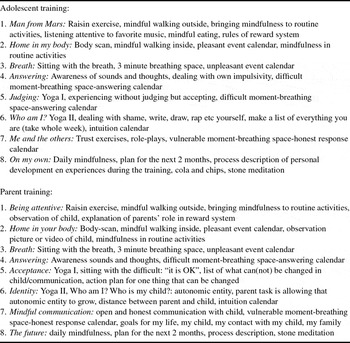
In the last session, parents and children were asked to make an action plan about how to continue their practice in the 8 weeks following the end of treatment (before the follow-up meeting), and why. They wrote down this action plan and shared it with the group. In Table 1 a short overview of the sessions is given.
Short overview of content of each of the eight sessions in adolescent and parent mindfulness training

Training was delivered by experienced cognitive-behaviour therapists. Therapists received initial training in mindfulness by Mark Williams, and were experienced in CBT and mindfulness- and meditation techniques. During the course of treatment, therapists met weekly for supervision with the first author to discuss the group process and individual patients, and to ensure treatment integrity.
Child training
As children in general and these children in particular have shorter attention span and are easily bored, practice in the group was adapted in the following way. Meditation exercises were shorter, with more variety to increase interest, and more concrete tasks: for example, yoga, massage, mindful walking outside, mindful eating, mindful listening, and mindful speaking.
The training focused on specific themes such as impulsivity, shifting attention, the relationship between attention/impulsivity and communication, and identity. For example, the following exercise was introduced to address impulsivity: Each child was presented half of a favourite chocolate bar. They were told that the trainers would leave for an undefined period of time. If they had not eaten the chocolate when the trainers returned, they would receive the other half as well. They were encouraged to practise mindfulness of the breath in the meantime. When trainers returned, the children who had not eaten their chocolate bar received the other half. Experiences were discussed in the group.
The application of mindfulness to children's own idiosyncratic difficulties, such as problems with family, school, homework, was addressed in two ways. First, during sitting meditations in the second half of the course, difficult experiences such as experiences of humiliation or being excluded were described. Children were asked to note their reactions to these experiences, to become aware of their thoughts and feelings, and to welcome them by saying to themselves: “It's OK. Whatever it is, let me feel it.” Finally, they were taught to refocus on their breathing and their body as a whole. The second way in which children's idiosyncratic problems were addressed was through role-playing difficult situations the children had actually experienced. First, a child (called the central child here) described a recent difficult situation (for example, a recent humiliation), which was then role-played with other children playing the other persons in that situation. The central child was encouraged to be mindful of any thought, feeling or sensation in his/her body. Then all children took a 3-minute breathing space, that is, closed their eyes, paid attention to what was going on in their mind and body (first step), followed the movement of their breath (second step), and enlarged their attention to their body as a whole (third step). Next, the situation was re-played while the central child was encouraged to answer, rather than react, based on his or her new awareness. A variation on this role-play exercise is that after the breathing space, other children reported their thoughts, feelings, and sensations about what happened in the role-play, in order to encourage the central child to become aware of other possible ways the situation could be experienced. Finally, the central child was asked to re-play the situation, using a wider awareness based on the experiences of the group.
To increase children's commitment to the training and regular practice, children earned points for session attendance, active session participation, and completing home practice exercises. Points could be exchanged for material (for example, a mobile phone) and immaterial (for example, going to a restaurant with the parent) rewards from their parents. Furthermore, children were promised a 20-euro voucher by the trainers if they finished the training. Though modest, this rewards appeared to motivate several adolescents, who explicitly stated that their continued presence in the training was due to their desire to receive the voucher.
Parent training
For parents, the protocol was adapted to their role as a parent and to the particular difficulties of their child. In addition to general mindfulness exercises, such as body-scan and sitting with the breath, additional exercises focused on the application of mindfulness to their interactions with their child. For example, parents were taught mindful and nonjudgmental observation of and listening to their child. They were encouraged to become aware of how they responded to their child's behaviour in an automatic, mindless manner, based on their past experiences with the child, and their own upbringing experiences. They then learned to first pay full attention to the child, and the interaction, and, based on this wider awareness, to answer rather than respond. As some of their child's problems were chronic, parents were taught to cultivate an attitude of acceptance of those aspects of their child's behaviour that might not change, as well as the consequences for their family life.
Parents were encouraged to practise daily. The benefits of regular practice were explained to the parents. Parents are important role models for their children; therefore if they don't practise themselves, the children may become less motivated to practise. Furthermore, parents can better help their child to use the mindfulness skills if they have experience with the effects in their own life. Finally, daily practice will help parents bring more calm in their families and take better care of themselves. Since many parents suffered themselves from attention and impulsivity problems, they were encouraged to also apply the skills to other aspects of their life.
Assessments
Personal goals
As children's symptoms were quite heterogeneous, the primary outcome measure was improvement on personal goals, assessed with the Goal Attainment Scale (GAS, Kiresuk and Sherman, Reference Kiresuk and Sherman1968). The GAS is a reliable and valid measure of personal change (Schlosser, Reference Schlosser2004). At the first assessment, the research assistant formulated with the child goals for treatment (e.g. “being able to concentrate on maths”) and parameters of improvement (e.g. (−1) deterioration = being able to concentrate on maths homework for less than 1 minute, (0) no improvement = 5 minutes, (1) some improvement = 10 minutes, (2) substantial improvement = 20 minutes, (3) highest possible improvement = 30 minutes). The research assistant also formulated treatment goals with parents, concerning problems with their child (e.g. “being able to set limits to my child”), and in their own lives (e.g. “being able to sleep”). Both parents and child rated child's goals, and parents rated their own goals as well. Therapists were blind to participants' goals.
Symptoms
Child's complaints were assessed by parent ratings on the 98 problem items Child Behavior Checklist (CBCL, Achenbach, Reference Achenbach1991a), consisting of a total score and two broadband syndromes, Internalizing (including the narrow-band syndromes Anxiety/Depression, Withdrawn, and Somatization) and Externalizing (including Delinquency and Aggression). As the narrow-band syndromes Social-, Thought-, and Attention problems are not part of the broadband syndromes Internalizing and Externalizing, but highly relevant for the present sample, these subscales were analysed separately. Children rated their own symptoms on the 102 items Youth Self Report (YSR, Achenbach, Reference Achenbach1991b). The YSR consists of a total score and two broadband syndromes, Internalizing and Externalizing, and the narrow-band syndromes Social, Thought, and Attention problems. Parents completed the Children's Social Behavior Questionnaire (CSBQ, Luteijn, Luteijn, Jackson, Volkmar and Minderaa, Reference Luteijn, Luteijn, Jackson, Volkmar and Minderaa2000), measuring behaviour problems typical for children with autistic-spectrum disorder. The CSBQ consists of 46 3-point items that form six subscales: not attuned, tendency to withdraw, orientation problems, lack of understanding, stereo-typical behaviour, and fear of change. The CSBQ possesses high homogeneity and test-retest reliability, and good convergent and discriminant validity (Hartman, Luteijn, Serra and Minderaa, Reference Hartman, Luteijn, Serra and Minderaa2006). Parents rated children's self-control on the Self Control Rating Scale (SCRC, Kendall, Reference Kendall1979), a 33-item 7-point Likert-type questionnaire. The SCRC possesses high homogeneity and is sensitive for treatment effect. Finally, the D2 Test of Attention (Brinckenkamp, Reference Brickenkamp1994) measures sustained and directed attention. The D2 consists of 20 lines in which the child rates certain targets within a time span of 20 sec. The D2 reliably and validly assesses accuracy and speed of visual scanning (Bates and Lemay, Reference Bates and Lemay2004).
Quality of life
Improvement in children's happiness was assessed using the Subjective Happiness Scale (SHS, Lyubomirsky and Lepper, Reference Lyubomirsky and Lepper1999), a 4-item scale ranging from 1–7, with high homogeneity and test-retest reliability. Children's quality of life was assessed with the Pediatric Quality of Life Inventory (Varni, Seid and Kurtin, Reference Varni, Seid and Kurtin2001), a 23-item 5-point questionnaire measuring adolescents' life quality in four domains: physical, mental, social and school functioning, rated by both parents and child. The reliability and validity of the Dutch Pediatric Quality of Life is satisfactory (Bastiaansen, Koot, Bongers, Varni and Verhulst, Reference Bastiaansen, Koot, Bongers, Varni and Verhulst2004).
Mindful awareness
Improvement in children's self-reported awareness was measured with the Mindful Attention and Awareness Scale (MAAS, Brown and Ryan, Reference Brown and Ryan2003). The MAAS measures with 15 7-point items the most important characteristics of mindfulness, namely an open and receptive awareness of and attention for what is happening here and now. The MAAS is a reliable instrument that assesses a unique quality of awareness, predicting self-regulation and well-being.
Data analytic approach
Father- and mother-scores were aggregated, and sub-scales were only analysed in case total score differences were significant. By means of paired t-tests, changes from waitlist to pretest, pretest to posttest and follow-up were analysed. Effect sizes of change (Cohen's d) were calculated by the mean of the difference (post minus pre) divided by the SD of these differences. Effect sizes <.4 are considered small, .4 - .8 medium, >.8 large.
Results
Waitlist
Few changes were seen from wait-list to pretest. All measures but one were stable between waitlist and pretest, with pre-post correlations ranging from .64 to .97, ps<.05. An exception was the SHS child report, r=.53, p<.1. Paired t-tests (two-tailed) showed no differences between waitlist and pretest on most measures, except for an improvement in concentration on the D2, t(7) = −3.0, p < .05, mean waitlist 5.3 (2.9), mean pretest 6.8 (2.4). Children reported minor improvement on the GAS (.86, SD 1.3); however, parents reported no improvement on their children's and their own GAS. As some measures were adapted for use with adolescents, and translated in Dutch, inter-item reliabilities were calculated. Good to excellent homogeneities were found for the SHS child report (.78), the SCRS parent report (.96 mother- and .90 father report), and the MAAS child report (.93). Correlations between parent-perceived child improvement and child self-perceived improvement were, respectively at posttest and at follow-up, .42 (p< .1) and .74 (p < .01) for CBCL externalizing, .74 (p<.01) and .35 (n.s.) for CBCL internalizing, .50 (p=.05) and .45 (p<.1) for Social, .33 and .07 (n.s.) for Thinking, and .17 (n.s.) and .41 (p < .1) for Attention problems, .16 and .25 for GAS, and .51 (p<.05) and .38 (n.s.) for Quality of Life.
Immediate effects
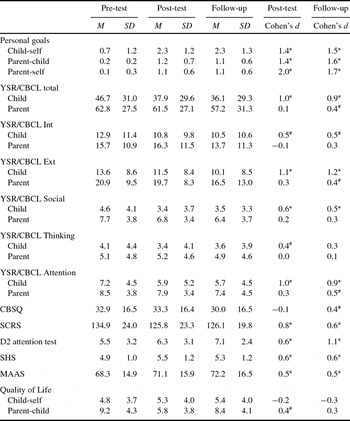
To examine changes from pretest to post-test, intent to treat analysis was used. Children reported significant and substantial improvement on their personal goals, 2.3 (1.2), t(13) = −5.3, p < .001; likewise parents reported significant improvement on their children's goals, 1.2 (.7), t(11) = −4.9, p < .001, as well as their own goals, 1.1 (.5), t(11) = −7.0, p < .001. Children reported significant or borderline significant improvement on YSR Total, t(13) = 3.9, p = .001, YSR Externalizing, t(13) = 4.0, p = .001, Internalizing, t(13) = 1.7, p = .05, Social-, t(13) = 2.4, p < .05, Thinking-, t(13) = 1.6, p<.1, and Attention-, t(13) = 3.8, p < .01, problems. Significant improvement occurred on children's Subjective Happiness, t(13) = −2.4, p < .05, on objective Sustained Attention, t(12) = −2.0, p < .05, and on Mindful Awareness, t(13) = 1.0, p < .05, but not on Quality of Life. Parents reported significant improvement on children's Self-Control, t(11) = 2.9, p < .05 and children's Quality of Life, t(11) = 1.5, p < .05. Parents reported no improvement on CBCL and CSBQ. Effect sizes were large for personal goals of both child and parent, for YSR Externalizing and YSR Attention, and for Self-Control (see Table 2).
Effects of mindfulness training (child-report n = 14, parent-report n = 12) after treatment and at 8-week follow-up, based on an Intent-to-treat Analysis

Notes: Effect sizes with a *indicate that the means on which the effect size is based differ significantly in the paired t-test, #indicates borderline significance. Note that because of rounding up of the effect sizes and different sample sizes for child and parent report, sometimes the same effect size is borderline significant or significant. CSBQ = Children's Social Behavior Questionnaire (parent rating), SCRS = Self Control rating Scale (parent rating), SHS = Subjective Happiness Scale (child rating), MAAS = Mindful Attention and Awareness Scale (child rating).
Longer-term effects
These immediate effects were maintained at follow-up, 8 weeks following the end of treatment. That is, comparing pretest to follow-up, significant and substantial improvement occurred on children's self-rated goals, 2.3 (1.3), t(13) = −5.6, p < .001, parent-rated child goals, 1.1 (.6), t(11) = −5.7, p < .001 and parents' own goals, 1.1 (.6), t(11) = −6.0, p < .001, significant improvement on child-reported complaints (YSR Total, t(13) = 3.4, p < .01, YSR Externalizing, t(13) = 4.3, p < .001, Internalizing t(13) = 2.0, p < .05, Social t(13) = 1.9, p < .05, Attention problems t(13) = 3.2, p < .01), on Subjective Happiness, t(13) = −2.2, p < .05, Mindful Awareness, t(13) = −2.0, p < .05, and Sustained Attention, t(12) = −4.0, p < .001. Children reported no improvement on YSR Thinking problems, t(13) = 1.0, n.s. Furthermore, parents reported significant improvement on children's Self-Control, t(11) = 2.0, p < .05. Parents reported borderline improvement on CBCL Total, t(11) = 1.4, p < .1 and CSBQ Total, t(11) = 1.5, p < .1. CBCL subscale analysis revealed borderline significant improvement on CBCL Externalizing, p < .1, but not Internalizing, significant improvement on Attention, p < .05, but not on Social- and Thinking problems. CSBQ subscale analysis revealed significant improvement on “not attuned to others”, p < .01, and “tendency to withdraw”, p < .05. Parents reported no longer-term improvement on child's Life Quality. Effect sizes of improvement were large for child and parents goals, YSR Externalizing and Attention (Table 2).
High end-state functioning
Treatment effect can be expressed in terms of the size of improvement (see Table 2), but also in terms of the number of participants who have symptom levels comparable to normal children. After treatment and at 8-week follow-up there was a reduction in the number and percentage of children below the sub clinical range (t-score 64 or below) on CBCL Total Score: at pretest 3 (25%), at posttest 5 (42%), and at follow-up 7 (58%). For the YSR, these figures were at pretest 8 (57%), at post-test and follow-up 12 (86%).
Completers only
To estimate the effects for families that had the full “dosage” of treatment, the data were re-analysed for families (n = 7) in which both parent and child followed the training and missed no more than three sessions each. The results were highly similar but the effect sizes were stronger on several measures (data are for posttest, follow-up): children's goals (post 1.4, follow-up 1.6), parent-reported children's goals (post 2.3, follow-up 2.4), parents' own goals (post 2.2., follow-up 4.7), CBCL Total (post .1, follow-up .9), YSR Total (post 1.3, follow-up 1.1), Self control (post 1.0, follow-up .7), SHS (post .3, follow-up 1.3), and MAAS (post 1.4, follow-up .9).
Increased awareness as a predictor of outcome
In order to test the assumption underlying mindfulness training that increased mindful awareness will decrease symptoms (e.g. Bishop, Reference Bishop2002), pre-post differences on children's MAAS were correlated with pre-follow-up improvement on CBCL and YSR. Indeed, increased child awareness at posttest predicted decreased CBCL-scores at follow-up, CBCL Total r =−.42, p < .1, CBCL Externalizing −.57, p < .05, CBCL Internalizing −.44, p < .1, and CBCL Attention −.61, p < .05. Increased child awareness did not predict YSR follow-up improvement, r = .22, n.s.
Discussion
This pilot study evaluated the effects of an innovative approach, mindfulness training for adolescents with ADHD, ODD/CD, and ASD with externalizing symptoms, and their parents. Results can be summarized as follows: (i) no improvement occurred during the waitlist period on most measures; (ii) children improved significantly and substantially on personal goals, attention, awareness, impulsivity, being attuned, social problems, and happiness; (iii) children's internalizing and notably their externalizing symptoms were reduced; (iv) improvement was maintained at 8-week follow-up; and (v) the dropout rate was high, with completers showing even more improvement.
Children (and their parents) reported substantial improvement after treatment on measures of attention, impulsivity, and awareness, indicating that mindfulness training was effective in targeting these symptoms. Furthermore, the additional benefits of substantial improvements on personal goals, externalizing symptoms, and happiness suggests that mindfulness training also had substantial non-specific effects, beyond what was predicted. Our reported effect sizes are high, compared with the mean effect size of 0.59 reported in a meta-analysis of mindfulness as a clinical intervention in adults with various disorders of (Baer, Reference Bear2003). These large effect sizes are remarkable, taken into account three aspects of our populations. First, children were severe in terms of number and types of diagnoses, long treatment histories, and family functioning problems. Second, effect sizes of psychosocial treatments for these disorders are generally modest (e.g. Bennett and Gibbons, Reference Bennet and Gibbons2000; van den Oord et al., Reference Oord, Van Den, Prins, Oosterlaan and Emmelkamp2006). Third, children's problems were heterogeneous, reducing the potential effect sizes for the YSR, CBCL, and CSBQ. Some children with long histories of mental health care indicated that this was the first therapy that really addressed their core problems, that is, their attention deficits.
We failed to find significant improvement of children's self-reported quality of life; however, this may have been due to the children rating their pre-training life quality fairly high: their item mean was “almost never” on the problems assessed in the Quality of Life Inventory. Interestingly, children's rating was twice as high as parents' ratings of children's life quality. The same pattern was found for self- versus parent report on CBCL/YSR: 57% of the children rated themselves below the sub-clinical cut-off pretreatment, whereas only 25% of the parents did so. As is typically seen in children with externalizing disorders, these children do not always acknowledge the severity of the problems identified by parents or other individuals in their environment.
Improvements were maintained at follow-up. This is particularly striking, as well as promising, given that children with attention- and impulsivity-type disorders often have problems generalizing and maintaining skills learned in therapy groups. Longer follow-up is needed to determine if the gains will be maintained. Booster sessions for families may be indicated to help maintain gains.
We found the training process itself was “hard work”. Children had difficulty concentrating and showed overt non-compliance. To illustrate, during the introductory exercise, 3-minutes concentration on a raisin, several children played with their mobile phone or listened to their MP-3 player. In the same vein, during a short walking meditation outside several smoked a cigarette. In the parent group some parents consistently came too late, lost or did not do home-work, or disturbed other parents during exercises. On the other hand, in the course of 8 weeks, groups became calmer and individuals were able to meditate for longer periods. Also, this improvement of some motivated others to hold on. We learned that it was important to trust the eventual effects and the group process during difficult moments in the course of training.
In this study, adolescents with different mental disorders of the externalizing type were included because of the underlying common attention problems that were targeted in the mindfulness training and because of the large co-morbidity across these disorders in clinical samples. Given the small numbers and high co-morbidity across the three diagnoses in the present sample, we cannot draw conclusions about the differential effectiveness of mindfulness for each of the diagnostic groups. We can, however, highlight some clinical impressions about how particular aspects of the training worked for adolescents with different diagnoses. For example, we found that the role-plays worked surprisingly well in adolescents with ASD. The clear structure of the role-plays (e.g. (i) role-play a difficult situation you had with someone; (ii) take a breath, and let your wise mind advise you; and (iii) try out this new insight in the role-play), with the possibility of stepping out to take a breathing pause, and as a consequence have more overview, may have helped. Overall, the ASD adolescents were most compliant with doing homework and benefited from the structure of daily assignments. Another clinical impression was that some adolescents with ODD/CD tended to negatively influence the group, stimulating others to be noncompliant. Note also that the dropout was highest in adolescents with ODD/CD. Therefore, it might be better for ODD/CD adolescents to first begin mindfulness training in an individual setting, as being in a group might make it more difficult for them to focus on personal goals. Adolescents with ADHD seemed to have most difficulty with the longer homework assignments such as the body-scan, whereas the short breathing space was very popular. However, we feel it is important to include the longer, more boring tasks, as they are comparable to the kinds of boring school tasks with which these adolescents often struggle. Further experimenting with mindfulness training with larger samples of adolescents in each of the three diagnostic groups is needed to adapt the training to the specific needs of each group.
For this study, we selected pre-adolescents and adolescents from 11 to 18, as younger children with these difficulties may not yet have the “meta-awareness” that is important for mindfulness training. However, mindfulness training has recently been modified for younger children and their families (Semple et al., Reference Semple, Lee, Miller and Baer2006). Parents suggested that the training would have been more effective if their children had received it earlier, because adolescence might have made them more resistant to comply. For example, some adolescents claimed that they had erased the mindfulness exercises on the CDs and recorded their own music over them. Although this was in fact impossible, it illustrates the attitude of overt non-compliance of some adolescents. From a prevention point of view, it may be worthwhile to investigate mindfulness training in younger children at risk for externalizing disorders, and mindful parenting in parents of still younger at risk children.
Limitations
This pilot study had several limitations. First, the sample size was small and multiple comparisons were carried out. Therefore, the reported effect sizes are more reliable effect indicators than the statistical tests. Second, we employed a quasi-experimental within-subject waitlist rather than a randomized waitlist group. There was much variability in waiting time between families. Two families received family treatment during waitlist, which is representative of usual practice, but a confounder for the measurement of effects of time and assessment alone. Third, outcome measures were restricted to those who followed the training (child and parent); thus we did not have access to teachers or others in the child's environment who may have observed progress. Fourth, as we evaluated parent and child training at the same time, the relative contribution of each to children's improvement is unknown. A strength of this study is that it was based on community mental health care patients, and results are therefore directly relevant for clinical practice (Graham, Reference Graham2000).
Further research
It is important to replicate this study in a larger sample, and to investigate the effects for children with ADHD, ODD/CD, and ASD separately. In addition, research is needed to elucidate the underlying change process involved in mindfulness training, such as whether changes in attention processes predict improvement in problem behaviour. To that end, it is important to include a larger battery of measures (e.g. from the Amsterdam Neuropsychological Test, De Sonneville, Reference De Sonneville, den Brinker, Beek, Brand, Maarse and Mulder1999) to objectively assess changes in various aspects of attention in addition to sustained attention such as focused attention, shifting attention, inhibition, and interference control.
Clinical implications
Mindfulness training appears to be a promising approach for adolescents who suffer from symptoms of inattention and impulsivity, within a wide variety of externalizing disorders (ADHD, ODD, CD) and autistic spectrum disorders. It may be combined with currently available treatments, or it may provide an alternative for adolescents who refuse or do not respond to medication. Mindful parenting may help parents accept and cope better with their children's attention and impulsivity problems, as well as their own inattention and impulsivity. Future randomized controlled clinical trials employing larger samples of children with attention and impulsivity problems within the externalizing and autistic spectrum disorders are needed to further these initial exciting findings.
Acknowledgements
We are grateful to Guido Sijbers for guiding a group and to Eugenie van der Horst for her role in assessing the families. The data for this study were collected while the first author worked at Maastricht University.



Comments
No Comments have been published for this article.