INTRODUCTION
Numerous studies have examined parasitism in aquatic organisms inhabiting disturbed environments (Poulin, Reference Poulin1992; Lafferty, Reference Lafferty1997; Marcogliese and Cone, Reference Marcogliese and Cone1997; Marcogliese, Reference Marcogliese2005). In fact, there is mounting experimental and field evidence that anthropogenic disturbance (e.g., urban effluents, thermal pollution, heavy metal pollution, land development) can influence the composition of parasite communities in fishes and snails (Overstreet and Howse, Reference Overstreet and Howse1977; Khan and Thulin, Reference Khan and Thulin1991; Poulin, Reference Poulin1992; Lafferty, Reference Lafferty1997; MacKenzie, Reference MacKenzie1999; Lafferty and Kuris, Reference Lafferty, Kuris, Thomas, Guégan and Renaud2005; Hernandez et al. Reference Hernandez, Bunnel and Sukhdeo2007). Interestingly, the parasite communities of amphibians have rarely been examined in the context of a disturbed habitat (but see Hamann et al. Reference Hamann, Kehr and González2006; Koprivnikar et al. Reference Koprivnikar, Forbes and Baker2006a; McKenzie, Reference McKenzie2007), despite the consideration of amphibians as sentinel organisms of environmental degradation (Kiesecker et al. Reference Kiesecker, Belden, Katriona and Rubbo2004). With populations of frogs in global decline due to various causes, including disease (Daszak et al. Reference Daszak, Cunningham and Hyatt2003; Kiesecker et al. Reference Kiesecker, Blaustein and Belden2001; Carey et al. Reference Carey, Bradford, Brunner, Collins, Davidson, Longcore, Ouellet, Pessier, Schock, Linder, Krest and Sparling2003), it is worth investigating if infection levels in these animals are altered in habitats disrupted by human activity.
An increasing number of wetlands are located either near or nested within agricultural landscapes (Lemieux et al. Reference Lemieux, Quémerais and Lum1995; Matson et al. Reference Matson, Parton, Power and Swift1997; Carpenter et al. Reference Carpenter, Caraco, Correll, Howarth, Sharpley and Smith1998). Wetlands are the interface between terrestrial and aquatic ecosystems, and their isolation, degradation, and erosion can have drastic effects on the ecology of both environments (Gibbs, Reference Gibbs2000; Amezaga et al. Reference Amezaga, Santamaría and Green2002), which will presumably affect the transmission of parasites within and between them. Components of agricultural runoff have been shown to increase parasite abundance in frogs by increasing susceptibility to infection through immunosuppression (Carey and Bryant, Reference Carey and Bryant1995; Kiesecker, Reference Kiesecker2002; Carey et al. Reference Carey, Bradford, Brunner, Collins, Davidson, Longcore, Ouellet, Pessier, Schock, Linder, Krest and Sparling2003; Christin et al. Reference Christin, Gendron, Brousseau, Menard, Marcogliese, Cyr, Ruby and Fournier2003, Reference Christin, Ménard, Gendron, Ruby, Cyr, Marcogliese, Rollins-Smith and Fournier2004), facilitating transmission through invertebrate intermediate host availability (Johnson and Chase, Reference Johnson and Chase2004; McKenzie, Reference McKenzie2007), and decreasing parasite pre-patent period (Gendron et al. Reference Gendron, Marcogliese, Barbeau, Christin, Brousseau, Ruby, Cyr and Fournier2003). Thus, parasite transmission may be enhanced in situations where immunosuppression as well as increased host abundance are overriding factors. Transmission may be reduced, however, if the parasites are directly harmed, or if contributions by hosts to the infective pool are diminished. A few pesticides, most notably atrazine, have been shown to reduce the survival and infectivity of the free-living larval stages of parasites (Pietrock and Marcogliese, Reference Marcogliese2003; Koprivnikar et al. Reference Koprivnikar, Forbes and Baker2006b). Finally, any development of the landscape surrounding frog habitats may reduce the use of this same habitat by definitive hosts, such as birds and small carnivorous mammals, and other amphibians (Kuris and Lafferty, Reference Kuris and Lafferty1994; Huspeni and Lafferty, Reference Huspeni and Lafferty2004; Hechinger and Lafferty, Reference Hechinger and Lafferty2005; Koprivnikar et al. Reference Koprivnikar, Forbes and Baker2006a).
In this study, the helminth parasite communities of northern leopard frogs (Rana pipiens) were characterized in animals collected from wetlands exposed to varying degrees of agricultural activity in the St Lawrence River basin of southern Quebec, Canada. Populations of leopard frogs are widespread in North America where they colonize a variety of habitats, including wetlands in areas of intense agricultural activity. As metamorphs, leopard frogs are initially mainly aquatic and then become more terrestrial with age, and thus are exposed to parasites and anthropogenic disturbance in both habitats. Since species richness and diversity in parasite communities reflect those of the free-living organisms on which parasites depend for transmission and reproduction (Marcogliese and Cone, Reference Marcogliese and Cone1997; Marcogliese, Reference Marcogliese2004; Hechinger and Lafferty, Reference Hechinger and Lafferty2005), a ‘healthy’ environment is considered to be one rich in parasite species (Marcogliese, Reference Marcogliese2005; Hudson et al. Reference Hudson, Dobson and Lafferty2006). In comparison, any unhealthy or anthropogenically disturbed environment should have reduced species richness. Landscape fragmentation and wetland isolation can restrict the access of amphibians, birds, and mammals to the area, thus possibly preventing their parasites from infecting other potential hosts in that wetland habitat. If the wetlands were contaminated by agricultural pesticides, we would expect heteroxenous parasite species to be less common if aquatic invertebrate intermediate hosts and/or free-living infective stages were harmed by chemical pollution. Essentially, any physico-chemical changes to the environment that prevent hosts from occupying or using a habitat should influence the transmission and establishment of parasites, especially those that depend on trophic pathways and food web structure for infection (Cone et al. Reference Cone, Marcogliese and Watt1993; Marcogliese, Reference Marcogliese2003, Reference Marcogliese2004). Additionally, exposure to pesticides can cause immunosuppression in frogs (Gendron et al. Reference Gendron, Marcogliese, Barbeau, Christin, Brousseau, Ruby, Cyr and Fournier2003; Gilbertson et al. Reference Gilbertson, Haffner, Drouillard, Albert and Dixon2003; Christin et al. Reference Christin, Ménard, Gendron, Ruby, Cyr, Marcogliese, Rollins-Smith and Fournier2004), resulting in an increased abundance of certain parasites, particularly those with direct life-cycles. Consequently, the following hypotheses were examined: (1) frogs inhabiting wetlands protected from anthropogenic activity should be infected with the most parasite species, (2) frogs from wetlands surrounded by agricultural landscapes, but with otherwise uncontaminated water, will be infected with fewer parasites that use birds and mammals as definitive hosts and (3) frogs from wetlands impacted by both pesticides and landscape modifications should be infected by the fewest parasite species, although certain parasites may increase in abundance.
MATERIALS AND METHODS
Study localities
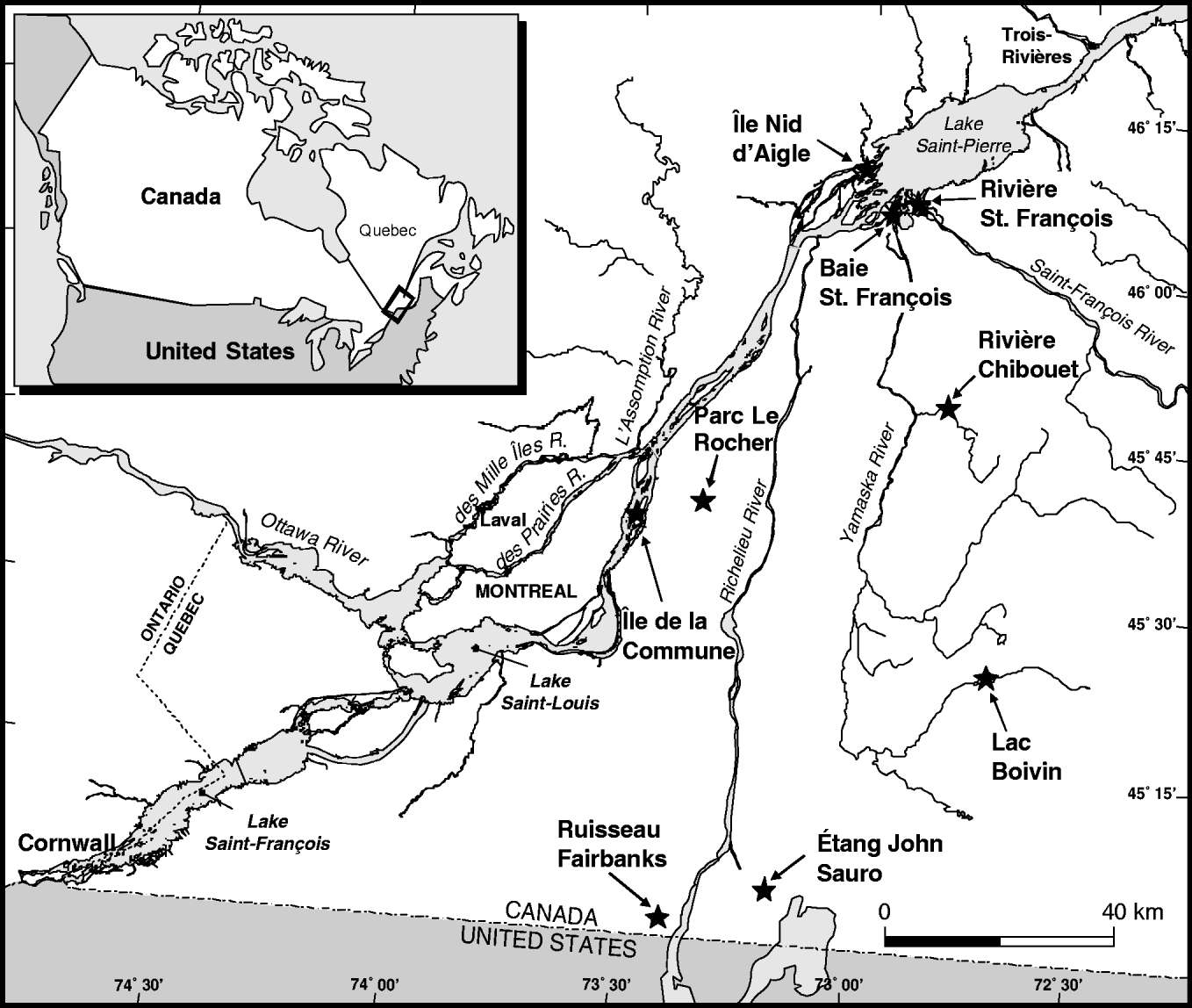
The St Lawrence River drainage basin in southern Quebec, Canada comprises tributaries and wetlands surrounded by agricultural fields largely dedicated to corn production. In brief, 7 wetlands were studied in 2004, and 2 more were added in 2005 (Fig. 1). Selection of all wetlands was based on long-term data on waterborne pesticides in rivers and water bodies in southern Quebec (Giroux, Reference Giroux1999, Reference Giroux2002) or on continuing studies related to pesticides and frogs. Two wetlands, Étang John-Sauro (Ref1) and Île Nid d'Aigle (Ref2), neither nested within agricultural land nor exposed to pesticide runoff were selected as reference localities. In addition, 7 wetlands were chosen based on 3 disturbance categories: (i) close proximity to agricultural landscape, no pesticide contamination (ii) distant from agricultural landscape, with pesticide contamination, and (iii) close proximity to agricultural landscape, with pesticide contamination. Wetlands in Parc Le Rocher (Ag1) and on Île de la Commune (Ag2) were chosen to represent the first category. Ag1 is a modified wetland within rural parkland, and although it is surrounded on a large scale by agricultural activity (and a small urban community), it is not directly adjacent to farmland and agricultural fields do not drain into it. Ag2 is adjacent to farmland, although pesticides have not been applied to the area since 2001. Rivière St François (P1) and Baie St François (P2) wetlands fit into the second category as they are not adjacent to agricultural land, yet are exposed to pesticide runoff through the streams and rivers draining into them. The other 3 wetlands are nested within agricultural landscapes sprayed with pesticides: Ruisseau Fairbanks (AgP1), Lac Boivin (AgP2), and Rivière Chibouet (AgP3). Despite some regulation in the water levels of Ref1 and P2, all wetlands were naturally formed, and all were verified to be leopard frog breeding habitat.
Map of localities in the St Lawrence River basin in southern Quebec, Canada. Reference Localities: Étang John-Sauro (Ref1) and Île Nid d'Aigle (Ref2), agricultural landscape localities: Parc Le Rocher (Ag1) and Île de la Commune (Ag2), pesticide localities: Rivière St. François (P1) and Baie St. François (P2), agricultural landscape/pesticide localities: Ruisseau Fairbanks (AgP1), Lac Boivin (AgP2), and Rivière Chibouet (AgP3).

Collection of environmental variables
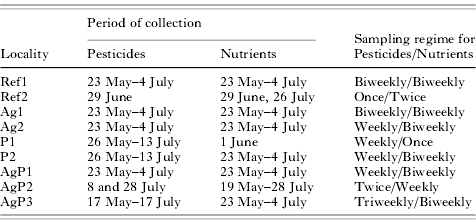
Water samples for pesticide and nutrient analyses were collected from May to July 2005, with the exception of pesticide samples from AgP3 that were collected in 2004 (Table 1). The timing of water collection was chosen to permit detection of peak pesticide concentrations and coincided with R. pipiens tadpole development. Water samples were prepared for organophosphorous pesticide and neutral herbicide analyses (Carrier, Reference Carrier2001). Samples from P1, P2, AgP2, and AgP3 were analysed by the Centre d'expertise en analyse environnementale du Québec of the Québec Ministère du Développement durable de l'Environnement et des Parcs (MDDEP); others were analysed at the Canadian National Laboratory for Environmental Testing in Burlington, Ontario. To measure the various nutrients (total and dissolved phosphorous, nitrates, nitrites, and dissolved organic carbon), water samples were prepared according to the Laboratoire du Centre Saint-Laurent protocol (1994). Nutrients from P1 were analysed by MDDEP, and those from the other localities were analysed by the Laboratoire des essays environnementaux du Québec (Environment Canada).
Summary of 2005 water collections from reference and agricultural localities for pesticide and nutrient analysis
(Sampling for pesticide analysis at AgP3 was conducted in 2004. Abbreviations for localities as in Fig. 1.)

Habitat characteristics for all localities were recorded prior to and during frog collection. The surface water temperatures, surface pH, and conductivity were recorded using a digital meter (YSI Model 63, Yellow Springs, Ohio, USA). Depth was measured at the approximate centre of the wetland. Additionally, GPS measurements were taken at points along the perimeter of the locality to permit calculation of wetland surface area. Landscape variables (forest area, urban area, agricultural area, and road area on a 100 and 500 m scale) were extracted using ArcGIS 9 (ESRI) from Landsat-generated satellite imagery.
Ranid tadpoles and molluscs were collected at each locality to estimate host density. Surveys were conducted in June 2005 when infected molluscs and tadpoles were expected to overlap temporally. Pipe samplers consisting of bottomless plastic garbage cans and dip nets were used to sample both molluscs and tadpoles. Sampling was stratified according to habitat type (emergent plant, submergent plant, and floating leaf) and depth range (0–20 cm, 21–40 cm, and 41–60 cm). The sampler covered an area of 0·1017 m2 and was randomly positioned within a stratum in the wetland. An average of 23 (15–34) samples was made at each locality, and each sample was placed at least 2 m from the previous one (D. Skelly, personal communication). The entire water column inside the sampler was swept from bottom to surface using dip nets (mesh size <2 mm). Ten sweeps were considered sufficient to census both tadpole and mollusc populations within the sampler (Heyer et al. Reference Heyer, Donnelly, McDiarmid, Hayek and Foster1994). Dip nets were also used for sampling along the margin. An average of 24 dip net sweeps (16–31) was taken at each wetland. In each sweep, the numbers of live snails, sphaeriid clams, and ranid tadpoles were recorded. Each was identified to family (Clarke, Reference Clarke1981; Desroches and Rodrigue, Reference Desroches and Rodrigue2004).
Host and parasite collections
Metamorph leopard frogs were collected in both 2004 (26 July to 6 August) and 2005 (22 July to 5 August) with dip net or by hand. Only those with a snout-vent length ⩽45 mm were kept (Seburn and Seburn, Reference Seburn and Seburn1998). Frogs were killed in buffered 0·8% tricaine methane sulfonate (MS222) and stored at −80°C until examined for parasites. The handling and treatment of animals were in accordance with the guidelines of the Canada Council on Animal Care. If the age range of the frog was in question, it was determined from the frog's longest toe phalanges (Leclair and Castanet, Reference Leclair and Castanet1987). Frogs were weighed, measured from snout to vent, sexed, and examined for parasites according to the method of Goater and Goater (Reference Goater and Goater2001). Helminth parasites were identified to genus and, if possible, to species, although it was difficult to identify many to species because specimens were frozen. Identifications were based on parasite descriptions in the literature (e.g., Rau et al. Reference Rau, Doyle and Gordon1978; Prudhoe and Bray, Reference Prudhoe and Bray1982; McAlpine and Burt, Reference McAlpine and Burt1998; Gillilland and Muzzall, Reference Gillilland and Muzzall1999; Muzzall, Reference Muzzall2005).
Data analyses
Quantitative descriptors were used in accordance with definitions provided by Bush et al. (Reference Bush, Lafferty, Lotz and Shostak1997). The parasite community structure at the various localities was examined at both the component and infracommunity levels using SPSS 13·0 and GraphPad Prism V4.0. Prevalence and mean abundance of infection were calculated for each parasite species at each locality. For non-normal data, non-parametric analyses were used or parametric analyses were performed on ranked data if more appropriate (Conover and Iman, Reference Conover and Iman1981). The critical level of significance was P<0·05, unless Bonferonni-corrections were applied.
Mollusc density at each locality was determined by extrapolating the number of snails and clams obtained from each sample to the number per 1 m2 of the wetland. Densities were compared by means of a Kruskal-Wallis test, followed by a Dunn's multiple comparison test.
Parasite data were screened to identify any inherent sampling biases. Mann-Whitney U tests were used to test for an effect of host sex on total parasite numbers and infracommunity species richness. The snout-vent lengths (SVL) of leopard frogs were compared among localities using a Kruskal-Wallis test. Both SVL and mass differed among localities even though all frogs were metamorphs. This variation was likely due to the plasticity of frog development and changes in ultimate size characteristics are known to result from environmental factors such as predation pressure (Laurila et al. Reference Laurila, Pakkasmaa, Crochet and Merilä2002), competition (Scott, Reference Scott1990), length of photo-period (Laurila et al. Reference Laurila, Pakkasmaa and Merilä2001), pesticides (Relyea, Reference Relyea2004), and a variety of other influences (e.g., Semlitsch et al. Reference Semlitsch, Scott and Pechmann1988). If SVL and the abundance of a parasite species were correlated at a given locality, the residuals obtained from a series of regressions of parasite species abundances with SVL were used as measures of abundance. Ranked abundances (residuals or unstandardized abundance values) were used in subsequent analyses when abundances were compared among localities. The abundance of each parasite species was compared among localities by one-way ANOVAs followed by a Tukey's post-hoc test if significant differences were detected. MANOVA was used to test if the abundance of an individual parasite species was related to the presence of pesticides at a locality (Ref1, Ref2, Ag1, Ag2=no pesticides; P1, P2, AgP1, AgP2, AgP3=pesticides). Univariate responses were compared using ANOVA where MANOVA results were significant. Species richness and diversity in both the infra- and component communities were determined for each locality. Species richness refers to the number of parasite species. Component community diversity was calculated using the Shannon-Wiener Diversity index, and infracommunity diversity, using Brillouin's index, at a given locality. Kruskal-Wallis tests and Dunn's multiple comparison tests were used to look for differences in infracommunity species richness and Brillouin's index values among localities. Species composition of component communities were qualitatively compared using Jaccard's similarity index (Magurran, Reference Magurran1988). Calculated similarity values were summarized with cluster analyses using the shareware program PHYLIP using the unweighted pair group method and arithmetic mean (UPGMA) method to give a visual interpretation of the results in the form of a dendrogram (Legendre and Legendre, Reference Legendre and Legendre1998).
Spearman-rank correlation tests were used to evaluate associations between environmental variables measured in 2005 (snail density; nitrates-nitrites; Ptotal; dissolved organic carbon; conductivity; wetland surface area; and forest area, urban area, and agricultural area at the 500 m scale) and overall parasite population and community descriptors as measured by mean parasite abundance, component community species richness, mean infracommunity species richness, Shannon-Wiener diversity index, and mean Brillouin's index. Landscape variables at the 100 m scale were excluded because the majority of the values were zero. Road area was correlated with both agricultural and urban area at the 500 m scale, and so was also removed from further consideration.
Canonical correspondence analysis (CCA) was used to examine relationships among the abundance of parasite species and selected environmental characteristics of the wetlands (Legendre and Legendre, Reference Legendre and Legendre1998) using CANOCO 4.0 (Ter Braak and Šmilauer, Reference Ter Braak and Šmilauer1998). Although the abundance of some parasite species was associated with SVL at certain localities, there were no discernable patterns (i.e., abundance of a parasite species was not associated with SVL at all or even the majority of localities), and so host size was not considered a covariate in the analysis. In the environmental data matrix, dummy variables were used to represent the intensity of pesticide contamination (Ref1, Ref2, Ag1, Ag2=1; P1, P2, AgP1, AgP2=2; AgP3=3). The species data matrix included the abundance of each parasite species (omitting species with an overall prevalence ⩽2%) in the 9 localities. Rare taxa were down-weighted to reduce the extreme influence of rare species and of particularly high abundance values. Three environmental variables were ultimately selected from a larger set during a forward selection process whereby those variables that significantly explained variance in the parasite data were identified. These were agricultural area (500 m scale), conductivity, and dissolved organic carbon. An unrestricted Monte-Carlo permutation test (with 999 permutations) was used to determine the significance of the canonical axes for parasite and locality variance.
RESULTS
Habitat characteristics
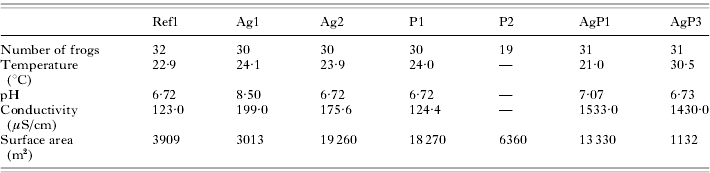
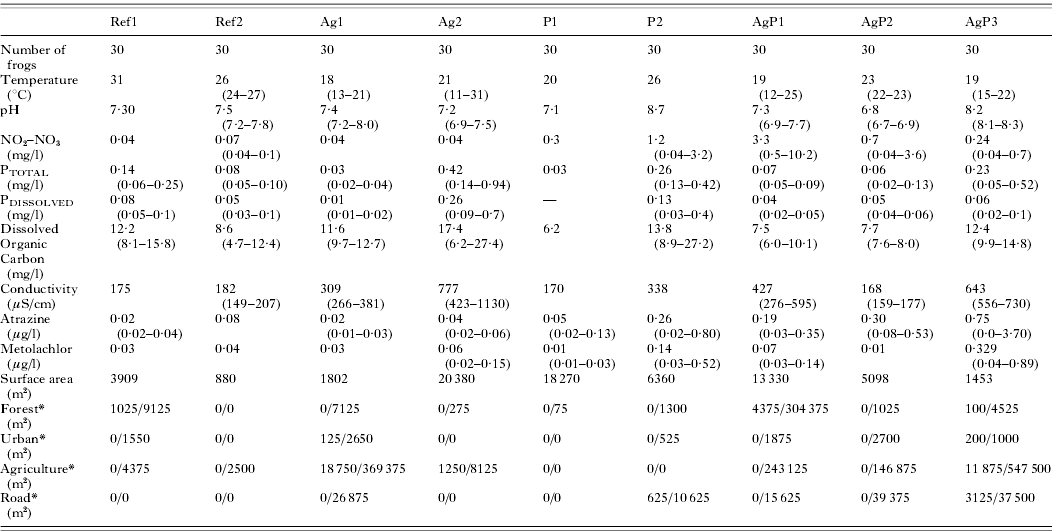
Most of the physicochemical variables varied markedly between 2004 and 2005 (Tables 2 and 3), and did not show a consistent pattern with agricultural activity. There was great variation in nutrient levels within and among localities, but overall, the concentrations of nutrients were higher at most agricultural localities. A suite of over 30 pesticides was detected (a detailed list is available from the authors), but only concentrations of atrazine and metolachlor are presented due to their common occurrence. These 2 herbicides were found at their highest concentrations at AgP3. Atrazine levels were moderate at P1, P2, AgP1, AgP2 and only trace amounts were detected at Ref1, Ref2, Ag1, and Ag2. Except for those at AgP3, levels of metolachlor were low and relatively consistent among reference and moderately contaminated agricultural localities. The wetland surface areas of Ag2, P1, and AgP1 were the largest and those of Ref2, Ag2, and AgP3 were the smallest. At 100 m and 500 m scales, AgP1 had the greatest forest cover, Ag1 was the most urbanized, Ag1 and AgP3 were the most cultivated, and AgP3 was surrounded by the greatest road surface area.
Summary of physicochemical characteristics of reference and agricultural localities in 2004
(Abbreviations for localities as in Fig. 1.)

Summary of physicochemical characteristics of reference and agricultural localities sampled in 2005
(Mean values presented with ranges in parentheses. Abbreviations for localities as in Fig. 1.)

* 100 m/500 m scale.
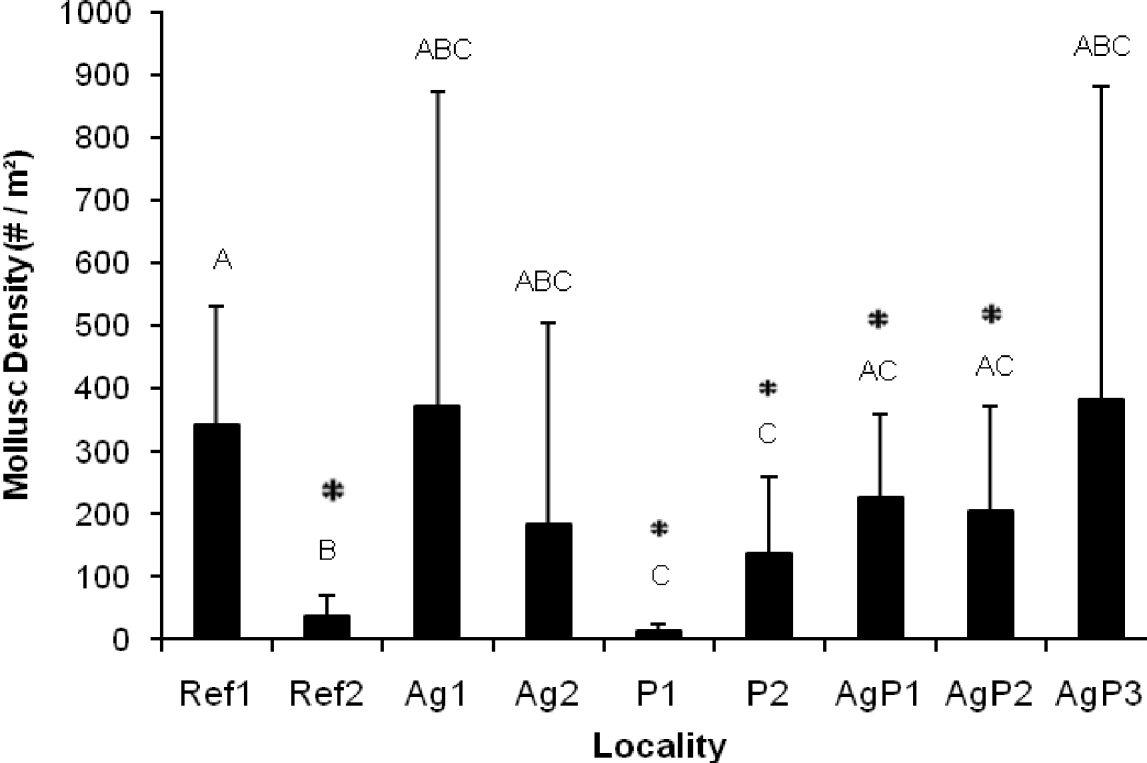
The SVL of metamorph leopard frogs differed significantly among localities (2004, χ26=102·06, P<0·001; 2005, χ28=180·58, P<0·001), but no consistent patterns in SVL were detected within or between reference and agricultural localities from year to year. Mollusc density varied among localities (χ28=65·94, P<0·001) (Fig. 2). However, heavy, continuous rainfall prior to the mollusc collections at Ref2, P1, P2, AgP1, and AgP2 greatly increased water levels, and may be responsible for drastically reducing mollusc densities at these localities. Nevertheless, few consistent differences were evident between agricultural and reference localities either before or after the rainfall. Too few tadpoles were collected at each locality to accurately assess tadpole density (data not shown).
Mean (+s.d.) mollusc density (no. of snails and clams/m2) at reference and agricultural localities. Superscript letters indicate significant differences (P<0·05). * Localities sampled during or after heavy rainfall; other localities were sampled beforehand. Abbreviations for localities as in Fig. 1.

Parasite populations and communities
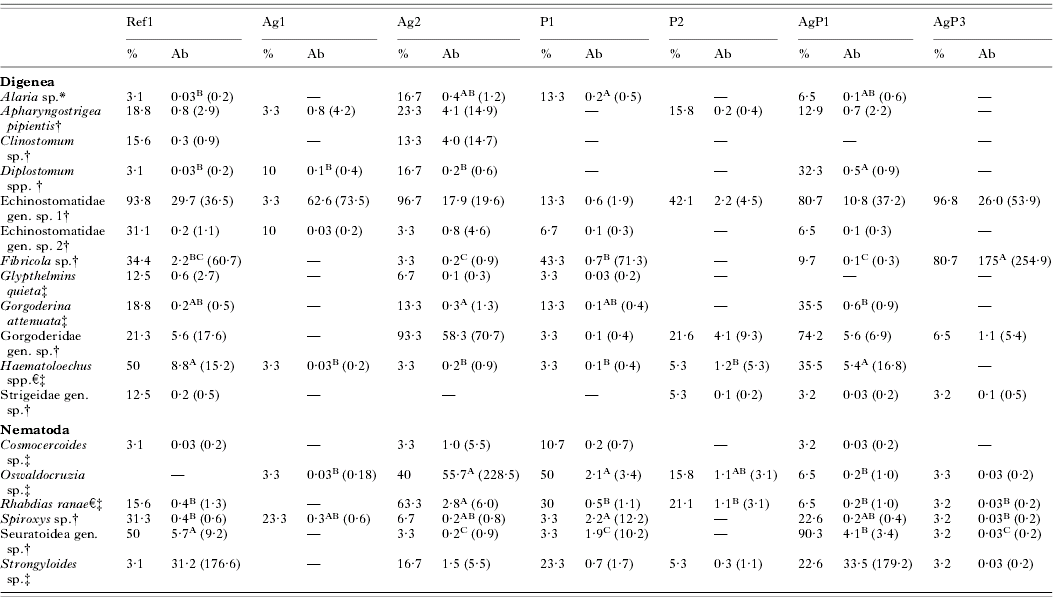
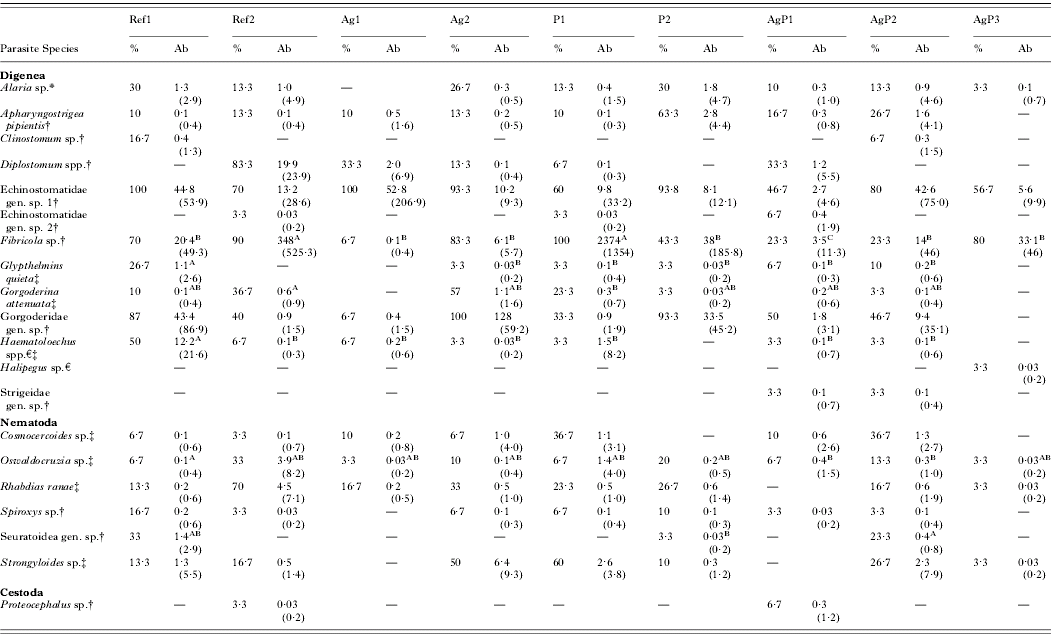
No sex-related differences were found in infracommunity richness (2004, U=5105·5, P=0·91, n males=100, n females=103; 2005, U=8756, P=0·58, n males=131, n females=139) or total parasite abundance (2004, U=4505·5, P=0·34; 2005, U=9012, P=0·89). Accordingly, data from both sexes were pooled. Eighteen helminth parasite species, including 12 digeneans and 6 nematodes, most of which used frogs as intermediate hosts, were found in 203 leopard frog metamorphs in 2004 (Table 4). In 2005, these same species were found in 270 leopard frogs, with an additional 2 species, Halipegus sp. and Proteocephalus sp. (Table 5). Most parasites were identified to genus, but 4 groups of larval parasites were only identified to family [Echinostomatidae, Gorgoderidae, Strigeidae, and Seuratoidea (tentative identification)]. Overall, 3 larval digenean species and 1 nematode species were the most prevalent and/or abundant parasites. In 2004, dominant species included Echinostomatidae gen. sp. 1 at Ref1, Ag2, and AgP3 infecting 94–97% of frogs at those localities; Fibricola sp. at P1 and AgP3; Gorgoderidae gen. sp. at Ag2; and Oswaldocruzia sp. at P1 (Table 4). In 2005, dominant species were Echinostomatidae gen. sp. 1. at Ref1, Ag1, AgP2, and P2, parasitizing 80–100% of the frogs; Fibricola sp. at Ref2, P1, and AgP3 with infection rates of over 80%; and Gorgoderidae gen. sp. at Ag2 and AgP1 (Table 5). Only Echinostomatidae gen. sp. 1 was found at all localities in both years.
Prevalence (%) and mean abundance (Ab±s.d.) of parasite species infecting Rana pipiens in 2004
(Superscript letters indicate significant differences in abundance among localities (P<0·05). Abbreviations for localities as in Fig. 1.)

* Mesocercaria.
€ Immature.
† Larva/Metacercaria.
‡ Adult.
Prevalence (%) and mean abundance (Ab±s.d.) of parasite species infecting Rana pipiens in 2005
(Superscript letters indicate significant differences in abundance among localities (P<0·05). Abbreviations for localities as in Fig. 1.)

* Mesocercaria.
€ Immature.
† Larva/Metacercaria.
‡ Adult.
MANOVA was significant for both years of collection (2004, Pillai's Trace=0·35, P<0·001; 2005, Pillai's Trace=0·73, P<0·001). In 2004, Fibricola sp. (F=8·181, P=0·005) and Spiroxys sp. (F=5·282, P=0·023) were more abundant in the pesticide localities, while Apharyngostrigea pipientis (F=9·266, P=0·003), Glypthelmins quieta (F=8·365, P=0·005), Haematoloechus spp. (F=7·530, P=0·007), and Rhabdias ranae (F=13·653, P<0·001) were more abundant in those localities relatively free of pesticides. In 2005, Fibricola sp. was more abundant in pesticide localities (F=81·598, P<0·001), and only the abundance of this parasite was consistently related to pesticide contamination in both years.
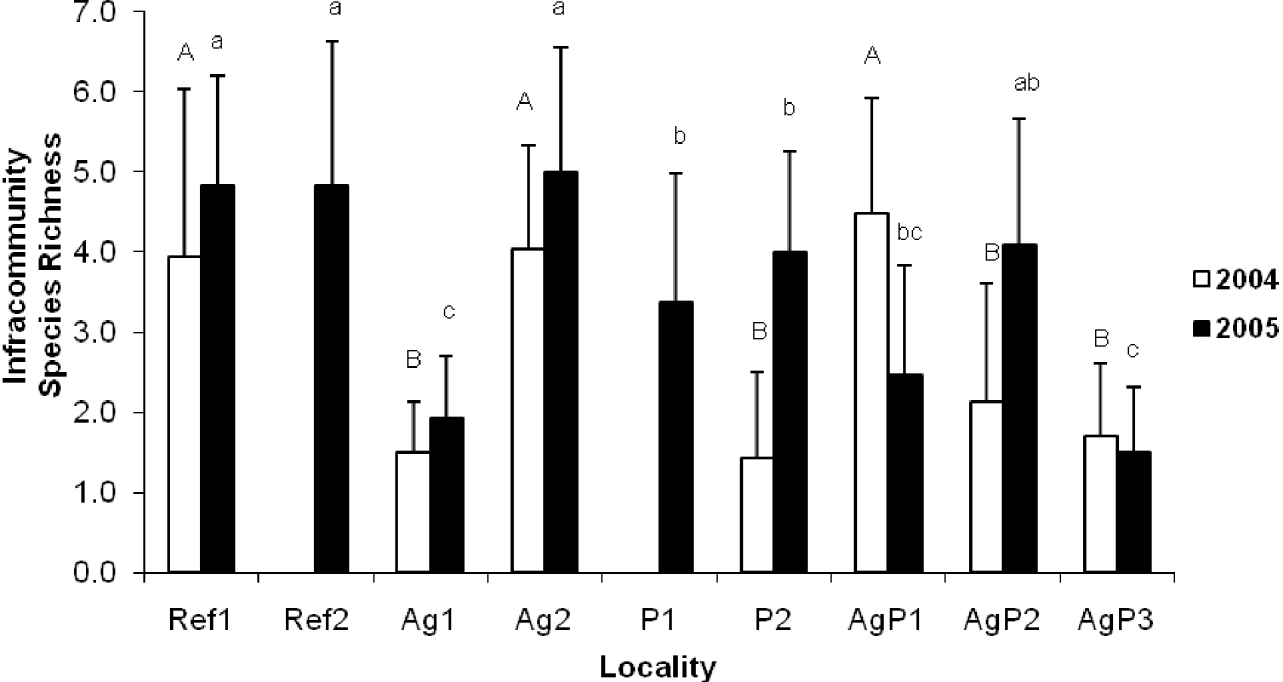
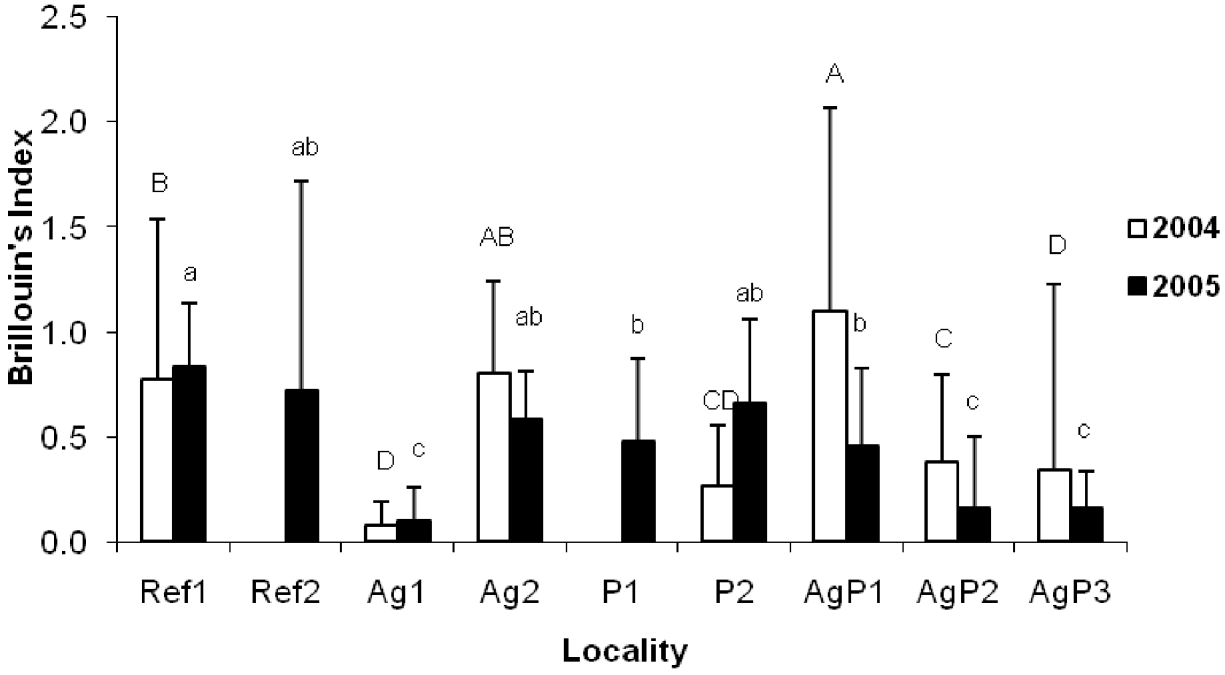
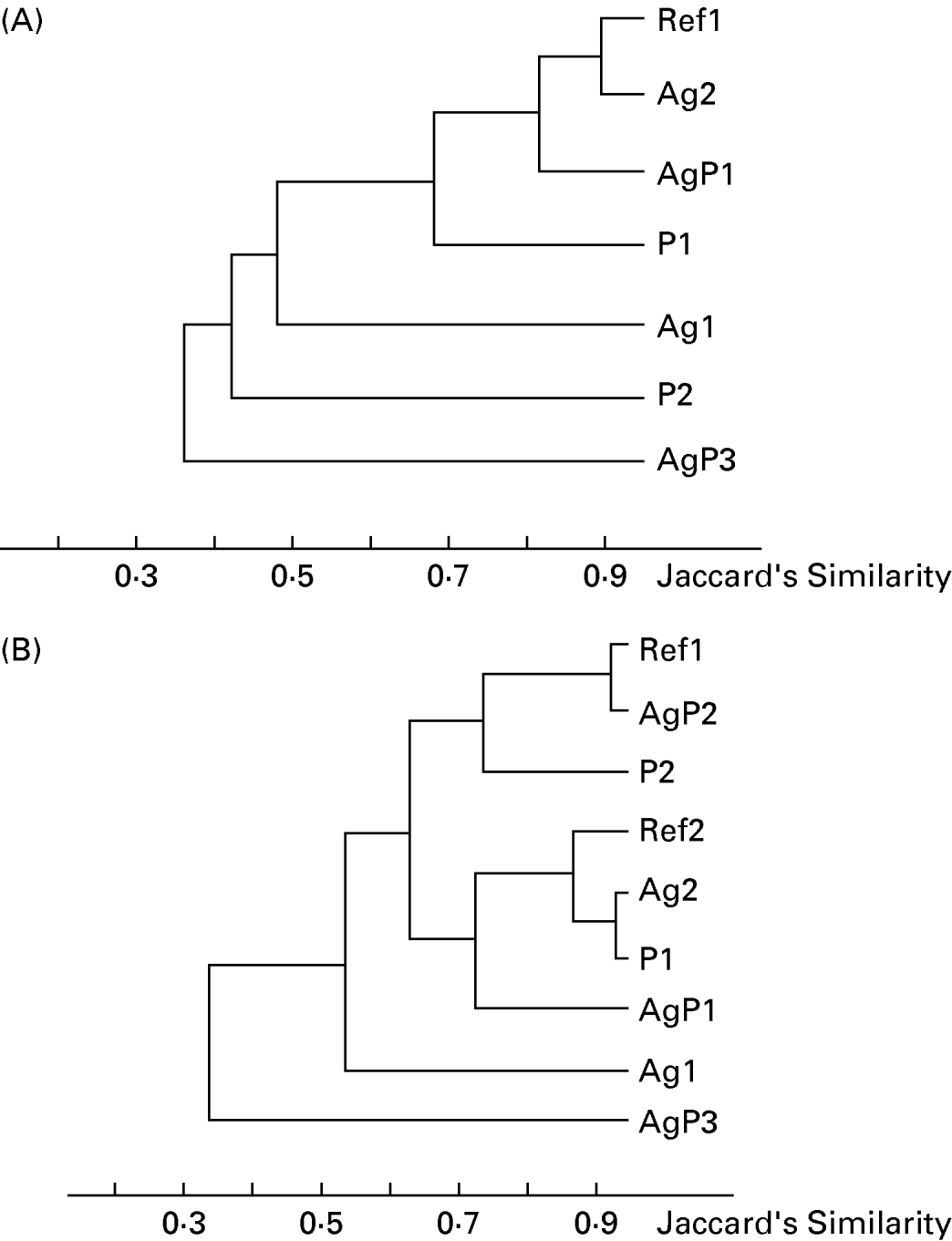
The component communities at Ag1 and AgP3 were constantly among the most depauperate (7–9 species). There was little difference among the rest of the localities (12–17 species), with the exception of the component community species richness at P2 which was comparable to that at Ag1 and AgP3 in 2004 (8 species). Parasite component communities at Ref2, Ag1, AgP2 and AgP3 had the lowest diversity (0·06–0·53) in both years, as measured by the Shannon-Wiener index. High diversity was encountered at Ref1, AgP1, and P2 in both years (1·25–2·06), in Ag2 in 2004 (1·45), and in P1 in 2005 (1·36). Differences in infracommunity species richness varied significantly among localities (2004, χ26=102·25, P<0·001; 2005, χ28=134·35, P<0·001) (Fig. 3). In 2004, frogs at Ref1, Ag2 and AgP1 harboured the most species-rich parasite infracommunities, while those from Ag1, P1, P2, AgP2 and AgP3 had the least number of species. In 2005, species richness in frogs from Ag1 and AgP3 were significantly lower than those from all other localities. Brillouin's diversity index for parasite infracommunities corroborated the general pattern seen at the component community level (Fig. 4). Significant differences were observed among localities in 2004 and 2005 (2004, χ26=91·93, P<0·001; 2005, χ28=107·37, P<0·001). In 2004, parasite infracommunities of frogs at Ref1, Ag2, and AgP1 were the most diverse, while those at Ag1, P2, and AgP3 were the least diverse. In 2005, Ag1, P1, and AgP3 consistently had the lowest infracommunity diversities relative to the other localities. Values for Jaccard's index for component communities ranged from 0·21 to 0·82 in 2004 and 0·22 to 0·93 in 2005. The dendrograms based on Jaccard's similarity in 2004 (Fig. 5A) and 2005 (Fig. 5B) reinforce the differences in species composition between Ag1 and AgP3 and the communities from other wetlands. In addition to P2 in 2004, both Ag1 and AgP3 were clearly separated from the other localities based on parasite species occurrence, and their component communities were the most dissimilar from the others in 2004 and 2005, as well as being very dissimilar from each other.
Mean (+s.d.) parasite infracommunity species richness of Rana pipiens at reference and agricultural localities in 2004 and 2005. Superscript letters indicate significant differences (P<0·05) among localities within a year (upper case: 2004, lower case: 2005). Abbreviations for localities as in Fig. 1.

Mean (+s.d.) Brillouin's Diversity Index for parasite infracommunities of Rana pipiens at reference and agricultural localities in 2004 and 2005. Superscript letters indicate significant differences (P<0·05) among localities within a year (upper case: 2004, lower case: 2005). Abbreviations for localities as in Fig. 1.

Dendrogram from UPGMA cluster analysis on parasite communities of Rana pipiens in reference and agricultural localities (A) in 2004, and (B) in 2005. The clusters are based on Jaccard's similarity indices of the species composition of parasite component communities. Abbreviations for localities as in Fig. 1.

Environment-community analyses
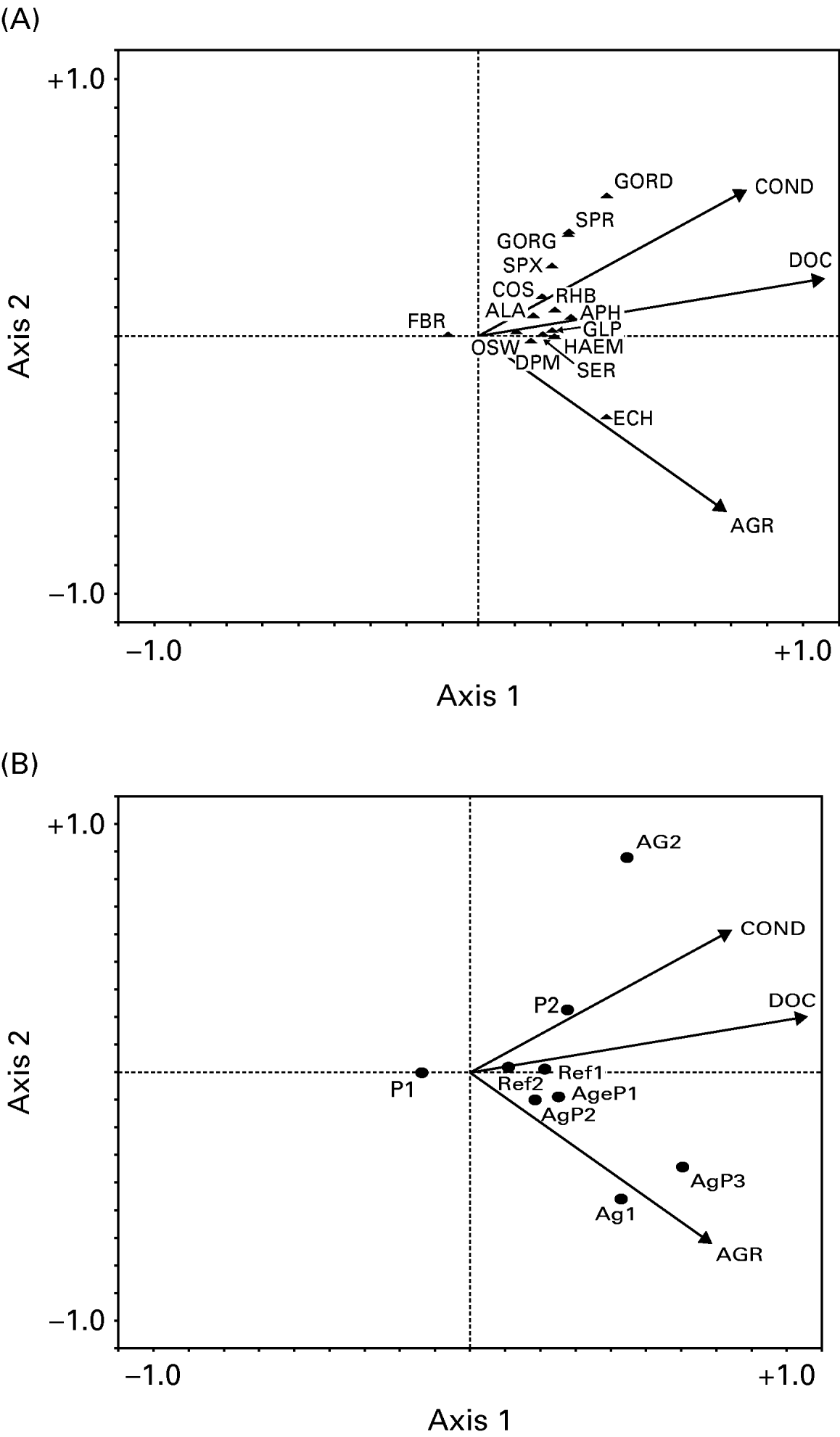
Mean infracommunity species richness was negatively correlated with urban area (Spearman's Rho=−0·86, P=0·01) and agricultural area (Rho=−0·69, P=0·04) at the 500 m scale. Mean total parasite abundance was negatively correlated with nitrates-nitrites (Rho=−0·77, P=0·01) and forest area surrounding the localities (Rho=−0·78, P=0·01). Component community species richness was negatively correlated with dissolved organic carbon (Rho=−0·73, P=0·03). Parasite communities and localities were distinguished further using CCA. The CCA model was significant for the first canonical axis (F=3·376, P=0·040) and for all 4 axes (F=5·730, P=0·015). Axis 1 explained 57·0% and Axis 2 accounted for a further 43·0% of the variation in the abundance of parasite species versus environment relationships. The sum of all unconstrained eigenvalues was 1·586 and that of all canonical eigenvalues was 1·229. Axis 1 had the larger eigenvalue (0·639) compared with the eigenvalue of Axis 2 (0·547) and therefore, the former axis defined the clearest gradient. The correlation coefficients showed that Axis 1 was most strongly associated with increasing dissolved organic carbon (r=0·75), whereas Axis 2 represented a gradient of decreasing agricultural area (r=−0·92) and increasing conductivity (r=0·83). On the ordination, the abundance of most parasite species was positively associated with dissolved organic carbon and conductivity and negatively associated with agricultural area (Fig. 6A), however, with 2 notable exceptions. Firstly, the abundance of Fibricola sp. was negatively related to dissolved organic carbon, but not to conductivity or agricultural area. Secondly, abundance of Echinostomatidae gen. sp. 1 was positively associated with agricultural area. Abundance of both gorgoderids (metacercariae and adults) and Strongyloides sp. were strongly and positively associated with Axis 1, and thus dissolved organic carbon. Wetlands surrounded by large areas of agricultural land formed the most distinct group on the ordination (Fig. 6B), regardless of whether they were contaminated with pesticides. Ag1, AgP1, AgP2, and AgP3 were all positively associated with agricultural area, with Ag1 and AgP3 demonstrating the strongest relationship. P2 and Ag2 were positively related to Axis 2, associated with the high levels of conductivity recorded at the 2 localities. With the exception of P1, all of the localities were positively associated with Axis 1. The parasite communities of frogs from wetlands surrounded by the largest areas of agricultural land were dominated by Echinostomatidae gen. sp. 1 (Ag1, AgP3), while those from P1 were dominated by Fibricola sp. Additionally, Ref1 and Ref2 had many co-occurring parasites, including Haematoloechus spp., Glypthelmins quieta, Seuratoidea gen. sp., Cosmocercoides sp., Oswaldocruzia sp., and Rhabdias ranae. Strongyloides sp. and gorgoderids were also encountered in high abundance at P2 and Ag2, localities with high conductivity.
(A) CCA biplot of environmental variables and parasite species abundance in Rana pipiens from reference and agricultural localities. Parasite species abbreviations: ALA=Alaria sp.; APH=Apharyngostrigea pipientis; COS=Cosmocercoides sp.; DPM=Diplostomum spp.; ECH=Echinostomatidae gen. sp. 1; FIB=Fibricola sp.; GLP=Glypthelmins quieta; GORD=Gorgoderidae gen. sp.; GORG=Gorgoderina attenuata; HAEM=Haematoloechus spp.; OSW=Oswaldocruzia sp.; RHB=Rhabdias ranae; SER=Seuratoidea gen. sp. SPX=Spiroxys sp.; SRG=Strongyloides sp. Environmental variable abbreviations: AGR=Agricultural area; COND=Conductivity; DOC=Dissolved organic carbon. (B) CCA biplot of environmental variables and localities.

DISCUSSION
The parasites of leopard frogs appear to have responded to environmental disturbance from agricultural activity, and specifically from landscape modification. While there were few differences between the parasite communities of the protected wetlands and 5 of the agricultural localities, consistently low species richness and diversity were found at 2 wetlands, Ag1 and AgP3. These were surrounded by the most agricultural (and generally developed) land, with only the latter being highly pesticide contaminated. These patterns in parasite communities are consistent with many previous studies of parasitism in substantially disturbed environments. Decreases in species richness and diversity in the helminth parasite communities of fishes and snails can indeed result from aquatic pollution or development in the surrounding landscape (Lafferty, Reference Lafferty1997; Marcogliese, Reference Marcogliese2004, Reference Marcogliese2005). As predicted in localities with landscape disturbance, fewer parasite species infecting mammals, birds, and frogs as definitive hosts were found at both Ag1 and AgP3. This lends support to our second hypothesis. Moreover, the CCA attributed individual parasite species abundance at all localities to landscape variables associated with the wetlands, notably agricultural area and also urban area. The above results strongly suggest that definitive host movement to agricultural wetlands may be restricted by landscape development reducing habitat suitability and accessibility. In contrast, component and infracommunity species richness were consistently and relatively high at our reference localities, but not necessarily higher than at some of the perturbed localities. Thus, our first hypothesis may apply only when comparing reference localities with those more severely affected by environmental disturbance.
If modification of the landscape reduces the diversity of potential intermediate and definitive hosts present in the habitat, this should be accompanied by a reduction in parasite diversity (Hudson et al. Reference Hudson, Dobson and Newborn1998). Therefore, agricultural or urban expansion which can fragment and effectively reduce habitat visitation by birds and small mammals, may consequently affect parasite transmission from these hosts (Kuris and Lafferty, Reference Kuris and Lafferty1994; Keas and Blankespoor, Reference Keas and Blankespoor1997; Laffery, Reference Lafferty1997; Smith, Reference Smith2001; Huspeni and Lafferty, Reference Huspeni and Lafferty2004; Lafferty and Kuris, Reference Lafferty, Kuris, Thomas, Guégan and Renaud2005; Bradley and Altizer, Reference Bradley and Altizer2006; Koprivnikar et al. Reference Koprivnikar, Forbes and Baker2006a). This is supported by the rarity or complete absence of many parasite species from Ag1 and AgP3 that may use frogs as intermediate hosts and ultimately infect birds (e.g., Apharyngostrigea pipientis, Clinostomum sp., and Diplostomum spp.) and small mammals (e.g., Fibricola sp. in the case of Ag1 only, and Alaria sp. at both localities). In contrast to Ag1 and AgP3, other wetlands on both the 100 m and 500 m scale were typically surrounded by vegetation (e.g., forest) or were part of more extensive wetlands, providing the travel corridors and foraging habitat necessary for a greater abundance and variety of bird species (Shirley and Smith, Reference Shirley and Smith2005). Fragmentation of these habitats may cause a significant decline in visitation even by those waterbirds that do frequent agricultural wetlands, including herons (Ardea spp.) (Czech and Parsons, Reference Czech and Parsons2002), definitive hosts for Apharyngostrigea pipientis and Clinostomum sp. The distribution of small mammals may also be affected particularly if there is little to no buffer area surrounding aquatic habitats (Jones et al. Reference Jones, Lortie and Pierce1988). Small mammals act as definitive hosts for many of the parasite species found in this study, including Alaria sp., Fibricola sp., and the echinostomes. In fact, Koprivnikar et al. (Reference Koprivnikar, Forbes and Baker2006a) found that the prevalence of Alaria sp. in the gray tree frog (Hyla versicolor) was positively associated with forest cover, and therefore suggested that the forested landscapes provide potential canid hosts with greater access to the wetlands.
Similarly, loss of physical cover around the wetlands may have reduced the diversity of invertebrate intermediate hosts (Davies and Nelson, Reference Davies and Nelson1994; Jones et al. Reference Jones, Helfman, Harper and Bolstad1999; Environment Canada, 2005) at Ag1 and AgP3. While some studies have shown that agricultural activity can increase intermediate host abundance and consequently parasite transmission (Johnson and Chase, Reference Johnson and Chase2004; Beasley et al. Reference Beasley, Faeh, Wikoff, Staehle, Eisold, Nichols, Cole, Schotthoefer, Greenwell, Brown and Lannoo2005; McKenzie, Reference McKenzie2007), this is not likely the case in this system. Reduced cover may explain the absence or low abundance of species acquired by frogs in their diet, such as Gorgoderina attenuata and Haematoloechus spp. Most adult trematodes of amphibians use aquatic or semi-aquatic arthropods or arthropod larvae as second intermediate hosts (Prudhoe and Bray, Reference Prudhoe and Bray1982), and development around freshwater lakes and streams can have significant negative effects on these invertebrate intermediate hosts. Indeed, low invertebrate diversity and abundance have been found in streams that are surrounded by land modified for agricultural and urban purposes (Beaven et al. Reference Beaven, Sadler and Pinder2001; Moore and Palmer, Reference Moore and Palmer2005). In heavily logged boreal watersheds, the low parasite infracommunity richness of northern redbelly dace (Phoxinus eos) was attributed to a reduction in the abundance of invertebrate intermediate hosts, particularly mayflies, as a result of the deforestation (Marcogliese et al. Reference Marcogliese, Ball and Lankester2001). In contrast, Ref1 and AgP1 were the most forested on both 100 m and 500 m scales, and frogs from these wetlands were consistently infected with the greatest abundance of trophically transmitted parasites.
Reduced or impaired access to wetlands from habitat fragmentation and isolation can also hamper wetland habitat use by amphibians (Semlitsch and Bodie, Reference Semlitsch and Bodie2003; Green, Reference Green and Lannoo2005) and, in fact, amphibians are often absent from intensely farmed areas (Loman and Lardner, Reference Loman and Lardner2006). Reduced amphibian diversity and abundance in agricultural wetlands would significantly limit opportunities for exchange of parasites among individual frogs, ultimately impeding the colonization of parasites requiring these animals as definitive hosts. In the present study, parasite species maintained by frog definitive hosts (Glypthelmins quieta, Gorgoderina attenuata, Haematoloechus spp., Cosmocercoides sp., Oswaldocruzia sp., Rhabdias ranae, and Strongyloides sp.) were rarely encountered, in low abundance, or absent at Ag1 and AgP3. Decreased forest cover and increased road density can negatively affect species richness in the amphibian community by impeding movement between wetlands, increasing the risk of predation and other mortality factors, and by making the habitat unsuitable for breeding (Houlahan and Findlay, Reference Houlahan and Findlay2003). The lower infection levels of the parasites listed above relative to those found at undeveloped or mildly developed wetlands may reflect reduced use of these wetland habitats by frogs.
Although many species encountered at reference and at other less disturbed agricultural wetlands were not present at Ag1 and AgP3, Echinostomatidae gen. sp. 1 was common at all localities. In fact, most frogs in both 2004 and 2005 were infected with the kidney echinostomes, a finding consistent with other studies of helminth parasites infecting eastern Canadian ranid populations (e.g., McAlpine and Burt, Reference McAlpine and Burt1998; Koprivnikar et al. Reference Koprivnikar, Forbes and Baker2006a). This parasite is one of the most common and abundant in the otherwise impoverished communities at Ag1 and AgP3, and its abundance was positively associated with agricultural area and those two localities in the CCA. Other landscape perturbations, such as intense urbanization (Skelly et al. Reference Skelly, Bolden, Holland, Freidenburg, Freidenfelds, Malcolm, Collinge and Ray2005) and loss of aquatic vegetation (Beasley et al. Reference Beasley, Faeh, Wikoff, Staehle, Eisold, Nichols, Cole, Schotthoefer, Greenwell, Brown and Lannoo2005) have been linked with heavy echinostome infections in green frogs and cricket frogs, respectively. Heavy infections have been associated with adult leopard frog mortality and can be lethal to tadpoles of this species (Schotthoefer et al. Reference Schotthoefer, Cole and Beasley2003). The broad specificity of echinostomes may make it more likely that suitable hosts will exist in impacted environments. Indeed, species of echinostomes commonly use frogs as second intermediate hosts (Prudhoe and Bray, Reference Prudhoe and Bray1982; Kostadinova and Gibson, Reference Kostadinova, Gibson, Fried and Graczyk2000), and infect a wide spectrum of hosts at different stages in their life-cycles. Their miracidia infect at least 4 genera of snails and cercariae infect most snails, fingernail clams, and tadpoles, while adults infect a variety of birds and mammals (McDonald, Reference McDonald1969; Olsen, Reference Olsen1974). The presence of highly host-specific parasites will theoretically decline when environmental disturbances cause host populations to be low, whereas generalist parasites and diseases should persist or even increase with environmental stress (Lafferty and Holt, Reference Lafferty and Holt2003).
The parasite community and species abundance data suggest that intense landscape development from agriculture is more related to parasitism and the health of wetland ecosystems than pesticides, at least at the pesticide concentrations encountered in this study. Nevertheless, in addition to the landscape disturbances, high pesticide concentrations at AgP3 may have contributed to the markedly reduced parasitism observed here. Thus, this provides partial support for the third hypothesis that species richness should be reduced at localities affected by both landscape and pesticides. Although cluster analyses failed to differentiate among the 4 types of wetlands, it revealed Ag1 and AgP3 as the most dissimilar from others in terms of parasite occurrence, but also very dissimilar from each other. While both were surrounded by the most agricultural territory, Ag1 was nested within a managed community parkland and AgP3 had the highest pesticide levels of all localities. However, decreased parasitism in agricultural wetlands such as at AgP3 may also be due to direct toxicity of pesticides to free-living stages (Pietrock and Marcogliese, Reference Marcogliese2003). Koprivnikar et al. (Reference Koprivnikar, Forbes and Baker2006b) found that 200 μg/l of atrazine affected the activity and survival of Alaria sp. cercariae and 20 μg/l atrazine reduced the infection success of Echinostoma sp. in Rana clamitans tadpoles. The results in the present study were somewhat consistent with their conclusions. Alaria sp. was absent at AgP3 and in P2 in 2004, and also rare in other agricultural wetlands, while infection levels of echinostomes at AgP3 in 2005 were among the lowest. Further investigations into how specific pesticides and pesticide mixtures affect the free-living stages of other parasite species known to infect amphibians are needed, particularly at concentrations more applicable to realistic field situations.
The abundance of monoxenous nematodes was consistently lower in frogs from AgP3, and Rhabdias ranae was significantly more abundant in 2004 in non-contaminated wetlands than agricultural wetlands where pesticides had been detected. These results are contrary to reports from laboratory studies which demonstrated that exposure to aquatic pollution leads to increased establishment of directly transmitted parasites possibly as a result of immunosuppression (for fish-monogenean examples, see Khan and Thulin, Reference Khan and Thulin1991 and MacKenzie et al. Reference MacKenzie, Williams, Williams, McVicar and Siddall1995).Yet, immunosuppression due to pesticide exposure may still be a factor influencing trematode parasitism in the present study. Fibricola sp., which infects frogs by cutaneous penetration, was more abundant in contaminated agricultural localities in both years. This parasite species, along with Echinostomatidae gen. sp. 1, one of the most abundant parasite species in AgP3, infects frogs at the tadpole stage when the immune system is most susceptible to suppression from pesticide exposure (Carey and Bryant, Reference Carey and Bryant1995; Gilbertson et al. Reference Gilbertson, Haffner, Drouillard, Albert and Dixon2003). Thus, even though species richness was reduced at this locality, certain parasites were encountered in relatively high numbers, as predicted by our third hypothesis. Trematodes with a similar transmission mode, specifically Ribeiroia ondatrae and Telorchis sp., have been shown to increase in prevalence in immunosuppressed tadpoles exposed in the field to agricultural run-off containing pesticides (Kiesecker, Reference Kiesecker2002). Nevertheless, the relationship of landscape to parasitism is so strong in the current system that any additional patterns caused by pesticide effects may be obscured.
At times, the concentrations of atrazine at AgP3 were 10 to 100 times greater than those measured at the 4 other pesticide contaminated agricultural wetlands and exceeded the Canadian Water Quality Guildelines (2001) of 3 μg/l of atrazine for the protection of freshwater life. Parasite infracommunity species richness and diversity of frogs at moderately contaminated localities tended to be comparatively lower than those from reference localities, but not as low as those from Ag1 and AgP3. Thus, it appears that even moderate levels of pesticide contamination may affect parasite communities, although no significant trends were detected. The responses of parasite communities may be subtle or absent if a disturbance or pollution level is moderate (Marcogliese et al. Reference Marcogliese, Gendron, Plante, Fournier and Cyr2006) and would be difficult to detect in part because the responses of all parasite species are integrated together in community analyses (Kennedy, Reference Kennedy1997; Lafferty, Reference Lafferty1997; Marcogliese, Reference Marcogliese2005). On the other hand, parasite communities may only respond noticeably if the disturbance exceeds a certain magnitude or threshold. This would also explain why we only have equivocal support for our first hypothesis, that parasite species richness would be greatest in localities free from agricultural influence.
Variation in certain water quality parameters, other than pesticides, was related to parasite species richness and abundance. Conductivity and dissolved organic carbon were significant predictors of component community composition. In fact, dissolved organic carbon was also positively associated with component community species richness and the abundance of most parasite species. This suggests that dissolved organic carbon reflects environmental conditions that sustain a highly diversified parasite community. Dissolved organic carbon can mediate the density of invertebrates in freshwater systems through trophic pathways (Wetzel, Reference Wetzel2001). High concentrations of dissolved organic carbon can cause shifts in the invertebrate community structure from small invertebrate species to large predatory invertebrates and insect larvae (Wissel et al. Reference Wissel, Boeing and Ramcharan2003). This could affect the transmission of parasite species such as Gorgoderina attenuata, Haematoloechus spp., and Spiroxys sp. that use insect larvae and other large aquatic invertebrates as second intermediate hosts. Interestingly, conductivity was strongly and positively associated with the abundance of gorgoderids (both adult and metacercariae) in the CCA. Conductivity generally reflects the ion content of water. Waters of low conductivity that are low in biologically important ions may not be suitable habitats for sphaeriid clams (McMahon and Bogan, Reference McMahon, Bogan, Thorp and Covich2001), the first intermediate hosts of gorgoderid parasites. Differences in density of sphaeriid clam populations among the localities may explain the association of gogorgoderid trematodes with conductivity. These differences may not have been detected in our limited invertebrate sampling regime, which also was compromised by intense rainfall during the sampling period.
In conclusion, our results generally supported the hypotheses of the study. Firstly, frogs inhabiting reference localities were infected by the greatest number of parasite species at the component and infracommunity level. Secondly, frogs from localities surrounded by large agricultural landscapes were infected with fewer species that use birds and mammals as definitive hosts and fewer species overall. This was largely attributed to fewer definitive hosts using the wetland habitats, consequently reducing the transmission of their parasites to the metamorph leopard frogs in those habitats. Thirdly, the most perturbed locality with both the highest pesticide levels and the greatest area of agricultural landscape had, along with a partially urbanized and agricultural locality, frogs infected with the fewest parasite species. While frogs from anthropogenically disturbed wetlands may be infected with fewer parasite species, this does not suggest that frogs in these environments are indeed in better health, for there may be deleterious interactions between contaminants and parasites (e.g., Marcogliese et al. Reference Marcogliese, Gagnon Brambilla, Gagné and Gendron2005). Furthermore, the fact that depauperate parasite communities likely reflect impoverished host communities suggests that these wetlands are seriously impacted and that the parasite communities of frogs appear to be good indicator organisms of ecosystem health. These observations should be considered in conservation planning in response to amphibian declines.
We thank Sean Locke, Lila Brambilla-Gagnon, Sophie Trépanier, Sonia Roy, Jean-Martin Chamberland, Michel Arseneau, Germain Brault, Claude Lessard, and Katia Étienne from the St Lawrence Centre (Environment Canada) for assistance in the collections. Denis Laliberté, Christian DeBlois, and Nathalie Dassylva contributed to the nutrient and pesticide analysis. Pierre Gagnon kindly provided statistical advice. François Boudreault generously prepared the map and produced the landscape data, and the voucher parasite specimens provided by Judith Price and Donald McAlpine greatly helped in our identifications. Thanks also go to John Sauro and Raymond Greffe who permitted us to sample on their lands, along with Danielle Chatillon of the Société des établissements de plein-air du Québec who facilitated access to Île de la Commune wetland. We are also grateful to Valerie McKenzie for her helpful comments. Funding for this work was provided by the Pesticide Science Fund (Environment Canada), an NSERC Postgraduate Scholarship awarded to K.C.K., and an NSERC Discovery Grant to J.D.M.