Introduction
Many authors have written regarding and discussing about the conceptual history of schizophrenia.Reference Garrabé 1 , Reference Berrios, Rogelio and Villagrán 2 One could assume that, before modern age, schizophrenia patients would be included under the unspecific terms as melancholia or mania. Such terms were already in use in the classic age, depending if the predominant psychomotor symptoms were retardation or agitation.Reference Zilborg and Henry 3 In the modern age this epopee started with the first description of démence, a deteriorating psychological condition, Reference Pinel 4 and démence précoce, nothing more than a progressive, heritable decline in function in young people.Reference Morel 5 Later the concept of dementia praecox was adaptedReference Pick 6 and developed as an ingeniously and consistent nosological entity, described as a chronic, deteriorating psychotic disorder characterized by rapid cognitive disintegration, usually beginning in the late teens or early adulthood.Reference Kraepelin 7 Although these words could be considered French and Latin translations of the same term, they were not quite true synonymous as concepts. There was, indeed, an abyss separating démence précoce from dementia praecox. Reference Minkowski 8 Nevertheless dementia praecox was the starting point for what would be the first ever use of the term, and concept for schizophrenia, describing a group of diseases that cause changes in thought processes and behavior in humans as well as difficulties relating to the world.Reference Bleuler 9
Eugen Bleuler, when used the term schizophrenia for the first time, described what he called the famous fundamental symptoms, that many clinicians would use for generations in daily practice as the four a’s mnemonic: alogia, autism, ambivalence, and affect blunting.Reference McNally 10 , Reference Arantes-Gonçalves, Gama Marques and Telles-Correia 11 Later, in the following decades, psychiatrists trusted in Kurt Schneider’s first rank symptoms such as somatic passivity, delusional perceptions and complex auditory hallucinations (voices commenting and voices discussing) as pathognomonic and sufficient for schizophrenia diagnosis.Reference Heinz, Voss and Lawrie 12 Nevertheless, a recent Cochrane systematic review revealed that those symptoms may lead to 40% of schizophrenia diagnosis failure.Reference Soares-Weiser , Maayan and Bergman 13 It is primordial to remember that these symptoms can all occur in many other disorders, Reference Marneros 14 and psychopathology is not helpful in distinguishing secondary from primary schizophrenia.Reference Falkai 15 –Reference Gama Marques 18
Furthermore throughout our readings we collected some more outstanding citations that clearly show how the scientific community has raised, in the last half century, so many different opinions regarding this fascinating topic. Thus, schizophrenia has been labeled by various authors in diverse manners, such as the graveyard of neuropathologists, Reference Plum 19 a myth with a strong genetic component, Reference Kety 20 closer to a life process than to an illness, Reference Ciompi 21 existing as long as mankind, Reference Strömgren, Wing and Wind 22 a scientific delusion, Reference Boyle 23 some ways of being human, Reference Jenner, Monteiro, Zagalo-Cardoso and Cunha-Oliveira 24 and a price to pay for language.Reference Crow 25
The Schizophrenia–Schizoaffective–Bipolar Meta-Spectrum
For decades that clinicians and researchers have been thinking and writing about the spectrum of schizophrenia disorders. Indeed both Kraepelin and Bleuler believed in schizophrenia as a spectrum, both in a clinical (individual) and hereditary (family) continuum, from just some exquisite personality traits to unquestionable chronic and debilitating psychosis.Reference Weller 26 Other authors would put the schizophrenia spectrum disorders on different levels of continuum: developmental, psychofunctional, existential, and genetic.Reference Reich 27
An intermediate outcome between that of schizophrenia and bipolar affective disorder is often called schizoaffective disorder. Patients with these schizoaffective psychoses are less likely to achieve a full remission than patients with bipolar disorders, who also present a much smaller prevalence of residual state between episodes.Reference Angst, Felder and Lohmeyer 28 Considerable debate has surrounded the inclusion of schizoaffective disorder in psychiatric nosology: some authors believe schizoaffective disorder may be a variant of schizophrenia in which mood symptoms are unusually prominent but not unusual in type; while others believe it is a condition that may instead reflect a severe form of bipolar disorder in which episode-related psychotic symptoms fail to remit completely between mood episodes. Alternatively, schizoaffective disorder could correspond to the co-occurrence of two relatively common psychiatric illnesses: schizophrenia and bipolar disorder, or even represent a third and different type of psychosis, completely autonomous from the bipolar and schizophrenia categories.Reference Abrams, Rojas and Arciniegas 29 Schizoaffective disorder diagnosis is, indeed, an authentic conundrum in the clinical setting.Reference Wilson, Nian and Heckers 30
Some authors suggest a genetic susceptibility continuum spanning across schizophrenia and bipolar disorder and including, at its two extreme ends, unique genetic factors associated with each disorder and a middle zone of overlap, occupied by schizoaffective disorder and containing shared genetic factors.Reference Owen, Craddock and Jablensky 31 Twin analysis are consistent with genetic influences on schizoaffective episodes being entirely shared with genetic influences on schizophrenic and manic episodes, while association studies suggest the possibility of some relatively specific genetic influences on broadly defined schizoaffective disorder.Reference Cardno and Owen 32
More recently, influent researchers wrote about the slow death of the concept of schizophrenia and the painful birth of the psychosis spectrum.Reference Guloksuz and van Os 33 Soon there were many voices rebutting this idea: some claimed that the concept of schizophrenia is still aliveReference Kahn 34; some argued that, although clearly not well and with limited validity, the concept of schizophrenia has a continued utilityReference Zoghbi and Lieberman 35; and others almost shouted that the half-alive concept of schizophrenia is still better than the spectrum of everything.Reference Bora 36
After reading this insightful discussion, we had to agree that schizophrenia is part of a spectrum, but it does not represent the extreme of a normally distributed trait, Reference Curtis and Derks 37 and shall be kept as a useful concept, Reference Lawrie 38 for researchers, clinicians, patients, families and society. Indeed, we do not believe in a psychotic spectrum of everything but instead in a meta-spectrum composed by three different spectra: the schizophrenias spectrum, the schizoaffective disorders spectrum and the bipolar disorders spectrum. Each of those spectra would include different nosological independent entities, from personality disorder to chronic full-blown psychosis.
The Schizophrenias Spectrum
Schizophrenia disorder spectrum is globally quite accepted and include already:
-
• Schizophrenia in all old subtypes: simple, hebephrenic or disorganized, paranoid, residual, undifferentiated, catatonic, Reference McGlashan and Fenton 39 cenesthopathic, Reference Basov 40 and even sluggish schizophreniaReference Jargin 41.
-
• Delusional disorder (previously known as paranoia) and paraphreniaReference Ravindran, Yatham and Munro 42.
-
• Paranoid personality disorder, schizoid and schizothypal personality disordersReference Bolinskey, Smith and Schuder 43 and all the latter old equivalents: latent schizophrenia, borderline schizophrenia, prodromal schizophrenia, prepsychotic schizophrenia, pseudoneurotic schizophrenia and pseudopsychopathic schizophrenia.
The Bipolar Disorders Spectrum
The bipolar spectrum is widely accepted internationally and usually includes:
-
• BipolarReference Kleist 44 I (previously known as manic depressive insanity) with manic or mixed episodes, with or without major depressive episodes, not forgetting the renewed interest in the new mixed features specifier for episodes of mood disordersReference Stahl, Morrissette and Faedda 45 , Reference Vázquez, Lolich and Cabrera 46.
-
• Other bipolar disorders in all its modern subtypesReference Akiskal and Pinto 47: I ½ protracted hypomania without depression; II depressive and hypomanic episodes; II ½ depressive episodes with cyclothymic temperament; III depressive episodes with antidepressant-induced hypomania; III ½ bipolar disorder with substance abuse; IV depressive episodes with hyperthymic temperament; V depression with mixed hypomania; and VI bipolarity in the setting of dementia.
-
• Hyperthymic and cyclothymic temperaments.Reference Akiskal and Mallya 48
The Schizoaffective Disorders Spectrum
Our contribution for this meta-spectrum would be the proposal of a new spectrum for schizoaffective disorders that would include:
-
• Schizoaffective patients included in the original descriptionReference Kasanin 49 and the more modern descriptions of schizomaniaReference Carloni and Spadoni 50 , Reference Os, Takei, Castle, Wessely, Der and Murray 51 and schizobipolar.Reference Stahl 52
-
• Cycloid psychosis on its classic forms: hyperkinetic-akinetic motility psychosis; excited-inhibited confusion psychosis; and anxiety-happiness psychosis. 53-57
-
• Other atypical psychosesReference Mitsuda 58 , Reference Hatotani 59 outside Kraepelinian dicothomy.
-
• Borderline personality disorder patients, who may have brief psychotic episodes (but not enough for schizophrenia diagnosis) independently of important mood changes (but also not enough for bipolar disorder diagnosis).Reference Zimmerman 60 , Reference Slotema, Blom, Niemantsverdriet, Deen and Sommer 61 We assume this idea as the most controversial of our proposal as psychotic symptoms in borderline personality disorder continue to be poorly understood and further research should try to ascertain the relationships between hallucinations and delusions on one hand and the processing of trauma, emotion regulation, distress tolerance and interpersonal sensitivity on the other.Reference D’Agostino, Rossi Monti and Starcevic 62
Conclusion
With this short epistemological perspective we want to raise awareness, among clinicians but also researchers, regarding the importance of the spectrum concept for the understanding and studying of idiopathic psychoses (previously known as nonorganic psychoses), especially regarding the authentic conundrum of schizoaffective disorder.
In the American Psychiatry Association’s Diagnostic and Statistical Manual of Mental Disorders, fifth edition (DSM-5), the diagnosis of schizoaffective disorder can be made only if full mood disorder episodes have been present for the majority of the total active and residual course of illness, from the onset of psychotic symptoms up until the current diagnosis. In earlier DSM versions, the boundary between schizophrenia and schizoaffective disorder was only qualitatively defined, leading to poor reliability. This change will provide a clearer separation between Schizophrenia with mood symptoms from Schizoaffective Disorder and will most likely reduce rates of diagnosis of schizoaffective disorder while increasing the stability of this diagnosis once made.Reference Malaspina, Owen and Heckers 63
On the other hand, clinicians all around the world have shown small improvements in accurately diagnosing vignettes using the World Health Organization’s International Classification of Diseases, 11th edition (ICD-11). It seems that the discrepancy in diagnosing schizoaffective disorder is related primarily to the presence of mood symptoms and discrepancies about whether those symptoms are more consistent with schizoaffective disorder or a mood disorder diagnosis. Continuing to identify ways to more accurately capture this symptom picture will be important in the future as well as systematic efforts to educate clinicians about differential diagnosis.Reference Peterson, Webb and Keeley 64
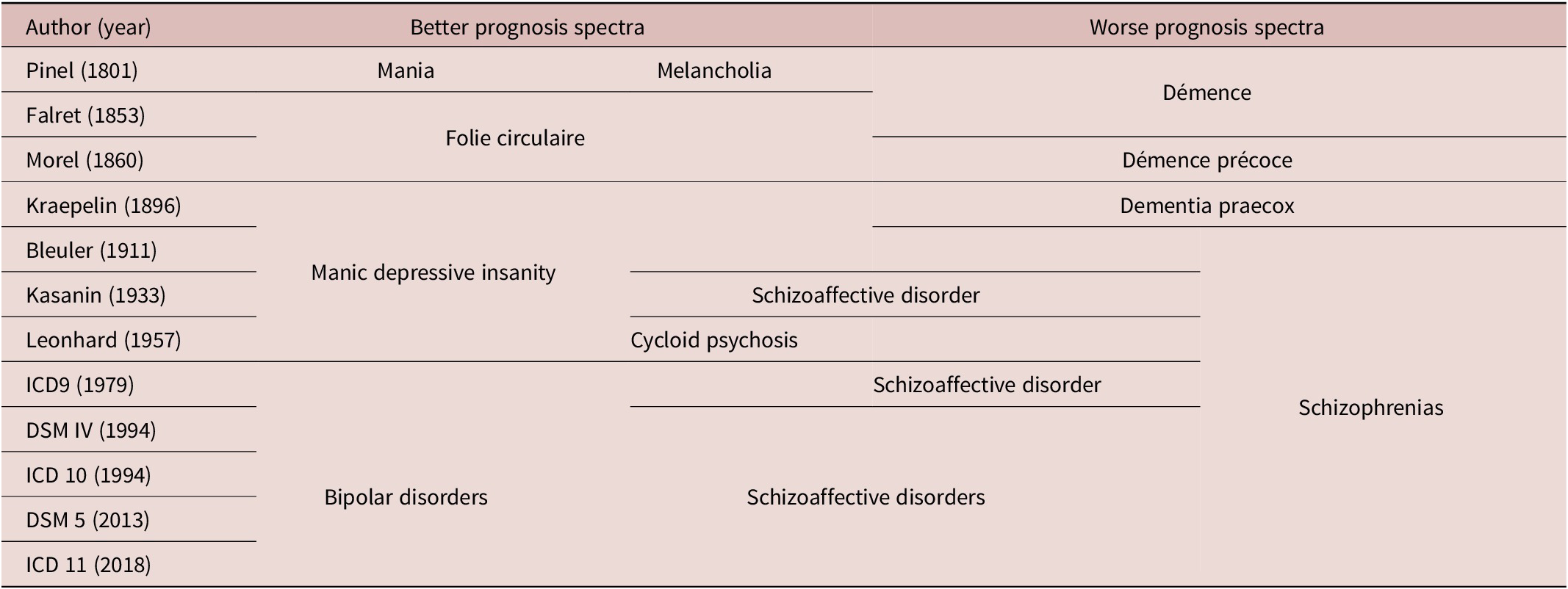
As a small contribute for this brainstorm we would like to present here an historical chronology for the schizophrenia–schizoaffective–bipolar spectra ( Table 1) plus a tridimensional model for these spectra ( Figure 1): the first axis for categories (affective versus nonaffective psychoses), the second axis for dimensions (personality versus full blown psychosis), and a third axis for biomarkers (remission versus relapse).
Epistemology of the schizophrenia–schizoaffective–bipolar spectra

The schizophrenia–schizoaffective–bipolar spectra.

We believe that without the schizophrenia–schizoaffective–bipolar spectra concept in our minds all our efforts will keep failing one the hardest quest: searching for biomarkers in schizophrenia and related disorders.
Acknowledgments
João Gama Marques would like to thank the precious help of Mr. André Machado in the English editing of this paper.
Disclosures
João Gama Marques and Sílvia Ouakinin have nothing to disclose.