INTRODUCTION
In Brown's (Reference Brown1973) classic research on children's oral morphological development in English, children were assumed to have mastered a grammatical morpheme in oral language when it was used correctly in obligatory contexts 90 percent of the time in three consecutive speech samples. Across the three children in Brown's study, regular forms of inflectional morphemes emerged in the following order: progressive (-ing), plural (-s), possessive (-s), past tense (-ed) and third person singular (-s). Brown also noted that derivations were largely absent in children's speech before five years of age. In the current study, we examine whether the pattern uncovered by Brown in the acquisition of inflectional suffixes in oral language is similar to the order in which children accurately spell these suffixes when they first begin to write.
Brown's (Reference Brown1973) pattern of results is convincing in part because it was replicated by de Villiers & de Villiers (Reference de Villiers and de Villiers1973) in a cross-sectional study of twenty-one young English-speaking children. De Villiers and de Villiers applied Brown's 90 percent correct criterion in obligatory contexts, modifying it in two separate ways for application to a cross-sectional sample. The first way, Method I, ordered acquisition of morphemes by individuals. Specifically, each child with the lowest Mean Length of Utterance (MLU) in which a particular morpheme was produced at the 90 percent correct criterion was identified. Each morpheme of interest was then rank-ordered according to the lowest MLU in which it occurred, with morphemes occurring in lower MLUs ranked as being acquired first. In Method II, the morphemes were ordered according to their average correct usage across all of the speech samples as a group. Morphemes that were used correctly most often in obligatory contexts overall were ranked first in the order of acquisition. The rank orders obtained with Methods I and II were highly correlated with Brown's original rankings, indicating that English-speaking children learn to use inflectional suffixes in roughly the same order. Both classic research studies tracked the same grammatical morphemes, and comparison of the results suggested that children mastered these morphemes in an invariant order during oral language development. However, research has not yet examined whether a similar order of acquisition exists in the mastery of written inflectional suffixes. This was our present goal.
The link between oral and written production of inflectional morphology
There may be a connection between the order in which children learn to use inflections orally and the ability to represent inflectional suffixes accurately in spelling. Children may have stronger lexical representations (Munakata, Reference Munakata2001) for inflections that are acquired first in oral language than for inflections acquired later; consequently they may spell these inflectional suffixes more accurately in their early writing attempts. This advantage might be especially relevant in the context of the multiple demands placed on young children as they write, which include forming letters correctly, remembering spelling conventions, and conveying meaning. Statistical learning models, which have been applied recently to spelling research (Deacon, Conrad & Pacton, Reference Deacon, Conrad and Pacton2008; Pollo, Treiman & Kessler, Reference Pollo, Treiman, Kessler, Grigorenko and Naples2007), would also predict that repeated exposure to written forms of morphemes would strengthen lexical connections for particular morphemes that are more familiar.
Empirical support for a link between order of acquisition for inflectional suffixes in oral language and in written language comes from research demonstrating a link between the awareness of and the ability to manipulate morphemes (morphological awareness), as well as the spelling of those same morphemes. This link has been uncovered in several studies of spelling of morphologically complex words (e.g. Carlisle, Reference Carlisle1996; Derwing, Smith & Wiebe, Reference Derwing, Smith, Wiebe and Feldman1995; Rubin, Reference Rubin1988; Shankweiler, Lundquist, Dreyer & Dickinson, Reference Shankweiler, Lundquist, Dreyer and Dickinson1996). Perhaps the best controlled evidence comes from a longitudinal study of the spelling of the past tense morpheme. Nunes, Bryant & Bindman (Reference Nunes, Bryant and Bindman1997a; Reference Nunes, Bryant and Bindman1997b) found that six- to eight-year-old children's awareness of past tense inflections in oral language (assessed with an analogy task targeting the past tense) explained a significant proportion of the variance in children's ability to represent past tense suffixes twenty months after awareness was tested. The connection between morphological awareness and spelling was robust to the effects of age, intelligence and general spelling ability, and emerged for spelling of both real (Reference Nunes, Bryant and Bindman1997a) and pseudo-words (Reference Nunes, Bryant and Bindman1997b). Given the specificity of the relationship between performance on oral and written tasks in studies examining single morphemes, we hypothesized that there might be some similarity in the order of acquisition of individual morphemes in oral and written language.
Naturalistic data on beginners' spelling of inflectional suffixes
As in oral laguage (Brown, Reference Brown1973), morphological inflections are used more frequently than derivations in young children's spontaneous writing (Treiman, Reference Treiman1993; Carlisle, Reference Carlisle1996). Previous studies have analyzed how beginners spell inflectional suffixes when writing their own journals and stories. It is difficult to establish the order of acquisition for inflectional suffixes in writing based on prior research. We review the available evidence below.
Read (Reference Read1986) examined several aspects of young children's naturalistic spellings. Many of the children that he studied were precocious writers, having begun to write before attending school, and they ranged in age between four and eight years. Read's primary research focus was on children's spelling errors that were related to the phonetic properties of target words. He reported a developmental sequence in which children initially spelled past tense verbs phonetically (e.g. halpt, cold and startid for helped, called and started, respectively). Subsequently, he found that children ignored the distinction between the allomorphs /t/ and /d/ for past tense verbs (spelling both of these as -d), but continued to spell the third allomorph /əd/ as -ed or -id. Read also found a similar developmental process in the spelling of the plural allomorphs /s/, /z/ and /əz/. Read concluded that because they changed the spelling of the morphological unit based on its phonetic pronunciation, young writers do not realize that different allomorphs have an underlying consistent meaning. However, in his emphasis on phonological aspects of spelling, Read did not address the question of how children master the range of inflectional suffixes that they must include in their early writing.
Treiman's study (Reference Treiman1993) of grade 1 children's naturalistic journal writing expanded Read's (Reference Read1986) work considerably. She provided detailed quantitative data on how six- to seven-year-old children spelled inflected and derived words, reporting the frequencies of children's different spelling strategies. Treiman found, within the course of a year, that many children seldom used certain inflectional suffixes (such as -er and -est adjectival suffixes). For the progressive suffix, children produced accurate spellings 48·5% of the time. Treiman reported that only 1·3% of the regular past tense verbs were spelled correctly in the first semester, but 25% were spelled correctly by the second semester (see Beers & Beers (Reference Beers, Beers, Templeton and Bear1992) for a similar conclusion based on experimental findings). Children were more accurate in their spellings of /s/ and /z/ suffixes for plural, possessive and third person singular, spelling them correctly 86% of the time in semester 1 and 82·7% of the time in semester 2. As part of her investigation of spelling accuracy for regular past tense suffixes (ending in /t/ or /d/) and for plural, third person and/or possessive suffixes (ending in /s/ and /z/), Treiman also compared these two-morpheme words to one-morpheme words ending in the same sounds that children included in their diaries. Treiman suggested that children's difficulties with the regular past tense suffix arose from the degree of conflict between its spelling and its phonology (i.e. -ed for the /t/ or /d/ sounds in contrast to -s for the /s/ or /z/ sounds).
Overall, Treiman's reports (Reference Treiman1993) of children's accuracy in spelling inflectional suffixes suggest that first-grade children master the /s/ and /z/ suffixes (plural, third person singular and possessive) first, the progressive suffix second and the regular past tense suffix third. This period, when children are first learning to write around the ages of five to seven years, appears to be the time when children make great strides in spelling development. Carlisle's (Reference Carlisle1996) study of older children in grade 2 and 3 (roughly seven- and eight-year-old) children's spontaneous spellings of inflectional suffixes found that typically developing children were over 90 percent accurate in spelling suffixes (including the regular past tense -ed), and that their spelling accuracy was correlated with experimental measures of oral production of morphologically complex forms. These findings suggest that children had mastered difficult inflectional suffixes in writing within a few years of schooling. Carlisle's findings also highlighted the connection between an ability to produce morphologically complex words in oral language and to use morphologically complex words in writing.
The naturalistic studies reviewed above provide preliminary information about how children begin to master the spellings of inflectional suffixes in English, and highlight some differences between oral and written inflectional suffixes. Carlisle's (Reference Carlisle1996) work suggests that children have mastered the spellings of many inflectional suffixes between the ages of seven and eight years, but the work of Read (Reference Read1986) and Treiman (Reference Treiman1993) indicates that younger children have trouble with several of these inflectional suffixes. Previous naturalistic research in spelling development from the onset of writing to the mastery of inflectional suffixes has not been investigated comprehensively, and this domain would benefit from the application of methodologies from oral to written language.
Experimental data on beginners' spelling of inflectional suffixes
Nunes et al.'s (Reference Nunes, Bryant and Bindman1997a) study of the past tense suffix tracked development of the understanding of one individual inflection through spelling. In a longitudinal study of 363 six-, seven- and eight-year-old children, Nunes and her colleagues examined children's understanding of the rule governing past tense spelling. The rule specifies that -ed is used for the endings of forms in which the sound of the base remains the same in the two forms (regular: e.g. kiss–kissed), and a phonetic spelling is used for past tense forms in which the sound of the base changes (irregular: e.g. feel–felt). Nunes et al.'s work delineated a developmental pattern with five spelling stages. Initially, children did not spell word endings consistently. In the second stage, children (average age of 7 ; 02) spelled the endings of all three types of words as they sounded (-t for /t/ and -d for /d/), reflecting a phonetic spelling strategy. Next, children began to use -ed, but they did so both correctly (e.g. kissed) and incorrectly (e.g. feled and sofed to spell felt and soft). Nunes et al. argued that children adjusted their rule to accommodate the ‘exception’ spelling -ed, but that they did not yet understand the morphological basis of this alternative spelling. In the next stage, children restricted -ed to the ends of regular and irregular past tense verbs. Finally, children used -ed exclusively for the regular past tense forms, likely reflecting an understanding that -ed is used to denote past tense in regular verbs only. These results support the idea that beginning spellers rely on phonological spelling strategies for the past tense suffix and that they only appreciate morphology's role in this context once they have gained a few years of literacy experience (see Bryant, Nunes & Snaith (Reference Bryant, Nunes and Snaith2000) and Nunes et al. (Reference Nunes, Bryant and Bindman1997b) for confirmation with pseudo-words). However, a limitation of this experimental paradigm is its focus on one suffix exclusively, limiting a broader view of children's abilities with other inflectional suffix spellings.
Using an alternative experimental paradigm, Deacon & Bryant (Reference Deacon and Bryant2005) compared children's spellings of two-morpheme words with different inflectional suffixes and one-morpheme word controls ending in the same letters (e.g. smarter versus corner). They found that six- to eight-year-old children were better at spelling the endings of inflected two-morpheme words than endings of one-morpheme control words. These results provide evidence that beginning spellers have some appreciation that morphological units, specifically inflections, are represented in spelling. And yet, the few examples of each of the morphemes included in the inflectional category (progressive -ing, comparative -er and -est) do not permit a detailed investigation of performance with each individual morpheme, or include the full range of inflectional suffixes that beginning spellers may use.
The present study
To date, there has been no longitudinal study that specifically tracks how children come to master the challenge of spelling inflectional suffixes. The purpose of this study was to examine the order in which beginning spellers learn to spell inflectional suffixes correctly and to compare this to the order in which inflectional suffixes are acquired in oral language based on prior naturalistic studies (Brown, Reference Brown1973; de Villiers & de Villiers, Reference de Villiers and de Villiers1973). The data for the current study were collected in a naturalistic situation – journal writing – over a two-year period. We predicted that children would master the spellings of inflectional suffixes in an order similar to the order in which these suffixes are acquired in spoken language, but that their acquisition of the regular past tense suffix would be later relative to its acquisition in oral language, because of the particular challenges it presents in English spelling compared with oral language.
To supplement our examination of how often children spelled inflectional suffixes correctly in obligatory contexts, we planned an additional analysis for past tense suffixes, based on an informative approach taken in both experimental and naturalistic research. Previous investigations of past tense spellings have compared the spellings of regular verbs to those of other words that end in /t/ or /d/ (Bryant, Nunes & Snaith, Reference Bryant, Nunes and Snaith2000; Carlisle, Reference Carlisle1996; Nunes et al., Reference Nunes, Bryant and Bindman1997a; Treiman, Reference Treiman1993). We expected that children would use a morphological spelling strategy (-ed) more often to spell the endings of regular verbs than to spell irregular verbs that end in the same sounds as regular past tense endings (/t/ or /d/) in spoken English, suggesting the use of a morphological spelling strategy.
METHOD
Participants
The participants were ten typically developing children (3 males) attending a public elementary school in Halifax, Nova Scotia, Canada. Data for the present study spanned a two-year period, from school entry in kindergarten (typically at the age of five years) through first grade. When data collection began, the mean age of the children was 5 ; 05 (SD=0·21 years). Typical development was established through parent report. None of the children had a parent-reported history or diagnosis of speech, language, hearing or learning problems. All children were from monolingual, English-speaking homes and attended the same elementary school.
Data collection
At the time of data collection, the school the children attended adhered to a whole language approach to teaching reading and writing. Consistent with this approach, there was no formal phonics instruction in the classroom, although spelling lists were sent home for memorization and informal discussions about sounding out and spelling words occurred as children were reading and writing. Journals were collected as part of the children's regular language arts curriculum. Most children made an entry in their journals at least once a week, and some children wrote more often, presumably when they had finished other class activities. The teachers encouraged the children to describe their own ideas and life events in these journals. Teachers would respond to the content of the journals, but spelling was not corrected. If children asked for assistance in spelling a word during journal writing, the teacher encouraged them to try their best to spell the word, or referred them to the displays of written words in the classroom, such as the calendar with the day of the week displayed.
The journals that the children wrote during class in kindergarten and first grade comprised the naturalistic writing samples analyzed in the current study. This study constitutes a secondary analysis of data from these journals, which were originally collected, transcribed and segmented into T-units as part of an investigation of factors influencing children's spelling accuracy (Kay-Raining Bird, Bedrosian, Rice & Szeto, Reference Kay-Raining Bird, Bedrosian, Rice and Szeto1999). The T-unit is ‘a main clause with all subordinate clauses or nonclausal structures attached or embedded within’ (Scott, Reference Scott and Nippold1988: 55). The parents of each child were asked to interpret the journal of their son or daughter at the end of each school term to help the researchers decipher some of the children's more inventive spellings. Words that could not be deciphered by either the parents or the coders preparing the glosses were not included in the analyses.
Coding
In order to compare the children's writing with conventional English spellings, a trained graduate student transcribed what the children wrote for each entry, retaining creative spellings, and then glossed the conventional spellings above these, using the parents' interpretations as a guide. A second graduate student recoded 10 percent of the data to determine reliability. Eighty-seven percent agreement was obtained for identifying transcriptions of misspelled words. When there were disagreements in coding, the original glossed transcriptions were used for analysis. The journal entries for each school year (kindergarten and first grade) were divided into two time periods corresponding to the first half (September to January) and second half (February to June) of each school year. This resulted in four time blocks (referred to as Time 1 through 4).
The journal entries were segmented into Terminable Units (T-units) using conventions outlined by Scott (Reference Scott and Nippold1988). A main clause starting with a coordinating conjunction was segmented as a separate T-unit unless a co-referenced subject was deleted in the second clause. Sentence segments, sentences with one or more unintelligible words, and sentences with an omitted main verb were not included in the analysis. Mean length of T-unit (MLT-unit) was calculated for each of the four time periods. Percent agreement was calculated to be 97 percent for T-unit segmentation and 88 percent for the identification of individual morphemes.
In terms of the corpus of words available for analysis, the average numbers of 1-, 2- and 3-syllable words produced in writing samples by children in the first half of kindergarten (Time 1) were 103·2 (SD=78·5), 18·1 (SD=9·9) and 4·3 (SD=3·9), respectively. These numbers increased to 983·7 (SD=866·2), 205·7 (SD=184·4) and 36·3 (SD=36·4) by the second half of grade 1 (Time 4). Only words containing selected inflectional suffixes were coded for the current data analyses: the present progressive (-ing), plural (-s), regular third person singular (-s), regular past tense (-ed) and possessive (-s). These suffixes correspond to the inflectional suffixes that Treiman found to be most frequent in children's early naturalistic writings, and they are those tracked in oral language development (Brown, Reference Brown1973; de Villiers & de Villiers, Reference de Villiers and de Villiers1973). Inflectional suffixes and irregular past tense verbs that were part of proper names (e.g. book titles) were not coded because children tend to be more accurate when spelling proper names (Treiman, Reference Treiman1993). The spellings of irregular past tense verbs ending in /t/ or /d/ were also coded as a comparison to regular past tense verbs. Children's mastery of irregular past tense verbs was not included in the order of acquisition because the irregular past tense is not a consistently spelled suffix. Furthermore, coding of irregular verbs was based on a restricted set that excluded verbs (e.g. saw, took, came) that ended in sounds other than /t/ or /d/.
We attempted to identify non-verb control words ending in /t/ or /d/ for comparison to the past tense verbs (e.g. fast, band), one-morpheme words ending in /s/ or /z/ (e.g. nice, because) to compare with plurals, possessives and third person suffixes, and one-morpheme words ending in /iŋ/ (e.g. swing) to compare with progressive suffixes. These words did not occur in sufficient numbers in the children's journal entries to serve as useful controls.
The spellings of target suffixes were coded as correct if they were spelled correctly, regardless of the spelling of the root word. To illustrate, haveing and having were both considered correct spellings of the present progressive suffix -ing. Possessive suffixes were coded as correct if -s was used with or without the inclusion of an apostrophe because of prior evidence that young spellers very rarely use apostrophes correctly (Bryant, Nunes & Bindman, Reference Bryant, Nunes and Bindman2000; Carlisle, Reference Carlisle1996; Stuart, Dixon & Masterson, Reference Stuart, Dixon and Masterson2004). Therefore, the use of -s as a suffix in an obligatory context for the use of a possessive (e.g. my brothers ball is red) was coded as a correct use of the possessive. Unconventional spellings were coded as incorrect, and if an inflection was omitted, it was coded as such.
Spellings of the plural suffix were coded as phonetic if they legally represented /s/, /z/ or /əz/, as required in context (e.g. dollse would be coded as phonetic because -se is a phonetic representation of /z/). Only seven phonetic, but incorrect, spellings occurred in Time 2 and only six each in Time 3 and Time 4, so meaningful comparison of these spelling strategies was not possible. Regular and irregular past tense spellings of word-final /t/ and /d/ in regular and irregular past tense verbs were coded as either -ed or phonetic. Phonetic coding was based on the verb's terminal sound (e.g. -t, -te for /t/ or -d, -de for /d/). In the few occurrences of past tense verbs in which -ed could be considered a correct phonological as well as morphological representation (e.g. decided), the suffix was coded as correct.
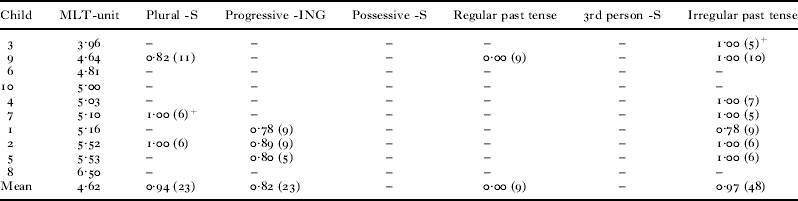
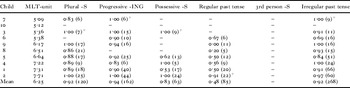
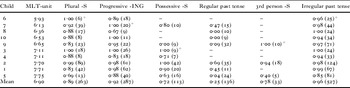
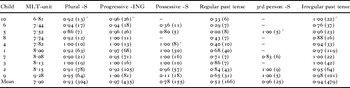
Obligatory contexts for each of the inflectional suffixes were identified. The linguistic context was considered obligatory if it was one in which a particular suffix was grammatically required in the T-unit that the child was using. If it was not clear from the context whether the inclusion of a particular suffix was obligatory, the suffix was excluded from analysis. To obtain the proportion of correct usage within obligatory contexts, the number of correct spellings of each suffix was divided by the number of obligatory contexts for the suffix (across all coded spellings). Proportion scores were only calculated for children when their journal provided at least five obligatory contexts for the inflectional suffix in question within one time period. A total of 55 obligatory contexts for the relevant inflection suffixes were included in the journals in Time 1, increasing to 430 contexts in Time 2, and further increasing to 832 in the first half of grade 1 (Time 3) and 1,085 in the second half of grade 1 (Time 4). These totals are shown in the bottom rows of Tables 1 to 4, divided according to the inflectional suffixes analyzed. It should be noted that the number of irregular past tense verbs in obligatory contexts are not included in the above totals. This is because, unlike all other inflectional suffixes, the changes in tense for irregular verbs often did not occur at the end of words (e.g. find and found change in the middle and not at the end).
MLT-unit lengths and proportion correct scores for each child for each of the morphemes studied in Time 1 (number of obligatory contexts used to calculate proportion scores in parentheses)
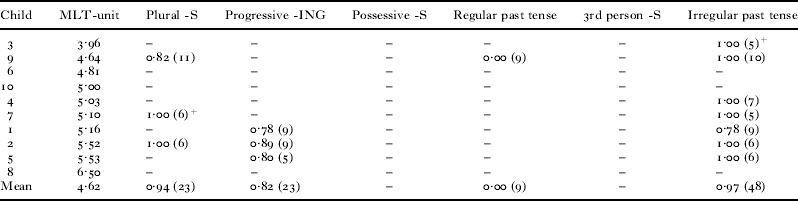
key: (#)=number of obligatory contexts used to calculate proportion scores.
Missing values=suffix used in less than five obligatory contexts.
+ =Child with lowest MLT-unit to use suffix correctly at 0·90 criterion.
MLT-unit lengths and proportion correct scores for each child for morphemes studied in Time 2 (number of obligatory contexts used to calculate proportion scores in parentheses)

key: (#)=number of obligatory contexts used to calculate proportion scores.
Missing values=suffix used in less than five obligatory contexts.
+ =Child with lowest MLT-unit to use suffix correctly at 0·90 criterion.
MLT-unit lengths and proportion correct scores for each child for morphemes studied in Time 3 (number of obligatory contexts used to calculate proportion scores in parentheses)

key: (#)=number of obligatory contexts used to calculate r proportion scores.
Missing values=suffix used in less than five obligatory contexts.
+ =Child with lowest MLT-unit to use suffix correctly at 0·90 criterion.
MLT-unit lengths and proportion correct scores for each child for morphemes studied in Time 4 (number of obligatory contexts used to calculate proportion scores in parentheses)

key: (#)=number of obligatory contexts used to calculate proportion scores.
Missing values=suffix used in less than five obligatory contexts.
+ =Child with lowest MLT-unit to use suffix correctly at 0·90 criterion.
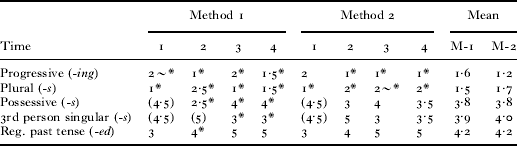
Two methods (Method 1 and 2) were used to determine the order of acquisition for accurate spellings of the inflectional suffixes, corresponding to Method I and Method II from de Villiers & de Villiers (Reference de Villiers and de Villiers1973). In Method 1, the children were ranked, in each of the four time periods individually, according to their MLT-unit length at the point of mastery. The first inflectional suffix with a proportion of 0·90 correct spellings in obligatory contexts for the child with the shortest MLT-unit was ranked first for each time period. An overall ranking for each inflectional suffix was calculated by taking the mean of the rankings for each inflectional suffix from Times 1 through 4. The mean rankings were then ordered from least to greatest to yield the overall order of acquisition for Method 1. In Method 2, we calculated the average proportion of correct spellings for each inflectional suffix across the entire sample of children within each time period. We then calculated the average rankings across the four time periods for each inflectional suffix.
RESULTS
Participant MLT-units and proportions of correct spellings for each inflectional suffix, as well as the accuracy for each inflectional suffix within the group, are presented in Tables 1, 2, 3 and 4 for Times 1 through 4 respectively. In the tables, the proportion of correct spellings for each relevant suffix is reported for each child individually, with children rank-ordered within each table from the shortest to the longest MLT-unit within each time period. Each child was assigned a unique participant number from 1 to 10, enabling the comparison of individual children's results across different time periods, despite the fact that the rank order of children's MLT-units did not remain consistent across time. Throughout the study, children used more irregular past tense verbs, plural suffixes and present progressive suffixes, compared with regular past tense, possessive and third person suffixes. No children attempted to spell possessive suffixes during Time 1 and no third person suffixes were used during Time 1 or Time 2. Children also used the regular past tense suffix more often than either the possessive or third person suffixes at all points during the study.
Order of acquisition
In the calculations for Method 1, the plural suffix reached the mastery criterion for a child with an MLT-unit of 5·10 during Time 1 (see Table 1). Three more suffixes were mastered in Time 2. These were the present progressive, possessive and regular past tense, in individuals with MLT-units of 5·09, 5·36 and 7·71, respectively (see Table 2). In Time 3, the last suffix, third person singular -s, reached 0·90 correct spelling in an MLT-unit of 6·65 (see Table 3). For rankings of inflectional suffixes first reaching criterion for any individual, and for averaged rankings across time periods, the following overall order of acquisition emerges: plural, present progressive, possessive, third person singular and regular past tense (see Table 5).
Rankings for each inflectional suffix using Method 1 and Method 2 for Time periods 1–4, and mean rankings
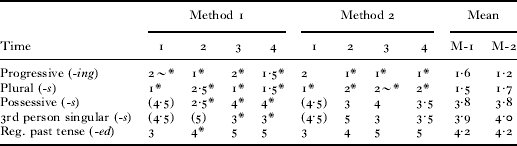
key: * indicates mastery i.e. ⩾0·90 correct in obligatory contexts.
~* indicates close mastery i.e. 0·89 correct in obligatory contexts.
(#)=rank assigned to suffixes with no data for a given time period.
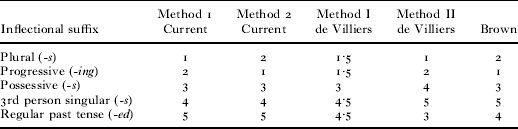
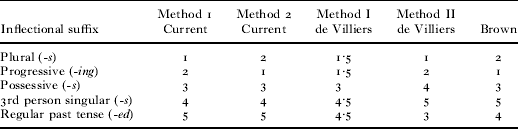
The order of acquisition of the selected inflectional suffixes determined using the Method 2 is presented for each time period in Table 5. In the first time period, only three of the five selected inflections were included in the journals. By Time 2, all selected inflectional suffixes, except the third person singular, were used by at least some of the children, and in Times 3 and 4 all selected suffixes were present in at least some journals. Averaging the rankings for each time period yielded an overall order of acquisition for Method 2 (see Table 5): progressive, plural, possessive, third person singular and regular past tense. Table 6 reports the orders of acquisition of the selected inflectional suffixes determined by Method 1 and 2 and compares these to the rank orders obtained by Brown (Reference Brown1973) and de Villiers & de Villiers (Reference de Villiers and de Villiers1973).
Order of acquisition for inflectional suffixes using Method 1 and Method 2 from the current study, and order of acquisition from Brown (Reference Brown1973) and de Villiers & de Villiers (Reference de Villiers and de Villiers1973)
Regular and irregular past tense spellings
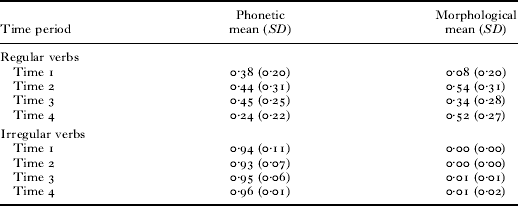
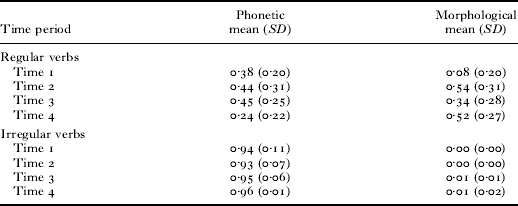
Table 7 includes the mean proportions of phonetic and -ed spellings for regular and irregular past tense verbs in obligatory contexts. Children used the -ed spelling almost exclusively with regular past tense verbs and, conversely, used phonetic spellings for the irregular past tense verbs during all of the time periods of the study. These spelling strategies created ceiling and floor effects that prevented the use of statistical analysis for comparisons across conditions (Russo, Reference Russo2003). Nevertheless, this pattern did reveal clear differences in the spelling strategies for regular and irregular past tense verbs.
Proportion of phonetic (i.e. -t, -d, etc.) and morphological (i.e. -ed) spelling strategies in children's attempts to spell regular and irregular past tense verbs
DISCUSSION
We examined the order in which young writers spelled inflectional suffixes correctly in obligatory contexts (as in de Villiers & de Villiers, Reference de Villiers and de Villiers1973) to compare their order of acquisition with earlier developmental work on oral language. We uncovered remarkable similarities between oral and written language acquisition, as well as some differences.
The pattern of results supported the hypothesis of an association between the accurate production of oral and written inflectional suffixes. On average, children mastered the spelling of the plural and present progressive suffixes at earlier time periods than the possessive, regular past tense and third person suffixes, which emerge later in oral language (see Table 6). The plural and progressive inflectional suffixes were also mastered by children with shorter MLT-units, compared with the later-acquired possessive, regular past tense and third person suffixes. This apparent order of acquisition in children's written inflectional suffixes is similar to the order of acquisition in oral language, in which the plural and progressive inflectional suffixes are the earliest acquired suffixes (Brown, Reference Brown1973; de Villiers & de Villiers, Reference de Villiers and de Villiers1973).
Particularly compelling evidence for a connection between order of acquisition in oral language and in written language comes from comparing children's mastery of the plural, possessive and third person suffixes. Accurate spelling of all three of these inflectional suffixes involves translating the same sounds to the same letters (i.e. /s/ and /z/ into the letter -s spelling). Therefore, beginning spellers should have no more trouble with one of these suffixes compared to another if they are using phonetic spelling strategies alone. However, spelling mastery of these three suffixes mirrored development in oral language, with plural suffixes being mastered before possessive and third person. This pattern of results supports the idea that beginners' knowledge of morphology in oral language plays a role in their spelling of the same morphemes.
One notable difference between the order of acquisition in previous oral language research and the current study occurred for the order of acquisition of the regular past tense suffix relative to the third person suffix. Beginning spellers had the most trouble spelling the regular past tense suffix correctly in obligatory contexts across all four time-points (see Table 6). Young writers' difficulty in spelling the regular past tense suffix is consistent with previous naturalistic (Treiman, Reference Treiman1993) and experimental spelling research (Beers & Beers, Reference Beers, Beers, Templeton and Bear1992; Nunes et al., Reference Nunes, Bryant and Bindman1997a).
A possible explanation for the late mastery of past tense spelling could come from the fact that the regular past tense presents a special challenge in English. Its correct spelling usually requires a morphological spelling that is not phonetic. In most cases, using -t or -d to spell the final consonant sound /t/ or /d/ is correct for irregular verbs and non-verbs, but this phonetic spelling strategy does not lead to a correct spelling of the regular past tense suffix -ed. This same challenge is not encountered for suffixes spelled with -s, because the /s/ and /z/ sounds are often spelled as -s in English, regardless of their morphological status (see e.g. Kemp & Bryant, Reference Kemp and Bryant2003). Children may need to acquire a better understanding of morphology's role in spelling to inhibit the use of a phonetic spelling strategy and thus to spell regular past tense verbs correctly. The particular challenge of the regular past tense spelling in English suggests that we exercise caution when drawing conclusions about written lexical representations based on oral language research.
Alternatively, the later acquisition of past -ed in spelling relative to spoken language may partly be due to differences in data collection between written and oral language. In our study, children were usually writing about past events and therefore may have had little opportunity to use third person singular forms. Certainly, the children used the third person singular forms relatively infrequently in this spelling study. This is not the case in oral language data collection, in which children have more opportunity to talk about past, present and future events. Further research could examine potential differences in frequency of usage of inflectional suffixes based on different methods of data collection.
We conducted an additional comparison between children's spelling of regular and irregular past tense verb endings to better understand spelling of past tense verbs (following on from Carlisle, Reference Carlisle1996; Nunes et al., Reference Nunes, Bryant and Bindman1997a; Treiman, Reference Treiman1993). Our comparison showed that these beginning spellers had some appreciation for the use of -ed as the specific marker for the regular past tense. Notably, children in this study almost never used -ed to spell the endings of irregular verbs (0 to 1%). They did use this letter combination correctly to spell between 8% and 54% of the regular verbs that they wrote, depending on the time period of the study. These findings confirm that beginning spellers are sensitive to the morphological role of -ed in marking regular past tense. The results also extend the study of regular past tense spelling to younger children than previously examined in naturalistic or experimental studies (e.g. Treiman, Reference Treiman1993).
The results of our investigation contrast directly with theories of spelling development that propose an exclusive reliance on phonetic spelling strategies in beginning spellers (Beers & Henderson, Reference Beers and Henderson1977; Nunes et al., Reference Nunes, Bryant and Bindman1997a; Reference Nunes, Bryant and Bindman1997b). According to these theories, children acquire an appreciation of morphology's role in spelling only after going through earlier stages of spelling dominated by the phonological principle. Our comparison of the irregular and regular past tense suffixes showed that beginners are able to discern that the -ed spelling plays a morphological role by confining its use almost exclusively to the regular past tense. This finding supports the theory that young writers draw on multiple sources for writing and spelling strategies, even in their earliest writings (Treiman & Bourassa, Reference Treiman and Bourassa2000). Recent theoretical reviews have brought the ideas of statistical learning to spelling development (e.g. Pacton & Deacon, Reference Pacton and Deacon2008; Pollo et al., Reference Pollo, Treiman, Kessler, Grigorenko and Naples2007), drawing, for example, on data demonstrating the impacts of frequency of specific letter patterns (e.g. Kemp & Bryant, Reference Kemp and Bryant2003). These theoretical approaches would suggest that children develop spelling strategies based on how often they encounter particular spelling patterns in reading and writing. The present study could be interpreted to suggest that oral, as well as written, language frequency might be important factors in strengthening children's associations between sounds, meanings and letters. That said, it is remarkably difficult to quantify exposure, and even standard print exposure measures (e.g. Cunningham & Stanovich, Reference Cunningham and Stanovich1990) cannot specify exposure to specific linguistic forms.
Studies that investigate the impacts of general and specific exposure in both the oral and print domains would be useful, whether these involve experimental manipulations or naturalistic observations. Quantifying the type and nature of oral and written language exposure would help to clarify the theoretical interpretations of our findings. For example, it is possible that suffixes that are mastered earlier in spoken English are easier for children to spell because these inflections have been used correctly in oral language for a longer period of time. It is also possible that they have been employed with a larger number of root forms, thereby consolidating sensitivity to their form. Such additional use of specific inflectional suffixes in oral language might enable children to establish stronger or more stable lexical representations for these inflections (following on from Munakata, Reference Munakata2001). A stronger lexical representation would be particularly helpful to beginning spellers because they have not yet mastered the many separate challenges of writing. Such explanations need to be contrasted with the more pure statistical approaches.
It would also be useful to extend the time period into the early preschool years to examine the age of acquisition of each inflectional form and its use in different contexts. The inclusion of both experimental and naturalistic methods within the same study would permit the combination of the tight controls of the former with the more ecologically valid approach of the latter. Any such work would benefit from larger samples to clarify the influences on correct spelling acquisition for individual suffixes in more diverse samples.
In conclusion, the present investigation provides evidence that children's ability to spell individual inflectional suffixes develops in a similar order to that in oral language. The adaptation of methods from oral language provided us with keen insight into very young writers' spelling of inflectional suffixes. Our findings suggest that oral language may set the stage for early progress in spelling, and that children use morphological strategies in their earliest writing attempts.