


Introduction
The rule of law is measured in many ways: through surveys of expert opinions and public perceptions, institutional proxies, and assessment of political, legislative, and judicial events bearing on the rule of law.Footnote 1 This essay argues that systematic interviewing of judges and other legal elites belongs in the empirical toolkit of rule of law scholarship.
The methodological literature in political science has solidified best practices for interviewing and has demonstrated that interviews can be a rigorous method for eliciting information when designed with care around selection, design, and reporting.Footnote 2 Interviews also draw on comparative advantages that legal scholars possess, including access, shared professional vocabulary about substance and procedure, and the capacity to read silence.Footnote 3 Interviews offer empirical access to the inside view of the actors whose decisions other measurement approaches capture only at a distance. We share these insights and apply them to rule of law measurement. To motivate these claims with empirical evidence, and illustrate best practices, we draw on twenty-four on-the-record interviews conducted in 2024 with sitting members of the Court of Justice of the European Union (CJEU).Footnote 4
The Skeptics
Judicial interviewing is viewed with skepticism from opposite ends of the epistemological spectrum. From the positivist side, Lee Epstein warns that “elites are often sources of tremendous bias” who may “have a narrow view of the events in question … have inaccurate information … or intentionally lie to protect themselves or others.”Footnote 5 From the interpretivist side, Jens Meierhenrich argues that truly grasping international law requires entering deeply into the webs of significance that practitioners spin—a task he reserves for long-term participant observation.Footnote 6
Both critiques capture something real. Judges operate within tightly scripted professional cultures. They speak about the délibéré only obliquely—as Judge Lucia Rossi put it, “We speak by judgments.”Footnote 7 And they have strong professional incentives to mute controversy. Participant observation would be welcome, but no international court we know of allows academics to shadow its deliberations.Footnote 8 Yet neither critique defeats interviewing. The interpretivist objection softens, under conditions of limited field access, where practice theorists themselves concede that “interviews centered on descriptions of activities” become the appropriate second-best.Footnote 9 The positivist objection turns into a specification problem: interviews can be designed so that responses are comparable across respondents, triangulated against other evidence, and reported transparently. Judges speak from professional scripts, and that is what makes those scripts informative. What is scripted, what is emphasized, and what is avoided all become data.
Selection, Design, Reporting
Interview-based research stands or falls on three moves: selection, design, and reporting.
Selection. The first question is whether interviewees are informants about an event or are themselves the object of study. Where the unit of analysis is an episode—a norm contest, a reform, a backlash—purposive sampling across roles (judges, registrars, litigants, officials) predominates. Where the unit of analysis is the judges themselves, representativeness matters, approximated through stratified purposive sampling by court, region, legal tradition, and gender. Jeffrey Dunoff and Mark Pollack’s dissent study interviewed eight sitting judges at each of two courts, varied deliberately across East/West, civil/common law, and gender lines.Footnote 10 Non-response is the perennial threat. Erik Bleich and Robert Pekkanen urge researchers to report the number of interviews sought, obtained, and declined, because who declines matters substantively.Footnote 11 In our experience, former academics accept more readily than career practitioners, potentially skewing samples toward one jurisprudential sensibility. Snowball sampling mitigates access problems but risks an echo chamber; multiple diverse “seeds” are the standard remedy, and for a contested concept like the rule of law, seed diversity is not optional. That said, legal academics often have unique access to relevant practitioner communities, which can minimize the non-response problem.Footnote 12 Acceptance itself is nevertheless a noisy signal: a judge’s willingness to be interviewed can reflect genuine independence or, equally, institutional openness cultivated to project the appearance of it, and the same ambiguity attaches to expressions of criticism on the record.
Design. Structured interviews yield easily coded data but foreclose challenge to the question; unstructured interviews privilege the respondent’s worldview but frustrate cross-case comparison. The methodological literature converges on a semi-structured design as the Goldilocks solution: open with “grand tour” questions, then follow with targeted probes.Footnote 13 The Borderlines interviews are organized in three parts—career and background; important cases; major challenges going forward—so the same thematic skeleton underlies every conversation while no two trace the same path. Saturation, as Bleich and Pekkanen describe it,Footnote 14 is the right stopping rule: the point at which further interviews reveal no new information and recommendations for new respondents mirror those already interviewed.
Reporting. Full transparency—posting transcripts—solves the reporting problem in principle, and it is the model for the Borderlines series, where every interview is released with only minimal editing. But most interviewing runs on confidentiality, and a modest device does much of the work: turn responses into “data-set observations” and report simple descriptive statistics (“six of eight judges spontaneously identified liberal-democratic values as central”). Tommaso Pavone’s 353 interviews, catalogued in appendices and cited by role, model this at scale; Karen Alter and Laurence Helfer’s Andean monograph does the same.Footnote 15 The move is to show the reader the shape of the corpus, not merely its most quotable fragments—the same discipline that credible index-builders document in their codebooks. Reporting in this way also disciplines what interviews can and cannot claim to measure. Interviewing judges yields a particular kind of expert opinion, with all the position-specific bias that entails. Descriptive statistics and triangulation against judgments and other outside sources keep that bias visible rather than hidden.
Evidence from the CJEU
We turn next to patterns from the Borderlines corpus that illustrate what systematic judicial interviewing adds to rule of law measurement.
The rule of law is what judges converge on, unprompted. When we asked judges which issues they considered most central to the Court’s present work, they turned repeatedly—unprompted—to liberal democracy, fundamental rights, and rule of law, rather than the Court’s bread-and-butter internal-market jurisprudence. Advocate General Jean Richard de la Tour said plainly: “Nowadays, our case law is mostly about the protection of fundamental rights.”Footnote 16 Judge Rossi traced the arc historically: “liberties, freedoms, fundamental rights, and now, in the last years, values. Fundamental values; identity; rule of law.”Footnote 17 Advocate General Juliane Kokott described the shift as a “transformation to a constitutional Court” that “now focuses on values—EU’s identity, the rule of law, fundamental rights.”Footnote 18 A structured protocol would have missed this convergence because we would not have known to ask; a pure ethnography would have missed it because we could not have coded its frequency across twenty-four interviews.
Engagement with rule of law questions was extensive, but not uniform. Judge Siniša Rodin insisted that Article 2 of the Treaty on European Union,Footnote 19 which establishes the core foundational values of the Union, is “normative” rather than descriptive and that Treaty values “clearly opt for liberal constitutionalism.” He estimated that “90%, if not more, of our so-called ‘rule of law litigation’ concerns judicial independence,” while explaining that the concept is “more than that”Footnote 20 —a calibration no index captures, and a reminder that judicial independence is one facet of the rule of law rather than the whole. Judge Constantinos Lycourgos discussed the Lin case’s handling of nulla poena sine lege Footnote 21 and noted that the Court’s judicial-independence case law is “unlikely to not be necessary in the near future.”Footnote 22 Advocate General Tamara Ćapeta reflected on the moment when, after taking it for granted, the Court was “put in front of explaining” the rule of law to the public, and thereby to itself, suddenly facing a line of cases about the rule of law.Footnote 23 By contrast, Vice President Thomas von Danwitz answered rule of law questions through the register of balancing and dual standards—emphasizing the Court’s duty to avoid “imposing a certain system” of judicial organization on European Union member states.Footnote 24 Vice President Lars Bay Larsen, asked to characterize the arc of the Polish judges’ jurisprudence, declined gently: “I’m not sure I want to characterize them.”Footnote 25 The distribution of comfort and discomfort across the bench is itself an empirical finding about how a court understands its rule of law role—one that quantitative coding of judgments would register not at all.
Rule of law was one of two topics many judges volunteered unprompted; the second was LGBTI+ rights. President Koen Lenaerts volunteered an extensive discussion of LGBTI+ rights in response to the final open-ended Borderlines interview question: “We have our Obergefell case,” he emphasized. Advocate General Kokott, flagging a pending Hungarian schools case, observed that “on the occasion of this case, the Court will probably also decide on the question how far values are justiciable.”Footnote 26 Advocate General Richard de la Tour likewise volunteered, as the most significant of his opinions, the Mirin case on the cross-border recognition of a transgender citizen’s gender identity, framing the issue as one of free movement and respect for private life under the Charter of Fundamental Rights of the EU.Footnote 27 Kokott’s prediction was vindicated on April 21, 2026, when the Court ruled against Hungary on the schools law and grounded its judgment directly on Article 2 of the Treaty on European Union as a standalone basis.Footnote 28 The interview thus captured something no judgment-based or vote-based method could: a prediction, made on the record before the hearing, that subsequent jurisprudence has now confirmed.
Whereas CJEU judges discussed rule of law and LGBTI+ unprompted, often extensively, there were questions on which they declined to speak extensively or in detail, even when prompted. For example, when asked about the Court reversing itself in its jurisprudence, several judges quickly moved to the next question.
Implications and Conclusion
Interviews reach the understandings and self-presentations of the actors whose behavior influences the rule of law—what judges converge on unprompted, where their engagement is intense and where it is evasive, how they narrate doctrinal change, even what they predict about the Court’s future jurisprudence. The Borderlines corpus produced findings of each of these kinds, several of which have already been borne out. Interviews can thus serve as leading indicators of doctrinal change relevant to the rule of law.
These findings carry downstream consequences. Investment tribunals, asylum adjudicators, and development banks routinely make second-order judgments about whether a state’s judiciary can protect a foreign investor or a returning refugee. Those judgments depend on how the judges themselves understand their role and their constraints—precisely what interviews are positioned to surface, and what doctrinal coding and aggregate measurement leave out.
Properly designed and reported, judicial interviews can show, with evidence and with discipline, how the people charged with defending the rule of law understand what they are defending, and how. That is the distinctive contribution interviews make, and the reason they belong in the empirical study of the rule of law.
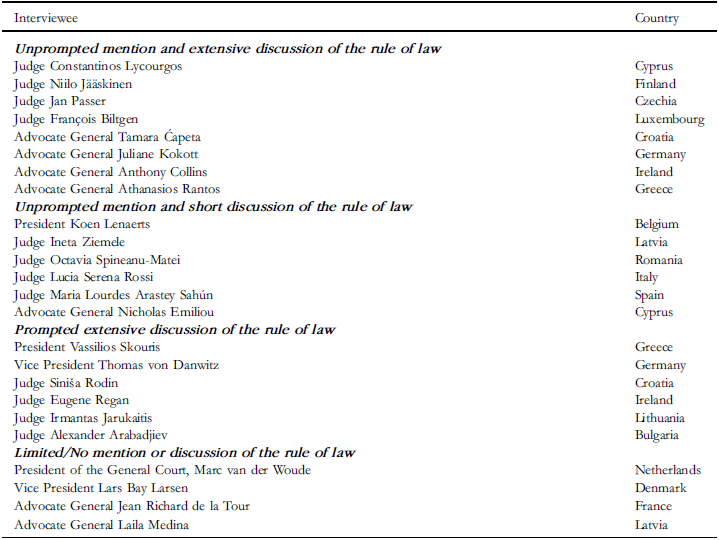
The Rule of Law in the Borderlines CJEU series

Table 1 Long description
The table categorizes interviewees by their country and the extent of their discussion on the rule of law. It has two columns, Interviewee and Country, with rows grouped under four discussion categories. The four groups are: Unprompted mention and extensive discussion of the rule of law (8 interviewees), Unprompted mention and short discussion of the rule of law (6), Prompted extensive discussion of the rule of law (6), and Limited/No mention or discussion of the rule of law (4). The table lists 24 interviewees with their respective countries and discussion categories.
Coding notes: unprompted = interviewee mentions the phrase “rule of law” first without interviewers mentioning/asking about it, otherwise prompted ; mention = interviewee mentions the phrase “rule of law” only in passing, does not go into discussion of the concept or Court’s relevant jurisprudence; extensive discussion = interviewee mentions the phrase “rule of law” and engages in discussion of the concept and/or the Court’s related jurisprudence. Beyond the 20/24 mentions and discussion of the rule of law, fourteen of twenty-four interviewees mention the independence of the judiciary in some form, ten refer to Article 2 values, six mention “human rights” or “fundamental rights,” and three “equality before the law.” Mentions of the rule of law and/or judicial independence combined cover twenty-two of twenty-four interviews, which illustrates that additionally accounting for or combining several elements of the rule of law can inflate numbers and decrease the information-value of observations.

 Open access

