

“Ever’ year,” said Joad. “Ever’ year I can remember, we had a good crop comin’, an’ it never come. Grampa says she was good the first five plowin’s, while the wild grass was still in her.”
John Steinbeck, The Grapes of Wrath, 1939
According to Portuguese agricultural records, the 1950s represented a period of acute soil degradation throughout the country, with especially disastrous effects in the south. This article subjects that well-established story to a retrospective analysis, reaching back to the last quarter of the nineteenth century in search of an historical explanation, one that would correspond to both the agricultural statistics and the discourses of the time; as well as to our current understandings of soil dynamics. How did the unrelenting expansion of agriculture between 1873 and 1960 relate to the evolution of soil fertility?
Several recent articles on the Portuguese landscape presume that the “Campanha do Trigo” (Wheat Campaign), launched in 1929 and lasting until the 1960s, caused the drastic degradation of agricultural soils in the southern half of the country. One article analyzes the reduction of open evergreen oak woodlands in the south during the twentieth century, attributing soil degradation to a “long history” of deforestation and erosion associated with the Campanha do Trigo and with previous episodes of wheat protectionism in the late nineteenth century (Costa et al. Reference Costa, Madeira, Lima Santos and Oliveira2011). Another one says that “the Campanha is often referred to as having been the most severe period of soil degradation…. And, in fact, it may well have been” (Ferreira Reference Ferreira2001: 187). It is a credible argument and one widely shared beyond academia, yet it has not been subjected to a thorough examination. The notable exception is the study on the hilly common land of Mértola (Santos and Roxo Reference Santos and Roxo2013).
The Campanha do Trigo was a broad national policy of the fascist Estado Novo (New State) regime, inspired by the “battaglia del grano” of Italian fascism and its warmongering (“the wheat of our land is the border that best defends us” was the Portuguese motto). Estado Novo policies created economic incentives, infrastructures, and propaganda aimed at expanding wheat cultivation and national self-sufficiency. In fact, Portuguese wheat protectionism began thirty years earlier, with the Elvino de Brito law of 1899, which established a higher price for domestic wheat and ensured its preferential consumption. The later Campanha do Trigo reproduced previous mechanisms of price and market controls, but added a set of financial and infrastructural crop supports, such as subsidies for land clearing and the purchase of fertilizers. The program also promoted the installation of large silos for storing wheat (see Baptista Reference Baptista1993; Reis Reference Reis1979; Santos and Roxo Reference Santos and Roxo2013).
As archival sources demonstrate, even basic definitions of key landscapes, like “charneca” (an encompassing term for uncultivated land, grassland, and shrubland, similar to heathland), or indeed “soil,” contain their own histories, which are intrinsically related to the history of land exhaustion. What happened in the 1950s may have had less to do with biophysical changes to the soil, and more to do with evolving perceptions of soil. Portuguese agronomists created the field of pedology in the 1930s, and the state, after 1938, promoted “soil conservation” as a key motivation behind the compulsory afforestation of “baldios” (wasteland commons). The combined history of soil and agriculture is also a history of the cognitive and ideological frameworks of agronomy.
Soil and Agriculture: An Environmental, Historical, and Epistemological Problem
Five months after the fall of the fascist regime in the April 25th Revolution of 1974, Villaverde Cabral published a book on the agrarian history of Portugal. Written in exile, it was an unprecedented attempt to provide a detailed timeline from the early 1800s until 1970. It was also the first perspective, at least within Portuguese historiography, to correlate transformations in the rural “social fabric” with the “development of capitalist relations of production” and “the progressive marginalisation of pre-capitalist sectors” (Cabral Reference Cabral1974: 12, 21, 24). Cabral presents the economy as “a mystifying category, designed to make us forget other categories such as the social and the political for starters” (emphasis added) (ibid.: 24). At two points, well into the text, the author summarizes his theoretical approach as shifting historical analysis to the “very soil of society,” in which specific, conflicting situations reside, themselves the result of “a vast variety of pressures” in constant evolution (ibid.: 24, 70, 81). The soil appears to be an apt metaphor for “social fabric,” emphasizing the basic and reciprocal characteristic of this category in relation to the economic situation, political-institutional solutions, and culture. However, this metaphor of the soil also suggests, paradoxically, its exclusion from “Portuguese society.” This innovative conception of historical agency, in which there is a nod both to the historian Pierre Vilar, and to the theoretical concepts of Italian workerism (cf. Neves Reference Neves2011), excluded specific agricultural processes, in which soil dynamics gain prominence.
Cabral came to agrarian history understanding that to study industrial production in the nineteenth century it was necessary to study agriculture, the dominant social and economic system at that time. “We cannot hope to understand globally the nexus of Portuguese history, without paying great attention to the agricultural question” (Cabral Reference Cabral1974: 26). This article takes one step further backward.
This line of argument did not pass unnoticed by Portugal’s economic historians. At the beginning of the 1980s, Jaime Reis suggested that in the Alentejo region (Southern Portugal) agriculture exhibited particular characteristics from the end of the nineteenth century, “of which Portuguese historians have been less fond.” These themes merited further attention, such as “the ecology and allocation of natural resources” (Reis Reference Reis1982: 17–18). Two years later, he published a well-known paper on the economic backwardness of Portugal, 1860–1913, in which he concluded that the “lack of agricultural progress during this period might have been mostly related to the soil and climatic conditions that prevented Portuguese farmers from participating in the ‘nitrogen revolution’” (Reis Reference Reis1984: 11). It is a lone reference to the cultivation of fallows in cereal crop rotations using nitrogen-fixing legumes, a modification that was already widespread in Northern and Central Europe but had little implementation in Portugal (Carmo et al. Reference Carmo, García-Ruiz, Ferreira and Domingos2017; Mazoyer and Roudart Reference Mazoyer and Laurence2006). Within the field of rural economics, meanwhile, Baptista advocated in 1979 that the “exhaustion” of the soil in the south had been a contributing factor, among others, to the great rural exodus of the 1960s (Baptista Reference Baptista1980: 367).
In the mid-twentieth century, there were already efforts to historicize the soil. The agronomist Amílcar Cabral, who later led the independence movement in Guinea Bissau and Cape Verde, worked on soil conservation in Portugal in the early 1950s. He conceived of the soil as a genesis guided by “natural laws,” cultivation practices, and the socioeconomic structure of farms. But it was also something that conditioned the development of science: “soil is ‘something that moves,’ meaning that it is constantly transforming. This implies the transformation of pedology itself” (Cabral Reference Cabral1988 [1951]: 88, 125). For Cabral, the soil is a participant in social processes, as is evident in the dedication of his undergraduate thesis to the landless day laborers, “peasants of the latifúndios, who live in uncertainty and under the threat of erosion” (ibid.: 83). A decade earlier, in a text on the “complexity of rural life,” the geographer Orlando Ribeiro discussed the importance of soil and climate in the creation of different types of settlements, concluding that “they are not in fact determining causes, but rather relations,” which should be brought together alongside others. “The proper way consists of gathering facts and bundling them together according to their apparent affinities: thus, they shall allow themselves to be explained” (Ribeiro Reference Ribeiro2014 [1941]: 426–27).
This literature review of Portuguese history, agriculture, and soil science demonstrates how disciplinary frontiers can make it difficult to develop a history of soil. Other, methodological challenges present however the main difficulties of this study. The soil does not speak of its past, left no written records, and in Portugal there are no long-term historical series of soil indicators, such as soil nutrient content or organic matter. Reconstructing the evolution of Portuguese agricultural soils is difficult and required caution. In 1963, an agronomist wrote: “I regret not having the elements which would allow me to measure the depths of degradation that the Alentejo soil has already reached—and I do not know if they even exist” (Sampaio Reference Sampaio1965). By focusing on the cultivation system and how it worked ecologically and agriculturally—that is, on the modes of production (Worster Reference Worster1990)—it is possible to establish a framework of analysis that promotes a historical understanding, literally from below. The observation of the cultivation system shifts historical analysis to the “very soil of society.”
The crisis that has shaken today’s understandings of society and nature, or the distinction between their histories is inseparable from contemporary environmental crises. The development of these two overlapping crises, the epistemological and the environmental, poses additional challenges for historiographical practice and for those hoping to gain a historical understanding of the present. As Dipesh Chakrabarty (Reference Chakrabarty2009: 199) observes: “all my readings in theories of globalization, Marxist analysis of capital, subaltern studies, and postcolonial criticism over the last twenty-five years, while enormously useful in studying globalization, had not really prepared me for making sense of this planetary conjuncture within which humanity finds itself today.” We find similar developments at the beginnings of environmental history. In the bibliography of William Beinart, for example, a political history of race relations in South Africa was gradually deepened by the study of agriculture and rural politics, “in which natural forces are more than just a backdrop to human history” (Beinart Reference Beinart2003: XV, Reference Beinart2021).
Map of Portugal.

Final image of the documentary film Gone with the Water: The National Issue of Erosion.
Source: Still image from the digital version of the film stored in ANIM (Arquivo Nacional da Imagem em Movimento, Cinemateca Portuguesa).

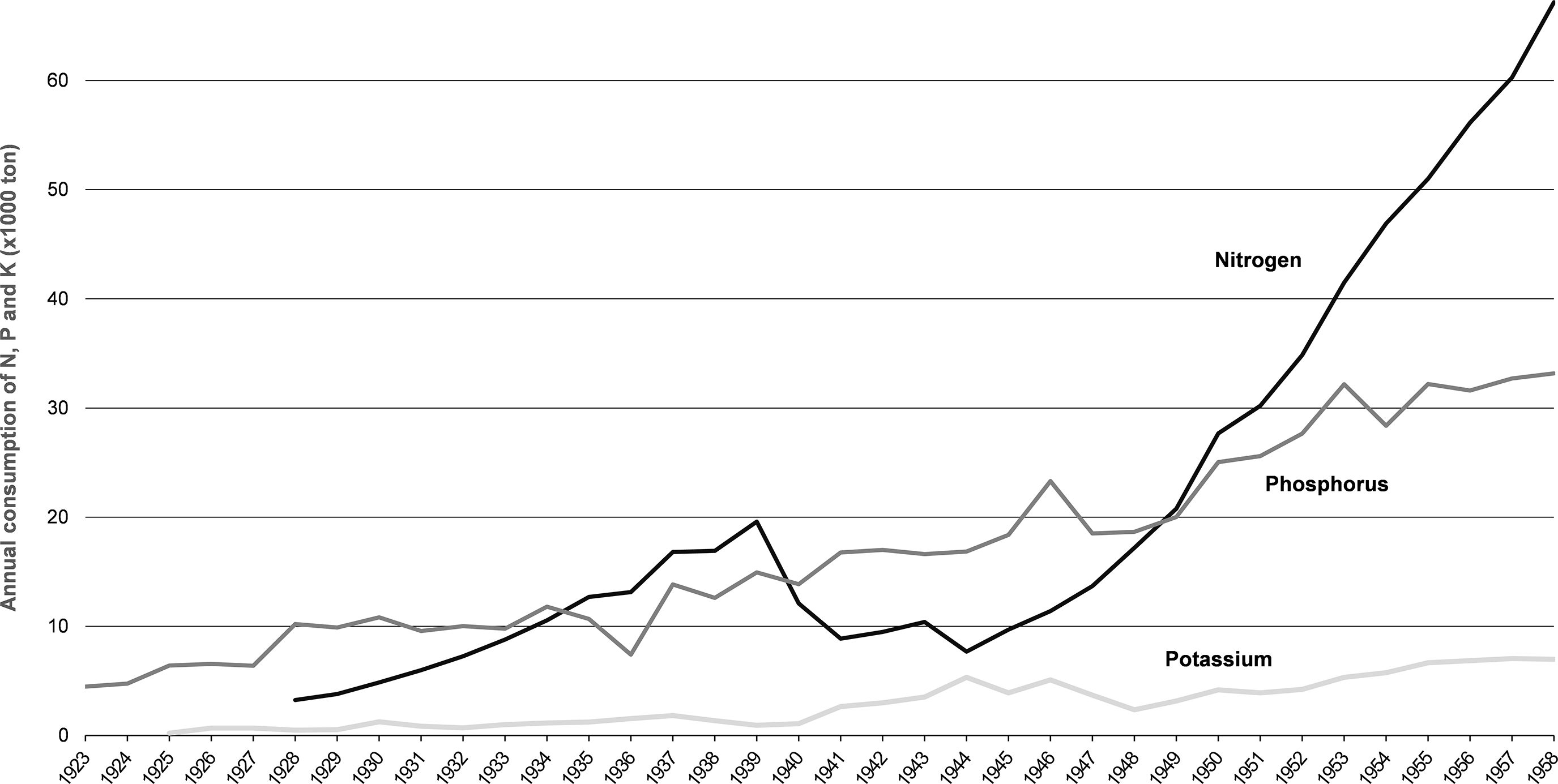
Evolution of the annual consumption of mineral fertilizers in mainland Portugal in the elemental forms of nitrogen (N), phosphorus (P), and potassium (P) between 1923 and 1958.
Sources: 1923–36: (Graça Reference Graça1939) It compiles the domestic production and imports of phosphate fertilizers that we assumed to be equivalent to 12 percent calcium superphosphate before converting to the elemental quantities of P. The imports of K and N are presented and there is no domestic production. 1928–29: (Almeida Reference Almeida1960; Graça Reference Graça1954) These two years allowed the overlapping of different sources and validation of data. 1937–57: (CRPQF 1958: 155, 352) It presents the annual consumption of fertilizers in the forms N, K2O, and P2O5. 1958: (Almeida Reference Almeida1960).
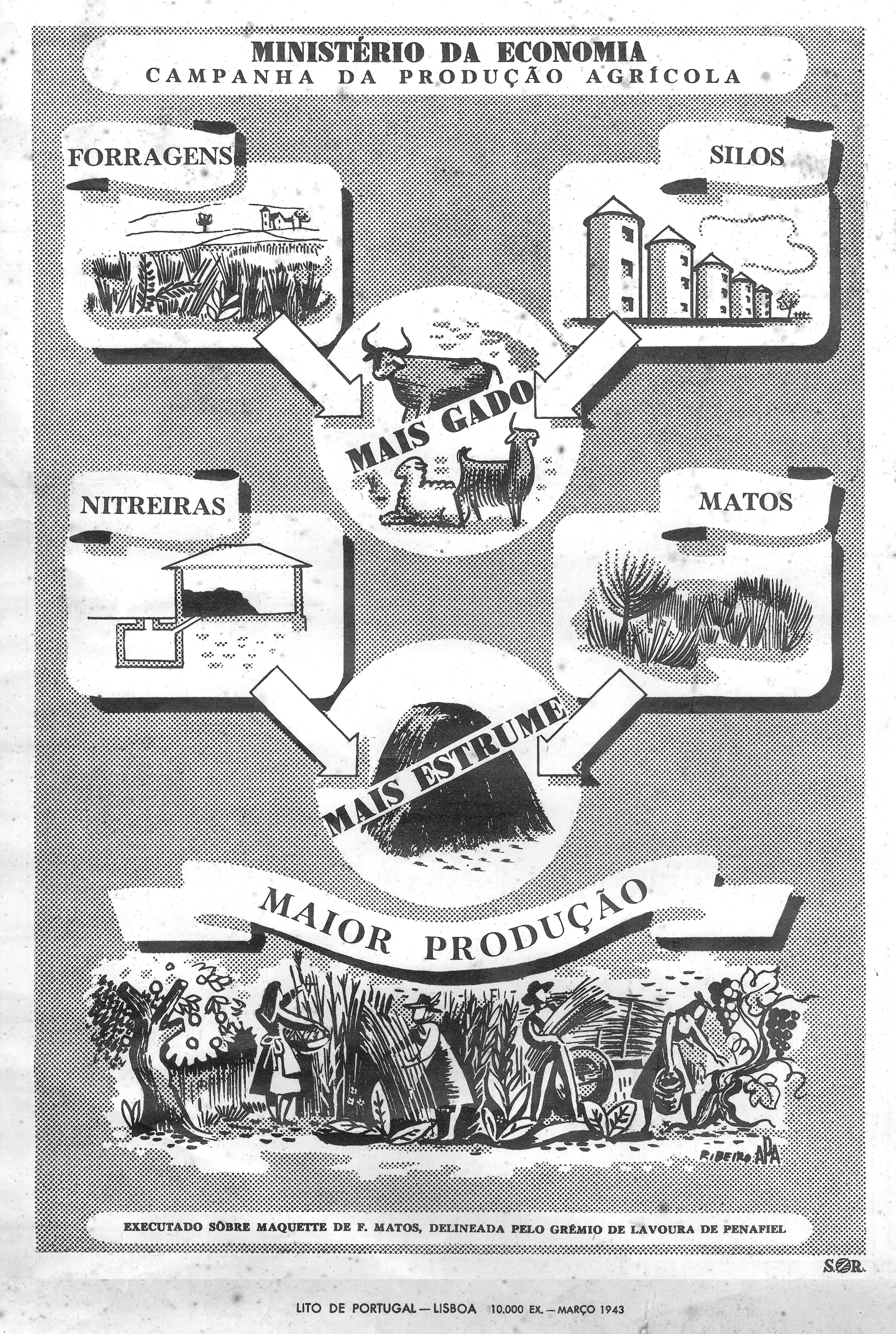
Poster of the Agricultural Production Campaign (March 1943, 10,000 copies).
Source: Personal archive of the authors (M. C.).
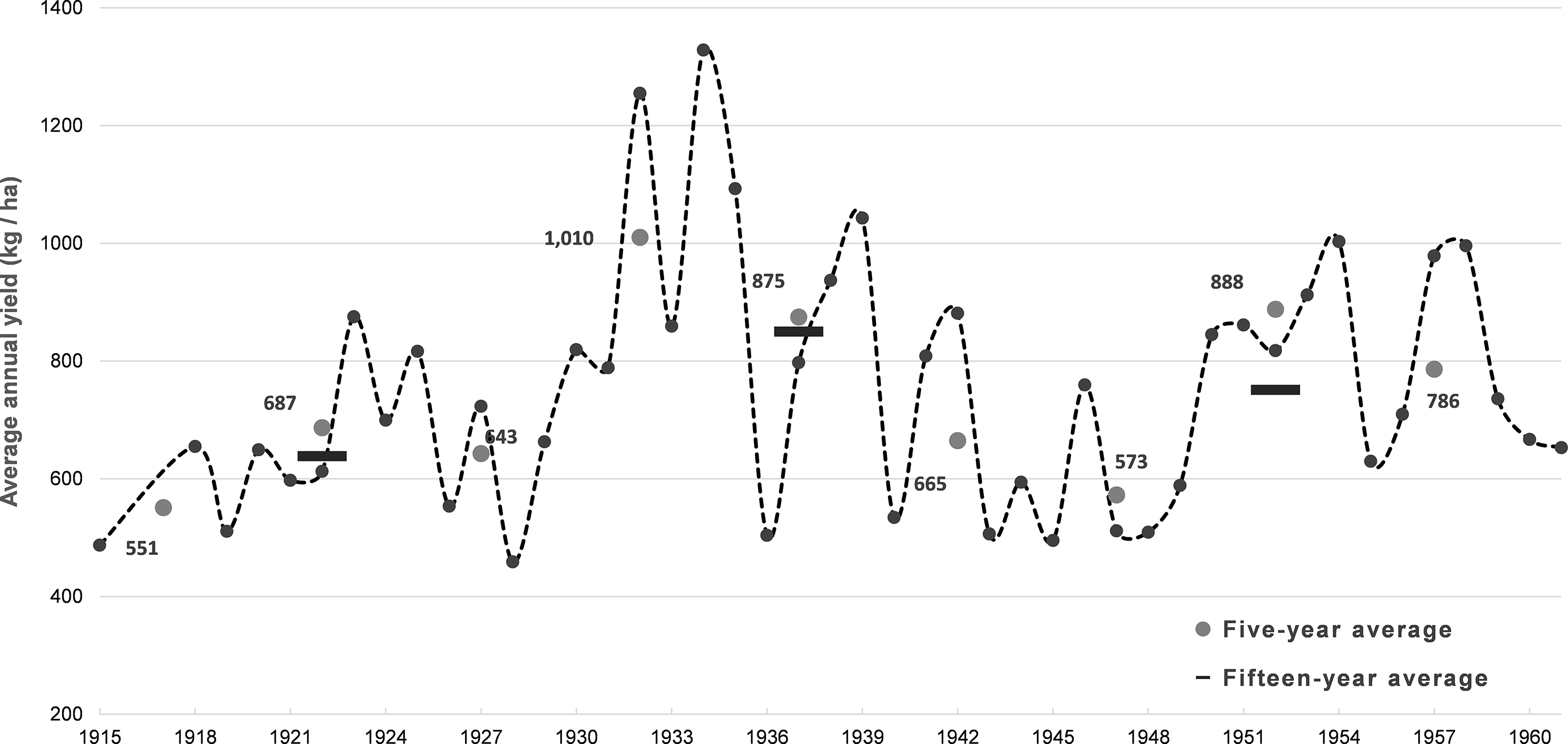
Average annual wheat yield in Portugal between 1915 and 1961 with five-year and fifteen-year averages.
Sources: 1915–61: (INE 1965) The Estatísticas provide wheat annual production and sowing area, the ratio of which gives the average yield. 1915 is the first year with data for national production and area (only 1916 and 1917 are missing).
Agricultural Soil Degradation, 1930–60
In the final decades of a long period of agricultural expansion initiated in the second half of the nineteenth century, warnings about the state of the soil increasingly emerged. These warnings were not fringe agronomics or the precocious soundings of environmentalism, nor were they related to political opposition to the Estado Novo regime. They came from agricultural institutions and their official reports, from the very agronomists who organized the Campanha do Trigo, from which testimonies, scientific discussion, and reform proposals emerged. António Câmara (Reference Câmara1951) wrote of a “land being plundered,” referring to erosion, deforestation, and soil infertility. He was the Campanha’s head of office, and as early as 1936 had noted that “recently cleared lands have progressively declined in productivity, and could partially, if not entirely, revert to their previous condition as charneca” (Câmara and Melo 1936: 368).
In 1943, the Campanha’s brigade chief in Beja, Mira Galvão (Reference Galvão1943a: 13) wrote: “knowing the terrain and climate of the hot and arid region of the Baixo Alentejo, and having observed Alentejo farms over the last thirty years both as an agronomist and as a farmer, I am convinced that the unproductivity that has, of late, become more pronounced in the lands of this region must be attributed not only to low levels of rainfall, which is always the determining factor for a good or bad year, but also, fundamentally, to the excessive wear inflicted on organic matter.” Galvão claimed that he was the first to sound the alarm about declining soil fertility, in a publication from 1930: “my call was barely heeded then and most of these poorer lands such as the Mértola and Serpa mountains, already at a disadvantage from the climate and the intensive rainfall that washes away into the rivers the best earth and its fertilizing principles, now refuse to produce. What is happening in this region is occurring mutatis mutandis throughout the poor lands that lie to the south of the Tagus” (ibid.: 9).
Greater context appears in the Agricultural and Forestry Survey conducted across most of the municipalities of the country between 1950 and 1958 and published in more than 250 volumes. “It is no exaggeration to say that agricultural soil, in the ordinary sense of the word, is almost non-existent: almost everywhere, ploughing tends to slice the schist, and the thickness of the arable soil rarely extends beyond a few centimetres, such is the true extent of soil displacement within two or three generations since the Grain Law [1899] and the Campanha do Trigo [1929].” This description refers to the municipality of Mértola (Russo et al. Reference Russo, Tavares and Ferreira1950: 88–89). In Odemira, “we can calculate that more than 40% of the county needs protecting from intense, active degrading” (Valente et al. Reference Valente, Raimundo and Durão1950: 127–31). Soil erosion was the primary problem, found repeatedly throughout the other southern municipalities of the Alentejo and the lower Algarve mountains, extending north through the left bank of the Guadiana River to the upper Alentejo, and then to the fields of Beira Baixa in the center of the country. In the remaining municipalities of the south erosion appears to be limited to the steeper slopes.
Throughout the south and central regions the surveys also reported a chronic lack of manure, which was associated with “land impoverishment” or “soil exhaustion.” In Ferreira do Alentejo, which had good quality soils for the southern region, it was neither erosion nor depletion, but the scarcity of organic matter: “the shortage makes itself felt even in the barros [deep clay-loam soils], resistant though they are by nature to depletion” (Pereira and Santos Reference Pereira and Santos1951).
A clearer picture emerges by comparing the surveys from Cuba and Mértola, both in the Alentejo, and presenting differing soil qualities under similar climatic and farming conditions. In both places, charneca covered between 20 percent and 30 percent of the total area in the 1880s; but only about 1 percent in 1950. Only 3 percent of Mértola’s soils, compared to 69 percent of Cuba’s, were considered suitable for grain cultivation (Feio Reference Feio1998: 32–33, 66). In Cuba, degradation phenomena were restricted to sloping areas and to shallow and sandy-textured soils on flat lands (which made up 40 percent of the municipality’s land). The report recommended allowing spontaneous weeds to grow on steep slopes and repopulating the remaining susceptible areas with cork and holm oak montados or rainfed fig and olive groves (Cruz et al. Reference Cruz, Júnior and Machado1951).
In Mértola the terrain is rugged across 90 percent of the municipality and the schist bedrock is detrimental to the production of good soil. Degradation was widespread: “the municipality is on its way to becoming a veritable desert” (Russo et al. Reference Russo, Tavares and Ferreira1950: 81). The reporters suggested “reverting either to old cultivation techniques with longer fallows in almost all of the cereal farmlands,” to the “artificial foresting of extensive areas,” or “returning the region to its previous landscape: charneca” (ibid.: 81). The extent and intensity that differentiated the two municipalities is explicit in the survey of Cuba, which made reference to “the calamitous situation observed in the municipalities on the banks of the Guadiana” as one that must be avoided there (Cruz et al. Reference Cruz, Júnior and Machado1951: 17–19).
The archives were generous. In 1952, the Office of Agricultural Services released the film “Gone with the Water: The National Issue of Erosion” (Coelho Reference Coelho1952). Halfway between scientific outreach and propaganda, it shows long stretches of slopes and hills completely stripped of vegetation, while a voice-over explains sediment transport by rainwater and concludes that “over the last few decades, cereal cultivation on sloping lands without soil protection measures has led rapidly to eroded soils and to virtual unproductivity.” In the final sequence, a map of Portugal shows the “main zones affected by erosion” (figure 2) where the size of the area (more than 50 percent of the country) and its prevalence in the North are staggering.
Toward the end of the 1950s, the preparatory report of the II Plano de Fomento (Development Plan) provided a comprehensive explanation: “the agricultural exploitation of our territory has perhaps led to a degree of extensification beyond the natural limits of the elements [soil and climate]” (Caldas Reference Caldas1958: 16, 192–93). A similar explanation had already been advanced as early as 1944 by three renowned agronomists in less uncertain terms: “We feel justified in characterising some of the initiatives of agricultural expansion as depredatory” (Gomes et al. Reference Gomes, Henrique and Castro Caldas1944: 199).
Agricultural Expansion and Soil Erosion: A First Explanation
The exacerbating effects of arable land expansion on erosion are undeniable and well established. A recent analysis of the rates of soil erosion measured on field plots all over Europe, confirms the fundamental importance of land use: arable lands and bare soil (such as tilled fallow) have at least one order of magnitude greater soil losses than land covered with permanent vegetation (grasslands, shrubs, or trees). As is to be expected, there is a positive relation between the gradient and length of slopes and the rate of erosion (Cerdan et al. Reference Cerdan, Govers, Le Bissonnais, Van Oost, Poesen, Saby, Gobin, Vacca, Quinton, Auerswald, Klik, Kwaad, Raclot, Ionita, Rejman, Rousseva, Muxart, Roxo and Dostal2010). It is, therefore, a plausible proposition that the erosion of the 1950s was the result of long-term agricultural expansion, which was, in turn, fostered by protectionist wheat policies implemented between 1899 and the 1960s. However, both national statistics and some regional studies appear to contradict such a linear explanation. Protectionism was not the sole engine of expansion, nor can the latter satisfactorily explain the progressive depletion of soil.
In 1873, Portugal’s mainland agricultural area covered approximately 4 million hectares, rising by 1951–56 to about 5.8 million hectares, most of which was cultivated with cereal rotations. Mainland Portugal covers about 8.9 million hectares in total. In 1873 it was estimated that there were also just more than 4 million hectares of “uncultivated but cultivable” land (Carmo et al. Reference Carmo, García-Ruiz, Ferreira and Domingos2017; INE 1968). So, at this point, with agricultural expansion already underway, about 45 percent of the territory consisted of “charnecas,” “baldios,” and “montes” (heathlands, commons, and uncultivated hills), areas of shrubland and vast pastures that supported livestock and villages. They provided firewood, furnished biomass for manure preparation, and served as a place for grazing, hunting, and gathering, receiving also the intermittent cultivation of grains under long rotations (Baptista Reference Baptista2010: 164; Radich Reference Radich2000, Reference Radich2001). Pery (Reference Pery1884: 17) observed in Cuba that “the cultivated area has increased greatly in the last twenty years, and each year another conquest is made on the charneca.”
By the 1940s, such “uncultivated” lands, statistically classified as “unproductive,” were declared virtually extinct in an extensive report on Portuguese agricultural evolution during the inter-war period: “there are no longer ‘new worlds’ waiting to be discovered within our tiny territory” (Gomes et al. Reference Gomes, Henrique and Castro Caldas1944: 98). Resorting to colonial rhetoric, Portuguese agronomy discovers the land that becomes permanent cereal farmland, henceforth included in national production statistics. In 1951–56, the area of uncultivated soil was estimated at 490,000 hectares, only 5 percent of the country. The 1940s and 1950s correspond to the “greatest demographic and territorial extent” (Baptista Reference Baptista2010: 165) of the agricultural and rural world, never seen before or repeated since. In sum, 3.5 million hectares of “uncultivated” lands were converted into “agriculture” and “forest” over 80 years. “Fifty years ago, all of this vast region, in which most of the country’s wheat is produced, was almost entirely covered by scrub which was periodically destroyed by wildfires,” wrote Galvão in 1943 in reference to Campo Branco, an undulating plain with thin schist soils, on the southern border of the Alentejo region (Galvão Reference Galvão1943a: 6).
Furthermore, the statistics show that of the 4 million uncultivated hectares of 1873, only around 1.5 million remained in 1907, a reduction of 2.5 million that probably did not happen entirely in the eight years after protectionism was introduced in 1899. Even if we suppose overly that the uncultivated area was reduced by 1 million hectares between 1899 and 1907, that would still leave 1.5 million hectares to have been cleared just before the cycle of protectionism began, between 1873 and 1899, when imported wheat was preferred by millers, especially wheat from the United States, not only because it was “cheaper … but also because it is easier to work and in general gives better quality flour” (Reis Reference Reis1979: 748). It would be a mistake, therefore, to overstate the role of the wheat policies and markets in agricultural expansion: in addition to some 2 million hectares cleared during the long period of protectionism (1899–1960), at least 1.5 million hectares were cleared before it had even begun. Examples from three rather different places reveal this earlier rural transformation.
In Alto Barroso, a mountainous region of plateaus and deep valleys tucked away in the northern borderlands of Portugal (Trás-os-Montes), 700 meters above sea level, the climate is not favorable for wheat or fruit crops, nor is much maize grown. In the second half of the nineteenth century it was rye that occupied the biannual, rye-fallow grain rotations, and a specialization was under way in the rearing of cattle for export to England (peaking between 1868 and 1884). This was a very isolated, roadless region, which had no grain trade with neighboring communities and exported only calves because they could walk to market. Grain cultivation developed slowly, matching the rate of population growth, while pastures expanded more significantly due to the extension of irrigated grassland and the continual conversion of uncultivated common land (generally broom shrubland and some forest) into unseeded pastureland. In 1939 the commons still covered more than half of the region, but much of it was already pasture. During the 1940s and 1950s there was a greater expansion of cultivated area and commercialization of crops (especially potatoes, which by 1944 occupied 18 percent of the common land). After the construction of the first road in 1932–34, significant erosion began on the most fragile and sloping soils. Meanwhile, the capacity for replenishment of nutrients in the cropland soil from manure was in critical decline due to the diminishing ratio between pastureland and cropland areas (Alves and Peres Reference Alves and Peres1951; Santos Reference Santos1992, Reference Santos1996). Although isolated, with important climatic constraints, and far removed from the national wheat policies, Alto Barroso expanded its agricultural area and intensified grazing, until soil degradation became evident.
The parish of Zedes (south of Trás-os-Montes) provides a second example. There, during the 1920s, the pasture area in the hills (“monte”) became insufficient for producing the manure required on rye crops, which were expanding in response to population growth and an increasing demand for food. With use of chemical fertilizers still very limited, farmers converted the forest almost entirely into sheep and goat pastures. Whenever the fertility of the cropland began to decline due to the lack of manure (i.e., of pastures), they extended cereal crops onto these hill lands, further upsetting the balance of nutrient transfer between land types. Agriculture was the main driver of deforestation in these mountains, for the forest “hid in its wood and soil that which agriculture has always needed: nutrients” (Aguiar and Azevedo Reference Aguiar and Azevedo2011).
Returning to a third example in the arid south, the eighteenth and nineteenth centuries brought the growing pressures of agriculture and firewood extraction to the wasteland commons of Mértola’s low mountains. These pressures derived from an expanding population, which grew fourfold between 1798 and 1890 in the mountain parishes, owing partly to the opening of a copper pyrite mine in 1859. Another factor was the charcoal trade along the Guadiana River with Cadiz and Gibraltar in Spain. A shortage of firewood for the mines during World War I led locals to strip the mountain of its remaining forest, which was finally parcelled up into small, privately owned plots of 2–6 hectares in 1926. There they grew wheat under intensive rotations in the context of wheat policies, poor soils, and poverty. The story of Mértola is one of transition, degradation, and hardship. At the end of the nineteenth century the mountain range was covered by overused heath that was entirely replaced by unproductive arable crops, and some montados. These were the “two tragedies” of the mountain, overused first as common land and then as private property (Galvão Reference Galvão1943b: 10; Santos and Roxo Reference Santos and Roxo2013).
These three examples make it clear that understanding the local scale is essential for reconstructing the historical relations between agriculture and soil. Moreover, the struggle to secure sufficient nutrients (stored in the soil, in biomass, or in sacks of fertilizer) appears as a relevant historical topic, albeit one that is barely visible, from the north to the south of the country. It is necessary, therefore, to look beyond the protectionism–expansion–erosion sequence of events.
The Fallow Impasse in the Transformation of the Cultivation System
The root causes of expansion in the last quarter of the nineteenth century—a larger population, new markets, and new transportation routes—did not disappear after 1900. In fact, the population doubled from 4 to 8 million between 1870 and 1960, with steep growth from 1920 onward. However, the wheat incentives did become important after 1899 in fostering land clearing and crop commercialization. In addition, wheat became the preferred crop in the best fields of the cereal rotations. Toward the end of the nineteenth century, wheat accounted for a smaller area than the other bread grains, rye or maize, but it came to dominate by 1915–20, strengthening its position until 1950, when it covered more than 800,000 hectares. By then it was the principal Portuguese crop, representing 30 percent of sown area, concentrated in the southern half of the country. Wheat cultivation increased wherever climatic conditions permitted, taking the place of rye and covering both newly cleared lands and formerly fallow land that had been released from intensified rotations (Gomes et al. Reference Gomes, Henrique and Castro Caldas1944; INE 1968; Lains and Sousa Reference Lains and Sousa1998; Reis Reference Reis1979).
Agronomists were hesitant about the topic of “pousio” (fallow) with some arguing that it was totally unnecessary under changed cropping techniques. Others recognized its persistent importance in the Portuguese ecological and economic framework. At one extreme was Vasco de Carvalho, who, in Reference Carvalho1893, attempted to refute the “arguments in favour of fallow,” a sign of a “decaying or backwards agriculture” (Carvalho Reference Carvalho1893: 10). Six decades later, the Agricultural and Forestry Survey of Mértola, which advocated for the reintroduction of long fallows throughout much of the municipality (Russo et al. Reference Russo, Tavares and Ferreira1950: 81), represented the opposite extreme. In between, there were suggestions that farmers should progressively reduce fallow through chemical fertilization and should carry out fallow cultivation with legumes and fodder crops. But the use of fallow in cereal rotations continued. In the 1950s the elimination of fallow remained an abstract concept, as a “possible solution,” from those who “intend to turn weak lands, with continental climate, into the lush, green meadows that characterize the regions of northern Europe,” to those who “swear that it is impossible to end the practice of the fallow” (Malato-Beliz Reference Malato-Beliz1953: 7–8). During the same decade, the still-young Organisation for European Economic Co-operation cited the cultivation of fallow as “the outstanding practical problem awaiting a solution in South Portugal” (quoted in Alves Reference Alves1961: 419).
In any case, “the trend for reducing the duration of rotations at the expense of the soil recovery period” was clear in 1944 (Gomes et al. Reference Gomes, Henrique and Castro Caldas1944: 98), and is evident in the land use data for the period 1873–1957 (table 1). These statistics for actual fallow areas, however, are not entirely reliable: the detailed arable crop surveys undertaken in the 1950s and 1960s in four municipalities of the south show fallow use to be higher than estimates for the first half of the twentieth century (Barros and Cascais Reference Barros and Cascais1956a, Reference Barros and Cascais1956b, Reference Barros and Cascais1960, Reference Barros and Cascais1964).Footnote 1 A previous study determined that fallow (including tilled fallow) would have covered around 46 percent of the country’s arable area in the period 1951–56, 2.4 million hectares annually without crops, at a moment when the consumption of chemical fertilizers was already reaching significant figures (Carmo et al. Reference Carmo, García-Ruiz, Ferreira and Domingos2017). Based on this percentage, it is possible to trace backward to 1873 assuming a conservative annual rate of variation in the proportion of fallow, and to reach a proportion of 66 percent, which is higher than the estimate made at that time.Footnote 2
The evolution of the agricultural land use between 1873 and 1957 in the national statistics

Source: INE 1968.
Notes: The last row presents the country’s fallow land in proportion to fallow land plus arable crops. The statistical category “uncultivated but productive area” consisted mainly of fallow (3/4 according to Gomes (Reference Gomes, Henrique and Castro Caldas1944: 97) and also permanent pastures. The “uncultivated but cultivable” included mainly uncultivated heathland.
This extra fallow area may well have been classified as uncultivated heathland in the calculations made at the end of the nineteenth century. Feio (Reference Feio1998: 30), commenting on Pery’s cartography and descriptions of 1880–90, concludes that “the distinction between recent fallow and a charneca with old bushes of a man’s height does not raise doubts. But in intermediate situations, where should we put the transition?… In parishes with great predominance of very weak lands there was no fallow, while in others the areas of both arable crops and charneca were small and almost everything was marked as fallow.” The field reporter of that time, an agronomist, surveyor, or clerk—and rarely a farmer—saw in the high vegetation of the charneca uncultivated, unused land, instead of the fallows that had been accumulating nutrients for some years. Campos Pereira wrote in 1915 that “one should not think that it is easy to say where the productive territory ends and the unproductive begins” (quoted in Radich Reference Radich2000: 66–67).
Fallow usage seems always to have been more significant than was indicated in the statistics. At the end of the nineteenth century at least two-thirds of arable land remained unsown, and by the mid-twentieth century the proportion was still around one-half. This should not come as a surprise: according to Rebelo da Silva’s accounts of national wheat production in Reference Silva1924, the cultivated wheat area should be multiplied by three or by four to estimate the total area required for cropping, which would put the proportion of fallow land at 66 percent or 75 percent, respectively (Silva Reference Silva1924).
Thus, Portuguese agriculture at the end of the nineteenth century could be characterized as notably itinerant. While the most fertile and moist soils would probably have been permanently farmed, most of the territory would have been reserved for long-term swidden cycles of crops, grazing and scrub that were constantly reset by slashing, burning, and ploughing. If it was not quite the “quasi-gatherer economy,” a term used by a French geographer in 1964 in reference to aspects of the agriculture of the south (Michel Drain quoted in Baptista Reference Baptista1980: 345), it was certainly “shifting cultivation,” which exploited the “fertility of the wild lands” (as described by agronomist Malato-Beliz [Reference Malato-Beliz1953: 6]) and produced an “extensive way of life” (as described by historian Albert Silbert [Reference Silbert1978: 472]).
But why fallow? asked Orlando Ribeiro in 1943. “Because cattle need their pasture? Because poor soils and scarce rains impose fallow? It is difficult to isolate the primordial fact, so entangled are grazing and extensive farming” (Ribeiro Reference Ribeiro1944: 21). Carmo et al. (Reference Carmo, García-Ruiz, Ferreira and Domingos2017) presents a plant nutrient flow model for the period 1951–56 that shows that fallow land accumulated on average only low levels of nitrogen, phosphorus, and potassium due to the intense extraction of biomass from fallow grazing. Remove livestock and its excretions from fallow, and the model shows a substantial increase in the accumulation of those three elements in the soil.Footnote 3 Therefore, it would seem that the fallow served less as a resting period for restoring soil fertility for future crop-growing, and more as a source of nutrients transferred to crop fields using manure. It was also a means of sustaining animal traction indispensable for farmwork. The curtailing of fallow also meant that a larger area of soil was exposed to erosive agents. This network of interdependencies was not always well understood by the agronomists of the day, but that did not stop it affecting the evolution of soil and agricultural systems.
Concrete examples from north and south complete the picture. In Alto Barroso, the biennial rye-fallow rotations dominated until the twentieth century and gradually changed from the 1930s to rye-potato. This transformation increased the demand for nutrients, which farmers then supported by increasing grazing areas, irrigated grasslands, and unseeded pastures in the wasteland commons. Those nutrient sources, however, became insufficient with the progressive expansion of potatoes onto pasturelands (Santos Reference Santos1992). From the late 1920s onward, farmers in Beira Baixa and the Alentejo were unaware (unlike those of Trás-os-Montes) of “any pastures other than those that grow in the vacant plots of their fields.” Wherever “fallow was reduced, it was always to the detriment of cattle-rearing.” When the main triennial wheat-fallow-tilled fallow rotation was curtailed, the soil showed “signs of fatigue” (Ribeiro Reference Ribeiro1944: 14–22).
In the southern Alentejo, during the clearings in the first few decades of the twentieth century, consecutive wheat crops obtained extraordinary yields, made possible by organic matter accumulated in the soil and by fertilization with phosphorus. Then the yields fell, with less fertile soils “refusing to produce” and “it soon became apparent that 2 to 6 years [of fallow] were enough to produce one, two, or even three crops.” With this realization, “the new regulation became the rule” (Galvão Reference Galvão1943a: 7–9). In addition, the short-term sharecropping contracts within the latifundium regime (Baptista Reference Baptista1980; Santos Reference Santos2004), largely present in the southern half of the country, were central to soil degradation. Prior to the Campanha, the “seareiros” (sharecroppers, after “seara,” the cereal field) were responsible for clearing land, which ended up in the hands of tenants and owners after the hard work and the first harvests. From the 1930s, sharecroppers cultivated the worst soils on large farms and had neither the capital nor the interest in establishing longer, less intensive rotations, or improved fertilizations. These contracts only gave them a right to the harvest, excluding the use of stubble and pastures on any fallow land (Baptista Reference Baptista1980, Reference Baptista1993: 168–74). The Campanha incentives led indeed “to the alignment of the landowners’ and the sharecroppers’ interests in overusing the land” (Santos and Roxo Reference Santos and Roxo2013: 137), although the latter impoverished not only the land but also themselves.Footnote 4
The 1930s marked a transition from an agricultural movement based on the ability to extend crops onto new lands, to a new situation where there was little land left unploughed and national production could no longer increase without intensifying water and nutrient cycles. However, the Campanha do Trigo (1929) renewed the call to expand cropland onto fallow and the remains of heathland. “As a result of the crop premiums, of the various stimuli created at that time, it was possible to clear the remaining charneca, which had persisted uncultivated because its cleaning and cultivation was uneconomical, … and the crop area was enlarged at the expense of the fallow” (Galvão Reference Galvão1943a: 9). Galvão’s 1930 article (“which sounded the ‘alarm’”), suggestively titled “Extensive Agriculture, Intensive Culture,” points out “the drawback of increasing the area of wheat cultivation at the expense of the fallows” (quoted in Galvão Reference Galvão1943a: 9). This concern was not new, as shown in the texts of Miguel Fernandes (Reference Fernandes1899), Rebelo da Silva (Reference Silva1924), and Amado Seabra (Reference Seabra1925), but the context and impact had changed. Appeals against the reduction of fallow multiplied: “a quite disastrous trend, unless, as is hardly ever the case, it is accompanied by changes to the choice of exploited plants and cropping techniques” (Gomes Reference Gomes, Henrique and Castro Caldas1944: 12, 98).
The intensification of the 1930s onward developed as a superimposed and limited movement, relying mostly on the increased use of chemical fertilizers, although they were still insufficient, and on the reduction of fallow, but nonetheless becoming the watchword of agricultural institutions.Footnote 5
The Different Rhythms of Chemical Fertilization: Phosphorus and Nitrogen
The spread of mineral fertilizers began in the second half of the nineteenth century and was a transformative development. Without them, Portuguese agriculture would have followed distinct paths, restricted to organic methods for maintaining soil fertility. Mineral theories of plant nutrition developed in the 1840s, first appearing in Portugal in 1842. The teaching of mineral fertilization arrived at the Lisbon Institute of Agriculture, taught by Ferreira Lapa, around 1860. In 1859 the Póvoa de Santa Iria factory (which would produce fertilizers until the second half of the twentieth century) began to make lime superphosphate. However, the use and production of fertilizers in Portugal was limited until the 1890s. In 1894 imports reached 4,000 tons (consisting of superphosphates, Chilean nitrate, and guanos), rising to 23,000 tons at the turn of the century (Almeida Reference Almeida1960; Graça Reference Graça1939, Reference Graça1954; Radich Reference Radich1996: 3–8).
From then on, the use of phosphorus fertilization only increased.Footnote 6 Until the 1910s, phosphates were mainly used in the wheat fields of the south, where they generated significant increases in productivity. Jaime Reis (Reference Reis1979: 785) suggests increases of between 24 percent and 55 percent, whereas Rebelo da Silva (Reference Silva1924) and Miguel Fernandes (Reference Fernandes1899) indicated the doubling or even trebling of production after “good clearings.” Fernandes, a large-scale farmer in Beja, reported astonishment at the effects of superphosphate on the first crop fertilized in the region by his father in 1884: “Passers-by stopped on the road intrigued by the sight of the manual fertilizer spreaders engulfed in clouds of white powder. … Within two months the benefits of the fertilizer were so salient that at a distance the stretches of land that had not been fertilized seemed as if they had not been sown at all” (Fernandes Reference Fernandes1899: 166). This fertilization, however, did not contain nitrogen or potassium. Potassium was relatively unimportant because it plays a less decisive role in grain growth and is already available in reasonable quantities in Portuguese soils (Almeida Reference Almeida1960; Carmo et al. Reference Carmo, García-Ruiz, Ferreira and Domingos2017). Nitrogen, however, the most important nutrient of the three, was largely absent from Portuguese synthetic fertilizers until the 1920s; farmers did not apply it at the same level as phosphorus until 1935 (see figure 3). This imbalance proved to be decisive for the various transformations underway in Portuguese agriculture.
Phosphates made grain cultivation economically viable in the “galegas” lands, shallow and poor soils that had grown over with scrub in the last quarter of the nineteenth century. Soils on freshly cleared land had high levels of organic matter, but were typically deficient in phosphorus. In these situations, the first fertilized wheat crops produced very high yields, but they rapidly declined as the organic matter of the soil—the main supplier of nitrogen consumed by the crops—fell to critical levels. Thus, it became necessary to restore nitrogen levels in the soil through the use of fallow, green manure, animal manure, or chemical and organic fertilizers. Agronomists and farmers made this argument repeatedly from the last decade of the nineteenth century onward, but the task of restoring nitrogen to the soil presented a series of natural, technical, and economic obstacles that were only effectively overcome after the end of the World War II.
In summary, fallows diminished, even on larger farms; organic fertilizers such as fish meal were effective but expensive, and the first synthetic nitrogen fertilizers, sodium nitrate and ammonium sulphate, were not only more costly than phosphorus but also their effects on production remained unclear; the effectiveness of green manures was constrained by climate; and animal manure was only able to fertilize a small fraction of the land, usually the most productive fields.Footnote 7 This chronic lack of nitrogen became a feature of Portuguese agriculture, decisively so in the center and south, where this situation dragged on for at least half century. “The nitrogen famine of our lands,” so goes a 1925 saying, which was still repeated as late as 1961 (Alves Reference Alves1961: 444; Seabra Reference Seabra1925: 5).
In the mid-1930s the situation was changing, with nitrogen consumption evolving (figure 3), increasing fivefold between 1928 and 1939. Finally, there were nitrogen-phosphate fertilizer formulations that were suitable for the different lands of the south that were increasingly used on the most capital-intensive farms.Footnote 8 In 1937 the state introduced a subsidy for the purchase of fertilizers for wheat crops (CRPQF 1958: 143). World War II abruptly interrupted fertilizer growth after 1939, bringing strict restrictions on imports that national production could not replace. The war reduced the use of nitrogen to early 1930s levels. The peaks reached in 1939 would not return until the 1950s, when there was an even greater boom. During the period of rationing the Portugal’s potassium consumption tripled, and phosphorus use increased “because with this, many farmers believed, they could counter the shortage of nitrogen fertilizers” (ibid. 137–40).Footnote 9
According to the nutrient model for 1951–56, presented in Carmo et al. (Reference Carmo, García-Ruiz, Ferreira and Domingos2017), the systemic nitrogen deficiency in soils lasted until the end of the 1950s, in contrast to growing accumulation of phosphorous and potassium. Field tests conducted by Almeida Alves during the 1950s with typical fertilizer quantities for the time produced the same pattern: the depletion of nitrogen content in wheat-tilled fallow rotations, and the accumulation of phosphorus and potassium, which revealed excessive fertilization (Alves Reference Alves1961).
The problem arose as early as 1899. The “declining fertility” described in phosphate fertilized, recently–cleared galega soils “although not as acute as in the case without fertilization, is nonetheless quite pronounced.” This reality “may not have worried the farmers of the region, but that is because they have not hitherto been short of new lands onto which they can extend their crops. It is therefore time to learn how to provide the nitrogen which the older lands are beginning to need” (Fernandes Reference Fernandes1899: 176).
By 1960 the evaluation was done. The use of chemical fertilizers “was one of the practices that had been neglected, having been completely or partially abandoned, or employed unevenly.” Often, the “expensive nitrogenous fertilizers, which Portugal did not manufacture, were excluded, whilst the supplying of nitrogen to crops was left to the humus accumulated by the resting lands and their spontaneous flora; and to the atmosphere.” There was “widespread use of phosphate fertilizers, even on extensively farmed land,” yet its “exclusive use, on lands with low or medium humus content, cannot ensure the sufficient natural restoration of the soil organic stocks” (Melo Reference Melo1960: 153).
In the northern regions, fertilizer use developed at a slower pace. In the 1930s synthetic nitrogen was nonexistent and did not take off until the 1950s, while phosphates were in limited use compared to the wheat-growing regions of the south. In the 1930s in Alto Barroso, for example, nitrogen fertilization was nonexistent, and phosphorus fertilization was on the order of 5 kg P/ha. In the 1970s it rose to 17 kg N/ha plus 18 kg P/ha (Santos Reference Santos1992: 126–27). To the east of this region, in 1931, fertilization was restricted to superphosphate sufficient to fertilize only 2 percent of the agricultural area (Aguiar and Azevedo Reference Aguiar and Azevedo2011: 109). In 1943 in Beira Baixa, in central Portugal, fertilizers were “still rarely used” (Ribeiro Reference Ribeiro1944: 19). Chemical fertilization there was delayed because of the greater availability of organic fertilizers deriving from the production of fodder and the vast pastures and scrublands. Minho, the rainiest region, in the northwest corner of Portugal, was the only place where the Agricultural and Forestry Survey declared an abundance of manure (Lobo et al. Reference Lobo, Alves and Rio1950).
The Defeat of Organic Technology
From the end of the nineteenth century there was a shortage of fertilizing biomass, which became gradually worse due to the combined effect of the expanding cropland, and the decreasing pastureland and shrubland. The national shortage of animal manure was estimated at 8 million tons in 1912 (compared to about 12 million of actual production), and at 25 million tons in 1955 (compared to about 13 million of actual production) (Caldas Reference Caldas1958; Carmo et al. Reference Carmo, García-Ruiz, Ferreira and Domingos2017; Ramalho Reference Ramalho1955). This evolution is clear in the Agricultural and Forestry Surveys of the 1950s, which described the “sources of organic matter” in each municipality: manure, waste, green manure, scrub, and other. A north-south gradient is evident, along which the shortage of manure and woody biomass increased, as well as local gradients between rugged relief areas left without grains growing on them, and flatter terrains from which shrubs and natural pastures had disappeared. Some municipalities imported straw and scrub from neighbouring areas to produce manure.Footnote 10
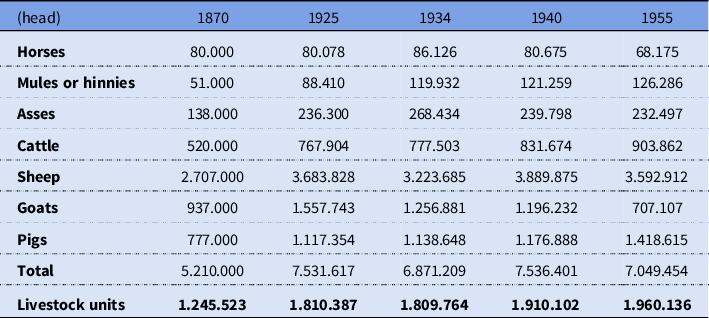
This does not mean that the production of organic fertilizers decreased. Between 1870 and 1955, livestock numbers measured in livestock units—the best indicator of manure production—are growing (see table 2). This outcome was one of the goals of the Campanha do Trigo: a 1943 Ministry of Economy poster outlined multiple ways to increase the quantity and quality of manure (figure 4). In the period 1951–56 the national quantity of manure reached just more than 13 million tons. Although much less significant, marine and urban manures made a small contribution of 6 to 10 percent in the same period (Carmo et al. Reference Carmo, García-Ruiz, Ferreira and Domingos2017).
Marine biomass, an important fertilizer in the coastal zones north of the Mondego, was in decline in the 1950s (Pereira Reference Pereira1996; Rezende Reference Rezende1944; Ribeiro Reference Ribeiro1963, Reference Ribeiro2014). Increasingly, rubbish from cities and towns moved to farmed areas through a flourishing market for biomass, especially in Lisbon, where river transport served areas south of the Tagus. In other cities, such as Braga, Évora, and Bragança, rubbish and sewage were collected and composted together in municipal dung heaps, or “nitreiras” (from “nitro,” meaning saltpeter or potassium nitrate) for the production of organic fertilizers, in what appears to be the first large-scale attempt at recycling plant nutrients, though it was later discontinued.Footnote 11
Rather than the replacement of organic with chemical fertilizers, both were indispensable to meet the growing need for nutrients that was noticeable from the nineteenth century onward. Organic and synthetic nutrient sources and technologies developed in parallel. In the background there was a scientific debate that, while confident that mineral fertilization was the ultimate solution for maintaining soil fertility, seldom neglected the benefits of organic fertilizers as well. Rebelo da Silva (Reference Silva1924), the agronomist on the frontline of chemical fertilizer research, production, and promotion in Portugal since the 1880s, showed that it was not economically possible to maintain soil fertility in the most deprived soils of the south with only nitrogen-phosphate fertilization. Restoring organic nitrogen to the soil would also be necessary. However, those who advocated for organic solutions admitted that they might soon disappear, while underlining nonetheless their future importance to “the study of permanent fertility” (Melo Reference Melo1939: 78).
In 1968, with access to mineral fertilizers now widespread, Feio expressed the tension between the two technologies, using the results of a field test to compare the effects of manure and chemical fertilization over a period of twenty-five years (1930–55). The benefits of manure in the tilled fallow-wheat-oat rotation were clear from the eighth year right through the end of the trial (resulting in an extra 400 kg/ha of grain), and ten years later more vigorous wild vegetation was still present in the plots that received manure. However, Feio eventually concluded that, given the high cost of manure and how difficult that it was to obtain it for all fields, the practice was “pointless” for farmers (Feio Reference Feio1968: 12).
The 1950s were a turning point for organic and mineral fertilizers. In 1949–50 Portugal was among the European countries with the largest proportion of fertilization with manure, but “the scarcity in our lands of organic material, especially in the centre and south, is alarming” (Graça Reference Graça1954: 13). By the start of the decade, only 30 percent of total phosphorous supplied to soil was organic, owing to widespread use of superphosphates, but nitrogen still came mostly from organic sources (about 64 percent). By the end of the decade, the nitrogen supplied to the soil was mostly mineral in origin (Carmo et al. Reference Carmo, García-Ruiz, Ferreira and Domingos2017).
The agroecosystem sustained soil fertility by means of the transfer of nutrients between different kinds of land usage, but it progressively weakened due to the expansion of cropland into permanent pasture and shrublands, and onto the temporary pastures of the fallows. It is not easy, however, to establish whether it was agricultural expansion or the spreading of mineral fertilizers that initiated this change. On the one hand, chemical fertilizers broke the interdependent systems of soil use and management, allowing the disconnected expansion of crops and cattle-rearing. On the other hand, the popularization of synthetic fertilizers was related to the inability of organic technologies to meet the demands of ongoing agricultural expansion. In some cases, such as in the Aveiro region, the increase in chemical fertilizer usage was due to a dramatic decline in the estuary’s marine biomass (that farmers had widely used as a fertilizer since the eighteenth century), which was caused by currents becoming stronger after construction work on the estuary’s mouth in 1936 (Alves Reference Alves1940; Rezende Reference Rezende1944). In Trás-os-Montes farmers did not use chemical fertilizers until the 1930s, when the imbalance between the pastured and cropped areas became critical. In other cases, however, such as in the grain-growing south, the state- and industry-motivated coincidence of rising wheat prices with falling superphosphates costs created the opposite effect, as chemical fertilizers enabled agricultural expansion onto charneca and fallow, reducing the possibility of maintaining soil fertility organically (Reis Reference Reis1979; Santos and Roxo Reference Santos and Roxo2013). Nevertheless, the decoupling of cropping, livestock farming, and forestry, already underway in the 1950s and today fully established, would have been impossible without chemical fertilizers.
At the end of the nineteenth century (1885), the vast Alentejo heathlands were alluringly nicknamed the “Far-West” (Veríssimo d’Almeida quoted in Reis Reference Reis1979: 746), but perceptions changed by the 1940s. The “identical case” of “depletion and unproductivity in the Great Plains” during the Dust Bowl created fears “that the poor lands to the south of the Tagus will suffer the same fate as their counterparts in North America” (Galvão Reference Galvão1943a: 10; Sampaio Reference Sampaio1944: 3).
The Evolution of Wheat Yields, Late Nineteenth Century–1960
The agricultural statistics make it possible to build a year-by-year series of wheat yields between 1915 and 1961, which shows strong interannual variability without any significant trends (figure 5). The linear regression of the data shows an increase of about 110 kg/ha over forty-seven years, but with no statistical significance, while the five-year averages show an increase of about 400 kg/ha between 1915 and 1934, followed by an identical reduction up to 1948. There was then a further increase (of around 200 kg/ha), with apparent stabilization around the 800 kg/ha yield, which is only slightly higher than the forty-seven-year average (= 752 kg/ha).
In 1961 Sardinha de Oliveira published a study of wheat productivity during the Campanha do Trigo, in which he showed that oscillating interanual yields were the result of variations in precipitation and temperature between the first sowings in autumn and the following spring. “There can be no doubt that this variation” in the average, five-year yields “corresponds very much to the vagaries of the meteorological conditions.” Comparisons to “meteorologically similar years” did not show increases in productivity (Oliveira Reference Oliveira1961: 9). According to the Alentejo farmer and agronomist, the stability of wheat production can be best understood as the result of a combination of conflicting factors. While farmers adopted “improved fertilization, precocious wheat varieties, and plant defence,... the naturally fertile conditions were depleted” (ibid.: 28).
This argument made the rounds in agronomy from the first half of the 1940s, which was, not by coincidence, a period of steadily declining productivity (Coelho Reference Coelho1946; Galvão Reference Galvão1943a; Sampaio Reference Sampaio1944). Almeida Alves proposed (also in Reference Alves1961) to extend the period of wheat stability from the end of the nineteenth century to the middle of the twentieth century, adding that expansion onto “less suitable lands” had also contributed to stabilising national average yields (Alves Reference Alves1961: 21–24). Later, referring to the two decades preceding 1915, Reis found constant results in wheat production in the Alentejo (on the order of 600 kg/ha) that left him “perplexed,” given the diffusion of phosphate fertilizers. In explanation, he focused on the statistical effect introduced by Alves: “superior results in all different types of soil” were cancelled out by “an increasing percentage of low quality soils in the total farmed area” (Reis Reference Reis1979: 783–75). Feio also verified a long period of stability in wheat production, by comparing Pery’s data collected in Alentejo municipalities in the last two decades of the nineteenth century, with average values for 1949–53 from the same municipalities. Like Reis, he put aside the negative evolution of soil fertility and explained the phenomenon purely on the basis of the statistical land use effect (Feio Reference Feio1998: 60–65).
The remarkable stability of wheat yields (rising some 150 kg/ha over sixty years of massive transformation) must be explained, as the agronomy of the day did, by the combination of gradually depleting soil fertility and the expansion of crops onto less fertile land. These two processes countered the many improvements to cropping techniques, particularly the use of phosphate fertilization and, a few decades later, of nitrogen-phosphate fertilization. “After the golden age of the Campanha,” referring to the 1932–35 period of high yields, “the lands again cleared rapidly lost fertility and there was even a decline in other, better lands as a consequence of the reduction of the fallow and of more intense farming, all contributing to lower yields or at least to counteract the benefits that had been brought about by useful innovations” (Oliveira Reference Oliveira1961: 28). If one ignores declining soil fertility, it is hard to explain why productivity stagnated between 1930 and 1960, a period when farmers did not clear much additional low-quality land compared to total cultivated area, and with the consumption of fertilizers still rising (notwithstanding the decline in nitrogenous fertilizers from 1939–47).
Back in 1899, Fernandes had obtained positive results, both with phosphate fertilization on cleared “new” lands and by intensifying rotations on his best galegas lands (where he still kept seven fields of fallow under a sixteen-year rotation). He had already shown that the generalized rotations of the Baixo Alentejo intensified “due to the precarious economic conditions of agriculture” under the “small-time sharecroppers,” as much as on “the large-scale plantations,” and resulting “as a general rule” in reduced yields, despite the use of phosphate fertilizers (Fernandes Reference Fernandes1899).
Conclusions
Prior to 1875, half of the country was uncultivated, covered with shrubland and extensive pastures, some of which farmers cyclically burnt and cleared for two or three years of crops, after which livestock returned and brush regrew. It was still the shifting cultivation of previous centuries, which remained, for instance, in the mountains of the eastern Algarve until the first half of the twentieth century (Cavaco Reference Cavaco1976: 72–83). Agricultural expansion began in the last half of the nineteenth century and did not stop until the late 1950s, when the area under cultivation reached a record high and arable crops covered the country from north to south. This movement intersected and overlapped with other transformations, producing an overall increase in soil erosion and depletion that followed common patterns:
-
1. Ploughed land without vegetation was more susceptible to erosion, especially on sloping ground, so the expansion of arable crops up the slopes led to increased surface soil transport;
-
2. Agricultural expansion into the grazing and brushland areas, and into gradually reduced fallow, weakened the transport of nutrients from pastures to croplands;
-
3. The beginning of chemical fertilization with phosphorus in the late nineteenth century reinforced previous imbalances as it made cultivation on the sloping poor lands economically viable, while enhancing the lack of nitrogen sources. The exploitation of the poor uncultivated lands was initially high, based on the accumulated soil fertility, but collapsed after the first harvests;
-
4. Cropping systems were under pressure from the late nineteenth century due to a systemic nitrogen deficiency that governed the general trends of expansion and intensification;
-
5. Chemical fertilizers did not emerge to serve as substitutes for organic ones, but rather to overcome a nutrient shortage caused by cropland expansion and intensification; nonetheless, chemical fertilization enabled (or encouraged) the decoupling of the various components of agroecosystems;
-
6. The main functions of fallow were to provide nutrients to animals, which transferred them to crops using manure, and to sustain animal traction indispensable for farmwork. To a lesser extent, fallow was also restoring soil fertility for future crop-growing;
-
7. Agricultural expansion, fallow reduction, insufficient manure, and disparate supplies of chemical phosphorus and nitrogen resulted in increasing pressure on soil organic matter, as suggested in the studies of Almeida Alves (Reference Alves1961), Ário de Azevedo (Reference Azevedo1973), and Carminda Cavaco (Reference Cavaco1976) in the south and Lima Santos in the north (Reference Santos1992); and
-
8. Wheat yields were virtually constant through the first half of the twentieth century, despite the large increase in phosphate fertilizers and, after 1945, nitrogen fertilizers, as a result of the degradation of soil fertility.
Portugal sidestepped an English-style agricultural revolution, by which farmers might have replaced fallows with soil-building fodder crops (nitrogen fixers and manure boosters, especially legumes), instead heading straight into the chemical fertilizer revolution once further expansion into new lands became impossible and soil depletion evident. But this did not happen overnight. Organic and chemical technologies competed to provide a solution with the gradual progress of biophysical limitations in the form of limited further space for expansion, depleted nutrients, and lost soil. Finally, in the 1950s, a clear winner emerged. The long persistence of fallow was the result of a slow transition away from organic fertilization methods and toward chemical fertilizer technologies.
The expansion of the agricultural frontier over the heathlands was sustained, for a while, by the soil organic nitrogen and superphosphate fertilizer pair. The separate dynamics of phosphorus and nitrogen combined with their historical, sometimes conflicting, interactions that pointed in different directions were important factors in the transformation of the Portuguese countryside. That transformation was biophysical, agricultural, and, of course, social.
Some, but not all, of the blame for this outcome rests with the Campanha do Trigo. It was a period that exacerbated and expanded what were already ongoing processes, and ones that also occurred in non-wheat regions. The long-term expansion of cultivated area and the intensification of rotations fostered by rural population growth, market development, and wheat protectionist policies greatly accentuated soil erosion and made organic fertilization progressively less effective. Farmers could only partially offset those processes with chemical fertilizers. “Erosion walked side by side with the thirst of the earth” (Oliveira Reference Oliveira1961: 28). It was also a period in which the multiplication of technical and scientific discourses about soil magnified the historical connection between degradation and the Campanha, overstating its responsibility.
Portugal’s soil and agricultural history differed in several aspects from that of Western Europe. In the United Kingdom, nitrogen fixation by legumes, a long-used technology, peaked around 1950 and was rapidly replaced by industrial fertilizers (Schandl and Krausmann Reference Schandl and Fridolin2007). The same happened in central and northern France during the 1950s and 1960s (Le Noe et al. Reference Le Noë, Billen, Esculier and Garnier2018). Portugal’s neighboring Spanish regions of Andalusia (González de Molina et al. Reference González de Molina, Infante Amate and Herrera2014), Galicia (Corbacho and Padró Reference Corbacho and Roc2021), and Catalonia (Galán Reference Galán2021) show many similarities with Portugal, but the cycle of expansion and intensification of pre-industrial agriculture occurred in those regions before the end of the nineteenth century and the widespread dissemination of chemical fertilizers. The Portuguese timeline of expansion and degradation corresponds much more closely to that of New World frontier expansions described in the US and Canadian plains (Cunfer Reference Cunfer2021; Larsen Reference Larsen2021), as indeed Portuguese agronomists noted at the time.
The expansion of the agricultural frontier, a surface variation of the agricultural area, does not necessarily call for the inclusion of soil dynamics in the social and political categories of agricultural history. But when soil degradation appears as an inescapable historical actor, it becomes mandatory to address soil biogeochemistry from a historical and social perspective, the in-depth variation of agricultural area, which has been devalued or simply misunderstood. Thus, land ceases to represent an opaque scenery traversed by farmers, tractors, and markets, gaining new complexities and highlighting unexpected protagonists like the soil.
These conceptual changes are crucial to understanding the current deterioration of agroecosystems, and a multifaceted crisis in Portugal’s present landscapes. The importance of the period from 1875 to 1960 for the subsequent large-scale rural exodus that began in the 1960s and continues to the present and for the growing vulnerability of the territory to wildfires since 1980 remains to be studied: What are the relations between soil degradation, the rural exodus, and new fire regimes?
Acknowledgments
Thanks are due to Manuel González de Molina, Frederico Ágoas, and an anonymous reviewer for their important critical reviews and contributions. Thanks also to Catarina Rodrigues for the preparation of figure 1, and to Ana Naomi de Sousa and Geoff Cunfer for the careful review of the English writing. Work was supported by FCT/MCTES projects UID/EEA/50009/2013, PTDC/EPH-His/6964/2014, and UIDB/04209/2020, and a doctoral grant SFRH/BD/90106/2012 (to M. C.).



