1. Introduction
Within the creative world, some artists may seek to create works that are deliberately ephemeral so that they may, for instance, highlight the transient nature of existence or to revel in the irrepeatability of a one-off performance or unique work. For others, however, any ephemerality may be entirely accidental. These artists may prefer, should circumstance permit, to make a more permanent mark on the creative landscape. When creating electroacoustic instruments, whatever the motivation of the original inventor, devices may often have the potential to be appreciated by a wider audience with respect to players, composers and researchers/developers that is not being fully explored due in part to the lack of available information about these instruments and devices, a problem that could begin to be resolved through the application of an in-depth shared knowledge base. The primary purpose of this paper, therefore, is to address this issue and to discuss and suggest a methodology (specifically one based on taxonomical and ontological processes) for the development of such a repository.
By using ontological methods (in-depth domain-based classification and collection systems) we are forced to define the domain or domains that we will be working within and to focus our attentions on the devices that are deemed to belong in each of them. This paper will also discuss the importance of defining domains and will suggest some examples that could be used, citing reasons for their inclusion. Thus, the goal at this stage is not to delineate a perfect and final set of domains, but rather to fully underscore the need for them in general, with regards to the survival and development of electroacoustic instruments as a whole. Steps can then be taken towards creating a unified ontological method of classification in order to fulfil the ultimate goal of developing a knowledge repository. The latter will allow for the sharing of information and the conservation of electroacoustic instruments and further our understanding of the development of the field in general.
As part of this process, it will be necessary to decide exactly what we want to preserve and why we want to preserve it. There is a natural human desire to classify and categorise,Footnote 1 a process which is arguably the first step in a preservation project such as is being suggested in this paper. The processes that decide exactly what ought to be included and why will inevitably inform each other but must also be limited by the desired scope of the proposed ontological project.
The three key aims of this paper, therefore, are:
1. To discuss the loss of electroacoustic musical instruments and the implications associated with this loss, thereby illustrating the need for a deeper understanding and broader shared knowledge of electroacoustic instruments.
2. To examine existing projects concerned with the classification, cataloguing and preservation of electroacoustic instruments.
3. To suggest and discuss ways in which taxonomical and ontological approaches could be used to:
a. design a new project to address the problem of loss within the field; and
b. Increase the understanding of and information about electroacoustic instruments.
2. The Loss of Instruments
It is my assertion that a great number of, particularly lesser-known, electroacoustic instruments are being lost. Those built in home studios or at universities for PhD research, for instance, are most at risk since limited resources and space available to store them properly result in their being consigned to shelves or cupboards, or dismantled for the component parts used to construct them in order to build different instruments. These instruments are often created by individuals who will also be the sole person who will ever compose for or perform with them. Moreover, these composer–inventors frequently only utilise an instrument in a limited number of compositions and will then move on to different projects, abandoning the previous venture as it has fulfilled, or conversely failed to fulfil, what they originally set out for it to achieve.
This loss of instruments is not restricted to the more ‘boutique’Footnote 2 style instruments; we also risk losing innovations to those instruments that have had a wider appeal. Composer–inventors have often been inspired by at least one of the more ‘famous’, well-documented electroacoustic instruments and have also attempted to modify these instruments in some way: for instance, by attempting to improve an interface or the versatility of an instrument.Footnote 3 The concern here is comparable to development in acoustic instrument design. If we take the example of the clarinet, the instrument that we know today that uses the Boehm system of keywork (itself inspired by a system originally designed for flutes) bears little resemblance to those first instruments that were produced around the beginning of the eighteenth century and which were, in turn, developed from the chalumeau. It is impossible to deny that the versatility gained from these developments has allowed for a much greater range of music to be written for and produced by the clarinet. If this is applied on a theoretical level to the development of electroacoustic instruments, it can be safely assumed that the same would be true and that, by developments to existing instruments being either lost or simply ignored, the repertoire for them is being stunted.
Unfortunately, due to the inherent nature of loss, it is impossible to know how many instruments, regardless of their perceived compositional value or importance to the field of electroacoustic music, have been lost or what the cost has been in relation to either electroacoustic instrument design or electroacoustic music in general, and indeed it may not ever be possible to assess this properly. In the case of PhD research, detailed records of the development of built instruments are likely to be made and kept, including circuit diagrams of the different stages of an instrument throughout its development from basic prototype to the final machine, along with explanations of the theories and inspirations that planted the seed for the growth of the instrument. The same is less likely to be true for home-built devices. If records are kept in the case of the latter, they are not as accessible to the academic world, which is arguably where the majority of electroacoustic music finds its audience. This is an important discussion in its own right, but it is also one that has relevance to the understanding of electroacoustic music and instrument loss in terms of ‘audience’. If an audience exists, instruments and compositions will have a greater chance of survival.Footnote 4
3. Orphaned Compositions
With the loss of electroacoustic instruments, we are not just squandering innovative technology, we are also orphaning any compositions made and recorded with them since the latter will not be able to be performed in a ‘live’ environment unless a facsimile version,Footnote 5 or a replica instrumentFootnote 6 is built that will function as a literal version of the original but will not necessarily be able to reproduce the same quirks and idiosyncrasies of the original instrument. Even if a composition can be reproduced by using replica instruments of some kind, they (the compositions) may not be able to be reproduced accurately;Footnote 7 for example, component parts may be obsolete and unobtainable. They are, however, being performed and that should be considered an important step in the right direction. Battier (Reference Battier2004) also displays concern with the loss of instruments and compositional works, and believes that a great many experiments in sound-producing devices, such as the noise machines built by the Italian Futurists, along with a large number of musical works, have already been lost or are unable to be performed in their original form. For him, this is particularly concerning since historically, in respect to art, loss is not merely a matter of something being misplaced but, rather, equates more to oblivion. This, evidently, also has repercussions for the creation of a ‘complete’ knowledge base.
As has already been alluded to, more often than not, composer–inventor-built instruments are largely used only by that individual, and the repertoire for the instruments is limited as a result of this. This situation also means that instruments are not being learnt in the same way that one might learn to play a ‘normal’ acoustic instrument, and the intricacies of the instruments are not being fully explored. Even with more famous instruments (for example the theremin) there are very few ‘virtuosic’ players and the repertoire is not that extensive. Most contemporary users are interested in the novelty value of the instrument, evoking the clichés associated with those sounds that have cultural reference points, for instance, 1950s b-moviesFootnote 8 (e.g. The Day the Earth Stood Still, 1951; It Came from Outer Space, 1953); the theremin in this case (though similar issues apply to other electroacoustic instruments) is relegated to something that has style rather than substance as a way to generate this sense of nostalgic kitsch.Footnote 9 This therefore presents us with a number of issues that need to be addressed and ultimately resolved. Composer–inventor-built instruments are not being used by other composers or learnt by performers because they are not being made accessible to these groups to do so, but instruments such as the theremin are in wide enough circulation and have a proven track-record as a viable instrument, and are still not receiving the more ‘high-brow’ mainstream attention that one might expect. Consequently, compositions that do utilise such instruments, whilst not orphaned in the same way as those created with lesser-known instruments, are not performed as widely as they could be and so remain firmly on the periphery.
4. A Question of Value
We must also, however, be aware of the possibility that the reason instruments have not had more success or that compositions do not reach a wider audience is simply because they are not very good. This issue of value judgements is a discussion that has resonated through critical debates within philosophy and the humanities since the Enlightenment in the eighteenth century and continues to do so. Immanuel Kant, a German critical historian and a key figure during the Enlightenment, wrote extensively about his notions of beauty, aesthetics and the idea of a sensus communis (universal consensus) that human beings shared and that could be used to make objective judgements regarding beauty and ‘goodness’ in art (Kant Reference Kant1951). Similarly, the writings of twentieth-century art critic Clement Greenberg, a follower of Kant, had a profound effect on the modern art world. He believed that ‘high’ (i.e. ‘good’) art would move society forward while ‘low’ (i.e. ‘bad’) was the mass-produced, institutionalised popular culture that was used by the state as propaganda to sway the rural poor of the countryside (Greenberg Reference Greenberg1939). Like Kant, Greenberg believed that the educated elite possessed the good judgement and ‘taste’ to be able to separate the avant-garde from the kitsch, and thus the ‘good’ from the ‘bad,’ respectively. But what we should understand here is that all value systems are based on a society’s worldview and cultural conditioning to certain kinds of ‘art’ (be they visual, musical, literary, etc.), and so no value judgements are ever truly objective.
We can apply these ideas to the topic at hand in thinking about how we might value ‘good’ and ‘bad’ instruments and instrument design. Regardless of whether or not an instrument’s perceived worth is ‘good’ or ‘bad’, there is always the possibility for learning something from it. Studying those ‘bad’ instruments is what frequently allows us to see what has and has not worked in a design or approach and determine why this is, therefore allowing for those mistakes to be ironed out and rectified in subsequent instruments. An instrument’s worth may, therefore, not lie in its success as a compositional or performative tool but rather in its failure at these things.
Considering further the question of what we want to preserve and why, criteria must first be set. For example, Susan Pearce describes the processes involved in the acquisition of works at the Victoria & Albert Museum, noting that the V&A ‘collects on aesthetic, technical, historical and documentary criteria’ (Pearce Reference Pearce1992: 114). This approach is common in many modern museums as a way to help contextualise a collection. By collecting a range of objects, rather than just the ‘masterpieces’, this method helps to add context to a given time period, an historical individual, or a certain style or trend (Pearce Reference Pearce1992: 110). For the topic at hand, the V&A’s criteria are useful in that they help to justify inclusions of lesser-known instruments so long as they have an accompanying body of documentation that explains their development, music composed with them, successes and failures, and so on. Each instrument could be evaluated before inclusion using these or similar criteria as guidelines.
We are therefore presented with a need to record, preserve and understand not just those instruments that have historical significance to the field, but also the strange and marginal instruments that have not received similar scholarly or popular attention. It is, evidently, impractical to keep and archive physical examples of every instrument, but with the appropriate methodologies for classification in place they can quite feasibly be documented sufficiently to allow other researchers, composers and inventors to take further steps in developing the concepts and technologies that went into their construction. It will also allow for their re-creation at a later date so that compositions are not completely orphaned and can be performed as intended, albeit with a greater effort required than for a more traditional ‘classical’ performance (since the instrument may need to be built from existing schematics and then learnt by the performer) and an invested interest in doing so.
5. Towards a Knowledge Base: Looking at Existing Projects
By creating an in-depth knowledge base, the above-mentioned problems (along with others yet to be identified) can 1) be assessed, 2) be addressed and 3) have possible solutions identified for them. Existing methods of archiving are valuable but they do not have the breadth or depth necessary to achieve these three goals, nor do they appear to be designed or constructed with them in mind.
In current scholarly research, strong efforts are being made towards a cataloguing of electroacoustic instruments. These efforts, however, are largely confined to the archiving and preservation of instruments for posterity, and the use of these archives and museums as learning and development tools for future composer–inventors is greatly restricted. For example, circuit diagrams, which are of great value to a knowledge base in many ways, are only sometimes available. Without having full access to the original instrument or having a schematic available to be able to build a replica instrument from scratch, several research and development activities are precluded. Furthermore, where the construction of a replica instrument is not possible, it is impractical to actually get ‘inside’ the original instrument and add or remove design elements in an effort to see where development could potentially occur. Therefore, it is impossible to understand on a practical level the intricacies and idiosyncrasies of how they work.
In addition (understandably though not necessarily the best or only approach), scholars have historically tended to focus their attentions on those instruments that have been deemed to be of significance to the development of the field and that have, in most cases, been very well documented already. In this way, unique instruments designed and built by composer–inventors are either under-researched or completely neglected. Thus, due to circumstance, design, or simply because they do not have a greater use value beyond the compositions they are created for, they are lost. These instruments may be too idiosyncratic to qualify as significant contributions to the development of the field, but that does not mean that they are not important; such instruments represent aesthetic desires and make a comment about the field of electroacoustic music as a whole, namely the DIY nature of the craft and the constant endeavour to create new and interesting machines, sounds and, ultimately, music.
Hugh Davies, composer, inventor of musical instruments and electroacoustic musicologist, was deeply concerned about and involved in the preservation of electroacoustic and electronic instruments. His work as external consultant on electronic instruments for the Gemeentemuseum in The Hague was based around creating information banks that he believed were essential tools and resources for any researcher (Davies Reference Davies2001). His research revolved around four main approaches:
1. the classification of electronic instruments;
2. the collection of electronic musical instruments;
3. the displaying of electronic musical instruments (in museums or other public spaces); and
4. the conservation and maintenance of electronic musical instruments.
The first of these, Davies’ classification system, is most directly applicable to the type of knowledge base suggested in this paper. This existing template can be assessed to establish its contribution to the goals being outlined here, and provides useful learning that can then be applied once development work begins. Those elements that both raise further concerns and which are demonstrated to be of use to the development of the knowledge base can then be applied to the research and mapped onto the initial framework as it is built. Davies’ other three areas of work do, however, demonstrate the tendency towards archiving and preserving instruments rather than attempting to analyse and generate information that can be used in a more useful way to further the development of existing and future instruments.
Davies’ own classification system for electronic instruments was initially intended to build upon the Hornbostel–Sachs classification of acoustic instruments, first described in 1914, and which scholars have attempted to add to over the course of the last hundred years. However, he also felt that it must be possible to devise a new system to describe this new category of ‘electrophones’Footnote 10 and outlined a system which ‘combines elements of a flowchart and those of an electrical block diagram, and applies as much to the operation of a combination of various devices … as to a performance on a single instrument’ (Davies Reference Davies2001: 297). The ontological system proposed in this paper can therefore be considered to be building on Davies’ efforts to create a new system of classification.
Davies favoured breaking up the family of electroacoustic instruments into three categories, preferring to use ‘electronic’ as the umbrella term where other researchers prefer to use the term ‘electroacoustic’, though acknowledging that neither is actually very accurate. The three categories in Davies’ system were: electroacoustic (where the sound is derived from vibrating objects influencing an electrical circuit), electromechanical (where the sounds result from rotating mechanisms influencing an electrical circuit) and electronic (where the sounds are generated entirely by electrical circuits and nothing else) (Davies Reference Davies1992). This work is valuable to the development of the ontological system proposed in this paper, providing pre-existing terminology and taxonomic knowledge which can be built into new frameworks and applied to the broader aims of such a project.
The ontological project being suggested differs considerably from, but is able to expand upon, Hugh Davies’ research and efforts in the preservation of electronic musical instruments. An ontological approach is, however, able to explore more deeply the nature of the subject it is applied to, in this case electroacoustic instruments, and will also consider to a greater degree those devices that have never been mass produced and remain much more firmly on the periphery.
The ElectroAcoustic Resource Site (EARS), which represents ongoing research and development in providing ‘resources for those wishing to conduct research in the area of electroacoustic music studies’ (EARS n.d.) under the guidance of Leigh Landy and Simon Atkinson, is a very good example of a project exploring a taxonomic (and also bibliographic) approach to electroacoustic music. I believe that the very existence of EARS demonstrates the desire, if not the necessity, for a better understanding of electroacoustic instruments within the field of studies. The remit for the EARS project is much broader than simply considering electroacoustic instruments, however, since it aims to provide resources for researchers for the whole field of electroacoustic studies in the widest possible sense. Because EARS appears to be following a taxonomic approach the research proposed by the present paper would complement it. It should be noted, however, that the ‘future developments’ section of the EARS site states that: ‘investigations are taking place concerning the application of new ontological approaches to the EARS index. This could enhance the further development of search methods’ (EARS n.d.). This development was initially proposed by Kenneth Fields, whose outlining of ontological processes would, he hoped, ‘provide a general framework for a design analysis of projects such as EARS for future development’ (Fields Reference Fields2007: 108), This is both pertinent and problematic to the current discussion, since whilst it does show an interest in ontological methodologies and is being applied to a current research project, his assertion that ‘the primary relationship in an ontology is the class/subclass relationship [that] derives a strictly hierarchical relationship of terms’ (Fields Reference Fields2007: 104) presents what is, in my opinion, a very taxonomical viewpoint of ontologies, a disparity which will be discussed in more detail below. It will, however, be interesting to see how the EARS project develops and which ontological methods are applied.
The EARS II project, currently still in its infancy, appears to represent a much more ontological approach, seeking to include multimedia examples of works in various genres of electronic music to ‘exemplify particular genres and categories … for use as part of an aural training system intended to introduce students to electroacoustic music’ (EARS II n.d.). Importantly, one of the key criteria for submitting examples to the site in the initial call for works was that materials include ‘the presence of detailed composer intention information to accompany the work’ (EARS II n.d.). This clearly reflects those criteria discussed earlier in this paper, once again showing shared concerns for the development of ontology-based projects.
Other projects concerned with the archiving of electroacoustic music, such as the Sonic Arts Research Archive (SARA: SARA n.d.), an online database of composers and artists involved with the application of new technologies in music and the sonic arts, and the related Applied Research in the Aesthetics of Digital Arts (ARiADA: ARiADA n.d.) initiative, an effort to co-ordinate the research being undertaken at the University of East Anglia’s electroacoustic studios through the relationship between compositional strategies and aesthetics, are also of value to the current discussion. Simon Waters, project co-ordinator for both of these research ventures, asserts that both, despite being apparently disparate areas of study, overlap in useful ways, specifically in that they are striving for what he terms an ‘elusive “completeness” ’ (Waters Reference Waters2006: 143) and also contends that such an endeavour is ultimately impossible. Whilst looking to achieve the same things in terms of this ‘completeness’, being aware that such an endeavour is not necessarily possible does not make the attempt futile, since it helps to serve as one of the driving forces to continue striving for greater knowledge. In this way, the nature of an ontology is ideal for such a project since it allows for there to be gaps in the taxonomical information stored in the knowledge base. The ontological approach creates a framework that taxonomical information can then be applied to.
The development of SARA, in particular, provides further useful ideas for the construction of a model that can be applied at the early stages of the evolution of an ontological network. A four-tier system was developed early on in SARA’s development that dealt with questions of copyright and ownership. These are very important issues which ought to be considered at an equally early stage in an ontological system if the knowledge base is going to include, for instance, detailed instructions on how to build and re-create other composer–inventor’s instruments and examples of works composed with them. Further to this, it is interesting to observe that, of these four tiers, the first two were concerned with databases and digital materials, whilst the final two were engaged with physical materials as well (Waters Reference Waters2006). It is encouraging to note that an actual physical repository, rather than just an online one, was considered as part of the SARA project, as this is something that would be of great value to an ontology of instruments. However, as discussed, it would be impractical to attempt to house even a fraction of the number of instruments that have been built by composers in the field over the years. If museums and other collections could be included in the development of the new ontology, a single store would be less necessary and greater levels of access for researchers to those better known instruments could be achieved.
The EARS and EARS II projects, along with both SARA and ARiADA, also provide us with another important resource for the development of an electroacoustic instrument knowledge base/repository: access to and information on scholars, researchers and other people involved in the sonic arts whose experience can be drawn upon by established and upcoming researchers. The information-sharing and ‘democratic’ nature of an ontology is somewhat reflective of this and will hopefully encourage these individuals to become involved with the project.
Davies’ work provides a useful starting point in the creation of a taxonomical system of classification of electronic and electroacoustic instruments, but does not aim to provide broader ontological knowledge. The other projects discussed tend to address the field of electroacoustic music as a whole, but have not focused on the individual instruments. Consequently there is a space for the combination of the approaches; as ontological approaches are applied to instruments, additional knowledge will be gained about them, which can inform the development of the taxonomy, and vice versa.
6. Ontological and Taxonomical Approaches
6.1. Taxonomies
Taxonomy and ontology (and indeed some others) are confused terms. As discussed in Gilchrist (Reference Gilchrist2003), they have been appropriated by those working in the information sciences but in so doing they are often used in overlapping and even contradictory manners. Consequently, it is important to define each of the terms so that readers of this paper will understand how the terms are being used here, their similarities and differences, and how they may be used together in the construction of the knowledge base. The fact that this disparity of definitions already exists within our own sphere of interest, as in Fields (Reference Fields2007) as mentioned above, underlines the importance of reaching some sort of unified definition of terms. Fields’ definition also, however, justifies a linking of taxonomical and ontological efforts although with a greater understanding of the differences between the two.
Gordon (Reference Gordon1987: 119) describes classification as ‘the activity of dividing a set of objects into a smaller number of classes in such a way that objects in the same class are similar to one another and dissimilar to objects in other classes’. For Gordon, taxonomy is a particular type of classification, where hierarchically nested sets of partitions are used.Footnote 11
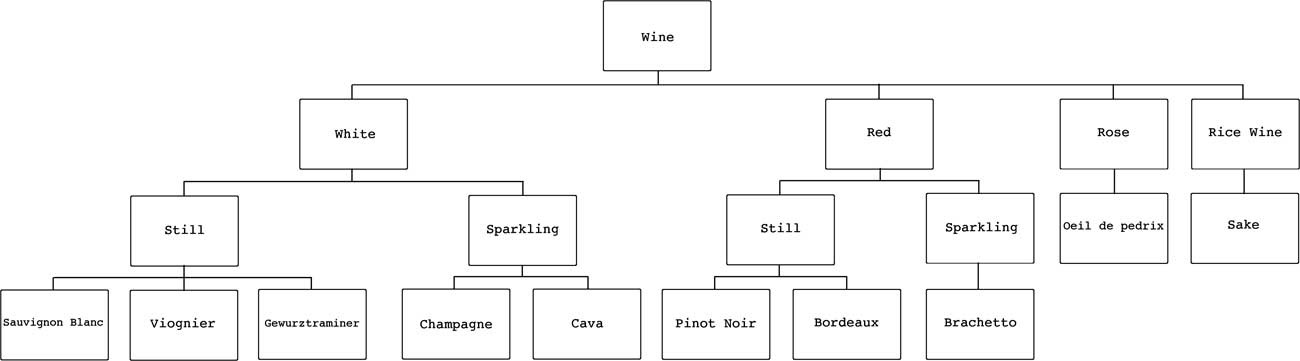
Taxonomy is a particular type of classification where it is relevant to investigate how classes are related to each other and, consequently, hierarchically nested sets of partitions are used. A tree-diagram can be used to clearly and simply demonstrate a hierarchical relationship. In this case, to keep from confusing the matter at hand, an unrelated example is used (figure 1). Equivalently, a taxonomy can be considered to group together similarities, as described in Rich’s definition where his explanation states that a taxonomy is:
a specific classification scheme that expresses the overall similarity between organisms in a hierarchical fashion. In the taxonomy, elementary similarities are first recognised and grouped into like populations (such as species or type); these populations are hierarchically nested into broader categories (such as genus, class, division, etc.), each group subsuming the lower level group immediately below it on the hierarchy. (Rich Reference Rich1992: 761)
Example hierarchy using unrelated subject matter.
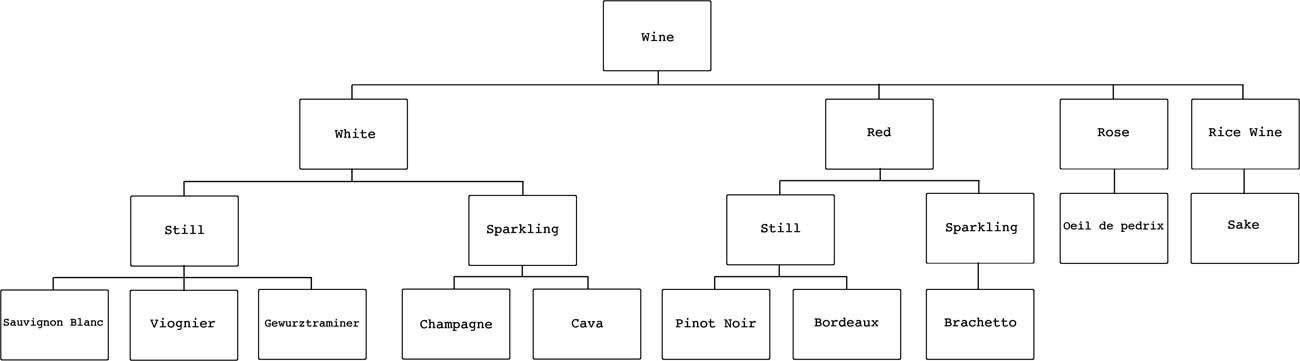
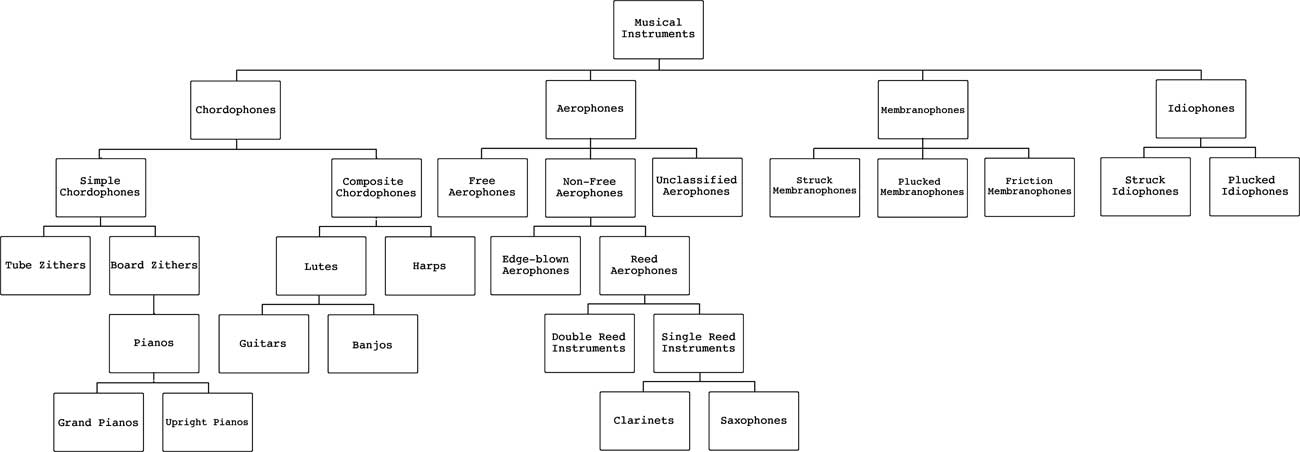
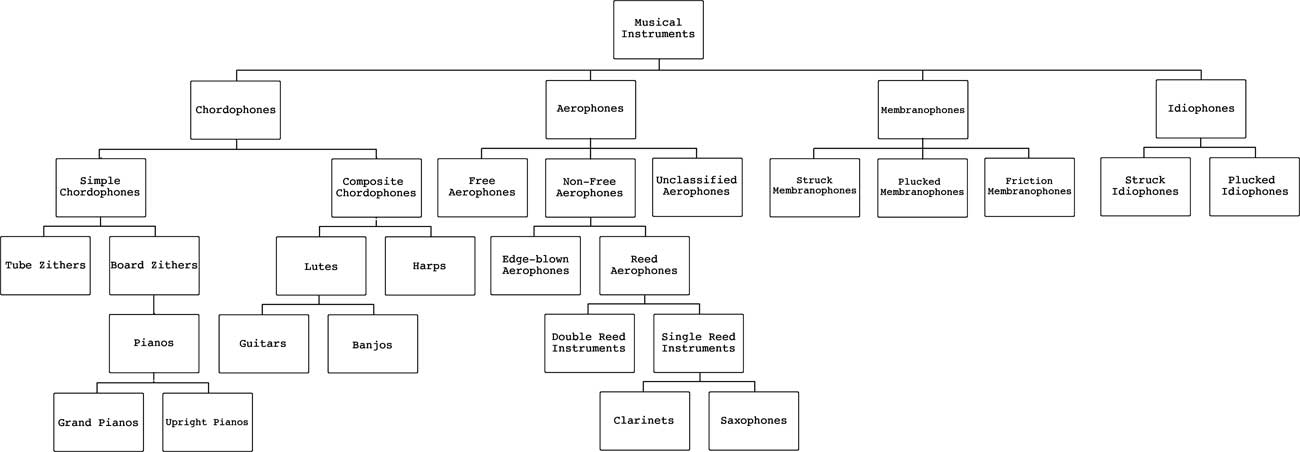
In practice the process of building a taxonomy will often involve elements of both approaches, looking to both for opportunities to group together instruments sharing common features and to divide larger categories. With this in mind, figure 2 shows a possible a tree-diagram for ‘traditional classical’ instruments (based on the Hornbostel–Sachs model).Footnote 12
Musical instrument hierarchy based on the Hornbostel–Sachs model.
Therefore, a taxonomical approach – whilst attractive and, I would argue, essential to the development of the much broader ontological methodology, since it provides the content of which the ontological framework is to be applied – is limited in terms of developing a deeper understanding of electroacoustic instruments by its own definition.
6.2. Ontologies
‘Ontology’ is the term used to refer to the shared understanding of some domain of interest which may be used as a unifying framework to solve … problems in the [appropriate] manner. [It] necessarily entails or embodies some sort of world view with respect to a given domain. (Uschold and Gruninger Reference Uschold and Gruninger1996: 5)
An ontological approach to the understanding of instruments would allow the recording of the electroacoustic instruments that have been built, determine their chronological placement and judge how ‘successful’ they were. It could also show why they were more or less successful, what family of instruments they fit into and how the composer–inventor has utilised aspects of previous instruments in the creation of his or her own. As such, they are all goals that should be aimed to be achieved. Such an approach could also be extremely useful in the design and development of new instruments as these composer–inventors, or other individuals interested in electronic instrument design, would be able to see exactly what makes an electroacoustic instrument desirable to other composers and more acceptable to the music-consuming public, and therefore have greater longevity within the field. Conversely, the knowledge could also be applied to create instruments that have a level of idiosyncrasy so great as to be completely undesirable to anyone other than themselves, thus serving a completely different aesthetic purpose.
6.3. The application of ontological and taxonomical approaches to the field
This discussion has clearly demonstrated the definite need for a more in depth knowledge base than currently exists to be developed for the survival and understanding of electroacoustic instruments, and that the application of taxonomical and ontological approaches to achieve this are desirable. There are, however, a number of problems which need to be recognised in order to categorise and understand ‘electroacoustic instruments’ before we can begin to create any meaningful information bank. One of these issues is deciding what constitutes an electroacoustic instrument. In the Call for Submissions for this issue of Organised Sound, for instance, it is made clear that it ‘is not possible to define “electroacoustic music” completely [since] we include all its many genres with their incompatible descriptors – acousmatic, live electronic, interactive, algorithmic, installation, glitch, post-laptop, live coding – you name it’. With this in mind, and with all of these different traditions to draw upon, how can we define the instruments that are used to make this vast range of styles of music that all find shelter underneath the electroacoustic umbrella?
A taxonomical approach allows for certain elements of the hierarchy to be developed more fully than others in a systematic way. Working, for example, from Davies’ existing work on the taxonomy of musical instruments, the overall domain could be defined to include all electrophones, but a given research project could decide to focus exclusively on the sub-domain of, say, electro-mechanical instruments. Researchers could also work relatively independently on instruments falling into different parts of a taxonomy to produce an overall knowledge base.
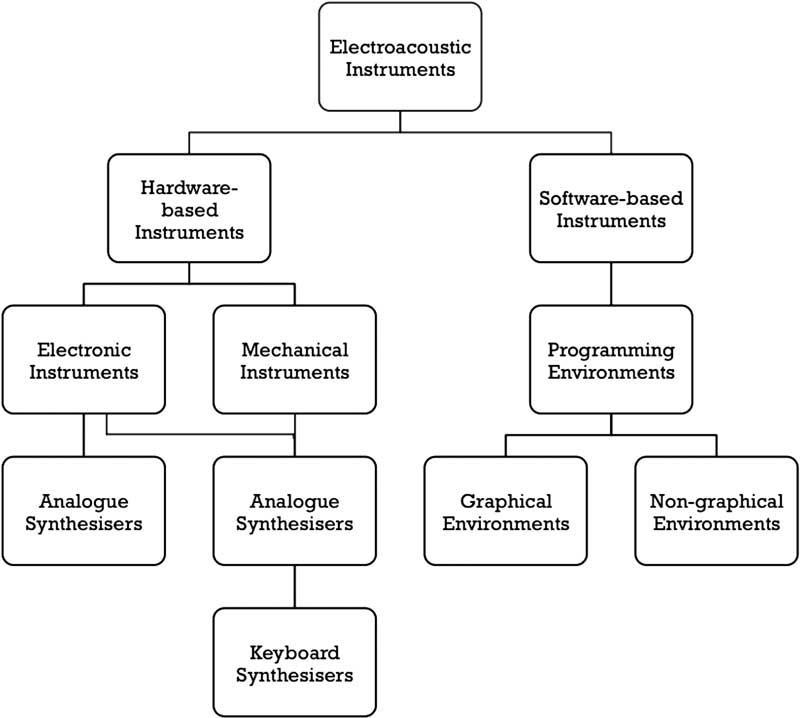
When deciding upon domains, the actual instruments are of little initial concern, but the nature of them, on the other hand, is paramount. It is the properties of instruments that will enable us to decide what instruments can be included and where to include them, observing, for example, such things as user interface, the way in which an instrument is able to be heard,Footnote 13 and whether the instrument is hardware or software based. Whilst a scoping study of existing instruments will need to be undertaken in order to take note of the different properties they display, the full assessment of the instruments can come at a later stage in the project. Therefore, once the domains have been set, instruments can then be inserted into them.
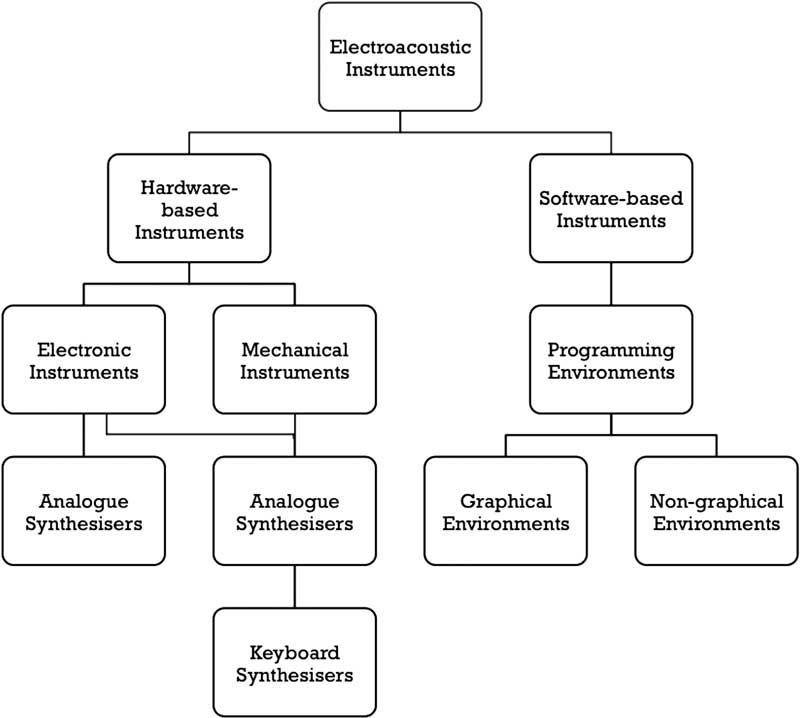
Figure 3 indicates how a preliminary tree-diagram of these initial domains could look.
Early stage electroacoustic instrument hierarchy.
Existing efforts in music ontologies for acoustic instruments actually deal with similar concerns to those presented here. Jordá (Reference Jordá2003) described ontological methods through visual feedback as a way to create ‘more intuitive, efficient and learnable instruments’, whilst Peeters (Reference Peeters2003: 1) addresses the ‘problem of classifying large databases of musical instrument sounds’. Concerns are therefore shared across the disciplines, and useful research done in one field can easily be mapped onto another, especially in the early stages of the development of the ontology.
The shared understanding that ontologies promote also helps to break down those barriers created by different researchers using a vast array of terminologies for what are essentially the same thing. Returning to Hugh Davies and his preferential use of the term ‘electronic’ rather than ‘electroacoustic’ as an umbrella for the whole range of instruments, an ontology would help to resolve this sort of disparity and research into these devices would take on a new level of clarity. This is achieved through improving communications between individuals and researchers and actually increasing the desire to have some form of unified approach to the field of study because the framework is in place to make such an endeavour that much easier. Today this is much easier than ever before thanks to the Internet and its continued development, and similar types of research can more easily be pooled and resources shared, meaning that less time is spent by people inadvertently covering the same ground when they ought to be working together, whereas they were not previously able to do so without some degree of difficulty. Information is both more quickly gathered and knowledge more in depth, theoretically displaying an exponential rise in the understanding of the data gathered in the early stages. It is understood that this situation is likely to diminish as the ontology becomes more complete.
6.4. Design criteria
Evidently, the design of an ontology is undertaken by a set of choices made by those involved in its construction and, therefore, criteria must inevitably be set. In designing an ontology that is to be applied to electroacoustic instruments, it is essential for the main criteria to include those problems and concerns that have already been discussed with regard to the understanding of the instruments themselves. But, in addition to this, we must also include criteria for setting out the way in which the knowledge is to be formalised within the ontology. An initial set of criteria would include, but not be restricted to:
• extensibility of the knowledge base; and
• ensuring clarity and coherence of information.
The more general criteria (above) inform the more specific (below) that are applicable to electroacoustic instruments as discussed in this paper:
• ensuring instruments are not lost;
• encouraging the re-use of instruments;
• enabling the use of instruments in terms of development purposes; and
• enabling the sharing of knowledge about instruments.
6.5. Domains
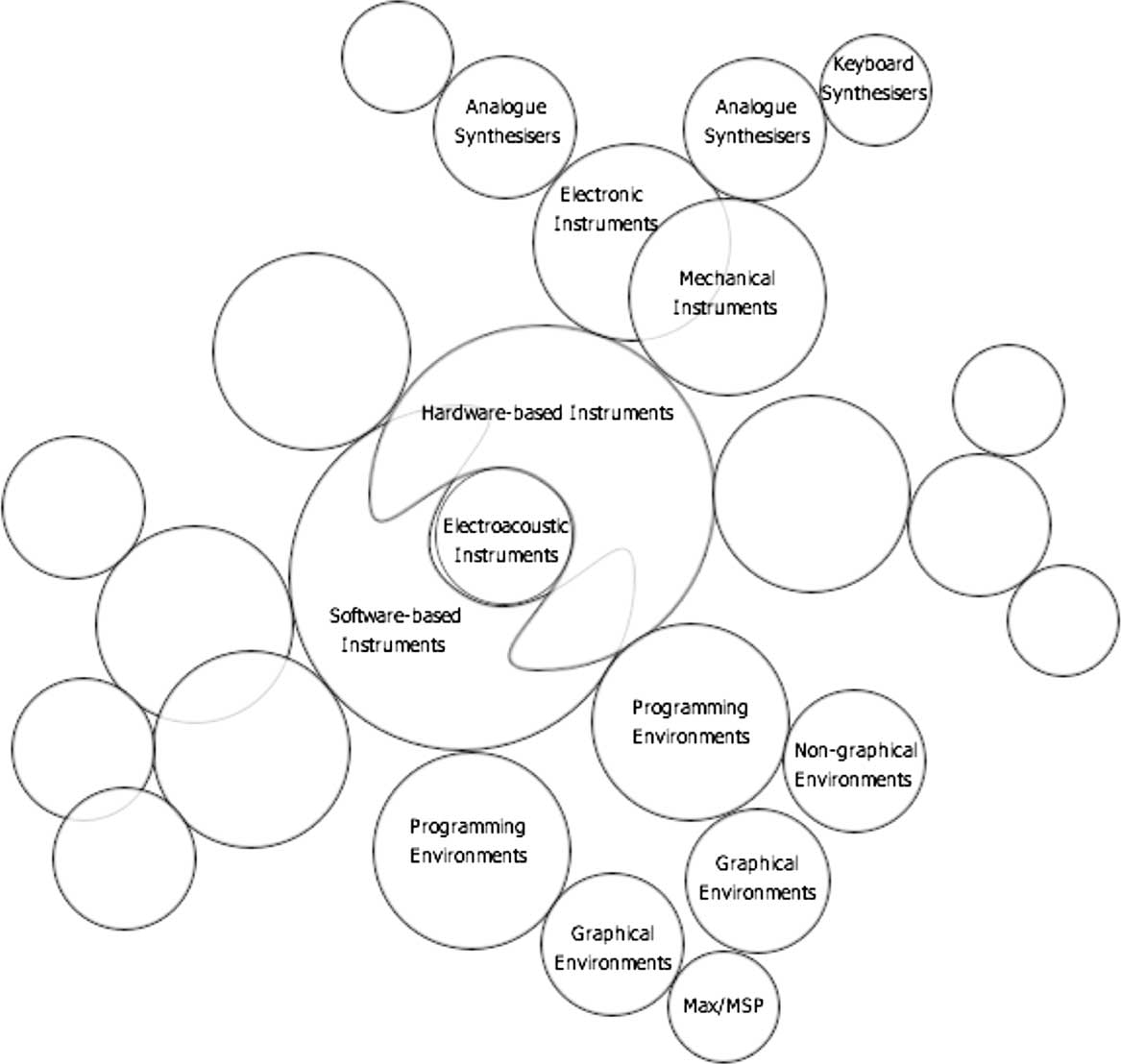
The domains for electroacoustic instruments can be set out on a basic level using a middle-out perspective, as suggested in Uschold and Gruninger (Reference Uschold and Gruninger1996), starting with ‘electroacoustic music’ as a whole, allowing for research in other aspects of the field to be incorporated at a later date, and working outwards from there. Setting ‘electroacoustic instruments’ as the domain that will be central to our concern, initial thoughts on the matter have led to initially moving outwards from here into two different areas: software-based instruments and hardware-based instruments. Domains overlap even at the earliest levels and it is anticipated that sub-domains will continue to do so as we work our way out to the instruments themselves, as is demonstrated in figure 4.Footnote 14
Early stage ontological model of electroacoustic instrument domains.
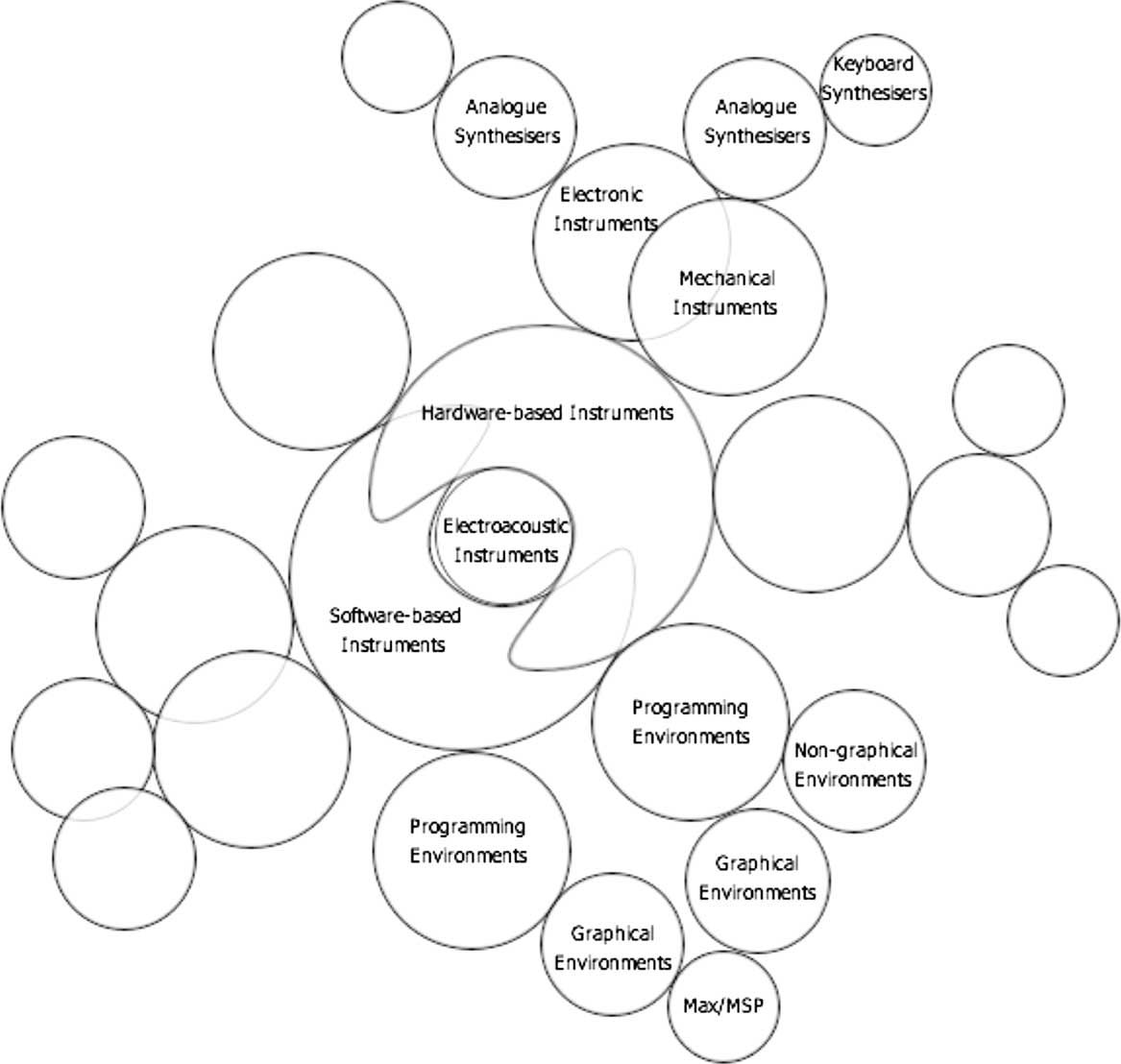
This is a very basic first look at the possible domains which could be included and the way that they interact with each other and their sub-domains. The final version would, of course, be much more in-depth and contain many more examples of domains before reaching the instruments themselves.
7. Emerging Thoughts
The development of an ontology for electroacoustic instruments requires that we first lay out a framework in which to work. There is not, at present, one standard methodology for the building of new ontologies. Lessons can be learnt, however, from the study of other completed ontologies, and ontologies in a wide range of fields should be studied to best inform the development of this project.
In respect to the scope of the project, and due to the nature of the ontological process, it is my hope that through this research and similar projects being carried out by other scholars that we will ultimately see a participatory system for collecting detailed information on instruments. Using this research as a base, I hope to be able to create a system to classify them, with the possibility of some form of physical repository for certain instruments. This repository need not be a single, centralised facility but could, in fact, be made up of the collections housed in various museums and institutions worldwide, brought together by the central web portal. Through the involvement of the wider community of electroacoustic composers and inventors, the information stored on instruments would grow via contributions to the central online database and this information in turn could be used to assess the possibility of the acquisition of a physical example of an instrument by one of the participating museums or institutions.
Initial work on the database in defining domains and sub-domains would provide a model for contributors that could be opened up to other electroacoustic institutions for further development, and through appropriate funding and advertising would eventually reach a point where the resource was actually serving the electroacoustic community. This is, evidently, a long-term project that is only in its very early stages of planning and is not something that can be realised overnight.
8. Conclusions
In outlining the potential loss of instruments and compositions, and hence the loss of the creative potential contained therein, the paper has demonstrated the clear need for knowledge bases of electroacoustic instruments to be developed. The paper outlines the benefits of adopting formal ontological and taxonomical approaches to this study and highlights some emerging thoughts that should be taken into consideration in this work. Further research is needed to develop these knowledge bases and to halt the extinctions occurring in the instrument zoo.