Over the last 30 years, advances in the diagnosis of and medical and surgical treatment for CHDs have resulted in dramatic increases in the survival of affected patients into their teenage and adult years. However, prolonged survival has carried with it significant morbidities, particularly among patients having the most complex defects. This includes sudden death, nearly always due to sudden tachyarrhythmias.
The reported incidences of sudden death among patients having undergone surgery for CHDs ranges from 0.9/1000 patient-years (or 0.9%/decade) in a paediatric and adult series from Oregon, United States of America,Reference Silka, Hardy, Menashe and Morris 1 to 5.3/1000 patient-years in a pure adult population in Canada.Reference Harrison, Connelly, Harris, Luk, Webb and McLaughlin 2 This compares to 180,000–250,000 sudden deaths/year in adults in the United States of America, or about 0.5/1000 patient-years in western countries.Reference Chugh, Jui and Gunson 3 , Reference Vaillancourt and Stiell 4 On the other hand, young patients having hypertrophic cardiomyopathy are reported to have a sudden death incidence of 27/1000 patient–years,Reference Yetman, Hamilton, Benson and McCrindle 5 and those having long QT syndrome have an incidence of 1–28/1000 patient-years.Reference Goldenberg and Moss 6
Considering all causes of death in patients with CHD, sudden death comprised 15–26%, congestive heart failure 13–27%, other cardiac causes, especially thromboembolic, 31–35%, and non-cardiac causes 8–23%, in four large series comprising over 1152 deaths from among >19,000 subjects over epochs from years 1953 to 2009.Reference Silka, Hardy, Menashe and Morris 1 , Reference Nieminen, Jokinen and Sairanen 7 – Reference Verheugt, Uiterwaal and van der Velde 9
Clinical variables associated with sudden death in adults having CHD
It is increasingly well established that features of cardiac electrical and mechanical stress interact and play a role in potentially lethal tachyarrhythmias. Prolonged QRS duration, prolonged QT interval dispersion, and moderately to severely diminished sub-aortic and sub-pulmonic ventricular systolic dysfunction are associated with risk. In a series of 936 adults who were operated upon as children for CHD, the hazard ratio for freedom from sudden cardiac risk was 29 (95% confidence interval (CI), 11–76) in patients having systemic ventricular dysfunction versus those who did not.Reference Gallego, Gonzalez and Sanchez-Recalde 10 In a patient cohort in which implantable cardioverter–defibrillators were placed for either primary or secondary prevention, appropriate device discharge was statistically more likely in those whose devices were placed for secondary prevention, in those having concomitant coronary artery disease, and in those having non-sustained but symptomatic ventricular tachycardia.Reference Koyak, de Groot and Van Gelder 11
In a retrospective single-centre experience, Alexander et alReference Alexander, Walsh, Saul, Epstein and Triedman 12 examined the role of electrophysiologic testing in 130 patients having a variety of surgically treated CHDs, including tetralogy of Fallot in 33%, d-transposition of the great arteries (atrial switch) in 25%, and left ventricular outflow obstruction lesions in 12%. The authors identified as indications for study non-sustained ventricular tachycardia (or worse) or concerning symptoms. In all, 32% of patients had inducible supraventricular tachyarrhythmias. By multivariable analysis, induction of ventricular tachycardia or fibrillation during ventricular programmed stimulation was found to be associated with a sixfold risk for non-survival and a threefold risk for clinical “serious arrhythmia”. The results of ventricular extra-stimulus testing was 87% sensitive for predicting mortality, but there was a 33% false-negative rate for clinical ventricular tachycardia.
Tetralogy of Fallot
This lesion complex has a prevalence of 0.356/1000 live births, making it the most common cyanotic heart defect.Reference Hoffman and Kaplan 13 Combined with surgical survival rates exceeding 99%, there is a large population of patients of nearly all ages living with this condition. Several features of this condition and its surgical treatment potentiate haemodynamic abnormalities, which in turn may play a role in arrhythmogenesis: a minority of infants cannot undergo primary repair and require placement of a systemic-to-pulmonary shunt to augment pulmonary blood flow, resulting in left heart volume overload; the majority of patients undergoing definitive repair require a transannular right ventricular outflow tract patch, resulting in pulmonary valve insufficiency and right ventricular volume overload; and all patients require placement of a patch to close the ventricular septal defect and sub-pulmonic resection of obstructing muscle bundles, resulting in regional scar formation and usually right bundle branch block.
In a patient series ranging from 163 to 793 patients, with a mean follow-up of 22 to 30 years, the incidence of sudden cardiac death was reported to be 1.2–3.0/1000 patient-years (or 1.2–3.0%/decade),Reference Silka, Hardy, Menashe and Morris 1 , Reference Gatzoulis, Balaji and Webber 14 – Reference Norgaard, Lauridsen, Helvind and Pettersson 17 which is lower than that of patients who had undergone atrial switch operation for d-transposition of the great arteries, surgical repair of left ventricular outflow tract disease, and possibly patients having single-ventricle variants.Reference Silka, Hardy, Menashe and Morris 1 , Reference Gallego, Gonzalez and Sanchez-Recalde 10
Efforts at identifying patients having tetralogy of Fallot who are at increased risk for sudden death date back to the 1970s and constitute an odyssey of sorts. Originally, sudden death was thought to be due to sudden complete heart block in patients having post-operative right bundle branch block, left axis deviation, and first-degree atrioventricular (AV) block. This has been shown to not be the case. In the 1980s, autopsy series showed regions of local fibrosis related to surgical scars and also diffuse fibrosis, especially in patients who had undergone surgical repair at older ages. Also during this period, correlations of sudden life-threatening events with holter-derived high-grade ventricular ectopy, exercise-induced ventricular ectopy, and inducible ventricular tachycardia during electrophysiologic testing were first being considered. The notion that the post-operative haemodynamic status could play a role in dangerous ventricular arrhythmias was first shown in a dog model of tetralogy of Fallot.Reference Dreyer, Paridon, Fisher and Garson 18
The modern era of risk analysis in patients with tetralogy of Fallot began in 1995 with Gatzoulis’ discovery that a QRS duration >180 ms (in patients with post-operative right bundle branch block) had a high predictive accuracy in identifying patients who would suffer sudden cardiac arrest.Reference Gatzoulis, Till, Somerville and Redington 19 This seminal discovery was subsequently confirmed by other investigators and continued the theme of electrical–mechanical interactions playing a role in dangerous arrhythmogenesis, as there was a striking correlation between the QRS duration and the cardiothoracic ratio on chest radiography. Subsequently, it was shown that a rapid rate of increase in QRS duration may be of even greater importance in identifying those at risk. In 2008, using modern statistical methods, Khairy et alReference Khairy, Harris and Landzberg 20 reported the first scoring system to determine risk, based upon an ambispective study of 121 tetralogy of Fallot patients who had already undergone implantable cardioverter–defibrillator implantation. Though flawed by the obvious selection bias, this experience brought to light the adverse influences of elevated left heart filling pressures and prior systemic-to-pulmonary arterial shunts. Using newer diagnostic modalities, additional electrical and pathological characteristics are also being discovered that may help refine risk assessment, including cardiac MRI-determined right ventricular fibrosis, fragmentation of the terminal portions of the QRS in the right precordial leads, increased QTc dispersion, increased myocardial sympathetic innervation by metaiodobenzylguanidine scanning, and reduced parasympathetic tone by heart rate variability analysis.
Electrophysiologic testing has a clear role in risk assessment in some patients following repair of tetralogy of Fallot. The largest report of the value of such testing was from a multicentre experience that included 252 patients whose clinical outcomes were evaluated an average of 6.5 years following electrophysiologic testing and 18.5 years after surgery.Reference Khairy, Landzberg and Gatzoulis 21 Indications for testing included “screening” in 36.9%, palpitations in 27.7%, syncope in 23.6%, clinical sustained ventricular tachycardia in 16.7%, and resuscitated sudden cardiac arrest in 1.2%. Independent predictors of inducible sustained ventricular tachycardia included age at testing of at least 18 years (odds ratio (OR)=3.3), history of having undergone prior systemic-to-pulmonary artery shunt (OR=2.8), history of palpitations (OR=3.1), modified Lown score for ventricular ectopy by ambulatory rhythm monitoring of >2 (OR=5.6), and cardiothoracic ratio by chest radiography of >60% (OR=3.3). The primary endpoint of sustained ventricular tachycardia or sudden cardiac death occurred in 24.6% of patients. This study illustrated that testing has excellent negative predictive value (92%) and fair positive predictive value (55%), which is improved (to 67%) by selecting symptomatic patients. Induction of sustained polymorphic ventricular tachycardia was the most highly predictive of long-term events. In our own practice, we consider electrophysiologic testing in any patient who has had syncope, episodes of concerning palpitations, or in those with any two of the following: high-grade (>Lown 2) ventricular ectopy, poor left ventricular function, and a QRS duration >180 ms.
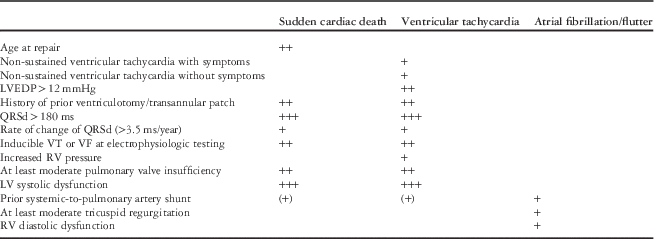
A summary of associations with arrhythmias, including atrial arrhythmias, in this patient group appears as Table 1.
Associations with arrhythmias following surgical repair of tetralogy of Fallot.

LV=left ventricular; LVEDP=left ventricular end diastolic pressure; QRSd=QRS duration; RV=right ventricular; VF=ventricular fibrillation; VT=ventricular tachycardia
In nearly all reports that are concerned with ventricular arrhythmias or sudden death in patients having tetralogy of Fallot, monomorphic ventricular tachycardia usually has been considered to have equivalence with sudden cardiac arrest, either as a clinical phenomenon or as an outcome from electrophysiologic testing. We do not agree with that notion in the presence of preserved ventricular function and when the tachycardia is relatively slow (<200 bpm). Such patients typically present conscious and haemodynamically compensated, at least for the immediate term. Treatment decisions may even include catheter ablation without implantation of an implantable cardioverter–defibrillator, so long as follow-up electrophysiologic testing is performed and is negative. However, this approach is not appropriate in patients having chronically reduced ventricular function.
It is often considered that after procedures are performed that improve the haemodynamic status of tetralogy of Fallot patients, risk for ventricular tachycardia and sudden death is also reduced. Although it may be the case that the QRS duration may shorten, at least transiently, after pulmonary valve replacement for severe pulmonary valve insufficiency,Reference Ferraz Cavalcanti, Sa and Santos 22 this may not translate to risk reduction of dangerous ventricular tachyarrhythmias. In a case–control study by Harrild et alReference Harrild, Berul and Cecchin 23 of 77 patients who received late pulmonary valve replacements for right ventricular dilation, there was no reduction in the incidence of ventricular tachycardia or sudden death at follow-up. Therefore, among patients who have had clinical ventricular tachycardia or resuscitated sudden cardiac arrest and who also are in need of pulmonary valve replacement, delay in definitive therapy for the arrhythmia until after “mechanical remodelling” occurs may not be appropriate.
d-transposition of the great arteries
In this severe CHD, there is ventriculo-arterial discordance in the presence of ventricular dextro (“d”) looping. Immediately at birth and at closure of the patent ductus arteriosus, closure of the foramen ovale, and conversion from a placenta (and umbilical vein)-based oxygen source to an intrinsic lung (and pulmonary venous return)-based oxygen source, the circulations become parallel with intense and eventually fatal systemic hypoxemia. Between the early 1960s and the late 1980s, the therapeutic strategy for these patients was creation of a large atrial-level communication at birth that would allow sufficient mixing of venous returns to sustain life until a surgical procedure, usually occurring at a few months to a few years of life, could be performed that would direct the venous returns to the opposite AV valves. Eponymously referred to as the Mustard and Senning operations, they result in extensive atrial surgical scar, possible damage to the sinoatrial node or its arterial supply, and possible reduction in normal atrial mechanical transport capacity. In summary, these hearts will have been exposed to months-to-years of muscle hypoxia, extensive atrial surgical scar, sinus bradycardia, and systemic afterload to the morphological right ventricle. It is no wonder that these patients are at risk for sinus node dysfunction, paroxysmal atrial re-entrant tachycardias, and ventricular tachyarrhythmias.
On the basis of 1862 patients and 18,677 patient-years of follow-up from seven reports, we find that the incidence of sudden cardiac death in this patient group is 5.6/1000 patient-years – or 5.6%/decadeReference Silka and Bar-Cohen 24 – an especially high incidence. In a case–control study of 47 sudden death or near-miss sudden death patients by Kaameraad et al,Reference Kammeraad, van Deurzen and Sreeram 25 significant associations included the prior occurrence of any arrhythmic symptoms, prior congestive heart failure, use of cardiac medications, and documented atrial flutter or fibrillation at follow-up. The latter is especially pertinent, insofar as the systemic right ventricle and its coronary artery perfusion seem to be especially intolerant of reduced diastolic filling times. There have been tragic reports of atrial flutter with 2:1 conduction changing to 1:1 conduction, presumably as intrinsic catecholamine levels rise, which in turn evolves into ventricular tachycardia and fibrillation. Aggressive management of atrial flutter in this patient group, be it pharmacologic, control of AV node conduction, or ablative, seems especially prudent.
In a multi-institutional, retrospective cohort study of 37 adult Mustard/Senning patients who had undergone implantable cardioverter–defibrillator implantation, with 23 being for primary prevention, significant associations with appropriate implantable cardioverter–defibrillator discharge by multivariable analysis were for the following: implantation for secondary prevention (hazard ratio=18 (95% CI 1.2, 261), p=0.034) and absence of β-blocker therapy (16.7 (1.3, 185.2), 0.03).Reference Khairy, Harris and Landzberg 26 Of note, unlike the tetralogy of Fallot population, programmed ventricular stimulation was not predictive in the transposition group. The authors stated that a history of supraventricular tachycardia may also be implicated. Intuitively, β-blocking medications reduce the ventricular response to atrial flutter and may be helpful in those having coincident ventricular dysfunction. Though this paper was not powered to consider haemodynamic factors, it is also clear that Mustard/Senning patients having very reduced right ventricular systolic function and tricuspid valve regurgitation may be at particular risk for sudden death. We have borrowed from the adult experience with patients having ischaemic and non-ischaemic cardiomyopathies and generally implant implantable cardioverter–defibrillators in patients having right ventricular ejection fractions less than 35%.
Since the late 1980s, the preferred surgical approach for d-transposition is the arterial switch operation. This procedure includes transferring the coronary arteries, and the surrounding buttons of the aortic wall, from the native aortic root to the neo-aorta. Although coronary occlusion is the major source of early postoperative death, the incidence of late sudden death is <1% at >18 years – this, despite the fact that asymptomatic coronary occlusion occurs in 2–7% of patients.Reference Villafane, Lantin-Hermoso and Bhatt 27 Before sports participation, young patients having undergone the arterial switch operation are advised to undergo extensive testing, including cardiopulmonary exercise testing and cardiac MRI, to evaluate for signs of coronary insufficiency, and an exercise test should be repeated every 2 years.Reference Takken, Giardini and Reybrouck 28 Tests having higher sensitivity for stress-induced ischaemia (adenosine-MRI, exercise-radionuclide scan, dobutamine echo) or for anatomic definition (computerised tomography or coronary arteriography) are relegated for patients with positive screening tests and for those with especially worrisome symptoms.
Left ventricular outflow tract obstructive lesions
Although this category of CHD includes a variety of lesions, the most important for this discussion is congenital aortic valve stenosis. Like other valvular defects, there is a spectrum of severity, and the degree of severity may worsen, resulting in worse obstruction, development of valvular insufficiency, or both. Therapy may include interventional catheterisation-based procedures, but almost invariably surgical intervention is required for the more severe lesions. Of course, this discussion will change, as transcatheter aortic valve replacement technologies progress.
It has long been thought that the combination of increased wall stress from pressure and/or volume overload plus any surgical scar would be a recipe for arrhythmogenesis in this disease. In the Second Natural History Study of Congenital Heart Defects, published in 1993, follow-up was from among the 2408 patients included in the First Natural History Study (who had been enrolled from 1958 to 1969), all of whom had valvar pulmonic stenosis, ventricular septal defect, or valvar aortic stenosis.Reference Wolfe, Driscoll and Gersony 29 Sudden unexpected death was highest in the aortic stenosis group at 5.4%, compared with 0.5% for pulmonic stenosis and 4.4% for ventricular septal defects. Moreover, the incidence of serious ventricular arrhythmias, liberally defined as couplets, multiform premature ventricular beats, or ventricular tachycardia, was 45% compared with 30 and 31%, respectively. This incidence was higher in those patients who had undergone surgery than in those who had not. Similar results were found in Silka’s report of sudden death incidence in patients having CHD.Reference Silka, Hardy, Menashe and Morris 1 Those having aortic stenosis had the highest incidence at 5.4/1000 patient-years (or 5.4%/decade), and those having coarctation of the aorta had an incidence of 1.3/1000 patient-years. Not all sudden deaths were arrhythmic; thromboembolism and aortic dissection also occurred. In the modern epoch, 422 patients who had undergone balloon valvotomy for aortic stenosis were reported by Brown et al.Reference Brown, Dipilato and Chong 30 The incidence of sudden death was much lower, at 0.18/1000 patient-years (or 0.18%/decade) among those older than 4 years (only one death), athough the rate was higher among infants. Risk factors included multiple obstructive lesions and pulmonary hypertension. Interestingly, there was no difference in risk among those who were exercise-restricted compared with those who were not. This report reminds us of the impact that later surgical interventions may have on sudden death risk.
Published guidelines provide guidance regarding sports participation in patients having unrelieved aortic stenosis. It is the other patient groups for whom risk and risk prevention remain most problematic, even in the modern era: patients who have mixed aortic valve disease (stenosis and insufficiency) but not of such severity that surgery is warranted; patients who have undergone valve repair or replacement, who have seemingly good haemodynamics, but who have ventricular ectopy, especially during exercise testing; and patients with symptoms of palpitations or syncope but good haemodynamics and negative exercise testing and holter monitoring.
Single-ventricle variants
This patient population comprises a number of disparate lesions, chiefly hypoplastic left heart syndrome, tricuspid atresia, double-inlet left ventricle, unbalanced AV canal defects, and severe heterotaxies. The long-term goal for these patients is to surgically connect the entire systemic venous return to the pulmonary arteries and separate the pulmonary arteries from the heart, leaving the heart as the pulmonary venous receptacle and systemic arterial pump. This can only be accomplished after the pulmonary vascular bed has matured, thus requiring one or more preliminary operations in most cases. The final circulation, referred to as a Fontan operation, is notable for gratuitously elevated systemic venous pressure, an absent pulmonary artery pump, but normal or near-normal systemic arterial saturation. The history of these operations and the myriad haemodynamic, rheologic, thrombotic, and arrhythmic consequences are beyond the scope of this review. However, compared with the other lesions and their surgeries previously discussed, sudden death after the Fontan operation is not always arrhythmic. Thromboembolic events are also important.
The incidence of sudden death after the Fontan operation has been reported to be 3.7/1000 patient-years (3.7%/decade) in Gallego’s series from Spain,Reference Gallego, Gonzalez and Sanchez-Recalde 10 higher than that of any other group, except for the Mustard/Senning patients. In the Boston experience of 261 patients at median follow-up of 12.2 years, there were 76 deaths, but only seven were sudden; all of them occurred in the first 7 years.Reference Khairy, Fernandes and Mayer 31 Although there are few reports on this subject, newer information should be increasingly available, because patient survival after surgery has improved more for this family of congenital lesions than for all others in the last 10–20 years.
Implantable cardioverter–defibrillators
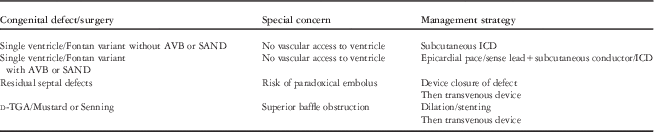
Patients having CHD and arrhythmic sudden death are as responsive to direct current conversion or defibrillation as any other patient group. Patient survival has improved as freedom from appropriate implantable cardioverter–defibrillator discharge has fallen in appropriately selected groups, especially in those who were implanted for secondary prevention.Reference Silka, Kron, Dunnigan and Dick 32 Although the majority of this review has been concerned with identifying risk factors for sudden death in patients having specific CHDs, there are challenges in device implantation in many patients related primarily to anatomic considerations. Improvements in subcutaneous implantable cardioverter–defibrillator technology will especially benefit some of these patients. In Table 2, issues related to implantable cardioverter–defibrillator implantation according to congenital heart surgery type are provided.
Implantable cardioverter–defibrillator (ICD) use following congenital heart surgery: special considerations.

AVB=atrioventricular block; d-TGA=d-transposition of great arteries; SAND=sinoatrial node dysfunction
Conclusions
It is only in the last few years of human history that there are more adults living with CHD than there are children. This is a testament to the extraordinary advances in medical and surgical technology. With these accomplishments comes the responsibility of anticipating the sequelae of medical and surgical interventions as well as the natural history of the disease. This includes identifying risk factors for sudden death, mitigating those risk factors, and, when necessary, providing primary prevention. We are only now meeting those goals to variable degrees, related to disease prevalence, changes in surgical outcomes, anatomic limitations, and the parallel advances in pharmacologic and device technologies.
Acknowledgements
None.
Financial Support
This research or review received no specific grant from any funding agency or from commercial or not-for-profit sectors.
Conflicts of Interest
None.
Ethical Standards
The authors assert that all referenced work contributing to this review complies with the ethical standards of biomedical or medicolegal investigation.