


Sexism and misogyny impose a drag on women’s ability to thrive in many arenas. These barriers are especially pervasive in economics and politics. Women and men participate in distinct labor sectors (Iversen and Rosenbluth Reference Iversen and Rosenbluth2006) and women earn less than men (Blau and Kahn Reference Blau and Kahn2003). Women are likewise underrepresented in political office (Dahlerup Reference Dahlerup2006; Inglehart and Norris Reference Inglehart and Norris2003; Paxton, Hughes, and Barnes Reference Paxton, Hughes and Barnes2020), which can yield worse policy outcomes for women (Brule Reference BruleForthcoming; Chattopadhyay and Duflo Reference Chattopadhyay and Duflo2004; Kittilson Reference Kittilson2008; Schwindt-Bayer and Mishler Reference Schwindt-Bayer and Mishler2005; Wängnerud Reference Wängnerud2009). In this manuscript, we identify a previously unacknowledged fiscal policy that directly affects women—the setting of import tariffs for gendered goods. These import taxes, which can vary across otherwise identical gendered apparel items (e.g., “women’s cotton shirts” and “men’s cotton shirts”), often impose penalties on women as consumers.Footnote 1 Comparing nearly 200,000 pairs of tariff rates on men’s and women’s products across 167 countries, we observe that imports of women’s goods, on average, are taxed 0.7% more than imports of men’s goods. These tax penalties, which compound through the transactions of wholesalers and retailers, are a powerful antecedent to the widespread end-point price discrimination suffered by women, known as the “pink tax.”
We describe this previously overlooked form of gender-based governmental discrimination and then ask whether increasing women’s political power can mitigate this penalty. Since legislatures ultimately control import tax schedules in most democracies (Nielson Reference Nielson2003), we posit that having more women representatives increases the probability that this import tax discrepancy is recognized and provides women with sufficient political power to remedy the issue. Our empirical analysis provides evidence for this claim. In democracies, equal representation of women would reduce the annual tax penalty on women by an average of $324 million per country and $15 billion across countries. This finding is robust to an array of modeling choices. It is further supported by a comparison of democracies with non-democracies (where legislators play a more limited role) and analyses examining the effect of gender quota implementation. Our work thus reveals a form of gender discrimination that affects women on a daily basis, while also providing powerful evidence that descriptive representation has a substantial policy impact.
The Pink Tax on Imported Goods
Gendered price discrimination in consumer goods, popularly referred to as the “pink tax,” is widespread. A recent report commissioned by New York City found that gendered price differentials manifest in about 60% of products and, given a gendered differential, the women’s product is 233% more likely to bear the premium (Bessendorf Reference Bessendorf2018). Notably, there have been some efforts to alleviate this economic penalty. In 1995, California approved legislation that forbade price discrimination by gender (Jacobsen Reference Jacobsen2018). More recently, in April 2019, Congresswoman Jackie Speier introduced the Pink Tax Repeal Act in the U.S. House of Representatives. Beyond the U.S., there have been efforts to address product-specific pink taxes—particularly on feminine hygiene products—in Canada, Colombia, Germany, India, and Kenya (Childs and Withey Reference Childs and Withey2006; Yazıcıoğlu Reference Yazcoğlu2018).
Despite growing interest among journalists, policy makers, and women’s rights advocates, political scientists and economists have paid little attention to the pink tax. This may be due to the assumption that, like other forms of price discrimination, it results from the market behavior of firms and consumers, including variation in men’s and women’s willingness to pay. In contrast, we posit that the pink tax can be shaped by central government policy. Because many consumer goods are imported from abroad, trade policy influences domestic prices and affects consumers directly (Baker Reference Baker2005). Governments can contribute to gendered price discrimination through distinct tariff rates on men’s and women’s products: products that are essentially identical in form, save for the gender of their target consumer. Higher import taxes on women’s versions of goods are in turn passed on to wholesalers, then retailers, and finally imposed upon women consumers.
To determine whether governments discriminate against women when setting tariff schedules, we gathered applied tariff rates from the World Integrated Trade Solution project. These data catalog tariff rates for over 5,000 products according to the Harmonized Commodity Description and Coding Systems (HS). The HS is created by the World Customs Organization, and virtually all governments rely on a version of the HS for legislating tariff rates and taxing imports; 98% of world trade passes through countries that use the HS for classifying trade flows.Footnote 2
We exploit the HS’s unusually sharp distinction between otherwise identical men’s and women’s apparel, the only category where it differentiates products by gender. The HS, for example, provides individual codes on swimwear “of textile materials (other than synthetic fibres), knitted or crocheted” for men (code 611239) and women (code 611249). Similarly, it distinguishes between coats, jackets, shirts, trousers, bath robes, and pajamas intended for men versus women. In total, we identify 78 product pairs of identical style and material that differ only in whether they are marketed toward men or women and on which governments can impose different tariff rates within the confines of the HS as the international standard.Footnote 3 Our main variable, the pink tax, is the difference in the tariff rate within these matched product pairs. Larger values indicate a greater tax on women. Because we use applied tariff rates, our measure also reflects the different rates set for different trade partners, which can cause inequities in the de facto tariff burden created by government policy.
To help describe our data, Figure 1 displays the import tax rates on a selection of products for the United States and Switzerland in 2010. A few points are noteworthy. First, the overall magnitude of import taxes varies. In this case, the U.S. taxes more than Switzerland on average. Second, there is substantial gendered variance even within narrowly defined product categories. In the United States, coats have one category (cotton) with nearly equivalent tax rates, another (other materials) favoring women, and yet another (man-made fibres) favoring men. Third, even within a single chapter, gender differences can range from null (cotton jackets in Switzerland) to a penalty of 500% or more (shirts of “other materials” in Switzerland).
Example of Tariff Differentials on a Selection of Familiar Products in the United States and Switzerland
Note: Selected products from chapter 61, apparel and clothing accessories, knitted or crocheted. Applied tariff rates, in 2010, from WITS.

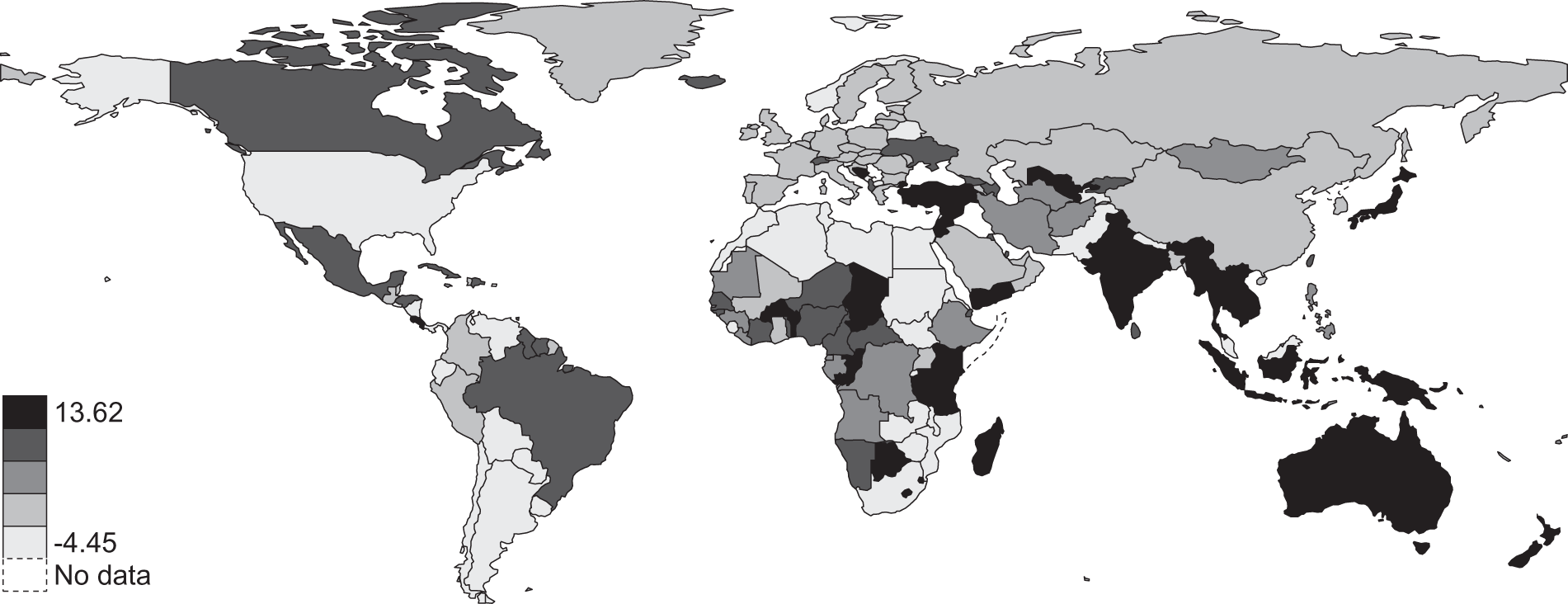
Figure 2 shows the average tariff differential for all products in all years by country, where darker shading represents higher pink tax rates. Overall, nearly 40% of product pairs have tariff differentials. And while many men’s products face higher tariff rates, on average women’s products bear a higher premium. In several countries, including wealthy democracies such as Canada and Japan, women are disadvantaged on more than 50% of product pairs.Footnote 4 Across all countries, the average pink tax is about 0.7%.
Average Pink Tax in Tariff Rates Across Apparel Products
Note: Authors’ calculations, based on applied tariff rates on apparel products, from WITS.
Women’s Numeric and Policy Representation
What explains gender disparities in tariff rates? The paired products we examine are typically produced by the same firms, or firms within the same industry, with the same basic materials. Standard theories of trade, including firm-, industry- or endowment-based theories, do not account for these discrepancies. For example, though women are disproportionately employed in the apparel industry—and governments have long sought to protect apparel products (as evident in the Multi Fibre Arrangement)—such protections should apply to both men’s and women’s apparel. Relatedly, while women are more likely than men to favor protectionism (Guisinger Reference Guisinger2017; Mansfield, Mutz, and Silver Reference Mansfield, Mutz and Silver2015), this preference should extend to both product types. Finally, although changes to the tariff schedule can have meaningful revenue consequences for governments (Bastiaens and Rudra Reference Bastiaens and Rudra2018), there is no obvious fiscal justification for imposing gendered tariff rates of the kind displayed above.Footnote 5 As early as 1960, a report to the U.S. government observed that these “[gender] distinctions are often difficult if not impossible to make and their economic justification is questionable” (United States Tariff Commission 1960).
We posit that in representative democracies women’s presence in—or absence from—elected office affects gender discriminatory tariffs. Import taxes are product specific and extraordinarily malleable. Importantly, legislators must consent to import tax changes either explicitly or implicitly. In presidential systems, legislatures often have monopoly control over the proposal, scrutiny, and passage of tax laws. Even where executives enjoy proposal rights, their bills must face legislative review before approval.Footnote 6 In parliamentary systems, cabinet proposals are likewise subject to parliamentary scrutiny and approval, and the cabinet is ultimately accountable to the legislature.Footnote 7 Lawmakers can thus either act directly to change tariff rates or hold governments accountable for proposals that perpetuate inequalities.
Given that representatives influence the tariff schedule, we expect that women’s presence in democratic legislatures is associated with lower levels of tax discrimination. The effects of women’s descriptive representation can be fourfold.
First, if a pink tax is in place, women in parliament bear direct costs of that discrimination and have a self-interested motivation to reduce tariff discrepancies. Consider, for example, historically contingent inequities that need political action to be removed, as is the case for the varying tariff rates on men’s and women’s products in Switzerland. Gender differences arose in part because Swiss import taxes on clothing were originally based on weight rather than price. Women’s clothing was lighter relative to its price, and the tax on women’s apparel was increased to bring the weight-based tax revenue in line with the revenue that would be generated by price-based taxes, in an attempt to avoid gender inequities in tariffs. The policy remained, but clothing changed. Women’s and men’s apparel is now often of similar weight and identical material. The once “gender-neutral” trade policy thus created a pink tax. Women parliamentarians in Switzerland, including National Councilors Jacqueline Fehr and Margrith von Felten, advocated for the elimination of this discrepancy. In 2000, in response to a parliamentary inquiry by Fehr, the Swiss federal government committed to addressing these gender inequities. The government took first steps to reduce the discrepancy in 2002 by accelerating already scheduled tariff reductions, and it planned for the elimination of the pink tax with the next WTO negotiation round.Footnote 8
Second, beyond self-interest, women representatives are more likely than men to advocate for women in the electorate. This is evident in their sponsorship of bills addressing women and participation in plenary and committee debates on areas of importance to women (e.g., Clayton, Josefsson, and Wang Reference Clayton, Josefsson and Wang2017; Franceschet and Piscopo Reference Franceschet and Piscopo2008; Gerrity, Osborn, and Mendez Reference Gerrity, Osborn and Mendez2007; Thomas Reference Thomas1994; Wängnerud Reference Wängnerud2009). In addition to women legislators’ efforts to remove tax penalties on feminine hygiene products (Childs and Withey Reference Childs and Withey2006; Yazıcıoğlu Reference Yazcoğlu2018), women have also advocated for the elimination of gendered price discrimination more broadly.Footnote 9 For example, in Argentina in 2018, National Deputy Monica Macha introduced a proposal to “establish price equality across genders for consumer goods” (Cámara de Diputados Reference de Diputados2018). Women have also tackled import duties placed on women’s apparel items. A 2016 report prepared by the Democratic party staff of the U.S. Congress Joint Economic Committee (JEC) identified the higher tariff rates placed on women’s goods as the first possible explanation for the pink tax (JEC 2016). This report was prepared when Congresswoman Carolyn Maloney was the ranking House member on the JEC. Importantly, women’s descriptive representation often has the greatest impact on issues that are neither frequently referenced on parties’ policy agendas nor owned by a particular political party (Weeks Reference Weeks2020). Because product-specific details of the tariff schedule are not typically a salient dimension of partisan competition, women should be able to pursue gender-equitable outcomes without countering their party’s platform.
Third, with more women in the legislature, unequal tariff rates are less likely to be adopted in the first place. Having more women involved in the policy-making process may deter or counter representatives who are tempted to pursue policies that internalize benefits toward their core constituency or externalize costs away from it. Women legislators may also block proposals that are inadvertently discriminatory. Accounts from the United States, for instance, attribute gender discrimination in customs tariffs to trade concessions made in return for unrelated trade advantages, and Yazıcıoğlu (Reference Yazcoğlu2018) views the apathy or ignorance of men—who often constitute a large majority of lawmakers—as the main obstacle to curtailing gender-based taxation (78). In the presence of women parliamentarians, who are more likely to be attuned to the gendered implications of trade rules, other policy actors should be less likely to pursue import tax policies that impose burdens on women.
Fourth, work on men and women in deliberative settings shows that men’s behavior responds to women’s presence and participation (Dietrich, Hayes, and O’Brien Reference Dietrich, Hayes and O’Brien2019; Mendelberg, Karpowitz, and Goedert Reference Mendelberg, Karpowitz and Goedert2014). The inclusion of women lawmakers, and the knowledge that women are present to scrutinize the behavior of the cabinet, bureaucracy, and their fellow legislators may cause the diffusion of more gender-equitable behavior throughout the legislature.
Of course, for (women) politicians to address gender differentials in import taxes, they must be aware of these discrepancies. This is certainly the case for at least some legislators. In addition to the examples above, the pink tax has received significant media attention. The New York Times, the Wall Street Journal, and Bloomberg News have each reported on gender inequities in tariff rates. For example, in 2007, the New York Times reported that on shoes with leather tops alone, discriminatory U.S. tariffs have created $71 million in additional annual taxes borne by women. Policy and think tank reports also address gender discrepancies in tariffs specifically, and a number of international organizations—including the United Nations, World Bank, OECD, and WTO—have promoted efforts to examine trade policy through a gendered lens (see appendix for details). Not all women lawmakers will have knowledge of, or an interest in, the pink tax generally and tariffs in particular. But, in democracies, increasing the number of women in parliament should increase the probability that at least some legislators are aware of these penalties and the likelihood that such legislators are in a position (through committee appointments, leadership roles, etc.) to advocate for the clear and simple solution: a single tariff rate on otherwise identical women’s and men’s apparel products.
Data and Design
To test our central argument—that in democracies women’s legislative presence is associated with decreased import tax penalties on women’s goods—we combine our data on tariff schedules with information on women’s descriptive representation. Our dependent variable is the inverse hyperbolic sine of the difference in tariff rates between women’s and men’s apparel products.Footnote 10 To avoid arbitrary choices about aggregating or weighting the data, our unit of analysis is the country-product pair-year. This choice accommodates the wide variation across product pairs in our data and is consistent with recent work that focuses on granular trade policy choices as a substantively important dimension of trade politics, and redistributive politics more generally (e.g., Betz Reference Betz2017; Betz and Pond Reference Betz and Pond2019; Kim Reference Kim2017). It also allows us to account for product pair-specific effects and to include product-specific variables, such as demand elasticities.
Our main explanatory variable is the log-transformation of women’s seat share, taken from the Quota Adoption and Reform Over Time dataset (Hughes et al. Reference Hughes, Paxton, Clayton and Zetterberg2019).Footnote 11 The distributions of the untransformed main variables for the estimation sample are given in Table 1. In addition to total sample descriptives (columns 1–4), we display the average within-country standard deviation (column 5) and the standard deviation of the within-country means (column 6). There is substantial variation across and within units on both variables. This allows us to present a simple specification and then demonstrate that our central conclusions are robust to a series of modeling choices rather than positing ex ante that an across or within unit approach is more valid or reliable. We do this in two stages. First, we examine the simplest specification and show that the central result is robust to a series of potentially confounding political and economic variables. Second, we present additional models that address endogeneity concerns (i.e., that countries with preferences for gender equity choose both to elect more women and to have more equitable tariff policies). Though the magnitude of the relationship between women’s seat share and the pink tax is, of course, sensitive to various modeling choices, the presence and direction of the effect is not.
Description of Central Covariates

Our main models focus on democracies, identified following Boix, Miller, and Rosato (Reference Boix, Miller and Rosato2013), and include a small set of control variables. We incorporate measures of economic conditions and development, which correlate with concerns for gender equity, by including GDP per capita and annual GDP growth (World Bank 2019). We likewise include economic complexity—the extent to which production is knowledge intensive—as a measure of economic development (Hausmann et al. Reference Hausmann, Hidalgo, Bustos, Coscia, Simoes and Yildirim2014) and women’s labor market participation rates to account for the role of women in the economy (World Bank 2019). With these variables included, our sample contains 67 democracies between 1995 and 2015, for a total of 73,954 product pairs.Footnote 12 Because our dependent variable is continuous, we estimate linear regression models. Standard errors are clustered by the country-product pair, allowing for arbitrary correlation over time within product pairs.Footnote 13
Results
The first column in Table 2 presents the unconditional correlation between women’s seat shares and the pink tax. The second column adds control variables. The findings match our expectations: women’s representation has negative, statistically significant effects on the pink tax on apparel imports.
Women’s Representation and Pink Tax on Apparel Imports
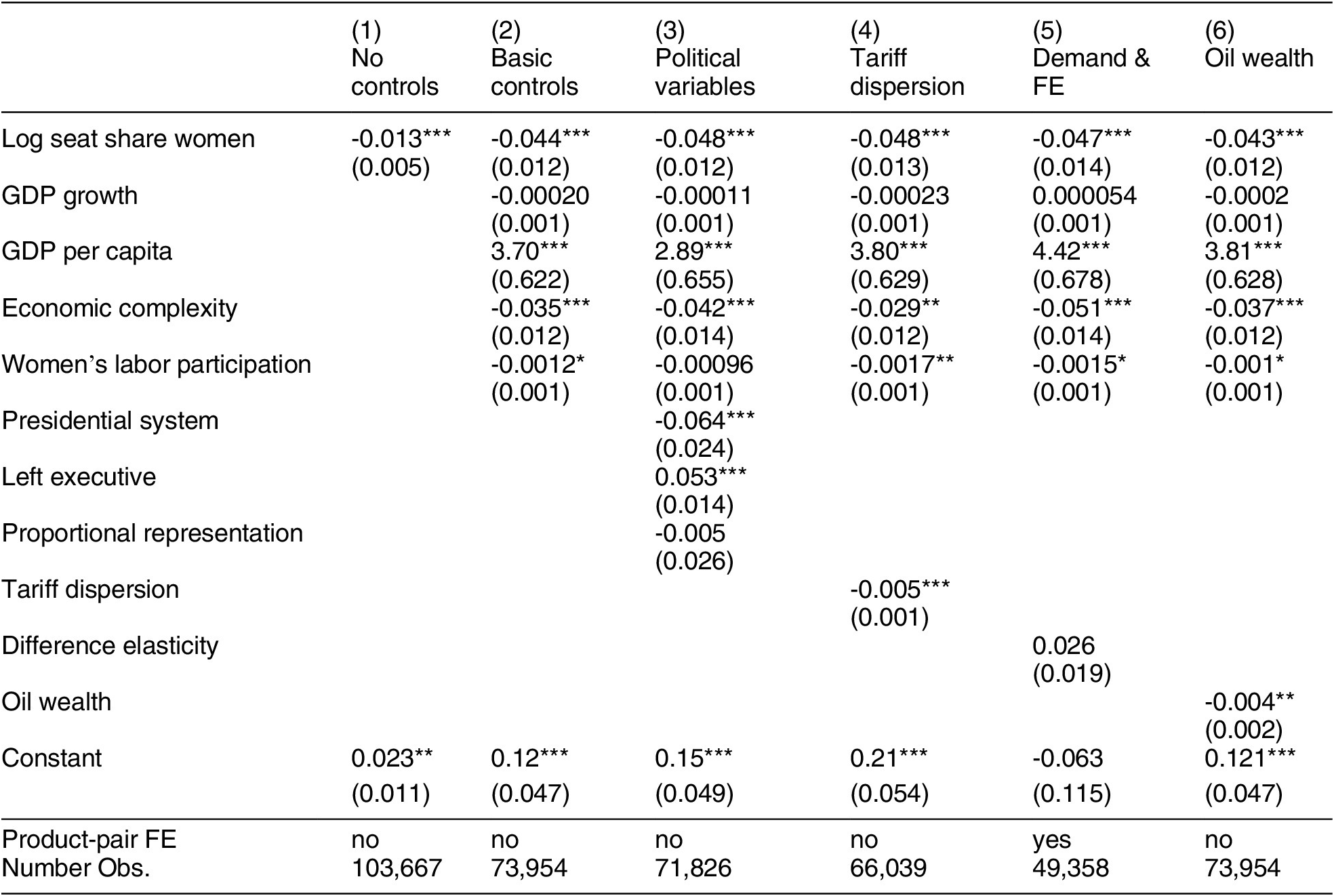
Note: Linear regression coefficients with standard errors in parentheses. *** p < 0.01, ** p < 0.05, and * p < 0.10, respectively. The SEs are clustered by country-product pair. DV: difference in tariff rates between women’s and men’s apparel products, inverse hyperbolic sine transformation.
The effects of increasing women’s representation are substantial. A 10% gain in seat share decreases the pink tax by approximately 0.44%. As another illustration, consider results based on the untransformed pink tax: the pink tax in our sample is on average 0.24%. Were all else to remain equal, but all legislatures were at gender parity, the average pink tax would be -0.19% and disadvantage men’s products, partially offsetting end-point price discrimination by producers and retailers. Multiplying the difference in import taxes due to the unequal representation of women with a country’s imports of gender-specific apparel implies substantial costs to women of the status quo relative to gender-balanced parliaments. Annually, and on gender-specific apparel imports alone, the added cost to women as consumers amounts to an average of $324 million per country and $15 billion across all countries in the sample. This is a lower-bound estimate, not taking into account that the difference in import taxes likely (1) also raises prices of domestically produced goods and (2) is compounded by other costs throughout the distribution process, such as sales taxes or margin-cushioning price increases.
The remaining models in Table 2 include variables that may correlate with both a country’s propensity to implement product-specific tariff rates and women’s representation. Model 3 controls for a country’s system of government (presidential versus parliamentary, using updated data from Cheibub, Gandhi, and Vreeland Reference Cheibub, Gandhi and Vreeland2010), as well as electoral rule and executive partisanship (Cruz, Keefer, and Scartascini Reference Cruz, Keefer and Scartascini2015). Model 4 controls for the standard deviation in tariff rates across all products, which reflects a government’s broader willingness to engage in product-specific trade policy. Model 5 includes the difference in the demand elasticity of men’s and women’s products (data from Ghodsi, Gruebler, and Stehrer Reference Ghodsi, Gruebler and Stehrer2016), which may account for higher tariffs on women’s products if governments take into account revenue or substitution effects, as well as product-pair fixed effects to control for product-specific features. Model 6 includes oil rents as a percentage of GDP, which can undermine political participation by women (Simmons Reference Simmons2016). The coefficient on seat shares remains negative and statistically significant in all models.
Table 3 presents the results from models directed at addressing endogeneity concerns. First, if our central results are driven by countries’ baseline preferences for gender equity—which would simultaneously explain both the election of women and lower pink taxes—then the correlation between representation and the pink tax should be similar in democracies and autocracies. If the results are instead driven by women’s participation in the policy-making process, then we should observe null (or much smaller) effects in autocracies, where legislatures have substantially less influence. This is borne out by Model 1. In non-democracies, gains in women’s representation have a substantively small (marginal effect of 0.003) and statistically nonsignificant (p-value of 0.587) effect, suggesting that women’s participation in the policy-making process is driving the result.
Addressing Endogeneity Concerns
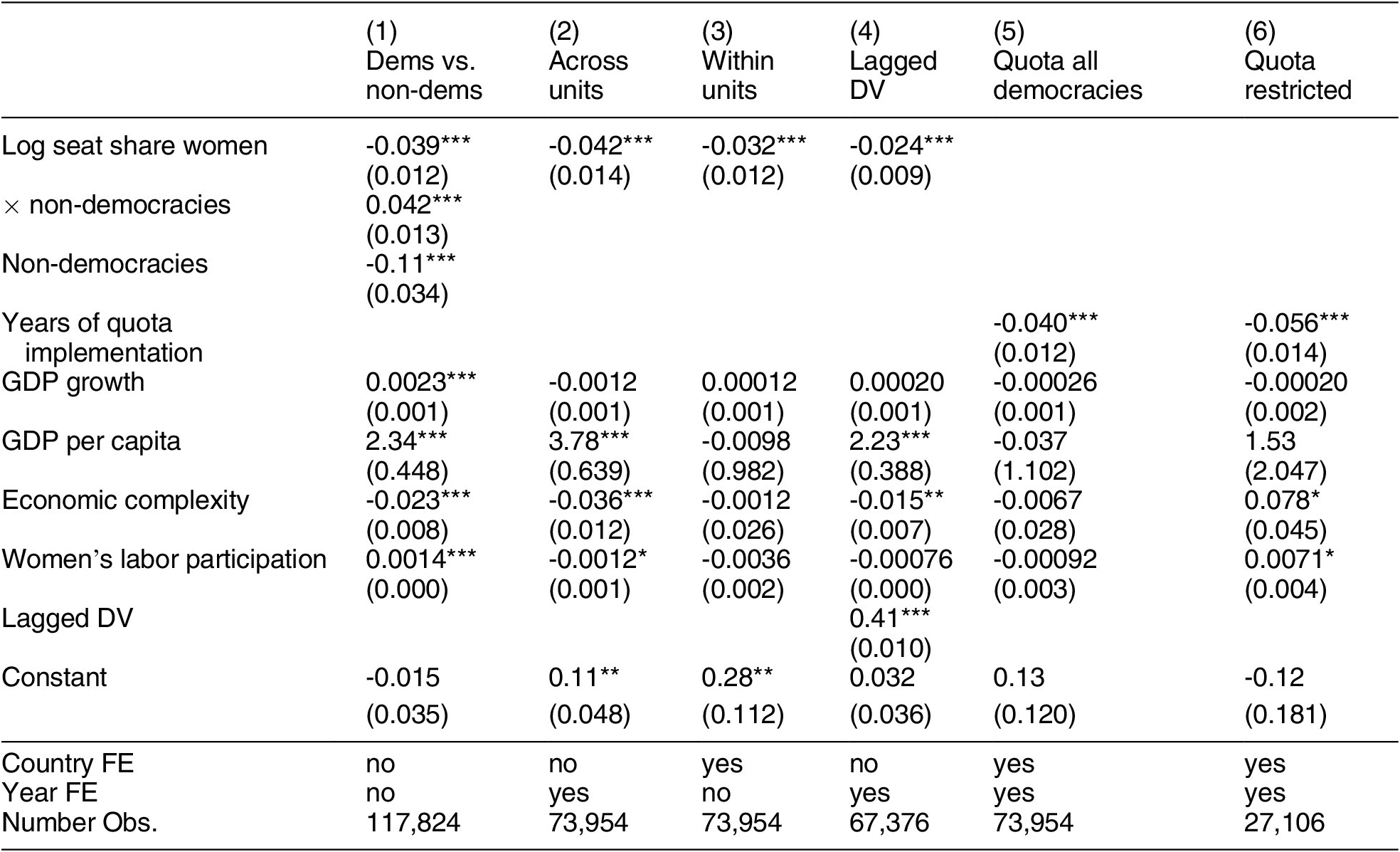
Note: Linear regression, coefficients and standard errors. *** p < 0.01, ** p < 0.05, and * p < 0.10, respectively. The SEs are clustered by country-product pair. DV: difference in tariff rates between women’s and men’s apparel products, inverse hyperbolic sine transformation.
We next include year- (Model 2) and country- (Model 3) fixed effects to demonstrate that the results are not a function of unmeasured covariates at these levels (e.g., preferences for gender equity that are correlated with time or clustered within countries).Footnote 14 Model 4 accounts for time and unit effects by including a lag of the dependent variable and year fixed effects. If our findings were an artifact of endogeneity or unmeasured variables, these specifications should erase the result. Yet, women’s representation remains correlated with more equitable tariff rates.
Models 5 and 6 examine the enactment of legislative gender quotas in a two-way fixed effects design, which allows us to identify a plausibly causal treatment effect. Here, the covariate of interest is the (logged) count of years since quota implementation. Model 5 includes all democratic countries, while Model 6 examines only quota-adopting countries. Both models reveal that implementing gender quotas leads to a pink tax reduction. Model 6 shows that this result holds even when selecting on quota adoption. Constraining the analysis to those countries sufficiently committed to gender equity to adopt quota policies, it is the implementation of this policy—electing more women to parliament—that draws down the pink tax. Additional discussion and analyses of quotas, including an analysis of “quota shocks” (Clayton and Zetterberg Reference Clayton and Zetterberg2018), are presented in the appendix. The appendix also includes a placebo test showing that women’s representation is unrelated to differences in tariff rates across nongendered apparel products.
Conclusion
This paper exposes a widespread tax on womanhood—gendered inequities in tariff schedules. Women’s goods, on average, are taxed more than men’s goods. These tax penalties contribute to the widespread end-point price discrimination suffered by women. The implications of this finding are twofold. First, governments may help remedy gender-biased consumer inequalities by eliminating import tax differentials on gender-classified imports. Second, women’s political inclusion is likely to increase the probability that legislatures address gender biases found within government policies.
By identifying a policy that affects all women as consumers and can be easily measured across space and time—and paying close attention to endogeneity issues in our analyses—our findings reinforce the link between descriptive and substantive representation. They also contribute to new scholarship on quota impacts. Future research should disentangle how women’s presence affects policy outcomes, including by shaping the agenda and influencing men’s behavior.
Our results also point to questions at the intersection of political economy and gender and politics. Political economy research reveals the challenges of globalization for underrepresented groups—including their difficulties entering lucrative export markets (United Nations 2018) and gaining compensation for displacement effects (Bastianes and Rudra Reference Bastiaens and Rudra2018). We show that domestic policy choices that shape globalization can also disadvantage women in their role as consumers. While trade policy largely ignores consumer interests (Betz and Pond Reference Betz and Pond2019), political inequalities among consumers leave a clear imprint. Complementing existing work on gender differences in trade preferences (Guisinger Reference Guisinger2017; Mansfield, Mutz, and Silver Reference Mansfield, Mutz and Silver2015), this underscores the need for more gendered analyses of trade policies including examining gender-differentiated import competition, labor market, and revenue effects, as well as variation in (and consequences of) women’s groups’ participation in trade consultations. Drawing on our research, future studies should also consider how women’s presence in legislatures—and other political bodies—affects these and other trade policies.
Supplementary Materials
To view supplementary material for this article, please visit http://dx.doi.org/10.1017/S0003055420000799.
Replication materials can be found on Dataverse at: https://doi.org/10.7910/DVN/UM0ZOF.




Comments
No Comments have been published for this article.