Introduction
Insecticides form the most important component in the global mosquito control effort (Najera & Zaim, Reference Najera and Zaim2001; McCarroll & Hemingway, Reference McCarroll and Hemingway2002). The wide-spread use of chemical insecticides to control mosquito vectors is largely a result of their effectiveness, simplicity, flexibility and economy. Continuous and chaotic application of these insecticides has lead to various problems such as environmental pollution, affecting non-target organisms and most importantly the phenomenon of resistance development among the vectors. Resistance is a genetic phenomenon, with mutations affecting insecticide target proteins and metabolism (Ffrench-Constant et al., Reference Ffrench-Constant, Daborn and Goff2004; Li et al., Reference Li, Schuler and Berenbaum2007). The development of resistance to all classes of insecticides has posed serious dilemma in vector control programmes. Insecticide resistance is expected to directly and profoundly affect the emergence and re-emergence of vector-borne infectious diseases (Krogstad, Reference Krogstad1996). Malaria vector control is currently very much dependent on a single class of insecticides, the pyrethroids (Zaim et al., Reference Zaim, Aitio and Nakashima2000), but there has been dramatic increase in pyrethroid resistance in the malaria vectors (Santolamazza et al., Reference Santolamazza, Calzetta, Etang, Barrese, Dia, Caccone, Donnelly, Petrarca, Simard, Pinto and della Torre2008).
According to the latest estimate, there were about 219 million cases of malaria in 2010 and an approximately 6,60,000 deaths world-wide (WHO, 2011). In India, annually 2,00,000 (in the range of 1,25,000–2,77,000) deaths occur because of malaria (Dhingra et al., Reference Dhingra, Jha, Sharma, Cohen, Jotkar, Rodriguez, Bassani, Suraweera, Laxminarayan and Peto2010). Anopheles stephensi is one of the important urban malarial vectors in the Indian subcontinent, accounting for about 15% of the total annual malaria incidence (Shetty, Reference Shetty, Raghunath and Nayak2002). It is one such medically important vector species, which also possess a number of favourable characteristics such as easy sampling and maintenance, shorter life span with high reproductive potential and polytene chromosomes. The said species has been selected for the present investigation.
The acquisition of insecticide resistance among such medically important vector species could also be used to assess the microevolution processes, because, in response to this strong selection pressure, evolution is quicker (Bouvier et al., Reference Bouvier, Bues, Boudinhon, Beslay and Sauphanor2001). As resistance reflects changes in the genotypic architecture of natural population, a full understanding of the evolution of this phenomenon requires an accurate and adequate knowledge of its genetic basis (Roush & Daly, Reference Roush, Daly, Roush and Tabashnik1990). Beyond the evolutionary approach, genetic data constitute a vital tool for investigating resistance mechanism and for predicting the behaviour of resistance genes, thus leading to a better understanding of resistance risks in populations. This information may be useful in pesticide resistance management for the implementation of appropriate control decisions (Georghiou & Taylor, Reference Georghiou and Taylor1986). Identifying insecticide resistance mechanisms is of paramount importance for pest insect control, as the understandings that underpin insect control strategies must provide ways of detecting and managing resistance and these studies rely heavily on detailed biochemical and genetic analyses (Perry et al., Reference Perry, Batterham and Daborn2011). The present paper describes the genetic basis of laboratory developed alphamethrin resistance/susceptible in A. stephensi.
Material and methods
Insecticide
Alphamethrin (=alpha-cypermethrin) (96.7% TC), a synthetic pyrethroid, is used in malaria prevention and control. This insecticide is effective against range of pests in agriculture, public health and animal husbandry. The IUPAC nomenclature is, a racemic mixture of (S)-α-cyano-3-phenoxybenzyl-(1R,3R)-3-(2,2-dichlorovinyl)-2,2-dimethylcyclopropane-carboxylate and (R)-α-cyano-3-phenoxybenzyl-(1S, 3S)-3-(2,2-dichlorovinyl)-2,2-dimethylcyclopropane-carboxylate with the molecular formula C22H19Cl2NO3. It is a non-systemic insecticide with contact and stomach action, and also acts as nerve poison. Alphamethrin-treated insects show restless behaviour, hyper-excitability, become uncoordinated and are then paralysed; flying insects are generally rapidly knocked down (peripheral nervous intoxification).
Mosquito rearing
Colonies of adult mosquitoes were maintained in cages of iron frames covered with nylon mosquito net and fed with 10% sucrose solution soaked in sterilized cotton. Females were provided with the blood meal from restrained mice upon maturation. Plastic vials (3″ diameter) lined with filter paper were placed inside the cage for oviposition. The laid eggs were kept for 72 h to ensure complete hatching. The hatched larvae were reared in white enamel pans containing filtered tap water and were fed with powdered yeast tablets on regular schedule, throughout their larval period. To avoid scum formation, the water in the pan was changed daily. Pupation begins between 8 and 10 days after hatching. The pupae were transferred into wide-mouthed bottles and emerging adults were released into the cages. These stocks were maintained at a temperature of 25±1 °C with relative humidity of 75±5% and 10 h of photoperiod throughout the course of investigations (Shetty, Reference Shetty1983).
Larval bioassay
Test concentrations for bioassay were prepared by adding 1 ml of the insecticide from different stock solutions in 249 ml water. Twenty-five late third instar larvae were introduced to these test solutions. The tests were performed in four replicates for each concentration. A control was set up by adding 1 ml of denatured alcohol (98 ml of absolute alcohol+2 ml ethyl methyl ketone) in 249 ml water. Mortality was observed after 24 h of exposure and was converted to percent mortality (WHO, 2005).
Selection of diagnostic dose for alphamethrin
To select the diagnostic dose for alphamethrin, LC99 was initially calculated from the bioassay of the experimental strain – Goruguntepalya (GGP) using the regression line method (Finney, Reference Finney1971). Twice the value of LC99 was fixed as the diagnostic dose to synthesize homozygous resistant (RR) and susceptible (SS) strains for alphamethrin (WHO, 2006).
Development of alphamethrin resistance and susceptible strains
Alphamethrin resistant (AMR) strain: GGP strain from Bangalore, South India was used to synthesize the homozygous resistant strain. The late third instar larvae from the iso-females of GGP were treated with the diagnostic dose of 0.12 mg l−1 separately. Twenty-four hours later the surviving larvae from the test showing lowest mortality were collected, maintained separately and used for inbreeding. Mass treatment was followed to treat the larvae of successive generations and the surviving ones were inbred to obtain further generations. The process of selective inbreeding was repeated for 27 generations by gradually increasing the dose from sub-diagnostic concentrations to 0.12 mg l−1 until a pure homozygous resistant (100% survival) strain was established.
Alphamethrin susceptible strain (AMS): GGP strain was used to synthesize homozygous susceptible stock. About 50% of the larvae obtained from the iso-females of GGP were treated to the diagnostic dose of 0.12 mg l−1. The untreated larvae of the line showing the highest percentage of mortality was selected for inbreeding and the selection procedure was repeated for ten generations to synthesize a pure homozygous susceptible strain.
Genetic studies of AMR
Reciprocal genetic crosses were carried out between the freshly emerged males and females of resistant (R) and susceptible (S) strain (R♂×S♀ and R♀×S♂). A part of the F 1 individuals were backcrossed (F 1×S) to parental type (S) and the remaining were inbred to get F 2 generations. Apart from this, larval bioassay was carried out for late third instar larvae from all the crosses. Simultaneously, male and female larvae from the progeny of all the crosses were subjected to the diagnostic dose (0.12 mg l−1) of alphamethrin to assess sex linkage, if any. The log-dosage probit mortality relationships were recorded for all the genetic crosses (Georghiou, Reference Georghiou1969; Finney, Reference Finney1971; Priester & Georghiou, Reference Priester and Georghiou1980; Mazzari & Georghiou, Reference Mazzari and Georghiou1995) and the degree of dominance was calculated using Stone's formula (Stone, Reference Stone1968).
Degree of dominance, D=(2X2–X1–X3)/X1–X3, where X1, X2 and X3 are the logarithms of LC50 (concentration for 50% lethality) values for resistant, F 1 hybrid and susceptible strains, respectively. The value of D varies from −1 to 1; D=1 indicates complete dominance, 0<D<1 incomplete dominance, −1<D<0 incomplete recessivity and D=−1 complete recessivity (Stone, Reference Stone1968).
Data analysis
LC50 and LC90 values were calculated according to the method of Finney (Reference Finney1971) and dosage-mortality (d-m; regression) lines were obtained by using GraphPad Prism version 5.00 for Windows, GraphPad Software, San Diego, California, USA. Mortality data from bioassays were corrected by natural control mortality using Abbott's formula (Abbott, Reference Abbott1925) and χ2 values were calculated following the procedure of Bailey (Reference Bailey1959).
Results
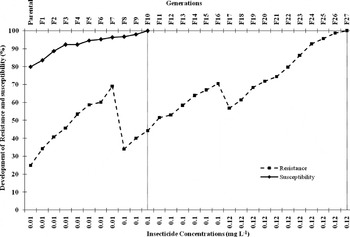
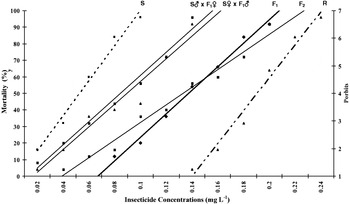
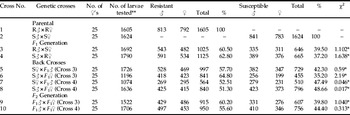
The homozygous resistant and susceptible strains of A. stephensi to alphamethrin were established for the diagnostic dose of 0.12 mg l−1 by selective inbreeding for 27 and ten generations, respectively (fig. 1). The data from various crosses for resistance and susceptibility are presented in table 1. The crosses R♂×R♀ (cross 1) and S♂×S♀ (cross 2) showed homozygosity to resistance and susceptibility, respectively. F 1 hybrids from the crosses 3 and 4 (reciprocal crosses between the resistant and susceptible strains) showed 60.50% and 62.80% resistance, respectively. The results of the backcrosses to homozygous susceptible parent showed 57.70%, 64.80%, 52.40% and 51.30% resistance, respectively (crosses 5, 6, 7 and 8). The crosses 9 and 10, i.e., F 2 progeny showed 60.20% and 55.60% resistance, respectively. The log d-m lines (fig. 2) were constructed for resistant, susceptible, F 1 hybrids and F 2 progeny. The d-m line of F 1 was found to be towards the resistant line (fig. 2). ‘D’ value was found to be 0.8. The null hypothesis (P<0.05) of monogenic resistance was tested from mortality data of backcross progeny compared with theoretical expectations using the χ2 test.
Development of AMR and susceptibility in A. stephensi. The late third instar larvae of GGP strain were initially treated with the sub-diagnostic dose as the diagnostic dose is too high or nearly fatal. The parental generation was treated with 0.01 mg l−1, which exhibited 25% resistance. The surviving larvae were collected and reared separately. The larvae from the F 1 generation were also treated with the same dose. This process of selection, inbreeding and treating to the same dose was carried up to F 7 where the resistance increased to 69.17%. F 8 generation was exposed to 0.1 mg l−1. The resistance level dropped to 34.15% with increase in dose. The same dose was continued up to F 16 where the resistance increased to 70.71%. F 17 onwards, the diagnostic dose (0.12 mg l−1) was used for treating which showed 57% resistance. The selection, inbreeding and treating to the diagnostic dose was continued up to F 27 where the strain showed 100% resistance (homozygous resistance). Similarly late third instar larvae from the iso-female of GGP strain which showed highest percent of susceptibility was reared as separate stock. About 50% of the larvae of the parental generation were treated with 0.01 mg l−1, which showed 80% susceptibility. The remaining larvae were reared as susceptible stock. At each generation, iso-females were separated and 50% of the larvae from each female were treated separately to the sub diagnostic dose. The line showing highest susceptibility was reared as susceptible stock. 0.01 mg l−1 was used for treatment for seven generations, where the F 7 was 96.32% susceptible. The dose was gradually increased to 0.1 mg l−1 from F 8 onwards up to F 10 where a 100% homozygous susceptible stock was established.

Dosage mortality relationships of AMR in A. Stephensi. The dosage mortality lines were constructed for the larvae from all the crosses including parental, reciprocal, back crosses and also for F 2 generation. The position of F 1 line is slightly towards the dominance line, which indicates incomplete dominance.

Inheritance pattern of alphamethrin resistance in A. Stephensi.

R, resistant; S, susceptible.
* Non-significant (P<0.05).
** Third instar larvae exposed to 0.12 mg l−1 for 24 h.
The expected percent mortality for cross 1 is zero, cross 2 is 100 and crosses 3–10 is 50%.
The d-m response of parental strains were characterized by straight lines, indicating the homogenous nature for resistant and susceptibility. The F 1 offspring also displayed a straight d-m line, confirming homozygosity of the resistance and susceptible genes involved (Raymond et al., Reference Raymond, Pasteur and Georghiou1987). Both the reciprocal crosses (crosses 3 and 4) exhibited a slightly higher percent of resistance than 50% and the position of the log dose probit line was also towards the resistant parent indicating incomplete dominance.
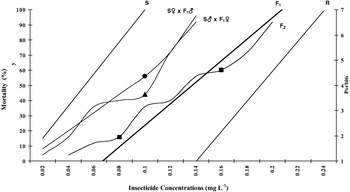
The expected segregation of the backcross of the RS (hybrid) to the S strain for single-factor Mendelian inheritance was calculated by the formula, x(BC)=½a 1(RS)+½a 2(S), where x is expected response of backcross at a dose, a 1 and a 2 are observed responses of RS and S populations at that dose (Georghiou & Garber, Reference Georghiou and Garber1965). The expected response at the diagnostic dose would be 50% kill/resistant, as all the S individuals would perish leaving behind 50% RS individuals. The observed resistance for the four back crosses (crosses 5, 6, 7 and 8) conducted were 57.70%, 64.80%, 52.40% and 51.30% with deviations from 50% being non-significant at P<0.05. Similarly, the expected F 2 segregation was calculated by the formula: x(F 2)=¼ a 1(R)+½a 2(RS)+¼a 3(S), where x is the expected response of F 2 to a given dose, and a 1, a 2 and a 3 are the observed responses of R, RS (hybrid) and S populations to that dose (Georghiou & Garber, Reference Georghiou and Garber1965). The expected x(F 2) response would be 50% kill/resistance. The observed resistance in both the F 2 crosses (9 and 10) were 60.20% and 55.60% with deviations from 50% resistance showing no significance at P<0.05. Monogenic control of resistance is indicated when the d-m line of F 2 or backcross exhibit a clear plateau of mortality is across a range of doses. The F 2 curve shows two inflection points: one at 0.08 mg l−1 indicating the kill of S individuals and the other at 0.16 mg l−1 indicating the kill of RS individuals. The BC lines show one inflection point each at 0.1 mg l−1, indicating the kill of S individuals leaving behind RS individuals (fig. 3). A careful scrutiny of the resistance/susceptible values (table 1), i.e. d-m lines (fig. 2), D (0.8) and the location of F 1 line towards the resistant line does reveal monogenic inheritance and does not reveal any consistent association of resistance through either sex (crosses 3 and 4). Therefore, possibility of sex linkage and cytoplasmic inheritance is ruled out, indicating that the amr gene is autosomal, monogenic and incompletely dominant in nature.
Dosage mortality relationships of AMR in A. stephensi showing break/inflection points on d-m lines of F 2 and backcrosses. The F 2 line showed two inflection points at 0.08 and 0.16 mg l−1, indicating the cessation of S individuals and RS individuals, respectively. Further the backcross lines (F 1♂×S♀; F 1♀×S♂) also showed one inflection point each at 0.1 mg l−1 indicating complete kill of S individuals leaving behind only RS individuals signifying monogenic inheritance.

Discussion
Insecticides have played an important role in the control of insect vectors especially, mosquitoes. However, the remarkable ability of insect populations to evolve resistance often leaves the control programmes with few options (Ferrari, Reference Ferrari, Beaty and Marquardt1996). Insecticide resistance has been a problem in all insect groups that serve as vectors of emerging diseases. Innumerable genetic, biologic and operational factors influence the development of resistance. In many respects, resistance is a chaotic problem, with different outcomes possible in a particular area, depending on the influence of diverse factors on initial conditions (Brogdon & McAllister, Reference Brogdon and McAllister1998; Andreev et al., Reference Andreev, Kreitman, Phillips, Beeman and Ffrench-Constant1999). The two major forms of resistance are target-site knockdown resistance (kdr), which occurs when the insecticide no longer binds to its target, and detoxification enzyme-based resistance, which occurs when enhanced levels or modified activities of esterases, cytochrome P450 oxidases or glutathione S-transferases (GST) prevent the insecticide from reaching its site of action (Brogdon & Mcallister, Reference Brogdon and McAllister1998). Alterations of amino acids responsible for insecticide binding at its site of action cause the insecticide to be less effective or even ineffective. The target of synthetic pyrethroids is the sodium channels of the nerve sheath (Williamson et al., Reference Williamson, Martinez-Torrez, Hick and Devonshire1996).
As of 1992, the list of insecticide-resistant vector species included 56 Anophelines and 39 Culicines including Anopheline examples, A. stephensi resistance to DDT, malathion, fenitrothion, temephos, fenthion; Anopheles culicifacies complex to DDT, malathion, fenitrothion, fenthion, carbamates, etc. (WHO, 1992). Pyrethroid resistance has been emerging despite early optimism that because of its rapid toxicologic action this newest large class of insecticides would not produce resistance (Malcolm, Reference Malcolm1988). High-level pyrethroid resistance has been reported to permethrin, deltamethrin, lambda-cyhalothrin in Anopheles funestus from Mozambique (Cuamba et al., Reference Cuamba, Morgan, Irving, Steven and Wondji2010); deltamethrin, cyfluthrin, alphacypermethrin, lambdacyhalothrin and permethrin in A. stephensi from Mangalore, India (Tiwari et al., Reference Tiwari, Ghosh, Ojha, Dash and Raghavendra2010); permethrin in Anopheles gambiae from Ghana (Muller et al., Reference Muller, Warr, Stevenson, Pignatelli, Morgan, Steven, Yawson, Mitchell, Ranson, Hemingway, Paine and Donnelly2008). kdr in A. stephensi to fenvalerate was shown to be very quick and of a high degree where in the 12th generation itself the kdr was 3.03 (KD50) which warrants caution in the use of synthetic pyrethroids (Verma & Rahman, Reference Verma and Rahman1986). kdr mechanisms in Aedes aegypti from Puerto Rico and Indonesia and Culex quinquefasciatus from Louisiana (Brogdon & Mcallister, Reference Brogdon and McAllister1998) and in A. gambiae (Elissa et al., Reference Elissa, Mouchet, Riviere, Meunier and Yao1993) have been detected. In Guatemala, pyrethroid resistance was first reported in an Anopheles albimanus population resistant to fenitrothion and also deltamethrin cross-resistance (Brogdon & Barber, Reference Brogdon and Barber1990). kdr in insects, resulting from mutation(s) in the voltage-gated sodium channel (vgsc) gene is one of the mechanisms of resistance against pyrethroid-group of insecticides and the most common mutation(s) associated with kdr in insects, including Anophelines, has been reported to be present at residue Leu1014 in the IIS6 transmembrane segment of the vgsc gene (Davies & Williamson, Reference Davies and Williamson2009; Singh et al., Reference Singh, Dykes, Lather, Agrawal and Adak2011). In Anophelines, the most common mutation conferring kdr, L1014 F (Enayati et al., Reference Enayati, Vatandoost, Ladonni, Townson and Hemingway2003), L1014 S (Singh et al., Reference Singh, Dykes, Lather, Agrawal and Adak2011) in A. stephensi; L1014F, L1014S and V1010L in A. culicifacies (Singh et al., Reference Singh, Dykes, Das, Pradhan, Bhatt, Agrawal and Adak2010) have been identified. Confirming electrophysiological evidence for reduced neuronal sensitivity to pyrethroids has been reported in insects including, C. quinquefasciatus and A. stephensi (Bloomquist, Reference Bloomquist and Lunt1988, Reference Bloomquist, Roe and Kuhr1993). Synergist and electrophysiological studies suggested that A. stephensi has a site-insensitivity type of pyrethroid-resistance mechanism (Omer et al., Reference Omer, Georghiou and Irving1980; Magesa et al., Reference Magesa, Aina and Curtis1994).
Our study showed that the gene amr is autosomal, monogenic and incompletely dominant in nature. Such a pattern of inheritance to pyrethroids has been reported in other pyrethroids insecticides such as deltamethrin (Rajashree & Shetty, Reference Rajashree and Shetty1998a) and cyfluthrin (Chandrakala & Shetty, Reference Chandrakala, Shetty and Sobti2006). Resistance controlled by single gene develops (Tabashnik, Reference Tabashnik1986) and spread (Roush & McKenzie, Reference Roush and McKenzie1987) rapidly compared with that of polygenic resistance. It extends quickly to new areas through migration of resistant insect (Denholm et al., Reference Denholm, Devine and Williamson2002). Based on the inheritance studies, one could generate information on specific genetic factors that dictate the evolutionary divergence of discrete resistant populations (Meinke et al., Reference Meinke, Siegfried, Wright and Chandler1998). Studies on the nature of insecticide resistance have shown that the phenomenon is due to pre-adaptations which usually involve single gene alleles and that the emergence of insecticide resistant strains is thus a consequence of Darwinian selection (WHO, 1964). Conclusions reported from the present experiment could lead to a better understanding of the rate of resistance development and inheritance mode of resistant gene involved.
It is concluded from the foregoing that the character of induced alphamethrin resistance in the laboratory maintained strain of A. stephensi is inherited as a partially dominant (incompletely dominant) single factor without sex linkage or appreciable cytoplasmic influence. The evidence for simple Mendelism, is based on log-dosage probit curves and agreement of the observed responses to those that may be expected in case of monofactorial inheritance.
A better understanding of resistance mechanisms will be extremely important for developing novel strategies to circumvent and to delay resistance development, controlling resistant mosquitoes and thus ultimately reducing the prevalence of mosquito-borne diseases. Characterization of the genes and regulation mechanisms involved in resistance may open the way to entirely new approaches to the study of resistance, eventually leading to the identification of the causative genes in insecticide resistance (Liu et al., Reference Liu, Xu, Zhu and Zhang2006).
The amr gene has several applications in conducting basic and applied research. It can be used as a marker in constructing linkage maps and molecular mapping. This can also be used in synthesizing genetic sexing strains (as a conditional lethal) for the preferential elimination of females in the larval stages; can be used in the genetic control programme through sterile insect technique (SIT) (Shetty, Reference Shetty, Raghunath and Nayak2002). Such a genetic sexing system has been developed in a few species of mosquitoes by using insecticide resistant genes as a conditional lethal in A. gambiae, A. stephensi and C. quinquefasciatus (Curtis et al., Reference Curtis, Akiyama and Davidson1976; Robinson, Reference Robinson1986; Shetty, Reference Shetty1987). The expression of certain enzymes that are involved in two different types of resistance mechanisms namely metabolite resistance (esterases, phosphatases, dehydrogenases, etc.) and target site resistance (acetylcholine esterases) are very specific in their expressions in each one of the insecticide-resistant strains and also vary within different life stages in a deltamethrin-resistant strain of A. stephensi (Rajashree & Shetty, Reference Rajashree and Shetty1998b). Similarly, cytological studies carried out from the polytene chromosomes of the ovarian nurse cells in various insecticide-resistant strains are characterized by the presence of specific inversion(s) which could be used as genetic markers (Ghosh & Shetty, Reference Ghosh and Shetty2004).
Acknowledgements
This work was supported by financial assistance from University Grants Commission (UGC) and Department of Science and Technology (DST), New Delhi to Professor N.J. Shetty.