Introduction
The development of novel materials with enhanced performance is a continuous process mainly driven by everyday demands. Furthermore, rapid human population growth is accelerating the need for fast enhancement of materials performance in areas ranging from organic photovoltaics to photocatalytic systems. The field of optoelectronics is an excellent example where constantly growing societal demands in energy usage have forced materials evolution to speed up. Recently, metal–organic frameworks (MOFs), which are crystalline materials consisting of organic linkers connected to inorganic secondary building units, have been evaluated as promising candidates for a variety of renewable-energy applications.
Early excitement about MOF-based materials was mainly due to their high surface areas, with applications focusing primarily on gas storage and separation. Reference Furukawa, Cordova, O’Keeffe and Yaghi1,Reference Zhou, Long and Yaghi2 Today, those applications could be considered “classic” applications for MOFs, due to the tremendous amount of research that has mainly centered on hydrogen/methane storage or CO2 sequestration. Reference He, Zhou, Qian and Chen3–Reference Zhai, Bu, Mao, Zhao and Feng6 More recently, it has been demonstrated that MOF applications can be successfully explored far beyond “smart sponges” with unprecedented surface areas. Reference Falcaro, Ricco, Doherty, Liang, Hill and Styles7,Reference Stavila, Talin and Allendorf8 For instance, the self-assembled nature of MOFs provides a powerful method for arranging hundreds of organic compounds with high structural organization, thereby providing an opportunity to utilize these materials as light-harvesting mimics of natural photosystems. At the same time, crystallinity allows one to determine the precise distances and angles between self-assembled organic linkers and, therefore, study and model short- and long-range energy-transfer processes. MOFs also offer a high degree of synthesis tunability, which could help adjust optical, electrical, and sometimes even mechanical properties from the design stage.
These materials have ideal properties for the development of new systems with desirable properties. In this article, we survey MOF applications in areas for which development is highly dependent on fundamental studies of MOF photophysics, including sensors, noninvasive thermometers, optoelectronic devices, photocatalysts, and photoswitches.
Sensors
The main principle of any sensing device is the conversion of a stimulus into a response. For example, an efficient change in inherent material properties after interaction with an analyte. Due to the combination of high surface area and structural tunability, MOFs stand out as a unique platform for sensing, with applications in this area being one of the most explored to date. Comprehensive review articles on this topic have been published elsewhere. Reference Cui, Yue, Qian and Chen9–Reference Zhao, Cui, Yang and Qian14 Because of the advantages of rapid response and high sensitivty, we focus on and summarize the state of the art in the area of MOF photoluminescence-based sensing, with a concise discussion of perspectives and remaining challenges in this rapidly growing field.
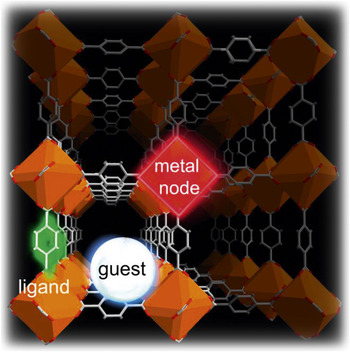
Luminescent MOFs have been proven successful for the detection of pollutants, toxins, and explosives. Reference Hu, Deibert and Li11 Compared to purely organic or inorganic sensors, the hybrid nature of MOFs offers the possibility of utilizing both organic linkers and inorganic building units for sensing enhancement or simultaneous multiple-analyte detection ( Figure 1 ). MOF photoluminescence response is strongly affected by changes in the coordination environment of the metal ions located at the nodes, interactions with guest molecules (e.g., π–π interactions, hydrogen and halogen bonding), and coordination of metal cations to organic linkers modified with chelating groups. Reference Cui, Yue, Qian and Chen9–Reference Zhao, Cui, Yang and Qian14 Through fine-pore tunability, MOFs also allow implementation of an analyte size-exclusion strategy, thereby offering an additional pathway for sensing selectivity enhancement. Furthermore, their relatively high thermal stability allows tuning of the sensor selectivity as a function of temperature. Thus, crystallinity, porosity, tunability, and structural modularity are distinct advantages for the rational engineering of MOF-based sensors.
Metal–organic framework photoluminescence: emission from an organic linker (green), a metal node (red), or a guest molecule (light blue).

Despite a broad range of analytes, such as explosives and toxic gases probed for detection by MOFs, there is still much room for improvement. The majority of MOF sensors are based on a “turn-off” mechanism (i.e., a decrease in the photoluminescence response upon exposure to an analyte). For example, toxins such as aflatoxins B1, B2, or G1, found in food, could be detected via fluorescence quenching of Zn2(BPDC)2(TPPE) (BPDC = biphenyl-4,4′-dicarboxylate, TPPE = 1,1,2,2-tetrakis(4-(pyridin-4-yl)phenyl)ethene). Reference Hu, Lustig, Zhang, Zheng, Wang, Teat, Gong, Rudd and Li15 The reverse, a “turn-on” response, especially in the visible range, Reference Shustova, Cozzolino, Reineke, Baldo and Dincă16,Reference Nagarkar, Saha, Desai, Talukdar and Ghosh17 is a more favorable, albeit less common, strategy because it facilitates visualization and easier real-time monitoring. This response is also more difficult to design.
Another underexplored area is tandem sensing. Highly tunable MOF structures allow the introduction of different functional groups for more sophisticated recognition, where several types of molecules can be simultaneously detected. Reference Shustova, Cozzolino, Reineke, Baldo and Dincă16,Reference Duke, Dolgopolova, Galhenage, Ammal, Heyden, Smith, Chen and Shustova18 Indeed, current studies mainly focus on a singular MOF “receptor.” For instance, common receptors in MOFs are unsaturated metal sites, which bind only one type of gaseous analyte (or every analyte in the mixture). Reference Shustova, Cozzolino, Reineke, Baldo and Dincă16,Reference Duke, Dolgopolova, Galhenage, Ammal, Heyden, Smith, Chen and Shustova18 Constantly growing activity in this area continues to promote rapid development of novel sophisticated structures, which indicates that the next generation of efficient MOF sensors is fast approaching.
White light-emitting diodes
The development of white light-emitting diodes (LEDs) is driven not only by the need to replace environmentally unfriendly light bulbs (or fluorescent lamps) with short lifetimes, but also by the possibility of a variety of new devices, including flexible screens. Highly efficient emission sources continue to be investigated by several research groups. Reference Xie, Zhang, Du, Qin, Bao, Li, Su, He, Fu and Lan19–Reference Liu, Wu, Wang, Zheng, Wang, Chen, Xiao, Wu, Guo and Huang24 MOF-based LEDs rely on synergistic photoluminescence arising from both organic and inorganic components of the framework. As a result, white emission can be achieved through fine-tuning of the color and the relative amount of monochromatic emission from the organic linkers and metal nodes. Reference Xie, Zhang, Du, Qin, Bao, Li, Su, He, Fu and Lan19–Reference Gallis, Rohwer, Rodriguez and Nenoff21 Compared to purely organic devices, the utilization of both ligand and metal nodes can provide more robust and stable materials with enhanced efficiency.
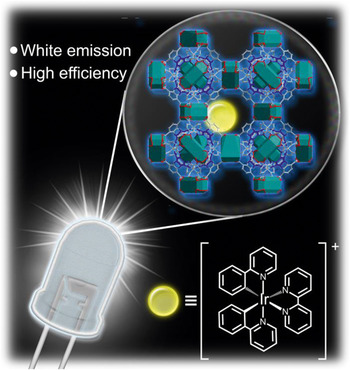
To date, there are two main approaches for engineering white light-emitting MOF-based materials. The first approach relies on combining red, green, and blue emitters, which need to be carefully balanced to produce white light. Realization of this approach occurs through the doping of a MOF framework with various concentrations of lanthanides, which exhibit versatile emissions (red, Eu; green, Tb; blue, Ce). Reference Sava, Rohwer, Rodriguez and Nenoff22–Reference Liu, Wu, Wang, Zheng, Wang, Chen, Xiao, Wu, Guo and Huang24 Although the metal doping strategy is attractive, it usually suffers, due to the fact that the ensuing LEDs have relatively low efficiency. A different approach for generating white light emission in these materials is based on a combination of blue emission from the framework with yellow emission from guest complexes inside the pores ( Figure 2 ). The latter strategy has already resulted in a white-emitting LED with high efficiency, which was engineered from blue-emitting ([CH3]2NH2)15([Cd2Cl]3[TATPT]4) (TATPT = 2,4,6-tris(2,5-dicarboxylphenyl-amino)-1,3,5-triazine) with immobilized yellow-emitting cationic iridium complexes. Reference Sun, Wang, Zhang, Qin, Li, Su, Zhu, Shan, Shao, Wu and Li25
White light emission of ([CH3]2NH2)15([Cd2Cl]3[TATPT]4) (blue framework) with immobilized (Ir[ppy]2[bpy])+ (yellow sphere). The blue, red, and gray components within the framework represent nitrogen, oxygen, and carbon atoms, respectively. Note: TATPT, 2,4,6-tris(2,5-dicarboxylphenyl-amino)-1,3,5-triazine; ppy, 2-phenylpyridine; bpy, 2,2′-bipyridine.

To summarize, a tremendous library of luminescent MOFs, in combination with potentially emissive organic linkers, Reference Zhang, Wang, Hu, Wang and Uvdal10–Reference Kuppler, Timmons, Fang, Li, Makal, Young, Yuan, Zhao, Zhuang and Zhou12 provides a high degree of flexibility for the rational design of high-performance LEDs. Currently, improving the efficiency of MOF-based LEDs is the main target for this field of research.
Noninvasive thermometers
The capability to tune MOF luminescence as a function of temperature has been utilized to develop noninvasive thermometers for remote temperature measurements. Reference Cui, Zhu, Chen and Qian26–Reference Cui, Xu, Yue, Guo, Yu, Chen, Gao, Yang, Qian and Chen31 In addition to being noninvasive, this type of temperature determination has advantages, including high sensitivity, quick response, and invariance with electric or magnetic fields, which could be critical for industrial manufacturing, for instance. In general, the photoluminescence response from an organic compound dramatically drops with an increase in temperature. Reference Shustova, Cozzolino, Reineke, Baldo and Dincă16 Recent studies have demonstrated that MOFs could significantly suppress the vibrational modes responsible for photoluminescence quenching at elevated temperatures. Reference Shustova, Cozzolino, Reineke, Baldo and Dincă16
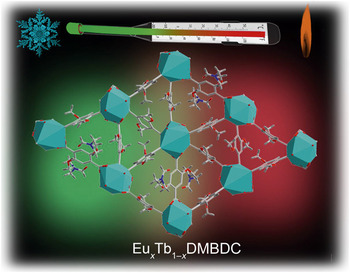
For example, ligand rigidity achieved through coordinative immobilization inside a MOF matrix allows, in some cases, extension of the luminescence temperature range of an organic molecule by more than 100°C. Reference Shustova, Cozzolino, Reineke, Baldo and Dincă16 This was clearly demonstrated with the tetraphenylethylene (TPE) chromophore when compared with a TPE-based MOF. Changes in the intensity of ligand-centered emission can therefore indicate temperature changes. However, tuning the emission color as a function of temperature is a more appealing strategy that also offers the possibility of remote temperature detection or detection by the naked eye. This approach has been demonstrated in bimetallic lanthanide-based MOFs, which contain two different metals inside the center—each metal with a distinct emission color depending on the surrounding temperature, thus providing an opportunity to drastically change the photoluminescence response ( Figure 3 ). Reference Zhao, Li, Song, Zhu, Hao, Meng, Wu, Feng, Song, Wang and Zhang28–Reference Cui, Xu, Yue, Guo, Yu, Chen, Gao, Yang, Qian and Chen31
Tuning of the emission profile of Eu x Tb1–x DMBDC (DMBDC = 2,5-dimethoxy-1,4-benzenedicarboxylate) as a function of temperature. Luminescent thermometry is accomplished through the design of a bimetallic lanthanide-based metal–organic framework. The color change represents the change in emission (from green to red) of the lanthanide framework as a function of temperature. Blue octahedra and gray, red, and blue spheres represent metal nodes, carbon, oxygen, and nitrogen atoms, respectively.

Further studies in MOF thermometry could lead to a number of novel applications, including thermal mapping of biological systems. However, this field suffers from the absence of more systematic studies, which would provide both the motivation and interpretation of correlations of MOF parameters (e.g., ligand design, metal choice, incorporated guest, and framework topology) with MOF-based thermometer performance.
Active layers in organic photovoltaics
Great demand for low-cost photovoltaic systems capable of converting sunlight into electrical energy has brought organic solar cells to the forefront as promising candidates for efficient photo-energy conversion. There are three main processes that influence the efficiency of bulk heterojunction (BH) solar cells—light harvesting, charge separation, and charge mobility. An almost unlimited number of combinations of metal ions and organic molecules, which could be utilized for MOF preparation, allow tailoring of the light-harvesting properties of a framework, starting from the design stage.
There are many studies of light-harvesting MOFs in which enhancement of light capture is achieved through several mechanisms involving light-absorbing organic linkers, guest molecules, or inclusions such as quantum dots. Reference Leong, Foster, Wong, Spoerke, Van Gough, Deaton and Allendorf32–Reference Son, Jin, Patwardhan, Wezenberg, Jeong, So, Wilmer, Sarjeant, Schatz, Snurr, Farha, Wiederrecht and Hupp36 MOFs also offer precise control of active layer morphology through creating an interpenetrating donor–acceptor network and, therefore, affecting charge separation and carrier mobility. Recent studies by the Dincă group demonstrated that charge mobility in a MOF matrix is comparable to or even higher than that in organic semiconductors. Reference Narayan, Miyakai, Seki and Dincă37 With light absorption and mobility demonstrated, at least as proofs of concept, the question of charge separation remains, which has not been studied extensively in MOFs. To this end, an interpenetrated donor–acceptor MOF morphology may offer an attractive strategy for eliminating problems associated with phase segregation, which is responsible for severe charge recombination losses in BH cells.
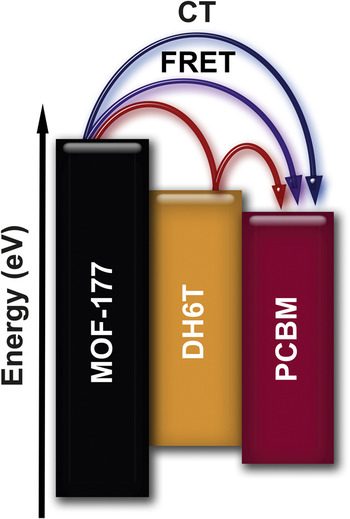
One of the first examples of utilizing a MOF for active-layer engineering was introduced by the Allendorf group, who developed a new organic photovoltaic material by incorporating α,ω-dihexylsexithiophene (DH6T) and (6,6)-phenyl-C61-butyric acid methyl ester (PCBM) inside a ZnO4(BTB)2 framework (MOF-177, BTB = 1,3,5-benzenetribenzoate). Reference Leong, Foster, Wong, Spoerke, Van Gough, Deaton and Allendorf32 Preliminary studies of energy-transfer processes in the designed material revealed that in the case of MOF linker excitation, Förster resonance energy transfer (i.e., the mechanism describing energy transfer between two chromophores) could occur between the framework and DH6T, and either energy or electron transfer could occur between MOF-177 and PCBM ( Figure 4 ). Thus, in this case, DH6T can play a dual role, serving as an acceptor for MOF-177 and donor for PCBM, thus facilitating energy transfer.
Band alignment of MOF-177, DH6T, and PCBM, showing energy transfer and electron transfer from the excited linker of MOF-177 to incorporated molecules of DH6T and PCBM. The donor–acceptor active layer was fabricated by incorporating DH6T and PCBM inside a ZnO4(BTB)2 framework (MOF-177, BTB = 1,3,5-benzenetribenzoate). The arrows depict the energy transfer (purple), charge transfer (blue), and FRET cascade (red). Adapted with permission from Reference Reference Leong, Foster, Wong, Spoerke, Van Gough, Deaton and Allendorf32. © 2014 Royal Society of Chemistry. Note: MOF, metal–organic framework; DH6T, α,ω-dihexylsexithiophene; PCBM, (6,6)-phenyl-C61-butyric acid methyl ester; CT, charge transfer; FRET, Förster resonance energy transfer.

Despite the advantages previously mentioned, the development of MOF-based materials as active layer components is still in the early stages. This is because despite significant efforts, we currently only have a rudimentary understanding of the underlying photophysical processes. For instance, the possible long- and short-range energy-transfer processes in a MOF matrix Reference Stavila, Talin and Allendorf8,Reference Zhang and Lin33,Reference So, Wiederrecht, Mondloch, Hupp and Farha38 could significantly affect device performance. The relationship between light-harvesting properties and MOF topology is also unknown, despite its importance for device-performance optimization. Finally, the question of integrating a MOF-based active layer inside a larger-scale device, including thin-film growth, remains open.
In conclusion, as multifunctional platforms, MOFs offer unique opportunities to incorporate light-harvesting building blocks, enhance charge separation and mobility, and prevent phase segregation—key components for successful engineering of organic photovoltaic devices. However, we should first address fundamental questions, including MOF photophysics.
Photocatalysts
A key advantage that makes MOFs attractive candidates for photocatalytic applications is the potential of integrating the three fundamental steps of artificial photosynthesis into a single material: light absorption, generation of charge-separated excited states, and charge transfer to reactive centers where reduction or oxidation could take place. Reference Zhang and Lin33,Reference So, Wiederrecht, Mondloch, Hupp and Farha38–Reference Wang, Wang and Lin41 MOFs may be able to mimic the natural photosystem (e.g., replication of chromophore organization in a leaf photosystem), a hierarchically ordered chloroplast-like structure that is capable of photon collection and subsequent energy transfer. In principle, the attributes that make MOFs attractive for photovoltaic applications are valid here as well. In addition, their porous nature, coupled with their structural tunability, could facilitate more facile diffusion of reactants and products relative to “conventional” solid photocatalysts, including metal-doped zeolites. Reference Corma and Garcia42–Reference Li, Yu and Jaroniec44
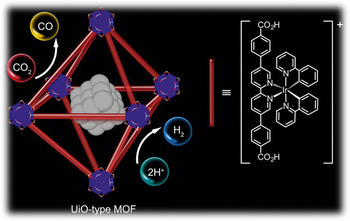
Furthermore, crystalline MOFs facilitate mathematicalpredictions and computational modeling, thus providing mechanistic insights for short- and long-range energy-transfer processes. In one recent example developed by the Lin group, platinum nanoparticles immobilized within MOF pores (Zr-based UiO framework built from a linear dicarboxylate ligand) (UiO = University of Oslo) showed a fivefold increase in catalytic efficiency for hydrogen evolution from water compared to its homogeneous control, or reference material ( Figure 5 ). Reference Wang, de Krafft and Lin45
Representation of photocatalytic hydrogen generation and CO2 reduction using a light-harvesting Zr-based metal–organic framework (MOF), UiO-67. The UiO-67 is prepared from organic ligands ([Ir(ppy)2(bpy)]Cl-derived dicarboxylic acid, red lines). The Pt nanoparticles (gray cubes) were loaded into the MOF cavities. Note: UiO, University of Oslo; ppy, 2-phenylpyridine; bpy, 2,2′-bipyridine.

Despite tremendous progress made in the design and synthesis of photoactive MOFs, it is still difficult to predict the photocatalytic activity of a new MOF-based system. Clearly, MOFs can function as photocatalysts, co-catalysts, or host materials for heterogeneous catalysis. However, the catalytic activity of these systems is often low and will need to be significantly enhanced to satisfy the requirements for practical implementation. There are a number of examples of MOFs that function as photocatalysts for hydrogen evolution, such as the one previously mentioned, but further development is necessary to enhance catalytic efficiency. The major factor that impedes such studies is the relatively low stability of many MOFs in an aqueous solution or in the presence of strong oxidants. For MOFs to become a major player in the field of photocatalysis, which is relevant for energy conversion, water-based processes should be targeted and, accordingly, materials that are more stable in such environments should be produced.
Photoswitches
Recent studies on understanding energy-transfer mechanisms in MOFs have suggested the idea of their use as photoswitches (i.e., molecules that can isomerize as a function of incident light). For instance, coordinative immobilization of photochromic molecules such as bis(5-pyridyl-2-methyl-3-thienyl)cyclopentene as organic linkers allows control over the emission wavelength as a function of external stimuli, particularly the excitation wavelength. Reference Williams, Rietman, Maier, Tan, Greytak, Smith, Krause and Shustova46 Therefore, this concept allows utilization of photochromic ligands to direct photophysical properties of large light-harvesting ensembles. Photoswitchable behavior was also demonstrated in a europium-containing MOF with a photoactive ligand, Reference Sun, Cai, Chen, Li and Zhang47 which acted as a switch due to efficient energy transfer from the lanthanide ion to the viologen-based linker. The initial photoluminescence response was recovered by exposing the MOF to atmospheric oxygen.
The idea of solid-state photoswitching is highly appealing for the design of smart windows/screens or sensors. Reference Wade, Li and Dincă48 In contrast to other MOF applications (e.g., in sensing or gas storage), there are few reports in the literature related to MOF-based photoswitches. This could be explained by a number of factors, including a slow response in the solid state, a limited number of optical cycles, a loss of MOF crystallinity or complete framework degradation during photoisomerization cycles, and challenges in the preparation of MOF thin films. To conclude, MOF photoswitching is still in its infancy, but could develop rapidly with the principles discussed here.
Summary
The foregoing discussions demonstrate only a small portion of possible applications for MOF-based materials in the rapidly growing areas of optoelectronics, sensing, photocatalysis, and photoswitching. Proof-of-concept examples, as well as ongoing challenges, have been highlighted. Further developments in these areas rely on the understanding of fundamental questions in MOF photophysics, including directional energy-transfer mechanisms, quantum-efficiency enhancement, and up-conversion phenomena. Therefore, in addition to device-fabrication development, the underlying photophysical processes in MOF-based materials must first be addressed for successful transduction of the current achievements into devices for everyday use.
Acknowledgments
N.B.S. acknowledges support from a CAREER Award from the National Science Foundation (DMR-1553634) and ASPIRE-I and III Awards granted by the USC Office of the Vice President for Research.

Ekaterina A. Dolgopolova is currently pursuing a PhD degree in inorganic chemistry at the University of South Carolina. She received her BS degree in materials science from Moscow State University, Russia, in 2013. Her research focuses on the development of novel metal–organic frameworks capable of directional energy transfer in a predesigned pathway. Dolgopolova can be reached by phone at 803-777-9852 or by email at dolgopoe@email.sc.edu.

Natalia B. Shustova joined the faculty at the University of South Carolina in 2013. She received her MS degree in materials science from Moscow State University (MSU), Russia, a PhD degree in physical chemistry from MSU, and a PhD degree in inorganic chemistry from Colorado State University. She completed postdoctoral research at the Massachusetts Institute of Technology. Her current research interests include graphitic hybrid materials for sustainable energy conversion, sensors, switches, and artificial biomimetic systems. Shustova can be reached by phone at 803-777-1903 or by email at shustova@sc.edu.