


Introduction
The Winneshiek Konservat-Lagerstätte was discovered in 2005 when geologists of the Iowa Geological Survey (IGS) were mapping the geology of the Upper Iowa River basin. During the field investigations, a local stratigraphic unit was recognized in the Decorah area in northeastern Iowa (Fig. 1.1, 1.2). From the name of the county where the unit was found, it was named the Winneshiek Shale (McKay et al., Reference McKay, Liu, Witzke, French and Briggs2011; Wolter et al., Reference Wolter, McKay, Liu, Bounk and Libra2011). Abundant well-preserved fossils, including some with soft-part preservation, occur in the shale, indicating that it is a new Konservat-Lagerstätte (Liu et al., Reference Liu, McKay, Young, Witzke, McVey and Liu2006, Reference Liu, McKay, Young, Witzke, McVey and Liu2007, Reference Liu, McKay, Witzke and Briggs2009). The fauna, particularly the conodonts, indicates that the age of the Winneshiek Lagerstätte is Middle Ordovician (Darriwilian in terms of global classification, and mid to late Whiterockian in regional US Series terminology).
Location of the Winneshiek Konservat-Lagerstätte and the position of the Winneshiek Shale in the Middle Ordovician stratigraphic succession in northeastern Iowa: (1) Map of the United States showing situation of Decorah, Iowa, the study area; (2) The Darriwilian stratigraphic column at Decorah showing principal lithological units; (3) Schematic Middle Ordovician paleogeographic map of most of Laurentia showing the position of the fossil site near the equator and land areas (modified from Witzke, Reference Witzke1990); (4) Polished sample of the Winneshiek Shale showing fine lamination.

The Winneshiek fossil fauna includes a variety of new forms, and the invertebrate fossils are dominated by arthropods (Lamsdell et al., Reference Lamsdell, Briggs, Liu, Witzke and McKay2015a; Nowak et al., Reference Nowak, Harvey, Liu, McKay and Servais2015; Briggs et al., Reference Briggs, Liu, McKay and Witzke2015 [2016]), including the oldest eurypterid Pentacopterus (Lamsdell et al., Reference Lamsdell, Briggs, Liu, Witzke and McKay2015b). Possible algae and jawless fish also occur in the fauna. However, the conodonts are the most common fossils (including isolated elements and natural assemblages), and account for 51% of the total number of collected specimens (N=5,354). Most of the conodont elements from the Winneshiek Shale are hyaline. Their crowns are amber-colored (CAI 1.5–2), indicating minimal thermal maturity. Some elements are found in coprolites or gut contents from carnivores. Of even more interest, the Winneshiek Konservat-Lagerstätte preserves abundant conodont bedding-plane assemblages. Although some contain elements of different taxa, repeated occurrences of bedding-plane assemblages with consistent element composition and non-random relative element positions indicate that these are natural assemblages (i.e., apparatuses). Several types of conodont apparatuses have been recognized from the Winneshiek Shale, and here we describe two that exhibit large size, unusual architecture and element composition, and which have not been reported previously. These unique conodont materials from the Winneshiek Shale are important for their natural classification as well as clarifying evolutionary relationships within the group.
Elements of the Winneshiek conodont apparatuses are usually preserved as three-dimensional mineralized objects in contrast to the elements in most other Ordovician apparatuses, which commonly appear as molds (e.g., Theron et al., Reference Theron, Richards and Aldridge1990; Aldridge et al., Reference Aldridge, Purnell, Gabbott and Theron1995, Reference Aldridge, Murdock, Gabbott and Theron2013). Furthermore, and unusual for an Ordovician conodont fauna, most of the elements contain basal bodies, which may provide significant value in taxonomic and phylogenetic studies. The apparatuses described below appear to have suffered relatively little postmortem movement of the individual elements: many paired elements are preserved together or in close proximity, some still reflecting the bilateral symmetry, making it possible to hypothesize the spatial arrangement of elements in the apparatus. Because of the three-dimensional preservation of the elements, one side is usually concealed in the shale, but this is not a major problem in conodont identification and apparatus reconstruction because different specimens reveal different sides of the elements.
More or less well-preserved Ordovician conodont apparatuses are known from only a handful of localities worldwide (e.g., Aldridge et al., Reference Aldridge, Purnell, Gabbott and Theron1995, Reference Aldridge, Murdock, Gabbott and Theron2013; Repetski, Reference Repetski1997; Tolmacheva and Purnell, Reference Tolmacheva and Purnell2002; Stewart and Nicoll, Reference Stewart and Nicoll2003; Dhanda, Reference Dhanda2004). Establishing the proper names for the apparatuses from the Winneshiek Lagerstätte based on priority rules is not easy because the form species names used in the literature for some morphologically similar conodont elements are based on fragmentary and/or poorly diagnostic type specimens. The present study focuses on two common types of apparatus in the Winneshiek collections, which we identify as Archeognathus primus Cullison, Reference Cullison1938 and Iowagnathus grandis new genus new species. The complete apparatuses and unusual architectures of both taxa are described herein for the first time.
Both Archeognathus primus and Iowagnathus grandis n. gen. n. sp. from the Winneshiek comprise very large elements with robust basal bodies. The largest element reported herein is longer than 16 mm, thus they are among the largest known (Liu et al., Reference Liu, Witzke, Briggs, McKay and Spencer2011, Reference Liu, Bergström, Witzke, Briggs and McKay2015). Although most apparatuses from the Winneshiek are less than 20 mm in length, an incomplete apparatus (specimen WS13-1 with 8 elements) of I. grandis n. gen. n. sp. is >31 mm, and the complete A. primus apparatus shown in Figure 2.1 has a length >13 mm. Based on the sizes of apparatuses and individual elements, the I. grandis n. gen. n. sp. apparatuses from the Winneshiek Lagerstätte have an estimated average length of 2–3 cm, which is larger than the Upper Ordovician apparatuses described from the Soom Shale in South Africa (e.g., Theron et al., Reference Theron, Richards and Aldridge1990; Aldridge et al., Reference Aldridge, Murdock, Gabbott and Theron2013). Although individual elements from both locations may be of comparable size (up to 15–20 mm), the Winneshiek Shale elements are notably more robust. Based on the conodont anatomy illustrated by the soft-bodied Carboniferous specimens from Scotland, several studies tried to estimate conodont body size from their apparatuses and elements (e.g., Purnell, Reference Purnell1994, Reference Purnell1995). The length of the body of the conodont animals from the Carboniferous of Scotland (Aldridge et al., Reference Aldridge, Briggs, Clarkson and Smith1986, Reference Aldridge, Briggs, Smith, Clarkson and Clark1993) is about 20 times that of the apparatus. Extrapolating this relationship to the Winneshiek specimens suggests that the Iowa conodont animals may have reached lengths of >0.5 m, especially for Iowagnathus grandis.
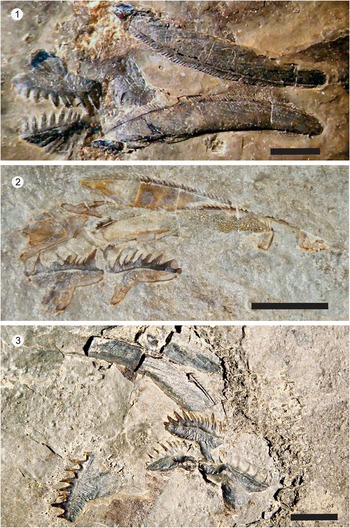
Three bedding-plane conodont apparatuses of Archeognathus primus Cullison, Reference Cullison1938 from the Winneshiek Shale. Note that all these 6-element apparatuses, which we interpret as complete, contain only one pair of coleodiform S elements and two pairs of ramiform P elements (P1 and P2), all with large basal bodies. Also note that the elements are consistently arranged, from left to right in Figure 2.1 and 2.2, as paired P1, P2, and S: (1) SUI 102853; (2) SUI 139882 (WL143); (3) SUI 139883 (WS16-1). Scale bar=2 mm.
Geological setting of the Winneshiek Shale
The Winneshiek Shale, which hosts the Winneshiek Konservat-Lagerstätte, is a greenish-brown to dark-gray, laminated sandy shale unit (Fig. 1.4), with some layers containing abundant pyrite and a high content of carbonaceous material. It is disconformably overlain by the St. Peter Sandstone, which is widely distributed in the Upper Mississippi Valley, and overlies a local un-named, thick and massive impact breccia unit (Fig. 1.2). In the study area, most of the Winneshiek Shale is buried in its ~25 km2 distribution area. The only known exposure of the unit is a small section at Decorah, Iowa that is mostly submerged in the Upper Iowa River. This exposure was excavated during the summer of 2010 by temporarily damming the river and using earth-moving equipment to dig into the riverbed, exposing a total thickness of ~4 m of the upper Winneshiek Shale. This 4 m section was sampled in detail and more than 2.5 tons of shale were systematically collected from it. This material was stored in the IGS facility building on the Oakdale Research Park Campus of the University of Iowa and kept in water until the shale slabs were split in the laboratory and carefully searched for fossils under binocular microscopes. With the assistance of trained students, this search was completed in three years, and resulted in a collection of more than 5,000 fossil specimens.
The full thickness of the Winneshiek Shale was revealed in two cores, which were drilled for the investigation of the Winneshiek Konservat-Lagerstätte. One of these is located at the single outcrop and the other is in the downtown area of the city of Decorah, ~3.5 km distant. The complete Ordovician sedimentary succession in the Decorah region was obtained from local geological data and from investigations of wells, some of which penetrated the Cambrian. Based on rock chips, the Winneshiek Shale has been recognized in at least 24 wells, indicating that the unit is 17–27 m thick and is distributed across the impact basin (Liu et al., Reference Liu, McKay, Witzke and Briggs2009; McKay et al., Reference McKay, Liu, Witzke, French and Briggs2011; Wolter et al., Reference Wolter, McKay, Liu, Bounk and Libra2011). Conodonts and other fossils occur through the Winneshiek Shale succession, but most of the fossils dealt with here were collected from the upper four meters of the excavated section.
Age of the Winneshiek Shale
Among the fossils collected from the Winneshiek Shale, only the conodonts currently furnish useful biostratigraphic evidence. However, pending assessment of the entire conodont fauna, our present focus is on the age indications provided by the two multielement species described herein along with one other species, Multioistodus subdentatus. None of these is a zone index, but their distribution elsewhere gives some indication of the age of the Winneshiek Shale.
The P (archeognathiform) elements of Archeognathus primus were first described from the Dutchtown Formation of Missouri (Cullison, Reference Cullison1938). Branson (Reference Branson1944, pls. 8, 9) published additional illustrations of Dutchtown conodont species, but provided no descriptions. Youngquist and Cullison (Reference Youngquist and Cullison1946) gave a more extensive account of this conodont fauna, but did not include any information about A. primus, presumably because they believed that it was not a conodont. Based mainly on new Dutchtown specimens, Klapper and Bergström (Reference Klapper and Bergström1984) described the “jaw-like” specimens of A. primus in considerable detail and recognized their conodont nature, but their study specimens did not permit any reconstruction of the apparatus. They recognized the similarity between the Dutchtown archeognathiform (P) and coleodiform (S) elements and “considered the possibility that they were elements of the same apparatus”, noting that “confirmation of this idea, however, requires additional evidence” (Klapper and Bergström, Reference Klapper and Bergström1984, p. 974). The present paper provides this evidence.
The Dutchtown Formation crops out to a limited extent in southern and southeastern Missouri, where it rests unconformably on the St. Peter Sandstone and is overlain by the Joachim Dolomite (see Branson, Reference Branson1944, fig. 12). Hence, it differs from the Winneshiek Shale in lying above rather than below the St. Peter Sandstone, although many authors have suggested that the St. Peter Sandstone is not the same age everywhere in the Midcontinent region (e.g., Ross et al., Reference Ross1982). It should also be noted that regional subsurface studies suggest that the St. Peter Sandstone interfingers with the calcareous Dutchtown Formation (e.g., Rexroad et al., Reference Rexroad, Droste and Ethington1982, fig. 2; Witzke and Metzger, Reference Witzke and Metzger2005). No archeognathiform elements have been reported from the Joachim Dolomite (Branson and Mehl, Reference Branson and Mehl1933; Andrews, Reference Andrews1967) or younger strata in Missouri.
Among the Dutchtown conodonts, Phragmodus flexuosus and P. polonicus are biostratigraphically important. The former is a geographically widespread species in upper Darriwilian and lower Sandbian strata in North America. The latter species, which has been collected from the type locality of the formation by one of us (SMB), is characteristic of the middle-upper Darriwilian of North America and occurs in coeval strata in Baltoscandia, Poland, and Siberia (see Ethington and Clark, Reference Ethington and Clark1981 and Dzik, Reference Dzik1994 for discussions of the taxonomy and other aspects of this species). The Siberian Platform occurrences (Moskalenko, Reference Moskalenko1970, Reference Moskalenko1973, Reference Moskalenko1983) in the Vihorevian Stage are of special interest because, as recognized by Moskalenko (Reference Moskalenko1970), the conodont fauna of this stage is similar to that of the Dutchtown Formation. The Siberian fauna includes, among other taxa, archeognathiform elements that may be congeneric with Archeognathus and one element (see synonymy in the Systematic section) that resembles the P2 element of Iowagnathus n. gen. of the Winneshiek fauna. Moskalenko described all her material only as form taxa and they have not yet been revised in modern multielement taxonomy. Moskalenko (Reference Moskalenko1983) correlated her Vihorevian fauna with that of the Darriwilian Eoplacognathus suecicus Zone in Baltoscandia. This might be correct although the absence of biostratigraphically important Baltoscandian taxa in the Siberian fauna makes precise correlation difficult.
In the Winneshiek conodont fauna, Multioistodus subdentatus, a species originally described from the Dutchtown Formation (Cullison, Reference Cullison1938), has been identified. This species has been recorded from the lower part of the Simpson Group of the Arbuckle Mountains of Oklahoma (e.g., Bauer, Reference Bauer2010), the Burger and Tyner formations of northeastern Oklahoma (Bauer, Reference Bauer1989), and several formations in Utah and Nevada (Ethington and Clark, Reference Ethington and Clark1981). All currently known occurrences of this species are of Darriwilian age.
Because of their successional relationship, the biostratigraphic age of the overlying St. Peter Sandstone would provide a minimum age for the Winneshiek Shale. Although the St. Peter Sandstone is essentially unfossiliferous, shaly intervals, particularly in the lower part of the unit, have yielded some biostratigraphically significant conodonts in drillcores from Iowa and Minnesota (Witzke and Metzger, Reference Witzke and Metzger2005). The most diagnostic fauna, which is from the Camp Quest core of Lemars, Plymouth County, in northwestern Iowa, includes representatives of Phragmodus flexuosus, Leptochirognathus sp., Erraticodon sp., Cahabagnathus sp. cf. C. friendsvillensis, Archeognathus sp., and Eoplacognathus sp., indicating a late Darriwilian age. This age is consistent with the resemblance of this conodont fauna to that of the McLish Formation of Oklahoma (Bauer, Reference Bauer1987). The St. Peter Sandstone in southwestern-most Indiana (i.e., even farther afield than northwest Iowa) has also yielded a somewhat similar, but taxonomically less diverse, conodont fauna (Rexroad et al., Reference Rexroad, Droste and Ethington1982). A taxonomically unusual, but probably approximately coeval, conodont fauna occurs in strata identified as the Dutchtown Formation in southeastern Indiana (Ethington et al., Reference Ethington, Droste and Rexroad1986). All the data indicate that conodont faunas with archeognathiform elements were widely distributed in the Midwest in the late Darriwilian. In view of the fact that the Winneshiek Shale is older than at least part of the St. Peter Sandstone, its fauna is also likely to be older. However, the geographically widespread Histiodella-Paraprioniodus-Pteracontiodus-Fahraeusodus fauna of early Darriwilian age is absent from both the Dutchtown and Winneshiek formations, which suggests that the Winneshiek Shale is of middle-late Darriwilian age. This is consistent with the fact that the early Darriwilian fauna occurs in the upper Everton Formation, which underlies the St. Peter Sandstone, in Missouri and Arkansas.
Paleoecology and taphonomy of the Winneshiek fauna
Paleogeographic studies indicate that northeastern Iowa occupied a marginal to near-shore setting in the tropical zone of Laurentia during the Middle Ordovician (Fig. 1.3) (Witzke, Reference Witzke1990; Niocaill et al., Reference Niocaill, van den Plum and van der Voo1997; Jin et al., Reference Jin, Harper, Cocks, McCusland, Rasmussen and Sheehan2013). Recent analyses of subsurface data indicate that the Winneshiek Shale and the underlying breccia unit are confined to a circular basin with a diameter of 5.6 km in the Decorah area. Multiple lines of geological evidence indicate that this circular basin was formed by a meteorite impact (Liu et al., Reference Liu, McKay, Witzke and Briggs2009; McKay et al., Reference McKay, Liu, Witzke, French and Briggs2011). The shape and dimension of the crater have recently been established by aerial geophysical surveys conducted by the U.S. Geological Survey (Koontz and McKay, Reference Koontz and McKay2013), and the crater has been named the Decorah Impact Structure. The crater resulted in an enclosed basin where anoxic conditions developed in the relatively undisturbed bottom water, which provided appropriate taphonomic conditions for the exceptional preservation that characterizes the Winneshiek Konservat-Lagerstätte.
Although the deposit is marine influenced, many typical Ordovician open-marine fossils, such as trilobites, graptolites, corals, bryozoans, and echinoderms, are absent in the Winneshiek fauna, which includes eurypterids (Lamsdell et al., Reference Lamsdell, Briggs, Liu, Witzke and McKay2015b), phyllocarids (Briggs et al., Reference Briggs, Liu, McKay and Witzke2015 [2016]), ostracodes, jawless fish, and linguloids. The Winneshiek Shale also yields abundant bromalites (mineralized gut contents and coprolites) and algae. The unusual composition of the fauna suggests that it inhabited a restricted environment, likely in brackish water, with a low salinity that was inhospitable to typical marine taxa (Liu et al., Reference Liu, McKay, Young, Witzke, McVey and Liu2006, Reference Liu, McKay, Young, Witzke, McVey and Liu2007, Reference Liu, McKay, Witzke and Briggs2009; Witzke et al., Reference Witzke, McKay, Liu and Briggs2011).
Materials and methods
Among the 5,354 numbered specimens collected from the Winneshiek Shale, 2,749 are conodonts and more than 10% of these conodont specimens are bedding-plane assemblages. As mentioned above, this study focuses on the apparatuses of two taxa identified as Archeognathus Cullison and a new genus Iowagnathus. Each taxon is represented by multiple, apparently complete or nearly complete apparatuses.
Based on their position in the section, the specimens collected from the top to the base of the excavated section are labeled WS1 through WS18, each number representing a stratum thickness of about 20 cm. Other specimens were collected from random slabs that were washed out from the river bed during flooding. These specimens are labeled WL.
Repository and institutional abbreviation
The specimens described and illustrated herein are reposited in the Paleontology Repository of the Department of Earth and Environmental Sciences, the University of Iowa, and are labeled SUI.
Systematic paleontology
Conodonta Eichenberg, Reference Eichenberg1930
Family Archeognathidae Miller, Reference Miller1969
Diagnosis
Large conodonts with individual elements that can be longer than 10 mm; a highly modified apparatus consisting of only three pairs of elements, one pair of coleodiform and two pairs of archeognathiform; all elements containing robust basal bodies with distinctive radial or oblique ridge-and-groove surface ornamentation; denticles hyaline and fibrous, with rare or absent white matter.
Remarks
Representatives of this family are currently known only from the Darriwilian to Sandbian interval of the Ordovician. There is only one referred genus: Archeognathus Cullison, Reference Cullison1938. Pending revision of relevant taxa (see Klapper and Bergström, Reference Klapper and Bergström1984; Miller, Reference Miller1969; Sweet, Reference Sweet1988), we assign Archeognathus to Archeognathidae Miller, Reference Miller1969, following Klapper and Bergström (Reference Klapper and Bergström1984).
Genus Archeognathus Cullison, Reference Cullison1938
Type species
Archeognathus primus Cullison, Reference Cullison1938, by original designation.
Diagnosis
Complete apparatus consisting of three pairs of large elements. One pair of coleodiform (S) elements long and elongate; thick basal body slightly curved with numerous small denticles along the upper (convex) margin to form a saw-blade shape. Two other pairs of archeognathiform elements (P1 and P2) smaller, with fewer but much more robust denticles, none developed as a cusp; prominent basal bodies of P1 and P2 elements with conspicuous handle-like projection from a more or less straight lower margin.
Remarks
In all important morphological features, including the appearance of the basal body, the P elements of this apparatus are identical with the holotype of A. primus from the Dutchtown Formation (Cullison, Reference Cullison1938, pl. 29, figs. 10a, b). However, in accordance with taxonomic priority rules, it is necessary to assess whether any other element in the Archeognathus apparatus was assigned to a new genus prior to 1938. The fact that this apparatus contains only one other type of paired element, here referred to as the S element, would appear to make it an easy task to establish priority. In previous conodont faunal studies, blade-like specimens of similar appearance to the S element in the Winneshiek taxon have in most cases been referred to the form genus Coleodus Branson and Mehl, Reference Branson and Mehl1933. Unfortunately, as noted by Klapper and Bergström (Reference Klapper and Bergström1984), Branson and Mehl’s (Reference Branson and Mehl1933) cotypes of C. simplex, the type species of Coleodus, which were collected from the Harding Sandstone of Colorado, are too fragmentary to permit a full description and confident identification, and it has never been revised in terms of multielement taxonomy. Inspection of Branson and Mehl’s (Reference Branson and Mehl1933, pl. 1, fig. 22) illustration of the most complete specimen, which we here select as the lectotype of C. simplex, shows that its denticulation and the shape of both the lower margin and lateral face of the process differ markedly from the corresponding features in the coleodiform element (S element) of A. primus. Thus, it is unlikely that they represent the same species. In addition, the Harding Sandstone is of late Sandbian age and substantially younger than both the Dutchtown and Winneshiek formations.
Coleodus has been used as a genus designation for several Middle, and even Late, Ordovician taxa of both hyaline and albid types of conodonts based on a superficial general similarity to C. simplex in descriptions of North American, Baltoscandic, and Chinese faunas that completely lack archeognathiform elements (e.g., Moskalenko, Reference Moskalenko1970; An et al., Reference An1983; Bauer, Reference Bauer2010). This suggests that Coleodus has become a wastebasket genus for homeomorphic but not closely related conodont elements, and that these species are not congeneric with A. primus. Thus, although Coleodus was established a few years earlier, we use Archeognathus as the generic designation for our Winneshiek taxon. Winneshiek apparatuses of this taxon include elements clearly representing Youngquistina Miller, Reference Miller1969 and this genus is here regarded as a junior synonym of Archeognathus.
Neocoleodus spicatus Branson and Mehl, Reference Branson and Mehl1933, the type species of Neocoleodus, has been recorded from several formations but is currently poorly known. It may be related to Archeognathus at the family level, but this type of element is not present in our Winneshiek collections.
Archeognathus primus Cullison, Reference Cullison1938
Camera-lucida drawings of the three types of elements in the Archeognathus primus apparatus: (1) P1 element, SUI 139884 (WS14-522); (2) P2 element, SUI 139885 (WS12-382); (3) S element, SUI 139886 (WL13). Scale bar=2 mm.

Schematic illustration of the architecture of the 6-element Archeognathus primus apparatus.

Reference Cullison1938 Archeognathus primus Cullison, p. 227, pl. 29, figs. 16a, b.
Reference Miller1969 Youngquistina mitteni Miller, p. 505, fig. 1.
1984 Archeognathus primus Cullison, Reference Cullison1938; Klapper and Bergström, p. 954, figs. 3–8, 9A, B, 10 (includes further synonyms).
Material
Complete or nearly complete apparatuses: SUI 102853, WL143, WL238, WL240, WL281, WS16-1, WS17-34; incomplete apparatuses: WL70, WL213, WL227, WL229, WL256, WL277, WS10-48, WS10-61, WS12-199, WS13-589, WS15-342, WS16-540; individual elements: WL13, WL58, WL211, WL225, WS12-251, WS12-382, WS14-522, WS16-386.
Diagnosis
The same as for the genus above.
Occurrence
Darriwilian to Sandbian (Middle to Upper Ordovician) of North America and possibly the Siberian Platform.
Description
Representatives of Archeognathus primus are some of the most common conodonts in the Winneshiek fauna and they are preserved both as individual elements and as apparatuses. A complete apparatus of this taxon (Figs. 2.1–2.3, 4, 9.1) includes six elements in three pairs, one of coleodiform and two of archeognathiform elements, all of them with robust basal bodies. The elements in each pair appear to be mirror images of each other, reflecting a bilateral symmetry. Locations of the three paired elements are consistent in its apparatus as shown by Figure 2.1 and 2.2 and illustrated by Figure 4.
The complete apparatuses of A. primus from the Winneshiek Shale are the first of this taxon discovered anywhere in the world. Because the element morphology and architecture of the apparatus differ greatly from those previously described from the Ordovician, applying the location system of Sweet (Reference Sweet1988; also see Purnell et al., Reference Purnell, Donoghue and Aldridge2000), which is now commonly used in conodont multielement classification, is not straightforward. In the collections at hand, we have failed to find any typical M elements in this type of apparatus. The absence of such an element is not a unique feature and has been reported in a variety of Ordovician multielement taxa, as well as in taxa of other ages.
Although several complete apparatuses of A. primus occur in our collection, it is still a challenge to recognize the orientation of the apparatus in the animal without evidence of the soft parts. However, the general location of these pairs of elements is consistent in these apparatuses. For descriptive purposes, we use conventional terminology. Based on their position at one end of the apparatus, as well as their multidenticulated morphology, it is likely that the single pair of coleodiform elements in the A. primus apparatus represents a highly modified S element. On this basis, the two pairs of archeognathiform elements can be designated P elements and are here referred to as P1 (Pa) and P2 (Pb) elements (Figs. 3, 4) occupying a caudal position according to the scheme of anatomical notation by Purnell et al., (Reference Purnell, Donoghue and Aldridge2000).
The coleodiform S element of A. primus resembles a slightly curved and elongated saw blade and can reach a length of >10 mm in the Winneshiek specimens. The degree of curvature of this element varies (Figs. 2.1, 2.2, 3.3, 8.4). Numerous, short, slightly reclined in the same direction, and densely packed (8–10 per mm) denticles form a uniform row along the convex margin. No cusp is present in either the left or right representatives of this pair of elements. The basal groove has a robust and thick basal body. In some specimens, an ear-like projection (indicated by the red arrow in Fig. 8.4) occurs near the posterior end of the concave side of the basal body of the element. This type of element is always the largest one in its apparatus (the example illustrated in Fig. 3.3 is 12.5 mm long).
The archeognathiform P1 and P2 elements in the apparatus of A. primus are smaller than the S element and are typically 2–3 mm long. Klapper and Bergström (Reference Klapper and Bergström1984), however, recorded specimens of this element 5–7 mm long and noted that they had seen specimens twice as large. Because they described the morphology of these elements in considerable detail, we restrict our description here to a few details. The P1 and P2 elements usually have 10–16 prominent, somewhat cone-shaped, denticles. Costae may occur on some denticle surfaces. These denticles are well separated and arranged in a row along the margin of the crown of the element. They are much longer and thicker than those in the S element with a length of ~0.5 mm that may vary along the denticle row. In many specimens, slightly shorter denticles occur between the larger ones, but none is developed as a distinct cusp. In several apparatus specimens, the denticles of the P elements point in the opposite direction to those in the S elements (Fig. 2.1, 2.2). Because this difference in denticle direction often occurs in our Archeognathus apparatuses, it may reflect the position of the elements in the living animal. In most specimens, the denticles of the P1 element are straighter than those in the P2 element. The space between adjacent denticles may vary slightly in the archeognathiform P1 and P2 elements, but their bases are connected by a continuous lamina. Longitudinal striae, which were described by Cullison (Reference Cullison1938, p. 227) and later illustrated by Miller et al., (Reference Miller, Cullison and Youngquist1947, pl. 1), are not evident in our specimens.
Both the P1 and P2 elements are provided with very prominent basal bodies. The most conspicuous feature of these bodies is what Klapper and Bergström (Reference Klapper and Bergström1984) referred to as a downward projection, oriented more or less obliquely to the denticle row. Based on the shape, we refer to this structure as a “handle-like” base projection. This projection is broader and located in a more central position in the P1 element than that in the P2 element (Figs. 2, 3.1, 3.2, 4, 8.1–8.3). In all the three pairs of elements of the A. primus apparatus, ridge-and-groove ornaments commonly occur on the surface of the basal bodies (Figs. 2.1, 2.3, 8.1–8.3). Where preserved, they are obliquely arranged on the S elements and roughly radiate from the base projection in the P1 and P2 elements.
Remarks
The holotype of Youngquistina mitteni Miller, Reference Miller1969, the type species of Youngquistina, which was collected from the Harding Sandstone in Colorado, agrees in all significant morphological features with the P1 element of A. primus and we consider Youngquistina to be a junior synonym of Archeognathus. The unidentified specimen with prominent basal body described by Mosher and Bodenstein (Reference Mosher and Bodenstein1969) from the lower part of the Chickamauga Limestone of Alabama is clearly a P element of an archeognathid. With a total size of ~1 mm long, this Chickamauga specimen is less than half the size of many Winneshiek examples of this element.
Although coleodiform elements are widespread in Middle and early Late Ordovician faunas, this is the first report of a natural apparatus in which they are associated with archeognathiform elements. However, some possible co-occurrences of coleodiform and archeognathiform elements have been reported from other Ordovician strata, such as in the conodont faunas of the St. Peter Sandstone of Iowa (Witzke and Metzger, Reference Witzke and Metzger2005). Webers (Reference Webers1966) reported Neocoleodus spicatus and Coleodus simplex (Webers, Reference Webers1966, pls. 4.5, 5.11; also cf. elements identified as species of Lonchodus illustrated by Stauffer, Reference Stauffer1935, pl. 10, figs. 1–7, 9–12) from the Glenwood Formation of Minnesota, which may represent elements of a species of Archeognathus. Mound (Reference Mound1965, pl. 4) reported Polycaulodus reversus and Pravognathus idoneus from the Joins Formation of Oklahoma, which possibly also represent a species of Archeognathus. Klapper and Bergström (Reference Klapper and Bergström1984) discussed other records of possible archeognathiform specimens from North America and Siberia. Because we have not had the opportunity to reexamine these taxa, we cannot add further information but note that the specimens illustrated by Moskalenko (Reference Moskalenko1983, figs. 3L, N, but not M) as Neocoleodus dutchtownensis Youngquist and Cullison show some similarity to archeognathiform elements. These and other co-occurrences of coleodiform and archeognathiform elements suggest that there were additional Ordovician archeognathid taxa, but far more extensive collecting is needed to confirm this observation.
Coleodiform elements have been recorded as species of Coleodus or Loxodus from a variety of formations in North America, Baltoscandia, Siberia, and China, where they are not associated with archeognathiform elements. Three examples of this are records of a species of Coleodus from the Winnipeg Formation of South Dakota (Sweet, Reference Sweet1982), the Mystic Formation of Quebec (Barnes and Poplawski, Reference Barnes and Poplawski1973), and the Hølonda Limestone of the Norwegian Caledonides (Bergström, Reference Bergström1980). In many cases, these elements are not hyaline, have somewhat larger denticles, and a carminate rather than bowed blade with a more pointed posterior blade end. An example of this type of albid element is Loxodus dissectus An in An et al., Reference An1983 from the Machiagou Formation in northern China (An et al., Reference An1983, text-figs. 5, 7, 13; Wang et al., Reference Wang, Bergström, Zhen, Zhang and Wu2014, pl. 3, fig. 8). This species is relatively common in this formation and used as a zonal index, but is not associated with archeognathiform elements. It should also be noted that incomplete specimens of the blade-like albid elements of, for example, Appalachignathus Bergström et al., Reference Bergström, Carnes, Ethington, Votaw and Wigley1974 and Loxodus Furnish, Reference Furnish1938, and the M element of Bergstroemognathus extensus (Graves and Ellison, Reference Graves and Ellison1941), could be confused with the S element of Archeognathus primus. Hence, care must be exercised in the identification of coleodiform elements because this type of element is homeomorphic and probably a component of a variety of multielement taxa.
Family Iowagnathidae new family
Diagnosis
Large conodonts with individual elements up to 16 mm or more in length; complete apparatus with 15 elements somewhat reminiscent of the prioniodinid type; elements with two or three multidenticulated processes and a distinct cusp; denticles hyaline and fibrous, with rare or absent white matter, but without obvious cavity; basal bodies robust, surface with radial ridge-and-groove ornamentation.
Remarks
Representatives of this family are known only from the Middle Ordovician. Only one referred genus: Iowagnathus new genus.
Genus Iowagnathus new genus
Type species
Iowagnathus grandis new species.
Etymology
Named for the State of Iowa, the source of the material.
Diagnosis
Same as for species by monotypy.
Remarks
Iowagnathus n. gen. is strikingly different from Archeognathus and others in the element component and arrangement of the apparatus, as well as in the morphology of the individual elements (Figs. 5–7, 8.7–8.19, 9.2), suggesting no close affinity at the genus level. In the presence of a denticulated anterior process in some of its elements, Iowagnathus n. gen. is reminiscent of the Darriwilian hyaline genus Paraprioniodus Ethington and Clark, Reference Ethington and Clark1981, especially as represented by its type species P. costatus (Mound) (see Ethington and Clark, Reference Ethington and Clark1981, p. 77–79; Rexroad et al., Reference Rexroad, Droste and Ethington1982, p. 9; Bauer, Reference Bauer2010, p. 16–17). However, as shown by the reconstructions of the P. costatus apparatus by those authors, the significant differences in the morphology of particularly the S0, M, and some S elements of the type species of Iowagnathus n. gen. and Paraprioniodus support separation at the genus level. The elements of Iowagnathus n. gen. also exhibit some general similarity to those of the hyaline genus Erismodus Branson and Mehl, Reference Branson and Mehl1933. However, as illustrated by Sweet (Reference Sweet1988), the elements of Erismodus lack the long denticulated anterior process in corresponding elements of Iowagnathus n. gen., and the appearance of the S0 element is completely different between the two taxa (for further discussion of Erismodus, see Sweet, Reference Sweet1982, p. 1039–1040). Based on the available information, we regard Iowagnathus n. gen. and Erismodus as separate genera. Another genus exhibiting some superficial similarity to Iowagnathus is Erraticodon Dzik, Reference Dzik1978. However, there are significant differences between especially the S and P elements of Erraticodon and those of Iowagnathus n. gen., and these genera are not synonymous.
Two apparently complete apparatuses of Iowagnathus grandis n. gen. n. sp. from the Winneshiek Shale, each containing 15 elements, 14 of which are paired and one unpaired. The unpaired S0 (Sa) element and the paired M elements are marked by arrows in each apparatus. Note the constant locations of the paired M elements in the apparatuses: (1) paratype, SUI 139887 (WS18-60); (2) holotype, SUI 139888 (WS18-266). Scale bar=2 mm.

Schematic illustration of the apparatus of the holotype SUI 139888 (WS18-266) of Iowagnathus grandis n. gen. n. sp. showing the element locational notations used in the present study. The apparatus is complete, but the left P1, the right P2, and both M elements are partly embedded in the shale matrix. Although not shown in this figure, the S3 elements have an anterior process, as seen in the paratype illustrated in Figure 5.1.

Camera-lucida drawings of elements in the Iowagnathus grandis n. gen. n. sp. apparatus: (1) S0 element, SUI 139894 (W18-246); (2) S1 element, SUI 139904 (WS15-342); (3) S2 element, SUI 139898A (WS13-656A); (4) S3 element, SUI 139898C (WS13-656C); (5) S4 element, SUI 139905 (WS17-296), note that this specimen is illustrated in posterior view with a hidden anterior process as a rectangular extension from the cusp; (6) P1 element, SUI 139899 (WS16-80); (7) P2 element, SUI 139900 (WS14-553); (8) M element, SUI 139901 (WS11-342). Scale bars=2 mm.

Iowagnathus grandis new species
Illustrations of individual elements showing typical element morphologies and microstructures of Archeognathus primus (1–6) and Iowagnathus grandis n. gen. n. sp. (7–19): (1) P1 element of A. primus with a centrally placed wide downward projection (“handle”) from the basal body; SUI 139889 (WS12-251); scale bar=1 mm; (2, 3) P2 elements of A. primus with a narrower downward projection placed near the end of the element; in the element illustrated in Figure 8.3, the amber denticle color has faded to white, and most of the basal body has been dissolved leaving only a carbon film; SUI 139885 (WS12-382) and SUI 139890 (WL58), respectively; scale bar=1 mm; (4) saw-blade like S element of A. primus with the basal body having a short “ear-like” extension near the end of the element, which is marked by a red arrow; SUI 139891 (WS16-386); scale bar=2 mm; (5) thin section of a denticle of A. primus showing compact growth lamellae; SUI 139892 (WL211); scale bar=100 µm; (6) thin section of basal body of A. primus showing thick undulate lamellae; SUI 139893 (WL225); scale bar=100 µm; (7–9) S0 elements (only the lower one in 8 and 9) showing variations in the element morphology of I. grandis n. sp.; SUI 139894 (WS18-246), SUI 139895 (WS13-1), and SUI 139896 (WS18-265), respectively; scale bar=2 mm in (7) and (8), 1 mm in (9); (10) color-faded denticle with fibrous lamellae, which are indicated by white arrows; sample SUI 102854; scale bar=100 µm; (11) S1 element of I. grandis n. sp. with nearly symmetrically placed lateral processes and large, distinctly ornamented basal body; SUI 139897 (WS16-235); scale bar=1 mm; (12) S2 element of I. grandis n. sp. with a slightly curved anterior process; SUI 139898A (WS13-656A); scale bar=1mm; (13) P1 element of I. grandis n. sp. with symmetrical lateral processes, prominent anterior cusp, and large, strongly ornamented basal body; SUI 139899 (WS16-80); scale bar=1 mm; (14) posterior view of S element of I. grandis n. sp. with uniformly long denticulated processes and reclined cusp; SUI 139905 (WS17-296); scale bar=1 mm; (15) P2 element of I. grandis n. sp. with short and approximately uniform processes and a long reclined cusp; SUI 139900 (WS14-553); scale bar=1 mm; (16) S3 element of I. grandis n. sp. with prominent, slightly curved, anterior process; SUI 139898C (WS13-656C); scale bar=1 mm; (17) M element of I. grandis n. sp. with asymmetrical lateral processes and prominent cusp; SUI 139901 (WS11-342); scale bar=1 mm; (18) thin section of a denticle of I. grandis n. sp. showing very thin growth lamellae; SUI 139902 (WS13-587); scale bar=100 µm; (19) thin section of basal body of I. grandis n. sp. illustrating relatively thick undulating lamellae; SUI 139903 (WL208); scale bar=100 µm.

Comparison of the architecture of the 6-element apparatus of Archeognathus primus (1), the 15-element apparatus of Iowagnathus grandis n. gen. n. sp. (2), the 15-element apparatus of ozarkodinid type (3), and the 19-element apparatus of Promissum pulchrum (4): Figures (3) and (4) are after Aldridge et al., (Reference Aldridge, Purnell, Gabbott and Theron1995), Donoghue et al., (Reference Donoghue, Purnell, Aldridge and Zhang2008), and Aldridge et al., (Reference Aldridge, Murdock, Gabbott and Theron2013). All these figures are based on interpretation of bedding-plane assemblages. The figures of the I. grandis elements are mostly based on SUI 139888 (WS18-266), in which several individual element pairs are readily recognizable. The estimated length of the illustrated apparatuses of A. primus and I. grandis is approximately 20 mm, but an incomplete I. grandis apparatus SUI 139895 (WS13-1) has a length more than 31 mm with individual elements up to 16 mm long, suggesting that much larger apparatuses were present. The occurrence of some element pairs in clusters, and the symmetrical arrangement of elements, indicate that they likely had a food-handling function.

?Reference Moskalenko1970 Microcoelodus festivus sp. nov. Moskalenko, p. 72, pl. 1, fig. 8.
Type specimens
Holotype: apparatus specimen SUI 139888 (WS18-266) (Fig. 5.2); Paratype: apparatus specimen SUI 139887 (WS18-60) (Fig. 5.1). Both are from the Winneshiek Shale, northeast Iowa.
Material
Complete or nearly complete apparatuses: SUI 102852, WL151, WS10-347, WS17-273, WS17-275, WS18-79, WS18-246; incomplete apparatuses: WL26, WL60, WL89, WL152, WL156, WL173, WLl79, WS10-72, WS10-195, WS10-197, WS11-21, WS13-1, WS13-656, WS15-71, WS16-82, WS17-2, WS17-287; individual elements: WL208, WS11-342, WS13-587, WS14-553, WS15-342, WS16-80, WS16-235, WS17-296, WS18-265.
Etymology
Grandis (Latin), big, referring to the large size reached by the elements and apparatus.
Diagnosis
Hyaline conodonts with an apparatus comprising 15 large ramiform elements, fourteen (P1, P2, M, S1-4) in pairs and one (S0) unpaired (Figs. 5, 6, 9.2). The unpaired S0 element symmetrical and morphologically jaw-like, essentially alate and without posterior or anterior process; cusp short and not prominent. The 14 paired elements more or less digyrate, multidenticulated, with two or three denticulated processes, near symmetrical to asymmetrical; each of the paired elements with a well-developed cusp. Denticles peg-like, sharply pointed, essentially rounded in cross section, and more or less reclined. All elements possess prominent basal bodies and grooves but without cavities.
Occurrence
Darriwilian (Middle Ordovician, Whiterockian), North America and possibly coeval strata in Siberia.
Description
Iowagnathus grandis n. gen. n. sp. is one of the most abundant conodont taxa in the Winneshiek collection. The apparatus of this species is composed of 15 large ramiform elements with robust basal bodies, 14 of which are paired and more or less symmetrical to asymmetrical, and one unpaired and essentially symmetrical. The unpaired element (indicated by arrows in Fig. 5.1, 5.2) is referred to as the S0 element. Four pairs of mutually similar S elements form a modified symmetry transition series that includes S1, S2, S3, and S4 elements. The apparatus also has paired M, P1, and P2 elements. Complete apparatuses of this taxon are illustrated in Figure 5.1 and 5.2, and a schematic illustration of the element notation is provided in Figure 6. Representative elements are illustrated in Figures 7 and 8.7–8.17. A schematic model of the apparatus elemental distribution is shown in Figure 9.2.
The ramiform, asymmetrical to more or less symmetrical paired M, S, and P elements of this species are not conspicuously different in general morphology. The unpaired, essentially symmetrical, and comparatively large S0 element, however, has a highly distinctive alate shape that is reminiscent of the corresponding element in the Devonian genus Apatognathus Branson and Mehl, Reference Branson and Mehl1934.
All the elements of Iowagnathus grandis n. gen. n. sp. are multidenticulated, and one of the denticles of each element is usually prominent in size and/or shape. For descriptive purpose, we call this denticle a cusp to distinguish it from others, although a cavity is absent. The S0 element (Figs. 5, 6, 7.1, 8.7–8.9) has a small but identifiable cusp and two symmetrically placed lateral processes that form an angle, which varies from acute to obtuse, or form a wide curve (Fig. 8.7–8.9). There is no anterior or posterior process. The denticles are straight or slightly reclined, of nearly the same length (~0.5 mm), and sharply pointed and rounded in cross section. However, the two denticles on each lateral process adjacent to the cusp are significantly shorter than the others, resulting in a small gap on each side of the cusp (see Fig. 8.7, 8.9). The length of the lateral processes of the S0 element is somewhat variable: the widely arched elements usually have somewhat shorter processes (commonly <5 mm long) and fewer denticles (usually <30). However, a total of 48 denticles were counted in the specimen shown in Figure 8.7. Another S0 element (lower specimen in Fig. 8.8) has a lateral width more than 16 mm, making it one of the largest conodont elements ever recorded.
The 14 paired elements in the I. grandis n. sp. apparatus are roughly similar in morphology, being ramiform with a central cusp and two lateral processes. However, whereas the S1, P2, and M elements have only two lateral processes, the S2, S3, S4, and P1 elements have a well-developed denticulated anterior process extended from the cusp (Fig. 7). The anterior process is hidden in the sediment in some specimens, but its presence is revealed in posterior view by a more or less rectangular extension of the basal body (Figs. 6, 7.5). The S2 through S4 elements, which usually have anterior processes, can be identified based on minor differences in shape and size. For example, the S3 element usually is smaller and has fewer denticles than other S elements in the apparatus. The paired P1 and P2 elements are essentially similar to the S elements with multidenticulate processes, but the P1 element is nearly symmetrical and with well-developed denticulated anterior process, and the P2 element is slightly asymmetrical with only two processes. Morphologically the P2 element is close to the S3 element, but the former lacks a third process. The M elements differ from others by their obviously asymmetrical morphology and smaller element size (Figs. 7.8, 8.17). Also, as indicated in Figure 5 and schematically illustrated in Figures 6 and 9.2, the paired M elements are always located at one end of its apparatus.
The denticles of the 14 paired elements are more or less reclined and mostly rounded in cross section, and costae or keels may occur, especially on the cusp. However, the denticles of the relatively short process of the M element are essentially blade- or plate-like in shape (Figs. 7.8, 8.17).
All the paired elements have robust basal bodies. The surface of the bodies has distinct ridge-and-groove structures that radiate from the center of the element (Figs. 7.2, 7.6, 8.11–8.13) similar to those described in Archeognathus primus.
There are some variations in the morphology of the elements of I. grandis n. sp., and they show interrelated changes in element size and denticle length. It appears that as the element became larger during ontogeny, the denticles became thicker but comparatively shorter. This might reflect denticle wear, but detailed study of the denticle surfaces is necessary to confirm this.
Remarks
The erection of a new genus and species for this type of apparatus is based on the absence of any previously named taxon with identical elements. The incompletely known Microcoelodus festivus Moskalenko from the Podkamennaya Tunguska and Moyero Rivers region in Siberia (Moskalenko, Reference Moskalenko1970), which was based on a single specimen and only illustrated in posterior view, is similar to the P2 element of the present species, but no associated elements of its apparatus have been recorded. Coleodus mirabilis Moskalenko, Reference Moskalenko1970 has an unusual morphology similar to that of the alate S0 element in Iowagnathus grandis n. gen. n. sp., but Moskalenko’s (Reference Moskalenko1970) illustrations suggest that this element differs in being albid and having a different type of process denticulation. In general appearance, and particularly denticulation, I. grandis n. sp. is similar to Erismodus? horridus Harris, Reference Harris1964 from the lower Joins Formation of Oklahoma. However, the illustrations of E.? horridus (Harris, Reference Harris1964, pl. 1.2a–1.2c) show two types of S elements that clearly differ from those of I. grandis n. sp. in that the third process of the S elements extends posteriorly from the base of the cusp rather than anteriorly.
Comparison with other conodont apparatuses
As described above, the elemental component, morphology and structure of Archeognathus primus and Iowagnathus grandis n. gen. n. sp. are significantly different. For comparison, the hypothesized architectures of A. primus and I. grandis n. sp., essentially based on elemental distributions in their apparatuses, are shown in Figure 9.1 and 9.2. Among the small number of natural conodont assemblages described from the Ordovician, none is closely similar to those from the Winneshiek Shale. As far as we are aware, the Winneshiek specimens are the first complete apparatuses with hyaline elements described. Another apparatus with hyaline elements, which was identified as Erismodus quadridactylus, was recorded from the Ordovician of North Dakota, USA (Dhanda, Reference Dhanda2004). Judging from the unpublished Ph.D. dissertation by Dhanda (Reference Dhanda2007), it is far less well preserved compared to the Winneshiek apparatuses and may not be complete. In general architecture, the 6-element apparatus of A. primus is unique although it may be interpreted as a much-modified version of the prioniodinid apparatus. In contrast, the 15 element I. grandis n. sp. apparatus has a general architecture of prioniodinid type, although individual elements differ markedly in shape from those of, for example, post-Ordovician ozarkodinid and polygnathacean apparatuses (e.g., Aldridge et al., Reference Aldridge, Smith, Norby and Briggs1987). Especially striking is the difference in the morphology and arrangement of the S elements.
A detailed comparison with post-Ordovician apparatuses is beyond the scope of the present paper, so we restrict ourselves to a discussion of two important examples. The first is Promissum pulchrum Kovács-Endrödy from the Upper Ordovician Soom Shale of South Africa (Theron et al., Reference Theron, Richards and Aldridge1990; Aldridge et al., Reference Aldridge, Purnell, Gabbott and Theron1995), which was originally thought to be a primitive land plant (Kovács-Endrödy, Reference Kovács-Endrödy1987). Aldridge et al., (Reference Aldridge, Purnell, Gabbott and Theron1995) recorded 19 elements in its apparatus. The second example, also from the Soom Shale, is Notiodella keblon Aldridge et al., Reference Aldridge, Murdock, Gabbott and Theron2013, which has 17 elements in the apparatus. According to Bergström and Ferretti (Reference Bergström and Ferretti2015), Notiodella is congeneric with Icriodella Rhodes, Reference Rhodes1953, and we use that designation here. The architecture of the Icriodella apparatus (Aldridge et al., Reference Aldridge, Murdock, Gabbott and Theron2013, fig. 12) is similar to that of Promissum, except in the case of the M and P elements, so we do not illustrate it here.
The general elemental distribution of the Archeognathus, Iowagnathus, ozarkodinid, and Promissum apparatuses is schematically compared in Figure 9. The Archeognathus apparatus is much simpler than the others, with a strikingly different template (Fig. 9.1), especially in the presence of only one pair of coleodiform (S) elements, suggesting no obvious relationship to the others. The multidenticulated morphology of the S elements suggests a similar function to those in Promissum. The apparatus of Iowagnathus n. gen. (Fig. 9.2), in contrast, exhibits a general similarity in organization to both Promissum and the ozarkodinid types of apparatuses. However, Iowagnathus n. gen. has a different basic architecture in that the element pairs appear to be lined up one after the other in two parallel rows rather than being positioned essentially side-by-side as is the case with most of the elements in the ozarkodinid (Fig. 9.3) and Promissum (Fig. 9.4) apparatuses. Also, the morphology of the M, S, and P elements, in particular, is too different to suggest any close relationship between these taxa. In general, the template of the Iowagnathus n. gen. apparatus shows a somewhat closer resemblance to the ozarkodinid type (cf., Mashkova, Reference Mashkova1972; Purnell and Donoghue, Reference Purnell and Donoghue1998; Donoghue et al., Reference Donoghue, Purnell, Aldridge and Zhang2008), which is best known from post-Ordovician strata, than to that of Promissum. As indicated by multiple apparatuses and specimens with paired elements from the Winneshiek Shale, the morphologically similar S1 to S4 elements in Iowagnathus n. gen., which occur between the M and P elements, suggest that they may have had a similar function as the P elements.
The apparatus of Iowagnathus n. gen. also differs in several significant respects from the reconstructed apparatuses of the Silurian genera Pterospathodus (Barrick and Klapper, Reference Barrick and Klapper1976), Astropentagnathus (Armstrong, Reference Armstrong1990), Apsidognathus (Armstrong, Reference Armstrong1990), and Aulacognathus (Armstrong, Reference Armstrong1990), indicating no close evolutionary relationships to these genera. Thus, both Archeognathus and Iowagnathus n. gen. appear to be isolated taxonomically from other genera. This taxonomic isolation is consistent with the fact that hyaline conodonts are not recorded from the latest Ordovician, although they are well represented in Middle and early Late Ordovician faunas.
Discussion
Exceptionally preserved apparatuses of Archeognathus primus and Iowagnathus grandis n. gen. n. sp. from the Winneshiek Shale provide unusual material for the reconstruction of their apparatus architecture and the determination of their affinity. In reconstructing apparatus architecture, it is obviously important to investigate the degree of post-mortem movement of individual elements. Where no movement has occurred, paired elements occupy consistent positions and the arrangement of the elements follows a particular pattern. Unfortunately, such specimens have not been available for many described apparatuses and their architectures have been inferred based on available evidence. Complete conodont apparatuses are very rare in the lower Paleozoic and virtually all are preserved in two dimensions on bedding planes, except the remarkable Upper Devonian Palmatolepis apparatus described by Lange (Reference Lange1968, pl. 1). Although element movement may occur during preservation, many elements in bedding-plane assemblages of both Archeognathus and Iowagnathus n. gen. from the Winneshiek Shale are arranged in morphologically similar pairs, some of which are located close together. This provides strong indication of little movement of these elements, especially as consistent patterns are evident in several apparatuses.
As described before, the two pairs of shorter archeognathiform elements in the Archeognathus primus apparatus are regarded as homologous with the P elements in Lange’s Palmatolepis apparatus and in numerous preserved apparatuses from the Pennsylvanian of Illinois (Aldridge et al., Reference Aldridge, Smith, Norby and Briggs1987), and the elongated coleodiform elements as S elements. The spatial arrangement of elements in the A. primus apparatus is best displayed in the specimens shown by Figures 2.1 and 2.2, in which the elements are consistently arranged, from left to right in the pictures, as paired P1, P2, and S elements. The distribution pattern of elements in the apparatus of I. grandis n. sp. is represented by the specimens shown in Figure 5, in which the location of the paired M elements always at one end of the apparatus and the P elements at the other is reminiscent of many other genera (Purnell et al., Reference Purnell, Donoghue and Aldridge2000). In addition to the illustrated specimens, similar elemental orientations of both taxa repeatedly occur in our collection, revealing consistent patterns that provide useful information for apparatus architecture reconstructions.
The unusual morphology of the hyaline archeognathiform (P) elements in Archeognathus has prompted several authors to discuss their classification, affinity, morphology, and function. Based on its “jaw like” appearance, the archeognathiform element, which was designated as the holotype of A. primus, was referred to as a toothed fish jaw or that of some other vertebrate (e.g., Miller et al., Reference Miller, Cullison and Youngquist1947; Barskov et al., Reference Barskov, Moskalenko and Starostina1982). Branson and Mehl (Reference Branson and Mehl1944) grouped conodonts with a “jaw structure” and fibrous denticles into the family Coleodontidae, to which they referred the genera Coleodus, Erismodus, and Neocoleodus. Based on an investigation of ultrastructures, Barnes et al., (Reference Barnes, Sass and Monroe1973) divided their Ordovician conodonts into two major groups, hyaline conodonts and cancellate conodonts. In addition to other microscopic features, these two groups are mainly characterized by the presence or absence of white matter. Klapper and Bergström (Reference Klapper and Bergström1984) considered the archeognathiform elements to have functioned as teeth and assigned them to conodonts, but they found no evidence of a vertebrate affinity. Based on the chemical composition and unusual fibrous structure of the elements, these fossils were regarded as possible vertebrates by Rhodes and Wingard (Reference Rhodes and Wingard1957). Barskov et al., (Reference Barskov, Moskalenko and Starostina1982) and Sansom et al., (Reference Sansom, Smith and Smith1994) suggested the presence of vertebrate bone structures in such fossils, especially Coleodus, Neocoleodus, and Chirognathus. All these studies were based on isolated elements, some of them incomplete. Because of their uncertain affinity, Clark et al., (Reference Clark1981) listed these fossils as family Unknown (Neocoleodus) or Problematic Taxa (Archeognathus and Coleodus), and Sweet (Reference Sweet1988) listed Archeognathus under order Unknown.
Lindström (Reference Lindström1964) studied the plastic-embedded holotype of A. primus Cullison (Reference Cullison1938, pl. 29, figs. 16a, b) and argued that its structure “is entirely different from the structure we always find in conodonts, and there is no reason to believe that Archeognathus, fish or no fish, is closely related to conodonts” (Lindström, Reference Lindström1964, p. 122). Many other authors also studied such fossils, but concluded that there is no morphological or other evidence that eliminates Archeognathus from conodonts. Sweet (Reference Sweet1988, p. 123) considered such fossils, especially Archeognathus, to “clearly exhibit the internal structure of conodonts” and remarked that “the basal structures have no counterpart in the Conodonta. No relationship to other groups is apparent”, thus they “might represent a separate class of the Conodonta.” The detailed micro- and macromorphology of Archeognathus were studied by Klapper and Bergström (Reference Klapper and Bergström1984), and the results were consistent with a conodont affinity, but they noted that “the fibrous conodonts apparently are a rather specialized group” (Klapper and Bergström, Reference Klapper and Bergström1984, p. 973). This study supports the identity of the Winneshiek specimens of Archeognathus and Iowagnathus n. gen. as true conodonts with particular element structures and arrangements in their apparatuses. However, the morphology and arrangement of elements in apparatuses of both taxa are significantly different from most euconodonts. Other groups, such as hagfish, also have a laterally operating feeding apparatus. Thus, future discoveries and investigations may clarify the phylogenetic classification of these unusual Winneshiek taxa.
Archeognathus and Iowagnathus n. gen. share several unusual morphological features, perhaps the most prominent one being the large basal bodies with their ridge-and-groove surface. Although the basal bodies of both taxa differ from those in other conodonts, as discussed above, we do not regard this as sufficient to separate them from Conodonta. However, such basal body surface ornamentation is not obvious in all Winneshiek elements of these taxa and it has not been observed in representatives of other species. Nor has it been observed in specimens of A. primus from the type stratum Dutchtown Formation of Missouri, which have quite smooth basal body surfaces (e.g., Klapper and Bergström, Reference Klapper and Bergström1984, figs. 3, 5A). The latter is also the case in the specimens from the Harding Sandstone of Colorado (Miller, Reference Miller1969) and the lower Chickamauga Formation of Alabama (Mosher and Bodenstein, Reference Mosher and Bodenstein1969). It is commonly accepted that basal bodies and basal funnels were parts of the conodont element in life, but that their different chemistry made them susceptible to dissolution during the fossilization process. Such basal structures are missing in most conodont collections from carbonate strata, but when present, they tend to occur in a variety of taxa (e.g., Sweet and Bergström, Reference Sweet and Bergström1962). The preservation environment of the shale-embedded fauna of the Winneshiek Konservat-Lagerstätte was very unusual. The presence of the conspicuous surface structure of the basal body may be a preservational artifact, perhaps a shrinkage feature, which reflects an early step in the dissolution process. However, further study is needed to clarify the nature of these remarkable basal body surface structures.
Both Archeognathus and Iowagnathus n. gen. show the same distinct growth lamellae, which are thin and compact in the denticles, but thick and massive in the basal bodies (Fig. 8.5, 8.6, 8.18, 8.19). Although lamellae are present in all conodonts, in our thin sections of Archeognathus and Iowagnathus n. gen. elements, we have not observed continuous lamellae between the crowns and the basal bodies as described in some albid conodonts (Müller, Reference Müller1981). This consistent discontinuity suggests that this feature is original and not a result of organic matter shrinkage during diagenesis (Müller and Nogami, Reference Müller and Nogami1971). However, some Winneshiek conodont elements do show diagenetic effects, which occur as conspicuous fading of crown denticles and dissolution of basal body material into carbonaceous films (Fig. 8.3). This suggests that, as in other conodonts, the chemical composition of the crown and the basal body is different. Another characteristic feature, which is shared with some other hyaline conodonts, is that denticles of both Archeognathus and Iowagnathus n. gen. are fibrous (Fig. 8.10) and white matter is very rare or absent. These similarities may suggest a relationship between the two taxa.
Although soft tissues of Archeognathus and Iowagnathus n. gen. have not been recognized in current Winneshiek specimens, these giant hyaline conodont elements with their robust basal bodies are clearly different from those of the small conodont animals with preserved soft tissues found in the Lower Carboniferous of Scotland (e.g., Briggs et al., Reference Briggs, Clarkson and Aldridge1983; Aldridge et al., Reference Aldridge, Briggs, Clarkson and Smith1986, Reference Aldridge, Briggs, Smith, Clarkson and Clark1993). The suprafamily classification of the two Winneshiek genera described herein remains undetermined pending further study.
Conclusions
The Middle Ordovician Winneshiek Konservat-Lagerstätte in Iowa contains a variety of unusually well-preserved conodonts, including many natural assemblages with elements preserved in three dimensions. Although no soft parts have been found associated with these natural assemblages, these fossil specimens provide important insights into their apparatus architecture and conodont element structures. In the taxa described herein, the apparatuses of the 6-element Archeognathus and the 15 element Iowagnathus n. gen. are characterized by giant element sizes and the unusual preservation of robust basal bodies. Such basal bodies are unknown in the elements of previously described lower Paleozoic conodont apparatuses, but occur in single elements from a few Ordovician faunas (e.g., Cullison, Reference Cullison1938; Jensen and Miller, Reference Jensen and Miller1969; Moskalenko, Reference Moskalenko1970, Reference Moskalenko1983; Klapper and Bergström, Reference Klapper and Bergström1984). The detailed features of the elements from the Winneshiek Konservat-Lagerstätte indicate that they are special types of conodonts, and their consistent elemental distribution in apparatuses provide exceptional materials for the reconstruction of their apparatus architectures.
Acknowledgements
G. Klapper, S. Leslie, J. Miller, J. Repetski, and an anonymous reviewer provided valuable comments during the course of this study. R. Rowden, T. Marshall, C. Davis, D. Campbell, and C. Monson assisted in the excavation of the Winneshiek Shale outcrop. Graduate students M. Spencer, J. McHugh, E. Wilberg, H. Zou, M. Tibbits, W. Cao, J. Matzke and undergraduate students K. McVey, D. McKay, M. Behling, B. Dye, J. Hansen, B. Neale, C. Kuempel, E. Greaves, K. Parson, and T. Maher helped with fossil search and sample preparation in the laboratory. Camera-lucida images were drawn by M. Liu. Thin sections were prepared by M. Wortel. P. Kerr helped with figure editing. The project was supported by NSF grants EAR 0921245 and EAR 0922054. This paper is a contribution to the UNIMORE-FAR2014 Project ROSAE (Responsible AF) and to the IGCP Projects 591 and 653.



