


Introduction
Externalizing behaviour problems – including anger and aggression – are among the most common types of social maladjustment in school-aged children (Wilmshurst, Reference Wilmshurst2009). These behaviours are often associated with difficulties in peer relations, low self-esteem, as well as academic problems (Ialongo, Vaden-Kiernan and Kellam, Reference Ialongo, Vaden-Kiernan and Kellam1998), thereby causing great impairment in children's daily functioning and resulting in high health and economic burden. Therefore, the improvement of available prevention programs and the development of innovative and effective intervention tools are urgently needed.
According to the social information-processing model described by Crick and Dodge (Reference Crick and Dodge1994), children's social behaviour is a function of six sequential steps of processing: (1) encoding of social cues; (2) interpretation of social cues; (3) goal selection; (4) response generation; (5) response evaluation; and (6) behaviour enactment. Among these six processing steps, the second one concerning interpretation of social cues is considered to be fundamental, because such interpretations are hypothesized to affect children's response to ambiguous peer provocations and thus influence children's (mal)adjustment and well-being (Dodge, Reference Dodge2006). Indeed, it has been convincingly demonstrated that highly aggressive children are more prone to over-attribute hostile intentions to peers, regardless of the actual “aggressiveness” of another's actions (e.g. when accidentally bumped by a peer while walking in the hallway at school, aggressive children are more likely to attribute the action to intentionally hostile behaviour on the peer's part; Dodge, Reference Dodge2006). There is also evidence that such attributional bias primarily occurs in ambiguous social situations (Waas, Reference Waas1988).
Over the past decade, experimental methods have demonstrated that interpretation biases are not invariant but rather can be modified by repeated exposure to emotionally valenced material (Mathews and Mackintosh, Reference Mathews and Mackintosh2000). Referred to as cognitive bias modification for interpretations (CBM-I), these paradigms modify interpretation biases by introducing a contingency in which participants are reinforced for consistently resolving the meaning of an ambiguous vignette in either a negative or a benign way. There is also evidence that similar procedures can be used to ameliorate the symptoms displayed by anxious youth. For example, Vassilopoulos, Banerjee and Prantzalou (Reference Vassilopoulos, Banerjee and Prantzalou2009) implemented a three-session training intervention to induce benign interpretation biases in socially anxious children (aged 10–11 years). Data showed significant alterations in interpretational style and social anxiety symptom reduction in the experimental training group compared to a group who received no training. It is important to extend these therapeutic benefits to young people with aggression, especially as aggressive youths are characterized by comparable cognitive distortions (at least at the earlier stages of information-processing; see Barrett, Rapee, Dadds and Ryan, Reference Barrett, Rapee, Dadds and Ryan1996).
There is evidence from previous research that attributional bias typical of aggressive children can be beneficially modified. For example, Hudley et al. (Reference Hudley, Britsch, Wakefield, Smith, Demorat and Cho1998) developed the Brain Power program, a 12-session attribution retraining intervention, which focused on the early stages of the social information-processing model. Based upon the link between faulty attributions and aggression, it was designed to train children to detect intentionality accurately, to attribute negative outcomes of ambiguous causality to accidental and non-hostile causes, and to develop decision rules to guide decision-making when facing ambiguous situations. Results from the pre- and posttests revealed that, relative to controls, aggressive boys in the attribution training condition achieved and maintained improvements in teacher ratings of self-control. Further, children in the attributional intervention displayed reductions in judgments of hostile intent, although these changes were not maintained at follow-up. The results of this intervention program suggested that cognitive interventions (targeting social information-processing) might support positive behavioural improvements among children with aggressive behaviour.
Interestingly, a recent study by Hawkins and Cougle (Reference Hawkins and Cougle2013) examined the possibility of using cognitive bias modification techniques to modify hostile attribution bias in adults. University undergraduates were randomized to one of three conditions: positive interpretation training, negative interpretation training, or a control condition. It was found that a single session of positive training resulted in greater increases in positive interpretation bias relative to the negative group, though these increases were only marginally greater than those in the control group. Crucially, during an interpersonal insult, participants in the positive group reported less anger than those in the control condition and were rated by observers as appearing less irritated than those in the negative group. These results suggest that cognitive bias modification procedures may be a promising intervention for reducing anger in adults.
In this study we sought to further examine the relationship between attributions and aggression in children using a cognitive bias modification procedure. Previous research (e.g. Vassilopoulos et al., Reference Vassilopoulos, Banerjee and Prantzalou2009) seems to indicate that at least three sessions are required for strong downstream effects on trait anxiety. Thus, the first aim of the present study was to manipulate attributional bias in aggressive children in three sessions over one week. Pre- and posttraining measures of attributional style were administered, and compared to a second group of children who did not receive any form of attribution training. Drawing mainly from the Hudley et al. (Reference Hudley, Britsch, Wakefield, Smith, Demorat and Cho1998) and the Vassilopoulos et al. (Reference Vassilopoulos, Banerjee and Prantzalou2009) studies reported above, it was predicted that training children with positive feedback about benign rather than hostile attributions would result in less hostile and more benign attributions in response to ambiguous social situations compared to a test-retest condition. It was also predicted that, following training, aggressive children trained to make more benign attributions would report less negative emotional reactions to the hypothetical stories, relative to children in the test-retest control condition. The second aim was to assess aggressive behaviour and reported self-control, both before and after the training sessions, in order to assess any group differences in these behaviours. We predicted that interpretation training would lead to a reduction in aggressive behaviour and to an increase in self-control.
Method
Design
Thirty-four children, identified for displaying high levels of aggressive behaviour through a process involving a combination of teacher ratings and peer sociometric nominations, were recruited and randomly allocated to three sessions of attribution training (n = 16), or to a test-retest control situation (n = 18). We assessed children's aggressive behaviours, self-control, initial attibutional bias, and emotional reaction estimates, and repeated all these assessments 2 weeks later.
The training and test-retest control groups did not significantly differ in mean age (F = 2.5), or gender composition, with 2 girls and 14 boys in the attribution training group, and 2 girls and 16 boys in the control group, χ 2 (1) = .01.
Participants
All children were white Europeans (mean age = 10.67 years, SD = 0.59, range 10–12 years) and were recruited from three regular primary schools in southwest Greece with the fully informed authorized consent of school authorities. Parental consent was also obtained via an opt-out procedure. Following Hudley et al. (Reference Hudley, Britsch, Wakefield, Smith, Demorat and Cho1998), the recruitment of participants was as follows: all students used a class roster to nominate peers who represented any of five behavioural descriptors: three aggressive (starts fights, loses temper, disrupts the group) and two prosocial (works well with others, is helpful to others). From this nomination procedure, each child received an aggression score (the mean of the standardized nominations for the three aggressive items). At the same time, teachers rated the behaviour of the students enrolled in their classFootnote 1 using the 8-item aggression subscale of the Teacher Checklist (Coie, Reference Coie1990). Ratings were summed to produce a total aggression score with a range of 0 -16. The higher the score the greater the amount of perceived aggressiveness. Internal consistency for the scale was excellent (Cronbach's α = .93). Children were classified as aggressive (n = 34) if their scores fell at or above the median on the teacher ratings of aggression, and at or above the median on peer nominations of aggressive behaviour. The percentage of disagreement (children scoring above the median on only one measure) was relatively low (25.9%). To further minimize stigmatization of aggressive participants, we also included nonaggressive children (peer-nominated for prosocial behaviour, n = 5) in the attribution training and control conditions, but their data were removed from subsequent analyses.
Attribution training program
Participants in the training condition read 45 descriptions of hypothetical social events adapted by Vassilopoulos et al. (Reference Vassilopoulos, Banerjee and Prantzalou2009) across three sessions (15 descriptions in each session). During the session, each child received a pack of 15 flashcards with the event descriptions printed on them and was asked to read one description at a time and answer the question that followed. For example, one item read as follows:
During art class, you find that some of your crayons are broken. What would you think if this happened to you?
(a) My schoolmate broke them because s/he doesn't like me (hostile attribution)
(b) They broke yesterday when we all drew a picture together (benign attribution)
After circling their chosen response, participants turned the card over and saw the required response (benign attribution) printed on the back with a “correct” feedback message above it. No explanation for the correct response was provided. Before turning to the next card, children were asked to “take a moment to think about the correct explanation”. They then repeated this procedure for the rest of the cards.
Measures
The Aggression Scale (AS; Orpinas and Frankowski, Reference Orpinas and Frankowski2001) is an 11-item self-report measure, which is used to assess the degree to which children (aged 11 to 13 years old) engage in overt aggression. Participants are asked to think about their behaviour over the past 7 days and rate how many times they actually engaged in certain behaviours (0 times to 6 or more times). The AS has displayed good psychometric characteristics (Orpinas and Frankowski, Reference Orpinas and Frankowski2001). For this measure for our sample, Cronbach's alphas were .83 and .88 at pre- and postassessment respectively. The AS also correlated with teacher ratings (Teacher Checklist; r = .33, p < .001), as well as with the standardized peer nominations of aggressive behaviour (r = .40, p < .001).
Self-control. Children's self-control was measured with the Social Skills Rating System child version (SSRS-C; Gresham and Elliot, Reference Gresham and Elliot1990). This version is a self-report questionnaire consisting of four subscales with 10 items each: “Cooperation”, “Assertion”, “Empathy”, and “Self-control.” In the current study only the “self-control” subscale was used, which includes behaviours that are manifested in conflict situations, such as responding appropriately to provocation or in situations where there is no conflict but where it is necessary to compromise attitudes. Each item is rated on a 3-point frequency scale (0 = never, 1 = sometimes, 2 = many times) based on the respondent's perception of the frequency with which they exhibit each behaviour. This subscale has demonstrated moderate internal consistency in the past (Cronbach's alpha = .68; Gresham and Elliot, Reference Gresham and Elliot1990). In the current sample, Cronbach's alphas were .67 at preassessment and .79 at postassessment.
An ambiguous vignette paradigm (adapted from Vassilopoulos et al., Reference Vassilopoulos, Banerjee and Prantzalou2009) was used to measure children's attributional bias and emotional reaction estimates. In total there were 18 vignettes. Half of the children (within each group) received vignettes 1–9 at preassessment and vignettes 10–18 at postassessment, whereas this order was reversed for the other half of the children. All vignettes described a negative outcome (e.g. damaged personal property, physical harm, social ridicule) for the student and most of them involved an unnamed peer (or group of peers) in either accidental or ambiguous (i.e. the intent of the interacting person is not clear) social situations. Each description was followed by two thoughts that sometimes occur to people in these situations. One attribution always involved a hostile disambiguation of the situation and the other attribution involved a benign disambiguation of the situation. For example, the interpretations in response to the following situation “You’ve invited a group of classmates to your birthday party. However, a few have not yet said if they’re coming” could be: a) They don't want to come because they don't like me (hostile attribution); and b) They don't know yet if they can come or not (benign attribution). Participants rated the attributions in terms of the extent to which they would be most likely to come to their mind if this event had happened to them, using a 5-point Likert scale ranging from 1 (I would not think of it at all) to 5 (I would think of it immediately). Hostile and benign attributions per situation were shown in a fixed random order. Participants also rated how angry they would feel if such an event had really happened using a 5-point Likert scale ranging from 1 (not at all angry) to 5 (very angry). Cronbach's alphas were .80, .68, and .85 (for hostile or benign attributions, and emotional reaction, respectively) at preassessment, as well as .92, .87, and .92 (for hostile or benign attributions, and emotional reaction, respectively) at postassessment.
Social anxiety. Before training, participants’ social anxiety was measured with the Social Anxiety Scale for Children-Revised (SASC-R; La Greca and Stone, Reference La Greca and Stone1993). The SASC-R is a 22-item scale that assesses children's subjective feelings of social anxiety and its correlates, including avoidance and inhibition, during various social situations. In the present study a 3-point scale (0 = never true, 1 = sometimes true, 2 = always true) was used instead of the original 5-point scale to make it more straightforward for the children. With the current sample, Cronbach's alpha was .84.
Procedure
First, all children in each classroom were invited to participate in a group activity that required repeated attendance, but without any mention of possible benefits. They were also told that a random selection process would take place and that they were free to withdraw from the study or decline to complete any task at any point. After children provided their assent, the AS, SASC-R, the self-control subscale of SSRS-C, and the measures of attributional bias and emotional reaction estimates were administered during lesson time. Next, the recruitment took place as described above. It is worth noting that neither trainers nor participants were aware of the condition until after pretest, otherwise this might have influenced the testing or the willingness to participate.
Participants allocated to the attribution training group were visited by the research assistant after one week and received the first training session. Before the intervention, children were made to believe that they were selected by chance (the experimenters pretended to draw named, identically-sized papers from a bowl in front of the class). They were then tested in small groups consisting of 4–6 students (4–5 aggressive students and 1 nonaggressive) in a quiet, well lit room at their school. Two subsequent visits were then arranged with the teacher of the class and the participants, spread as evenly as possible over the next 7 days. Each training session lasted approximately 15 minutes. The re-administration of the AS, self-control measure, and the measures of attributional bias and emotional reaction estimates took place immediately after the third session.
Participants allocated to the control condition were also visited after 2 weeks, and completed the same tests of attributional bias and emotional reaction estimates, together with the AS and the self-control measure. Finally, participants were informed of the purpose of the bias modification paradigm and thanked for their participation in the study.
Results
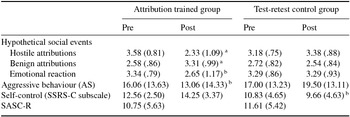
Groups did not significantly differ in levels of self-reported aggressive behaviour, self-control, social anxiety, hostile attribution ratings, benign attribution ratings, and emotional reaction estimates at preassessment. Means and standard deviations are presented in Table 1. As it is known from the literature that social anxiety is an important correlate of interpretation and judgmental bias (Vassilopoulos and Banerjee, Reference Vassilopoulos and Banerjee2008), the SASC-R was added as a covariate in the analyses.
Means (and standard deviations) of the main variables for each group on each occasion of testing

Notes: SSRS-C: Social Skills Rating System-Child; SASC-R: Social Anxiety Scale for Children-Revised.
a pre- vs. posttraining means differ significantly (p ≤ .001).
b pre- vs. posttraining means differ significantly (p ≤ .01).
Attributional bias
We predicted that children in the attribution training group would be less likely to endorse hostile attributions and/or more likely to endorse benign attributions than would those in the control group. This hypothesis was tested using mixed ANCOVAs with Group (attribution training versus control) and Order (vignettes 1–9 before vignettes 10–18 vs. vice versa) as the between-subjects factors and Time (pre- versus posttraining) as the within-subjects factor (with SASC-R as covariate). In the ANCOVA on hostile attributions, a main effect of time, F(1, 29) = 12.76, p<.001, was qualified by a significant interaction of time and group, F(1, 29) = 35.29, p<.001, partial η 2 = .55. Post hoc comparisons showed a significant reduction in hostile attribution ratings after training, p < .001, but no significant reduction in ratings for the control group, p > .10. Simple effects tests also revealed that although there was no significant difference between groups at pretraining, F = 2.2, participants in the training condition were less likely to endorse hostile attributions compared to participants in the control condition at posttraining, F(1, 32) = 9.55, p = .004.
Furthermore, the ANCOVA also yielded an unintended but nevertheless significant interaction of order of events and time, F(1, 29) = 10.26, p = .003, partial η 2 = .26. With one order of events the reduction in hostile attributions during the experiment was greater (Ms changing from 3.54, S.E. = .82 to 2.70, S.E. = 1.14), compared with the other order of events (Ms changing from 3.14, S.E. = .72 to 3.11, S.E. = 1.05).
The analysis of benign attribution scores also showed a significant interaction effect of time with group, F(1, 29) = 14.26, p = .001, partial η 2 = .33. Post hoc comparisons showed a significant increase in benign attributions ratings after training, p < .001, whereas the control group did not significantly change in their benign attribution scores, p > .10. Simple effects tests also revealed that although there was no significant difference between groups at pretraining, F < 1, participants in the training condition were more likely to endorse benign attributions compared to participants in the control condition at posttraining, F(1, 32) = 6.09, p = .02 (see Table 1).
Perceived anger
Changes in emotional reaction estimates were examined using a similar ANCOVAFootnote 2 to that described above. As with the hostile attribution ratings, there was a significant interaction of time and group, F(1, 29) = 5.18, p = .03, partial η 2 = .15. Consistent with findings above, post hoc comparisons revealed a significant decrease in ratings of perceived anger after training, p = .004, but no significant reduction in ratings for the control group, p > .10. In addition, although there was no significant difference between groups at pretraining, F < 1, participants in the training condition showed a trend to report less anger compared to participants in the control condition at posttraining, F(1, 32) = 3.01, p = .09 (see Table 1).
Aggressive behaviour and self-control
The hypothesis that participants in the attribution training condition would show greater reduction in self-reported aggressive behaviour than those in the control condition was tested using a 2 (Group) x 2 (Time) mixed ANCOVA (with SASC-R as covariate). Results again indicated that the hypothesized interaction of time and group was significant, F(1, 31) = 6.97, p = .01, partial η 2 = .18. According to our post-hoc comparisons, the attribution training group showed a significant reduction in aggressive behaviour, p = .01, but aggression scores did not significantly change for the control group, p > .10. However, simple effects tests did not reveal a significant difference between groups at either pretraining or posttraining, Fs < 1.8 (see Table 1).
The analysis of self-control scores (SSRS-C subscale) also showed the predicted interaction effect of time and group, F(1, 31) = 10.66, p = .003, partial η 2 = .25. Post hoc comparisons revealed that participants in the training group reported a trend-level increase in self-control, p = .06, whereas participants in the test-retest situation reported a significant decrease in self-control over time, p = .009. Again, although there was no significant difference between groups at pretraining, F < 1.8, participants in the training condition reported more self-control compared to participants in the test-retest situation at posttraining, F(1, 32) = 10.60, p = .003 (see Table 1).
Discussion
The current pilot study experimentally tested whether a Cognitive Bias Modification of Interpretations (CBM-I) procedure designed to modify hostile attributional bias has effects on (both hostile and benign) attributions and behaviour in children. These early data hold promise. First, they suggested that the intervention was successful in reducing hostile attributions in children who were relatively high in aggressive behaviour. That is, primary school children, who received three sessions of training designed to influence attributional biases in a more positive direction, showed more change than did non-trained controls on a measure of attributional bias and emotional reaction estimates. Second, our data showed that the experimental intervention could significantly reduce self-reported aggressive behaviour, a change that did not characterize children in the comparison test-retest group. These results were significant even after controlling for concurrent social anxiety levels. Note that only a trend level effect of training was observed on a measure of self-control.
Altogether, the results of the present study are well in line with previous findings demonstrating that cognitive bias can be trained in children (Muris, Huijding, Mayer and Hameetman, Reference Muris, Huijding, Mayer and Hameetman2008; Muris, Huijding, Mayer, Remmerswaal and Vreden, Reference Muris, Huijding, Mayer, Remmerswaal and Vreden2009; Vassilopoulos et al., Reference Vassilopoulos, Banerjee and Prantzalou2009). Moreover, our study has extended Hudley et al.'s (Reference Hudley, Britsch, Wakefield, Smith, Demorat and Cho1998) findings by showing that three sessions of attribution training using an adapted CBM-I paradigm can reduce biased judgments of the interacting person's intent. However, since we did not examine long term durability we cannot say whether the intervention procedure followed in the present study led to permanent changes in attributional style or simply primed transient response patterns. Nonetheless, the study provides promising evidence that patterns of attribution in aggressive children are responsive to a simple intervention training program.
Noteworthy, our results also showed that the attribution training program not only reduced hostile attributions, but also reduced self-reported aggression. This finding is in line with social information-processing theories suggesting that cognitive biases may be causally linked to aggressive responses by influencing how real-life ambiguous events are processed (see Crick and Dodge, Reference Crick and Dodge1994). In a similar vein, we also found that attribution training influenced children's reports of perceived anger in response to potentially provocative situations. This finding is consistent with past studies demonstrating that hostile attribution is an important cognitive correlate of anger in both children and adults (e.g. Epps and Kendall, Reference Epps and Kendall1995). However, it remains unclear whether this would generalize to feelings of anger if children actually had to participate in a provocative interpersonal situation. It should be recognized, however, that multiple interpersonal processes contribute to the display of peer-directed aggression (Crick and Dodge, Reference Crick and Dodge1994) and that attributional bias training on its own is unlikely to result in an amelioration of all symptoms displayed by aggressive children. For example, in the present study, children's self control was only marginally influenced by the training (although changes in hostile or benign attributions were found to correlate with changes in reported self-control). Future studies should examine methods of enhancing the effects of attribution training programs on children's cognition and aggressive behaviours not only by increasing the number and duration of sessions, but also by incorporating the work into a comprehensive program addressing related cognitive and behavioural deficits, for example, by incorporating psychoeducational material and by adding role play and problem-solving activities.
Despite the promising results of the present investigation, there are a number of additional issues that need to be addressed. First, we compared an attribution training condition with a test-retest control group that did not receive any parallel sessions. Therefore, we cannot rule out the possibility that the positive results may be attributed to some other influence, such as simple repeated exposure to hypothetical social scenarios in the trained group. Future studies should try to include a placebo group. Second, although our study did select a sample of children displaying moderate to high levels of aggression according to their teachers and peers, a clear objective for future research is to establish whether interpretation biases in children with diagnosable psychopathology (Oppositional Defiant Disorder and Conduct Disorder) can also be modified, and whether any such modification is sufficient to impact on psychopathology outcomes. Moreover, Hudley et al.'s (Reference Hudley, Britsch, Wakefield, Smith, Demorat and Cho1998) observation that children showing hostile or reactive aggression (i.e. which can be seen as an angry, impulsive reaction to a presumed threat or provocation) are especially likely to respond to attributional bias modification - compared to proactive aggressive children (i.e. planned “cold-blooded” aggression to dominate or intimidate) - seems promising and certainly warrants further investigation.
Another limitation of the study is the lack of clinical cut-off scores regarding the aggression scale (AS), which makes it difficult to compare the sample mean with a clinical sample. However, the relatively high cross-informant agreement on participants’ aggressive behaviour offers some reassurance that the children who were selected presented higher than average aggression levels. Finally, one further caveat of the study is that it relied exclusively on self-report, so it is possible that demand characteristics could have played a role in the effects of training. Future studies should employ multi-informant and/or behavioural measures in order to evaluate the impact of the training program on aggressive behaviour.
In summary, this study has shown that hostile attributions to potentially provocative situations in a sample of school age children can be modified through a CBM-I procedure, and that this training could have a beneficial effect on children's perceived anger and self-reported aggressive behaviour. The results of this study, albeit rather preliminary, are promising as they lay an important foundation for further research to directly evaluate the utility of attribution training as a viable intervention option.



Comments
No Comments have been published for this article.