Implications
To overcome bottlenecks in finfish aquaculture of candidate species, such as pikeperch, knowledge of the effects of specific egg parameters, which affect and predict the future embryo development, is of major importance. We studied the influence of biochemical egg parameters (fatty acid profiles and cortisol content) in 44 egg batches under commercial hatchery conditions. The results highlight the links between reproductive and stress physiology and reveal potential for optimization of hatchery management, especially regarding the development of species-specific broodstock diets, which are currently not available.
Introduction
Failure of fertilization and high variability in embryo survival are impeding farming of emerging aquaculture species such as pikeperch, Sander lucioperca (Schaerlinger and Żarski, Reference Schaerlinger and Żarski2015). Therefore, reaching and maintaining a reliable supply of high quality eggs is an important task for reproductive management in aquaculture (Brooks et al., Reference Brooks, Tyler and Sumpter1997; Bobe and Labbé, Reference Bobe and Labbé2010; Valdebenito et al., Reference Valdebenito, Gallegos and Effer2015). In this context, egg quality is commonly defined as the ability of an oocyte to be fertilized and to subsequently develop into a viable embryo, which is able to hatch successfully. This ability depends to a large extent on egg traits including morphological parameters and biochemical composition of the oocyte, which in turn are determined maternally. In contrast, apart from the male contribution to the offspring genotype, paternal influences are mainly limited to fertilization rate (Brooks et al., Reference Brooks, Tyler and Sumpter1997; Bobe and Labbé, Reference Bobe and Labbé2010).
Pikeperch is among the species with the highest potential for a year-round production in recirculating aquaculture systems (RAS) in Europe. Fast rates of growth in RAS and high market acceptance have recently encouraged the establishment of several commercial pikeperch farms. Under natural conditions, these piscivorous freshwater percids reproduce only once per year during spring. In RAS, reproduction can be achieved by photothermal control of sexual maturation (Hermelink et al., Reference Hermelink, Wuertz, Trubiroha, Rennert, Kloas and Schulz2011 and Reference Hermelink, Wuertz, Rennert, Kloas and Schulz2013; Żarski et al., Reference Żarski, Horváth, Held and Kucharczyk2015). Thus, by rearing and managing several broodstocks separately, spawning can be achieved at any given time of the year supporting a constant market supply.
Oogenesis is controlled by a complex regulatory network integrating endocrine, metabolic and catabolic pathways. Several factors modifying egg composition during oogenesis have been described in fish and broodstock rearing strongly influences the time course as well as the quality of eggs (e.g. Brooks et al., Reference Brooks, Tyler and Sumpter1997; Izquierdo et al., Reference Izquierdo, Fernández-Palacios and Tacon2001; Bobe and Labbé, Reference Bobe and Labbé2010; Migaud et al., Reference Migaud, Bell, Cabrita, McAndrew, Davie, Bobe, Herraez and Carrillo2013). There is increasing evidence that stress affects the maternal nutritional status, modulating the availability of highly unsaturated fatty acids (HUFA) (Moodie et al., Reference Moodie, Loadman, Wiegand and Mathias1989; Van Anholt et al., Reference Van Anholt, Spanings, Koven, Nixon and Bonga2004; Lund et al., Reference Lund, Skov and Hansen2012). In turn, HUFA composition of broodstock diets is reflected in the eggs and affects the future development. The HUFA are integrative parameters being associated with bioenergetic aspects, as well as various physiological (e.g. components of cell membranes) and endocrine (e.g. precursors of eicosanoids) mechanisms (Bell et al., Reference Bell, Henderson and Sargent1986; Sargent et al., Reference Sargent, Tocher and Bell2002; Tocher, Reference Tocher2003).
In several species, including freshwater percids, fatty acid (FA) profiles of eggs have been studied as predictive markers of egg quality (Fernández-Palacios et al., Reference Fernández-Palacios, Izquierdo, Robaina, Valencia, Salhi and Vergara1995; Czesny and Dabrowski, Reference Czesny and Dabrowski1998; Abi-Ayad et al., Reference Abi-Ayad, Kestemont and Mélard2000; Henrotte et al., Reference Henrotte, Mandiki, Prudencio, Vandecan, Mélard and Kestemont2010). The identification and evaluation of egg parameters, such as egg size and morphology or specific FA, which are indicative or predictive for the future developmental potential of an embryo, are commonly recognized as important research tools in fish physiology (Bobe and Labbé, Reference Bobe and Labbé2010; Migaud et al., Reference Migaud, Bell, Cabrita, McAndrew, Davie, Bobe, Herraez and Carrillo2013; Valdebenito et al., Reference Valdebenito, Gallegos and Effer2015). Benefits arise from better insights into mechanisms determining egg quality and may help to improve hatchery technology, as well as broodstock management. For example, reliable predictive egg parameters would allow for a comparative monitoring across a range of production sites or populations. To date, such indicators of pikeperch egg quality are predominantly based on oocyte morphology (Schaerlinger and Żarski Reference Schaerlinger and Żarski2015) or markers of oxidative stress during embryo development (Schaefer et al., Reference Schaefer, Overton and Wuertz2016). In other freshwater percids, such as Eurasian perch, Perca fluviatilis, or walleye, Sander vitreus, FA profiles were used to classify egg quality (Czesny and Dabrowski, Reference Czesny and Dabrowski1998; Abi-Ayad et al., Reference Abi-Ayad, Kestemont and Mélard2000; Henrotte et al., Reference Henrotte, Mandiki, Prudencio, Vandecan, Mélard and Kestemont2010). The HUFA in particular have been associated with reproductive performance and successful development in several cultured fish species including pikeperch (Fernández-Palacios et al., Reference Fernández-Palacios, Izquierdo, Robaina, Valencia, Salhi and Vergara1995; Lund et al., Reference Lund, Skov and Hansen2012; Dabrowski et al., Reference Dabrowski, Rinchard, Czesny and Korzeniowska2015). In rainbow trout, Oncorhynchus mykiss, for example, Watanabe et al. (Reference Watanabe, Takeuchi, Saito and Nishimura1984) reported an increased mortality of early stages in response to n-3 HUFA deficiency. In Eurasian perch, the ratio of specific HUFA has been identified as major driver of spawning quality (Henrotte et al., Reference Henrotte, Mandiki, Prudencio, Vandecan, Mélard and Kestemont2010). Differences in HUFA within a broodstock population of North American walleye, S. vitreus, a close relative of pikeperch, explained for variability in egg quality (Mejri et al., Reference Mejri, Audet, Vandenberg, Parrish and Tremblay2014).
In comparison with Eurasian perch (Abi-Ayad et al., Reference Abi-Ayad, Kestemont and Mélard2000; Henrotte et al., Reference Henrotte, Mandiki, Prudencio, Vandecan, Mélard and Kestemont2010), walleye (Czesny and Dabrowski, Reference Czesny and Dabrowski1998; Czesny et al., Reference Czesny, Rinchard and Dabrowski2005) or yellow perch, Perca flavescens (Dabrowski et al., Reference Dabrowski, Rinchard, Czesny and Korzeniowska2015), there is only limited knowledge on the FA composition in pikeperch eggs and subsequent effects on reproduction and egg quality. Consequently, the ideal FA composition of pikeperch eggs supporting optimal embryonic development is unknown and there are no species-specific broodstock diets available. By identifying FA, which are associated with optimal development, the formulation of such diets is supported and will contribute to an improved reproductive management in the future. The distinction between the polar (representing the phospholipid fraction) and the neutral (representing the triglycerides and wax esters) FA fraction is important, as the latter is predominantly stored within the oil globule and not primarily utilized during embryogenesis (Moodie et al., Reference Moodie, Loadman, Wiegand and Mathias1989; Wiegand, Reference Wiegand1996).
In addition to FA profiles, it was shown that cortisol, as parameter of the primary stress response, is tightly coupled to reproductive physiology in fish, affecting maturation and egg quality (Schreck et al., Reference Schreck, Contreras-Sanchez and Fitzpatrick2001). In contrast to FA profiles, cortisol levels in the eggs do not seem to directly affect embryo development, as observed in coho salmon, Oncorhynchus kisutch (Stratholt et al., Reference Stratholt, Donaldson and Liley1997). This is probably due to a rapid decline of cortisol after fertilization as reported in tilapia, Oreochromis mossambicus (Hwang et al., Reference Hwang, Wu, Lin and Wu1992), rainbow trout (Brooks et al., Reference Brooks, Tyler and Sumpter1997) and coho salmon (Stratholt et al., Reference Stratholt, Donaldson and Liley1997). Still, given the coherence between stress and reproductive physiology it appears likely that egg cortisol and FA levels are linked. To date, this inter-linkage is not well described in fish eggs. Hence, a better understanding of the underlying mechanisms can support the optimization of hatchery protocols in several species, as well as allow for fine-tuning of commercial broodstock management.
Consequently, we hypothesized: (i) that it is possible to identify specific FA, which are indicative of the future developmental potential of the eggs, and (ii) that the cortisol content is linked to aspects of the egg FA profiles.
Material and methods
Sampling
Samples were collected during routine reproduction at a commercial pikeperch farm (Aquapri, Egtved, Denmark) in accordance with EU and National legislation for animal welfare in fish production. The breeders (mixed sexes in a ratio of ~1 : 1.5 to 1 : 2 females:males, same genetic origin) were kept in four separate broodstock groups (50 to 70 individuals/broodstock) and were reproduced successively. Fish were fed the same diet (mix of four commercial pelleted diets) at apparent satiation and were always handled by the same experienced personal to standardize procedures and minimize handling stress. Maturation was induced once per year in each broodstock, applying 4 months of wintering (<14°C) and subsequent warming to ~16°C to support gonad maturation and to induce natural ovulation. Assessment of maturation stage and detection of ovulation was monitored using the biopsy technique (c.f. Żarski et al., Reference Żarski, Horváth, Held and Kucharczyk2015). No hormone treatment was applied. The temperature protocol was identical for all groups, but applied in intervals of 3 months providing four distinct spawning seasons per year. Egg batches of 44 females (five to eight females per spawning season) with an average size (±SD) of 69.3±5.9 cm standard length ranging from 56.0 to 80.0 cm were sampled during six spawning seasons over two years. At time of apparent ovulation, fish were anesthetized (Kalmagin 20%; Centrovet, Santiago de Chile, Chile) and eggs were stripped. Samples of unfertilized eggs were taken, frozen, transported to the lab in liquid nitrogen and stored at −80°C. The remaining eggs were fertilized (dry) with freshly stripped sperm of available males (one to three different males) after a visual sperm quality check (sperm activation visible). Fertilized eggs were transferred to Zug jars and incubated at ~15°C to 16°C. A minimum of 50 eggs were monitored in triplicates at 2, 24, 48, 72 h post fertilization (hpf) and during hatching (day 4) for the determination of respective embryo survival and hatching rates (%) using a Stereozoom IT-TR microscope (Gundlach, Harlev, Denmark). In some cases, individual rates of embryo development at a certain time point could not be assessed. Data of egg batches with extremely high mortality, which were probably caused by working operations in the hatchery, were excluded from analysis.
Fatty acid analysis
Approximately 100 mg eggs (wet weight), were freeze-dried in an Alpha 1-4 LOC-1M (Christ, Osterode, Germany) for 48 h. For FA analysis, ~3 mg eggs (dry matter, DM) were extracted and measured according to Boëchat et al. (Reference Boëchat, Krüger, Chaves, Graeber and Gücker2014) with the following modifications. Samples were homogenized for 2 min by ultra-sonic treatment and 20 mg butylhydroxytoluol (Carl Roth, Karlsruhe, Germany) were added as antioxidant to 100 ml chloroform–methanol (2 : 1 V:V). An aliquot of 1.2 ml of the upper layer was evaporated at 40°C with a rotary evaporator (Rotavapor R200 and heating bath B490; Büchi, Essen, Germany) and re-suspended in 500 µl chloroform–methanol (2 : 1 V:V). Before methylation, solid phase extraction of polar and neutral lipids was performed using Strata NH2 (55 µm; 70 Å) 1000 mg/6 ml columns (Phenomenex, Torrance, CA, USA), which were pre-conditioned with 5 ml chloroform–methanol (2 : 1 V:V). First, neutral lipids were extracted with 20 ml acetone (Carl Roth). After drying of the column, polar lipids were extracted with 20 ml methanol (Carl Roth). Extracts were evaporated as described above.
After methylation of each fraction, 4.5 ml hexane (Carl Roth) were added and incubated for 15 min under continuous shaking. The solution was centrifuged (5 min, 2300×g) and the upper layer containing the FA methyl esters (FAME) extract was transferred to a glass tube. This extraction was repeated twice with 2 ml hexane. Subsequently, 15 ml potassium hydrogen carbonate solution (2.8 g/l KHCO3; Sigma-Aldrich, St. Louis, MI, USA) were added to the extracts, briefly mixed and the hexane phase was transferred to a 100-ml pear-shaped flask. After evaporation, the FAME were re-suspended in 200 µl hexane and stored at 4°C until analysis in an Agilent 6890N gas chromatograph (Agilent, Santa Clara, CA, USA) equipped with an Agilent 5973 N mass selective detector (Agilent) and a fused silica capillary column (J&W CP-Sil 88 for FAME; Agilent). The FAME were identified by their retention times and mass spectra in full scan mode (SCAN), previously calibrated with FA standards (FAME Mix 47885-4, PUFA n°1-47033 and PUFA n°3-47085-4; Sigma-Aldrich). Detection and determination thresholds were 0.1 and 0.4 µg/mg, respectively. For statistical analysis, values below the quantification limit were set to 0.05 µg/mg. The divergence in total FAME content using either the applied set quantity of 0.05 µg/mg for specific FAME (below quantification limit) or the maximum determination threshold of 0.4 µg/mg accounted on average for 3.4% difference.
Measurement of cortisol
For determination of cortisol concentrations, ~60 mg eggs were manually crushed with a pistil for 2 min. Extraction and analysis of 30 µl crushed eggs were performed according to Hermelink et al. (Reference Hermelink, Wuertz, Trubiroha, Rennert, Kloas and Schulz2011) using a cortisol-specific enzyme-linked immunosorbent assays (ELISA; IBL, Hamburg, Germany). Each sample was measured in duplicate and concentrations were calculated from a dilution series. Recoveries determined by spiking experiment were above 91%.
Data analysis
If not otherwise mentioned, data are presented as mean±SD. Data were tested for normality with Kolmogorov–Smirnov normality test. For group comparison, one-way ANOVA with Tukey’s post hoc test (parametric data) or Kruskal–Wallis test with Dunn’s post hoc test (non-parametric data) were used. Correlation analysis was performed with Pearson’s (r) and Spearman’s (ρ) correlation. Percentage data were transformed (arcsine square root) before Pearson’s correlation, which is only presented if there was no significant result using Spearman’s correlation. The CV for respective data was calculated as CV=100×(SD/mean). Data analysis was performed with PRISM software (version 4.03; GraphPad, Irvine, CA, USA) or SPSS (version 22; IBM, Armonk, NY, USA).
Results
Rates of embryo development
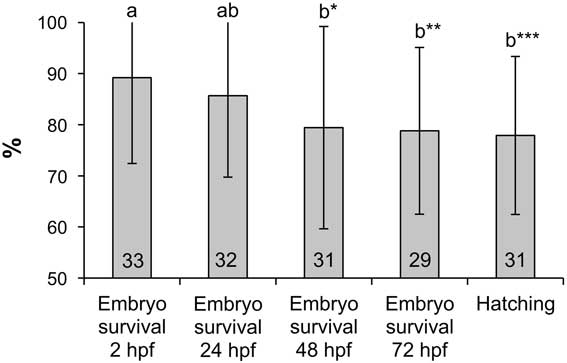
Survival at 2 hpf ranged from 40.0% to 100.0% with an average of 89.2%±16.8% (Figure 1). Thereafter, embryo survival dropped from 85.7%±15.9% at 24 hpf to 79.4%±19.8% at 48 hpf and was 78.8%±16.3% at 72 hpf. Hatching rates observed on day 4 were 77.9%±15.5% on average ranging from 40.0% to 99.0%. Thus, highest mortality occurred during early embryogenesis (9.8% from 2 to 48 hpf). Embryos surviving until 48 hpf were likely to hatch successfully (only 1.5% mortality on average from 48 hpf to hatching). Hatching rates were significantly correlated with embryo survival after 2, 24, 48 or 72 hpf (Spearman’s correlation: 2 hpf, ρ=0.56, n=30; 24 hpf, ρ=0.58, n=30; 48 hpf, ρ=0.87, n=30; 72 hpf, ρ=0.93, n=29; P<0.001).
Embryo survival post fertilization (2, 24, 48, 72 hours post fertilization (hpf)) and hatching rates of egg batches in pikeperch (mean±SD). For each batch, triplicates of 50 eggs (100%) were monitored. The number of batches considered is given per column. Whiskers indicate the standard deviation. a,bSignificant differences in-between groups (Dunn’s multiple comparison). Levels of significance: *P<0.05, **P<0.01, ***P<0.001.

Batch-specific egg parameters
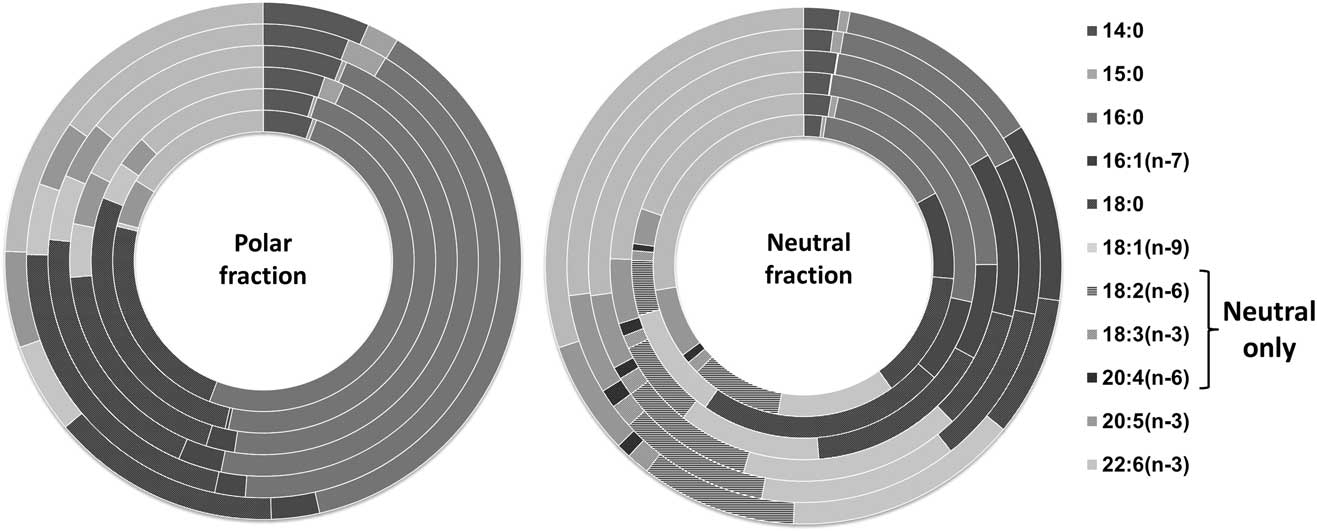
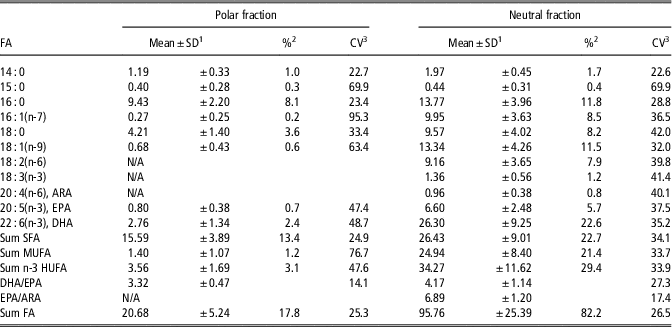
The total FA content (polar and neutral fraction) was 116.5±25.7 µg/mg DM with a minimum of 66.1 and maximum of 171.7 µg/mg showing high variability (CV=22.06). The polar fraction ranged from 9.3% to 30.1% of total FA and represented on average 17.8% of the total FA. Arachidonic acid (ARA, 20 : 4(n-6)) could only be detected within the neutral FA fraction. The compiled FA profiles of all egg batches are listed in Table 1. Interestingly, the CV of the total FA of both, polar and neutral fraction, were lower compared with the vast majority of CV of the individual FA. This indicates a high variation in individual FA composition with less variability in total FA content. This is highlighted by the high variability in relative FA contents observed within the group of best performing egg batches (>90% hatching rate) with an average of 111.2±18.1 µg/mg total FA ranging from 85.0 to 132.1 µg/mg (Figure 2).
Fatty acid (FA) composition (relative to total FA) of major neutral FA (left) and polar FA (right) in the group of best performing (>90% hatching rate) egg batches (one column per batch).

Mean absolute and relative abundance of major fatty acids (FA)Footnote * representing 97.1% of total FA found and selected ratios in polar and neutral fatty acids for all 41 batches of pikeperch eggs

ARA=arachidonic acid; EPA=eicosapentaenoic acid; DHA=docosahexaenoic acid; SFA=saturated fatty acid; MUFA=monounsaturated fatty acids; HUFA=highly unsaturated fatty acid; DM=dry matter.
* Other FA routinely found, but generally below quantification limit of 0.4 µg/mg DM: 12 : 0, 17 : 0, 20 : 0, 20 : 1(n-9), 20 : 2 (unknown isomer), 22 : 0, 22 : 1(n-9), 24 : 0, 24 : 1 (unknown isomer).
1 Absolute FA content (µg/mg DM) and SD.
2 % of total FA.
3 CV for each FA.
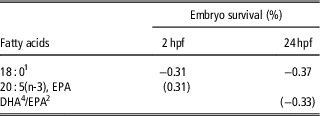
Specific FA of the polar fraction, 18 : 0 and 20 : 5(n-3) (eicosapentaenoic acid, EPA), and the ratio of 22 : 6(n-3) (docosahexaenoic acid, DHA) to EPA within the neutral fraction were significantly correlated with the embryonic survival at a given time point (Table 2), or, in other words the performance of the batch until a certain stage. Comparison of grouped egg batches with high (>90% hatching rate, n=7), mid (70% to 90% hatching rate, n=15) or low (<70% hatching rate, n=9) egg quality showed no significant differences for 18 : 0 (Kruskal–Wallis test, P=0.29) and EPA (Kruskal–Wallis test, P=0.68) within the polar fraction or the ratio of DHA to EPA within the neutral fraction (one-way ANOVA, P=0.18). The mean ratio of total n-3 to n-6 FA (neutral and polar fraction) was 4.0±1.3 and was not significantly correlated with embryo survival or hatching. The average ratio of DHA/EPA/ARA (neutral and polar fraction) was 29.0/7.4/1.0.
Significant correlations (P<0.05) of fatty acids and embryo survival at time (Spearman’s or Pearson’s correlation coefficient, the latter in brackets)

hpf=hours post fertilization; EPA=eicosapentaenoic acid; DHA=docosahexaenoic acid.
1 Polar fraction.
2 Neutral fraction.
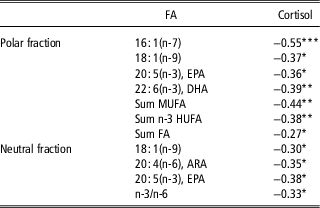
Egg cortisol content was highly variable ranging from 22.7 to 293.2 ng/ml with an average of 85.4±49.5 ng/ml (CV=57.96). Embryo survival and hatching were not influenced by egg cortisol concentrations (Spearman correlation, P>0.21). Comparison of high, mid or low egg quality showed no significant differences in cortisol concentrations (one-way ANOVA, P=0.57). However, there were several significant correlations between cortisol and specific FA (Table 3). Monounsaturated FA (MUFA), both specific individual MUFA (16 : 1(n-7) within the polar fraction; 18 : 1(n-9) within the polar and neutral fraction) and the sum of MUFA and FA (polar fraction), as well as HUFA (polar fraction: EPA, DHA, sum of n-3 HUFA; neutral fraction: ARA, EPA) showed a negative correlation with egg cortisol concentrations. Levels of EPA were in turn significantly related to embryo survival (2 hpf). In contrast, the ratio of n-3 to n-6 HUFA within the neutral fraction was positively correlated with cortisol content.
Correlation of egg cortisol levels and fatty acid (FA) contents.

EPA=eicosapentaenoic acid; DHA=docosahexaenoic acid; MUFA=monounsaturated fatty acids; HUFA=highly unsaturated fatty acid; ARA=arachidonic acid.
Significant correlations are listed including the correlation coefficients (Spearman’s correlation).
Levels of significance: * P<0.05, ** P<0.01, *** P<0.001.
Discussion
Variability in egg quality remains a major issue in pikeperch aquaculture constraining the reliable and constant supply of larvae. In fact, demand for stocking material exceeds the supply by far. Optimization of current hatchery management requires reliable predictive markers and a better understanding of the mechanisms involved in the determination of egg quality. Furthermore, the influences of egg traits, especially FA profiles, are still controversially discussed and there is an urgent need for predictive species-specific quality parameters. Here, we determined batch-specific biochemical egg parameters to study the inter-linkage of reproductive and stress physiology and the influence of respective egg components on the survival during embryogenesis until hatching under stable hatchery conditions (identical rearing and reproduction protocols).
The overall egg quality observed here was relatively high suggesting good hatchery practice. Still, survival of fertilized oocytes decreased significantly over time until hatching in a stage-specific manner. Here, mortality was elevated during early embryogenesis until 48 hpf as observed in other freshwater percids. Similarly, highest mortality in successfully fertilized eggs occurred during the first 48 h in Eurasian perch and embryos surviving until this stage were very likely to hatch successfully (Schaerlinger and Żarski, Reference Schaerlinger and Żarski2015). Cleavage defects or impairment of genome activation were considered most relevant, in particular during the first 24 h after fertilization.
In other cultured freshwater percids, FA composition of the eggs, especially in regard to HUFA, is an important cause of variability affecting batch-specific embryonic survival rates (Dabrowski et al., Reference Dabrowski, Rinchard, Czesny and Korzeniowska2015; Kestemont and Henrotte, Reference Kestemont and Henrotte2015; Schaerlinger and Żarski, Reference Schaerlinger and Żarski2015). The FA are crucial components for the developing embryo influencing key processes, such as membrane functioning, energy production and synthesis of biochemical messengers (e.g. prostaglandins). Therefore, differences in FA profiles potentially modulate physiological processes and vice versa. Consequently, specific FA may represent important markers for egg quality, especially if the underlying mechanisms, such as the inter-linkage with stress physiology, are uncovered.
Lund and Steenfeldt (Reference Lund and Steenfeldt2011) reported similar findings in the eggs of wild-caught pikeperch, for example, total FA (here: 116.4 mg/g DM, Lund and Steenfeldt: 116.8 mg/g DM), EPA, DHA, 18 : 2(n-6). Still, there were major differences in ARA (0.8 compared with 5.5%), saturated FA (SFA; 36.1 compared with 10.7%) and MUFA (22.6 compared with 33.6%). Khemis et al. (Reference Khemis, Hamza, Messaoud, Rached and M’Hetli2014) reported even higher contents of MUFA (up to 49.8%), but comparable low levels of ARA as determined here (1.1% to 1.5%). In this study, total percentage of HUFA was lower compared to our study and the results of Lund and Steenfeldt (Reference Lund and Steenfeldt2011). However, both studies did not report observations on egg quality.
Inter-, as well as intra-specific differences in the FA composition of eggs are well documented, both between closely related species and in-between populations of the same species (Czesny and Dabrowski, Reference Czesny and Dabrowski1998; Czesny et al., Reference Czesny, Rinchard and Dabrowski2005). We observed a very high variability in absolute, as well as relative FA composition in-between the egg batches under stable hatchery conditions. This variability was even more prominent in individual FA compared with the CV of total FA of the polar and neutral fraction, as well as the total FA contents. Therefore, the FA profile varies substantially between different egg batches. Interestingly, embryo survival, especially during late embryogenesis and hatching, was supported by a variety of different FA profiles. Differing FA profiles in pikeperch eggs however, equally supported embryo development here suggesting potent coping abilities. This is further underlined by the analysis of the high quality batches. Here, optimal survival was observed across a range of FA profiles (absolute and relative FA composition).
Despite the variability observed, specific FA (18 : 0, EPA) were significantly correlated with survival of the embryos, in particular during early embryo survival (<48 hpf) when mortality was elevated. Eicosapentaenoic acid is involved in eicosanoid synthesis and constitutes to cell membrane bilayers (Izquierdo et al., Reference Izquierdo, Fernández-Palacios and Tacon2001; Yang et al., Reference Yang, Zheng, Ma, Li, Jiang and Qin2015). Congruently, positive effects of EPA on egg quality have been reported in other species (Fernández-Palacios et al., Reference Fernández-Palacios, Izquierdo, Robaina, Valencia, Salhi and Vergara1995). On the other hand, high levels of 18 : 0 (stearic acid, SA) within the polar fraction had a negative effect on embryo survival here. In bovine oocytes, the addition of SA had a negative impact on fertilization and cleavage rates (Leroy et al., Reference Leroy, Vanholder, Mateusen, Christophe, Opsomer, de Kruif, Genicot and Van Soom2005), but there are – to our best knowledge – no studies reporting such effects in fish. Yet, it is not clear why such high polar SA levels exerted a negative effect on survival in pikeperch, as the values were in the range of previous reports in walleye eggs (Czesny et al., Reference Czesny, Rinchard and Dabrowski2005). Possibly, high abundance of the saturated SA led to alternations of membrane fluidity after incorporation to the membrane phospholipids subsequently affecting overall cell functioning in pikeperch.
Here, elevated ratios of DHA/EPA in the neutral fraction were negatively correlated with embryo survival at 24 hpf. Congruently, it was shown that high ratios of DHA/EPA are associated with larval malformations (Yang et al., Reference Yang, Zheng, Ma, Li, Jiang and Qin2015). In turn, malformations are primary causes of embryo mortality in percids (Schaerlinger and Żarski, Reference Schaerlinger and Żarski2015). In contrast, DHA/EPA ratios (no separate analysis of neutral and polar FA fractions) were positively correlated with hatching success in pinfish, Lagodon rhomboids (Broach et al., Reference Broach, Ohs and Breen2017) highlighting potential species- or fraction-specific differences. As the neutral fraction of the FA is not primarily utilized during embryogenesis (Moodie et al., Reference Moodie, Loadman, Wiegand and Mathias1989; Wiegand ,Reference Wiegand1996), we assume that such a high ratio of DHA/EPA is an indicator of perturbation at the maternal level affecting other egg traits, rather than a result of direct physiological pathway causing embryo mortality.
In contrast to previous observations in percid eggs (Czesny et al., Reference Czesny, Rinchard and Dabrowski2005; Dabrowski et al., Reference Dabrowski, Rinchard, Czesny and Korzeniowska2015), we did not detect ARA within the polar fraction. Arachidonic acid is the main precursor of eicosanoids (Bell et al., Reference Bell, Henderson and Sargent1986; Sargent et al., Reference Sargent, Tocher and Bell2002; Tocher, Reference Tocher2003), which are essential for embryonic development. It is not clear whether pikeperch embryos rely on the neutral ARA or elongate and desaturate 18 : 2(n-6). Nevertheless, pikeperch embryos seem to cope well with such low ARA content. In other teleosts, it was shown that ARA tended to be conserved during early development (Gunasekera et al., Reference Gunasekera, De Silva and Ingram1999). Generally, it can be expected that FA, especially of the neutral fraction, exert an important influence on larval development after hatching before first feeding. These topics, especially the supplementation of specific HUFA, should be addressed in future studies.
Conclusively, differences in FA contents only partially explain for embryo mortalities and may therefore not represent ideal predictive parameters for egg quality. In the context of the high egg quality observed, we conclude that average FA composition in the present study is close to an optimum and alternative coping strategies of the developing embryos allow for a broad range of batch-specific variability. Also, the FA profiles were similar to those of other percids (e.g. high DHA, low ARA levels, as summarized by Schaerlinger and Żarski, Reference Schaerlinger and Żarski2015). Therefore, functional broodstock diets should focus on optimized HUFA contents. The abundance of SA, however, needs to be reduced. Also, it has to be noted that the excess of FA can have adverse effects on embryogenesis, as shown for very high n-3 HUFA in gilthead seabream, Sparus aurata (Fernández-Palacios et al., Reference Fernández-Palacios, Izquierdo, Robaina, Valencia, Salhi and Vergara1995), resulting in lower hatching success. Likewise, egg EPA content was negatively correlated with hatching success in pinfish (Broach et al., Reference Broach, Ohs and Breen2017). Similar to our results, Czesny et al. (Reference Czesny, Rinchard and Dabrowski2005) observed high embryo viability in eggs with varying FA composition in wild-caught walleye. As breeder nutrition is a major driver of subsequent egg composition (Izquierdo et al., Reference Izquierdo, Fernández-Palacios and Tacon2001), it can be argued that individual wild fish may utilize different prey. Under hatchery conditions in RAS however, where breeders are fed the same formulated diet, such high variability was not expected.
The observed inter-linkage of egg FA profiles and cortisol suggests that this variability was affected by differences in maternal stress levels. Stress exerts critical effects on reproductive mechanisms, such as interference with vitellogenesis, estrogen production and disruption of endocrine pathways affecting the composition of the oocytes (c.f. Milla et al., Reference Milla, Wang, Mandiki and Kestemont2009 for review). Campbell et al. (Reference Campbell, Pottinger and Sumpter1994), for example, observed negative effects of handling stress on circulating vitellogenin and subsequent embryo and larval survival in rainbow trout. Depending on the maturation stage, cortisol can also have positive effects, as it supports final oocyte maturation, oocyte hydration and ovulation (Milla et al., Reference Milla, Wang, Mandiki and Kestemont2009). Here, varying cortisol levels had no direct effects on embryo survival rates, similar to previous observations in other fish species (Stratholt et al., Reference Stratholt, Donaldson and Liley1997). Therefore, cortisol as primary stress marker seems not suited as marker to predict egg quality. The previously reported rapid decline of cortisol after fertilization (Hwang et al., Reference Hwang, Wu, Lin and Wu1992; Brooks et al., Reference Brooks, Tyler and Sumpter1997; Stratholt et al., Reference Stratholt, Donaldson and Liley1997) is possibly caused by a ‘loss’ or dilution of cortisol during the uptake of water after fertilization. This may further mask effects of cortisol on egg development and may explain why embryos rather seem to develop independently of observed cortisol levels.
Cortisol levels observed here (average 85.4 ng/ml) are well in the range of previous observations on plasma cortisol levels of pikeperch spawners during controlled reproduction. Sarameh et al. (Reference Sarameh, Falahatkar, Takami and Efatpanah2013) reported blood plasma cortisol levels of ~70 to 100 ng/ml for stressed and unstressed (no significant difference) female pikeperch. In comparison to detected baseline cortisol levels in other fish species these levels indicate relatively high stress during reproduction under hatchery conditions (c.f. review by Schreck et al., Reference Schreck, Contreras-Sanchez and Fitzpatrick2001), as it was shown that elevations of maternal cortisol levels are reflected in the eggs (Stratholt et al., Reference Stratholt, Donaldson and Liley1997; Andersson et al., Reference Andersson, Silva, Steffensen and Höglund2011). However, this does not explain for the observed negative correlations of cortisol and specific egg FA, which are continuously transferred into the oocytes during vitellogenesis and accumulate over time. This process is completed before the necessary handling procedures during the applied protocol for in vitro fertilization (biopsy).
Cortisol was negatively correlated with important aspects of the FA profiles, including EPA and other HUFA. Decreased contents of these FA in oocytes at high cortisol levels in turn may have resulted in reduced survival. This suggests an indirect effect of stress on egg quality. There is growing evidence related to the inter-linkage of stress and FA profiles, especially in regard to HUFA (Moodie et al., Reference Moodie, Loadman, Wiegand and Mathias1989; Van Anholt et al., Reference Van Anholt, Spanings, Koven, Nixon and Bonga2004). Fish with higher energy expenses or differing lipid allocation, for example, caused by stress (Strand et al., Reference Strand, Magnhagen and Alanärä2007), have lower reserves available for reproduction. Therefore, high stress levels may directly impede FA deposition during vitellogenesis. Consequently, cortisol accumulation may indicate chronic (handling) stress experienced by the female. However, it remains unknown whether cortisol levels in ovulated eggs reflect female stress levels experienced during the incorporation of respective FA during early and mid vitellogenesis.
The negative correlation of cortisol and FA may have been alternatively caused or additionally intensified by cellular processes through oxidative stress and subsequent lipid peroxidation. Similar to the observations on the influence of cortisol, DNA damage as result of oxidative stress did not directly affect embryo development in pikeperch eggs (Schaefer et al., Reference Schaefer, Overton and Wuertz2016). However, there are indications that oxidative stress is involved in the alternation of egg FA profiles either by modifying mitochondria functioning and/or through lipid peroxidation (Schaefer, Reference Schaefer2016). This may explain why MUFA and HUFA, which are more susceptible towards peroxidation (Sargent et al., Reference Sargent, Tocher and Bell2002), and not SFA are affected by high egg cortisol.
In regard to the improvement of hatchery management, these results highlight the importance of stress reduction. Stress may result in critical alternations of the egg FA composition subsequently leading to reduced survivability of the embryos. In comparison to other farmed animals, including common aquaculture species, freshwater percids have to date not been the target of selective breeding efforts, but first breeding programs have been launched. Given the results presented here, these programs should target stress related traits in particular in broodstock fish to further optimize resource utilization and reproductive performance.
Acknowledgments
The authors would like to thank the cooperation partner AquaPri and the members of the IGB working group Sustainable Aquaculture and Applied Physiology, especially E. Kreuz, as well as V. Schoening. The authors are thankful for the support of the AQUAGAMETE (FA1205) COST action network. This study was funded by the German Research Foundation (DFG KL 745/6-1).