INTRODUCTION
Deforestation is a major source of disturbance in the tropics, leading to smaller and more isolated tropical forest patches. Since forests are important pollinator sources for agricultural crops in tropical regions (Klein et al. Reference KLEIN, STEFFAN-DEWENTER and TSCHARNTKE2003a, Ricketts Reference RICKETTS2004), forest loss and fragmentation may reduce the species richness and abundance of crop pollinators. Pollen transfer success (e.g. the number of pollen grains deposited on stigmas, or the number of pollen tubes found in styles) and reproductive success in some crops rely on the number of visitor species and visitor abundance, which is often negatively correlated with distance from natural habitats (Greenleaf & Kremen Reference GREENLEAF and KREMEN2006a, Reference GREENLEAF and KREMENb; Kremen et al. Reference KREMEN, WILLIAMS and THORP2002, Reference KREMEN, WILLIAMS, BUGG, FAY and THORP2004; Morandin & Winston Reference MORANDIN and WINSTON2006, Morandin et al. Reference MORANDIN, WINSTON, ABBOTT and FRANKLIN2007, Ricketts et al. Reference RICKETTS, REGETZ, STEFFAN-DEWENTER, CUNNINGHAM, KREMEN, BOGDANSKI, GEMMILL-HERREN, GREENLEAF, KLEIN, MAYFIELD and MORANDIN2008, Winfree et al. Reference WINFREE, WILLIAMS, DUSHOFF and KREMEN2007). However, most studies examining the effect of natural habitat proximity on crop pollination come from temperate regions, and there have been few studies in tropical forests (Blanche et al. Reference BLANCHE, LUDWIG and CUNNINGHAM2006, Blanche & Cunningham Reference BLANCHE and CUNNINGHAM2005, Heard & Exley Reference HEARD and EXLEY1994, Klein et al. Reference KLEIN, STEFFAN–DEWENTER and TSCHARNTKE2003b). Yet tropical studies are particularly needed given that most tropical tree species are self-incompatible (and consequently solely dependent on animal pollination) (Bawa Reference BAWA1990, Ollerton et al. Reference OLLERTON, WINFREE and TARRANT2010).
Further pollination studies in the tropics are also necessary given that many pollinator taxa, such as nectarivorous bats, are found only in these regions. While some economic crops common in South-East Asia (such as rambutan and mango) depend on insect pollination (Carvalheiro et al. Reference CARVALHEIRO, SEYMOUR, VELDTMAN and NICOLSON2010, Dag & Gazit Reference DAG and GAZIT2000, Heard Reference HEARD1999, Shivaramu et al. Reference SHIVARAMU, SAKTHIVEL and REDDY2012), others rely on bats (e.g. durian, Durio zibethinus L.) or both insects and bats (e.g. bitter bean, Parkia speciosa Hassk.). For these two plant species, the cave-dwelling nectar bat, Eonycteris spelaea, is clearly a principal pollinator (Bumrungsri et al. Reference BUMRUNGSRI, HARBIT, BENZIE, CARMOUCHE, SRIDITH and RACEY2008, Reference BUMRUNGSRI, SRIPAORAYA, CHONGSIRI, SRIDITH and RACEY2009). Moreover, other cave-dwelling frugivorous bats, Rousettus spp., also facultatively feed on nectar (Nathan Reference NATHAN2005). Thus, proximity to caves might affect durian pollination. Few studies have evaluated the consequences of forest fragmentation on the relationship between bat pollinators and plant reproductive success (Quesada et al. Reference QUESADA, STONER, ROSAS-GUERRERO, PALACIOS-GUEVARA and LOBO2003, Reference QUESADA, STONER, LOBO, HERRERIAS-DIEGO, PALACIOS-GUEVARA, MUNGUÍA-ROSAS, O.-SALAZAR and ROSAS-GUERRERO2004) and no studies have yet directly evaluated the effect of distance to caves on the reproductive success of chiropterophilous plants.
To date, the majority of studies examining how natural habitat proximity affects crop pollination and reproductive success have been conducted in farms dominated by a single plant species (Greenleaf & Kremen Reference GREENLEAF and KREMEN2006a, Reference GREENLEAF and KREMENb; Morandin & Winston Reference MORANDIN and WINSTON2006, Morandin et al. Reference MORANDIN, WINSTON, ABBOTT and FRANKLIN2007, Ricketts et al. Reference RICKETTS, REGETZ, STEFFAN-DEWENTER, CUNNINGHAM, KREMEN, BOGDANSKI, GEMMILL-HERREN, GREENLEAF, KLEIN, MAYFIELD and MORANDIN2008). Tropical farms often grow multiple crop species together, creating mixed fruit orchards (Jha & Dick Reference JHA and DICK2010, Kusumaningtyas et al. Reference KUSUMANINGTYAS, KOBAYASHI and TAKEDA2006, Michon & Mary Reference MICHON and MARY1994). Such mixed orchards can provide high-quality foraging habitat for pollinators, as diverse crops can offer nutritionally complementary rewards. Additionally, phenological complementarity of different crops can sustain pollinator populations across staggered flowering seasons (Blüthgen & Klein Reference BLÜTHGEN and KLEIN2011, Moeller Reference MOELLER2004). Therefore, the negative effects of isolation from forest on the pollinator community may be less prevalent in areas dominated by mixed crop orchards than in areas dominated by monocultures.
In this study, we aimed to investigate the effect of proximity to forest patches and caves on pollination success by examining three sympatric species of tropical economic crops that vary in their pollinator requirement. We hypothesized that the abundance and species richness of pollinators, as well as crop reproductive success, would be greater in farms close to the forest. In addition, we predicted that abundance and species richness of frugivorous/nectarivorous bats would be strongly related to cave proximity, leading to higher reproductive success for chiropterophilous plant species closer to caves.
METHODS
Study sites
Mixed fruit orchards are commonly found around traditional villages in South-East Asia, supplying products both for household use and local markets. The typical size of an orchard patch ranges from 300 m2 to 1 km2. Each orchard consists of planted fruit crops and certain native tree species, as well as herb and shrub species. This multi-storied system thus resembles a forest in both structure and diversity. The best-known examples in Thailand are found in the Lan Saka District, Nakhon Si Thammarat Province, where fruit orchards or ‘suan-somrom’ have operated for over 100 y. The main fruit trees are durian (Durio zibethinus L.), bitter bean (Parkia speciosa Hassk.), mangosteen (Garcinia mangostana L.), domestic jackfruit (Artocarpus integer (Thunb.) Merr.), langsat (Lansium domesticum Corrêa), rambutan (Nephelium lappaceum L.) and mango (Mangifera indica L.).
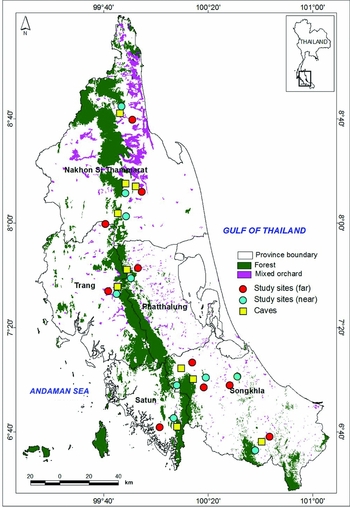
Mixed fruit orchards in southern Thailand are distributed among forest patches (Figure 1). The study took place from September 2012 to June 2013, using 20 mixed-fruit orchards situated at varying distances from 10 forest patches in southern Thailand (Nakhon Si Thammarat, Phattalung, Trang, Satun and Songkhla provinces; 6°20'–8°20'S and 99°40'–110°00'E). The actual size of the 10 patches of tropical rainforest, excluding rubber and oil palm plantations, ranged in area between 3.6 to 650 km2 and occurred at altitudes between 230 to 1090 m asl. We used 1:133400 scale photographic imagery from Landsat Thematic Mapper data with a geographic information system (ARC GIS 10.2) to create a map of land use. From this map, we could determine forest patch size and the distance from each orchard to the nearest forest edge, as well as to the nearest cave. We also calculated the proportion of forest fractions within a 20-km radius around each study orchard. All study species (durian, rambutan and mango), were found in each study orchard.
Map of study area. Visitors and fruit set were sampled from 20 orchards at varying distances from 10 forest patches in southern Thailand.

For each forest patch, we selected a pair of orchards (one near to and one far from the forest patch) that were managed without pesticide use. We used pollinator foraging distances to determine the cut-off distances for near and far orchards. Since previous work indicates that the mean foraging distance of local pollinator species ranges 2–7 km (1.97 km for a stingless bee (Wahala & Huang Reference WAHALA, HUANG and Harrison2005); 1.7–6.9 km for Rousettus bats (Bonaccorso et al. Reference BONACCORSO, WINKELMANN, TODD and MILES2014); 4.4 km for Eonycteris spelaea bats (Acharya et al. Reference ACHARYA, RACEY, SOTTHIBANDHU and BUMRUNGSRI2015)), we classified orchards as near if they were < 1 km away from the nearest rainforest patch and as far if they were >7 km away from rainforest. All pairs of orchards were at least 10 km apart. The distance from each study orchard to the nearest caves (potential roosts for nectarivorous bats) ranged from 0.7 to 29 km (mean distance to caves ± SD: 9.42 ± 7.24 km). Cave with roosting bats were listed by Bumrungsri (Reference BUMRUNGSRI1997) and the Shepton Mallet Caving Club (http://www.thailandcaves.shepton.org.uk).
Study species
Nephelium lappaceum L. (rambutan, Sapindaceae) typically flowers from March–May, with occasional flowering from August to October, depending on local weather conditions (Whitehead Reference WHITEHEAD1959). The flowers are white, and inflorescences are either male or hermaphroditic. Rambutan can be monoecious or dioecious, but male-only plants are rare. On male panicles, there are c. 1000–5000 flowers per inflorescence (Lim Reference LIM1984, Shivaramu et al. Reference SHIVARAMU, SAKTHIVEL and REDDY2012). For panicles with hermaphroditic flowers, each panicle may contain around 200–800 flowers (Lim Reference LIM1984, Shivaramu et al. Reference SHIVARAMU, SAKTHIVEL and REDDY2012). Anthesis starts at about 07h00 and co-occurs with nectar secretion and stigma receptivity. Stigmas remain receptive for a single day (Lim Reference LIM1984, Shivaramu et al. Reference SHIVARAMU, SAKTHIVEL and REDDY2012). Rambutan is self-incompatible and therefore depends on pollinators such as Trigona and Apis ceranna bees (Heard Reference HEARD1999, Lim Reference LIM1984, Shivaramu et al. Reference SHIVARAMU, SAKTHIVEL and REDDY2012, Van Welzen et al. Reference VAN WELZEN, LAMB and WONG1988).
Durio zibethinus L. (durian, Bombacaceae) is widely distributed and cultivated throughout South-East Asia. In southern Thailand, flowering starts sometime during March–May and lasts for only 2–3 wk (Bumrungsri et al. Reference BUMRUNGSRI, SRIPAORAYA, CHONGSIRI, SRIDITH and RACEY2009). Each inflorescence is composed of 3–100 greenish-white hermaphroditic flowers. Flowers open late in the afternoon (16h00) and nectar secretion begins soon after (Bumrungsri et al. Reference BUMRUNGSRI, SRIPAORAYA, CHONGSIRI, SRIDITH and RACEY2009). Pollen dehiscence begins around 19h30–20h00 and the stigma is already receptive when anthers release pollen. Bumrungsri et al. (Reference BUMRUNGSRI, SRIPAORAYA, CHONGSIRI, SRIDITH and RACEY2009) found durian trees to be highly self-incompatible. Pollen limitation was found in previous studies, and the main visitors are nectarivorous bats (Eonycteris spelaea) and the giant honey bee (Apis dorsata) (Bumrungsri et al. Reference BUMRUNGSRI, SRIPAORAYA, CHONGSIRI, SRIDITH and RACEY2009, Stewart et al. Reference STEWART, MAKOWSKY and DUDASH2014).
Mangifera indica L. (mango, Anacardiaceae) plants in our study area were primarily of the Bao variety, which shows two flowering peaks (February and September). The flowering period of each tree lasts for 10 d after the first bud opens. Mango inflorescences are composed of hermaphroditic and male flowers (in which the pistil is abortive; Dag & Gazit Reference DAG and GAZIT2000). The percentage of hermaphroditic flowers varies from 1.25–35.6% (Sharma & Singh Reference SHARMA and SINGH1970). Mango flowers open during the night and early morning (by 08h00). Nectar production and stigma receptivity begin soon after the flower opens (Sharma & Singh Reference SHARMA and SINGH1970) but anther dehiscence does not occur until 11h30, and continues until 15h45. Self-pollinated flowers produced fewer fruits (0.0–1.68%) than cross-pollinated flowers (6.4–23.4%), and overall fruit set in the wild is very low (only 0.1% of hermaphroditic flowers set fruits that reach maturity) (Carvalheiro et al. Reference CARVALHEIRO, SEYMOUR, VELDTMAN and NICOLSON2010, Sharma & Singh Reference SHARMA and SINGH1970). The main flower visitors are insects from the orders Diptera, Hymenoptera, Lepidoptera and Coleoptera (Carvalheiro et al. Reference CARVALHEIRO, SEYMOUR, VELDTMAN and NICOLSON2010, Dag & Gazit Reference DAG and GAZIT2000, Sharma & Singh Reference SHARMA and SINGH1970).
Sampling of flower visitors
We determined the flower visitors to our three study species using 10 trees per species per orchard. We selected three inflorescences of a similar size from the middle of the canopy, selecting trees with many flowers. We observed all insect visits for approximately 5 min per inflorescence (15 min total per tree). When insects were observed visiting flowers, we stopped the timer to identify and count the number of insects. In addition to recording visitation data, we also recorded the number of flowers observed. Surveys were conducted from 08h00 to 11h00 and from 15h00 to 19h00 on days with calm weather (i.e. sunny and without rain, temperature ranging from 31–38ºC). Following observations, we collected samples of flower visitors with sweep nets. Common insects that could not be identified to species were grouped by morphotype (Memmott & Godfray Reference MEMMOTT, GODFRAY, Lasalle and Gauld1993). For each forest patch, both the near and far orchards were sampled on the same day.
We placed camera traps (Moultrie game spy d55-IRXT infrared flash camera) c. 5–10 m from each study inflorescence (three inflorescences per tree) using the same 30 trees (10 trees per species) examined during flower visitor observations. Camera-trap data were used to determine the visitation rates of each bat species (number of visits per night) to each inflorescence. To confirm the species identity of bats observed via camera traps, we also mist-netted in each study orchard between 19h00 to 02h00. We used three mist nets (2.6 × 6 m) for two nights per orchard. Mist nets were placed as close as possible to the flowers of durian trees, and netted bats were identified to species following Francis & Barrett (Reference FRANCIS and BARRETT2008).
Reproductive success
To assess the effect of distance from forest on reproductive success, we compared fruit set resulting from open pollination in orchards near and far from forest patches. Three inflorescences were marked with twist ties for each of the 30 study trees (10 trees per species), choosing inflorescences with a similar number of flower buds. We counted the number of fruits per inflorescence for each study tree c. 2 wk after the tree finished flowering (so that our measure of pollination success was not influenced by any potential effects of resource limitation). However, for durian we examined the number of fruits set 4 wk after the tree finished flowering, because this species shows late-acting self-incompatibility (Bumrungsri et al. Reference BUMRUNGSRI, SRIPAORAYA, CHONGSIRI, SRIDITH and RACEY2009, Honsho et al. Reference HONSHO, SOMSRI, TETSUMURA, YAMASHITA and YONEMORI2007).
Analysis of data
For each of the three crop species, the response variable (number of fruits set in each inflorescence) was examined using a generalized linear mixed model (GLMM), comprising a logit link function. Distance to forest, forest patch size, distance to nearest cave, proportion of forest surrounding study sites, visitor richness and visitor frequency were included as explanatory variables. Individual tree, study orchard and forest patch were treated as random factors. To find the best scale for forest proportion, we conducted a regression between the proportion of forest surrounding each study site at different radius scales (2, 4, 8 km) and the number of fruits set for the three crop species. The number of parameters minimized the goodness-of-fit given by the Akaike's information criterion (AIC, Burnham & Anderson Reference BURNHAM and ANDERSON2004). To determine the best predictive model, the GLMM with the lowest AIC was selected.
For crops in which distance to forest was found to be a significant variable explaining fruit set, Generalized Linear Models (GLM) were conducted to examine the relationship between the stingless bee visitation frequency, number of visiting insect species and distance to forest. All statistical analyses were performed using R, version 2.13.0 (http://www.R-project.org).
RESULTS
Rambutan
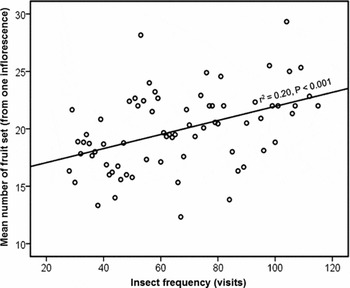
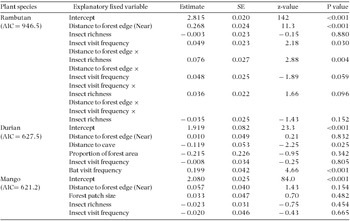
The number of fruits set per inflorescence in orchards near forest patches (mean ± SD: 22.5 ±6.33) was significantly higher than in orchards far from forest patches (16.8 ± 4.72). There was also a positive linear relationship between insect visitation frequency and the number of fruits set (Figure 2, Table 1). However, forest patch size and insect richness had no effect on fruit set. There was a significant positive correlation between proximity to forest patch and insect richness (Table 1). The most abundant flower visitors were stingless bees (70.9%) and honey bees (Apis cerana, 10.7%), followed by Diptera (9.34%) and other insects (9.11%) (n = 4756). Stingless bees were significantly more frequent at rambutan flowers near forest patches (40.8 ± 23.5 visits per 15-min observation) than at flowers far from forest patches (25.4 ± 17.4 visits per 15-min observation; F 1, 598 = 897, P < 0.001). We found that the proportion of forest within a 2-km radius around each orchard showed a significant positive effect on the number of fruits set in rambutan (GLM, F = 23.2, df = 598, P < 0.001).
A linear regression plot for the number of rambutan fruits set and insect visitation frequency to rambutan flowers in mixed fruit orchard in southern Thailand. Each data point is based on the mean number of fruits set from one inflorescence.

Results of generalized linear mixed models for the number of fruit set for three different crops in southern Thailand. For rambutan, fixed effects are distance to the forest edge, insect richness and insect abundance. For durian, fixed effects include distance to the forest edge, distance to cave, bat visitation frequency, proportion of forest within a 20-km radius, and insect visitation frequency. For mango, fixed effects include distance to the forest edge, forest patch size, insect richness, and insect visitation frequency.

Durian
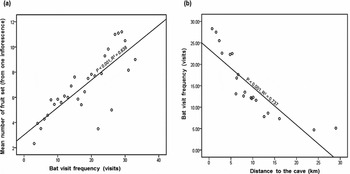
The number of fruits set per inflorescence of durian was not significantly affected by distance to forest; however, there was a significant negative effect of distance to the nearest cave on the number of fruits set. Bat visitation frequency was significantly negatively correlated with distance to the nearest cave (Figure 3, Table 1). Nocturnal flower visitors included fruit bats (Pteropodidae) and giant honey bee (Apis dorsata), while diurnal visitors included stingless bees (Meliponini), giant honey bee (Apis dorsata) and honey bee (Apis cerana). Bat visitation frequency (as determined from camera traps) declined sharply with distance to caves (Figure 3). Camera-trap data revealed that the main bat species were Eonycteris spelaea (63.9%), Cynopterus spp. (19.6%), other species (16.5%) (n = 3039 photos). We netted 271 individuals of six fruit bat species (94 E. spelaea, 52 Macroglossus sobrinus, 51 Rousettus amplexicaudatus, 30 R. leschenaulti, 20 Cynopterus horsfieldi and 25 C. brachyotis) across 480 h of mist-netting.
A linear regression plot for the number of durian fruits set and bat visit frequency to durian flowers in mixed fruit orchard in southern Thailand (a). A linear regression plot for bat visitation frequency to durian flowers and distance to the nearest bat roosting cave. Each data point represents the number of fruits set from one inflorescence (b).

Mango
When examining fruit set per inflorescence in mangos, we found no significant difference between sites near forest patches (8.37 ± 2.98) and far from forest patches (8.11 ± 2.90) or with forest patch size (Table 1). None of the visitor variables affected the number of fruits set per inflorescence (Table 1). The main flower visitors were flies (65.2%), stingless bees (9.45%), honey bees (12.2%), beetles (5.24%) and other insects (7.86%). The main fly visitors were from the families Muscidae (house fly), Calliphoridae (blow fly) and Syrphidae (hover fly). Fly visitation frequency alone also did not significantly affect the number of fruits set (GLM, F = 0.0003, df = 598, P = 0.986).
DISCUSSION
This study highlights the influence of distance to forest patches and caves on crop pollination. There are two important results. First, proximity to forests and caves affects the number of fruits set in some crops. Second, proximity to forest patches and caves affects the species richness and abundance of flower visitors, leading to changes in crop reproductive success. We will discuss each of these aspects including implications for conservation.
Proximity to forest on fruit set
Our results show that the effect of distance to forest on fruit set differed by plant species depending on the pollinating guild. Pollination success in rambutan was enhanced substantially by proximity to forest, while distance to forest was less influential for fruit set in durian and mango. This pattern was likely due to the different flower visitors, and the dependence of these visitors on forest habitat. Pollination success in rambutan was positively correlated with insect visitation frequency. Since stingless bees made up more than 50% of the visitors to rambutan, these results suggest that stingless bees are potentially the major pollinating insects for this species. A previous Neotropical study also found that rambutan is highly dependent on pollinators, as the fruit set of trees with pollinators was about 10 times greater than trees without pollinators (Rincón-Rabanales et al. Reference RINCÓN-RABANALES, ROUBIK, GUZMÁN, SALVADOR-FIGUEROA, ADRIANO-ANAYA and OVANDO2015). For rambutan, we established for the first time that pollination success, represented by the number of fruits set per inflorescence, is dependent on insect visitation frequency. Similar findings have been reported for other plant species such as coffee, in which fruit set was positively correlated with the richness of flower-visiting bee species (Klein et al. Reference KLEIN, STEFFAN-DEWENTER and TSCHARNTKE2003a). Additionally, pollination success in both macadamia and longan were negatively correlated with the distance to tropical rainforest, and the major pollinating insects of longan are stingless bees (Blanche et al. Reference BLANCHE, LUDWIG and CUNNINGHAM2006). Ricketts (Reference RICKETTS2004) found that bee diversity, visitation rate, pollen deposition rate and fruit set were all affected by proximity to forest (Ricketts Reference RICKETTS2004). Such evidence implies that insects from the forest (e.g. stingless bees) mainly collect pollen and consistently contact stigmas during foraging, resulting in greater reproductive success; in contrast, non-forest insects (e.g. Apis mellifera, A. cerana) primarily collect nectar and contact stigmas less often. Moreover, we found a positive correlation between the proportion of forest within a 2-km radius around each orchard and the number of fruits set by rambutan plants, similar to studies by Kremen et al. (Reference KREMEN, WILLIAMS, BUGG, FAY and THORP2004) and Winfree et al. (Reference WINFREE, WILLIAMS, DUSHOFF and KREMEN2007) which showed that the proportion of natural habitats strongly affected native bee communities. However, our GLMM analyses did not find that rambutan fruit set was significantly influenced by the proportion of forest around each orchard; this might be a consequence of autocorrelation between the proportion of forest around study sites and distance to forest.
The distance to forest patches did not affect fruit set quantity in durian, presumably because insects contribute little to the pollination success of this crop (Bumrungsri et al. Reference BUMRUNGSRI, SRIPAORAYA, CHONGSIRI, SRIDITH and RACEY2009). Nectarivorous bats, especially E. spelaea, are the most important pollinators of durian (Bumrungsri et al. Reference BUMRUNGSRI, SRIPAORAYA, CHONGSIRI, SRIDITH and RACEY2009), even though our results showed that the giant honey bee (Apis dorsata) was the most frequent nocturnal visitor to the flowers. Bumrungsri et al. (Reference BUMRUNGSRI, SRIPAORAYA, CHONGSIRI, SRIDITH and RACEY2009) found that insect-pollinated durian flowers set no fruit, compared with 10% fruit set in flowers that were exposed to bat visitors. Our results show a strong negative relationship between distance to cave and number of fruits set in durian. Results from a previous study support our finding that a cave-roosting nectarivorous bat, E. spelaea, was a more frequent pollinator than foliage-roosting bats (Stewart et al. Reference STEWART, MAKOWSKY and DUDASH2014). There are only a few studies of bat pollinators in relation to forest fragmentation. Previous authors have found that pollination success of chiropterophilous plants was affected by forest fragmentation (Quesada et al. Reference QUESADA, STONER, ROSAS-GUERRERO, PALACIOS-GUEVARA and LOBO2003, Reference QUESADA, STONER, LOBO, HERRERIAS-DIEGO, PALACIOS-GUEVARA, MUNGUÍA-ROSAS, O.-SALAZAR and ROSAS-GUERRERO2004; Stoner et al. Reference STONER, QUESADA, ROSAS-GUERRERO and LOBO2002). This is the first study to document that bat visitation frequency decreases with distance from caves, and reduces pollination success of chiropterophilous species.
Distance to forest patches did not significantly influence fruit set of mango trees. Since flies were the most frequent visitors to mango flowers, it seems likely that their abundance is not sensitive to forest proximity, as has previously been demonstrated in hover flies (Steffan-Dewenter & Tscharntke Reference STEFFAN-DEWENTER and TSCHARNTKE1999). A study in Israel found that blow flies are as effective as honey bees in pollinating mango trees (Dag & Gazit Reference DAG and GAZIT2000). However, the most abundant mango flower visitors in South Africa were ants and honey bees, and increasing distance from natural habitats led to strong declines in fruit production (Carvalheiro et al. Reference CARVALHEIRO, SEYMOUR, VELDTMAN and NICOLSON2010). Our results corroborate previous work indicating that dipterans are much less sensitive to forest proximity than hymenopterans (Steffan-Dewenter & Tscharntke Reference STEFFAN-DEWENTER and TSCHARNTKE1999). In addition, apomixis also occurs in mango (Singh et al. Reference SINGH, DHYANI and AHUJA2011), presumably reducing the negative effects of pollen limitation on mango reproductive success.
Proximity to forest patches and caves on species richness and abundance of flower visitors
The foraging distance of animal can strongly affect their population dynamic, life history, and community interaction including pollination (Holling Reference HOLLING, Samson and Knopf1994, Ritchie & Olff Reference RITCHIE and OLFF1999) and foraging distance has been shown to increase with body size for various taxa (Greenleaf et al. Reference GREENLEAF, WILLIAMS, WINFREE and KREMEN2007). The negative effects of isolation from forest may be even greater for small bee species (Araújo et al. Reference ARAÚJO, COSTA, CHAUD-NETTO and FOWLER2004, Gathmann & Tscharntke Reference GATHMANN and TSCHARNTKE2002, Greenleaf et al. Reference GREENLEAF, WILLIAMS, WINFREE and KREMEN2007, Steffan-Dewenter & Tscharntke Reference STEFFAN-DEWENTER and TSCHARNTKE1999). Stingless bees were more frequent visitors to rambutan flowers in orchards near forest patches, suggesting that rainforests provide important habitats for these bees. Similarly, bee sampling in Indonesian agroforestry systems detected a decrease in both the richness and abundance of social bees (Meliponini stingless bees and Apini honey bees) with increasing distance from forest (Klein et al. Reference KLEIN, STEFFAN-DEWENTER and TSCHARNTKE2003a). Since most stingless bees nest in tree cavities, they are sensitive to disturbance, especially deforestation (Brown & Albrecht Reference BROWN and ALBRECHT2001, Eltz et al. Reference ELTZ, BRÜHL, VAN DER KAARS and LINSENMAIR2002). While visitor abundance decreased with distance from forest, we did not detect an effect of forest proximity on visitor species richness. This lack of correlation may be due to low taxonomic resolution, since we were not able to identify every insect to species level.
The higher visitation rate of bats to durian flowers near caves emphasizes the role of caves as sources of pollinators to surrounding durian trees. The cave nectar bat, E. spelaea, was the most abundant bat species (c. 60% of bats observed at flowers) and has previously been shown to be an important pollinator of durian (Bumrungsri et al. Reference BUMRUNGSRI, SRIPAORAYA, CHONGSIRI, SRIDITH and RACEY2009). Furthermore, durian pollen was the most abundant species (42%) carried by E. spelaea in March and April (during durian's flowering season), showing that E. spelaea is a faithful visitor to durian flowers (Bumrungsri et al. Reference BUMRUNGSRI, LANG, HARROWER, SRIPAORAYA, KITPIPIT and RACEY2013). In addition, our mist-net data showed that about 30% of captured bats were Rousettus, which is also a cave-roosting bat. Based on these data, we suggest that this bat genus is probably also important for pollination of durian orchards near roosting caves (as corroborated by A. Stewart, pers. comm.), even though no individuals were observed at durian flowers with our camera traps.
Implications for conservation
Forest fragmentation and deforestation can directly affect a complex set of plant and animal interactions (Fortuna & Bascompte Reference FORTUNA and BASCOMPTE2006), promoting a higher rate of self-pollination and consequently reducing pollination success of animal-pollinated plant species (Lennartsson Reference LENNARTSSON2002). This can lead to changes in functional diversity in natural areas (Girão et al. Reference GIRÃO, LOPES, TABARELLI and BRUNA2007). Our results highlight the roles of different groups of pollinators visiting plant species with different pollination syndromes. Varying degrees of pollen limitation in these three native plant species indicate that the effect of pollinator abundance on plant reproductive success varies by plant taxa, and that the dispersal success of pollinators is related to isolation from source habitats. It is clear that rainforest patches can act as reservoirs for stingless bees, and probably other pollinator species as well. Preservation of forest, even forest patches, will ultimately protect the nesting and foraging habitat of many key pollinators, and thus maintain the richness and abundance of these vital pollinators (Ricketts Reference RICKETTS2004). However, most intensive agricultural farms do not incorporate nesting and foraging site options in their normal farming practice (Kremen et al. Reference KREMEN, WILLIAMS and THORP2002, Tscharntke et al. Reference TSCHARNTKE, KLEIN, KRUESS, STEFFAN-DEWENTER and THIES2005). For bees, our most important pollinator, nest provisioning is an alternative way to maintain populations in areas far from forests. Over the last 10 y, stingless bee-keeping has grown rapidly in Australia, and 24% of bee keepers are using these bees for crop pollination such as macadamia, lychee, watermelon, avocado and mango (Halcroft et al. Reference HALCROFT, SPOONER-HART, HAIGH, HEARD and DOLLIN2013, Heard & Dollin Reference HEARD and DOLLIN2000). In eastern Thailand, stingless bee domestication has been applied in rambutan orchards, however, stingless bee-keeping in other regions of Thailand and tropical countries has not yet been widely applied to crop pollination. Thus, we recommend that fruit growers keep bee hives on their farms and preserve forest remnants. In addition, more environmentally friendly agricultural practices such as agroforestry should be implemented over larger scales to provide greater nesting options and floral resources for pollinators throughout the entire year.
In addition to forest and insect pollinators, caves and nectarivorous bat populations should also be protected. Due to durian's self-incompatibility and reliance on nectarivorous bats for pollination, the future survival of this crop is dependent on the survival of these bats. Hunting of fruit bats such as E. spelaea has led to serious declines in bat populations throughout South-East Asia, including in Thailand (Mickleburgh et al. Reference MICKLEBURGH, HUTSON and RACEY1992, S. Bumrungsri, pers. obs.). As a consequence, the likelihood of pollination failure in durian may increase. Eonycteris spelaea (Bumrungsri Reference BUMRUNGSRI1997, Start Reference START1974) is also known as the major pollinator of other economically and ecologically important plants including Oroxylum indicum, Parkia speciosa, P. timoriana, Sonneratia spp. and Duabanga grandiflora (Bumrungsri et al. Reference BUMRUNGSRI, HARBIT, BENZIE, CARMOUCHE, SRIDITH and RACEY2008, Reference BUMRUNGSRI, SRIPAORAYA, CHONGSIRI, SRIDITH and RACEY2009, Reference BUMRUNGSRI, LANG, HARROWER, SRIPAORAYA, KITPIPIT and RACEY2013; Hopkins Reference HOPKINS1994, Start & Marshall Reference START, MARSHALL, Burley and Styles1974, Srithongchuay et al. Reference SRITHONGCHUAY, BUMRUNGSRI and SRIPAO-RAYA2008). Mixed planting of these species can promote the visitation of bat pollinators to fruit orchards year-round, particularly since a recent study found that E. spelaea exhibits strong fidelity to foraging areas (Acharya et al. Reference ACHARYA, RACEY, SOTTHIBANDHU and BUMRUNGSRI2015). Maintaining crop yields and ecological complexity requires a combination of conservation measures, including protecting both pollinators (e.g. insects and bats) and their habitats (e.g. forests and caves). Moreover, maintaining small forest patches and limestone karsts may provide stepping stones across fragmented landscapes, and attract greater numbers of pollinators to agricultural areas (Klein et al. Reference KLEIN, BOREUX, BAUHUS, CHAPPELL, FISCHER, PHILPOTT, Kettle and Koh2014).
Our approach still has some key limitations that will need to be addressed in future studies. We estimated plant reproductive success by measuring fruit set 2 wk after flower opening and we studied the effect of natural habitats on three plant species. However, we still lack knowledge about how natural habitat proximity can affect ecological interaction networks (and plant-pollinator networks in particular) within the whole community. Thus, future studies should focus on how adjacency to natural habitat affects both structure and function in pollination networks.
ACKNOWLEDGEMENTS
Funding for this project was provided by the Thailand Research Fund (TRF) through the Royal Golden Jubilee PhD Program joint with Prince of Songkla University under Grant No. PHD/0225/2552 and Prince of Songkla University's graduate school. We are extremely grateful to S. Ith, S. Bilasoi, N. Chaichart and D. Sanamxay for providing invaluable assistance with field sampling, and L. M'Gonigle and N. Kongchouy for assistance with statistical analyses. We thank the members of the Small Mammal & Bird Research Unit, the Kremen's lab at UC Berkeley, and the community Ecology group at the University of Bristol who helped develop ideas. We also thank A. Stewart for comments on earlier versions of this manuscript.