INTRODUCTION
The cnidarian fauna of the Pakistani waters is poorly known, but a recent compilation of literature data is available (Gul et al., Reference Gul, Morandini, Häussermann and Pörschmann2015b). Jellyfishes, although abundant in certain periods, were only rarely reported in the scientific literature. In the past, only three species were mentioned for the region: Cephea sp., Pelagia noctiluca (Forskål, Reference Forskål1775) and Sanderia malayensis Goette, Reference Goette1887 (Stiasny, Reference Stiasny1937a).
So far, recent efforts have increased the knowledge, reaching a number of eight scyphomedusae from the Pakistani waters: Catostylus perezi Ranson, Reference Ranson1945, Cephea coerulea Vanhöffen, 1902, Marivagia stellata Galil & Gershwin, 2010, Netrostoma setouchianum (Kishinouye, 1902) and Rhopilema hispidum (Vanhöffen, Reference Vanhöffen1888) (Gul & Morandini, Reference Gul and Morandini2013, Reference Gul and Morandini2015; Gul et al., Reference Gul, Moazzam and Galil2014, Reference Gul, Moazzam and Morandini2015a). Interestingly, four of the aforementioned species belong to the family Cepheidae Agassiz, Reference Agassiz1862, which has a higher richness in Indo-Pacific waters (Kramp, Reference Kramp1970).
The goal of this report is to register one more cepheid jellyfish, Netrostoma coerulescens Maas, Reference Maas1903, from the coast of Pakistan, presenting a brief description and comparison with other members of the genus.
MATERIALS AND METHODS
On 20 March 2014, during fishing activities at Pitiani creek (24°26.23853′N 67°17.44481′E), one crowned jellyfish was collected as by-catch, brought to the laboratory and preserved in 4% formaldehyde solution in sea water. The morphology and canal system of the specimen was studied, a small piece of the mouth arm was cut and the surface view plus detail of its branching was photographed microscopically; filaments at the centre of the arm disc were also photographed. This specimen was identified as Netrostoma coerulescens Maas, Reference Maas1903 and is briefly described here. The specimen is now deposited in the Museum of Department of Zoology, Jamia Millia Government Degree College (JMGDC MDZ), Malir, Karachi, Pakistan. We also found one medium-sized crab inside the subumbrella of this jellyfish.
Additionally, one specimen was previously collected as by-catch on 11 November 2010 during trawling off the coast of Pakistan (24°59.03′N 65°43.62′E); the specimen was photographed and examined on board, but due the absence of technical facilities it could not be preserved. As we had no opportunity to further study the specimen, we present it here as Netrostoma sp.
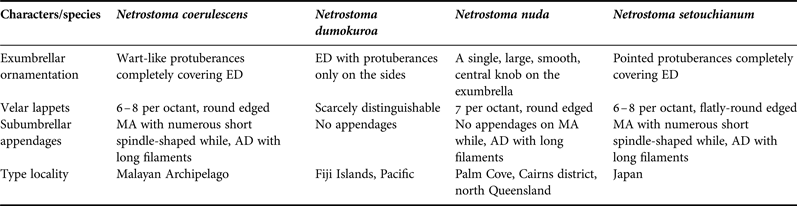
Identification follows Kramp (Maas, Reference Maas1903; Stiasny, Reference Stiasny1937b; Kramp, Reference Kramp1961). We assumed that the number of warts/protuberances on the exumbrellar dome of the crowned jellyfishes (Cephea and Netrostoma) may vary with growth and thus, is not considered here as a diagnostic character. Differentiation between genera of the family Cepheidae Agassiz, Reference Agassiz1862 and comparison of key morphological features of the valid species within the genus Netrostoma Schultze, Reference Schultze1898 are also provided (Tables 1 & 2).
Differentiation between genera of the family Cepheidae Agassiz, Reference Agassiz1862. Data from Mayer (Reference Mayer1910), Kramp (Reference Kramp1961), Gershwin & Zeidler (Reference Gershwin and Zeidler2008) and Galil et al. (Reference Galil, Gershwin, Douek and Rinkevich2010). AD, arm disc; EU, exumbrella; MA, mouth arms.

Comparison of key morphological features of the valid species within the genus Netrostoma Schultze, Reference Schultze1898; type localities are also shown. Data from original descriptions: Mayer (Reference Mayer1910), Kramp (Reference Kramp1961) and Gershwin & Zeidler (Reference Gershwin and Zeidler2008). AD, arm disc; ED, exumbrellar dome; MA, mouth arms.
RESULTS
SYSTEMATICS
Class SCYPHOZOA Goette, Reference Goette1887
Subclass DISCOMEDUSAE Haeckel, 1880
Order RHIZOSTOMEAE Cuvier, 1800
Family CEPHEIDAE Agassiz, Reference Agassiz1862
Genus Netrostoma Schultze, Reference Schultze1898
Netrostoma coerulescens Maas, Reference Maas1903
(Figure 1A–F)
Netrostoma coerulescens Maas, Reference Maas1903 from Pitiani creek, Pakistan (JMGDC MDZ CN 21), bell width 300 mm. (A) Specimen in exumbrellar view; (B) Closer view of exumbrella showing wart-like protuberances on the central dome and a distinct furrow (arrow) around; (C) Closer view of bell margin highlighting round-edged velar and pointed rhopalar lappets; (D) Microscopic view showing mouth arms' lateral branching and formation of tubular appendages (possibly digitata); (E) Surface of a mouth arm; note the numerous minute tubular appendages (arrows) and one spindle-shaped appendage; (F) Subumbrellar view showing filaments (arrow) at the centre of arm disc.
MATERIAL EXAMINED
One specimen, 20 March 2014, Pitiani creek (24°26.23853′N 67°17.44481′E), bell width 300 mm (JMGDC MDZ CN 21).
DESCRIPTION
Umbrella thinner at margin, bearing a low exumbrellar central dome with a distinct furrow around it (Figure 1A). Dome completely ornamented with about 20 wart-like protuberances; outer ones relatively loosely set, inner ones raised and greatly fused (Figure 1B). Eight distinct, round velar lappets per octant; rhopalar lappets also distinct, small and pointed (Figure 1C).
Mouth arms eight, short, laterally compressed, bifurcated distally, bearing numerous tiny, lateral branches, each having several minute tubular appendages (Figure 1D, E); surface of mouth arms with numerous short, spindle-shaped appendages (Figure 1E); both having microscopic warts. Centre of arm disc with a cluster of mostly thin, transparent, small filaments of varying length (Figure 1F). Three inter-rhopalar canals per octant forming a wide-meshed network reaching into the velar lappets. Subumbrellar radial muscles strongly developed.
REMARKS
Netrostoma coerulescens Maas, Reference Maas1903 can be distinguished by its wart-like protuberances completely covering the exumbrellar dome; 6–8 distinct, round-edged velar lappets in each octant; small, pointed rhopalar lappets; short, laterally compressed, distally bifurcated mouth arms having numerous short, spindle-shaped appendages, and the centre of arm disc with long filaments (Maas, Reference Maas1903; Stiasny, Reference Stiasny1937b; Kramp, Reference Kramp1961; present study). A comparison of N. coerulescens with other species is provided in Table 2.
DISCUSSION
Cephea Péron & Lesueur, 1810 and Netrostoma Schultze, Reference Schultze1898 are two closely related genera of the family Cepheidae, commonly known as crowned jellyfishes. The main features that are used to differentiate the genera are the exumbrellar morphology and the presence/absence of subumbrellar appendages and their shape. Cephea can be easily distinguished by having numerous long, pointed ‘lash-like filaments’ on mouth arms (Menon, Reference Menon1930) besides other morphological features (see Table 1).
The unique character of Netrostoma is the presence of short appendages on mouth arms (Kramp, Reference Kramp1961; Gul et al., Reference Gul, Moazzam and Morandini2015a). Kramp (Reference Kramp1961) mentioned two types of appendages on the mouth arms of Netrostoma coerulescens – the tubular and the spindle ones; however, the former are most likely the digitata, which help the rhizostome medusae in feeding (Arai, Reference Arai1997). Surprisingly, we also noticed numerous similar whitish, spindle-shaped appendages on the surface of mouth arms in an underwater image of a live specimen of Marivagia stellata Galil & Gershwin, 2010 provided by Galil et al. (Reference Galil, Gershwin, Douek and Rinkevich2010: Figure 4).
Maas (Reference Maas1903: Figures 41 & 42) illustrated one large wart in the middle of the central dome surrounded by about ten smaller ones and the dome appears completely ornamented. However, in the specimen at hand (Figure 1A, B) no such single large wart was noticed in the centre. Menon (Reference Menon1930) reported numerous gelatinous warts on the exumbrellar dome of this species in specimens examined from India. The same author (Menon, Reference Menon1936) stated that this middle, large wart can be formed by the coalescence of a number of smaller ones. Stiasny (Reference Stiasny1937b) considered Netrostoma typhlodendrium, which had (~80) round warts with no middle larger one, identical with the discussed species. Kramp (Reference Kramp1961) also seems at doubt about the presence of one large wart in the centre and thus, he does not mention it in the diagnosis of Netrostoma coerulescens. We also collected a Netrostoma specimen as by-catch during trawling off the coast of Pakistan (24°59.03′N 65°43.62′E), which had (~80) round warts on the exumbrellar dome, but as it was not retained, we could not study it in more detail and thus, it is present here as Netrostoma sp. (Figure 2A, B).
Netrostoma sp. freshly collected from off the Pakistani coast (24°59.03'N 65°43.62'E). (A) Exumbrellar view highlighting the numerous warts; (B) Subumbrellar view.
It is clear that the higher diversity of species of the family Cepheidae in the Indo-Pacific waters presents an intriguing and exciting source of study. Following Kramp (Reference Kramp1961) there are ten species out of 12 that inhabit such clear, shallow water environments. But the boundaries between the species of Cephea and Netrostoma are based on a few characters – which may vary depending on development and the level of damage to specimens – and are also based on a few observed medusae individuals. The group needs an urgent approach that would combine detailed morphological studies of a large series of animals, the observation of developmental series and the use of molecular techniques in order to unravel the valid species.
Netrostoma coerulescens is an Indo-west Pacific species (Kramp, Reference Kramp1961). In the Arabian Sea, it was previously collected from the Gulf of Oman during John Murray's Expedition (1933–34) as a single, badly damaged specimen (Stiasny, Reference Stiasny1937a) and Nair (Reference Nair1951) later briefly mentioned this scyphomedusa from the Trivandrum coast, India. Therefore, present record is the first confirmed report of this species from the Arabian Sea, offering its first record from Pakistani waters.
ACKNOWLEDGEMENTS
We are grateful to the anonymous reviewers for their critical evaluation of the manuscript. ACM was supported by grants 2010/50174-7 and 2011/50242-5 from the São Paulo Research Foundation (FAPESP), and by CNPq (301039/2013-5). This is a contribution of NP-BioMar, USP.