Introduction
Benthi, Nicotiana benthamiana Domin, is an herbaceous plant in the Solanaceae family that was discovered in Australia before it spread to other countries in the 18th century. Benthi is frequently used to research the interaction between pathogen and host, plant innate immunity, and defense signal transduction because it is very sensitive to pathogens such as viruses, bacteria, oomycetes, and fungi (Goodin et al. Reference Goodin, Zaitlin, Naidu and Lommel2008). After hundreds of years of development, N. benthamiana has evolved into an essential model plant in many pathogen and host interaction systems due to its simple cultivation, short growth cycle, quick reproduction, and high regeneration frequency (Goodin et al. Reference Goodin, Zaitlin, Naidu and Lommel2008). Recently, N. benthamiana has been utilized as a model plant in comparative assessments of the developmental rate of the rice root-knot nematode, Meloidogyne graminicola Golden and Birchfield, 1965 on different hosts (Naalden et al. Reference Naalden, Verbeek and Gheysen2018).
Root-lesion nematodes (Pratylenchus spp.) are migratory endoparasitic nematodes that are widely distributed, with broad host ranges and damaging effects to their hosts. Their feeding activity and tunnelling inside the roots cause large cavities and necrosis of the cortex, resulting in debilitation of the root system and consequent arrest of plant growth, leaf chlorosis, and yield losses (Lamondia et al. Reference Lamondia2003). Among the Pratylenchus species, the coffee root-lesion nematode, P. coffeae (Zimmerman, 1898) Filipjev and Schuurmans Stekhoven, 1941 is one of the most economically important species because of its wide distribution and severely damaging effects on a variety of ornamental plants, food, and cash crops including banana, citrus, coffee, maize, peanut, ramie, sesame, soybean, tobacco, wheat, and yam (Li et al. Reference Li, Zhao, Song, Sun, Xia, Yuan, Li and Wang2021). Morphological and molecular analyses have shown that P. coffeae is a species complex consisting of cryptic species (De Luca et al. Reference De Luca, Troccoli, Duncan, Subbotin, Waeyenberge, Coyne, Brentu and Inserra2012). Root-lesion nematode populations identified tentatively as P. coffeae occur in tobacco (N. tabacum L.) farms in Shandon Province, China. There is no information on the host status of N. benthamiana to P. coffeae.
Our study was conducted to: (i) morphologically define a root-lesion nematode population collected from the above mentioned tobacco fields and reared on carrot disks; (ii) provide molecular characterization and phylogenetic relationships of this population with other related species using ITS rRNA and 28S rRNA gene sequences; (iii) assess nematode reproduction rate and response of N. benthamiana to P. coffeae parasitism after exposing seedlings of this plant growing in pots containing 18003 soil to an initial population density of 1,000 specimens of P. coffeae per pot for 60 days; and (iv) assess, in the same conditions of the above experiment, nematode reproduction rate and the response of N. benthamiana to the parasitism of four putative P. coffeae populations from crops grown in different regions of China.
Materials and methods
Isolation and culture of nematodes
Samples of brown, rotting tobacco roots were collected from tobacco farms located in Weifang City, Shandong Province, China. Root-lesion nematodes were extracted from these root samples using a modified Baermann funnel method (Hooper et al. Reference Hooper, Hallmann, Subbotin, Luc, Sikora and Bridge2005) and assigned population number SD-YC-1. Under a stereomicroscope, a single female root-lesion nematode was handpicked, cleaned with streptomycin sulfate, and placed on a carrot disk at 25°C in the dark for 90 days (Li et al. Reference Li, Wang, Liu, Lu, Wang and Li2019). The cultured nematode population was then used for morphological and molecular analyses and the host study, together with four other putative populations of P. coffeae from crops grown in different regions of China (Table 1) and preserved in the Plant Nematode Laboratory of Henan Agricultural University.
Nematode populations used in this study

Morphological identification of root-lesion nematode
For morphological identification, nematodes were killed by heat fixed in 4% FG solution (formalin:glycerin:water = 10:1:89), dehydrated, and then processed in pure glycerin and mounted in permanent glass slides using Xie’s (Reference Xie2005) method. Nematode specimens were examined, measured using a Nikon Eclipse Ti-S (Nikon, Tokyo, Japan) ocular micrometer and photographed with the same microscope.
Molecular identification and phylogenetic analysis of root-lesion nematodes
DNA from individual nematodes was extracted using protease K method (Wang et al. Reference Wang, Zhang and Gu2011). The rDNA ITS regions were amplified by polymerase chain reaction (PCR) using universal primers 18s (5′- TTGATTACGTCCCTGCCCTTT -3′) and 26S (5′- TTCACTCGCCGTTACTAGG -3′) (Vrain et al. Reference Vrain, Wakarchu, Lévesque and Hamilton1992), and the 28S rDNA D2–D3 region was amplified by PCR with universal primers D2A (5′-ACAAGTACCGGGAAAGTTG-3′) and D3B (5′- TCGGAAGGAACCAGCTACTA-3′) (Subbotin et al. Reference Subbotin, Ragsdale, Mullens, Roberts, Mundo-Ocampo and Baldwin2008). The specific primers TW81 (5′- GTTTCCGTAGGTGAACCTGC-3′) and coffeae group-specific (5′- CTTAAGCCATGTGCCAACTC-3′) (De Luca et al. Reference De Luca, Troccoli, Duncan, Subbotin, Waeyenberge, Coyne, Brentu and Inserra2012) were used for the specific detection of this nematode species. The PCR reaction system was prepared according to the instructions of KOD FX DNA polymerase (Toyobo, Japan). The PCR reaction conditions were as follows: pre-denatured at 94°C for 2 min, followed by 35 cycles (denatured at 98°C for 10 s, annealed at 58.2°C (ITS rDNA) or 51.7°C (28S rDNA) for 30 s, extended at 68°C for 90 s), and final extension at 72°C for10 min. PCR products were purified with a DNA gel recovery kit (Sangon Biotech (Shanghai) Co., Ltd., Shanghai, PR China), connected to a one-step ZTOPO-Blunt/TA cloning vector (Zoman, Beijing, PR China), transferred to DH5αcells, and then sent to Sangon Biotech (Shanghai, PR China) for sequencing. The newly obtained sequences were submitted to the GenBank database under the accession numbers: OQ449389 (rDNA-ITS) and OQ449390 (28s rDNA). These new consensus sequences for each gene of rDNA-ITS and 28S rRNA were aligned with corresponding published gene sequences of Pratylenchus obtained from the GenBank database using the nucleotide BLAST program in NCBI (http://blast.ncbi.nlm.nih.gov/Blast.cgi).
Multiple alignments of sequences were performed using the Clustal W technique in MEGA 7 (Tamura et al. Reference Tamura, Peterson, Peterson, Stecher, Nei and Kumar2011). The Akaike Information Criterion (AIC) was used to choose the best-fit model, using MrModeltest 2.3 (Nylander Reference Nylander2004). Sequence datasets were analysed with Bayesian inference (BI) Using MrBayes 3.2.7 (Huelsenbeck & Ronquist Reference Huelsenbeck and Ronquist2001). Posterior probabilities (PP) were given on appropriate clades. Outgroup taxa for ITS and D2-D3 datasets were selected according to Wang et al. (Reference Wang, Zhuo, Ye and Liao2015) and Subbotin et al. (Reference Subbotin, Ragsdale, Mullens, Roberts, Mundo-Ocampo and Baldwin2008).
Influence of initial densities of five P. coffeae populations on growth of N. benthamiana in pots
Seeds of N. benthamiana were washed three times with sterile water, treated with 75% ethanol for one min, disinfected with 12.5% sodium hypochlorite for 30 min, washed seven times with sterile water, and then sown in sterilized soil medium in 1800 cm3 pots. After seed germination, seedlings were grown at 25°C with 16 h of sunshine and 8 h of darkness for 30 days in a greenhouse.
Five P. coffeae populations were cultured on carrot disks (Reise et al. Reference Reise, Huettel and Sayre1987) for 50 days. The nematodes on carrot disks were then washed down with sterile water and suspended in water at a concentration of 1,000 nematodes/ml. Seedlings of N. benthamiana of the same growth status were chosen and inoculated with 1 ml water suspension containing 1,000 nematodes (Pi) per pot. Each nematode population inoculated on N. benthamiana was a treatment, and each treatment was set up with five replications. For the non-inoculated controls (ck), 1 ml of sterile water was inoculated on N. benthamiana in a pot. All pot experiments were repeated twice in a greenhouse (25 °C, 12 h light/12 h dark photoperiod) (Hahn et al. Reference Hahn, Sarah, Boissseau, Vines, Wright and Burrows1996).
Plants were harvested 60 days after inoculation. Plant height and fresh weight of shoot and roots were recorded. Meanwhile, the symptoms of the nematode infection were observed and photographed. The final population density (Pf) was obtained by extracting nematodes from soil and roots according to Li et al. (Reference Li, Zhao, Song, Sun, Xia, Yuan, Li and Wang2021), and then the reproduction factor, which is a ratio of final (Pf) and initial (Pi) population densities, was determined. The host plant selection criteria considered Rf > 1 a good host, 1 ≥ Rf > 0 a poor host, and Rf = 0 a non-host, as proposed by Goo et al. (Reference Goo and Sipes1997); this was used to evaluate whether N. benthamiana was a good host of P. coffeae. The data were analysed with SPSS 22.0 software(Chicago, USA), and Duncan’s new multiple range test (DMRT) was used to make multiple comparisons at the 5% significance level to calculate the standard error (SE).
Histopathological observation
At the end of the experiment, roots of N. benthamina seedlings inoculated with different populations of P. coffeae were washed with tap water to remove soil particles and processed for histological examination. Roots were stained according to Bybd et al. (Reference Bybd, Kirkpatrick and Barker1983) and then examined under the microscope. Paraffin root sections were made according to Wang et al. (Reference Wang, Li, Xie, Wu and Xu2016) and Sasanelli et al. (Reference Sasanelli, Vovlas, Trisciuzzi, Cantalapiedra-Navarrete, Palomares-Rius and Castillo2013). Infected roots were cleansed with water, divided into 1 cm segments and fixed in FAA fixative for 48 h, dehydrated, embedded in paraffin, and then sectioned. Sections were stained with safranin and fast green solution and photographed using a Nikon Eclipse Ti-S optical microscope.
Results
Morphological characterization of SD-YC-1 population
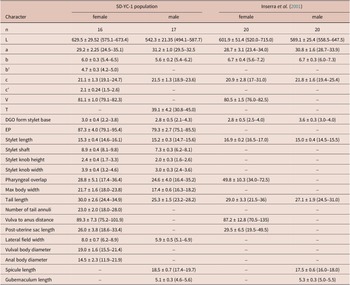
The SD-YC-1 population collected from tobacco in Weifang City, Shandong Province was identified as P. coffeae based on the morphological characterization. The morphometric data are listed in Table 2.
Morphometrics of a population of Pratylenchus coffeae collected in Weifang City, Shandong Province

Notes: All measurements are in μm and in the form of mean ± standard deviation (range). n, number of specimens measured; L, body length; a, body length/greatest body width; b, body length/length from the lips to the junction of oesophageal gland and intestine; b’, body length/length from the lips to oesophageal gland end; c, body length/tail length; c’, tail length/tail diameter at anus; V, distance of vulva from the lips × 100/body length; T, distance form cloaca opening to anterior most part of testis/body length × 100%; DGO, distance between dorsal oesophageal gland opening and stylet knobs.
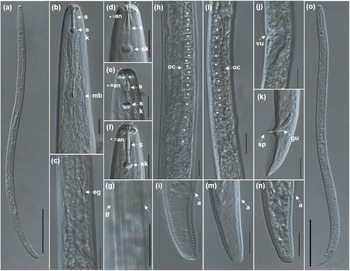
Female: Body straight or slightly bent into the shape of the letter c after heat relaxation (Figure 1a). Labial framework heavily sclerotised; labial region with two annuli; stylet 15.3 ± 0.4 (14.6–16.1) μm long; orifice of dorsal pharyngeal gland approximately 3.0 ± 0.4 (2.2–3.8) μm posterior to stylet base (Figure 1d–f). Pharyngeal gland lobe overlapping intestine ventrally for about 0.7 to 2 times the maximum body width (Figure 1c). Lateral fields with four longitudinal lines (Figure 1g). Excretory pore immediately posterior to hemizonid. Ovary with oocytes in one row (Figure 1h). Spermatheca rounded to oval filled with sperm (Figure 1i). The length of the post-uterine sac 0.9–1.6 times the width of the vulval body diameter (Figure 1j). Tail tapering slightly, terminus mostly broadly rounded, varying from somewhat narrower to almost truncate, usually with 18–28 annuli (Figure 1l–n).
Light micrographs of Pratylenchus coffeae from tobacco in Shandong Province, China. (a) female entire body; (b) anterior region; (c) pharyngeal gland lobe overlapping the intestine; (d)–(f) lip region; (g) lateral field; (h)–(i) ovaries showing oocytes(oc); (j) post-vulval region showing the post-uterine sac; (k) spicules; (l)–(n) female tail region; (o) male entire body. Scale bars: 100 μm ((a), (o)) and 10 μm ((b)–(n)). An, annuli; s, stylet; sk, stylet knob; oc, ovary cells; lf, lateral feld; mb, median bulb; eg, pharyngeal glands; vu, vulva; a, anus; sp, spicules; gu, gubernaculum.

Males: Body shorter and more slender than females (Figure 1o). Lip region, stylet, and median pharyngeal bulb slightly weaker than females. Spicules slender, slightly ventrally curved; gubernaculum 4.6–5.6 μm long; bursa enveloping tail tip; tail tip pointed (Figure 1k).
Remarks: The morphological characters of the nematode population collected in Weifang City, Shandong Province, were consistent with the description of a topotype population of P. coffeae reported by Inserra et al. (Reference Inserra, Duncan, Troccoli, Dunn, Handoo, Troccoli and Vovlas2001), except that the overlap at the pharyngeal gland was slightly shorter (17.4–36.4 μm vs. 34.0–72.5 μm).
Molecular characterization and phylogenetic analysis of P. coffeae
One 1247 bp rDNA-ITS sequence and one 781 bp D2-D3 region of 28S rDNA sequence were obtained from this population, and the specific primer TW81/coffeae group-specific amplified only one sequence length of 421bp. This is consistent with the literature on P. coffeae. The newly obtained rDNA-ITS sequence (OQ449389) showed the highest similarity (99.68%) with a P. coffeae sequence (KR106219) from Ruichang City, Jiangxi Province. The newly obtained 28S rDNA sequence (OQ449390) shared 99.74% similarity with the P. coffeae sequence from two other populations (MT586754, MN750755). The coffeae group-specific sequence (OR363694) showed 99.53% similarity with the P. coffeae sequence from two other populations (OQ674268, MW513459).
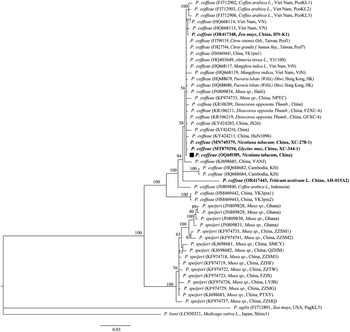
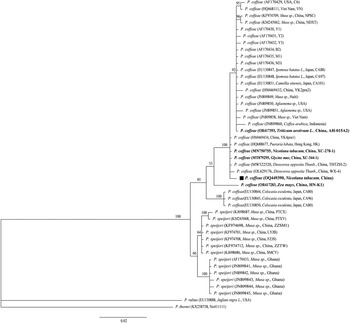
The Bayesian phylogenetic tree (Figure 2) constructed based on rDNA-ITS contained 50 sequences. In the P. coffeae species complex, P. speijeri was isolated into a single branch, which was highly supported (100%). The newly obtained sequence and four additional populations—XC-278-1, HN-K1, AH-015A2, and XC-344-1— clustered together with other P. coffeae rDNA-ITS sequences in a highly supported branch (100%). The Bayesian phylogenetic tree (Figure 3) constructed based on the rDNA-28S D2-D3 region contained 46 sequences. Two species of the P. coffeae species complex, P. speijeri and P. coffeae, formed a highly supportive branch (100%). In the monophylline formed by P. coffeae, P. speijeri formed a single sprig and obtained a high level of support (100%). The newly obtained sequence and the four additional populations—XC-278-1, HN-K1, AH-015A2, and XC-344-1—of P. coffeae clustered in a 100% supported clade.
Bayesian tree of Pratylenchus as inferred from ITS rRNA gene sequences under GTR+I+G model. Posterior probabilities more than 50% are given for appropriate clades. Newly obtained sequence is indicated in bold font.

Bayesian tree of Pratylenchus as inferred from 28S rRNA gene sequences under GTR+I+G model. Posterior probabilities more than 50% are given for appropriate clades. Newly obtained sequence is indicated in bold font.

Parasitism of P. coffeae on N. benthamiana
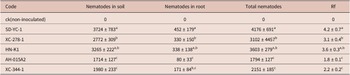
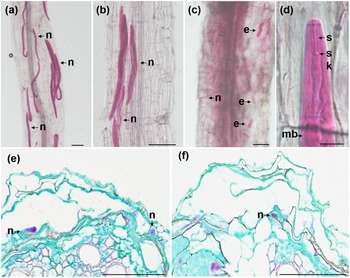
After 60 days of inoculation, many P. coffeae were isolated from the N. benthamiana root and rhizosphere soil, and the reproduction factors (Rf) were all greater than 1 in each treatment (Table 3). The SD-YC-1 P. coffeae population had the highest reproduction, reaching 4.2. According to the host plant selection criteria (Goo et al. 1997), N. benthamiana is a good host of P. coffeae. The staining study revealed that a significant number of nematodes and eggs were found in the roots (Figure 4a–d). Histological sections (Figure 4e–f) revealed that P. coffee was primarily present in the cortex of the roots of N. benthamiana, with no evidence of presence of nematodes in the stele.
Final population densities (Pf) and reproduction factor (Rf) of five populations of Pratylenchus coffeae on Nicotiana benthamiana 60 days after the inoculation of 1000 nematodes/pot

Note: Data are mean ± standard error of five replicates. Different lowercase letters within the same columns indicate significant difference at 0.05 level. The same below. Reproductive factor (Rf) = final isolated nematodes/initial inoculation nematodes.
Nicotiana benthamiana roots infected by Pratylenchus coffeae. (a)–(d), a large number of P. coffeae in the cortex of the roots; (e)–(f) root cross sections showing large cavity in the cortical parenchyma. Note sectioned nematode bodies (n). Scale bars: 100 μm ((a)–(c) and (e)–(f)); 10 μm (d).

Pathogenicity of different populations of P. coffeae
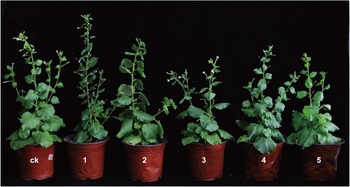
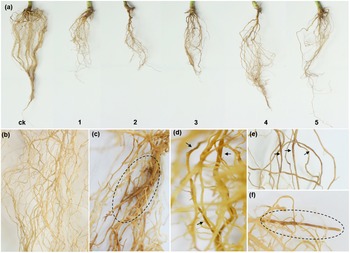
Sixty (60) days after inoculation, N. benthamiana plants showed weak growth, decreased tillering, high root reduction, and noticeable brown spots on the roots in comparison to uninoculated plants (Figure 5, Figure 6a). The disease spots were initially small, enlarged gradually, and then the entire roots became necrotic and decayed (Figure 6c–f).
Above-ground growth of Nicotiana benthamiana 60 days after inoculation with five populations of Pratylenchus coffeae. ck, non-inoculated plant; 1–5, infected plants with poor growth 60 days after inoculation with HN-K1, SD-YC-1, XC-278-1, AH-015A2, and XC-344-1 populations of P. coffeae.

Growth suppression of Nicotiana benthamiana roots induced by five populations of Pratylenchus coffeae. ck, root system of non-inoculated plant; 1–5, roots of plants 60 days after inoculation with populations HN-K1, SD-YC-1, XC-278-1, AH-015A2, and XC-344-1, respectively; (b) uninoculated plant root system; (c)–(f) necrotic areas on root systems of N. benthamiana inoculated with P. coffeae.

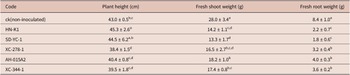
The fresh shoot weight and fresh root weight of inoculated N. benthamiana were significantly lower than those of the non-inoculated plants (P < 0.05), but there was no clear trend in plant height between the inoculated and uninoculated plants (Table 4). The fresh shoot and root weights of N. benthamiana inoculated with SD-YC-1 P. coffeae population were 13.3 g and 1.8 g, respectively, which were the lowest of all treatments. The fresh shoot and root weights of N. benthamiana inoculated with P. coffeae AH-015A2 population (18.2 g and 4.0 g, respectively) were less affected by the colonization of this population. As a result, the tested populations were clearly pathogenic to N. benthamiana in this study; however, there were differences in pathogenicity among different populations. The P. coffeae SD-YC-1 population from Weifang, Shandong, had the strongest pathogenicity, and the AH-015A2 population from Suzhou, Anhui Province, had the weakest pathogenicity.
Effects of five different populations of Pratylenchus coffeae on the growth of Nicotiana benthamiana 60 days the inoculation 1000 nematodes/pot

Note: Data are mean ± standard error of five replicates. Different lowercase letters within the same columns indicate significant difference at 0.05 level. The same below.
Discussion
In plant pathology, the term “pathogenicity” is typically used to describe an organism’s capacity to cause illness or the extent of physiological harm that pathogens inflict on their host plants (Shaner et al. Reference Shaner, Stromberg, Lacy, Barker and Pirone1992). The pathogenicity of one population of root-lesion nematodes may be different for different hosts, and one species from different hosts or geographical regions may also differ in pathogenicity of the same host. In this study, five populations of P. coffeae showed differences in pathogenicity of N. benthamiana. These pathogenicity differences may be due to long-term adaptation of nematodes to the environment (Tian et al. Reference Tian, Shi, Munawar and Zheng2019). We found bodies and eggs of P. coffeae in the roots of N. benthamiana, indicating that P. coffeae can successfully parasitise and complete its life history in the roots of N. benthamiana, which is the same as that of peanut (Liao et al. Reference Liao, Zhang, Xiao and Zhag2015), sesame (Li et al. Reference Li, Xia, Liu, Hao, Sun, Li and Wang2020), and soybean (Wang et al. Reference Wang, Hao, Liu, Xia, Sun, Li and Li2021).
N. benthamiana is an important model plant for studying plant-pathogen interaction, subcellular localization, and plant genetic engineering (Goodin et al. Reference Goodin, Zaitlin, Naidu and Lommel2008). Therefore, functional studies of host-pathogen interactions using N. benthamiana are likely to reveal the molecular mechanism of pathogenesis of Solanaceae crops, and they may be of great significance for the prevention and control of plant diseases (Dong et al. Reference Dong, Burch-Smith, Liu, Mamillapalli and Dinesh-Kumar2007). In this study, we identified that N. benthamiana was a good host of P. coffeae and can be used to study the interaction with P. coffeae. The genome of P. coffeae is has been sequenced, and analysis of the genome sequence helps to learn better about the genes that may control the pathogenic effect, and N. benthamiana can be used as a model plant to mine response genes involved in plant-pathogen interaction. Using the efficient and stable genetic transformation of N. benthamiana, we can obtain overexpression or silencing of the interacting genes in transgenic plants; observe the phenotype of the transgenic plants; study the impact of the transgenic plants to nematodes; and analyse the interaction mechanism between nematode effect proteins and N. benthamiana. These may provide new ideas and targets for the prevention and control of P. coffeae.
Conclusions
In this study, a root-lesion nematode was isolated from the rhizosphere of tobacco in Weifang City, Shandong Province, China. Morphological and molecular identification showed that the nematode species was a representative of P. coffeae. Parasitism and pathogenicity tests suggested that N. benthamiana was a good host plant to P. coffeae. The results of this study indicate N. benthamiana may be suitable for studying interactions between this root-lesion nematode species and its hosts.
Financial support
This work was supported by the Natural Science Foundation of Henan Province (No. 232300420192) and the Key Research and Development and Promotion of Special Scientific and Technological Projects in Henan Province (No. 202102110225).
Competing interest
The authors declare that there are no conflicts of interest.
Ethical standard
Written informed consent was obtained from all participants prior to the publication of this study.