Introduction
Rhododendron L. is one of the largest genera in the Ericaceae, with a wide distribution in North America, Europe, Asia and Australia. Taxonomic treatments by Cullen (Reference Cullen1980), Chamberlain (Reference Chamberlain1982), Fang et al. (Reference Fang, Fang, He, Hu, Yang, Chamberlain, Wu, Raven and Hong2005) and many others allow species to be identified with relative ease.
During a plant exploration tour in March 2009 to the Tale valley in Lower Subansiri district of Arunachal Pradesh, the first author spotted an interesting Rhododendron species in the vegetative state growing as an epiphyte in semi-evergreen forest, but could not identify it. The same Rhododendron species was found in the vegetative state by the authors in May 2011 between Tato and Mechukha in West Siang district of Arunachal Pradesh at c.1900 m growing on rocky hill-slopes. It was only in June 2012 that the second author collected the plant in flower and, to our surprise, it was a solitary-flowered Rhododendron species. It is widespread in West Siang district and characters such as the inflorescence and other floral parts are constant. After critical study of the literature (Hooker, Reference Hooker1849; Clarke, Reference Clarke and Hooker1882; Cullen, Reference Cullen1980; Chamberlain, Reference Chamberlain1982; Long, Reference Long, Grierson and Long1991; Fang et al., Reference Fang, Fang, He, Hu, Yang, Chamberlain, Wu, Raven and Hong2005; Sastry & Hajra, Reference Sastry and Hajra2010) and consultation at several Indian herbaria (ARUN, ASSAM, BSD, BSHC, CAL, DD) it was found to be allied to Rhododendron maddenii Hook.f.
Rhododendron subsection Maddenia (Hutchinson) Sleumer comprises shrubs or small trees, usually epiphytic, with young growth lepidote and often loriform setose. The inflorescence is terminal, 1–6-flowered; calyx variable; corolla funnel campanulate; stamens 8–22, declinate; ovary 5–12-locular. The capsules are lepidote; seeds winged and finned (Cullen, Reference Cullen1980). There are c.36–45 species in this subsection, distributed in Eastern Himalaya, China, Myanmar, Thailand, Laos and Vietnam (Cullen, Reference Cullen1980; Fang et al., Reference Fang, Fang, He, Hu, Yang, Chamberlain, Wu, Raven and Hong2005). Rhododendron maddenii Hook.f. is a complex and very variable species. Many species are epiphytic and straggly shrubs usually with white and/or pale pink or rarely yellow flowers; the white flowers are usually fragrant while the yellow ones have little or no scent. The inflorescence is 2–6-flowered, and a yellow blotch is present at the base of the corolla tube; the stamen number varies from 17 to 25.
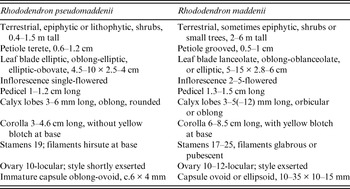
The present collection from Arunachal Pradesh differs from Rhododendron maddenii by the solitary-flowered inflorescence, short pedicel, absence of a yellow blotch at the base of the corolla tube and stamens always 19. It is compared with Rhododendron maddenii in Table 1 and is here described and illustrated as a new species.
A comparison between Rhododendron pseudomaddenii and R. maddenii

Species Description
Rhododendron pseudomaddenii A.A.Mao & M.Bhaumik, sp. nov.
Similar to Rhododendron maddenii Hook.f., but differing by the inflorescence single-flowered, pedicels shorter, up to 1–1.2 cm long and corolla smaller, 3–4.6 cm long, without yellow blotch at corolla base, and stamens always 19. – Type: Arunachal Pradesh, West Siang, Yourlung to Lamang, (28°40′267″N, 93°58′195″E), 3000 m, 15 vi 2012, Bhaumik 27782 (holo CAL; iso ARUN, ASSAM). Figs 1,2.
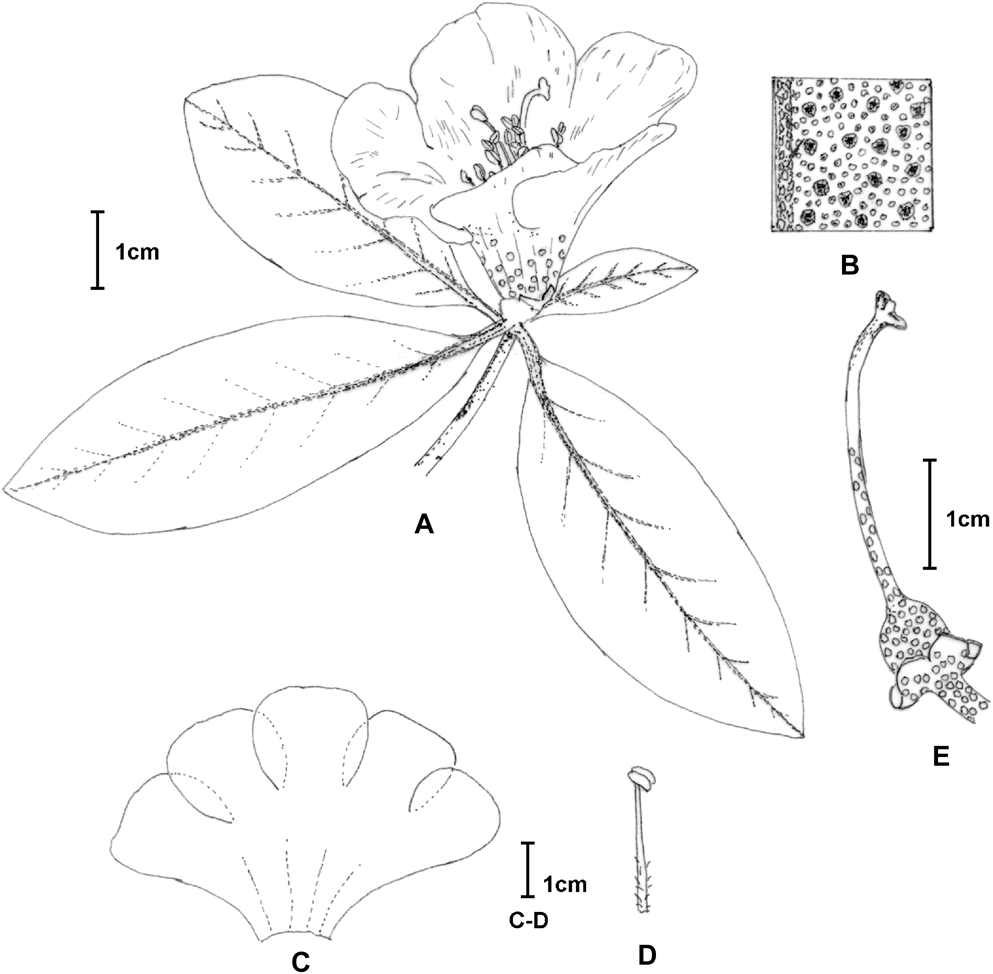
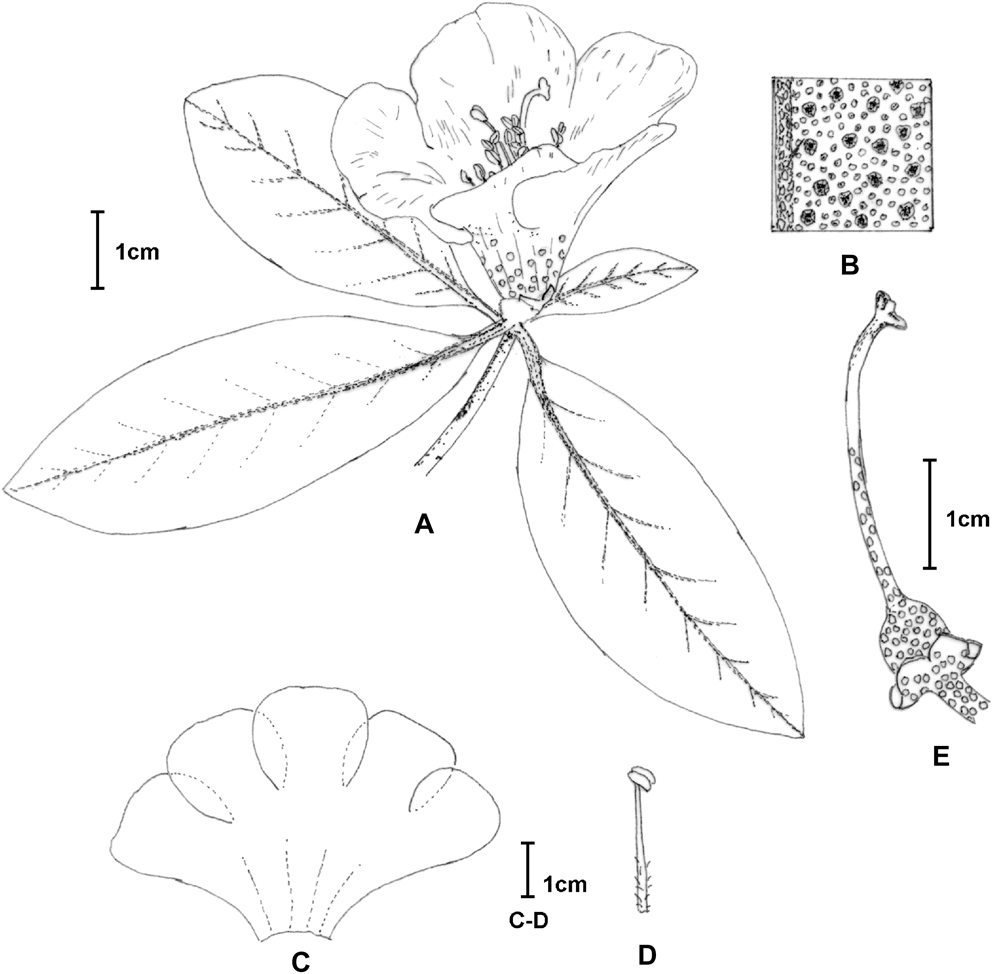
Rhododendron pseudomaddenii A.A.Mao & M.Bhaumik. A, flowering twig; B, abaxial surface of leaf blade; C, corolla spread out; D, stamen; E, gynoecium with calyx and pedicel.
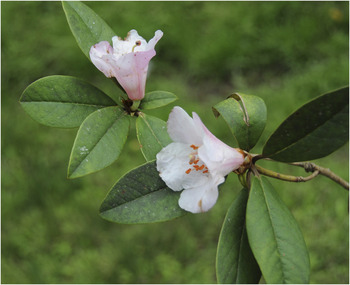
Rhododendron pseudomaddenii A.A.Mao & M.Bhaumik.
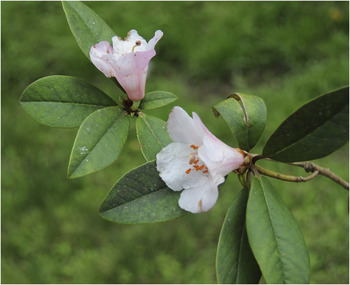
Terrestrial, epiphytic or lithophytic shrubs, 0.4–1.5 m tall. Stem bark light brown to silvery, smooth not peeling off, 0.3–1.3 cm in diameter, laxly branched. Leaves congested towards apical part of the twig; blade coriaceous, elliptic, oblong-elliptic, elliptic-obovate, 4.5–10 × 2.5–4 cm, base cuneate, apex acute, margins recurved, adaxial surface glabrous, midvein sunken, abaxial surface dense scales; petiole terete, 0.6–1.2 cm, dense scales. Inflorescence bud conical, terminal single-flowered. Flower white to pinkish white, funnel campanulate, c.4.6 cm long, c.5.5 cm across; pedicels 1–1.2 cm long, terete, scales. Calyx 5-lobed; lobes semi-membranous, oblong, 3–6 mm long, rounded, apiculate, outer surface covered with scales. Corolla 3–4.6 cm long, with peltate scales outside; lobes 5, imbricate, subglobose, c.2.2 × 2.5 cm, rounded at apex. Stamens 19, unequal, 1.5–3 cm long; filament 1.3–2.7 cm long, hirsute at base, anther lobes c.5 mm long, dorsifixed. Ovary oblong-ovoid, c.5 × 3 mm, truncate to rounded at apex, scaly; style c.3.2 cm long, recurved, shortly exserted from corolla, densely scaly at base, glabrous at apex; stigma discoid. Immature capsule oblong-ovoid, c.6 × 4 mm, scaly.
Specimens examined. India. Arunachal Pradesh, West Siang, Yourlung–Lamang, 3000 m, 15 vi 2012, Bhaumik 27782 (ARUN); Yourlung–Lamang, 2600 m, 15 vi 2012, Bhaumik 27790 (ARUN); Mechukha, 1950 m, 1 ix 2012, Bhaumik 27928 (ARUN); Mechukha riverbank, 1900 m, 19 vi 2012, Bhaumik 27907 (ARUN); Tato–Mechukha, 1900 m, 12 v 2011, A.A. Mao 20343 (ARUN); Tato–Mechukha, 1900 m, 12 v 2011, Bhaumik 25774 (ARUN).
Distribution. India (Arunachal Pradesh).
Habitat and ecology. The plant is found growing as an epiphyte or lithophyte in semi-dense temperate forest at an elevation of 1900–3000 m. It is associated with Rhododendron arboreum Sm., R. leptocarpum Nutt., R. xanthostephanum Merr., R. arizelum Balf.f. & Forrest, Toxicodendron acuminatum (DC.) C.Y.Wu & T.L.Ming, Taxus wallichiana Zucc., Pinus roxburghii Sarg., Rubus cooperi D.G.Long and other shrubby species. Flowering: June–August; fruiting: September–November.
Etymology. The specific epithet derives from its closeness to Rhododendron maddenii Hook.f.
IUCN conservation status. LC (IUCN, 2012). This species has been found in five different locations in West Siang district where 5–10 mature individuals were seen at each location, and there are a few plants in the Pange hills of Lower Subansiri district of Arunachal Pradesh.
Acknowledgements
The authors are grateful to Dr P. Singh, Director, Botanical Survey of India, Kolkata for providing the facilities necessary to conduct this work.