The problem of antisocial and aggressive behavior persists in today's youth in spite of enduring efforts to prevent such behavior. For instance, homicide is the second leading cause of mortality among youth and adolescents (Blum & Qureshi, Reference Blum and Qureshi2011). Although advances have been made in understanding the biological underpinnings of these behaviors, efforts have primarily focused on adults, although antisocial behavior is generally established during childhood and adolescence. Antisocial behavior during childhood and adolescence has been associated with multiple other problems: attentional problems in school (Kolko & Pardini, Reference Kolko and Pardini2010), reading deficits (Nigg, Hinshaw, Carte, & Treuting, Reference Nigg, Hinshaw, Carte and Treuting1998), poor peer relationships (Wentzel, Russell, & Baker, Reference Wentzel, Russell, Baker, Furlong, Gilman and Huebner2009), difficult parenting practices (Shaffer, Lindhiem, Kolko, & Trentacosta, Reference Shaffer, Lindhiem, Kolko and Trentacosta2012), and other adjustment problems. Furthermore, children and adolescents who exhibit antisocial behavior are more likely to demonstrate these behaviors in adulthood (Robins, Reference Robins1978) and be criminal offenders (Murray, Irving, Farrington, Colman, & Bloxsom, Reference Murray, Irving, Farrington, Colman and Bloxsom2010), and antisocial behavior during childhood is predictive of drug (Lynskey & Fergusson, Reference Lynskey and Fergusson1995) and alcohol use (Knop et al., Reference Knop, Penick, Nickel, Mortensen, Sullivan and Murtaza2009; Maggs, Patrick, & Feinstein, Reference Maggs, Patrick and Feinstein2008). Similarly, peer victimization is predictive of later delinquency and criminal offending at age 49 (Farrington & Ttofi, Reference Farrington and Ttofi2011). Establishing the biological processes implicated in antisocial behavior in short-term longitudinal studies is essential for developing more complex hypotheses in longer term longitudinal studies. The focus of this report was on two potential vulnerabilities for antisocial behavior: an individual's variability over 1 year in the concentration of testosterone secreted throughout the day (as opposed to mean changes across the day) during pubertal development and an individual's lifetime history of exposure to violence during childhood and adolescence. These biological and experiential characteristics (i.e., variability in diurnal testosterone over time and exposure to violence) have both been associated with antisocial behavior (Buka, Stichick, Birdthistle, & Earls, Reference Buka, Stichick, Birdthistle and Earls2001); however, the association among testosterone, exposure to violence, and antisocial behavior is rarely examined in children who are progressing through pubertal development when testosterone rises or in females. In addition, exposure to violence has not been examined in conjunction with developmental psychobiological characteristics, yet contextual and environmental influences such as violence exposure are known to influence testosterone production (for a review, see Raine, Reference Raine2002). This report aims to provide new evidence of an association between an individual's longitudinal variability in diurnal testosterone in late childhood and early adolescence, history of exposure to violence, and the development of antisocial behavior in a multilevel model framework.
Testosterone and Antisocial Behavior
The rise in testosterone coincident with the onset and progression of puberty has long been speculated to be associated with the rise in antisocial behavior during adolescence. Testosterone rises during puberty secondary to a complex change in the brain wherein there is a reactivation of hormones that have been quiescent since the prenatal or early postnatal period. This remodeling at puberty forms the basis for reproductive maturation (Sisk & Foster, Reference Sisk and Foster2004; Susman & Rogol, Reference Susman and Rogol2004). A key mechanism responsible for the increase in testosterone is reactivation of gonadotropin releasing hormone (GnRH) via the GnRH pulse generator. GnRH stimulates the pituitary to secrete gonadotropins, luteinizing hormone and follicle-stimulating hormone. Luteinizing hormone and follicle-stimulating hormone travel via peripheral circulating blood to affect target cells in the testes in males and the ovaries in females (Grumbach, Reference Grumbach2002; Styne & Grumbach, Reference Styne and Grumbach2007). Serum and salivary testosterone increases as a consequence of this stimulation (Butler et al., Reference Butler, Walker, Walker, Teague, Riad-Fahmy and Ratcliffe1989) and has a predictable secretary diurnal pattern in girls and boys (Ankarberg & Norjavaara, Reference Ankarberg and Norjavaara1999; Ankarberg-Lindgren & Norjavaara, Reference Ankarberg-Lindgren and Norjavaara2004; Diver, Imtiaz, Ahmad, Vora, & Fraser, Reference Diver, Imtiaz, Ahmad, Vora and Fraser2003). Testosterone is highest (acrophase) in the morning, with a trough of levels approximately 12 hr later (Brambilla, Matsumoto, Araujo, & McKinley, Reference Brambilla, Matsumoto, Araujo and McKinlay2009) and decreases across the day. The diurnal change, or circadian rhythm, is a highly evolved mechanism that is related to variations in blood pressure, sleep, gastrointestinal functioning, and body temperature. Ankarberg-Lindgren and Norjavaara (Reference Ankarberg-Lindgren and Norjavaara2011) and others showed the developmental increase in testosterone (e.g., Nottelmann, Inoff-Germain, Susman, & Chrousos, Reference Nottelmann, Inoff-Germain, Susman, Chrousos, Bancroft and Reinisch1990) and the diurnal rhythm of testosterone secretion during both prepuberty and puberty in boys and girls. In the current study, awakening testosterone secretory activity correlated with daytime secretory activity for testosterone (Matchock, Dorn, & Susman, Reference Matchock, Dorn and Susman2007). Atypical variations can result in both physiological and mental health problems (e.g., sleep problems). The importance of diurnal rhythms in development are just now beginning to be understood. However, diurnal secretory patterns across childhood and early adolescence are rarely longitudinally examined or examined in relation to antisocial behavior in spite of the importance of this transition in understanding neurohormone changes and antisocial behavior.
It is well established that antisocial activity, primarily criminal activity, increases during adolescence, peaks around age 17, and declines as individuals make the transition to young adulthood (Farrington, Reference Farrington1986; Piquero, Reference Piquero2008). However, the concurrent growth in testosterone and antisocial behavior is not well established. In one of the few exceptions, Halpern, Udry, Campbell, and Suchindran (Reference Halpern, Udry, Campbell and Suchindran1993) found few significant relations between changes in testosterone and aggression. Most of the studies linking testosterone and antisocial behavior in childhood and adolescence are cross-sectional. In the 1980s testosterone was found to be related to the presence of externalizing behaviors in young adolescent males but not females (Susman et al., Reference Susman, Inoff-Germain, Notelmann, Loriaux, Cutler and Chrousos1987); however, externalizing behaviors in females may be better explained by the social environment, for example, negative life events, rather than internal hormone concentrations (Brooks-Gunn & Warren, Reference Brooks-Gunn and Warren1989). In addition to the rise in testosterone during adolescence, other aspects of puberty may contribute to the increasing antisocial behavior during adolescence, such as the degree or timing of pubertal maturation. For example, early maturing male adolescents were more likely to report involvement in delinquent behavior than were their later maturing peers (Felson & Haynie, Reference Felson and Haynie2002). Similarly, youth who were further along in pubertal development were more likely to report violent behavior occurring in the previous year than were their peers in the early stages of pubertal development (Hemphill et al., Reference Hemphill, Kotevski, Herrenkohi, Toumbourou, Carlin and Catalano2010). The commonality among these findings is that biological transformations associated with puberty that are the result of an increase in gonadal hormone activity, particularly an increase in testosterone, are associated with the presence of antisocial behavior in children and adolescents.
The vast majority of the literature on the biological basis of antisocial behavior focuses on testosterone leading to increases in antisocial and aggressive behaviors, as supported by experimental studies (Hermans, Putman, & van Honk, Reference Hermans, Putman and van Honk2006). However, evidence also suggests that specific behaviors (e.g., dominance behaviors), situational anticipation (e.g., competition), or competitive outcomes (e.g., winning or losing) may have a suppressive or escalating effect, or a bidirectional influence on testosterone secretion in humans. More recently, the change in testosterone in anticipation of and in response to competition was found to differ by sex, the individual's level of experience, and social affiliation (Kivlighan, Granger, & Booth, Reference Kivlighan, Granger and Booth2005). In addition, most of the previous findings are based on interindividual or group differences in testosterone. An exception is Granger et al. (Reference Granger, Shirtcliff, Zahn-Waxler, Usher, Klimes-Dougan and Hastings2003), wherein saliva samples were collected in the morning, midday, and late afternoon on multiple days (intraindividual) and were assayed for testosterone. For boys, lower levels of testosterone and testosterone levels that decreased more slowly across the day were related to higher levels of anxiety–depression and attention problems. For girls, steep declines in testosterone production across the day were related to higher levels of disruptive behavior problems, but this association was only evident after including pubertal development as a moderator in the model. In a sex hormone replacement trial, Finkelstein et al. (Reference Finkelstein, Susman, Chinchilli, Kunselman, D'Arcangelo and Schwab1997) also showed within-subject changes in aggressive behavior that varied by sex in delayed puberty adolescents across several months. Girls administered estrogen reported more aggressive behavior and impulses at earlier stages of puberty than did boys at comparable doses of testosterone at comparable pubertal stages. Extrapolating from these findings, one might conclude that changes in gonadal hormones during puberty are implicated in aggressive behavior.
Within-individual change analyses demonstrated that increases in salivary testosterone were associated with increased sexual activity in males (Halpern, Udry, & Suchindran, Reference Halpern, Udry and Suchindran1998). However, increase in testosterone is a significant predictor of coital transition in girls, with greater increases in testosterone increasing the likelihood of making the predicted transition to coitus (Persky et al., Reference Persky, Dreisbach, Miller, Khan, Lief and Charney1982). Similarly, Persky et al. (Reference Persky, O'Brien, Fine, Howard, Kahn and Beck1977) showed that with subjects, the consumption of alcohol decreased testosterone levels over time. The approach to considering within- and between-person effects for testosterone advances the literature because previous reports tended to establish momentary or daily changes in testosterone compared to across 12 months. That is, we used an innovative assessment of testosterone, not of momentary shifts but rather of changes within individuals, across a longitudinal period of 12 months.
Exposure to Violence and Antisocial Behavior
Social learning theories support the role of early exposure to violence in the development of antisocial behavior in childhood and adolescence (Bandura, Reference Bandura1978), and suggest that early exposures provide a model for children to mimic. Exposure to violence and antisocial behavior in the child's home and the varied contexts of development (e.g., school) are associated with antisocial behavior in adulthood (Loeber & Hay, Reference Loeber and Hay1997). Furthermore, adolescents classified as either a perpetrator or a perpetrator and a victim reported greater levels of externalizing behaviors than did nonperpetrator, nonvictim adolescents (Yen et al., Reference Yen, Ko, Yen, Tan, Chang and Chen2010). The findings of Yen et al. (Reference Yen, Ko, Yen, Tan, Chang and Chen2010) and social learning theories suggest that the experience of violence, regardless of the child's role in the violent event, increases the risk of exhibiting antisocial behaviors.
The shortage of literature on biopsychosocial characteristics of children and adolescents displaying antisocial behaviors highlights the importance of considering not only biological characteristics of children and adolescents when studying antisocial behavior but also experiential characteristics of children. This report will establish the utility of examining past violent experiences in conjunction with variability in diurnal testosterone, to understand how these experiences contribute to the psychobiology of antisocial behavior in pubertal-aged youth.
Sex Differences and Antisocial Behavior
Sex differences are expected to be an important independent contributor to antisocial behavior and in the differential pathway by which adolescents adapt to exposure to violence. For instance, males are more likely to report externalizing behaviors and females are more likely to report experiencing internalizing problems (Leadbeater, Blatt, & Quinlan, Reference Leadbeater, Blatt and Quinlan1995; Oldehinkel, Verhulst, & Ormel, Reference Oldehinkel, Verhulst and Ormel2011). Adolescents of both sexes are more likely to react to exposure to violence than are children given that adolescence is a sensitive period of development associated with an increase in deviant behavior in males and females (Oldehinkel et al., Reference Oldehinkel, Verhulst and Ormel2011). Testosterone is considered to be one of the mechanisms explaining sex differences in antisocial behavior because males are higher than females in both externalizing behaviors and testosterone during adolescence (Leadbeater et al., Reference Leadbeater, Blatt and Quinlan1995). In consideration of previously established developmental differences between males and females in both testosterone and antisocial behavior, analyses presented in this report are stratified by sex to unmask whether the longitudinal pathway by which change in antisocial behavior occurs in relation to exposure to violence and testosterone is different for males and females.
A Model of Between- and Within-Person Change
The complex nature of the underlying causes of antisocial behavior requires a dynamic model to capture the processes associated with changes in hormones as children transition into puberty. Previous work tended to use mean changes or correlation approaches to test the testosterone and antisocial behavior hypothesis. Although these methods are appropriate to test some hypotheses, they do not capture change within the individual. Between- and within-person measures of diurnal testosterone over time may be a better indicator of the biological processes that are associated with antisocial behavior than a static mean level approach (Ram & Gerstorf, Reference Ram and Gerstorf2009). In brief, assessing within-person variation in testosterone across time is more characteristic of the dynamics of the actual internal hormone milieu than is a mean level at any one time. Furthermore, within-person variation in testosterone in the transition through pubertal development may represent an adaptive response to the adolescent's changing social environment, although this measure does not capture rapid changes in testosterone that may occur in response to immediate environmental triggers, and so interpretation of the findings are limited to the individual's dynamic states rather than current state. Thus, within-person variation in diurnal testosterone over time was tested to assess change between and within adolescents over 1 year.
Hypotheses
This report is based on the theory that the transition through puberty is a biological and psychological stressor when circulating levels of testosterone increase (Buchanan, Eccles, & Becker, Reference Buchanan, Eccles and Becker1992), self-perception and peer relationships are changing (Oldehinkel et al., Reference Oldehinkel, Verhulst and Ormel2011), and there is an increase in externalizing behaviors (Negriff & Susman, Reference Negriff and Susman2011). It was hypothesized that between- and within-person variation in diurnal testosterone would be associated with symptoms of antisocial behavior, and that these associations would be more pronounced in males than in females, with the exception of lifetime exposure to violence (Brooks-Gunn & Warren, Reference Brooks-Gunn and Warren1989). It was also expected that lifetime exposure to violence would moderate the association between within-person variation in diurnal testosterone and symptoms of antisocial behavior.
Methods
Participants
Study participants included 135 (n = 69 females) children and adolescents, ages ranging from 8 to 13 years. On average, the age at which females begin the transition through pubertal development is earlier than the onset of puberty for males (see Susman et al., Reference Susman, Houts, Steinberg, Belsky, Cauffman and Dehart2010). To account for this difference in timing of puberty, this study utilized a cross-sequential design, and at the first wave of measurement, females were ages 8, 10, or 12 years (M = 10.06 years, SD = 1.67) and males were ages 9, 11, or 13 years (M = 11.03 years, SD = 1.63). Data for females were collected on days 5 through 9 of the menstrual cycle to control for hormone variations across the menstrual cycle. The sample's racial/ethnic background is predominantly White/non-Hispanic (88.9%), and also included Hispanic (3.0%), African American/Black (3.0%), Asian (1.5%), and American Indian (0.7%) participants. The Hollingshead Scale (Reference Hollingshead1975) was used to determine the socioeconomic status of the sample participants by creating a composite score of the child's head of household's occupation and highest earned academic degree. On average, families participating in the study are considered to be situated in the middle class (M socioeconomic status = 50.47, SD = 12.73). The recruited sample is representative of nonclinical youth living in the towns and small-city suburban neighborhoods from which the sample was drawn.
Recruitment
The American Student List (http://investing.businessweek.com/research/stocks/private/snapshot.asp?privcapId=4514234), a database of children listed by geographic location, was used to recruit the sample based on ZIP codes. Parents of the 966 children were randomly selected and contacted by mail. If there was interest in participating in the study and children met eligibility requirements (see Susman et al., Reference Susman, Dockray, Schiefelbein, Herwehe, Heaton and Dorn2007), the children and a parent/guardian were included in the study. Eligibility criteria were boys ages 9, 11, or 13 years; girls ages 8, 10, or 12 years; not on medications that affect hormone concentrations (e.g., oral steroids); and free from chronic physical (e.g., diabetes) or serious mental health problems that would interfere with completing the measures. The information was obtained via a screening interview.
Procedures
Children and a parent or guardian visited a General Clinical Research Center at a large research university on three different occasions, 6 months apart, between the hours of 2:30 p.m. and 5:30 p.m. (M = 3:38 p.m., SD = 0.58) and provided consent (parent/guardian) and assent (child) to participate in the study prior to data collection. Children and a parent/guardian completed a battery of questionnaires to assess the mental and physical health history of the child as well as an evaluation of current symptoms and diagnoses of psychiatric disorders.
Measures
The following section provides detailed descriptions of the collection and calculation of diurnal testosterone, lifetime exposure to violence, and antisocial behavior measures included in the multilevel model for antisocial behavior. All measures were given at all times of measurement.
Testosterone secretion
Each child and parent/guardian pair were trained verbally on proper collection of saliva samples at home and were also given written instructions on the procedures. Saliva was to be collected on a nonschool day at the same awakening time as if it were a school day at all three occasions of measurement. Upon awakening and preceding food intake and brushing of teeth, three saliva samples were collected (Sample 1 at awakening, Sample 2 at 20 min following awakening, and Sample 3 at 40 min following awakening). Three additional saliva samples were collected at noon before consuming a midday meal, at 4 p.m., and at bedtime. At times of saliva collection, children rinsed their mouths with water and passively drooled into a 5-ml tube for 5 min or until 4 ml of saliva was collected. Participants were instructed to store tubes in a home refrigerator until they could be returned to the research laboratory. Parents returned the samples to the lab or the research staff retrieved the samples from the home within 1 to 2 days.
Saliva samples were assayed in duplicate using Salimetrics kits (Salimetrics, State College, PA). Samples were assayed for testosterone using a highly sensitive enzyme immunoassay (ELISA) developed for saliva (Catalog No. 1-2402). The test has a range of sensitivity from 6.1 to 600 pg/ml. Average intra- and interassay coefficients of variation were 6.7% and 14.05%, respectively (Salimetrics, State College, PA). The mean of two testosterone values for each sample was used in the analysis. Diurnal testosterone is defined as a measure of the total testosterone secreted from awakening time to bedtime. Diurnal testosterone was calculated as area under the curve with respect to ground (AUCg; Pruessner, Kirschbaum, Meinlschmid, & Hellhammer, Reference Pruessner, Kirschbaum, Meinlschmid and Hellhammer2003). AUCg testosterone captures total secretion across the day as distinguished from testosterone change within the day (Granger et al., Reference Granger, Shirtcliff, Zahn-Waxler, Usher, Klimes-Dougan and Hastings2003). The AUCg is a metric not of momentary shifts in testosterone but rather of changes across the period of days and months. The justification for using AUCg diurnal testosterone, as opposed to morning, midday, and evening testosterone, is that the heritability of testosterone levels in early adolescence is evident in the morning (Hoekstra, Bartles, & Boomsma, Reference Hoekstra, Bartels and Boomsma2006), and therefore may not capture environmental influences (e.g., exposure to violence) on the stability of testosterone secretion across 1 year. An additional strength of AUCg over other measures of diurnal testosterone is that research has found AUCg to simplify analyses while still utilizing the multiple measurements, thereby producing a meaningful measure of total hormone secretion across a time period (Fekedulegn et al., Reference Fekedulegn, Andrew, Burchfiel, Violanti, Hartley and Charles2007).
One aim of the study was to determine whether within-person variability in diurnal testosterone over 1 year explains an individual's symptoms of antisocial behavior. To calculate a measure of within-person variability in diurnal testosterone, the diurnal testosterone scores (AUCg) from the three, 6-month time points were first used to calculate a mean diurnal testosterone (MDT) score for each individual (i.e., MDT score is the individual's mean of Time 1, Time 2, and Time 3 testosterone AUCg). Next, residual diurnal testosterone values were calculated for each individual at each occasion of measurement by subtracting individuals' raw diurnal testosterone scores at each time point (i.e., Time 1 AUCg, Time 2 AUCg, and Time 3 AUCg) from their respective MDT score (e.g., MDT – Time 1 AUCg) to quantify each individual's deviation from their respective mean (i.e., an individual's variability in diurnal testosterone over time). In the analysis, each individual had three residual diurnal testosterone scores (within-person).
Exposure to violence
The My Exposure to Violence (My ETV) self-report questionnaire was used to assess the frequency of recent (i.e., past 12 months) and lifetime violent experiences as both a witness and a victim (Selner-O'Hagan, Kindlon, Buka, Raudenbush, & Earls, Reference Selner-O'Hagan, Kindlon, Buka, Raudenbush and Earls1998) at Time 1 and Time 3, and consists of six scales: lifetime and past year exposure to witnessed violence, victimization, and total exposure to violence. In this analysis, exposure to violence is considered the sum of all witnessed and victimization events occurring over the child's lifetime, as measured at the initial visit. Lifetime as opposed to recent exposure to violence was used in the present analysis because previous research suggests models of cumulative risk best describe the long-term effects of early life adversity on health and behavior outcomes during childhood and adolescence (Appleyard, Egeland, van Dulmen, & Sroufe, Reference Appleyard, Egeland, van Dulmen and Sroufe2005). The My ETV has acceptable test–retest reliability (r = .75 to .94) and internal consistency (r = .68 to .93; Selner-O'Hagan et al., Reference Selner-O'Hagan, Kindlon, Buka, Raudenbush and Earls1998). The Cronbach α for the lifetime exposure to violence scale for the present sample is considered to be low (α = 0.55). A Cronbach α if item deleted was obtained for each scale item, and with the exception of one item that assessed whether a child witnessed a serious accident (Cronbach α if item deleted = 0.56), the removal of any particular item resulted in a decrease of Cronbach α.
Antisocial behavior
Children and a parent/guardian completed two measures that tap into symptoms of antisocial behavior at Time 1, Time 2, and Time 3: the Diagnostic Interview for Children, Revised (DISC-IV; child report) and the Child Behavior Checklist (CBCL; parent report). The DISC-IV is a structured interview that corresponds with the DSM (Shaffer, Fisher, Lucas, Dulcan, & Schwab-Stone, Reference Shaffer, Fisher, Lucas, Dulcan and Schwab-Stone2000) and is used to evaluate symptoms of psychopathology in children. The CBCL is a measure completed by a parent or guardian that assesses externalizing behaviors in children (Achenbach & Dumenci, Reference Achenbach and Dumenci2001). Oppositional defiant disorder and conduct disorder symptom scores (DISC-IV), and symptom scores for rule-breaking behavior, aggressive behavior, attention problems, and an externalizing behavior T score (CBCL) were used to create a composite antisocial behavior score.
The CBCL subscale scores and the DISC-IV symptoms were summed to form a composite score, given the correlation between the CBCL subscales and the DISC symptom scores. For both boys and girls, all subscales contributed comparably to the total score. The Cronbach α values for the total antisocial behavior score were 0.74 for boys and 0.78 for girls. The CBCL subscales and conduct disorder and oppositional defiant disorder symptoms scores were also analyzed separately based on previous studies showing that the stress response is differentiated in adolescents with varying types of behavior problems (King et al., Reference King, Tonge, Heyne, Pritchard, Rollings and Young1998; Randazzo, Dockray, & Susman, Reference Randazzo, Dockray and Susman2008).
Pubertal stage
Children and adolescents underwent a physical examination performed by a pediatric nurse at all three occasions of measurement to determine pubertal stage following the Tanner criteria (Tanner, Reference Tanner1962). If the child or adolescent did not consent to the physical examination, a self-rating of pubertal stage was used (n = 8). Breast stage and genital stage at each occasion of measurement were used for females and males, respectively, in the analysis.
Data analysis plan
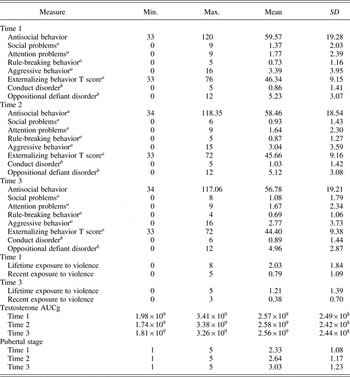
The distributions of the data were examined for normalcy and outliers. All outliers were replaced with a value of plus or minus two standard deviations from the mean. Means, standard deviations (Table 1), and Pearson correlation analyses were performed on the within-person measures of diurnal testosterone, exposure to violence, and antisocial behavior. A multilevel model was fit using SAS software to examine the relation between antisocial behavior and within-person variability in diurnal testosterone (Level 1) and between-person differences in exposure to violence and sex (Level 2) in adolescents (Model 1). Occasion of measurement (i.e., time) was not included as a Level 1 predictor because the sequential order of within-person variability in diurnal testosterone scores was not thought to explain symptoms of antisocial behavior (i.e., a linear association was not tested) because these processes (i.e., antisocial and aggressive behaviors, and within-person variability in diurnal testosterone) were not expected to change linearly during the time span of 1 year in which these children and adolescents were assessed. Variability in testosterone is expected to vary as a result of daily contextual influences as well as normative increase in testosterone during puberty. Level 1 is
 $$\eqalign{{\rm ASB}_{ti} = {\rm \beta}_{0i} + {\rm \beta}_{1i}\, &\hbox {within-person variability} \cr & \quad \quad \quad \quad \quad \quad \quad\hbox{in diurnal testosterone}_{ti} + e_{ti}.}$$
Level 2 is
 $$\eqalign{{\rm \beta}_{0i} &= {\rm \delta}_{00} + {\rm \delta}_{01}{\rm ETV}_{i} + {\rm \delta}_{02}{\rm Sex}_{i} + u_{0i}\comma \; \cr {\rm \beta}_{1i} &= {\rm \delta}_{10} + {\rm \delta}_{11}{\rm ETV}_{i} + {\rm \delta}_{12}{\rm Sex}_{i}.}$$
Descriptive statistics

Note: Antisocial behavior is a composite score of scales from the CBCL and DISC-IV. Exposure to violence was assessed using the My ETV (Selner-O'Hagan et al., Reference Selner-O'Hagan, Kindlon, Buka, Raudenbush and Earls1998). The pubertal stage was assessed using the Tanner staging criterion (Tanner, Reference Tanner1962). AUCg, Area under the curve with respect to ground (Pruessner et al., Reference Pruessner, Kirschbaum, Meinlschmid and Hellhammer2003).
a Scales were from the CBCL (Achenbach, Reference Achenbach and Dumenci2001).
b Scales were from the DISC-IV (Shaffer et al., Reference Shaffer, Fisher, Lucas, Dulcan and Schwab-Stone2000).
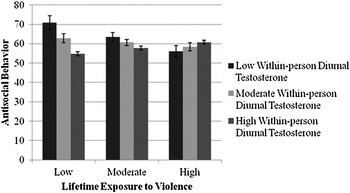
It was hypothesized that there would be significant main effects on antisocial behavior for within-person variability in diurnal testosterone, exposure to violence, and sex, such that on average, greater exposure to violence would be associated with higher levels of antisocial behavior and males would report more antisocial behavior symptoms than females. Hypothesis tests were also performed to determine whether there were sex differences in within-person variability in diurnal testosterone and if there was a moderating effect of exposure to violence on the variability in diurnal testosterone and antisocial behavior association. Sex was removed from the model, and models were run separately for females (Model 2) and males (Model 3) to uncover within-sex differences in these associations. A post hoc analysis was performed on significant interactions following the technique proposed by Jaccard and Turrisi (Reference Jaccard and Turrisi2003). For variables in each significant interaction, moderate (mean centered), high (mean centered + 1 SD), and low (mean centered – 1 SD) terms were computed, and antisocial behavior was regressed on all permutations of two of the low, moderate, and high significant interaction terms, including the respective interaction (e.g., low by moderate), using a multilevel model. The slope and standard errors for each multilevel model were plotted in a histogram as a visual representation of the significant interaction (Figure 1).
Within-person diurnal testosterone by lifetime exposure to violence interaction. Model 2 is females; diurnal testosterone is calculated as area under the curve with respect to ground (Pruessner et al., Reference Pruessner, Kirschbaum, Meinlschmid and Hellhammer2003); within-person diurnal testosterone is the difference between the raw diurnal testosterone at each time point and mean diurnal testosterone; antisocial behavior is a composite score (see Methods Section); and lifetime exposure to violence is measured by the My ETV (Selner-O'Hagan et al., Reference Selner-O'Hagan, Kindlon, Buka, Raudenbush and Earls1998).

Results
Descriptive statistics
Descriptive information for all variables and a Pearson correlation analysis appear in Table 1. The Pearson correlation analysis indicated that antisocial behavior symptoms, within-person variability in diurnal testosterone, and lifetime exposure to violence were not significant correlated (p > .05). There were no significant sex differences in the measures of antisocial behavior, variability in diurnal testosterone, and lifetime exposure to violence (p > .05).
Hypothesis tests
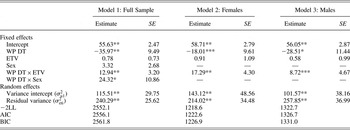
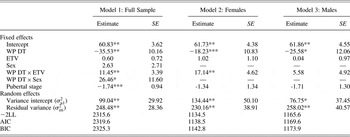
Estimates, standard errors, and measures of fit for each model appear in Table 2. Pubertal stage was added to each model as a time-varying covariate to control for each child/adolescent's pubertal stage of development. Pubertal stage was a marginally significant predictor of antisocial behavior for the full sample only (β = –1.74, p = .07), and when included in each model, the previously significant main effects and interactions remained statistically significant. Therefore, the results for analyses controlling for pubertal stage are not discussed in this report but are presented in Table 3. All models were tested with recent exposure to violence occurring within the 12 months prior to the initial assessment in place of lifetime exposure to violence prior to the initial visit to test whether the results differed for recent as opposed to lifetime violence exposure. The findings remained the same for the sex-stratified models (Models 2 and 3), and in the full sample, the two-way interaction between sex and within-person variability in diurnal testosterone across 1 year dropped out of significance.
Multilevel model for antisocial behavior

Note: WP DT, Within-person diurnal testosterone; ETV, exposure to violence. ETV is from My ETV (Selner-O'Hagan et al., Reference Selner-O'Hagan, Kindlon, Buka, Raudenbush and Earls1998). Diurnal testosterone is calculated as area under the curve with respect to ground (Pruessner et al., Reference Pruessner, Kirschbaum, Meinlschmid and Hellhammer2003). WP diurnal testosterone is the difference between raw diurnal testosterone at each time point and mean diurnal testosterone. Sex: Male = 0, female = 1; −2LL, −2 log likelihood; AIC, Akaike information criterion; BIC, Bayesian information criterion, relative model fit statistics.
*p < .05. **p < .01. ***p < .001.
Multilevel model for antisocial behavior with pubertal stage

Note: WP DT, Within-person diurnal testosterone; ETV, exposure to violence. ETV is from My ETV (Selner-O'Hagan et al., Reference Selner-O'Hagan, Kindlon, Buka, Raudenbush and Earls1998). Diurnal testosterone is calculated as area under the curve with respect to ground (Pruessner et al., Reference Pruessner, Kirschbaum, Meinlschmid and Hellhammer2003). WP diurnal testosterone is the difference between raw diurnal testosterone at each time point and mean diurnal testosterone. Sex: Male = 0, female = 1. −2LL, −2 log likelihood; AIC, Akaike information criterion; BIC, Bayesian information criterion, relative model fit statistics.
*p < .05. **p < .01. ***p < .001.
Model 1: Full sample
The analysis revealed a significant main effect for within-person variability in diurnal testosterone (β = –35.97, p < .001) and significant two-way interactions between lifetime exposure to violence (β = 12.94, p < .001) and sex (β = 24.32, p = .03) and within-person variability in diurnal testosterone, providing evidence for a moderating effect of lifetime exposure to violence and sex on the association between within-person variability in diurnal testosterone over time and symptoms of antisocial behavior (Table 2).
A post hoc analysis was performed to deconstruct the significant two-way interaction between within-person variability in diurnal testosterone and lifetime exposure to violence. The post hoc test revealed that when lifetime exposure to violence is low, adolescents with low variability in diurnal testosterone over 1 year report more symptoms of antisocial behavior than do adolescents with high variability in diurnal testosterone over 1 year. In contrast, when lifetime exposure to violence is high, adolescents with high variability in diurnal testosterone over 1 year report more symptoms of antisocial behavior than do adolescents with low variability in diurnal testosterone over 1 year. The post hoc analysis revealed no differences in antisocial behavior symptoms between within-person variability in diurnal testosterone groups (i.e., low, moderate, or high) when lifetime exposure to violence is moderate.
The post hoc analysis of the two-way interaction between within-person variability in diurnal testosterone over 1 year and sex revealed that when within-person variability in diurnal testosterone over 1 year is low, females report more symptoms of antisocial behavior than do males. No differences in antisocial behavior symptoms were found between males and females with moderate and high within-person variability in diurnal testosterone. To further explore these within-sex differences, the model was run separately for females (Model 2) and males (Model 3).
Model 2: Females
The analysis revealed a moderately significant main effect for within-person variability in diurnal testosterone (β = –18.01, p = .06) and a significant two-way interaction between within-person variability in diurnal testosterone and lifetime exposure to violence (β = 17.29, p < .001), providing evidence for a moderating effect of lifetime exposure to violence on the association between within-person variability in diurnal testosterone over 1 year and symptoms of antisocial behavior in females only (Table 2).
A post hoc analysis was performed on the significant two-way interaction between lifetime exposure to violence and within-person variability in diurnal testosterone (Figure 1). When lifetime exposure to violence is low, females with low variability in diurnal testosterone over 1 year report more antisocial behavior symptoms than do females with moderate or high variability in diurnal testosterone over 1 year. When lifetime exposure to violence is moderate, females with low and moderate variability in diurnal testosterone over 1 year report more symptoms of antisocial behavior than do females with high variability in diurnal testosterone over 1 year. There were no significant differences in antisocial behavior symptoms between the different levels of within-person variability in diurnal testosterone over 1 year (i.e., low, moderate, or high) when lifetime exposure to violence is high.
Model 3: Males
There was a significant main effect for within-person variability in diurnal testosterone over 1 year (β = –28.51, p = .01) and a marginally significant two-way interaction between lifetime exposure to violence and within-person variability in diurnal testosterone over 1 year (β = 8.72, p = .07) in males only (Table 2). In males, less variability in diurnal testosterone over 1 year was associated with more symptoms of antisocial behavior. A post hoc analysis of the marginally significant interaction was not performed.
Discussion
The purpose of this report was to identify whether within-person variability in diurnal testosterone, lifetime exposure to violence, and sex are associated with antisocial behavior in children and adolescents. The findings are noteworthy in that they are based on a within-subject longitudinal design that followed boys and girls across pubertal development, not just within days, on both hormone and violence exposure measures. A measure of within-person variability in diurnal testosterone was then calculated to test whether within-person changes over time are associated with antisocial behavior, rather than testing mean changes over time. The findings are novel, given that lifetime exposure to violence moderated the association between within-person variability in diurnal testosterone and antisocial behavior symptoms. There was a significant two-way interaction between within-person variability in diurnal testosterone and lifetime exposure to violence in the full sample (Model 1) and in females (Model 2), suggesting that internal variation in diurnal testosterone is an important consideration in antisocial behavior during adolescence.
The mechanisms whereby testosterone affects antisocial and aggressive behavior remain speculative; however, multiple neural mechanisms have been implicated, including the amygdala and augmentive communication between the amygdala and the brain stem. In support of this hypothesis, Bos, Hermans, Ramsey, and van Honk (Reference Bos, Hermans, Ramsey and van Honk2012) showed that testosterone injections decreased functioning connectivity between the amygdala and the orbitofrontal cortex during judgments of familiar and unfamiliar faces, presumably resulting in more amygdala vigilant responses and perhaps less regulated the orbitofrontal cortex functioning and decision making. There is also the possibility that estrogen, as opposed to testosterone, regulates antisocial behavior, given that testosterone is readily aromatized into estrogen. Estradiol is capable of inducing neural and behavioral effects via nongenomic mechanisms (McEwen & Alves, Reference McEwen and Alves1999). Studies are needed to understand the neural mechanism underlying the effects for testosterone variability and moderated effects.
As hypothesized, the exploratory analysis of the two-way interactions among variability in diurnal testosterone, exposure to violence, and sex revealed that antisocial behavior symptoms were greater in adolescents with high variability in diurnal testosterone across 1 year and high lifetime exposure to violence. However, in females, low diurnal testosterone variability was associated with more reports of antisocial behavior symptoms in the context of low and moderate lifetime exposure to violence. Within-person variability in diurnal testosterone may reflect change in the normative variability of increases in testosterone at puberty, or variability in testosterone may be related to situations where adolescents are winning or losing in competitions (Booth, Shelley, Mazur, Tharp, & Rogers, Reference Booth, Shelley, Mazur, Tharp and Rogers1989) or in situations in which there is fear or stressors involved (for a review, see Chichinadze & Chichinadze, Reference Chichinadze and Chichinadze2008). The latter interpretation is more likely to be the case, given that normative variability related to stage of puberty was not a significant covariate in the models. In girls, low variability may be disadvantageous in situations of low adversity in the late childhood and early adolescent years, given that a variety of experiences with peers and stimulating environments may be lost to girls. Situations in which there is exposure to violence may also provide modeling opportunities for antisocial behavior (e.g., fighting) or are stimuli for adolescents to initiate antisocial behavior (Bandura, Reference Bandura1978), particularly when the vulnerability of low diurnal testosterone variability is present. These findings suggest that in the near absence of lifetime exposure to violence (low or moderate), high diurnal testosterone variability over time may be protective against the development of antisocial behavior in females, although future studies are necessary to directly test this interpretation of the findings. Furthermore, the three-way interaction among variability in diurnal testosterone, lifetime exposure to violence, and sex was not tested, so it is not possible to ascertain from this study whether there are sex differences in the association among variability in diurnal testosterone, lifetime exposure to violence, and antisocial behavior. Granger et al. (Reference Granger, Shirtcliff, Zahn-Waxler, Usher, Klimes-Dougan and Hastings2003) suggests that intraindividual variability over time may be more important to model than interindividual differences, especially in girls. High variation may be an adaptive response to environmental challenges with peers or competitive situations. Specifically, variability in a complex system may allow for faster adaptation to the requirements of the current situation. Conrad (Reference Conrad1986) suggests that systems whose components vary in an independent fashion are more adaptable than systems with less variability. Of note is that there were no significant main effects for lifetime exposure to violence or sex on antisocial behavior.
We tested the effect of pubertal stage in the multilevel model and found that the pubertal stage of these children (at least with respect to the measurement of secondary sex characteristics) did not significantly contribute to the model once the other parameters were estimated. This may mean that interpersonal violence exposure and diurnal variation in testosterone together are more specific and relevant predictors of antisocial behaviors than is mere pubertal stage. Such findings have the potential to advance the field toward the identification of underlying mechanisms and moderators of antisocial behaviors during this important age range. The hypothesis needs to be tested in a sample with children in the entire range of pubertal status because most of the children in the current report were in the early or middle stages of pubertal development.
This report is also unique in that it is the first to present findings that within-person variability in diurnal testosterone and lifetime exposure to violence are associated with the presence of antisocial behavior in young adolescents. Existing literature does not generally recognize the utility of within-person variability in diurnal testosterone as a measure of an adolescent's adaptive or maladaptive response to a changing social and family environment. The finding that the interaction between lifetime exposure to violence and within-person variability in diurnal testosterone is present for females and not males is consistent with previous research suggesting the long-term effects of violent exposures may be more detrimental for females than males (for a review, see Buka et al., Reference Buka, Stichick, Birdthistle and Earls2001). In the male-only model, the lifetime exposure to violence by within-person variability in diurnal testosterone interaction only approached significance. It could be the case that girls are more sensitive to changing testosterone concentrations than are boys. This interpretation is consistent with Finkelstein et al. (Reference Finkelstein, Susman, Chinchilli, Kunselman, D'Arcangelo and Schwab1997), who showed that girls increased more in self-reported aggression at low doses of exogenously administered estrogen than boys responded to comparable doses of testosterone.
Low variability in diurnal testosterone was consistently associated with greater antisocial behavior when there were fewer reports of lifetime exposure to violence in female adolescents. At present, there is no identified literature available on the association between within-person variability in diurnal testosterone and antisocial behavior. In addition, most previous studies only include mean levels of testosterone. To the extent that mean testosterone levels can be compared to indices of variability, the following interpretation is proposed. The findings are supported by previous research that tested hypotheses regarding the association between testosterone and estrogen levels and externalizing behaviors in adolescents. Finkelstein et al. (Reference Finkelstein, Susman, Chinchilli, Kunselman, D'Arcangelo and Schwab1997) found that antisocial behavior was significantly increased in hypogonadal adolescents receiving a low dose of estrogen (females) or a middose of testosterone (males). In the current report, when lifetime exposure to violence was high, male and female adolescents with high variability in diurnal testosterone reported more antisocial behavior symptoms than did those with low variation in diurnal testosterone. This finding suggests that instability in diurnal testosterone paired with increased adverse experiences like exposure to violence during sensitive periods of development is a risk factor for antisocial behavior.
To the extent that basal levels can be compared to daily testosterone secretions, principally AUCg, it is not clear whether higher or lower testosterone is an adaptive or maladaptive characteristic of individuals. In general, the field considers that maturational increases in testosterone at puberty prime parents and teachers of problems to come. Nevertheless, increasing testosterone is a normative aspect of development, and lower levels of testosterone relative to peers was associated with behavior problems in an earlier study (Susman et al., 1997). Similarly, variability in testosterone might be considered a negative aspect of neuroendocrine functioning as testosterone rises during puberty. Important to note is that the findings appear independent of degree of advancing pubertal maturation and not associated with antisocial behavior. The notion that advancing pubertal development influences negative behaviors and emotions is too simplistic. The majority of adolescents adapt to their rapidly changing bodies to become increasingly oriented to new peers and social challenges.
Two major strengths of this study are the longitudinal nature of the data as well as the inclusion of biological and self-report measures; however, the small and homogenous sample included in the study limits the generalizability of the findings to White/non-Hispanic adolescents living in suburban communities. The small sample also limits the ability to test whether the type of violent exposure or the child's role in the violent event (witness or victim) is important in moderating the association between diurnal testosterone variability and antisocial behavior and reciprocal influences between testosterone and antisocial behavior. The reciprocal model posits that actions or thoughts stimulate the production of testosterone and the ensuing testosterone secretion has a reciprocating effect by influencing future behaviors (for a review, see Mazur & Booth, Reference Mazur and Booth1998). A reciprocal model was not adopted, given there were only three time points in the study. An additional limitation is that there are no measures of what predicts change in within-person variability in testosterone. Statements about what may be influencing the change would be conjecture about how exposure to violence is influencing responses to unknown factors. Future work should examine in-depth possible influences on within-person change.
These limitations do not depreciate the value of this study because no study to date has investigated within-person variability in diurnal testosterone, and these findings can be used as an empirical foundation for future longitudinal research. The findings in this report reflect variability in diurnal baseline levels as opposed to testosterone in response to threat such as a physical altercation. Acute exposure to violence or other threats could induce rapid changes in testosterone that might not be detected by baseline samples. It follows that more research is needed to assess both the shorter and longer term associations between testosterone and antisocial behavior as has been demonstrated in athletic competition (Wood & Stanton, Reference Wood and Stanton2012). In the future, studies should continue to test hypotheses regarding the cause–effect associations between variability in diurnal testosterone over time and exposure to violence by collecting data from a large, diverse sample of children and adolescents. Furthermore, future analyses should consider analytic models that better explain the presence or absence of antisocial behavior, such as within-person variation in reactivity to stressors, as measured by cortisol, or the interaction between cortisol reactivity and diurnal testosterone. In brief, the interaction between lifetime exposure to violence and within-person variability in diurnal testosterone should be further explored to understand the long-term effect of exposure to violence on the development of children and adolescents into adulthood. Exposure to violence represents a naturalistic situation that can be used to identify the effects of ecologically valid situations on the neurobiology of the endocrine system across development.