Implications
The results of this study emphasize the important role that environmental enrichment/modification may play in increasing activity levels, reducing lameness and improving welfare within large commercial flocks of broiler chickens.
Introduction
From 3 weeks of age, commercially housed broiler chickens show a marked reduction in activity levels, and from 39 days of age, they spend ∼76% to 80% of their time lying down (Weeks et al., Reference Weeks, Danbury, Davies, Hunt and Kestin2000). High levels of inactivity have been linked with an increase in the incidence and severity of leg problems (Kestin et al., Reference Kestin, Knowles, Tinch and Gregory1992; Prayitno et al., Reference Prayitno, Phillips and Stokes1997). Increased exercise has been shown to improve leg health by exerting positive effects on the skeletal and muscular development of broiler chickens (Reiter and Bessei, Reference Reiter and Bessei1998; Bizeray et al., Reference Bizeray, Estevez, Leterrier and Faure2002). Exercise may be promoted by provision of enrichment stimuli, such as straw bales, perches and pecking objects. This is becoming more common for broiler chickens because of recent increases in public awareness surrounding animal welfare issues, and the introduction of increased welfare products by various UK retailers in recent years. However, the suitability of different types of commercial enrichment is governed by a number of factors, including the cost and ease of both implementation and sterilization. Straw bales are one of the most commonly used forms of enrichment for broiler chickens in the United Kingdom. The relatively low cost of bales means that these can be replaced from one rearing cycle to the next, preventing the spread of disease between crops of birds. Research suggests that the provision of straw bales stimulates increased activity levels in commercial flocks (Kells et al., Reference Kells, Dawkins and Borja2001). However, it appears that effects on leg health are yet to be investigated.
The quality and intensity of the light provided is another environmental factor that may affect activity levels and lameness in boiler chickens (Newberry et al., Reference Newberry, Hunt and Gardiner1988). The main artificial light sources used within commercial poultry houses are incandescent bulbs, fluorescent lamps, high-pressure sodium lamps (HPS) and metal halide lamps (NH). The artificial light in which commercial broilers are typically housed has an intensity of ∼10 to 12 lx (e.g. Lewis and Morris, Reference Lewis and Morris1998). This is considerably dimmer than the outside light intensity measured at noon on an overcast day, which has been estimated at ∼1000 lx for countries in Northern Europe (Schlyter, Reference Schlyter2009). However, the EU broiler directive introduced in 2010 (Council Directive, 2007/43/EC) now calls for a minimum light intensity of 20 lx across 80% of the floor within poultry houses during the light period.
UV wavelengths of between 320 and 400 nm may play an important role in avian colour vision (Prescott and Wathes, Reference Prescott and Wathes1999), and the provision of these wavelengths may also increase exploratory and foraging behaviours, such as ground pecking (Maddocks et al., Reference Maddocks, Cuthill, Goldsmith and Sherwin2001). Provision of natural light through windows is one way in which commercial broiler chickens could be provided with light of greater intensity containing relevant UV wavelengths. In addition, research has shown that reducing injurious pecking in male turkeys by redirecting pecking towards enrichment stimuli, such as loose straw, was more effective in UV-positive than in UV-negative lighting (Sherwin et al., Reference Sherwin, Lewis and Perry1999). Therefore, the birds’ attraction to, and use of, straw bales may increase under natural light containing UV wavelengths, potentially amplifying any positive effects of the provision of straw bales on bird behaviour and health. Artificial light sources, such as incandescent bulbs, HPS and NH lamps, provide light energy across the entire visible spectrum but do not emit UV wavelengths. Fluorescent tubes emit small amounts of UV radiation; however, the plastic safety covers for these lights used within commercial poultry houses absorb the majority of these wavelengths. Both light emitting diodes and ‘daylight’ or ‘full spectrum’ lamps may emit UV wavelengths; however, to date, this type of lighting has not been commonly adopted within the poultry industry. The more commonly used sources of artificial light therefore emit little, or no, UV wavelengths (Kristensen et al., Reference Kristensen, Perry, Prescott, Ladewig, Ersbøll and Wathes2006).
The aim of this experiment was to assess the singular and combined effects of the provision of natural light and straw bales on the behaviour and leg health of commercial broiler chickens. We hypothesized that both the activity levels and walking ability of birds provided with either type of enrichment would be increased relative to those of birds supplied with artificial light only and no straw bales, and that there would be an additive effect of providing both forms of enrichment simultaneously.
Material and methods
Treatments and experimental design
The effects of the presence or absence of natural light (NL) and straw bales (SB) on the welfare of broiler chickens was assessed in 2 × 2 factorial design study, which took place in Northern Ireland between January and August 2010. NL was supplied (where applicable) through 46 windows per house (measuring 220 cm wide × 60 cm high), which were located at a height of 1.5 m along the length of the two ‘long’ sides of the house. Windows comprised double glazed, toughened glass that allowed both visible wavelengths and a small amount of UV radiation to pass through. These windows were shuttered for the first 4 days of the rearing cycle and during the dark period of the lighting regime in the NL treatment, and throughout the rearing cycle in treatments where no NL was provided. Artificial light was provided in all houses.
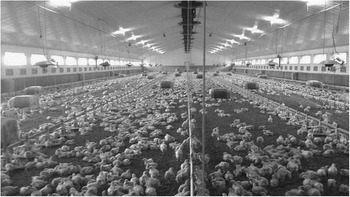
Thirty bales of wheat straw, each measuring 800 × 400 ×400 mm, were supplied per house (where applicable) on Day 1 of the rearing cycle. These were dispersed as evenly as possible throughout the house at an average density of ∼1 bale per 44 m2. As is normal commercial practice for the company on whose farms this research took place, plastic covering was left around the edges and across the top of the bales. This increased the time the bales remained intact over the course of the rearing cycle. Over the course of the study, all bales were cut open by the experimenter in order to minimize differences in the size of area exposed to the birds. This practice resulted in approximately two-thirds of each long side of the bale being exposed (Figure 1). Bales were not replaced during the cycle and had usually been fully dismantled by the birds by week 6 of the rearing cycle.
Photo showing exposed area and spatial distribution of straw bales. Bale edges are wrapped in white translucent plastic.

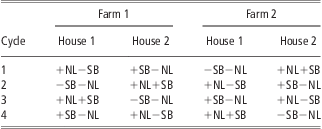
Treatments were applied to two houses on each of the two farms, and therefore in four houses in total. The two houses on each farm were selected as a matched pair, and were matched exactly for floor area, number of chicks placed, strain of bird and lighting regime, including timing of the dark period. All four houses were of an identical rectangular design, orientation and number of windows. As the birds used were part of the normal commercial enterprises of the company, the number of replications, and hence the ability to fully randomize treatments within farms, was limited. However, each treatment combination was replicated four times as shown in Table 1. The date that chicks were placed and removed was matched exactly for houses within and between farms, except for Replicate 2 at Farm 1. Owing to a logistical problem with the numbers of chicks available for placement, House 1 was stocked one day before House 2. In order to counteract any confounding effects, all measures were taken on the same day after placement, 1 day apart in Houses 1 and 2 at Farm 1, for the second replicate only.
Replication of treatments across farms
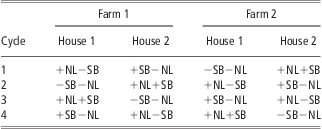
+/−NL = presence or absence of natural light; +/−SB = presence or absence of straw bales.
Animals, husbandry and housing
A total of 368 000 Ross broiler chickens obtained from one breeding company (Aviagen Ltd, UK) were used. Approximately, 23 000 birds were placed in houses ‘as hatched’ resulting in mixed sex houses. The total floor area/house available to the birds was 1320 m2 at Farm 1 and 1324 m2 at Farm 2, resulting in an approximate initial stocking density of 17 birds/m2. Approximately, a quarter of the birds from each house were removed for slaughter during week 5 of the production cycle, and the remaining birds were removed during week 6 (day 42). Stocking densities did not exceed 30 kg/m2. Temperature, ventilation and feeding regimes and feed sources and blends were identical between and within farms. Birds were fed on an ad libitum basis and received three different commercially available diets across the cycle.
The artificial lighting regime used was normal practice for the commercial supplier and was identical across all houses. The hours of darkness supplied rose by 1 h/day from 1 h at a day old, to 6 h by 7 days old. This regime was then maintained from 7 until 28 days old. From 29 days old, hours of darkness were gradually reduced by 1 h each day to 1 h by 33 days old. This was then maintained until the end of the rearing cycle at 42 days. The dark period was between 2000 and 0200 h on Farm 1, and between 0000 and 0600 h on Farm 2. Both lights and shutters were automatically controlled using timers. Shutters were set to automatically close and open at the start and end of the dark period, respectively.
Artificial light was provided using two rows of 24 fluorescent strip lights running parallel to each other along the length of the house. Rows were placed 8 m from the nearest wall. However, the type of fluorescent tube used differed between farms. Forty-eight 1.2 m low-frequency T8 tubes, emitting 3000 lm each, were used at Farm 1 (F40w/29-530/RS warm white energy rating B, Disano Illuminazione UK Ltd, Doncaster, UK), and 48 1.2 m high-frequency T8 tubes, emitting 3350 lm each, were used at Farm 2 (F36/830 warm white energy rating A, Disano Illuminazione UK Ltd). Identical light fittings were used in all houses (4ft Disano Hybro 951 IP65 fitting, Disano Illuminazione UK Ltd). As is normal of the supplier's older houses, fluorescent tubes on Farm 1 were suspended using a pulley system. Owing to the management style of the farmer at Farm 1, lights were lowered closer to the birds during brooding. These were fully raised towards the ceiling from day 5 of the study. The fluorescent lights on Farm 2 were fixed to the ceiling.
Large gas pan heaters were placed in two uniform lines down the length of all houses, and all drinkers were of the nipple variety and included cups. As is the usual practice on these farms, bedding comprised wood shavings and was placed in the house before the arrival of the birds. Sixty-six kilograms of wood shavings was supplied per 1000 birds. Additional sawdust was added to specific areas of the houses when deemed necessary by farmers.
Measurements
Behavioural observations
Behaviour was assessed using direct focal observations and counts, and scan sampling from videos. Behavioural observations were taken between 1100 and 1530 h once a week, starting on week 2 of the rearing cycle. The house shape was mapped and virtually divided into 36 equal size quadrants. Quadrants in which measures were carried out were preselected each week using random number tables. They were categorized as being either at the edge or centre of the house, and an equal number of both types of quadrants were selected for each measure.
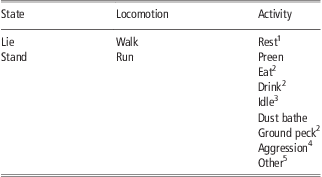
Individual focal observations of six birds per house per week were conducted using an electronic data recorder (Psion Workabout mx, Psion Industrial Plc., London, UK). The observations were continuous and lasted for 10 min. A 5-min settling period was implemented before each focal observation. The house in which initial observations were carried out was alternated on a weekly basis. Each observation was conducted in a different quadrant, and the bird to be observed was chosen by placing an ‘x’ on a randomly chosen section of a Perspex grid divided into 36 5 cm2 squares, as in Kells et al., (Reference Kells, Dawkins and Borja2001). The Perspex was held up at arm's length at the edge of the selected quadrant and an observation made of the bird observed closest to the ‘x’. Birds interacting with straw bales were not chosen. The behaviours recorded during focal sampling are shown in Table 2, with the exception of ground pecking and dust bathing, which were only recorded during the video observations. The total percentage of time birds spent performing different behaviours, and the frequency of performance of behaviours, was determined.
Ethogram of behaviours observed during direct focal sampling and during scan sampling from videos
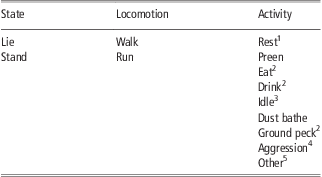
1Resting: bird is sitting or standing still with head rested on breast, chest or floor – eyes are open or closed.
2Eating, drinking and ground pecking are recorded as continuous (i.e. non-stop) bouts from the moment the birds lower their heads to the feeder or ground, or stretches up to the drinker, until they raise or lower their heads.
3Idle: bird remains still in the standing or lying position with head in the upright position – eyes are open. Bird is not engaged in locomotion or any of the other activities within the ethogram.
4Aggressive interaction included the occurrence of any of the following behaviours (modified after Estevez et al., Reference Estevez, Tablante, Pettit-Riley and Carr2002): stand-off, threat and peck. A stand-off was considered when two birds stood facing one another with their heads raised at the same level. A threat was defined as an encounter in which a bird stands with the neck erect and feathers raised in front of a second bird that had its head at a lower level. When a bird raised its head at and vigorously pecked a second bird, it was defined as a peck.
5Other = any additional behaviour performed by birds other than those included in the ethogram. This included wing flapping, vigilance, being disturbed by another bird, disturbing another bird, panting and ground pecking.
Adapted from Weeks et al. (Reference Weeks, Danbury, Davies, Hunt and Kestin2000) and Kells et al. (Reference Kells, Dawkins and Borja2001).
Video recordings of the same six quadrants selected for focal observations per house per week were also taken. One-quarter of each quadrant was recorded for 15 min in the absence of the researcher. The quarter of each quadrant recorded was preselected using a random number table. The quarters selected did not contain straw bales in order to ascertain whether or not their presence stimulated increased activity in the population as a whole. The first 5 min of the film was cut from all videos in order to ensure that a settling period had been imposed after the exit of the researcher from the house. Each 10-min film was played back on a PC, and the view frame divided into 10 equal-sized sections. Instantaneous scan sampling for each 10-min clip involved recording both the total number of birds present and the numbers of birds performing different behaviours in different sections of the frame at 60 s intervals, as in Kells et al. (Reference Kells, Dawkins and Borja2001). One section was scanned every minute, with scans of all 10 sections being completed in 10 min. The order in which each of the 10 sections was chosen was randomized using a random number table. An ethogram of recorded behaviours is shown in Table 2. Idling was not recorded during scan sampling, as it was not easy to distinguish between idling and other unrecorded behaviours, such as ‘vigilance’ or ‘panting’, from videos.
Weekly counts were made by direct observation of the number of birds gathering within 1 m of, and perched on top of, straw bales. Bales were preselected for observation using a random number table. The observer stood on top of a bale to make observations at the beginning of the second, fourth and sixth focal observation. Four bales were observed per count. Only birds within 1 m of a single long side and a single short side of a bale were visible at any one time. Numbers of birds were doubled to give ∼360° counts (Kells et al., Reference Kells, Dawkins and Borja2001).
Leg health
Leg health was assessed using a latency to lie test (Weeks et al., Reference Weeks, Knowles, Gordon, Kerr, Peyton and Tillbrook2002; Berg and Sanotra, Reference Berg and Sanotra2003) and spontaneous gait scoring. Gait scoring was performed in 25 quadrants, and latency to lie in 20 quadrants in each house each week. Quadrants were randomly selected for each measure each week, with the added provision that each quadrant was only selected once for each measure in order to limit the possibility of selecting the same bird repeatedly. Birds were selected for gait and latency to lie scoring in the same way as birds selected for focal observations. The bird observed closest to the ‘x’ was gait scored, and the bird observed lying closest to the ‘x’ was assessed for latency to lie. Gait was scored on a scale of 0 to 5, where 0 = normal movement and 5 = unable to walk (Kestin et al., Reference Kestin, Knowles, Tinch and Gregory1992).
The latency to lie test involved gently encouraging a lying bird into a standing position. A stopwatch was then used to record the time spent standing before the bird sat down. The test was terminated if no attempt to sit was witnessed after 5 min (Weeks et al., Reference Weeks, Knowles, Gordon, Kerr, Peyton and Tillbrook2002). The test was conducted without use of a water bath (e.g. Sherwin et al., Reference Sherwin, Lewis and Perry1999) in order to limit stress associated with bird handling and removal from house. All measures of leg health were carried out within one house before moving on to a second house, and the first house used in observations was alternated weekly.
The incidences of pododermatitis and hock burn at slaughter were recorded by slaughterhouse staff. The incidence of hock burn was recorded in 200 birds at thinning and 200 birds at slaughter. Both hocks were checked for burns while still attached to the bird and one value (i.e. presence or absence of hock burn) recorded. Two-hundred feet from birds at thinning and 200 feet from birds at clearing were examined for the presence of pododermatitis. Feet had already been removed from the birds by this stage and were examined as single feet rather than in pairs. The presence of pododermatitis and hock burn was recorded when lesions larger than a match head, or ∼3 mm in width, were evident on the sole of the foot or on the hock, respectively.
Environmental parameters
Light intensity (lux) values were recorded from the centre of the six quadrants selected for focal observations in each house each week, using a light meter (Digital lux meter LX1010B, Handsun Co. Ltd, Shanghai, China) held at arm's length and at bird height. Four readings were taken at right angles to one another (N, S, E and W) and averaged to give one reading for each quadrant. Readings for all quadrants were averaged each week to give an average house light intensity value. UV wavelengths (μW/cm2) were measured using a UV meter (UV-340 meter, Lutron Electronic Enterprise Co. Ltd, Taiwan, China) and following the same procedure, with the exception that a single measurement was taken in each quadrant, pointing the meter towards the nearest source of UV light.
During weeks 5 and 6 of the rearing cycle, samples of litter were taken from eight random areas throughout the house. Four samples were taken from the edge and four from the centre of the house. Samples were stored in plastic bags and transported in a cool box to limit drying. Samples were thoroughly mixed to produce a whole house sample and dried at 80°C for 24 h. The dry matter percentage of the litter was then assessed (McLean et al., Reference McLean, Savory and Sparks2002).
Airborne ammonia levels were recorded at bird height at weekly intervals from the centre of two randomly selected quadrants in each house using a Gastec pump and ammonia detection tubes (a1-envirosciences group, Wirral, UK). Daily temperature and humidity levels were taken from farm records. Weather conditions (in terms of sun, rain and cloud cover) were also recorded during observational days for each site.
Productivity and mortality
The numbers of birds that died and that were culled for lameness/poor leg health and other reasons were taken from company records on a weekly basis. Farmers culled as normal throughout the study.
Statistical analysis
Data were analysed using Genstat (Version 12.0, VSN International, UK). As all rearing cycles ran concurrently and the four treatments were balanced across both farms, the variable ‘farm’ was disregarded and analysis was carried out as for a balanced Latin square design. A histogram of the residuals for each behaviour, during each week, showed a normal distribution. Therefore, the means of all measures, except counts of birds clustering around straw bales, were compared using ANOVA with NL × SB × Week as a treatment factor and (House × Cycle)/Week as a blocking factor. For each measure, average values per treatment, week and replicate were used as experimental units, and all main and interactive effects were determined in the analysis. Averaged counts of birds clustering around straw bales in +NL and –NL treatments were compared using ANOVA with NL × Week as a treatment factor. In this analysis, average values per treatment and week were used as experimental units. Owing to problems obtaining the necessary equipment, average airborne ammonia values were missing for the last 4 weeks of cycle 4 at both farms.
Results
Environmental parameters
Average daytime light intensity and UV levels in the +NL treatment were 85.2 lx and 3.37 μW/cm2, respectively, and in the −NL treatment, 11.4 lx and 0 μW/cm2, respectively. Litter moisture levels were lower in the natural light treatment (+NL 32.0%, −NL 34.6%, s.e.m. 0.73%, P < 0.05), but were unaffected by the provision of straw bales (P > 0.05). Litter moisture levels were also significantly reduced in litter samples collected in week 6 compared with those collected in week 5 (week 5: 36.5% week 6: 30.0%, s.e.m. 1.89%, P < 0.05). There was no significant treatment effect on average weekly levels of airborne ammonia (P > 0.05).
Behaviour
Focal observations
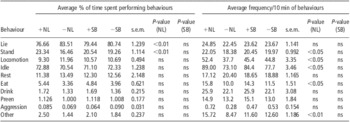
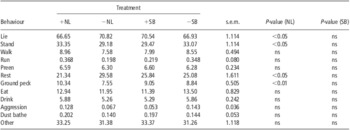
Because of the extremely small percentage of time that focal birds spent running, these data were amalgamated with data on walking to create a ‘locomotion’ category. Main treatment effects are presented in Table 3. The time spent lying was significantly reduced in +NL birds compared with –NL birds (P < 0.001). Provision of straw bales had no significant main effect on the percentage of time spent performing different behaviours (P > 0.05).
Effect of natural light and straw bales on the duration and frequency of performance of different behaviours recorded during focal observations

+/−NL = presence or absence of natural light; +/−SB = presence or absence of straw bales; ns = non-significant.
Data analysed by ANOVA with NL × SB × Week as a treatment factor and (House × Cycle)/Week as a blocking factor.
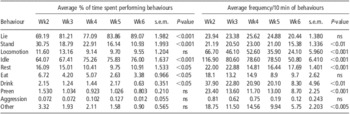
The average percentage of time spent resting and eating were significantly affected by age (Table 4). There were significant three-way interactions between bird age and the provision of natural light and straw bales on the percentage of time spent in locomotion (s.e.m. 4.647%, P < 0.05) and idling (s.e.m. 3.142%, P < 0.05). Both treatment factors had inconsistent effects on these parameters across different weeks. There was also an interaction between age and straw bales on the percentage of time spent drinking (s.e.m. 0.493%, P < 0.05). −SB birds spent a greater percentage of time drinking during weeks 2 to 4, and a lower percentage of time drinking during weeks 5 and 6, than +SB birds.
Effect of age on the duration and frequency of performance of different behaviours recorded during focal observations

Wk = week, ns = non-significant.
Data analysed by ANOVA with NL × SB × Week as a treatment factor and (House × Cycle)/Week as a blocking factor.
The provision of natural light led to an increase in the average frequency (per 10 min) of standing, locomotion, eating and idling (Table 3). The provision of straw bales had no significant main effect on the frequency of any of the recorded behaviours. Bird age had a significant effect on the frequency of standing, drinking, locomotion, idling, resting and preening (Table 4). The frequency of lying, eating and aggression was unaffected by age.
Group scans
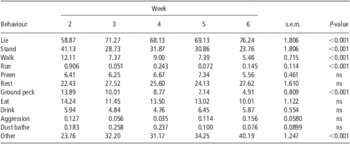
Main treatment effects are presented in Table 5. On average, there were 67 (±31) birds present in each video. There was a lower percentage of +NL birds lying (P < 0.05) and resting (P < 0.05), and a greater percentage ground pecking (P < 0.01) relative to –NL birds. Provision of straw bales had no significant effect on the percentage of birds observed performing different behaviours (P > 0.05). Bird age had a significant effect on the percentage of birds lying, walking, running and ground pecking (Table 6).
Effect of natural light and straw bales on the average percentage of birds performing different behaviours during instantaneous scans

+/−NL = presence or absence of natural light; +/−SB = presence or absence of straw bales; ns = non-significant.
Data analysed by ANOVA with NL × SB × Week as a treatment factor and (House × Cycle)/Week as a blocking factor.
Effect of age on the average percentage of birds performing different behaviours during instantaneous scans

ns = non-significant.
Data analysed by ANOVA with NL × SB × Week as a treatment factor and (House × Cycle)/Week as a blocking factor.
Interaction with straw bales
The average number of birds gathered within 1 m of straw bales differed between artificial and natural light treatments, with +NL birds gathering in greater numbers than –NL birds (+NL 72.7, −NL 52.6, s.e.d., 3.56, P < 0.001). The average number of birds gathered also decreased with age (week 2 = 82.9, week 3 = 66.9, week 4 = 54.6, week 5 = 46.1, s.e.d., 5.03, P < 0.001).
Leg health
There was an interaction between treatments in average gait scores, with higher scores in birds from the −NL−SB treatment than in birds from all other treatments, and higher scores in birds from the −NL+SB treatment than in birds from the +NL treatments (+NL+SB 1.02, +NL−SB 1.00, –NL+SB 1.09, −NL−SB 1.28, s.e.m. 0.008, P < 0.001). Average latency to lie was significantly longer in the +NL than –NL treatment, and in the +SB than –SB treatment (Table 7).
Effect of natural light and straw bales on average latency to lie, incidences of hock burn and pododermatitis, percentage of birds culled and slaughter weight

+/−NL = presence or absence of natural light; +/−SB = presence or absence of straw bales; ns = non-significant.
Data analysed by ANOVA with NL × SB × Week as a treatment factor and (House × Cycle)/Week as a blocking factor.
There was an increase in gait score with age (week 2 =0.40, week 3 = 0.66, week 4 = 1.07, week 5 = 1.61, week 6 = 1.76, s.e.m. 0.038, P < 0.001) and a decrease in average latency to lie (week 2 = 22.41 s, week 3 = 15.32 s, week 4 = 14.20 s, week 5 = 10.34 s, week 6 = 10.84 s, s.e.m. = 0.778 s, P < 0.001).
Culls, mortalities and productivity
Enrichment had no significant effect on the incidence of hock burn and pododermatitis or on the average slaughter weight of birds recorded during thinning and clearing (Table 7). Enrichment also had no significant effect on the percentage of birds culled.
Discussion
The provision of natural light led to a reduction in the percentage of time birds spent lying and also in the number of birds observed resting. Natural light also led to an increase in the frequency of idling, with +NL birds displaying more frequent bouts of idling on average. The increase in idling bouts may reflect the fact that +NL birds were more active, and therefore made transitions in and out of idling more frequently. This is supported by the fact that the average frequency of bouts of active behaviours, such as standing, locomotion and eating, were increased in +NL birds, as was the number of birds observed ground pecking.
The design of this study did not allow the specific elements of natural light that were responsible for the increase in activity levels to be identified. It may be because of the increased intensity of light within windowed houses (Newberry et al., Reference Newberry, Hunt and Gardiner1988), to the UV wavelengths contained within natural light (Maddocks et al., Reference Maddocks, Cuthill, Goldsmith and Sherwin2001) or to a combination of these factors. Avian vision evolved under natural light conditions and is thought to function more effectively at higher light intensities (King-Smith, Reference King-Smith1971) and in light containing UV wavelengths (Prescott and Wathes, Reference Prescott and Wathes1999; Sherwin et al., Reference Sherwin, Lewis and Perry1999; Cuthill et al., Reference Cuthill, Partridge, Bennett, Church, Hart and Hunt2000). Improvements in vision may have increased birds’ awareness of their surroundings, reduced fearfulness and led to an increase in locomotion and exploratory behaviours within this study.
For logistical reasons, the behavioural observations for this study were carried out between 1100 and 1530 h. Provision of an extended dark period or ‘night’ is known to stimulate a circadian rhythm in the behaviour of commercial broiler chickens (Bessei, Reference Bessei2006). Therefore, it is probable that the daily activity of chickens within this study followed a crepuscular pattern, and that behavioural observations took place within the low activity period between the morning and evening ‘peaks’. Despite this, a significant increase in activity levels was still witnessed in birds provided with natural light compared with those supplied with artificial light only.
The effect of treatment on activity levels in this study may also have reflected the variable nature of light intensity within windowed houses. Research has shown that the total amount of movement in a group of broilers is similar at fixed light intensities of 5 and 100 lx, but is increased at the higher light intensity in an alternating lighting schedule (Kristensen et al., Reference Kristensen, Perry, Prescott, Ladewig, Ersbøll and Wathes2006). Daily variations in the intensity and quality of natural light may also have led to an increase in activity levels through the alteration of circadian and ultradian rhythms. It has been suggested that both the provision of increased intensity lighting (Alvino et al., Reference Alvino, Archer and Mench2009) and dynamic patterns of light intensity (Kristensen et al., Reference Kristensen, Perry, Prescott, Ladewig, Ersbøll and Wathes2006) may promote greater behavioural synchronization among flocks. This may increase opportunities for undisturbed resting during the dark period, which may lead to increased activity levels during the light period.
The results of this study suggest that +NL birds tend to gather in larger numbers around bales than −NL birds. Improved vision under natural light may stimulate broilers to seek out a safe place to perform behaviours such as resting and preening, which would increase vulnerability to predation under natural conditions (Wood-Gush et al., Reference Wood-Gush, Duncan and Savory1978). Increased UV reflectance of straw under natural light (Prescott and Wathes, Reference Prescott and Wathes1999; Sherwin et al., Reference Sherwin, Lewis and Perry1999) may also increase the attractiveness of straw for +NL birds. The increased contrast between open, light areas and darker, shadowed areas around bales under natural light may increase the perceived value of the bale as a safe shelter or resting place for the birds.
The provision of natural light and straw bales appears to have exerted positive effects on walking ability and average latency to lie. Natural light appears to be the most important factor influencing latency to lie, with +NL birds remaining standing for the longest on average. This effect may be associated in part with a possible increase in ‘vigilance’ in birds with improved vision housed under increased intensity light or light containing UV wavelengths. However, leg health will also be a deciding factor in the ability of birds to remain standing for any length of time (Weeks et al., Reference Weeks, Knowles, Gordon, Kerr, Peyton and Tillbrook2002).
Increases in activity have been linked with improvements in the skeletal and muscular development of broilers (e.g. Reiter and Bessei, Reference Reiter and Bessei1998; Bizeray et al., Reference Bizeray, Estevez, Leterrier and Faure2002), which may exert positive effects on leg health and walking ability. Sunlight contains long-wave UVA wavelengths (315 to 400 nm), which are closest to visible light in the spectrum, and shorter-length UVB (280 to 315 nm) and UVC wavelengths (100 to 280 nm). UVB wavelengths are involved in the synthesis of vitamin D (Stanford, Reference Stanford2006), which has an antirachitic effect. However, glass blocks up to 90% of wavelengths under 350 nm (Lewis and Gous, Reference Lewis and Gous2009), making it unlikely that vitamin D synthesis within flocks would have been affected. The incidence of infectious diseases within flocks would not have been affected by germicidal UVC wavelengths, as the ozone layer filters out UVC wavelengths contained in sunlight (Lewis and Gous, Reference Lewis and Gous2009). There were also no nutritional (Waldenstedt, Reference Waldenstedt2006) or slaughter weight differences (Brickett et al., Reference Brickett, Dahiya, Classen, Annett and Gomis2007) between birds from different treatments, which may have otherwise accounted for differences in leg health.
Our results support those of past research suggesting that commercially housed broiler chickens show a marked reduction in activity levels and an increase in lying time with increasing age (Weeks et al., Reference Weeks, Danbury, Davies, Hunt and Kestin2000; Bizeray et al., Reference Bizeray, Estevez, Leterrier and Faure2002). The percentage of birds performing active behaviours such as standing, locomotion and ground pecking, the percentage of time birds spent eating and the frequency of standing, drinking, locomotion and preening tended to decrease as birds aged. Both lying and idling appear to have increased with age. The decrease in resting behaviour between 2 and 5 weeks of age across all treatments most likely occurred as a result of increasing stocking density and the resulting increase in the ‘jostling’ or disturbance of resting birds by their contemporaries (Newberry and Shackleton, Reference Newberry and Shackleton1997; Cornetto and Estevez, Reference Cornetto and Estevez2001). Past research has also linked increased BW to an increase in the occurrence of leg problems among commercial flocks (Sanotra et al., Reference Sanotra, Lund, Ersboll, Petersen and Vestergaard2001). The results of this study show that both walking ability and latency to lie decreased with age, possibly as a result of increasing weight gain.
Contrary to results of past research conducted on commercial farms (Kells et al., Reference Kells, Dawkins and Borja2001), we found no significant main effect of the provision of straw bales on activity levels. This may have been due to the low density of straw bales provided within the current study (1 bale per 44 m2v. 1 bale per 17 m2). An interaction was found between straw bales and age on the percentage of time spent drinking. There was also an interaction between treatments and bird age on the percentage of time spent in locomotion and idling. Effects on these parameters appeared inconsistent across weeks. Variation in factors such as BW, stocking density, heat stress, natural light intensity and UV content and duration may have influenced the performance of behaviours within these flocks.
Results indicate that litter from +NL houses had a lower moisture content than that found within –NL houses. Temperature and humidity levels are automatically controlled within commercial houses. Therefore, it is likely that the reduction in moisture was primarily facilitated by the increased activity levels found in +NL birds, which may have contributed towards an improvement in the movement of air through the litter and an increase in evaporation. The incidence of both hock burn and pododermatitis was not affected by either the provision of natural light or straw bales. This suggests that these conditions may be partly influenced by factors other than the moisture content of the litter and the activity levels of the birds. For example, genetics may play a role in increasing/decreasing the susceptibility of birds to pododermatitis (Kjaer et al., Reference Kjaer, Su, Nielsen and Sørensen2006; Ask, Reference Ask2010). Higher BWs have also been linked to the occurrence of hock burn but not pododermatitis (Kjaer et al., Reference Kjaer, Su, Nielsen and Sørensen2006).
In conclusion, environmental modification has the potential to increase activity levels and improve the leg health of commercial broiler chickens, and light appears to be particularly important in this respect. The relative importance of different components of natural light, such as intensity and wavelength, on chicken welfare remains unclear, and this is an area that warrants further investigation. The results of this study also suggest that improvements in walking ability and leg health are linked to increased activity levels. The provision of straw bales failed to exert significant main effects on activity levels within this study, suggesting that the density of bales supplied was below optimum.
Acknowledgements
This research project was funded by the Department of Agriculture and Rural Development in Northern Ireland. The authors also wish to thank Moy Park Ltd for allowing access to their farms and for their support and advice throughout the project.