The consumption of cheese is widespread throughout the world, as it is a convenient, ready-to-eat product and meets many nutritional needs due to its high content of various nutrients (Santiago-López et al., Reference Santiago-López, Aguilar-Toalá, Hernández-Mendoza, Vallejo-Cordoba, Liceaga and González-Córdova2018). Nowadays, consumers are increasingly aware that a healthy diet has potential benefits for human health. Biologically active compounds naturally present in cheese may provide these positive health effects in addition to their nutritional function (Sokovic Bajic et al., Reference Sokovic Bajic, Djokic, Dinic, Veljovic, Golic, Mihajlovic and Tolinacki2019; Tofalo et al., Reference Tofalo, Perpetuini, Battistelli, Pepe, Ianni, Martino and Suzzi2019).
Gamma-aminobutyric acid (GABA) is produced by glutamic acid decarboxylation by the enzyme L-glutamic acid decarboxylase. This enzyme is expressed by several types of microorganisms, including certain strains of lactic acid bacteria (LAB) associated with fermented dairy products such as yogurt and cheese. At the beginning of cheese production and during ripening, casein is the target of enzymes that cause proteolysis, releasing low molecular weight peptides and amino acids. These enzymes are present in milk (plasmin) and rennet (chymosin) or are released by the indigenous microbiota in raw milk. During this process, the release of a large amount of L-glutamate can be observed, as the native caseins of milk have a high content of this amino acid (Siragusa et al., Reference Siragusa, De Angelis, Di Cagno, Rizzello, Coda and Gobbetti2007; Tofalo et al., Reference Tofalo, Perpetuini, Battistelli, Pepe, Ianni, Martino and Suzzi2019). Since it is a precursor of GABA, the accumulation of this amino acid leads to the synthesis of GABA in fermented foods. GABA is a neurotransmitter that plays an important role in the regulation of neuronal excitability as well as in the regulation of blood pressure (Inoue et al., Reference Inoue, Shirai, Ochiai, Kasao, Hayakawa, Kimura and Sansawa2003; Siragusa et al., Reference Siragusa, De Angelis, Di Cagno, Rizzello, Coda and Gobbetti2007; Xu et al., Reference Xu, Wei and Liu2017; Tofalo et al., Reference Tofalo, Perpetuini, Battistelli, Pepe, Ianni, Martino and Suzzi2019). Thus, GABA has the potential to serve as a bioactive ingredient in functional foods due to its antihypertensive, anti-anxiety and anti-stress properties (Linares et al., Reference Linares, O'Callaghan, O'Connor, Ross and Stanton2016; Tofalo et al., Reference Tofalo, Perpetuini, Battistelli, Pepe, Ianni, Martino and Suzzi2019).
Portuguese cheeses possessing protected designation of origin (PDO) status have a long history of manufacture following traditional methods. They are produced from raw cow, sheep and/or goat milks without the addition of starters. These cheeses are typically named according to the region where they are manufactured, and all of them possess unique features associated with their artisanal modes of manufacture and ripening (Reis and Malcata, Reference Reis and Malcata2011). These cheeses are becoming increasingly popular with consumers due to their unique texture and flavour. Serra da Estrela is probably the best representative of PDO cheeses made from fresh raw sheep milk and uses a plant extract (Cynara cardunculus) as a coagulant. Other PDO cheeses made from raw milk from small ruminants (sheeps and/or goats) include those produced in the south of mainland Portugal, such as Serpa, Azeitão, Nisa and Beira Baixa. PDO cheeses in the Azores made from raw cow milk include Pico and São Jorge (S. Jorge) cheeses, produced on the Azorean islands of the same name. Few studies have reported the presence of GABA in cheese, and none have investigated the GABA content in Portuguese PDO cheeses. The quantification of GABA, derived from the metabolism of microorganisms present in cheese made from unpasteurized milk, may contribute to the valorization of artisanal cheese in the Azores region and mainland Portugal. Therefore, the objective of our study was to determine the GABA content in PDO cheeses produced from cow milk in the Autonomous Region of the Azores and from sheep and goat milk in mainland Portugal.
Materials and methods
Portuguese PDO cheeses were purchased at the local market and included the following varieties made from cow milk: Pico and S. Jorge (cheeses aged 3, 4, 7, 12 and 24 months) and these made from sheep milk or a mixture of sheep and goat milk: Azeitão, Nisa, Serpa, Serra da Estrela and yellow cheese from Beira Baixa. Each cheese (5 g) was grated and 15 ml of HCl (0.1 m) was added, followed by homogenization at 4000 RPM for 5 min, with an Ultra–Turrax homogenizer (Janke E Kungel IKA® – Labortechnik T50). After homogenization, the containers were sealed and immersed in a water bath (Büchi Waterbath B–480) at 50°C for 30 min. Then the samples were centrifuged (Hermle Z – 323, Mandel Scientific Company) at 3000 × g for 15 min. The supernatant was collected and stored (0–5°C) until determination of GABA content.
GABA content in cheese extracts was determined by HPLC (VWR Hitachi, model Elite Lachrom, Japan) equipped with an automated injector, an RP-18 column (Purospher® STAR, 5 μm particle size), and a Diode Array Detector (DAD), according to the method described by Cunha et al. (Reference Cunha, Coelho, Ribeiro and Silva2022). Samples (100 μl) of the HCl/cheese extracts (supernatants) were mixed with 900 μl of 20% trichloroacetic acid (TCA, Sigma, Darmstadt, Germany). The mixture was centrifuged at 4000 × g for 10 min, and the supernatant was filtered using 0.45 μm filters (Whatman, Darmstadt, Germany). The filtrate was derivatized with a solution of o-phthaldialdehyde (Sigma). The reaction solution (OPA) was prepared on the same day using 10 mg of o-phthaldialdehyde reagent, 10 μl of 2-mercaptoethanol (99% extra pure, Acros organics, Geel, Belgium) and 2.5 ml of acetonitrile (Sigma), in a tube protected from light. For the derivatization reaction, 100 μl of sample/standard, 500 μl of borate buffer pH 10.4 (0.4 m boric acid) and 100 μl of OPA reagent were used. In tubes protected from light, the mixture was vortexed for 30 s and reacted at room temperature for 5 min. Each sample (20 μl) was injected and monitored at 334 nm. Ammonium acetate buffer (0.02 m), pH 7.3 (solvent A) and acetonitrile (solvent B) were used as solvents. System elution consisted of the following program: 80% solvent A and 20% solvent B for 5 min; increase to 100% solvent B for 5 min; reduction to 20% solvent B and 80% solvent A for 2 min. The flow rate used was 0.6 ml/min and the column temperature was set at 25°C. All solvents were filtered through a 0.45 μm filter and degassed in an ultrasound bath (Ultrasons Medi-II, Selecta Calibration curves were plotted using four concentrations of the GABA standard (150, 300, 450, and 600 mg/l).
Statistical analysis
At least four samples were analysed for each cheese type. One-way analysis of variance (ANOVA) was applied to the results. When statistically significant differences (P < 0.05) were detected in the ANOVA, Tukey's test for multiple comparisons between cheese varieties was applied. Correlation analysis for maturation time of S. Jorge cheese and GABA content was performed by use of a bivariate (two-tailed significance) correlation test. Correlation was considered significant at P < 0.05. Statistical analysis was carried out with IBM SPSS Statistics, version 25 (SPSS Inc., Chicago, IL, USA).
Results
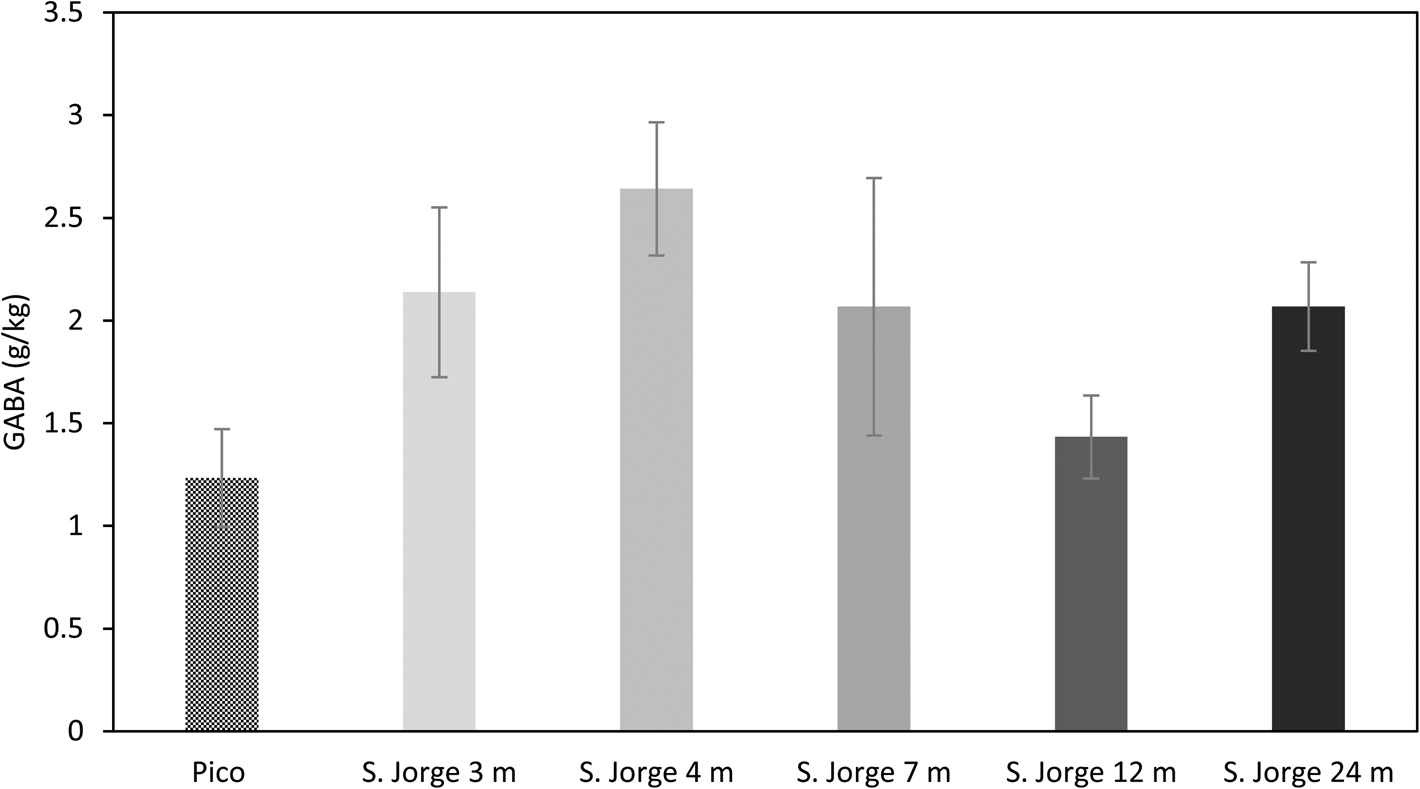
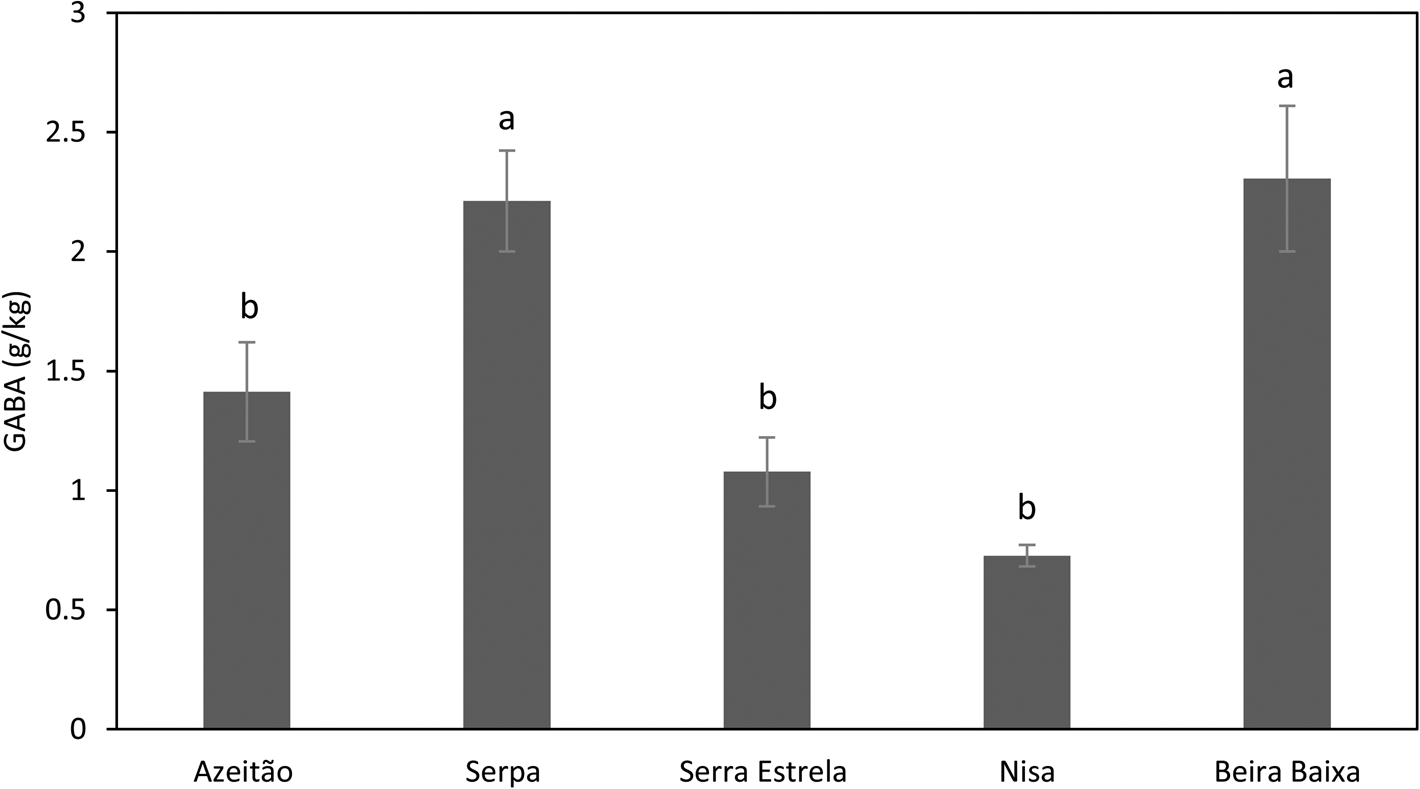
GABA concentration in PDO cheese made from cow milk varied from 1.23 to 2.26 g/kg cheese (Fig. 1). The lowest GABA level was found in Pico PDO cheese (1.23 ± 0.24 g/kg), while the highest GABA concentration was observed in S. Jorge PDO cheese with 4 months maturation (2.64 ± 0.32 g/kg). Since S. Jorge cheese is consumed with a wide range of ripening times (typically 3, 4, 7, 12, and 24 months), the variation in GABA content over the length of ripening time was also evaluated (Fig. 1). Despite the observed variation in the GABA content of S. Jorge cheese, no correlation (P > 0.05) was found with the ripening period. The highest GABA content was observed in 4-month-old cheeses (2.64 ± 0.32 g/kg). However, a decrease in GABA content was observed in 7- and 12-month-old cheeses (2.07 ± 0.63 g/kg and 1.43 ± 0.20 g/kg, respectively), while GABA content increased in 24-month-old cheese (2.07 ± 0.22 g/kg). Cheeses made from sheep and goat milks are shown in Figure 2. The average GABA content in cheeses made from sheep milk was 1.36 ± 0.15 g/kg. High variability was observed in GABA values, which was significant (P < 0.05) and ranged from 0.73 to 2.31 g/kg. The lowest value was observed in Nisa cheese and the highest values were observed in Serpa cheese (made with sheep milk) and Beira Baixa spicy yellow cheese (made with a mixture of sheep and goat milk).
Mean GABA concentration (g/kg cheese) in PDO cheeses made from raw cow milk: Pico cheese and S. Jorge cheeses with ripening times of 3, 4, 7, 12, and 24 months. The values are the average of four samples and the error bars show sem. No significant differences (P > 0.05) were found between cheese types.

Mean GABA concentration (g/kg cheese) in PDO cheeses made from raw sheep milk (Azeitão, Serpa, Serra da Estrela and Nisa) and in PDO cheese made from a mixture of goat and sheep milk (Beira Baixa). The values are the average of four samples and the error bars show sem. Different lowercase letters indicate significant differences (P < 0.05) between cheese types.

Discussion
Cheese made from raw milk has a high bacterial diversity that is not destroyed by pasteurization (Bottari et al., Reference Bottari, Levante, Neviani and Gatti2018). Therefore, the microbial load of Portuguese traditional cheeses is high because they are not inoculated with commercial starter cultures and are made from raw milk (Reis and Malcata, Reference Reis and Malcata2011). The present study included traditional PDO cheeses produced either in the Azores from whole cow milk or in certain regions of mainland Portugal from sheep and goat milk.
The average GABA concentrations observed in this study (ranging from 0.73 to 2.64 g/kg) are higher than those found in other works. Siragusa et al. (Reference Siragusa, De Angelis, Di Cagno, Rizzello, Coda and Gobbetti2007) analysed the GABA concentration of 22 Italian cheeses and reported values ranging from 0.26 to 391 mg/kg of cheese. Similarly, Nomura et al. (Reference Nomura, Kimoto, Someya, Furukawa and Suzuki1998) reported GABA levels ranging from 4.2 to 177 mg/kg in seven commercial cheeses (Camembert, Gouda, Blue, Cream, Cheddar, Edam, and Emmental). However, Lacroix et al. (Reference Lacroix, St-Gelais, Champagne and Vuillemard2013) reported higher levels in four commercial French cheeses, with GABA content ranging from 0.3 to 3.2 g/kg cheese, so not dissimilar to our values. Also, high GABA levels, reaching maximum values of 10 g/kg, were reported in sheep milk cheeses from Sardinia (Manca et al., Reference Manca, Porcu, Ru, Salaris, Franco and De Santis E2015).
Compared with the cheeses made from cow milk, Pico cheese had the lowest GABA content, which could be related to its short ripening period, since it does not normally ripen for more than 22 d (Riquelme et al., Reference Riquelme, Câmara, Maria de Lurdes, Vinuesa, da Silva, Malcata and Rego2015). In contrast, the cheese S. Jorge had the highest GABA levels, since it has a longer ripening period, ranging from 3 to 24 months (Kongo et al., Reference Kongo, Gomes, Malcata and McSweeney2009). The higher GABA levels in longer matured cheeses are most likely due to more extensive proteolysis in the cheeses. Milk caseins have a high content of glutamic acid, which can be released during cheese ripening and converted to GABA by LAB with L-glutamic acid decarboxylase activity (Li et al., Reference Li, Chen, Ge, Dang, Ren, Zeng and Li2022). It has been reported that ripened hard and semi-hard cheeses provide an adequate matrix and ideal conditions for GABA production by LAB (Lacroix et al., Reference Lacroix, St-Gelais, Champagne and Vuillemard2013). The concentration of GABA in cheese is also related to the inhibition of GABA-degrading enzymes. GABA transaminase catalyses the reversible conversion of GABA to succinic semi-aldehyde, which is further metabolized to succinate (Carafa et al., Reference Carafa, Stocco, Nardin, Larcher, Bittante, Tuohy and Franciosi2019). In this way, the GABA content of aged cheese results from the balance between proteolysis and the release of glutamic acid, together with the action of L-glutamic acid decarboxylase, present in some LAB, and the degradation of GABA. This could explain the great variability of GABA content during the ripening of S. Jorge cheese. It is possible that the decrease in GABA content in cheeses older than 4 months is due to the action of GABA transaminases present in some LAB. In contrast, GABA levels increase again in cheeses with 24 months of maturation. Because different batches were analysed for each ripening time, it is not possible to conclude that the observed differences are due to an effective pattern of variation in GABA content during ripening of this cheese. It is possible that these differences are due to variations in the microbiota in each cheese/batch, which is to be expected in cheeses made from raw milk. To confirm this observation, the same batch would need to be analysed throughout the ripening period. However, several authors also reported similar variations in GABA content during the ripening period (Siragusa et al., Reference Siragusa, De Angelis, Di Cagno, Rizzello, Coda and Gobbetti2007; Manca et al., Reference Manca, Porcu, Ru, Salaris, Franco and De Santis E2015).
In reference to Portuguese PDO cheese, made from raw sheep milk, the average GABA concentration (1.36 ± 0.15 g/kg) is slightly higher than the values reported by Diana et al. (Reference Diana, Rafecas, Arco and Quílez2014) in two Spanish sheep milk cheeses (0.98 g/kg), but more similar to the GABA content found by Renes et al. (Reference Renes, Ladero, Tornadijo and Fresno2019) in sheep milk cheeses (1.3 g/kg) with longer maturation time (240 d of ripening). According to Tofalo et al. (Reference Tofalo, Perpetuini, Battistelli, Pepe, Ianni, Martino and Suzzi2019), the quality of sheep milk and the type of rennet used in the production of cheese seem to have some influence on the GABA content of these cheeses. Some of the Portuguese cheeses made from sheep milk, such as Serra da Estrela cheese, are curdled with an aqueous extract of wild thistle (Cynara cardunculus). In Serra da Estrela cheese, it was previously found that GABA content increases with ripening time, reaching 55 and 131 mg/100 g DM (about 0.36 and 0.85 g/kg of cheese) after 90 and 150 d, respectively (Tavaria et al., Reference Tavaria, Franco, Carballo and Malcata2003). In the present study, the GABA levels of Serra da Estrela cheese were slightly higher than the values observed in 150-day-old cheese. However, Tavaria et al. (Reference Tavaria, Franco, Carballo and Malcata2003) reported that cheese made from refrigerated milk had higher levels of GABA, which was due to the growth of psychrotrophic bacteria known to favour the decarboxylation of glutamate to GABA. In addition, several authors reported that cheese made from sheep and goat milk had the highest GABA levels and had a microbiota with a higher GABA-producing capacity than cheese made from cow milk (Siragusa et al., Reference Siragusa, De Angelis, Di Cagno, Rizzello, Coda and Gobbetti2007; Diana et al., Reference Diana, Rafecas, Arco and Quílez2014). However, the present study showed that raw cow milk cheese may contain high levels of GABA. In addition, several LAB strains previously isolated from raw cow milk (Pico and S. Jorge PDO cheeses) were found to produce high levels of GABA (Ribeiro et al., Reference Ribeiro, Domingos-Lopes, Stanton, Ross and Silva2018; Cunha et al., Reference Cunha, Coelho, Ribeiro and Silva2022).
Based on the range of GABA content in cheeses of 73–264 mg/100 g determined in this work, a daily portion of 30 g of cheese provides approximately 22–79 mg of GABA. Thus, all PDO cheeses analysed had a GABA content greater than 16 mg per serving, a value that was reported as the minimum value associated with health promotion in the study by Renes et al. (Reference Renes, Ladero, Tornadijo and Fresno2019). The same authors reported that consumption of a serving of cheese with a GABA content of 16 mg was effective in lowering blood pressure in individuals with mild hypertension. In the present study, all PDO cheeses analysed exceeded this value and had the potential to lower blood pressure.
In conclusion, a large variability in total GABA content was found between the different Portuguese PDO cheeses. However, regardless of the origin of the milk (cow, sheep or goat milk), the cheeses investigated in this study had high levels of GABA, above the minimum amount indicated for a health-promoting effect, so that they can be proposed as functional foods.
Acknowledgements
This work was supported by the Fundação para a Ciência e Tecnologia (FCT) – Project UID/CVT/00153/2019. S.C. Ribeiro is thankful to the Fundo Regional da Ciência e Tecnologia (FRCT) for financial support – grant M3.1.a/F/017/2018.