Introduction
Complete atrioventricular septal defect is characterised by a common atrioventricular junction, deficient atrioventricular septation, and varying degrees of atrioventricular valve imbalance. Without repair, pulmonary overcirculation may lead to heart failure, failure to thrive, recurrent respiratory infection, progressive pulmonary vascular disease, and premature death. Contemporary practice generally favours definitive repair at approximately 4–6 months of age. In North American cohorts, the reported median age at repair has ranged from 3.7 to 4.6 months. Reference Atz, Hawkins and Lu1–Reference Karolcik, Rao and Lucas3
Delayed repair beyond infancy nevertheless remains clinically relevant where diagnosis, referral, and access to specialised congenital cardiac surgery are limited. International data indicate that definitive repair is performed later in lower- and middle-income settings than in high-income settings. Reference Bateson, Deng and Ange4 Late-presenting patients may also have pulmonary hypertension, malnutrition, previous palliative procedures, or more advanced valve pathology. Acceptable outcomes have been reported in selected late-presenting cohorts, although selection and referral pathways strongly influence the observed results. Reference Patel, Ananthanarayanan and Gajjar5–Reference Al-Wassia, Al-Radi and Maghrabi7
This study compared in-hospital outcomes after complete atrioventricular septal defect repair in patients aged 12 months or younger and those older than 12 months, with particular attention to invasive operability assessment, mortality, postoperative complications, and early atrioventricular valve outcomes.
Materials and methods
Study design and patient population
This retrospective observational study evaluated patients referred to a single centre for complete atrioventricular septal defect repair between January 2020 and December 2024. Eighty-five patients were assessed for definitive repair. Two patients with severe, irreversible pulmonary vascular disease were considered inoperable after multidisciplinary evaluation and did not undergo repair. Of the 83 patients who underwent surgery, 81 had complete perioperative and in-hospital data and formed the analytic cohort.
All patients were international referrals from countries where timely access to specialised congenital cardiac surgery was limited. The delays were neither clinically intended postponements nor part of an elective institutional policy. Patient-level causes were not recorded in a standardised format; available referral documentation predominantly described inadequate local congenital cardiac surgical infrastructure, restricted access to specialist care, and prolonged international transfer pathways.
Patients were categorised as 12 months or younger or older than 12 months at definitive repair. Group assignment was based on exact dates of birth and operation; age was rounded to the nearest whole month for summary reporting. The younger group should not be interpreted as an optimally timed early-repair cohort because its median age was 8 months.
Clinical and echocardiographic data
Collected variables included age, sex, body weight, Down syndrome, Rastelli type, previous pulmonary artery banding, repair technique, cardiopulmonary bypass time, aortic cross-clamp time, permanent pacemaker implantation, mechanical ventilation duration, ICU stay, and in-hospital outcomes. Transthoracic echocardiography was performed before surgery, early after surgery, and before discharge to assess ventricular function, residual shunts, estimated pulmonary artery pressure, and right and left atrioventricular valve regurgitation.
Cardiac catheterisation and operability
All patients evaluated for repair underwent preoperative cardiac catheterisation. Recorded variables included mean pulmonary artery pressure, pulmonary capillary wedge pressure or left atrial pressure, the pulmonary-to-systemic flow ratio, indexed pulmonary and systemic vascular resistance, and the ratio of indexed pulmonary to systemic vascular resistance. Pulmonary and systemic blood flow were calculated using the Fick principle. Indexed pulmonary vascular resistance was calculated as the difference between mean pulmonary artery pressure and pulmonary capillary wedge or left atrial pressure divided by indexed pulmonary blood flow.
Patients with elevated indexed pulmonary vascular resistance underwent acute vasoreactivity testing with 100% oxygen and inhaled nitric oxide. The dose of inhaled nitric oxide was not uniformly documented. Operability was determined by a multidisciplinary paediatric cardiology and congenital cardiac surgery team using a literature-informed framework. Reference Jone, Ivy and Hauck8 Indexed pulmonary vascular resistance below 6 Wood units·m2, a ratio of indexed pulmonary to systemic vascular resistance below 0.30, and net left-to-right shunting favoured repair. Values between 6 and 8 Wood units·m2 required individual assessment of vasoreactivity, pulmonary-to-systemic flow, shunt direction, oxygen saturation, ventricular function, and clinical status. Persistently greater values without meaningful reactivity and with bidirectional or right-to-left shunting were considered strongly unfavourable. Two referred patients met these inoperability criteria.
Outcomes
The primary outcomes were in-hospital mortality and major postoperative complications. In-hospital mortality was defined as death before discharge from the index hospitalisation. Major complications included renal dysfunction requiring peritoneal dialysis, arrhythmia requiring intervention, significant bleeding, sepsis or pulmonary infection, hepatic dysfunction, neurological events, extracorporeal membrane oxygenation, and permanent pacemaker implantation for complete atrioventricular block. Secondary outcomes included mechanical ventilation duration, intensive care unit stay, postoperative and predischarge estimated pulmonary artery pressure, early right and left atrioventricular valve regurgitation, and residual shunts.
Surgical technique
All operations were performed through a median sternotomy. Cardiopulmonary bypass was established with aortic and bicaval cannulation, mild systemic hypothermia at 32–34°C, and antegrade cold del Nido cardioplegia. Repair used either a double-patch or modified single-patch technique according to ventricular septal defect morphology, leaflet anatomy, and surgeon preference. Atrioventricular valve reconstruction was tailored to the individual leaflet pathology.
Valve competence was first assessed by saline testing after reconstruction. Transoesophageal echocardiography was used selectively when saline testing raised concern for clinically relevant residual regurgitation. Mild or mild-to-moderate residual regurgitation was accepted only in the absence of leaflet prolapse, restriction, a significant eccentric jet, or haemodynamic compromise. Moderate or severe regurgitation prompted revision before completion of the operation. A 2–3 mm patent foramen ovale was intentionally left in every patient as a potential decompression route during episodes of elevated right-sided pressure.
Postoperative management and follow-up
All patients received milrinone and sildenafil at 0.5–1 mg/kg per dose every 6–8 hours during the early postoperative period. Inhaled nitric oxide was not used postoperatively. Routine monitoring included continuous invasive arterial pressure and oxygen saturation, central venous pressure, serial arterial blood gas analysis, and serial transthoracic echocardiography. Hypoxia, hypercapnia, acidosis, pain, and agitation were actively avoided.
Adequate analgesia and sedation were maintained. Extubation was undertaken after haemodynamic stability, satisfactory gas exchange, normothermia, and absence of clinically significant pulmonary hypertensive instability had been achieved. Pulmonary hypertensive crises occurred, but their incidence was not recorded as a dedicated retrospective variable. Follow-up was limited to the postoperative hospitalisation and predischarge assessment.
Statistical analysis
Analyses were performed using R software, version 4.4.1. Continuous variables were summarised as mean with standard deviation or median with interquartile range, as appropriate. Normality was assessed using the Shapiro–Wilk test. Non-normally distributed variables were compared using the Mann–Whitney U test. Categorical variables were compared using Fisher exact or chi-square tests, as appropriate. Odds ratios with 95% confidence intervals were calculated for mortality and major complications. All tests were two-sided, and a p value below 0.05 was considered statistically significant. Reporting followed the Strengthening the Reporting of Observational Studies in Epidemiology guidance.
The institutional ethics committee approved the retrospective study; full details are provided under Ethical standards.
Results
Patient characteristics
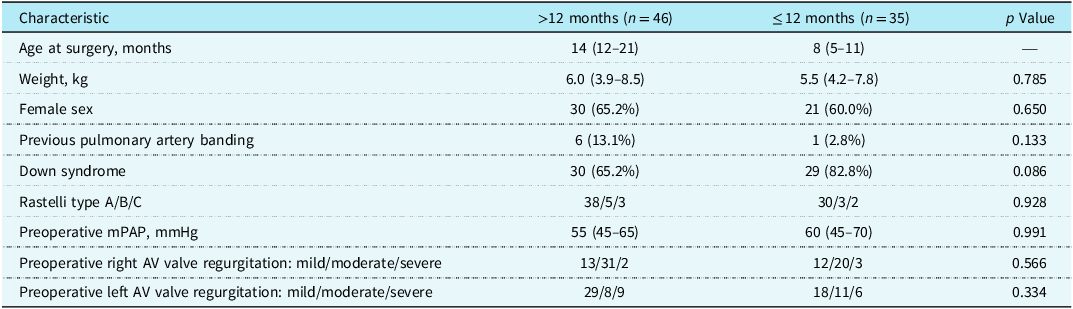
The analytic cohort comprised 81 patients: 35 aged 12 months or younger and 46 older than 12 months. Median age was 8 months (interquartile range, 5–11) and 14 months (interquartile range, 12–21), respectively. Median weight was 5.5 kg and 6.0 kg. Down syndrome was present in 29 of 35 patients (82.8%) and 30 of 46 patients (65.2%), respectively. Seven patients had undergone pulmonary artery banding before referral. Preoperative mean pulmonary artery pressure was 60 mmHg and 55 mmHg, respectively. Baseline and preoperative characteristics are presented in Table 1.
Baseline and preoperative characteristics by age at definitive repair

Table 1. Long description
The table has 11 rows and 4 columns. The columns are labeled Characteristic, >12 months (n = 46), <= 12 months (n = 35), and p Value. The rows list various characteristics such as Age at surgery, Weight, Female sex, Previous pulmonary artery banding, Down syndrome, Rastelli type A/B/C, Preoperative mPAP, Preoperative right AV valve regurgitation, and Preoperative left AV valve regurgitation. Each row provides specific data for the two age groups and a p value for comparison. Notable trends include the higher percentage of Down syndrome in the <= 12 months group (82.8%) compared to the >12 months group (65.2%), and the slightly higher preoperative mPAP in the <= 12 months group (60 mmHg) compared to the >12 months group (55 mmHg).
Values are median (interquartile range) or number (percentage). Group assignment was based on exact age; ages were rounded to the nearest whole month for reporting. Continuous variables were compared with the Mann–Whitney U test. Fisher exact tests were used for two-by-two categorical comparisons, and chi-square tests were used for multinomial distributions. AV = atrioventricular; mPAP = mean pulmonary artery pressure.
Operative and early outcomes
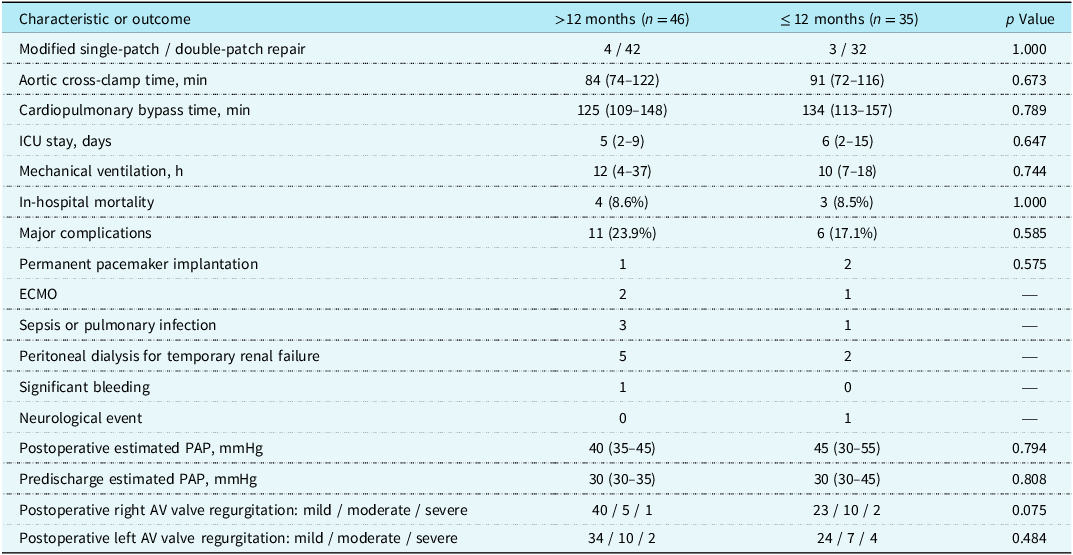
The double-patch technique was used in 32 of 35 patients aged 12 months or younger and 42 of 46 patients older than 12 months. Median cardiopulmonary bypass times were 134 and 125 minutes, and median aortic cross-clamp times were 91 and 84 minutes, respectively. No statistically significant differences were detected in these measures or in ICU stay and mechanical ventilation duration (Table 2).
Operative characteristics and early outcomes by age at definitive repair

Table 2. Long description
A table comparing operative characteristics and early outcomes by age at definitive repair. The table has 16 rows and 4 columns. The columns are labeled as follows: Characteristic or outcome, >12 months (n = 46), ≤ 12 months (n = 35), and p Value. The rows include various operative characteristics and outcomes such as Modified single-patch / double-patch repair, Aortic cross-clamp time, min, Cardiopulmonary bypass time, min, ICU stay, days, Mechanical ventilation, h, In-hospital mortality, Major complications, Permanent pacemaker implantation, ECMO, Sepsis or pulmonary infection, Peritoneal dialysis for temporary renal failure, Significant bleeding, Neurological event, Postoperative estimated PAP, mmHg, Predischarge estimated PAP, mmHg, Postoperative right AV valve regurgitation: mild / moderate / severe, and Postoperative left AV valve regurgitation: mild / moderate / severe. Each row provides specific values for the two age groups and a p Value indicating the statistical significance of the differences observed.
Values are median (interquartile range), number (percentage), or number. Individual patients could experience more than one major adverse event; therefore, event counts do not sum to the number of patients with major complications. Odds ratios for patients older than 12 months versus those aged 12 months or younger were 1.02 (95% confidence interval, 0.21–4.86) for mortality and 1.52 (95% confidence interval, 0.50–4.61) for major complications. AV = atrioventricular; ECMO = extracorporeal membrane oxygenation; ICU = intensive care unit; PAP = pulmonary artery pressure.
In-hospital mortality occurred in 3 of 35 patients (8.5%) aged 12 months or younger and 4 of 46 patients (8.6%) older than 12 months. The odds ratio was 1.02 (95% confidence interval, 0.21–4.86; p = 1.000). Major complications occurred in 6 of 35 patients (17.1%) and 11 of 46 patients (23.9%), respectively. The odds ratio was 1.52 (95% confidence interval, 0.50–4.61; p = 0.585). The wide confidence intervals indicate substantial uncertainty and do not support a conclusion of equivalence.
Among patients older than 12 months, causes of death were sepsis or pneumonia, low cardiac output syndrome, multiorgan failure, and pulmonary hypertensive crisis complicated by endotracheal bleeding. Among patients aged 12 months or younger, causes were sepsis or pneumonia, low cardiac output syndrome, and a neurological event. Cause-specific statistical analysis was not performed because only seven deaths occurred.
Extracorporeal membrane oxygenation was required in two older patients and one younger patient. Sepsis or pulmonary infection occurred in three and one patients, and temporary peritoneal dialysis was required in five and two patients, respectively. Permanent pacemaker implantation was required in one and two patients, respectively. No patient required early reoperation for residual septal shunt, atrioventricular valve regurgitation, or bleeding.
Valve and pulmonary pressure outcomes
Postoperative right and left atrioventricular valve regurgitation distributions did not differ significantly between the age groups. Severe left atrioventricular valve regurgitation before discharge was present in 4 of 35 younger patients and 2 of 46 older patients. Postoperative and predischarge estimated pulmonary artery pressures also did not differ significantly (Table 2).
A 2–3 mm patent foramen ovale was left in every patient. No patient developed clinically significant persistent desaturation attributable to the residual atrial communication, and no patient required reintervention for the fenestration during the index hospitalisation. Pulmonary hypertensive crises occurred but were not systematically enumerated. All patients received postoperative sildenafil; inhaled nitric oxide was not used postoperatively.
Seven patients had undergone pulmonary artery banding before referral, including one younger and six older patients. Reliable external records regarding age at banding, original indication, pre-banding haemodynamics, and interval to definitive repair were unavailable; patient-level analysis of this subgroup was therefore not possible.
Discussion
Among selected patients who survived to international referral and were considered operable after catheterisation, no statistically significant differences were detected between repair at 12 months or younger and repair beyond 12 months in in-hospital mortality, major complications, ventilation duration, ICU stay, pulmonary artery pressure, or early atrioventricular valve regurgitation. The study was not powered to establish equivalence or non-inferiority, and the wide confidence intervals preclude firm conclusions regarding clinically important differences.
The median age of 8 months in the younger group was itself later than the timing reported in contemporary North American cohorts. Reference Atz, Hawkins and Lu1–Reference Karolcik, Rao and Lucas3 This study therefore compares a later-in-infancy group with a beyond-infancy group rather than optimally timed repair with delayed repair. The age distribution is consistent with international evidence showing later definitive repair where access to congenital cardiac surgery is constrained. Reference Bateson, Deng and Ange4
Invasive assessment is particularly important in late-presenting complete atrioventricular septal defect. Operability should not be determined by a single resistance threshold; indexed pulmonary and systemic vascular resistance, pulmonary-to-systemic flow, shunt direction, oxygen saturation, ventricular function, clinical status, and vasoreactivity must be interpreted together. Reference Jone, Ivy and Hauck8 The observed outcomes in the older group are likely influenced by survivor and referral bias. Patients with rapidly progressive pulmonary vascular disease may have died before referral, may never have been referred, or may have been considered inoperable. Two such patients were identified in the referral population. The findings therefore apply only to a selected operable subgroup and should not be used to justify intentional delay.
Early atrioventricular valve outcomes were not significantly different between groups. Saline testing with selective transoesophageal echocardiography allowed residual regurgitation to be assessed before completion of repair, and no patient required early valve reoperation. However, predischarge assessment cannot predict late left atrioventricular valve dysfunction, reoperation, or left ventricular outflow tract obstruction, which require structured surveillance. Reference Fong, Betts and Ayer9–Reference Buratto, Lui and Hu14 A universal 2–3 mm atrial communication was not associated with early reintervention or persistent clinically important desaturation, but this study was not designed to compare fenestrated and complete atrial closure. Reference Callahan, Jegatheeswaran and Barron15
Seven patients had undergone pulmonary artery banding. Contemporary evidence generally favours primary repair when feasible, with banding reserved for selected circumstances. Reference Buratto, Hu and Lui16 The absence of reliable historical records prevented assessment of the indications and independent effect of banding. Postoperative management emphasised milrinone, sildenafil, invasive monitoring, avoidance of factors that increase pulmonary vascular resistance, and cautious extubation. The lack of systematic recording of pulmonary hypertensive crises limits evaluation of their incidence and relationship to mortality.
Limitations
This retrospective single-centre study included a small cohort and few adverse events. It was not powered to establish equivalence or non-inferiority. The cohort included only internationally referred patients who survived to evaluation and were considered operable, creating survivor and referral bias. Patient-level reasons for delayed surgery were not recorded systematically. Although invasive haemodynamic measurements were obtained clinically, aggregate indexed pulmonary vascular resistance, pulmonary-to-systemic flow, and vasoreactivity response values were not retained as study variables and could not be compared between age groups. Detailed historical data for the pulmonary artery banding subgroup were unavailable, and pulmonary hypertensive crises were not recorded as a dedicated variable. Follow-up ended at discharge; freedom from reoperation, progression of left atrioventricular valve regurgitation, late pulmonary hypertension, and long-term survival could not be evaluated.
In conclusion, complete atrioventricular septal defect repair beyond 12 months was feasible in selected patients who survived to referral and were considered operable after invasive haemodynamic assessment. In-hospital mortality remained substantial, and the absence of statistically significant differences from the younger group does not establish equivalence. Timely diagnosis, referral, and repair during early infancy remain the preferred strategy.
Acknowledgements
OpenAI ChatGPT (GPT-5.6 Thinking; accessed July 2026) was used for English-language editing and structural refinement during manuscript revision. All scientific content, clinical data, statistical results, and references were reviewed and verified by the authors, who take full responsibility for the final manuscript.
Financial support
This research received no specific grant from any funding agency, commercial, or not-for-profit sectors.
Competing interests
None.
Ethical standard
The authors assert that all procedures contributing to this work complied with the ethical standards of the relevant national guidelines on human research and with the Helsinki Declaration of 1975, as revised in 2008. The study was approved by the Istanbul Atlas University Ethics Committee on 12 May 2026 (Decision No. 05/04). Written informed consent was obtained from the parents or legal guardians of all patients.