Introduction
Many patients undergoing a total laryngectomy have chronic obstructive pulmonary disease,Reference Sylvester, Marchiano, Park, Baredes and Eloy1 which is often treated with dry-powder inhalers. The use of dry-powder inhalers is often preferred to alternatives on the market such as pressurised metered-dose inhalers, soft-mist inhalers and nebulisers because (1) they have carbon footprints 18 times lower than metered-dose inhalers,2 (2) there is often improved compliance amongst patients who struggle to co-ordinate inhaler activation with their inspiration as required with metered-dose inhalers, and (3) they are more lightweight and portable compared to nebulisers.Reference Sylvester, Marchiano, Park, Baredes and Eloy1
However, the anatomical changes resulting following a laryngectomy complicate the use dry-powder inhalers because patients are unable to form a tight seal around the mouthpiece and generate sufficient inspiratory effort to release the medication from the device. Therefore, different treatment options need to be offered. Delays in providing a suitable alternative in this cohort of patients with age-/smoking-related changes to the lungs and reduced mucociliary clearance, who are recovering from prolonged operation time and intubation period puts them at greater risk of post-operative pulmonary complications such as atelectasis, acute exacerbations of chronic obstructive pulmonary disease (COPD) and hospital-acquired pneumonia.
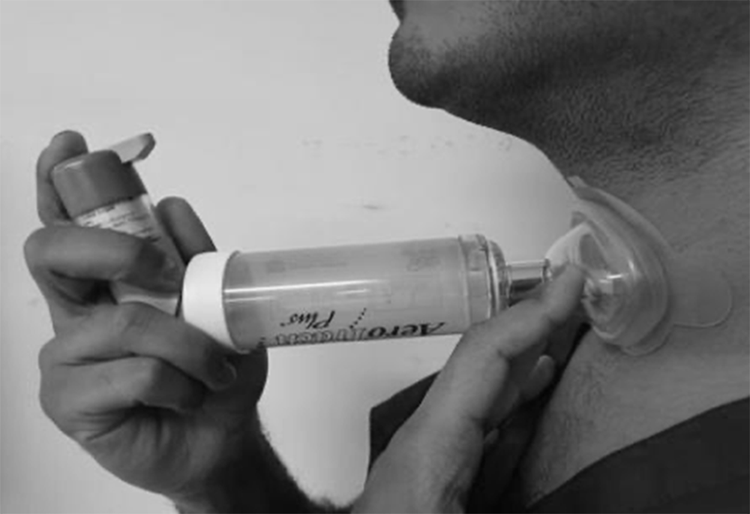
The solution used most often is to provide inhaled drug therapy through a nebuliser, however many of the combination inhalers that patients with moderate to severe COPD are on do not have a preparation that can be used in a nebuliser. To overcome these limitations, an alternative and more practical option is to deliver the aerosol therapy via a metered-dose inhaler used with a spacer attached to an infant face mask, which is placed over the laryngeal stoma. Nandapalan et al.Reference Nandapalan, Currey and Jones3 have shown the effectiveness of the latter approach and Mirza et al.Reference Mirza, Hopkinson, Malik and Willatt4 also described a similar method in patients with a tracheal stoma or tracheostomy tube. Despite this, there is currently a scarcity of resources that suggest which metered-dose inhalers can be substituted for the dry-powder inhaler a patient is currently using.
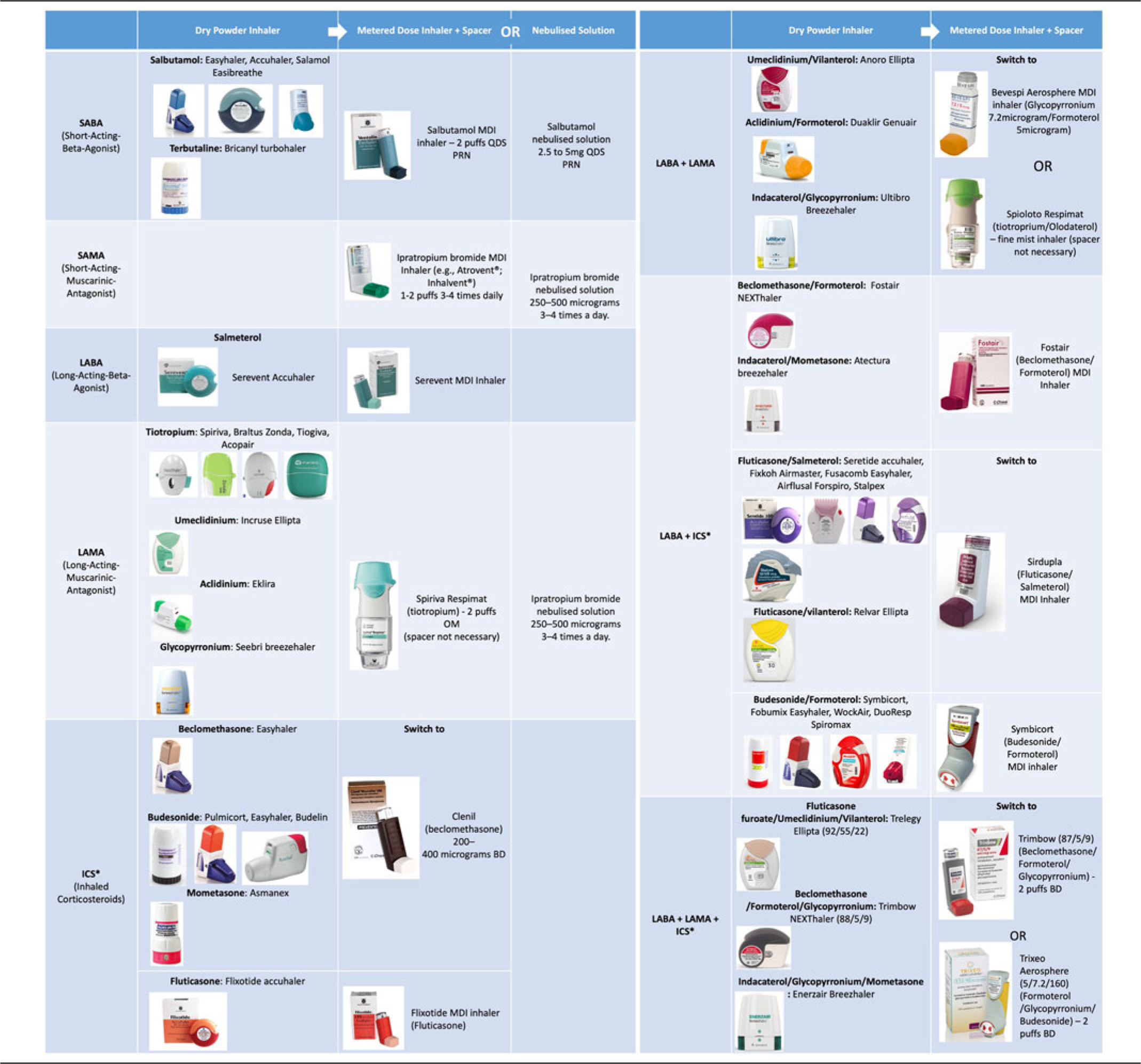
Recognising the difficulties that healthcare professionals responsible for managing COPD in laryngectomised patients face, we sought to devise a table that simplifies the process of switching patients from their dry-powder inhalers to appropriate metered-dose inhalers to be used with an infant face mask and spacer (Fig. 1), soft-mist inhalers or nebulised solutions.
Photo showing a metered-dose inhaler attached to a spacer and infant face mask that can be used over a laryngeal stoma for the administration of inhaled medication.

Methods
We worked with the respiratory team and specialist pharmacists within our head and neck centre to create a simple conversion table to help clinicians switch laryngectomy patients with COPD from their dry-powder inhalers to appropriate metered-dose inhalers, soft-mist inhalers or nebulised solutions on which they could be established.
NICE guidance5, 6, Reference Venkatesan9 alongside our local and formulary guidelines were consulted to find the appropriate switch from dry-powder inhalers to metered-dose inhalers, soft-mist inhalers and nebulised solutions. The online resource Right Breathe7 was used to confirm the compatibility of spacer devices with the suggested metered-dose inhaler inhalers.
Results
We devised a table (Table 1) that gives illustrative representations of the inhalers that are commonly used and details the drugs within them to make it easy for both the patient and caring clinician to identify the appropriate switch required.
Conversion table demonstrating metered-dose inhaler, soft-mist inhaler and nebulised solution alternatives for commonly used dry-powder inhalers (full table available at https://www.shoutatcancer.org/inhaler-conversion-table)

Discussion
Delays or failure to establish patients undergoing a total laryngectomy on a suitable alternative to their dry-powder inhaler in the pre-operative period or once they have had their laryngectomy places them at greater risk of post-operative pulmonary complications resulting in a longer hospital stay, greater cost of careReference Sylvester, Marchiano, Park, Baredes and Eloy1 and a greater decline in long-term pulmonary function.Reference Ackerstaff, Hilgers, Meeuwis, Knegt and Weenink8 Therefore, it is important that clinicians are able to find the most appropriate inhaler to prescribe in this group of patients and have a resource that aids them in their decision-making process.
• Many patients undergoing a laryngectomy have chronic obstructive pulmonary disease, which is often treated with dry-powder inhalers
• The anatomical changes after a laryngectomy make dry-powder inhalers unusable in a cohort of patients and there is little understanding amongst clinicians what alternative inhalers can be used for patients using dry-powder inhalers
• Delays or failure to establish suitable alternatives to their dry-powder inhalers place patients at greater risk of post-operative pulmonary complications
• There is a lack of resources that provides information on which metered-dose inhalers can be substituted for dry-powder inhalers
• Within our head and neck centre we created a simple conversion table to help clinicians to switch prospective laryngectomy patients with chronic obstructive pulmonary disease/asthma from their dry-powder inhalers to appropriate metered-dose inhalers
Conclusion
We recommend that all patients with COPD managed with a dry-powder inhaler and who are undergoing laryngectomy should be switched to a suitable alternative prior to or immediately after their surgery to help reduce the risk of post-operative pulmonary complications. We hope our table can be of use to clinicians responsible for their care. The full table is available at https://www.shoutatcancer.org/inhaler-conversion-table.
Supplementary material
The supplementary material for this article can be found at https://doi.org/10.1017/S0022215125000106.
Acknowledgements
We would like to thank Dr Fareed Ahmed for demonstrating the use of a metered dose inhaler, spacer and infant face mask in Figure 1.
Funding
None to declare.