INTRODUCTION
The pelagic stingray Pteroplatytrygon violacea (Bonaparte, 1832) (Dasyatidae) is distributed in circumpolar and subtropical areas, including the Mediterranean Sea. Pteroplatytrygon violacea is the only species of stingray known to occupy pelagic waters (e.g. see Mollet, Reference Mollet2002; Veras et al., Reference Veras, Branco, Hazin, Wor and Tolotti2009). Pelagic stingrays are caught in great numbers in longline fisheries worldwide and are considered to be by-catch due to their lack of commercial value (Domingo et al., Reference Domingo, Menni and Forselledo2005; Forselledo et al., Reference Forselledo, Pons, Miller and Domingo2008). Several studies have shown that the geospatial overlap between the habitat of this species and important longline fishing grounds has resulted in large amounts of by-catch with unknown effects on the population and ecosystem structure (Domingo et al., Reference Domingo, Menni and Forselledo2005; De Siqueira & De Sant'Anna, Reference De Siqueira and De Sant'Anna2007; Forselledo et al., Reference Forselledo, Pons, Miller and Domingo2008).
The Western Mediterranean is an important fishing ground for the Spanish surface drifting longline fleets which target swordfish (Xiphias gladius), albacore tuna (Thunnus alalunga) and bluefin tuna (Thunnus thynnus). The main gear used for this fleet are as follows: surface longliners targeting albacore (longline albacore (LLALB)); surface longliners using a hydraulically operated monofilament longline reel targeting swordfish (longline American (LLAM); surface longliners targeting bluefin tuna (longline Japanese (LLJAP)); and traditional surface longliners targeting swordfish (longline home-based (LLHB)). The principal differences in longline gear are related to hook type and size, bait type and operational depth. A brief description of the gear follows.
LLALB: This is the shallowest longline gear. The size of the hook and the thickness and length of the fishing lines are less than those used in other longline fisheries. Between 2000 and 7000 hooks are set and baited with sardine (Sardina pilchardus). LLALB is a drifting longline that is used in high-sea fishing grounds with depths of up to 1500 m and is mainly used from July to October. The size and type of hooks used are J-shaped Mustad number 5.
LLAM: A hydraulically operated monofilament longline reel (commonly known as the ‘American roller’). Unlike the traditional longline, the American roller uses a hydraulic reel that is often placed at the stern of the boat to collect the line. The monofilament longline is between 90 and 100 km in length with fewer hooks (900–1100), implying a greater distance between hooks. Fishing depth is greater than that of the LLALB and LLHB, with the deepest hooks working at 70 m below the sea surface. This gear is used throughout the year. The size and type of hooks used are J-shape Mustad number 2 (~7.5 × 2.5 cm2), usually baited with mackerel (Scomber sp.) and squid (Illex sp.).
LLJAP: This is a monofilament longline exclusively used during May, June and the first half of July, which is the period when bluefin tuna enter the Mediterranean to breed. This gear differs from LLAM in that the fishing depth is greater, the bait is almost always squid (Illex sp.) heavier than 500 g, and the gear remains in use for 24 h. LLJAP typically use a C-shaped hook. No more than 1200 hooks are used per set.
LLHB: The length of this gear varies between 37 and 65 km and is set with between 1500 and 4000 hooks. The main line hangs from floats and depth sensors show that the average depth of the hooks is 30 m (maximum depth 50 m). LLHB uses the same type of hooks and bait as LLAM.
A full description of the gear and fisheries is available in García-Barcelona et al. (Reference García-Barcelona, Ortiz de Urbina, de la Serna, Alot and Macias2010a), Macías et al. (Reference Macías, García-Barcelona, Báez, de la Serna and Ortíz de Urbina2012a) and Báez et al. (Reference Báez, García-Barcelona, Mendoza, Ortiz De Urbina, Real and Macías2014a).
Previous studies conducted in the Western Mediterranean Sea have reported that the pelagic stingray is the most common elasmobranch by-catch in LLALB and the second most common elasmobranch by-catch in LLHB (Filanti et al., Reference Filanti, Megalofonou, Petrosino and De Metrio1986; Di Natale et al., Reference Di Natale, Mangano, Navarra and Valastro1995; Orsi Relini et al., Reference Orsi Relini, Cima, Garibaldi, Palandri, Relini and Torchia1999). They have a low discard survival rate due to damage to the jaws and mouth (Baum et al., Reference Baum, Bianchi, Domingo, Ebert, Grubbs, Mancusi, Piercy, Serena and Snelson2009). In the case of Spanish longline vessels, there are significant differences between years and gear in the number of individuals caught. According to Macías et al. (Reference Macías, Gómez-Vives and de la Serna2004), 8% of the individuals caught by the Spanish longline fleet were pelagic stingray, whereas Báez et al. (Reference Báez, Real, Camiñas, Torreblanca and Garcia-Soto2009) suggested that 68% of the individuals caught by the Spanish artisanal longline fleet were pelagic stingray.
Despite these differences, and the important potential impact of longline fisheries on the pelagic stingray population, few studies have investigated the by-catch of this species or the temporal oscillation of by-catch events.
This study provides information on the eco-geographic parameters and temporal oscillations that contribute to P. violacea by-catch by the Spanish surface drifting longline fleet operating in the Western Mediterranean Sea. It also explores in depth the conditions that lead to the high by-catch rates of this species and suggests how these rates could be reduced.
MATERIALS AND METHODS
Data collection
Since 2000, on-board scientific observers have compiled pelagic stingray by-catch data from drifting longline vessels by type of gear. Data were collected following the recommendations of the International Commission for the Conservation of Atlantic Tunas (ICCAT). The data series used in this study comprises the period 2000–2013.
For each fishing set, observers recorded the fishing set location and gear characteristics (i.e. total length, mean depth, number of hooks, etc.). They also monitored 100% of the total hooks retrieved and recorded information on species composition, and the number and estimated weight of the target species and the by-catch, including pelagic stingray.
Given that the on-board data showed that gear types LLHB and LLALB were involved in 96.05% of pelagic stingray by-catch, this study investigated by-catch on these two types of gear. The aim of the observers was to record captures and identify specimens of pelagic stingray.
Data analysis
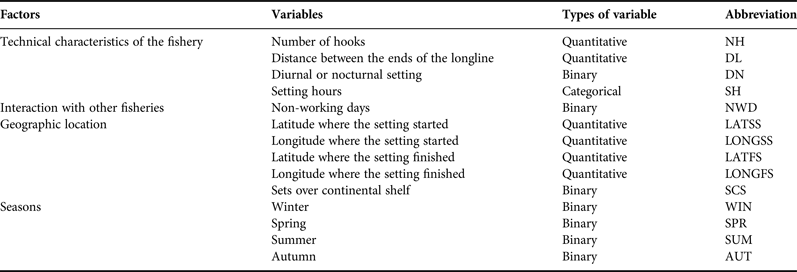
General Linear Models (GLMs) are the most used techniques to analyse factors affecting by-catch (e.g. see García-Barcelona et al., Reference García-Barcelona, Macías, Alot, Estrada, Real and Báez2010b; Jiménez et al., Reference Jiménez, Abreu, Pons and Domingo2010). Many authors have recommended the use of logistic binary regression as a useful GLM to evaluate the probability of environmental conditions and fishing practices having an effect on by-catch (e.g. see Báez et al., Reference Báez, García-Barcelona, Mendoza, Ortiz De Urbina, Real and Macías2014a and references therein), and to relate the probability of an event occurring (e.g. the probability of catching a pelagic stingray) with a set of variables and explanatory factors. We performed binary logistic stepwise forward/backward regression on the presence or absence of pelagic stingray by-catch using IBM SPSS Statistics version 19 to test whether the probability of incidentally catching a pelagic stingray (1 or more) can be predicted by some of the explanatory variables listed in Table 1.
Variables used for analysing the association between pelagic stingray by-catch and the corresponding grouping factors.
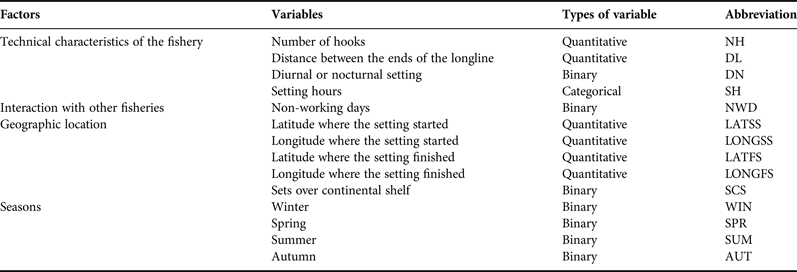
By performing a logistic regression on the presence/absence of by-catch on each variable separately, we selected a subset of variables significantly related to the distribution of the by-catch. To control for the increase in type I errors due to multiple tests (see Báez et al., Reference Báez, García-Barcelona, Mendoza, Ortiz De Urbina, Real and Macías2014a), we only accepted those variables that were significant under a False Discovery Rate (FDR) of q < 0.05, using the Benjamini and Hochberg procedure. We then performed forward stepwise logistic regression on the subset of significant predictor variables to obtain a multivariate logistic model.
Model coefficients were assessed using an omnibus test. The goodness-of-fit between expected and observed proportions of by-catch events over 10 classes of probability values were evaluated using the Hosmer and Lemeshow test. This test also follows a Chi-square distribution, where a P value <0.05 indicates lack of fit of the model (Hosmer & Lemeshow, Reference Hosmer and Lemeshow2000). On the one hand, the omnibus test is used to determine whether there are significant differences between the −2LL (less than twice the natural logarithm of the likelihood) of the initial step, and the −2LL of the model, using a Chi-squared test with one degree of freedom. On the other hand, the Hosmer and Lemeshow test compares the observed and expected frequencies of each value of the binomial variable according to their probability. In this case, we expected that there would be no significant differences, thus obtaining a good model fit.
In addition, the discrimination capacity of the model (trade-off between sensitivity and specificity) was evaluated with the receiving operating characteristic (ROC) curve. The area under the ROC curve (AUC) provides a scalar value representing the expected discrimination capacity of the model (Lobo et al., Reference Lobo, Jiménez-Valverde and Real2008).
Regardless of the goodness-of-fit of the model, logistic regression is sensitive to the presence/absence ratio (Hosmer & Lemeshow, Reference Hosmer and Lemeshow2000). The favourability function (Real et al., Reference Real, Barbosa and Vargas2006) adjusts the model to provide information on the degree to which the environmental conditions favour the event, regardless of the presence/absence ratio. The threshold of 0.5 used in the favourability model is easier to interpret, as it indicates neutral environmental conditions (i.e. neither favourable nor unfavourable for pelagic stingray by-catch). Favourability was easily calculated from the probability obtained from the logistic regression according to the expression:
 $$F\, = \,(P/({\rm 1} - P))/(n{\rm 1}/n0) + (P/({\rm 1} - P))$$
where P is the probability of a stingray by-catch event occurring, n1 is the number of observed events of stingray by-catch, and n0 is the number of observed sets with no stingray by-catch.
In a second step, we used fishing activity that operated under similar eco-geographic conditions with a favourability value >0.6F in explanatory models for the LLHB and LLALB. We then calculated annual pelagic stingray by-catch CPUE rates in the LLHB and LLALB as the total number of individuals caught in a year divided by the thousands of hooks deployed that year. This formula shows that the standardized CPUE per year correlates with the North Atlantic Oscillation. The Mediterranean climate displays great interannual variability that is closely related to atmospheric oscillation patterns (Vicente-Serrano & Trigo, Reference Vicente-Serrano and Trigo2011). The North Atlantic Oscillation (NAO) is responsible for most of the climatic variability in the North Atlantic region, and modifies the direction and intensity of westerlies and the location of anticyclones (Vicente-Serrano & Trigo, Reference Vicente-Serrano and Trigo2011).
Monthly NAO index values were taken from the website of the National Oceanic and Atmospheric Administration (NOAA website, available at http://www.cpc.noaa.gov/products/precip/CWlink/pna/naoindex.html). The atmospheric oscillations present strong inter-annual and intra-annual variability (Hurrell, Reference Hurrell1995). We used the mean winter NAO from October to December (NAOw) in the year previous to the by-catches, and the NAO in the previous year (NAOpy).
To test the possible effect of NAOw and NAOpy on the CPUE of pelagic stingray, we used the CPUE from favourable sets per year (fCPUE), i.e. sets >0.6F.
RESULTS
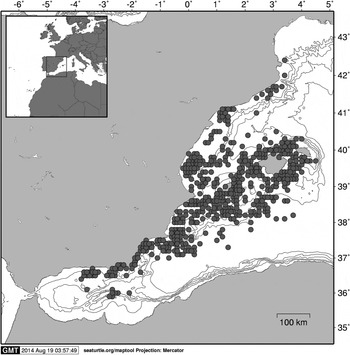
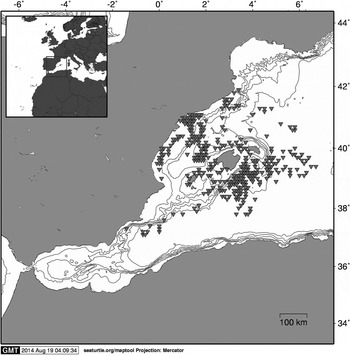
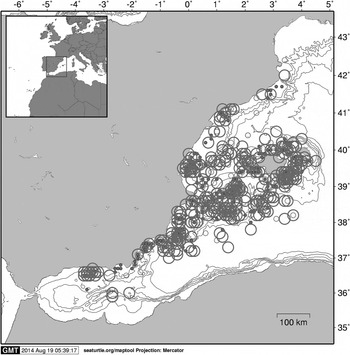
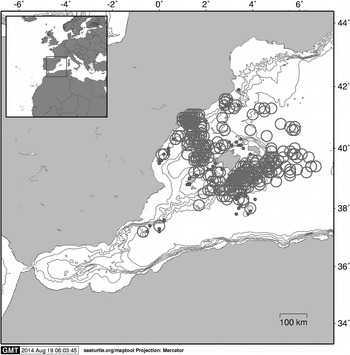
Between 2000 and 2013, 3007 longline fishing operations were monitored in 68 different fishing vessels (Figures 1 & 2). During this period, we recorded 57 574 pelagic stingray by-catches by the Spanish longline fleet. Most of this by-catch (55 301 individuals) was caught by the LLHB (Figure 3) and LLALB (Figure 4) with a CPUE of 14.237 and 3.316, respectively. The number of specimens caught per LLHB and LLLALB fishing operation fluctuated between 0 and 505 (average 27) and between 0 and 148 (average 8), respectively. However, we observed a high rate of pelagic stingray by-catch (i.e. the number of fishing operations by-catching at least one pelagic stingray vs the total sets observed). Thus, in the LLHB and LLALB, the rates were 904/1387 (65.2%) and 510/853 (59.7%), respectively.
Distribution of the observed fishing operations in traditional surface longliners targeting swordfish (LLHB).

Distribution of the observed fishing operations in surface longline targeting albacore (LLALB).

Distribution of the by-catch frequency in traditional surface longliners targeting swordfish (LLHB) per fishing operation. Key: Small circle = catch ≤5 pelagic stingrays; medium circle = catch between 5–10 pelagic stingrays; large circle = catch >10 pelagic stingrays.

Distribution of the by-catch frequency in surface longline targeting albacore (LLALB) per fishing operation. Key: Small circle = catch ≤5 pelagic stingrays; medium circle = catch between 5–10 pelagic stingray; large circle = catch >10 pelagic stingrays.

General logistics models (GLMs)
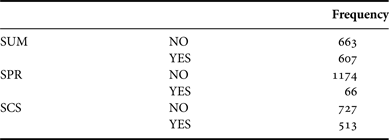
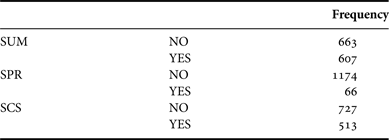
We obtained two statistically significant logistic models for LLHB and LLALB. For the LLHB, we obtained a model with the variables number of hooks (NH), latitude where setting started (LATSS), fisheries over the continental shelf (SCS), distance between the ends of the longline (DL), Spring (SPR), and Summer (SUM). The model's goodness-of fit was significant according to the omnibus test (omnibus test = 165.343, df = 6, P < 0.0001; Hosmer and Lemeshow test = 11.272, df = 8, P = 0.187), and its discrimination capacity was good (AUC = 0.724). The logit function (y) obtained from the logistic regression was as follows (see Table 2 for qualitative variable codes):
 $$\eqalign{y\, = \, & - 27.212 + {\rm NH} \times 0.00035 + {\rm LATSS} \times 0.671 + {\rm DL} \times 0.012 \cr & {\rm SCS}\left\{ {_{{\rm YES} = 0}^{{\rm NOT} = 1.311} + {\rm SPR}\left\{ {_{{\rm YES} = 0}^{{\rm NOT} = 0.847} + {\rm SUM}\left\{ {_{{\rm YES} = 0}^{{\rm NOT} = - 0.911}} \right.} \right.} \right.} $$
Qualitative variable codes used for the logistic regression model of catching at least one pelagic stingray as the independent variable in the case of traditional surface longliners targeting swordfish. Abbreviations as in Table 1.
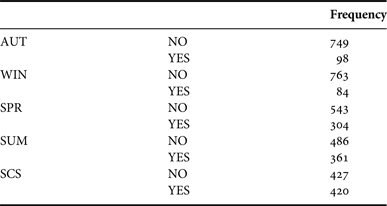
For the LLALB, we obtained a model with the variables fisheries over continental shelf (SCS) and Summer (SUM). The model's goodness-of fit was significant according to the omnibus test (omnibus test = 234.174, df = 2, P < 0.0001; Hosmer and Lemeshow test = 15.611, df = 2, P = 0.864), and its discrimination capacity was good (AUC = 0.805). The logit function (y) obtained from the logistic regression was as follows (see Table 3 for qualitative variable codes):
 $$y\, = \, - 6.34 + {\rm SCS}\left\{ {_{{\rm YES} = 0}^{{\rm NOT} = 2.41} \, + \,{\rm SUM}\left\{ {_{{\rm YES} = 0}^{{\rm NOT} = 0.877}} \right.} \right.$$
Qualitative variable codes used for the logistic regression model of catching at least one pelagic stingray as the independent variable in the case of surface longline targeting albacore. Abbreviations as in Table 1.
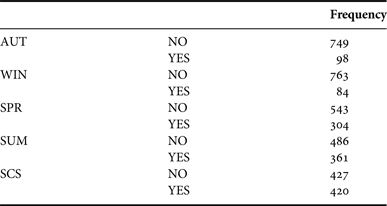
The favourable sets for the LLHB model are: SCS = Not, SPR = Not, and SUM = Yes; and for the LLALB are SCS = Not and SUM = Not.
Temporal oscillation analysis
For the LLHB, a significant correlation was found between favourable CPUE per year (fCPUE) and the NAOpy (Pearson r = −0.582, P = 0.037, N = 13).
For the LLALB, no correlation was found between the fCPUE and the NAO; however, sets >0.6F were only observed for 8 years.
DISCUSSION
Pelagic stingrays inhabit the water column to depths of 100 m. The LLHB and LLALB gear operate at less than 100 m and therefore overlap with their habitat (Wilson & Beckett, Reference Wilson and Beckett1970), unlike LLJAP and LLAM gear which operate at greater depths. The results show that the majority of stingrays were by-caught on LLHB and LLALB gear.
Pelagic stingray by-catch presents eco-geographic and temporal distribution patterns. This trend was found to be primarily associated with the summer season and fishing activity over the continental shelf. Previous studies have shown that different eco-geographic and gear-type parameters strongly influence the CPUE of pelagic stingray. Santana-Hernández et al. (Reference Santana-Hernández, Espino-Barr and Valdez-Flores2011) and Domingo et al. (Reference Domingo, Menni and Forselledo2005) proposed a correlation between sea surface temperature (SST) and by-catch CPUE; however, the proposed temperature ranges differed: 26–27°C and 20–23°C, respectively. SST was not included as a variable in our models, but the highest temperatures occur in summer (an explanatory variable in our two models) in the Western Mediterranean. According to our model, LLHB was positively correlated with summer. This finding could be a consequence of the greater activity of stingrays at warmer temperatures (i.e. in summer). In contrast, LLALB was negatively correlated with summer. This difference could be associated with seasonality and the fishing strategy associated with each type of gear. LLHB is used throughout the year over the oceanic and continental shelves, whereas LLALB is used more frequently in summer over the continental shelf and in other seasons is mainly used in oceanic areas.
Both models showed that setting the gear away from the continental shelf was one of the most important variables that influences by-catch. In line with Domingo et al. (Reference Domingo, Menni and Forselledo2005), the results also show that the majority of captures took place in deeper waters further from the coast; this result is consistent with the oceanic distribution of this stingray species.
A significant association was also found in the LLHB model between the number of hooks per set (NH), latitude where the setting started (LATSS), and distance between the ends of the longline (DL). In a previous paper on seabird by-catch by Spanish longliners, Báez et al. (Reference Báez, García-Barcelona, Mendoza, Ortiz De Urbina, Real and Macías2014a) found that these three variables were associated with an increased probability of by-catch. NH and DL are two variables related to observed fishing effort and an increase in NH implies an increase in the probability of capture. Similarly, an increase in DL implies that a greater area is covered by the fleet, which could also increase the probability of pelagic stingray by-catch. Latitude where setting started (LATSS) could be related to the differential distribution of the fishing effort.
Climatic oscillations caused by the NAO influence marine and terrestrial systems (Ottersen et al., Reference Ottersen, Planque, Belgrano, Post, Reid and Stenseth2001). The results for LLALB and LLHB were limited by the fact that by-catch data were only available for 8 and 13 years, respectively, with sets >0.6F. This limited amount of data may explain why no apparent association was found between LLALB by-catch and positive NAO years. Nevertheless, a negative association was found between LLHB by-catch and NAOpy. The effect of the NAO on the SST is known to have multiple effects on marine biological communities, such as biological recruitment, species distribution, or predator–prey interactions (Ottersen et al., Reference Ottersen, Planque, Belgrano, Post, Reid and Stenseth2001). According to Báez et al. (Reference Báez, Gimeno, Gómez-Gesteira, Ferri-Yáñez and Real2013), negative NAO phases could increase the SST in the Alboran Sea. Negative NAO phases also favour rainfall and run-off, which increases land-based nutrients entering the sea and thus may increase plankton productivity. In this sense, negative NAO phases have been implicated as drivers of induced blooms along the Iberian Peninsula coastline (Báez et al., Reference Báez, Real, López-Rodas, Costas, Salvo, García-Soto and Flores-Moya2014b). However, given the limited amount of data available, it remains difficult to characterize these effects with a high degree of certainty.
Despite their high levels of indirect exploitation as by-catch in longline fisheries, pelagic stingrays are listed as ‘Least Concern’ (LC) under the International Union for the Conservation of Nature (IUCN) (Baum et al., Reference Baum, Bianchi, Domingo, Ebert, Grubbs, Mancusi, Piercy, Serena and Snelson2009). Recent studies have shown that the use of ‘C-shaped’ circle hooks could reduce pelagic stingray by-catch (Piovano et al., Reference Piovano, Simona and Giacoma2010; Domingo et al., Reference Domingo, Pons, Jiménez, Miller, Barceló and Swimmer2012; Ferrari & Kotas, Reference Ferrari and Kotas2013). However, this measure is expensive and could have undesirable effects (Macías et al., Reference Macías, Mejuto, García, Ramos-Cartelle, Ariz, Delgado De Molina, Ramos, De La Serna, García, Báez and Ortiz De Urbina2012b). Thus, we suggest that this type of fishing is undertaken in ecological conditions that do not favour pelagic stingray by-catch, such as fishing during the summer season over the continental shelf with the aim of avoiding the overlap between the fishing period and the main period of pelagic stingray activity.
This study presents the first multifactorial analysis of pelagic stingray by-catch by the Spanish longline fleet in the Western Mediterranean. The findings not only relate to the Spanish longline fleet in the Mediterranean Sea, but may also relate to other fisheries worldwide.
ACKNOWLEDGEMENTS
We are grateful to the skippers and fishermen for providing data from the boats. We also thank two anonymous referees for their comments. The authors acknowledge use of the Maptool program, which was used for analysis and the graphics presented in this paper. Maptool is a product of SEATURTLE.ORG (information available at http://www.seaturtle.org).
FINANCIAL SUPPORT
The onboard observer programme in commercial longline vessels was supported by different projects from the IEO based in Malaga, GPM-4 program (IEO) and PNDB (EU-IEO).