This study investigates the effects of formal bureaucratic independence under varying democratic conditions. During the 1980s and 1990s, governments in many developing countries created formally independent privatisation agencies staffed by technocrats, which to different degrees were legally empowered to sell state assets in order to create or extend market economies. The creation of these new agencies rested on a widespread expectation that formal independence insulates bureaucrats from popular opinion (and subsequent pressure from politicians), and thus helps agencies achieve potentially divisive policy goals without political interference.
Much of the received wisdom on bureaucratic independence arises from research and theories developed in relatively stable, industrialised democracies. By contrast, research on bureaucratic agency independence in developing countries, where political and economic settings are more volatile, has barely begun (Boylan Reference Boylan2001; Levi-Faur Reference Levi-Faur2003; Jordana and Levi-Faur Reference Jordana and Levi-Faur2005; Dubash and Morgan Reference Dubash and Morgan2012; Araral Reference Araral2014). Consider privatisation, a central component of neoliberal reform programmes undertaken by many developing countries in the 1980s and 1990s and the subject of extensive analysis by scholars. Despite the sale of thousands of firms worldwide by 2007 (World Bank 1999, 2007), most studies of privatisation overlook the bureaucratic agencies charged with implementing the transformation. The creation of privatisation agencies and widespread privatisation coincided with protracted efforts to establish democratic forms of governance, and the emergence of vociferous, well-organised civil society actors (Dubash and Morgan Reference Dubash and Morgan2012; Hochstetler Reference Hochstetler2012). Scholars understand little about how, or whether, privatisation agencies operated under such volatile conditions.
This study examines the relationship between formal public agency independence and public policy outcomes in countries that are classified by the United Nations as “developing”, owing to their low levels of income or industrialisation (United Nations 2015, 140). We explore this relationship by examining the role of privatisation agencies in the sale of state-owned enterprises (SOEs) to domestic and foreign investors in Africa. Analysis of privatisation agencies in Africa allows assessment of formal bureaucratic institutions where economies are fragile, governance institutions are relatively weak, and political conditions are changing. Many scholars have observed that formal institutions in developing countries, especially those in Africa, are either “extractive” – that is, designed to benefit only a few individuals at the expense of the many (Acemoglu and Robinson 2012) or occluded by more powerful “informal institutions”. In either case, local conventions, personalistic deals and clientelistic relationships govern political decisionmaking, especially in authoritarian states (Mkandawire Reference Mkandawire2015). Yet, authoritarian as well as newly democratic countries establish formal institutions, nonetheless, sometimes after heated disagreements, and often at great costs. Rather than dismissing formal bureaucratic institutions in Africa as ineffectual, we approach them as opportunities for empirical evaluation and theoretical development. We seek to identify more systematically the variation in their design and the contexts in which they operate.
During the 1990s, most African countries committed to liberalise their economies and encourage the growth of a private sector, and many of them created privatisation agencies to value and sell state assets pursuant to those ends. Influenced by the experiences of bureaucratic agencies in more developed democracies, national governments and influential external actors such as the International Monetary Fund (IMF) and the World Bank offered persuasive arguments for the formal independence of these privatisation agencies from the interference of politicians. Some of these agencies operated for nearly two decades and sold thousands of firms.Footnote 1 Privatisation agencies were often controversial, and their effects were at the core of electoral debates in many developing countries that were also democratising during the 1990s. Yet, rigorous empirical analyses of which formal institutions were established, how independent they were and the extent to which these institutions realised their objectives are scarce.
In order to evaluate the relationship between agency design and privatisation outcomes, we use original indices of formal agency independence over time. As our findings will show, privatisation agencies in Africa varied considerably in their formal independence and in the degree to which they realised their goals. To summarise our claims and findings, we argue that developing countries that establish formally independent bureaucratic institutions engage in what Putnam (Reference Putnam1988) calls a “two-level game”. At one level, formal agency independence signals a credible commitment to and a capacity for policy implementation to wary international development organisations and sceptical investors, who might otherwise withdraw support (Araral Reference Araral2009). At another level, this same formal independence also sends a similarly credible signal to potential domestic opponents of the policy. The extent to which the latter signal affects outcomes depends on how authoritarian or democratic the domestic political context is. Under relatively authoritarian conditions, we find that the signal that greater agency independence sends to investors is credible and results in greater privatisation, whereas the creation of a less independent agency sends a weaker signal and results in less privatisation in authoritarian contexts. However, as conditions become more democratic, the net effects of agency independence decline and eventually disappear. We attribute this variation in outcome to opponents of privatisation, who in more democratic contexts use their newfound power to stymie agency efforts and slow down the privatisation process. The result is a surprising democratically contingent technocracy: for privatisation agencies, formal bureaucratic agency independence is most meaningful under authoritarian regimes, but ironically less significant under more democratic conditions in developing countries. These findings prompt reconsideration of the conventional wisdom about the effects of formal agency independence in developing countries and authoritarian states. They direct fresh attention to the importance of political and economic contexts in understanding formal political institutions generally, and bureaucratic independence specifically.
We begin with a review of research on bureaucratic independence, paying attention to its effects in developing countries that are also democratising. We then turn to the empirical subjects of this analysis: privatisation agencies in Africa. On the basis of observations of these agencies and the processes of privatisation in Africa, we develop a democratically conditional theory of technocracy. We evaluate the theory with a pair of hypotheses and a time series analysis of an original data set that measures privatisation agency independence in 29 African countries. We report our results and conclude with a discussion of their implications.
Bureaucratic independence in developing countries and emerging democracies
Consistent with the broad withdrawal of states from economic production and the growth of market economies over the last 30 years, the delegation of oversight and rule enforcement to formally independent bureaucratic agencies has expanded. Scholars who study such agencies have been particularly concerned with the extent of agency independence from popular pressure and the interference from politicians that is likely to follow their creation. Formal agency independence refers to the degree to which an agency’s personnel are legally empowered to make decisions that fall within their stated area of responsibility and to enforce established rules without interference from politicians motivated by electoral concerns (Hanretty and Koop Reference Hanretty and Koop2011). In this way, formal independence is supposed to “improve the credibility of policy-making by insulating it from short-term politics and providing technical expertise” (Maggetti Reference Maggetti2007, 271). As Gilardi (Reference Gilardi2008) has observed, de jure and de facto independence do not always coincide (see also Maggetti Reference Maggetti2007). Independence may be formally established by decree but be circumscribed in practice; alternatively, agencies may act more independently than formal law stipulates. Rather than assuming a priori that governments in many developing countries ignore formal institutions at their convenience, our study seeks to analyse empirically the variation in the design of privatisation agencies and the political conditions under which they operate.
Much of the theory that informs the study of bureaucratic independence in comparative politics has focussed on central banks and regulatory agencies (Elgie Reference Elgie1998; Majone Reference Majone1999; Gilardi Reference Gilardi2005, Reference Gilardi2007; Maggetti Reference Maggetti2007), not on privatisation agencies, which were re-distributive rather than regulatory in their objectives. Although privatisation agencies pursued objectives different from these other agencies, many of the broader theoretical justifications for the independence of regulatory agencies or central banks explicitly or implicitly underlie decisions to create privatisation agencies across Africa in the 1990s. First, independent agencies are hedges against coalitional drift (Shepsle Reference Shepsle1992): if a party in power changes the existence of an independent agency increases the likelihood that policies established by a previous government will continue uninterrupted (Boylan Reference Boylan2001; de Figueiredo Reference De Figueiredo2002). Second, formal agency independence is a signal of credible commitment to a particular course of action. In the case of privatisation, it indicates to investors that a government has made a commitment to sell firms and has the capacity to do so (White and Bhatia 1998). Finally, the creation of a formally independent agency is expected to shield a reform process from rent-seeking politicians or partisan capture (Waterbury Reference Waterbury1992). As one World Bank assessment of privatisation in Africa concluded: “… if the process is to be efficient and transparent, a strong central agency should be established that is empowered, independent, and provided with adequate resources” to carry out its mission (White and Bhatia 1998, 2).
Much of the existing research on independent bureaucracies has examined countries where democracy is well established, political and economic institutions are stable and mechanisms of political accountability are assumed. That is, democracy is a constant, not a variable, in much of the literature on bureaucratic independence. However, what about developing countries, where institutions are weak and democracy is either absent or just emerging? These conditions raise questions about the generalisability of theories about and observations of bureaucratic independence. As Fukuyama (Reference Fukuyama2013) has highlighted, bureaucratic autonomy can have markedly different impacts in different political contexts (see also Levy and Spiller Reference Levy and Spiller1994).
A few examples illustrate the challenges of examining bureaucratic independence in developing countries. In developed, consolidated democracies, technocratic independence may be controversial because there are contradictions between agency independence and majoritarian rule (Majone Reference Majone1999; Boylan Reference Boylan2001; Gilardi Reference Gilardi2008). However, in developing democracies, where the authority of government is not well established and generalised trust is still low, highly insulated technocratic institutions may also undermine the very legitimacy of the policies that they are charged with implementing – Przeworski warns of the possible negative effects of technocratic insulation on democracy, noting that “[a] technocratic policy style deprives the political forces of incentives to participate in democratic institutions and may threaten their consolidation” (Reference Przeworski1997, 82; see also Boylan Reference Boylan2001). Along similar lines, Von Mettenheim and Malloy (Reference Von Mettenheim and Malloy1998, 15) argue that the implementation of neoliberal reforms by technocrats in emerging Latin American democracies not only restricted participation and consultation (which was bad for democracy) but also resulted in outcomes that angered and divided business – the intended beneficiary of reforms.
On the other hand, despite widespread transitions to democracy in much of the developing world during the 1980s and 1990s, many countries have remained authoritarian or have suffered authoritarian reversals. Although such regimes still depend on repression, censorship and the discretionary abuse of power to exercise their authority, contemporary scholarship has begun to recognise and investigate how they “order power” (Slater Reference Slater2010) by adopting formal institutional arrangements, building political coalitions and promoting quality of government in order to sustain their durability over time (Charron and Lapuente Reference Charron and Lapuente2011). Of particular relevance to our study, a number of scholars document more systematically the degree to which even authoritarian regimes tie their hands by establishing, and respecting, formal institutions such as constitutions, legislatures or independent judiciaries (Wright Reference Wright2008; Svolik Reference Svolik2012; Ginsburg and Simpser Reference Ginsburg and Simpser2013; Pepinsky Reference Pepinsky2014). This work is particularly relevant to our study as many regimes in Africa were authoritarian when they decided to shift to market-based economic models.
Our examination of agency independence in Africa not only advances and broadens existing research on the bureaucratic independence of different kinds of agencies but also extends the study of formal institutions to diverse political contexts. Surprisingly, a few scholars have accounted for degree of democratisation in models of agency independence. If the effects of agency independence are contingent upon a country’s democratic context, then the received wisdom about bureaucracy in the public policy process requires revision.
Towards contingent technocracy
From the 1980s until the early 2000s, when many governments in developing countries were reducing their intervention in the economy, privatisation agencies were among the first institutions established to implement the highly technical and controversial task of re-distributing state enterprises to the private sector. As they did in other regions, the IMF, the World Bank and donors pressured African countries to establish formally independent agencies, in the belief that they would increase privatisation and other liberalisation measures (Dubash and Morgan Reference Dubash and Morgan2012; Hochstetler Reference Hochstetler2012). In some cases, such formal bureaucratic institutions were “hollow institutional shells”, “transplanted” at the prompting of international development organisations (Dubash and Morgan Reference Dubash and Morgan2013, 8). In this study, we empirically evaluate the country-specific political contexts that shaped their ultimate operation over time.
Privatisation agency staff were expected to have the expertise and the objectivity to carry out privatisation in a technically sound and efficient manner. Independent, technocratic agencies were supposed to avoid or minimise the distributional conflicts typically associated with the sale of SOEs. Independence was meant to shield technocrats from the influence of privatisation’s potential losers, such as organised labour or SOE managers, who might resist or sabotage the process. Yet, unlike central banks or regulatory agencies, the staff of privatisation agencies had to work alongside finance and related economic ministries to select, value, sell and monitor the transfer of SOEs to private sector. As the process was essentially re-distributive, the implementation of privatisation often was accompanied by an additional degree of controversy even, or especially, within the state (Hellman 1998; van de Walle Reference Van de Walle2001; Pitcher Reference Pitcher2012).
To evaluate the effects of formal independence under varying democratic conditions, the present study examines privatisation in Africa between 1990 and 2007, a region and a period in which thousands of SOE sales occurred. We advance a conditional theory of agency independence in developing countries. On the basis of existing research, we expect that the extent of formal agency independence (1) creates more or less technical capacity to administer the privatisation process, (2) signals to investors and creditors that a government is more or less credibly committed to privatisation and (3) signals to domestic political interests that a government is more or less credibly committed to privatisation. We complicate these expectations to account for political context, arguing that the roles and impacts of agency independence may vary in more or less authoritarian or democratic polities. We focus in particular on formal agency independence (as opposed to de facto independence) to highlight the political signals that governments send through agency independence.
Technical capacity
Our first expectation is straightforward: bureaucratic agencies staffed by professionals that are more independent from the push and pull of everyday politics help build the technical capacity necessary to carry out the privatisation process. This logic was part of the rationale behind the creation of such agencies (White and Bhatia 1998). When agencies have more limited authority, ambiguous missions or shared responsibility over SOEs, the pace and extent of privatisation should be slower, ceteris paribus.Footnote 2 Formal independence clarifies the agency’s mission (Wilson Reference Wilson1989), and thus is more likely to produce a more effective agency.
Signal to investors
Previous research and World Bank policy statements indicate that investors and international finance institutions perceive the creation of independent bureaucracies as signals of a government’s commitment to reform and its ability to carry it out (Keefer and Stasavage Reference Keefer and Stasavage2002; Stasavage Reference Stasavage2003). By the late 1980s and 1990s, the World Bank began to promote the creation of independent privatisation agencies as evidence of commitment to market-based models of reform (World Bank 1995; Pamacheche and Koma Reference Pamacheche and Koma2007), and the adoption of such agencies became a conscious policy choice by African governments as they pursued economic liberalisation. Formal independence – that is, the degree of authority, autonomy from politicians and clarity of mission as laid out in enabling legislation – is central to independence as a signal of credible commitment to privatisation. Independence established by legislation is a public statement of a government’s priorities. For authoritarian countries in Africa seeking loans and grants from international financial institutions, the creation of independent privatisation agencies helped solve a credibility problem. All else equal, investors are more reluctant to invest in places where political conditions and government adherence to ex ante rules are unpredictable (Borner et al. Reference Borner, Brunetti and Weder1995). Therefore, we would expect that under authoritarian conditions, establishing a less independent agency would signal that the government was not serious about privatisation and would discourage investors from purchasing firms. On the other hand, by establishing an agency that clearly mandates the privatisation of parastatals, the companies to be sold and the responsibilities of the technocrats who run them, authoritarian governments would send two important signals to investors and international financial institutions. First, the creation of a more independent privatisation agency increases the number of veto players and makes it harder to reverse policy. Second, the greater reliance on technocrats reduces uncertainty regarding the capacity to implement a major policy change, which is a major concern of investors in developing countries (Araral Reference Araral2014).
The value of bureaucratic independence as a signal of credible commitment declines as democracy increases, however. Existing research suggests that investors perceive signals of commitment to liberalisation from democratic governments as more credible than similar signals from authoritarian governments. As democracies enlarge the number of potential veto players through institutional arrangements and tend to be more transparent, privatisation reforms, if they are adopted, are likely to be more durable under democratic than authoritarian governments (World Bank 1995; Diermeier et.al. Reference Diermeier, Ericson, Frye and Lewis1997). As democracy increases, the value of formal agency independence as a signal to investors should decline because the presence of multiple veto players offers some assurance that the reforms will endure. In other words, in the presence of a policy that commits a democratic government to privatisation, we should see privatisation occur with or without a formally independent agency devoted to the programme. This logic is similar to Gilardi’s (Reference Gilardi2007, 312) explanation regarding why delegation to regulators is sometimes unnecessary: veto players can act as a “functional equivalent of delegation”. Consequently, we expect the importance of signalling an agency’s formal independence to investors to be greater under authoritarian than democratic conditions.
Uganda illustrates the credibility provided by greater technocratic independence under authoritarian conditions. After earlier, half-hearted attempts to privatise resulted in very few sales, the Ugandan government established a privatisation agency in late 1993 and endowed it with a degree of independence to carry out privatisation. In 1995, the agency was granted greater independence: it was designated as a separate ministry with privatisation as its sole purpose. A presidential decree formally and explicitly gave the agency the responsibility to recommend firms for privatisation, to delineate methods of privatisation and to value SOEs. Sales of SOEs increased with the creation of the agency in 1993, and doubled between 1994 and 1995 with the granting of greater formal independence. Reflecting on the 1995 reforms, the former director of Uganda’s Privatization Unit observed that “clearer processes and guidelines for transactions” (Nyirinkindi and Opagi Reference Nyirinkindi and Opagi2010, 365) such as the creation of the Privatization Unit quickened the pace of implementation. He also highlighted the “extensive operational autonomy” of the agency and credited it with the programme’s success (Nyirinkindi and Opagi Reference Nyirinkindi and Opagi2010, 364). Yet, those sales occurred when Uganda was an autocratic regime; as Uganda became more democratic, sales slowed down. The next section helps explain why that happened.
Signal to domestic political interests
The adoption of neoliberal reforms by governments in developing countries in the 1980s and 1990s not only broadcast government intentions to potential beneficiaries of reform, but also sent signals to its potential domestic opponents (Haggard and Kaufman Reference Haggard and Kaufman1989; Kahler Reference Kahler1993). For example, Kahler (Reference Kahler1993, 377) argues that IMF conditionality was a “lightning rod” in the domestic politics of developing countries. When governments endow an agency with formal independence to sell off SOEs, the signal of credible commitment is broadcast to opponents of privatisation as well as investors. In contrast to regulation or the creation of a central bank, the politics of privatisation are often explosive. The politics of privatisation in developing countries is therefore what Putnam (Reference Putnam1988) calls a “two-level game”: on one level, governments negotiate strategically with investors and international financial institutions; on another level, they negotiate with either an organised or inchoate domestic opposition. Trade unions and their members, managers of SOEs, rent-seeking politicians and other potential “losers” may perceive privatisation as a threat to their immediate interests; a signal of commitment to privatisation may become a rallying point to unite otherwise fractured or disparate opposition groups. Moe’s (Reference Moe1995) theory of structural choice suggests precisely such a dynamic, arguing that interest groups that oppose certain public policies will also oppose the creation of independent, professionally staffed bureaucracies to execute those policies.
The degree to which opposition groups can affect privatisation depends on their political contexts. For this reason, opposition responses to a privatisation agency’s efforts under more authoritarian governments will be different from those in more democratic countries. As authoritarian governments are more likely to suppress the opposition, popular or sectoral discontent with a privatisation agency’s actions will have little effect so long as the agency maintains elite support. Under these conditions, bureaucrats may pursue privatisation with the government’s endorsement and with less fear of popular disruption.
On the other hand, in more democratic contexts, formal agency independence may send a similarly credible signal to privatisation’s potential losers, who are empowered to challenge their mandate (Dubash and Morgan Reference Dubash and Morgan2013). The very existence of a privatisation agency or the initial sales of SOEs can draw unflattering media criticism. Maggetti (Reference Maggetti2012) notes that politically salient regulatory agencies often attract significant public attention; privatisation agencies in developing democracies might be expected to draw even more intense scrutiny, not only owing to the nature of their task but also to the heightened level of activism of newly enfranchised groups. They can become a focus of popular and electoral opposition to privatisation by employees who fear loss of jobs or insiders who might lose valuable benefits (Pamacheche and Koma Reference Pamacheche and Koma2007). To the extent that formal independence ignites active opposition to the agency’s work, therefore, the privatisation efforts of technocrats in democracies may actually be more effective with less independent agencies. Under more democratic conditions, technocrats may be central to the privatisation process for pragmatic reasons (they have the necessary expertise, after all), but they must work with and through the pluralistic interest group politics that mark democratic countries.
South Africa exemplifies the emergence of an organised domestic opposition over the mere mention of privatisation, which subsequently shaped the functions of the bureaucracy charged with implementing it. Following the shift to multiparty politics, the government indicated its intention to sell many of the country’s 300 parastatals in a series of policy papers between 1994 and 2002. Unions and social movement groups reacted so explosively to the proposal that the government was forced to retreat almost immediately to the safer language of “restructuring” rather than “privatisation”. The Office of Public Enterprises, which was ostensibly charged with selling state enterprises, was upgraded to a Department in 1999, but it was never a standalone agency because of the earlier outcry. Instead, it had multiple and overlapping functions including the oversight of South Africa’s largest parastatals. By circumscribing the independence of the unit charged with restructuring, the South African government assuaged protesters but also sent mixed messages to investors. Much to the annoyance of big business, economic liberalisation slowed down after 2000, and the government never fully privatised major SOEs in telecommunications, electricity, water and defence (Pitcher Reference Pitcher2012). Only recently has privatisation reappeared on the government’s policy agenda.
The course of privatisation in Zambia and Malawi lends support to the idea that the work of more autonomous agencies tends to suffer when democratic conditions improve. The Zambian and Malawian governments established more independent agencies when they decided to privatise. In both cases, these agencies privatised more companies when conditions were relatively less democratic. Privatisation slowed under more democratic conditions because governments were more willing to reconsider negative policy effects and listen to opponents of privatisation than when authoritarian conditions prevailed. The effect of political context on privatisation was particularly evident in the Zambian elections of 2001. Aided by a more open environment, occasioned by the elections that year, opposition politicians and parties attracted support by campaigning against foreign purchases of SOEs (Chifuwe 2002; Larmer and Fraser 2007). When the ruling party captured only a relative majority for the Presidency and the parliament, unions joined with churches and antipoverty groups to capitalise on the government’s electoral weakness and repeatedly challenged the government over privatisation (Akwetey and Kraus 2007; Pamacheche and Koma Reference Pamacheche and Koma2007). Although the Zambian Privatization Agency still had important assets to sell including Zamtel (the state telecommunications company) and the Zambia National Commercial Bank, increased legislative and public oversight slowed privatisation considerably.
Contingent technocracy
Three different mechanisms, then, affect the politics of privatisation when governments establish agencies to implement the process. Independent agencies build the technical capacity to carry out a privatisation programme. A high degree of formal agency independence sends investors a signal that the government’s commitment to privatisation is credible, which results in sales of firms. This signal is more potent under authoritarian regimes, because the creation and staffing of an agency demonstrates that the government is willing to tie its hands; under more democratic regimes, if a privatisation policy is adopted, stronger civil institutions and multiple veto players provide sufficient credibility and sustain the status quo. However, the creation of a more formally independent agency sends a similarly credible signal to popular domestic political interests who are opposed to privatisation. As democratisation increases, opposition groups are more emboldened to protest against and perhaps block privatisation, thus halting or slowing sales of firms. Owing to these countervailing forces, we expect the net effect of greater agency independence to decline as democratisation increases. The result is a democratically contingent technocracy, in which the impact of formal agency independence depends upon the political context in which the agency operates. Formal independence (as opposed to actual or de facto independence) is important to the theory advanced here, as independence and clarity of mission that are enshrined in legislation are directly observable, and thus provide transparent signals to investors and the public. A pair of hypotheses follows:
H1: Technocratic independence: Privatisation of SOEs increases as formal agency independence increases, independent of democratic context.
H2: Contingent technocracy: Privatisation of SOEs increases as formal agency independence increases under relatively authoritarian conditions, but its effect declines as democracy increases.
Hypothesis 1 represents the conventional wisdom about technical capacity and technocratic independence. Hypothesis 2 captures the idea that a high degree of formal agency independence builds administrative capacity and offers a credible signal to investors under relatively authoritarian conditions. Under more democratic conditions, the value of such a signal declines, because democratic institutions provide sufficiently credible commitments, and in a recently democratic, developing country greater agency independence may mobilise a backlash. Taken together, these hypotheses explain whether and how independent agencies function in developing countries and/or under different regime types. Paradoxically, in the two-level game of international investment and development, formal bureaucratic independence may be most potent under authoritarian regimes. We evaluate these hypotheses with an analysis of privatisation agencies and the sales of SOEs in African countries.
Data and model: privatisation agencies in Africa
We evaluate our hypotheses with a data set of privatisation agency independence and privatisation of SOEs by 29 African countries in the 1990s and 2000s. This was a period of significant transition, with many African countries liberalising economically and democratising politically. The pace of democratisation and the character of transition varied considerably across countries, however. This variation across space and time offers uncommon empirical leverage on the effects of institutions.
In this study, we analyse countries for which the World Bank made available data on privatisation of SOEs from 1991 to 2007 and for which legislation was available. With 1990 as a base year, our sample yields a total of 493 country-years. The selected countries vary in population, resources and economic development. They also vary markedly in the degree and stability of democratisation across cases and over time. Each of the sampled countries privatised one or more SOEs during the period of analysis, and therefore we can infer that there was at least some government support for privatisation in these countries. All but one (Mauritius) of our sampled countries formally created and/or authorised bureaucratic agencies with varying degrees of formal independence, and charged them with privatisation of SOEs.
Dependent variable
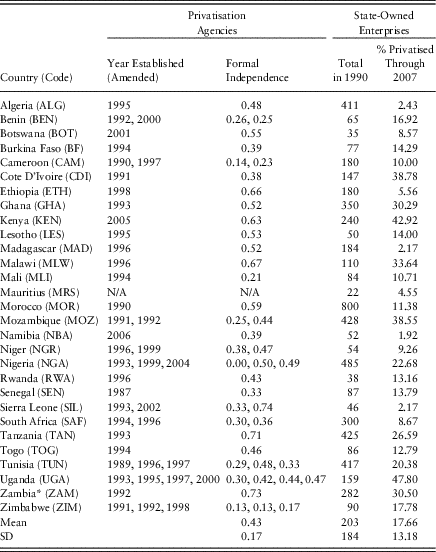
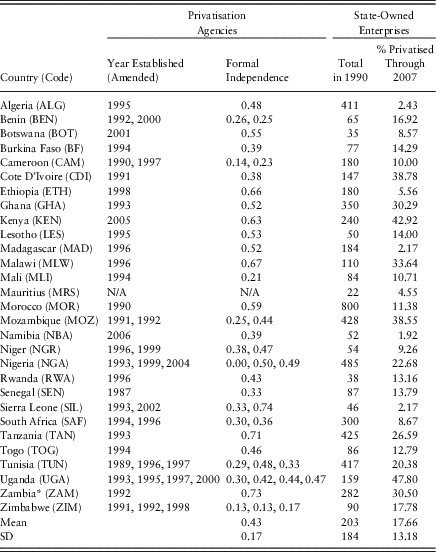
The dependent variable in this study is privatisation of SOEs. For the present analysis, we understand privatisation to mean the partial or full sale; divestiture; or transfer through the exercise of pre-emptive rights of a SOE to the private sector. As we are interested in the impact of privatisation agencies, we do not count corporatisation or commercialisation (i.e. restructuring of an enterprise to make it more competitive) of a SOE as a case of privatisation if the state retains principal management of the enterprise. We constructed an initial (1990) count of SOEs for each country based on archival and secondary sources as described in Appendix A. We measure privatisation as the cumulative percentage of a country’s 1990 SOEs sold each year through 2007. Measuring privatisation cumulatively is important because the extent of privatisation in any given country-year is in large part a function of how many of the country’s SOEs have already been privatised. Data on annual privatisations for each country were collected from two data sets on privatisation compiled by the World Bank from 1988 to 1999 and 2000 to 2007.Footnote 3 For each country-year, then, the dependent variable is the per cent of the country’s 1990 SOEs that were privatised by the end of the current year. For example, if a country had 100 SOEs in 1990 and privatised 10 of them in 1991 and 15 more in 1992, the cumulative percentage of SOEs privatised in 1992 would be 25. The main merits of this approach are replicability and face validity: data are from a common source and the measurement accounts for the widely varying size of the initial state-owned sectors across the sample of countries. Table 1 lists the countries in our sample, the relative independence of their privatisation agencies (discussed below), the year in which the privatisation agency was founded and the cumulative percentage of 1990 SOEs privatised in each country by 2007.
This approach has at least two limitations. First, our measure of privatisation weights each privatisation transaction equally, whether the transaction is large or small. Research on privatisation outcomes in East and Central Europe and Latin America demonstrates that privatising larger SOEs can be riskier or more difficult for governments than privatising smaller SOEs, owing to their greater employment levels and more extensive linkages with other sectors of the economy (World Bank 1995). A more perfect measure would capture the values of the SOEs being privatised, along with the count of SOEs privatised. Unfortunately, as many of these countries had barely functioning capital markets, it is impossible to assign accurate initial values to the SOEs that governments held in 1990 in any consistent way, and thus it is impossible to measure the cumulative share of a country’s SOEs as measured by capital value. However, the sale of each SOE generates its own difficulties and challenges, and the decision to privatise each one has the potential to activate supporters or opponents. This sensitivity is especially pronounced when state companies are privatised in a region of a country where there are a few alternative opportunities for employment. Although the revenue generated by such companies may constitute only a small percentage of the government’s total economy, the consequences can be devastating at a subnational level if the company collapses or its workforce is downsized following privatisation.
A second limitation of this metric is that it does not reflect the characteristics or quality of individual privatisation transactions. Our measure reveals the extent to which a country privatised in a given year but not the specific features of the privatisation process. Rent-seeking politicians may have captured particular sales by channelling advantageous transactions to favoured constituencies, even in the presence of formally independent privatisation agencies. Such capture is impossible to observe in the present data. In spite of these shortcomings, the percentage of SOEs privatised is nonetheless a useful way to measure outcomes for the present purpose: at a minimum, this metric indicates that a SOE has changed hands from the public to the private sector and that the firm is no longer under formal control of the government.
Independent variables
The main independent variables of interest are privatisation agencies’ formal independence and democracy. We measure independence with an original coding of the enabling legislation for each country’s privatisation agency, similar to Ennser-Jedenastik’s (Reference Ennser-Jedenastik2016) and Gilardi’s (Reference Gilardi2008) analyses of formal independence among regulatory agencies. The coded legislation for each country is described in Appendix B. In 10 countries, the agency’s enabling legislation changed once or more during the period of analysis. In these cases, the independence measure changes from year to year.
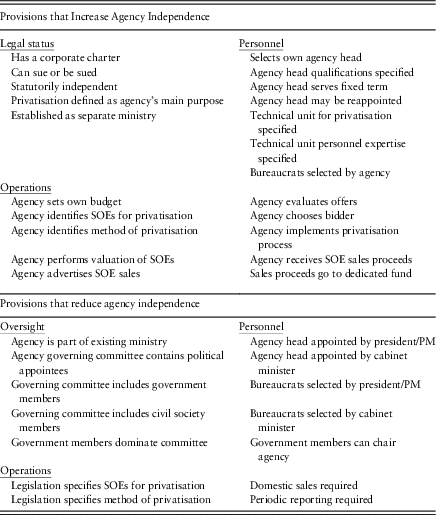
Our coding scheme for agency independence is based on a fine-grained review of each privatisation law passed in each country, an approach complicated by differences in language, legal traditions and levels of detail. Some laws are relatively brief and sparse, whereas others are long and very specific; some laws specify important institutional arrangements, whereas others are silent on the same institutions. In total, we coded nearly 50 laws, decree-laws, decrees, directives and ordinances from Anglophone, Lusophone and Francophone countries. We analysed each law section by section, identifying provisions that provided agency staff more or less discretion or gave elected officials more or less influence over the agency’s work. Legislative provisions that accorded an agency more discretion over its own operations to value parastatals, advertise the privatisation of firms and approve bids or explicitly limited the formal influence of politicians over the agency were classified as increasing agency independence; provisions that limited agency discretion or created formal channels for politicians to influence the agency’s work were classified as reducing independence. For each provision, the legislation was coded as a binary dummy with 1 if it made an agency more formally independent and 0 if it made the agency less independent. Table 2 lists the legislative provisions that we identified as indicators of independence. Appendix B lists the legislation that we coded to create the index.
Legislative indicators of formal agency independence
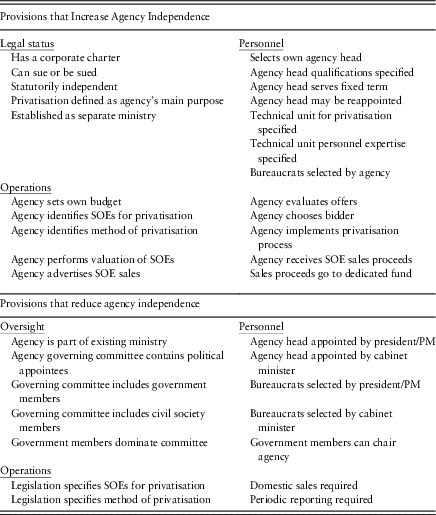
Note: SOEs=state-owned enterprises.
Source: Authors’ coding. See Appendix B for list of legislation coded.
A challenge that arises with any such coding scheme is how to handle cases where legislation is silent on an issue. For example, if legislation fails to address the means of dismissal of an agency head, should that be interpreted to mean that politicians may dismiss an agency head at will, or that they may not? Hanretty and Koop (Reference Hanretty and Koop2011, 203) caution care in addressing such “legislative lacunae”, and thus we develop a measure of agency independence that accounts for relative specificity of enabling legislation. The legislation underlying the present analysis varied widely in its provision of independence to privatisation agencies, from 35 such provisions (Kenya’s 2005 Privatisation Act and Togo’s 1994 Decree on Privatization) to just two (Nigeria’s 1993 Bureau of Public Enterprises Act). In order to create comparable measures across disparate laws, we created an index of agency independence. For any given country j, the independence index is the number of provisions that gives the privatisation agency greater formal independence (coded 1) divided by the number of such provisions in j’s enabling legislation (see Table 2). The result is an index bounded by 0 and 1. For example, Tanzania’s 1993 Public Corporations Act includes 28 provisions that formally define its privatisation agency’s independence, 20 of which tend to give the agency more independence, for a formal independence score of 0.71 (20/28). The results of our coding are reported in Table 1. Our regression models use standardised measures of independence to ease interpretation.
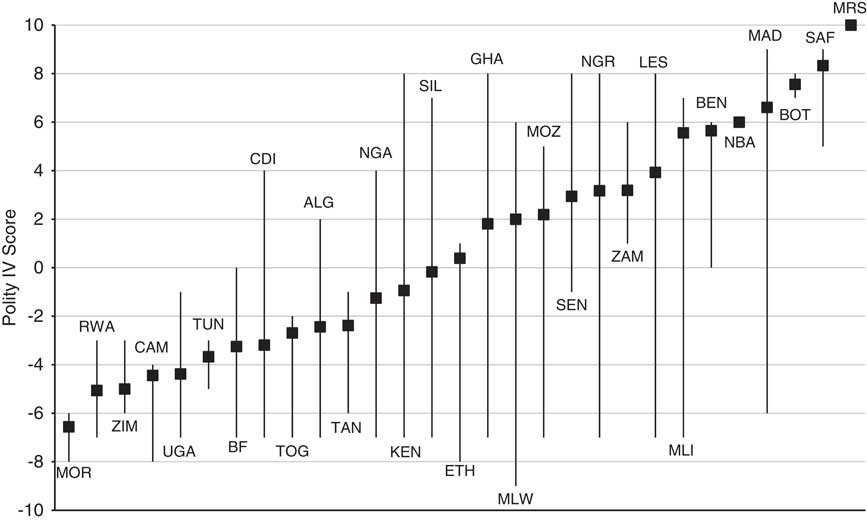
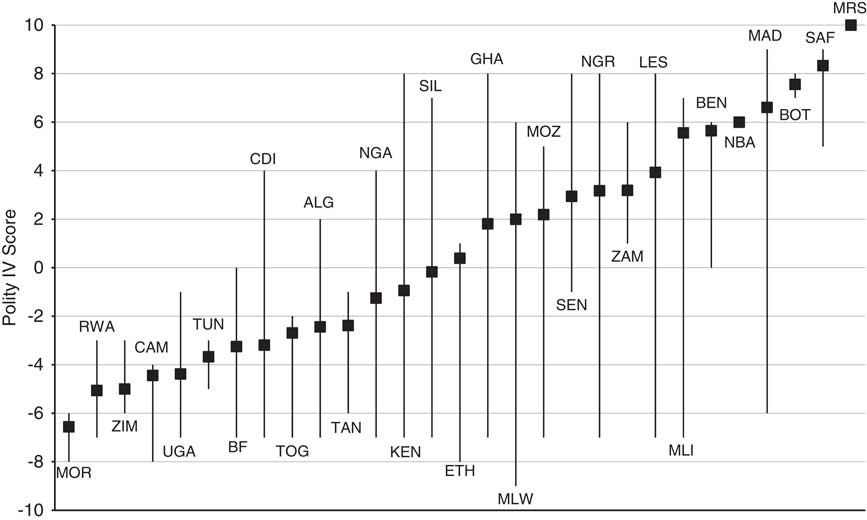
Hypothesis 2 involves the interaction of agency independence with a country’s degree of democratisation. We use annual assessments from the Polity IV project to measure the degree of democracy for each country. Each year Polity IV offers assessments that place national governments on a 21-point scale ranging from −10 (hereditary monarchy) to +10 (consolidated democracy) (Polity IV Project 2010). Although Polity IV scores tend to be stable over time in much of the world, they varied considerably across countries and time in Africa from the 1990s until 2007, reflecting the tumultuous economic and political transformations that occurred on the continent during that period (see Figure 1). This variation is useful in the present analysis because it allows us to observe how a privatisation agency’s formal independence correlates with outcomes as democratic conditions change. We also standardise the Polity IV measure of democracy in our models to ease its interpretation and facilitate analysis of interactions.
Polity IV scores in sampled countries, 1990–2007. Note: Boxes show mean Polity IV score and vertical lines indicate the range of Polity IV values for each country from 1990 to 2007.
Our statistical models include controls for size of the population and economy. All else equal, we would expect that larger countries with larger economies would have more SOEs, and thus our privatisation models control for size of economy using log population, and log gross domestic product (GDP) per capita, measured in 2007 US dollars. We also control for the size of the state sector in each country and year with government consumption as per cent of GDP, which we expect to be negatively correlated with privatisation. These annual population and economic data were drawn from the United Nations National Accounts Main Aggregates Database.Footnote 4 Finally, we include a dummy variable coded 1 for national election years or 0 for years between elections, with the expectation that countries might alter privatisation activity during election years. Controls for other demographic and economic variables such as population growth rate, economic growth rate, public sector employment and per capita gross national income were not included because they had no significant correlation with privatisation in our models, did not improve model fits or because annual data for each country were not available; we rely on our estimation procedure to account for unobserved country-level and annual variation. A descriptive summary of the variables used in our analysis is included in Appendix C.
Estimation
To evaluate our hypotheses, we develop a pair of pooled time series regression models of cumulative per cent SOE privatisations in our sample of countries over 17 years, similar to Humphreys and Bates (Reference Humphreys and Bates2005). The unit of analysis is country-year, so that each case represents the politics, institutions and privatisation actions of country j in year t. As our dependent variable is cumulative, the models include one-year lagged dependent variables, and thus our 18-year sample yields a 17-year time series.
Although each country in our sample privatised some SOEs during the period of analysis, different countries created privatisation agencies at different times, and one country in our sample (Mauritius) never created an independent agency during the period of study.Footnote 5 Altogether, about 31% of the sampled country-years has no privatisation agency at all. Analysis of these “zero cases” presents an acute challenge to the analysis of institutions (Gilardi Reference Gilardi2005). A basic approach to country-years with no privatisation agency is simply to include these cases with agency independence as zero values. This approach enjoys some face validity and makes efficient use of data, but may attenuate standard errors because it assumes that “no agency” is analytically equivalent to “agency with extremely low independence” (which it clearly is not in many cases).
Endogeneity further complicates estimation. The decision to create a bureaucratic agency and endow it with some degree of independence is itself a political act related to the outcome of interest: privatisation (see also Pepinsky Reference Pepinsky2014). Countries in Africa and elsewhere were not in a direct race towards privatisation, and the degree of formal independence assigned to a privatisation agency is likely to be associated with variables that also determine the degree of political support for privatisation itself. For example, evidence suggests that South Africa established a privatisation agency with low formal independence owing to concerns over domestic opposition to privatisation (Pitcher Reference Pitcher2012). The great variation in democracy and agency independence within and across the countries over time in our sample offer potential traction on these relationships, but isolating the effect of agency independence on policy outcomes requires accounting for factors that predict agency independence. A two-stage instrumental estimator would be an ideal solution; however, no data are available that would independently predict creation of a privatisation agency that would not predict privatisation itself. An alternative would be simply to drop “zero cases” and analyse only country-years in which a privatisation agency exists. However, ignoring these cases throws away potentially important information and obscures the problem of endogeneity rather than addressing it directly, and dropping zero cases would not address bias caused by variation in the degree of agency independence.
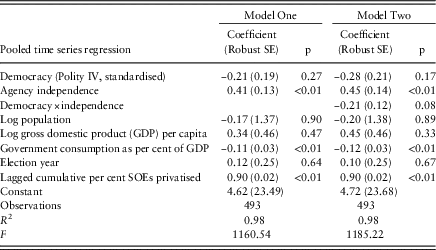
Instead, we retain all 493 cases and estimate our models using the generalised propensity score (GPS) weighting method suggested by Hirano and Imbens (Reference Hirano and Imbens2004), which is a generalisation of the more familiar binary treatment propensity score. This approach aims to remove biases in comparisons by treatment status in observational data by adjusting for differences in the likelihood that individual cases receive various levels of the treatment. The method proceeds in two stages. The first stage estimates the likelihood of being assigned some level of treatment (including zero), as a function of observable covariates. This procedure yields a GPS, the inverse of which is used to create propensity weights for each case. The second stage is a pooled time series estimator with country and year fixed effects, applying the propensity score weights in order to correct for biases that arise due to endogeneity. In the present analysis, the “treatments” are varying degrees of formal agency independence. We calculate propensity weights on the basis of several economic, demographic and political variables. We also include a dummy for each country-year’s participation in IMF standby agreements as coded by Dreher (Reference Dreher2006) as a means of measuring the influence of international development institutions on the creation of privatisation agencies (1 if the IMF held a standby agreement with a country in a given year, 0 otherwise). Propensity weighting cannot eliminate the effects of endogeneity in estimation, but it helps guard against bias. Full details on the calculation of propensity weights are reported in Appendix C. As tests of robustness, we fitted models with a variety of alternative estimation procedures, including several without GPS weighting. We also fitted models without the “zero cases”. The results of these and several other alternative estimates are reported in Appendix D. The estimated effects of democracy and agency independence were remarkably consistent with the results reported in Table 3.Footnote 6
Models of cumulative percentage of state-owned enterprises (SOEs) privatised 29 African countries, 1991–2007 (1990 base year).
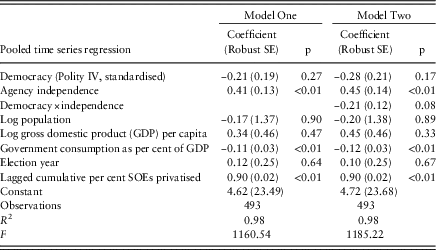
Note: Cells contain coefficients and robust standard errors generated by pooled time series models with inverse-propensity score weighting (see Appendix for propensity score estimation). Country and year effects omitted.
Table 3 reports the results of two propensity score weighted, time series models, estimated with robust standard errors. Model One includes direct effects only for evaluation of Hypothesis 1. Model Two adds multiplicative interaction terms for democracy with independence in order to evaluate Hypothesis 2.
Results
Hypothesis 1 predicts that privatisation increases as formal agency independence increases. Model One indicates such a positive correlation, consistent with the conventional view of technocratic insulation as a means of carrying out complex, controversial policy. All else equal, Model One estimates that a 1 SD increase in formal agency independence correlates with a 0.41% increase in cumulative per cent SOEs privatised in a given year.
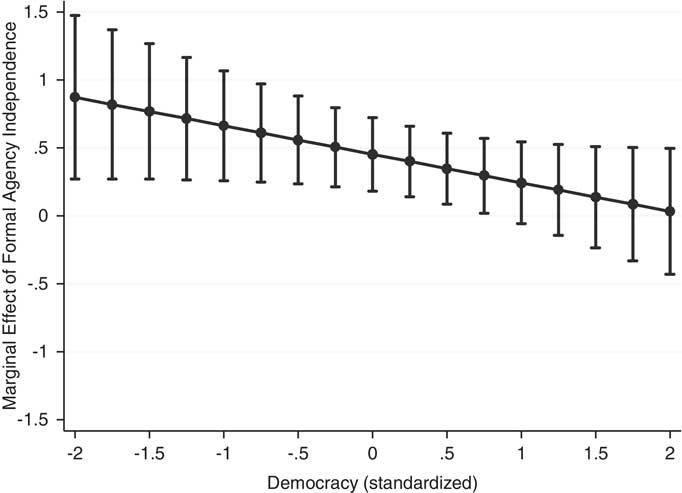
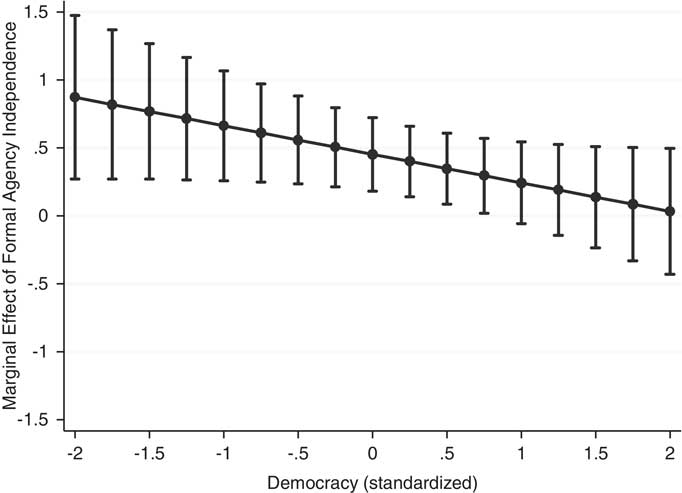
Turning to Hypothesis 2, Model Two’s democracy×independence interaction affirms the contingent independence hypothesis: agency independence positively predicts privatisation under authoritarian conditions, but the effect declines and then disappears as democracy increases. Following the method suggested by Brambor et al. (Reference Brambor, Clark and Golder2006), we illustrate this interactive relationship in Figure 2, which shows the estimated marginal effect of a 1 SD change in formal independence on cumulative privatisation at various levels of democracy. The plot indicates that agency independence correlates positively with privatisation under relatively authoritarian conditions – that is, when democracy is low to moderate – but that the correlation declines as democracy increases, consistent with Hypothesis 2. In substantive terms, a 1 SD change in formal agency independence predicts a corresponding 0.66% change in cumulative SOEs privatised under relatively authoritarian conditions (1 SD below the mean, a Polity IV score of about −3.8). Under more democratic conditions (1 SD above the mean, a Polity IV score of about +5.4), a 1 SD change in formal agency independence predicts just a 0.24% change in cumulative SOEs privatised – statistically indistinguishable from 0. Put simply, formal agency independence appears to affect the extent of privatisation only when democracy is low to moderate; under more democratic conditions, agency independence has no discernable effect. Together, these results are consistent with our expectations about democratically contingent technocratic independence.
Marginal effect of formal agency independence on cumulative privatisation. Note: Bars indicate 95% confidence intervals.
Discussion
Our results affirm that an agency’s degree of formal independence affects policy outcomes in the ways that existing studies in developed democracies have claimed: greater independence facilitates the implementation of a technically complex, politically sensitive policy. However, when we examine the impact of independence under varied political conditions, the results indicate that the effects of these agencies are contingent upon the political contexts in which they operate. More authoritarian environments were common in Africa during our period of analysis; from 1990 to 2007, 22 of our 29 sampled countries experienced at least one year in which their Polity IV scores were more than a full standard deviation below the mean, and only two countries (Botswana and Mauritius) consistently maintained Polity IV scores more than a standard deviation above the mean. Where pluralistic governance is absent and civil institutions are fragile, a high degree of technocratic independence under an authoritarian regime can help assure wary investors that a state is committed to liberalisation. If agencies are less independent, investors may worry about the stability of the government’s commitment to liberalisation, and thus be less willing to riskmaking an investment.
The effects of formal agency independence disappear under more democratic conditions. Our interpretation of this finding is that, just as formal agency independence sends signals to investors, it also alerts domestic interests to the government’s commitment to sell SOEs and to the potential re-distributive effects of privatisation. In a context in which rights to protest may have been newly acquired, opponents of privatisation may act to stymie sales by targeting agency activities. Meanwhile, the relative value of formal agency independence as a signal to investors declines in democracies, as pluralistic bargaining and multiple veto players offer assurance to investors. Strikingly, the effects of formal institutions in the process of privatisation are strongest under authoritarian conditions.
Directions for future study
This study contributes to an emerging body of research that recognises the diverse ways in which political institutions operate in developing and transitional democracies and economies. Its findings suggest several new avenues of enquiry. First, although our findings are consistent with our broad idea of democratically contingent technocracy, the present analysis does not allow us to disentangle the precise contributions of capacity, signalling to investors and signalling to domestic actors that underlie our findings. Additional statistical and/or qualitative analysis is needed to understand precisely which mechanisms are at work, under what conditions and with what effects. We pursue this line of enquiry in additional research through a qualitative comparison of privatisation agencies operating under different regime types in Africa (Pitcher and Teodoro Reference Pitcher and TeodoroForthcoming). Second, bureaucratic politics in both authoritarian and democratic developing countries remains little understood and deserves greater attention. It would be valuable to have a data set on agency independence in other parts of the world that is comparable with the one we have used here. A clear direction for additional research is to test the contingent technocracy hypothesis in other contexts. Latin America, eastern Europe and central and east Asia, where extensive privatisation occurred with and without democratisation, but where privatisation agencies have been ignored, offer promising opportunities to look for such interactions.
Finally, efforts should be made to measure the quality of privatisation transactions and liberalisation efforts more broadly. As noted earlier, our measure of privatisation treats all transactions equally, yet technocratic agencies likely play different roles in the privatisation of more valuable, more politically sensitive or more strategically significant SOEs. In Pitcher and Teodoro (Reference Pitcher and TeodoroForthcoming), we rely on case studies to explore the quality of transactions in more detail. Additional research on firms and sectors could more clearly identify the degree to which independent agencies affect the quality of the privatisation process through adherence to the professional standards that they were meant to uphold.
Conclusion
Policymakers and scholars have often prescribed insulating bureaucrats from popular opinion, endowing them with formal authority, and giving them a clear mandate to implement technically complex, politically contentious policies. Besides the administrative capacity that independent agencies offer, they signal a credible commitment to investors and international financial institutions. However, agency independence also sends signals to domestic political audiences, some of whom do not share the objectives of privatisation. Our findings enrich emerging understandings about how such agencies should work in different political contexts and what their “downstream effects” are (Pepinsky Reference Pepinsky2014, 649). Where governments are engaged in “two-level games”, formal bureaucratic independence might have its most significant effects under authoritarian conditions, owing to the value of formal institutions as signals of credible commitment and capacity to investors. This result is consistent with Maggetti’s (Reference Maggetti2007) finding in the context of established, stable democracies in Europe that formal agency independence has little effect on outcomes, but sharpens an emerging body of research that analyses the purpose and effectiveness of formal institutions under authoritarian conditions.
We conclude with an observation about our empirical subject: privatisation of SOEs in Africa. Looking back on the tumultuous politics of African privatisation in the 1990s, the World Bank’s Oliver Campbell White admitted that “One of the mistakes we made in privatizing in Africa was not talking to labour leaders early on” (quoted in Harsch Reference Harsch2000, 14). White continued:
We need to pay a lot more attention to garnering information on people’s views and getting people to participate in the formulation of policy. Yes, this may well slow up design, preparation, and implementation early on. But once you get that out of the way, [a privatization programme is] much more likely to be successful (quoted in Harsch Reference Harsch2000, 16, 17).
The present research contributes to a re-evaluation of the role of formal institutions and a reconsideration of the value of delegating power to independent agencies in developing countries that are undergoing political and economic change. Our findings suggest that the formal design of bureaucratic agencies matters even in contexts where political conditions are volatile. In such circumstances, agency design ought to balance technocratic independence with a degree of responsiveness to the public, especially (but not only) where democratic institutions are fragile or emerging. Democratic governments seeking stable, long-term policy change may find that fostering greater engagement between bureaucrats and interest groups may be more effective than insulating technocrats from the people they serve.
Acknowledgements
The authors thank Madiha Afzal, Rod Alence, George Alter, Emily Beaulieu, Thomas Flores, Amy Pond, Guy Whitten and participants in a University of Michigan Center for Political Studies seminar for comments on earlier versions of this article. The authors thank Cassandra Grafström, Maithili Jalihal and Jessica Steinberg for research assistance. Catherine Morse provided valuable help locating legislation for coding. The authors are grateful to three anonymous reviewers and the editor for helpful comments on earlier versions of the manuscript.
Supplementary Material
To view supplementary material for this article, please visit https://doi.org/10.1017/S0143814X16000258