1. Introduction
The South China Block comprises the Yangtze Block in the northwest and the Cathaysia Block in the southeast (Fig. 1a). The Ordovician–Silurian Wuyi–Yunkai orogeny caused deformation and metamorphism over much of southeastern South China, and the development of a foreland basin in the northwestern Cathaysia Block and southern Yangtze Block (Li et al. Reference Li, Li, Wartho, Clark, Li, Zhang and Bao2010). However, the pre-Wuyi–Yunkai configuration of South China and the nature of the orogeny remain controversial. Some have suggested that an ocean existed between the Yangtze and Cathaysia blocks for at least the latest Neoproterozoic to Cambrian period (Shui, Reference Shui1988; Liu & Xu, Reference Liu and Xu1994) or even until the Jurassic (Hsü et al. Reference Hsu, Sun, Li, Chen, Pen and Sengor1988, Reference Hsu, Li, Chen, Wang, Sun and Sengor1990) before the two blocks joined together. The Mesozoic ocean model did not receive much support because the key evidence for the so-called ‘Mesozoic Banxi mélange’ was later proved to be Neoproterozoic in age and with different tectonic affinities (e.g. Zhou, Reference Zhou1989; Li et al. Reference Li, Zhou, Zhao, Fanning and Compston1994; Li, Z. X. et al. Reference Li, Li, Kinny, Wang, Zhang and Zhou2003). The Cambrian ocean model (Shui, Reference Shui1988; Liu & Xu, Reference Liu and Xu1994) suggests that the Yangtze and Cathaysia blocks first docked at their eastern ends during the early to middle Neoproterozoic period, with a V-shaped ocean widening to the west (as wide as ~ 2000 km) until the Cambrian period. This residual ocean closed during the Ordovician–Silurian period, leading to the formation of a coherent South China Block. Such a collision was taken as the cause of the Ordovician–Silurian ‘Caledonian orogeny’ in South China (Huang et al. Reference Huang, Ren, Jiang, Zhang and Qin1980; Yang, Cheng & Wang, Reference Yang, Cheng and Wang1986; Ren, Reference Ren1991), which was recently renamed the Wuyi–Yunkai orogeny with a redefined age range of > 460– 415 Ma (Li et al. Reference Li, Li, Wartho, Clark, Li, Zhang and Bao2010). The boundary between the two blocks was consequently considered a suture zone due to the closure of the Cambrian ocean (e.g. Xu & Qiao, Reference Xu and Qiao1989; Liu & Xu, Reference Liu and Xu1994; Xu, Xu & Pan, Reference Xu, Xu and Pan1996; Chen et al. Reference Chen, Hou, Xu and Tian2006).
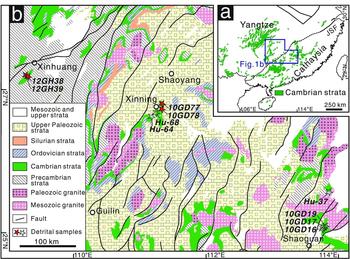
(a) Distribution of Cambrian strata in the South China Block, highlighting the inferred boundary between the Yangtze and Cathaysia blocks. JSF – Jiangshan–Shaoxing Fault. (b) Geological map of central South China, highlighting three Cambrian sampling regions from central Yangtze, southeastern Yangtze and northern Cathaysia. Red stars are samples from this study, and white stars are samples reported in previous studies.

Alternatively, it has been argued that the complete amalgamation between the Yangtze and Cathaysia blocks had already finished by the Neoproterozoic period (e.g. Li, Zhang & Powell, Reference Li, Zhang and Powell1995; Charvet et al. Reference Charvet, Shu, Shi, Guo and Faure1996; Zhao & Cawood, Reference Zhao and Cawood1999; Zhou et al. Reference Zhou, Yan, Kennedy, Li and Ding2002; Li et al. Reference Li, Bogdanova, Collisons, Davidson, De Waele, Ernst, Fitzsimons, Fuck, Gladkochub, Jacobs, Karlstrom, Lu, Natapov, Pease, Pisarevsky, Thrane and Vernikosky2008, Reference Li, Li, Li, Lo, Wang, Ye and Yang2009), and that the Wuyi–Yunkai orogeny was an intraplate orogeny related to South China's collision with Gondwanaland, which closed a Neoproterozoic failed continental rift (Li, Reference Li and Flower1998; Li & Powell, Reference Li and Powell2001). In such a model, no ocean floor is required for the basin (the Nanhua Basin) between the Yangtze and Cathaysia blocks. The intraplate model was also supported by other researchers, based on magmatic and metamorphic analyses of lower Palaeozoic rocks (Li et al. Reference Li, Li, Wartho, Clark, Li, Zhang and Bao2010), provenance analyses of Cambrian–Silurian sandstones (Wang et al. Reference Wang, Zhang, Fan, Zhang, Chen, Cawood and Zhang2010) and structural analyses of lower Palaeozoic strata in the region (e.g. Faure et al. Reference Faure, Shu, Wang, Charvet, Choulet and Monie2009; Charvet et al. Reference Charvet, Shu, Faure, Choulet, Wang, Lu and Le Breton2010; Shu et al. Reference Shu, Jahn, Charvet, Santosh, Wang, Xu and Jiang2014). However, the provenance analyses by Wang et al. (Reference Wang, Zhang, Fan, Zhang, Chen, Cawood and Zhang2010) combined data from Cambrian–Silurian sandstones together, thus mixing the Cambrian provenance data with that of the Ordovician–Silurian sandstones formed during the Yangtze-ward propagation of the intraplate Wuyi–Yunkai orogeny from the Cathaysia Block. As syn-orogenic foreland basin sedimentary rocks on the Yangtze Block would naturally contain detritus shed from the growing orogen on the Cathaysia Block, we do not regard Wang et al.'s (Reference Wang, Zhang, Fan, Zhang, Chen, Cawood and Zhang2010) provenance analysis as a vigorous enough test for the Cambrian ocean model.
Here we use a provenance analysis of Cambrian sedimentary rocks to test whether or not a Cambrian ocean was present. If the ocean existed, the provenance of Cambrian sandstones from the Yangtze and Cathaysia sides of the Nanhua Basin will likely be different. Otherwise, detrital exchanges between the two blocks are expected. We report new detrital zircon U–Pb geochronological data for four Cambrian sandstone samples from the Yangtze Block side (two from central Yangtze and two from southeastern Yangtze) of the Nanhua Basin, and compare them with published U–Pb results from both northwestern Cathaysia and southeastern Yangtze to argue against the Cambrian ocean model in South China.
2. Geological setting and sampling
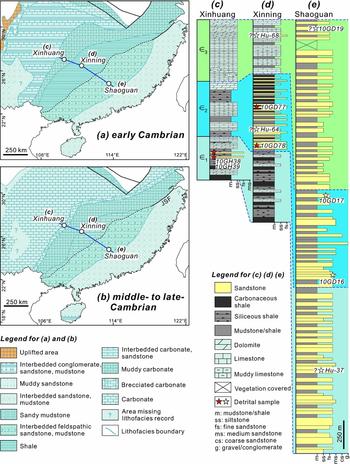
The boundary between the Yangtze and Cathaysia blocks lies approximately along the Jiangshan–Shaoxing Fault in the NE South China Block (Fig. 1a). The southwestern extension of the boundary is unclear due to poor exposure and tectonic modifications (Ren, Reference Ren1991; Li et al. Reference Li, Li, Wartho, Clark, Li, Zhang and Bao2010), but has been defined using the mostly disconnected Cambrian lithofacies boundaries between Cathaysian clastic sedimentary facies and Yangtze clastic–carbonate facies (Fig. 2a, b) (Liu & Xu, Reference Liu and Xu1994). This boundary was also taken as a suture zone of the Cambrian ocean by Liu & Xu (Reference Liu and Xu1994) and Chen et al. (Reference Chen, Hou, Xu and Tian2006). During the Cambrian period, sedimentation over the Yangtze Block was dominated by carbonate, muddy carbonate and sandy carbonate, with some clastic–carbonate intercalations in the lower Cambrian (Fig. 2a) (e.g. BGMRHN, 1988; RGMRHN-a, 1975; RGMRHN-b, 1972; Liu & Xu, Reference Liu and Xu1994). In contrast, the Cathaysia Block received massive clastic sedimentation, consisting of shale, siltstone, arkosic sandstone, quartz sandstone and pebbly sandstone (Fig. 2a, b) (e.g. BGMRJX, 1984; BGMRGD, 1988; Zhang & He, Reference Zhang and He1993; Liu & Xu, Reference Liu and Xu1994; Yao et al. Reference Yao, Li, Li, Li and Yang2014).
(a, b) Palaeogeographic maps of the South China Block (revised after Liu & Xu, Reference Liu and Xu1994): (a) early Cambrian, (b) middle to late Cambrian. (c–e) Stratigraphic columns of Cambrian strata and sandstone samples from (c) the Xinhuang section of central Yangtze (RGMRHN-b, 1972), (d) the Xinning section of southeastern Yangtze (RGMRHN-a, 1975), and (e) the Shaoguan section of northern Cathaysia (Yao et al. Reference Yao, Li, Li, Li and Yang2014; W. H. Yao & Z. X. Li, unpub. data, 2014). Red stars are samples from this study, and white stars are samples reported in previous studies.

Three sampling localities across the Yangtze–Cathaysia boundary were selected, including central Yangtze (Xinhuang), southeastern Yangtze (Xinning) and northwestern Cathaysia (Shaoguan) (Fig. 1b). The Xinhuang section consists of ~ 1400 m of Cambrian strata, with massive carbonate–shale units and minor fine-grained sandstone layers in the lower Cambrian strata (Fig. 2c) (RGMRHN-b, 1972). The Xinning section consists of ~ 1800 m of Cambrian strata, including 680 m of clastic strata. It consists of shale, siliceous shale and minor carbonate in the lower Cambrian strata, shale and sandstone intercalations in the middle Cambrian strata, and carbonate with minor shale in the upper Cambrian strata (Fig. 2d) (RGMRHN-a, 1975). The Shaoguan section consists of ~ 3800 m of Cambrian strata, with thick siltstone, feldspathic quartz sandstone, pebbly sandstone and thin grey-purple mudstone beds (Fig. 2e) (Zhang & He, Reference Zhang and He1993).
A grey medium-grained quartz sandstone sample (12GH38) and a grey-white fine-grained sandstone sample (12GH39) were collected from the lower Cambrian strata at the Xinhuang section (Fig. 2c), whereas a dark green medium-grained sandstone sample (10GD77) and a grey fine-grained sandstone sample (10GD78) were collected from the middle Cambrian strata at the Xinning section (Fig. 2d). Results of two sandstone samples (Hu-64, Hu-68) from the middle to upper Cambrian strata of the Xinning region (Fig. 2d), three sandstone samples (10GD16, 10GD17, 10GD19) from the middle to upper Cambrian strata, and one sandstone sample (Hu-37) from the lower Cambrian strata of the Shaoguan region (Fig. 2e) were reported in previous studies (Wang et al. Reference Wang, Zhang, Fan, Zhang, Chen, Cawood and Zhang2010; Yao et al. Reference Yao, Li, Li, Li and Yang2014) and used here for comparison.
3. Analytical methods
Mineral separation of sandstone samples was conducted at the Institute of Hebei Regional Geology and Mineral Survey in Langfang, China. Conventional magnetic and density techniques were adopted to concentrate non-magnetic and heavy fractions. Zircon grains, together with zircon standards, were cast in epoxy mounts and polished to reveal half sections for analysis. All zircons were documented with transmitted and reflected light microphotographs as well as cathodoluminescence (CL) images to reveal their internal structures. Zircon U–Pb analyses were carried out in the John de Laeter Centre at Curtin University, Australia, using the Sensitive High Resolution Ion MicroProbe (SHRIMP) facility. Standard operating conditions of 2 nA O2 − primary beam and a spot size of ~ 25 μm in diameter and ~ 2 μm in depth were followed, and each U–Th–Pb measurement consisted of six cycles. U abundance was calibrated using zircon standard BR266 (Stern, Reference Stern2001), and 206Pb/238U ratio was constrained by zircon standard Plešovice (Sláma et al. Reference Slama, Kosler, Condon, Crowley, Gerdes, Hanchar, Horstwood, Morris, Nasdala, Norberg, Schaltegger, Schoene, Tubrett and Whitehourse2008). The detailed analytical procedure follows that of Williams (Reference Williams, McKibben, Shanks, III and Ridley1998). Data reduction was carried out using the SQUID v2.50 (Ludwig, Reference Ludwig2001a ) and Isoplot/Ex v2.49 (Ludwig, Reference Ludwig2001b ) packages. Zircon U–Pb data and Concordia plots are shown in Figures S1, S2 and Table S1 in the online Supplementary Material available at http://journals.cambridge.org/geo.
4. Analytical results
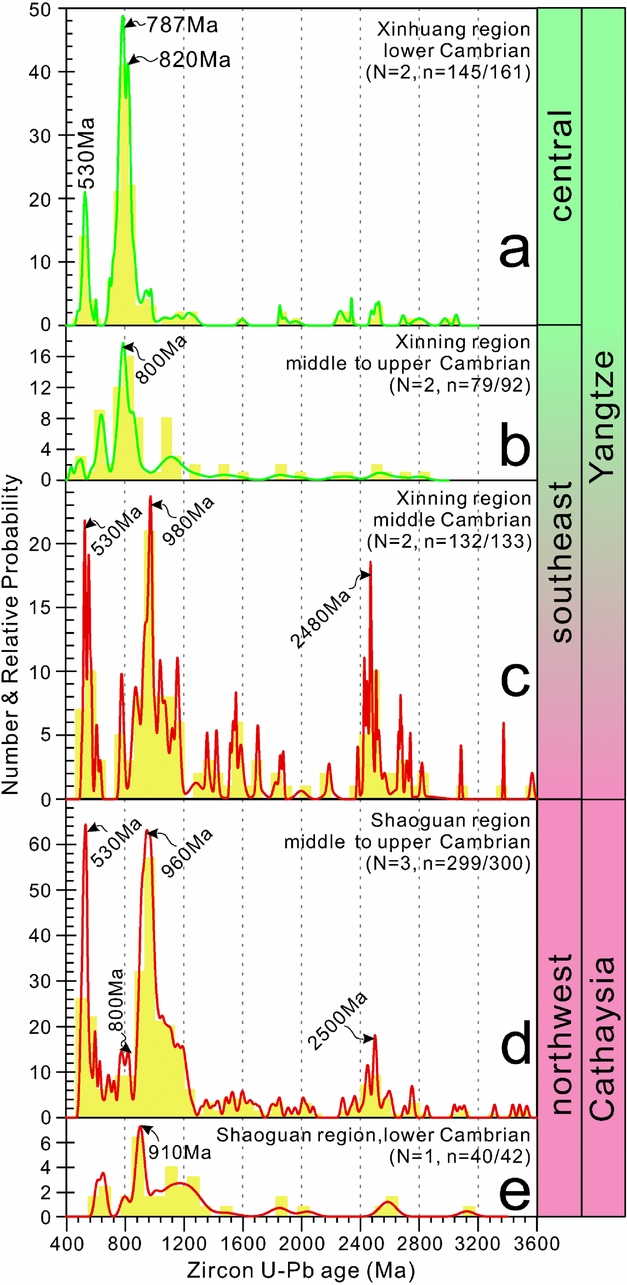
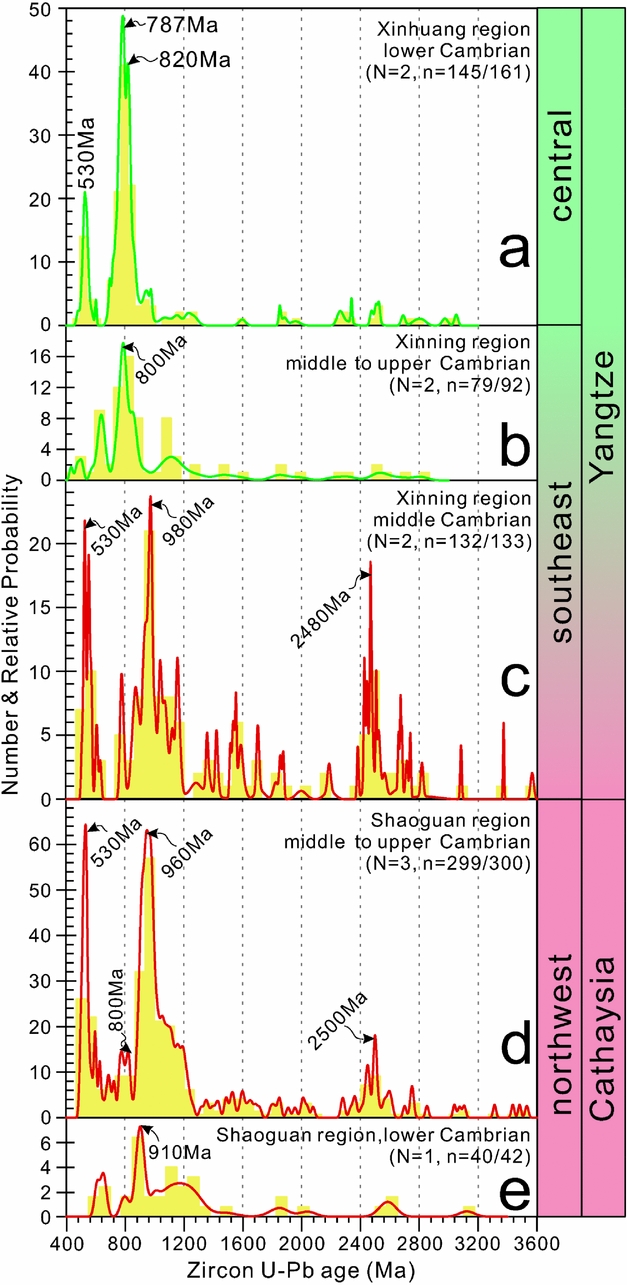
Samples 12GH38 and 12GH39 from central Yangtze (the Xinhuang section) are similar in U–Pb age patterns. Of the total 161 analyses, 145 are concordant (in the 90–110 % range), with ages ranging from 3050 ± 12 to 480 ± 10 Ma. Both samples show a prominent age peak at 850–750 Ma and a moderate age peak at 530–500 Ma, with a few scattered Proterozoic ages (Fig. 3a). Samples 10GD77 and 10GD78 from southeastern Yangtze (the Xinning section) are quite consistent in their U–Pb age patterns. Of the total 133 analyses, 132 are concordant, ranging from 3576 ± 11 to 509 ± 6 Ma. Both samples show prominent age peaks at 1100–900 Ma and 530–500 Ma, a moderate age peak at 2500 Ma, plus a few scattered Proterozoic ages (Fig. 3b). The detrital zircons of all four samples exhibit large compositional variations in Th and U contents, and most zircons (84 %) have Th/U > 0.3; only eight grains (3 %) have Th/U < 0.1 (Table S1 in online Supplementary Material available at http://journals.cambridge.org/geo). Th/U ratios and zoning structures of zircons indicate that most detrital zircons are probably of magmatic origin.
Plots of zircon U–Pb age histograms and relative probability of Cambrian sandstone samples from (a) Xinhuang (this study), (b) Xinning (this study), (c) Xinning (Wang et al. Reference Wang, Zhang, Fan, Zhang, Chen, Cawood and Zhang2010), (d) Shaoguan (Yao et al. Reference Yao, Li, Li, Li and Yang2014), and (e) Shaoguan (Wang et al. Reference Wang, Zhang, Fan, Zhang, Chen, Cawood and Zhang2010). Plotted ages are within concordance of 90–110 % for analysed zircons. N – number of samples, n – number of concordant analyses/total number of analyses.
5. Discussion
5.a. Cambrian sediment dispersal across South China
Geochronological results show that lower Cambrian sandstones from central Yangtze (Xinhuang) have a prominent age peak at ~ 790 Ma and a subordinate peak at ~ 530 Ma (Fig. 3a), whereas Cambrian sandstones from northwestern Cathaysia (Shaoguan) have a different prominent peak at ~ 960–910 Ma and a subordinate peak at ~ 530 Ma, with minor peaks at ~ 800 Ma and ~ 2500 Ma (Fig. 3d, e) (Wang et al. Reference Wang, Zhang, Fan, Zhang, Chen, Cawood and Zhang2010; Yao et al. Reference Yao, Li, Li, Li and Yang2014). This indicates that the Yangtze and Cathaysia blocks likely had different provenances during the Cambrian period. Statistical analysis (K–S test) (Kolmogorov, Reference Kolmogorov1933; Smirnov, Reference Smirnov1944) was conducted on samples from central Yangtze and northwestern Cathaysia, and the results (Table S2 in online Supplementary Material available at http://journals.cambridge.org/geo) also indicate that these two groups of samples had different provenances.
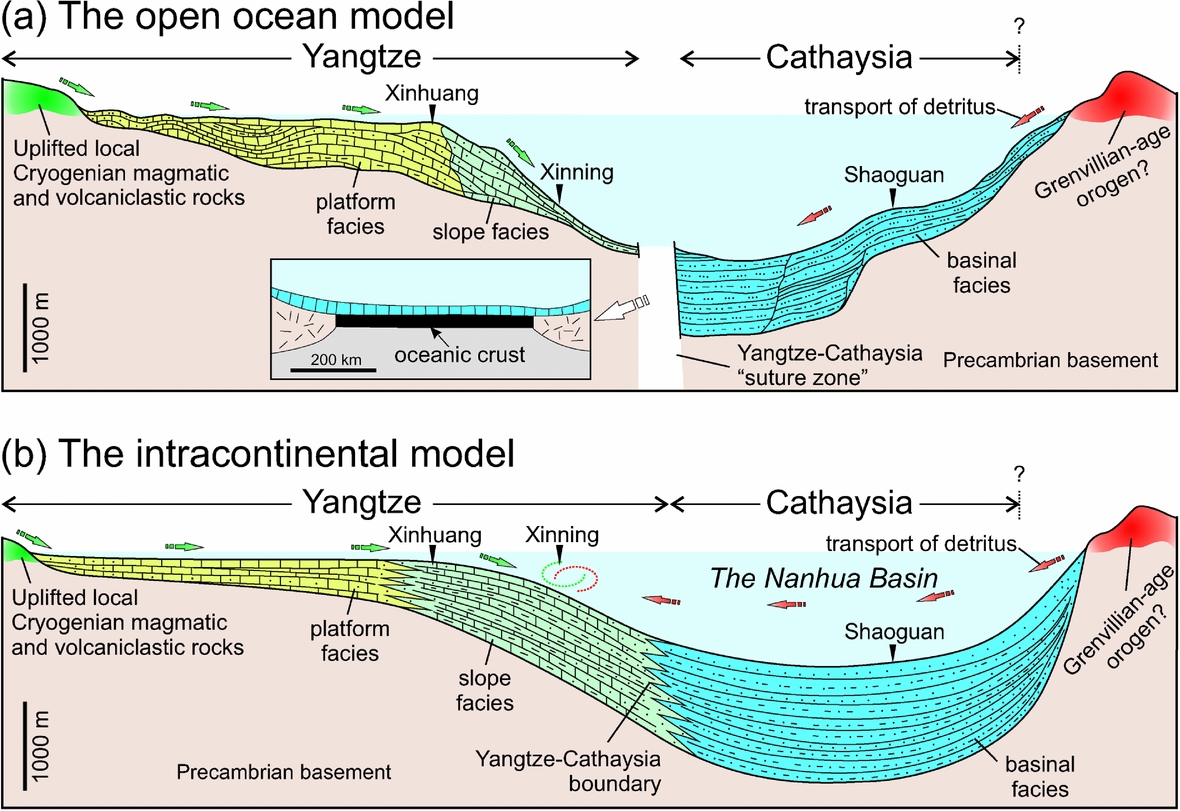
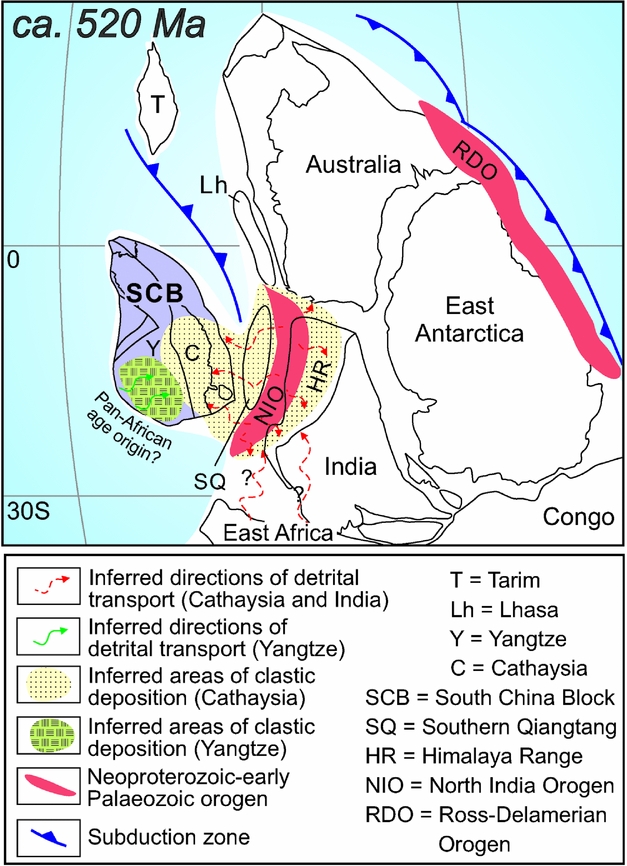
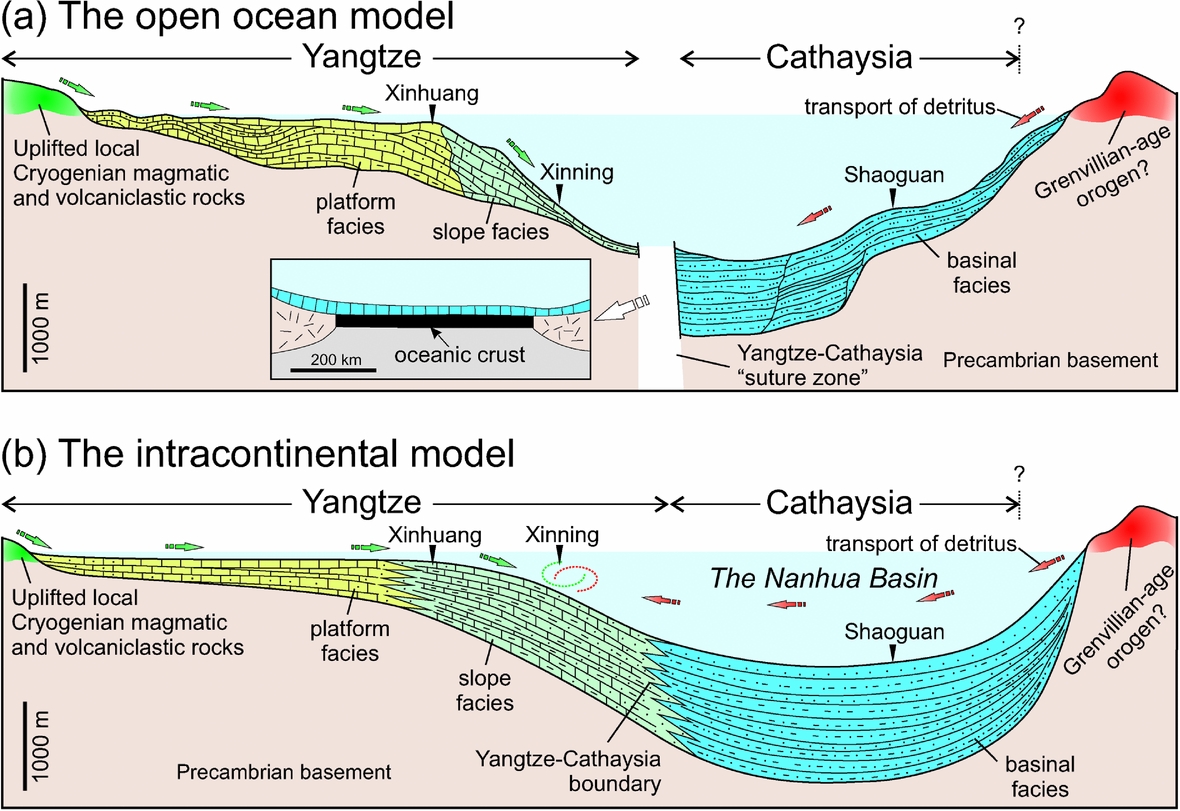
The palaeogeography of South China shows that, during the early Cambrian period, the Yangtze Block was dominantly a marine carbonate platform, receiving intercalated clastic and carbonate sediments with water deepening to the southeast; around an isolated land area, conglomeratic facies were deposited (Fig. 2a). During the middle to late Cambrian period, it received carbonate and muddy carbonate deposition (Fig. 2b) (Liu & Xu, Reference Liu and Xu1994). Since Cryogenian volcanic, volcaniclastic and intrusive rocks (860–750 Ma) are widespread in western Yangtze Neoproterozoic rift basins (e.g. Zhou et al. Reference Zhou, Yan, Kennedy, Li and Ding2002, Reference Zhou, Ma, Yan, Xia, Zhao and Sun2006; Li, X. H. et al. Reference Li, Li, Ge, Zhou, Li, Liu and Wingate2003; Li, Z. X. et al. Reference Li, Li, Kinny, Wang, Zhang and Zhou2003; Li, X. et al. Reference Li, Li, Zhou, Liu, Liang and Li2003; Wang & Li, Reference Wang and Li2003), we speculate that these c. 860–750 Ma rocks in western Yangtze were probably uplifted during the early Cambrian period and provided detritus to the Cambrian sandstones of central Yangtze (Fig. 4a, b). The Cathaysia Block, on the other hand, received deposits of intercalated marine sandstones and mudstones, possibly with no exposed land in the region during the Cambrian period (Fig. 2a, b). Both the NW-directed palaeocurrents and northwestward-fining sediments in the Cambrian strata of Cathaysia and southeastern Yangtze indicate an external provenance outboard to southeastern Cathaysia (Wang et al. Reference Wang, Zhang, Fan, Zhang, Chen, Cawood and Zhang2010; W. H. Yao & Z. X. Li, unpub. data, 2014). Yao et al. (Reference Yao, Li, Li, Li and Yang2014) proposed that South China was probably once connected to the northern Indian part of Gondwanaland, along the southeastern margin of Cathaysia. The Grenvillian magmatic rocks (1100–950 Ma) (e.g. Liu et al. Reference Liu, Siebel, Massonne and Xiao2007; Cottle et al. Reference Cottle, Jessup, Newell, Horstwood, Noble, Parrish, Waters and Searle2009), minor c. 880–820 Ma magmatic rocks and recycled 2500 Ma zircons in sedimentary rocks (e.g. Myrow et al. Reference Myrow, Hughes, Goodge, Fanning, Williams, Peng, Bhargava, Parcha and Pogue2010) of northern India and adjacent orogens probably provided detritus to Cathaysia during the Cambrian period (Figs 4b, 5).
Cartoons illustrating possible paths of sediment transport during the Cambrian period for (a) the open ocean model and (b) the intracontinental model (revised after Liu & Xu, Reference Liu and Xu1994). Detrital provenance analyses of Cambrian sandstones support the intracontinental model.
A palaeogeographic reconstruction of South China on the margin of eastern Gondwanaland at c. 520 Ma (revised after Yao et al. Reference Yao, Li, Li, Li and Yang2014), showing mixing of two different detrital provenances at the Yangtze–Cathaysia boundary.
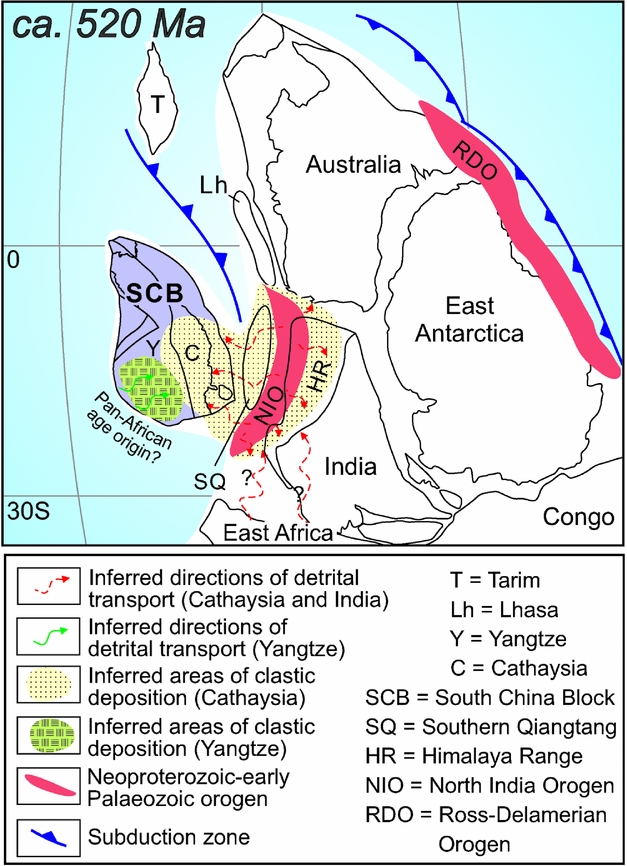
The common age peak at ~ 530 Ma in both central Yangtze and northwestern Cathaysia (Fig. 3a, d, e) suggests that both source areas (western Yangtze and northern India?) were affected by an early Palaeozoic orogeny and produced ~ 530 Ma magmatic rocks in the source regions. The 530 Ma magmatic detritus was recorded in Cambrian sandstones not only from central Yangtze and northwestern Cathaysia, but also from southeastern Yangtze (Xinning) (Fig. 3c). However, Cambrian sandstones in southeastern Yangtze exhibit mixed age patterns, with a major ~ 800 Ma peak in the middle to upper Cambrian sandstones (Fig. 3b) and a major ~ 980 Ma peak in the middle Cambrian sandstones (Fig. 3c). The ~ 800 Ma age peak is probably of the same origin as those in the lower Cambrian sandstones from central Yangtze (Fig. 3a), i.e. from western Yangtze. However, the ~ 980 Ma peak in southeastern Yangtze (Fig. 3c) indicates that detritus was probably sourced from northern India, and transported across Cathaysia to southeastern Yangtze (Figs 4b, 5). This interpretation is supported by the NW-directed palaeocurrents in the Xinning Cambrian strata (Wang et al. Reference Wang, Zhang, Fan, Zhang, Chen, Cawood and Zhang2010).
Sediment dispersal in South China can thus be summarized as the following. During the early Cambrian period, Cryogenian magmatic rocks in western Yangtze provided detritus to central Yangtze (Xinhuang). Northwestern Cathaysia (Shaoguan) received detritus from the southeast – an external source, possibly northern India, which likely hosted a Grenvillian-aged orogen (Fig. 4b). In southeastern Yangtze (Xinning), on the lower slope of the Yangtze platform compared to the Xinhuang region, mainly deep-water shales and siliceous shales were deposited during the early Cambrian period. During the middle to late Cambrian period, southeastern Yangtze probably received a major flux of detritus from a Grenvillian-aged orogen to the southeast, with a smaller portion of detritus from local western Yangtze sources (Fig. 4b).
5.b. Was there a Cambrian ocean in South China?
In the Cambrian ocean model as proposed by Shui (Reference Shui1988) and Liu & Xu (Reference Liu and Xu1994), the Yangtze Block (central and southeastern Yangtze) should only have recorded detrital grains from western Yangtze (e.g. with a ~ 800 Ma age peak) (Fig. 3a, b) rather than showing a ~ 980 Ma age peak (Fig. 3c). The fact that the southeastern Yangtze recorded a dominantly Cathaysia-like provenance argues against the Cambrian ocean model. There are additional lines of evidence arguing against the ocean model, including: (1) the absence of early Palaeozoic ophiolites or arc-like magmatic rocks related to ocean closure in the region (Chen et al. Reference Chen, Rong, Rowley, Zhang, Zhang and Zhan1995; Li, Reference Li and Flower1998); (2) early Palaeozoic granites in South China that are largely sourced from remelting of old basement rocks with little input of juvenile mantle (e.g. Chen & Jahn, Reference Chen and Jahn1998; Zhou, Reference Zhou2003; Zeng et al. Reference Zeng, Zhang, Zhou, Zhong, Xiang, Liu, Jin, Lu and Li2008; Li et al. Reference Li, Li, Wartho, Clark, Li, Zhang and Bao2010; Wang et al. Reference Wang, Zhang, Fan, Zhao, Zhang, Zhang, Zhang and Li2011); (3) lower Palaeozoic sedimentary rocks in South China exhibit strongly negative εNd(t) values (e.g. Li & McCulloch, Reference Li and McCulloch1996; Chen & Jahn, Reference Chen and Jahn1998), which is inconsistent with being originated from a juvenile crust generated during an ocean closure in the early Palaeozoic period; and (4) sedimentary facies across the Cambrian Nanhua Basin are laterally coherent and vertically continuous and conformable (e.g. Liu & Xu, Reference Liu and Xu1994), with no sign of convergent tectonics.
Based on the palaeogeography of South China and mixed provenance of Cambrian sandstones in southeastern Yangtze, we therefore favour the intracontinental model (e.g. Li, Reference Li and Flower1998; Faure et al. Reference Faure, Shu, Wang, Charvet, Choulet and Monie2009; Charvet et al. Reference Charvet, Shu, Faure, Choulet, Wang, Lu and Le Breton2010; Li et al. Reference Li, Li, Wartho, Clark, Li, Zhang and Bao2010; Wang et al. Reference Wang, Zhang, Fan, Zhang, Chen, Cawood and Zhang2010; Shu et al. Reference Shu, Jahn, Charvet, Santosh, Wang, Xu and Jiang2014). In this model, the Yangtze and Cathaysia blocks had become a coherent block before the Cambrian period. Detritus from the uplifted western Yangtze was transported along the Yangtze platform and deposited in central Yangtze (Xinhuang) (Fig. 3a) as well as southeastern Yangtze (Xinning) (Fig. 3b). Detritus shed from northern India or even eastern Africa (a Grenvillian-age orogen? see Yao et al. Reference Yao, Li, Li, Li and Yang2014 for detailed discussion) travelled to northern Cathaysia (Shaoguan) (Fig. 3d, e) and all the way to southeastern Yangtze (Xinning) (Fig. 3c). Since central Yangtze (Xinhuang) is located on the upper opposite slope of the Nanhua Basin, it would have been difficult for Indian detritus to reach that region.
Provenance analyses of Cambrian sandstones across the Yangtze–Cathaysia boundary therefore provide evidence that argues against the existence of a broad Cambrian ocean, but is consistent with the intracontinental model, which is also supported by sedimentary facies analyses across South China (Chen et al. Reference Chen, Rong, Rowley, Zhang, Zhang and Zhan1995; Shu et al. Reference Shu, Jahn, Charvet, Santosh, Wang, Xu and Jiang2014; W. H. Yao & Z. X. Li, unpub. data, 2014). Since southeastern Yangtze received shale and siliceous shale without clastic deposits in the lower Cambrian strata, it failed to record provenance mixing from the Cathaysia side. This may lead to the speculation that an ocean could still have existed during the early Cambrian period. However, as mentioned before, such a speculation can be ruled out because there is neither any record of an arc system nor any sign of convergent tectonics within the Nanhua Basin during the entire Cambrian period.
Acknowledgements
The authors thank Hao Gao for assistance in SHRIMP U–Pb dating, Hongxia Ma for making zircon mounts, and Chris Elders for commenting on the manuscript. Comments from chief editor Mark Allen, reviewer Jacques Charvet and an anonymous reviewer improved this manuscript greatly. This study was supported by the Australian Research Council (DP110104799), a Chinese Academy of Science SAFEA International Partnership Programme for Creative Research Teams grant (KZCX2-YW-Q04–06) and the National Natural Sciences Foundation of China (41173039). This is TIGeR (The Institute for Geoscience Research) publication #569, and contribution 469 from the ARC Centre of Excellence for Core to Crust Fluid Systems (http://www.ccfs.mq.edu.au/).
Declaration of interest
None.
Supplementary material
To view supplementary material for this article, please visit http://dx.doi.org/10.1017/S0016756814000338