According to Hewitt, Flett, Turnbull-Donovan, and Mikail (Reference Hewitt, Flett, Turnbull-Donovan and Mikail1991), Self-Oriented Perfectionism (SOP) is considered to be the intrapersonal facet of multidimensional perfectionism. It is defined as the self-application of unrealistic performance standards, the motivation to reach perfection and the tendency to self-criticize when making a mistake or when failing to achieve the proposed goals.
Unlike other multidimensional perfectionism dimensions, such as Socially Prescribed Perfectionism, whose close link with neuroticism and psychopathology in general is evident (e.g., Morris & Lomax, Reference Morris and Lomax2014), there is no agreement as to the adaptive or maladaptive nature of SOP. Thus, its differential association with adjustment and maladjustment variables suggests an ambiguous pattern of correlates, a topic that is not free from debate.
In the field of child and adolescent perfectionism, SOP, together with Socially Prescribed Perfectionism, are assessed using the Child/Adolescent Perfectionism Scale (Flett et al., Reference Flett, Hewitt, Besser, Su, Vaillancourt, Boucher and … Gale2016). However, several validations of the scale (e.g., McCreary, Joiner, Schmidt, & Ialongo, Reference McCreary, Joiner, Schmidt and Ialongo2004), including the Spanish population validation (Vicent, Reference Vicent2017), have found a better fit for a three-dimensional model that maintained the Socially Prescribed Perfectionism dimension while dividing the SOP items into two separate dimensions: Self-Oriented Perfectionism-Criticism (SOP-C) and Self-Oriented Perfectionism-Strivings (SOP-S). This new conception of SOP as two independent facets has been supported by results from studies that have examined the correlates of both intrapersonal perfectionist dimensions, i.e., SOP-C and SOP-S (Harvey, Moore, & Koestner, Reference Harvey, Moore and Koestner2017; Herman, Wang, Trotter, Reinke, & Ialongo, Reference Herman, Wang, Trotter, Reinke and Ialongo2013; McCreary et al., Reference McCreary, Joiner, Schmidt and Ialongo2004; O’Connor, Rasmussen, & Hawton, Reference O’Connor, Rasmussen and Hawton2010). Thus, it has been demonstrated that SOP-C is positively linked with maladjustment variables such as depression, anxiety, stress and negative affect. Moreover, SOP-C is not significantly related with adjustment variables such as school performance or positive affect. In contrast, SOP-S presents a more adaptive correlate pattern, as long as it is not significantly correlated with measures of psychological distress. Nevertheless, this construct is positively and significantly correlated to adjustment variables such as school performance (Harvey et al., Reference Harvey, Moore and Koestner2017; Herman et al., Reference Herman, Wang, Trotter, Reinke and Ialongo2013; McCreary et al., Reference McCreary, Joiner, Schmidt and Ialongo2004; O’Connor et al., Reference O’Connor, Rasmussen and Hawton2010).
Aggressive behavior is a complex construct involving multiple ways, functions and components. This study is based on the conceptualization of Buss and Perry, who consider three components of aggressive behavior: Cognitive (hostility), emotional (anger) and motor (physical and verbal aggression). Currently, it has been shown that aggressive behavior responds to a non-linear continuity pattern, which is especially significant in children manifesting high levels of aggressiveness at early ages (Petersen, Bates, Dodge, Lansford, & Pettit, Reference Petersen, Bates, Dodge, Lansford and Pettit2015; Piquero, Carriaga, Diamond, Kazemian, & Farrington, Reference Piquero, Carriaga, Diamond, Kazemian and Farrington2012). Likewise, beyond the strong continuity that characterizes aggressive behavior, the existence of certain risk factors responsible for the variability in its development is assumed (Petersen et al., Reference Petersen, Bates, Dodge, Lansford and Pettit2015).
So, taking into account this empirical background, it is important to analyze aggressive behavior in children, as well as certain personality traits such as intrapersonal perfectionism, whose manifestations are visible in childhood (Oros, Iuorno, & Serppe, Reference Oros, Iuorno and Serppe2017). This goal aims to identify those variables that may act as risk or protective factors of the development of maladaptive patterns of aggressive behavior. However, research on perfectionism, in general, and specifically, on SOP, has been characterized by examining its correlates with internalizing disorders, such as depression, anxiety, eating disorders, obsessive-compulsive disorder, etc. (e.g., Morris & Lomax, Reference Morris and Lomax2014). There is a limited, yet growing interest in the understanding of how this personality trait may affect certain externalizing problems, such as aggressive behavior (e.g., García-Fernández, Vicent, Inglés, Gonzálvez, & Sanmartín, Reference García-Fernández, Vicent, Inglés, Gonzálvez and Sanmartín2017; Stoeber, Noland, Mawenu, Henderson, & Kent, Reference Stoeber, Noland, Mawenu, Henderson and Kent2017; Vicent, Inglés, Sanmartín, Gonzálvez, & García-Fernández, Reference Vicent, Inglés, Sanmartín, Gonzálvez and García-Fernández2018).
The review conducted in this study finds several limitations regarding the previous empirical evidence. First, it should be noted that, to our knowledge, no studies to date have separately examined the dimensions of SOP-C and SOP-S. Thus, previous works have used SOP as a unitary measure of intrapersonal perfectionism, despite criticism regarding the dimensionality of such scale (e.g., McCreary et al., Reference McCreary, Joiner, Schmidt and Ialongo2004). This may explain why results of past studies have been contradictory and do not permit clear conclusions regarding the relationship between SOP and aggressive behavior. In this line, for instance, some works have found evidence for a positive and significant association between SOP and hostility (Besser, Flett, & Hewitt, Reference Besser, Flett and Hewitt2004; Lee & Mi, Reference Lee and Mi2010) and anger (e.g., Blankstein & Lumley, Reference Blankstein and Lumley2008; Myoung-Ho, Reference Myoung-Ho2009; Reference Saleh-Esfahani and Ali-Besharat2010); while other studies have found that the relationship between SOP and anger was not significant (e.g., Dunkley & Blankstein, Reference Dunkley and Blankstein2000; Hewitt et al., Reference Hewitt, Caelian, Flett, Sherry, Collins and Flynn2002; Macedo et al., Reference Macedo, Bos, Marques, Maia, Soares, Pereira and … Azevedo2009; Stoeber, Schneider, Hussain, & Matthews, Reference Stoeber, Schneider, Hussain and Matthews2014).
Moreover, to our knowledge, with the exception of the works of Stoeber et al. (Reference Stoeber, Noland, Mawenu, Henderson and Kent2017) and Vicent et al. (Reference Vicent, Inglés, Sanmartín, Gonzálvez and García-Fernández2018), no prior studies have jointly considered the three components of aggressive behavior. That is, previous studies have only focused on hostility and anger. Hence, the data available on the link between the motor component of aggressive behavior (i.e., physical and verbal aggression) and SOP is limited to these two works (i.e., Stoeber et al., Reference Stoeber, Noland, Mawenu, Henderson and Kent2017; Vicent et al., Reference Vicent, Inglés, Sanmartín, Gonzálvez and García-Fernández2018). Specifically, Vicent et al. (2018), in a sample of 1,202 Spanish students aged 8–12, found that participants with a profile of high scores on all aggressive behavior dimensions scored significantly higher on SOP than their peers having a moderate or low profile. However, results of this study do not offer knowledge on independent relations between SOP and each dimension of aggressive behavior. This issue was resolved by Stoeber et al. (Reference Stoeber, Noland, Mawenu, Henderson and Kent2017), who conducted bivariate and partial correlational analysis using three samples of undergraduates (N = 318, 417 and 398) aged 17 to 51, in order to determine the relationship existing between perfectionist dimensions (controlling for all other facets) and aggressive behavior. The authors obtained bivariate positive and significant correlations between SOP, Verbal Aggression and Hostility, as well as positive partial correlations between SOP and Physical Aggression. Nonetheless, as stated above, the use of SOP as a unitary construct may lead to incorrect results due to its bi-dimensional structure, which consists of two distinct dimensions. Therefore, they should not be assessed using a single scale.
In order to overcome these limitations, this study aims to analyze the relationship existing between the components of aggressive behavior (i.e., cognitive or hostility, emotional or anger, and motor or physical and verbal aggression) and the two intrapersonal perfectionist dimensions (i.e., SOP-C and SOP-S) in a population of Spanish children. Specifically, it is intended to (a) determine the existence of statistically significant differences between participants having high and low scores on SOP-C and SOP-S for each of the dimensions of aggressive behavior, and (b) examine the predictive capability of SOP-C and SOP-S on high scores on the aggressive behavior components. According to prior research that considers that, respectively, SOP-C and SOP-S represent the maladaptive and adaptive facets of intrapersonal perfectionism (Harvey et al., Reference Harvey, Moore and Koestner2017; Herman et al., Reference Herman, Wang, Trotter, Reinke and Ialongo2013; McCreary et al., Reference McCreary, Joiner, Schmidt and Ialongo2004; O’Connor et al., Reference O’Connor, Rasmussen and Hawton2010), it is expected that:
Hypothesis 1. Students with high SOP-C will score significantly higher on hostility, anger, physical and verbal aggression than their peers with low levels of SOP-C. Likewise, SOP-C will be a positive and significant predictor of high scores on the components of aggressive behavior.
Hypothesis 2. Non-significant differences will be found between the high and low SOP-S groups on hostility, anger and physical and verbal aggression. Similarly, SOP-S will be a non-significant predictor of high scores on the components of aggressive behavior.
Method
Participants
Participants were selected using a multi-stage random cluster sampling, with the geographical areas of the Spanish provinces of Alicante, Murcia and Albacete (center, north, south, east and west) serving as the primary units. The secondary units were the school centers (between one and three centers that were randomly and proportionally selected from each geographical zone). Thus, a total of 10 public and private schools were selected. Finally, the classrooms were considered as the tertiary units. Specifically, four classrooms, one per each academic grade from 3rd to 6th grade of primary school education were randomly selected. An initial sample of 982 students was obtained, of which 4.96% were excluded because they failed to provide the consent of their parents and/or legal guardians; 4.89% because they did not have the minimum reading level to be able to respond the tests; and 4.28% because of omissions or errors in their responses. Thus, a final sample of 804 students aged 8 to 11 (M = 9.57; DE = 1.12) was recruited. As a Chi-square test reveals (χ2 = 5.08; p = .17), the sample distribution was homogeneous across sex and age. 51.7% of participants were male and 48.3% were female. As for the distribution according to age, 21.9%, 27.1%, 22.6% and 28.4% of participants were 8, 9, 10 and 11 years old, respectively. Regarding the sample’s ethnic composition, 86.94% were Spanish, 6.34% African, 4.73% Latin-American, 1.37% were from European countries other than Spain, and 0.87% were Asian.
Instruments
Child/Adolescent Perfectionism Scale (CAPS; Flett et al., Reference Flett, Hewitt, Besser, Su, Vaillancourt, Boucher and … Gale2016; Vicent, Reference Vicent2017). The SOP-C and SOP-S subscales of the Spanish version of the CAPS (Vicent, Reference Vicent2017) were used. Both subscales consist of four items that are valued using a 5-point Likert scale. The SOP-C assesses perfectionist self-criticism and fear of making mistakes (e.g., “I get angry with myself when I make a mistake”), whereas the SOP-S measures the desire and efforts made to be perfect (e.g., “I try to be perfect in everything I do”). The Spanish validation (Vicent, Reference Vicent2017), using a child population aged 8 to 11, revealed adequate indexes of reliability and temporal stability (SOP-C: α = .70, txx = .73; SOP-S: α = .72, txx = .62).
Aggression Questionnaire (AQ; Buss & Perry, Reference Buss and Perry1992; Santisteban & Alvarado, Reference Santisteban and Alvarado2009). This is a self-report of 29 items that are valued using a 5-point Likert scale. The test consists of four dimensions: I. Hostility or the tendency to experience annoyance and the cognitive evaluation toward others, considering them as a source of conflict (e.g., “When people are especially friendly, I wonder what they want”); II. Anger or the tendency to experience feelings or emotions characterized by annoyance, irritation or fury (e.g., “Sometimes I feel like a bomb about to explode”); III. Physical Aggression or aggressive behavior manifested through any form of physical mistreatment (e.g., If I am provoked enough, I may hit another person”); IV. Verbal Aggression or aggressive verbal behavior, such as insults, threats, taunts, etc. (e.g., “When people don’t agree with me, I can’t help arguing with them”). Santisteban and Alvarado (Reference Santisteban and Alvarado2009) obtained adequate indexes of reliability, Cronbach’s alpha, ranging from .65 (for the Anger subscale) to .87 (for Physical Aggression). Reliability levels for this study were Cronbach’s alpha = .77, .71, .82 and .77, respectively, for Hostility, Anger, Physical and Verbal Aggression.
Procedure
A meeting was arranged with the management teams of the selected educational centers in order to inform them of the goals of our study and to request their collaboration. Once they confirmed their participation, parents or legal guardians of the participating students were asked to sign the informed consent. Those students receiving the consent of their parents or legal guardians completed the tests in groups, during school hours, and for a period of approximately 40 minutes. A duly trained research team member supervised the administration process. This researcher emphasized the anonymous and voluntary nature of the activity. At no time were students asked to provide information that could reveal their identity. Thus, in order to safeguard the confidentiality of the data, each participant was assigned a random number.
Data analysis
In order to determine any potential differences between students with high (scores ≥ 75 percentile) and low (scores ≤ 25 percentile) levels of SOP-C and SOP-S, the t-Student test was used on the mean scores obtained in the AQ dimensions. Effect sizes were calculated with the d index to obtain the magnitude of the observed differences. This index was interpreted in accordance with the Cohen’s criteria (1988): Small effect (values between .20 and .50), moderate (values between .51 and .79) and large (values equal to or greater than .80).
Similarly, the binary logistic regression method, following the forward stepwise process based on Wald’s statistic, was used to examine the predictive capacity of SOP-C and SOP-S on high scores (≥ 75 percentile) for the four components of aggressive behavior. The logistic model estimates the probability of an event or an outcome (i.e., high Anger, Hostility, Physical and Verbal Aggression) taking place, as opposed to not taking place, in the presence of one or more predictors (i.e., SOP-C and SOP-S). This probability is estimated using the OR (Odd Ratio) statistic which is interpreted as follows: OR > 1 indicates prediction in a positive sense, OR < 1 indicates prediction in a negative sense, and 1 indicates no prediction (De Maris, Reference De Maris, Schinka and Velicer2003).
Statistical analyses were performed with the SPSS/IBM version 22.0 program.
Results
Differences in the components of aggressive behavior based on high and low SOP-C
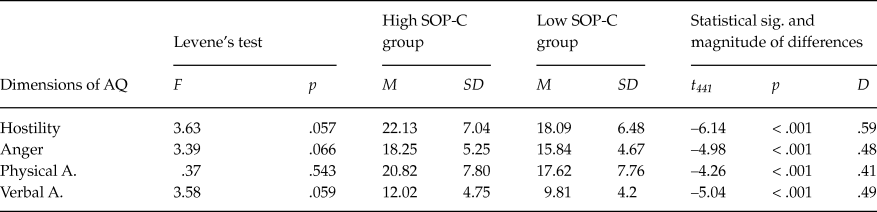
Table 1 reveals that students with high SOP-C differed significantly from their peers having low SOP-C with regards to levels of Hostility, Anger, Physical and Verbal Aggression. Specifically, students with high SOP-C revealed higher scores. Likewise, in all cases, effect sizes associated with these differences were of a small magnitude (d = between .41 and .49), with the exception of Hostility, whose effect size was moderate (d = .59).
Means, Standard Deviations and Effect Sizes for the AQ Dimensions Obtained by Groups with High and Low SOP-C

Note: Physical A. = Physical Aggression; Verbal A. = Verbal Aggression.
Predictive capability of SOP-C on the high scores in the components of the aggressive behavior
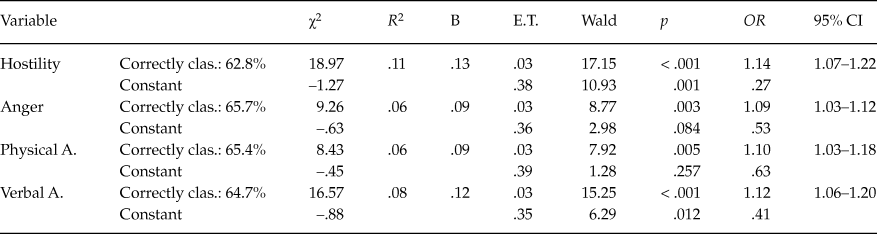
According to Table 2, the proportion of corrected classified cases ranged from 62.8% (for Hostility) to 65.7% (for Anger) and Nagelkerke’s R 2 ranged from .06 (for Anger and Physical Aggression) to .13 (for Hostility). Results revealed that SOP-C was a significant and positive predictor of high scores in the four AQ dimensions. Specifically, it was found that the probability of having high levels of Hostility, Anger, Physical Aggression and Verbal Aggression increases by 14%, 9%, 10% and 12%, respectively, for each point scored on the SOP-C.
Binary Logistic Regression for the Probability of Presenting High Scores on the AQ Dimensions, according to SOP-C

Note: Physical A. = Physical Aggression; Verbal A. = Verbal Aggression; Correctly clas. = Correctly classified; CI = confidence interval.
Differences in the components of aggressive behavior based on high and low SOP-S
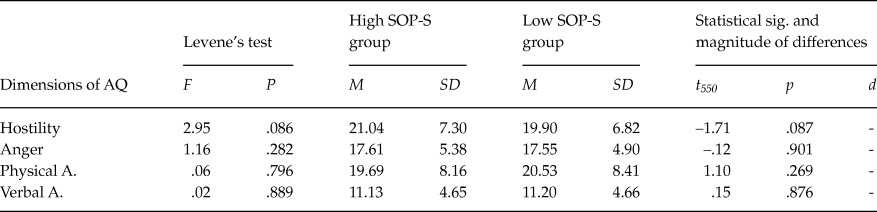
Table 3 presents the results for the differences between high and low SOP-S in the mean scores of aggressive behavior. The groups with high and low SOP-S did not differ significantly in terms of Hostility, Anger, Physical Aggression or Verbal Aggression.
Means, Standard Deviations and Effect Sizes for the AQ Dimensions Obtained by Groups with High and Low SOP-S

Note: Physical A. = Physical Aggression; Verbal A. = Verbal Aggression.
Predictive capability of SOP-S on the high scores in the components of aggressive behavior
Regarding the predictive capability of SOP-S on high levels of Hostility, Anger, Physical Aggression and Verbal Aggression, none of these four dimensions were significantly predicted by SOP-S.
Discussion
The goal of this work was to examine the relationship between the two dimensions of intrapersonal perfectionism (i.e., SOP-C and SOP-S) and aggressive behavior, considering its cognitive (Hostility), emotional (Anger) and motor (Physical and Verbal Aggression) components.
Regarding SOP-C, participants with high levels on this dimension scored significantly higher on all components of aggressive behavior as compared to their peers with low levels of SOP-C. Small and medium affect sizes indicate that the differences are not only significant, but their effects are also sufficiently large as to be theoretically interesting and to have practical consequences on daily life (Lakens, Reference Lakens2013). It was also found that SOP-C positively predicted high levels of the four dimensions of aggressive behavior. Thus, Hypothesis 1, according to which it was expected to find evidences of a positive and significant relationship between SOP-C and aggressive behavior, has been confirmed.
Regarding the link between SOP-C and the emotional and cognitive component of aggressive behavior, individuals with high levels of self-critical perfectionism tend to judge themselves harshly and to focus on their mistakes, regardless of their insignificance. This leads them to experience feelings of fury and anger, especially when they make mistakes or experience frustrating situations. So, it has been demonstrated that self-criticism is associated with Anger (Dunkley & Blankstein, Reference Dunkley and Blankstein2000; Dunkley, Blankstein, & Flett, Reference Dunkley, Blankstein and Flett1995), either towards oneself or others (e.g., Abi-Habib & Luyten, Reference Abi-Habib and Luyten2013). Moreover, self-criticism appears to be associated with the tendency of students to present non-pathological paranoid subclinical beliefs (Mills, Gilbert, Bellew, McEwan, & Gale, Reference Mills, Gilbert, Bellew, McEwan and Gale2007), which is a mode of thought marked by exaggerated self-referential biases that occur in normal everyday behavior (Fenigstein & Vanable, Reference Fenigstein and Vanable1992). Along the same line, paranoid beliefs generate increased hostility: “People with paranoid beliefs appear to live in a hostile, rather cold world, where a certain kind of affiliative emotion, both from others and within the self, may be constricted” (Mills et al., Reference Mills, Gilbert, Bellew, McEwan and Gale2007, p. 362).
On the other hand, there may be two causes for the nexus between SOP-C and the motor component of aggressiveness. First, it may be due to the fact that subjects with high levels of self-criticism tend to have difficulties in controlling their anger since they lack the self-regulatory mechanisms to do so (Abi-Habib & Luyten, Reference Abi-Habib and Luyten2013; Dunkley et al., Reference Dunkley, Blankstein and Flett1995). Therefore, sometimes their expression of anger toward others may generate interpersonal conflicts that may result in physical or verbal aggressions. On the other hand, paranoid thinking leading to a hostile perception of the environment could also be associated with aggressive behaviors since aggressiveness is a basic defense mechanism towards perceived threats (Mills et al., Reference Mills, Gilbert, Bellew, McEwan and Gale2007).
In accordance with Hypothesis 2, the results of this study also revealed the absence of statistically significant differences between students with high and low SOP-S. Moreover, SOP-S did not significantly predict high levels of any of the AQ dimensions. This suggests that perfectionist efforts and motivation to achieve perfection (i.e., SOP-S) are not associated with consistent aggression during late childhood. Although SOP-S clearly has positive consequences on certain aspects such as academic performance, its benefits may not extend to other areas, such as affective level or the control of aggressiveness. On the contrary, SOP-C has clear negative consequences that are already manifested from an early age (Harvey et al., Reference Harvey, Moore and Koestner2017). Therefore, our findings are consistent with those from previous works that consider self-criticism and effort as the dysfunctional and healthy facets of intrapersonal perfectionism, respectively (Harvey et al., Reference Harvey, Moore and Koestner2017; Herman et al., Reference Herman, Wang, Trotter, Reinke and Ialongo2013; McCreary et al., Reference McCreary, Joiner, Schmidt and Ialongo2004; O’Connor et al., Reference O’Connor, Rasmussen and Hawton2010).
Thus, the negative and positive (or at least, not dysfunctional in terms of aggressiveness) nature of the SOP-C and SOP-S dimensions, respectively, may justify the fact that prior studies examining the relationship between SOP, as a unitary construct, and aggressive behavior, has revealed such heterogeneous results (Besser et al., Reference Besser, Flett and Hewitt2004; Blankstein & Lumley, Reference Blankstein and Lumley2008; Dunkley & Blankstein, Reference Dunkley and Blankstein2000; Hewitt et al., Reference Hewitt, Caelian, Flett, Sherry, Collins and Flynn2002; Lee & Mi, Reference Lee and Mi2010; Macedo et al., Reference Macedo, Bos, Marques, Maia, Soares, Pereira and … Azevedo2009; Myoung-Ho, Reference Myoung-Ho2009; Reference Saleh-Esfahani and Ali-Besharat2010; Stoeber et al., Reference Stoeber, Noland, Mawenu, Henderson and Kent2017; Stoeber et al., Reference Stoeber, Schneider, Hussain and Matthews2014; Vicent, Reference Vicent2017). In this sense, these divergences may possibly be explained by the fact that SOP is associated with aggressive behavior, either positively or non-significantly, depending on the intrapersonal facet that prevails (i.e., self-criticism or strivings). These results also agree with empirical evidence suggesting that self-criticism appears to be the most critical pathological component of perfectionism (Dunkley, Zuroff, & Blanstein, Reference Dunkley, Zuroff and Blankstein2006), and that SOP could be positive if removing the overlap with self-criticism (Powers, Koestner, Zuroff, Milyavskaya, & Gorin, Reference Powers, Koestner, Zuroff, Milyavskaya and Gorin2011; Powers, Milyavskaya, & Koestner, Reference Powers, Milyavskaya and Koestner2012).
This study has certain limitations. First, caution should be used when generalizing the results to populations distinct from those considered in this work (i.e., Spanish students aged 8 to 11). Second, although self-reports constitute the usual assessment instrument for perfectionism and aggressive behavior, we should recall that its use is not devoid of certain problems. Therefore, future studies should use other assessment techniques, and should consider alternative sources such as parents, classmates or teacher nominations. Third, the study design prevents us from establishing causal relationships between the analyzed variables. This aspect may be enhanced through the use of longitudinal data and structural equation modeling. Likewise, in the case in which significant cause-effect relationships were obtained between SOP-C and components of aggressive behavior, it would be interesting to determine the direction of this relationship. Similarly, future works should analyze whether or not a direct relationship exists between SOP-C and Physical and Verbal Aggression, or whether this relationship was mediated by Hostility and Anger. Moreover, taking into account the heterogeneity of aggressive behavior, it would be interesting to examine the relationship between SOP-C and other functions and means of aggressiveness, such as reactive and proactive aggression. Specifically, it would be interesting to examine whether or not SOP-C is more related to a reactive type of aggression as opposed to a proactive one.
Finally, given the existence of certain gender-based differences in aggressive behavior (e.g., Björkqvist, Reference Björkqvist2018), gender should be considered in future works as a potential moderator variable of the relationship between SOP-C and aggressive behavior.
Despite these potential limitations, this study offers a novel contribution to the scientific community, given that it is the first study to examine the relationship between intrapersonal perfectionism and the components of aggressive behavior (i.e., cognitive, emotional and motor), considering the SOP-C and SOP-S dimensions as separated variables. Moreover, this work also serves to advance the research on childhood perfectionism, a field that has yet to be sufficiently explored (Oros et al., Reference Oros, Iuorno and Serppe2017). Instead of the absence of a significant relationship between perfectionist strivings and the dimensions of aggressive behavior, results suggest that children with high levels of self-criticism and a fear of making mistakes tend to be more hostiles, experience more frequent feelings of anger and manifest more aggressive behavior. Therefore, it is recommended that violence and aggression prevention programs include strategies to build resilience, self-acceptance and self-compassion from an early age, so as to counteract this tendency towards self-criticism and fear of failure (Flett & Hewitt, Reference Flett and Hewitt2014); tendencies that, unfortunately, are increasingly prevalent in Western society (Curran & Hill, Reference Curran and Hill2017).