1. Introduction
Around the middle of the twentieth century, science was included in the national systems of innovation and knowledge. Many countries implemented the reforms, forging a closer cooperation between research institutions and businesses as well as governmental bodies in order to improve the transfer of knowledge and technology to economy (Messeni Petruzzelli Reference Messeni Petruzzelli2011; Rasmussen et al. Reference Rasmussen, Moen and Gulbrandsen2006). These processes led to science and research no longer being an autotelic value, but an economically measurable value. Research driven by curiosity and a simple quest for the truth was replaced by striving to deliver solutions that reflect current social and economic needs (Bauer Reference Bauer2013; Mittelstrass Reference Mittelstrass2012; Nowotny Reference Nowotny2006).
The change has been expressed by the development of grant programmes built around social and economic challenges significant for the state. This set-up is meant to provide an incentive for researchers to implement useful research and ensure an effective use of research budgets. Consequently, a growing proportion of the funds for research is offered as part of competitions or calls for project proposals, and there is a mounting pressure on researchers to apply and compete for funding (Nowotny Reference Nowotny2006; Ziman Reference Ziman1996, Reference Ziman2000).
The success of the new approach is conditioned by the perception of the implemented changes by academia. However, the transit from broadening and disseminating knowledge to its capitalisation gives rise to many controversies. Currently, there are still professionally active researchers for whom research work is a quest for the truth within the scope of their basic research, whereas applied research is perceived as being on a par with business activity (Mittelstrass Reference Mittelstrass2012; Ziman Reference Ziman2000). Consequently, many of these academics are split by an internal conflict resulting from their perception of the entrepreneurship paradigm as a threat to the traditional ‘purity of science’. Such scholars are reluctant to become involved in knowledge and technology transfer as they are convinced that they should rather devote themselves to pure research and teaching (Etzkowitz et al. Reference Etzkowitz, Webster, Gebhardt and Terra2000).
The phenomena mentioned above are present in the Polish world of science, too. Therefore, in this article, we identify the ethoses of science approved by Polish researchers and, subsequently, analyse how these ethoses impact the way the system of research financing is perceived by these researchers. The answer to the question is provided by a nationwide survey of 800 researchers implemented by the National Information Processing Institute (OPI PIB) at the turn of 2016.
2. The Ethos of Science
According to Robert K. Merton (Reference Merton2002), the ethos of science is an emotionally loaded set of values and norms binding for researchers and internalised by them to varied degrees. The ethos of science is composed of communism, universalism, disinterestedness and organised scepticism, jointly referred to in the literature as the acronym CUDOS.
Communism means that, as an effect of cooperation, knowledge is a common value, and a researcher can only strive for his/her recognition as the first one to make a discovery. According to this principle, patenting and non-publication of research results is considered as immoral.
The second element of the ethos, universalism, says that the decision regarding whether a certain research hypothesis is true or not ought to be made on the basis of objective criteria, regardless of the researcher’s individual traits such as nationality, ethnic origin, religion or gender.
The third good practice in science is disinterestedness. A scientist should not have a direct vested interest, whether economic or political, in his or her research, as such interests may lead to a bias in the evaluation of research results. Pure disinterestedness is a feature of the researchers who seek new knowledge simply for its own sake.
Organised scepticism, in turn, requires that the achievements of science be verified in a consistent and communal manner, and that research theories, methods and techniques be secularised.
Although the context for Merton’s work was the development of Nazism in Germany (he published his theory in 1942) and the threat of subordinating science to a totalitarian regime, the set of values promoted by Merton has been present in Western European thought for two and a half thousand years (Huff Reference Huff2007; Kalleberg Reference Kalleberg2007). In the past, researchers used to participate in a gift economy, the system of free-of-charge exchange of the effects of their research based on the principle of mutuality and responsibility. They only expected recognition from the world of science (Mauss Reference Mauss1990). It was a social ideal which gave each member of the academic community a sense of stability. Many researchers still perceive ‘pure science’ according to this paradigm (Ziman Reference Ziman2000).
More recently, capitalisation of knowledge began to supersede values such as autonomy, objectivity, communism or disinterestedness (Etzkowitz et al. Reference Etzkowitz, Webster, Gebhardt and Terra2000; Kalleberg Reference Kalleberg2007; Krimsky Reference Krimsky2006). Industrial science, which had emerged by the 1960s, is almost the opposite of academic science as its aim is to deliver results with direct commercial value. It also introduces norms and features which are foreign to academic science, such as proprietary, local, authoritarian, commissioned and expert, abbreviated in the literature to the acronym PLACE. These norms mean, respectively, that industrial science produces classified knowledge which is not necessarily to be made public; that science focuses on local problems and needs rather than broadening an understanding of the world; that research is managed rather than performed individually; and, finally, that research aims at achieving commissioned, practical objectives through the work of hired experts (Ziman Reference Ziman2000).
An argument used against the industrial approach is that it leads to a loss of researcher impartiality and neutrality: by collaborating with industry, researchers generate profits such as licence fees or dividends. Another controversial element is the privatisation of research results through patents, which prevent other researchers from developing the research thread for free. The situation produced by industrial science is clearly in opposition to Merton’s norm of communism and is often referred to as the ‘tragedy of anticommons’ (Heller and Eisenberg Reference Heller and Eisenberg1998; Radder Reference Radder and Radder2010).
According to John M. Ziman (Reference Ziman2000), science even more recently has taken on a new shape which he refers to as post-academic. The introduction of this term suggests that contemporary science no longer matches either the purely academic or the industrial model. Ziman emphasises, however, that post-academic science stems from academic science and constitutes its continuation, which is why it retains many of its features. He also claims that objectivity can be maintained in post-academic science despite the lack of disinterestedness. In this view, individual interests lead only to short-term bias and loss of objectivity, which are then corrected by the community of researchers who act in accordance with the other norms of organised scepticism, communism and universalism.
It is now expected of post-academic scientists that they should at least partially direct their activities to applicability, with an awareness of the possible applications of their work (Ziman Reference Ziman1996, Reference Ziman2000). As a result of focusing on practical problems which are posed by someone else and cross-disciplinary by nature, academic science with its individual bias has ceased to be adequate. Team work has emerged as the indispensable element facilitated by the development of electronic communication and growing network density (Ziman Reference Ziman1996). Research teams are now working almost like small businesses and their members have become consultants or experts with advisory roles (Ziman Reference Ziman2000).
3. The System of Financing Research in Poland
Optimal allocation of funds that takes into account the needs of researchers is one of the current key objectives of scientific policy (Lundvall and Borrás Reference Lundvall, Borrás, Fageberger and Mowery2005). We can distinguish two basic models of public systems of science financing: the institutional model and the project model. In the institutional model, funds for research are transferred to research institutions. The goal of the model is to maintain the research potential of the institutions (block funding approach) or to promote the quality and usefulness of the research (performance-based approach).
The project model, in turn, is fully based on the mechanism of competition. In this model, the direct recipients of the funds are researchers employed at research institutions. They compete (either individually or as part of teams) with one another to win funds in competitions announced by financing institutions.
Effective allocation of funding is aided by hybrid science financing systems. These systems combine the mechanisms of promotion of scientific excellence with the egalitarian model, which assumes that funding should be transferred to meet the real needs of research institutions. The hybrid science financing system has also been introduced by decision makers in Poland. In order to secure public funding for research, Polish research institutions must prove they play a role in social and economic development. In practical terms, this means competing for funds from a permanently insufficient public pool of funds for science.
Although gross domestic expenditures on R&D (GERD) has increased threefold in Poland over the last decade to PLN 25.6 billion in 2018, it only constitutes 1.21% of Poland’s GDP (own calculations based on Statistics Poland). Funds from the state budget are still one of the main sources of funding for research. The burden of funding research in Poland rests on the government, with its total contribution to the financing structure at 35% in 2018 (according to Statistics Poland).
As for institutional funding, national research institutions receive funds for their statutory activity, i.e. the fulfilment of tasks defined in their charters and resulting from a continuous implementation of research and development. The amount of the statutory funding depends on evaluations done at least once every four years. The evaluation is treated as a tool to support effective management and an incentive to follow the direction indicated by the Ministry of Science and Higher Education (Sadowski and Mach Reference Sadowski and Mach2014). In 2016, PLN 2.5 billion were spent on statutory activities, PLN 170 million more than in 2015 (according to OPI PIB). However, between 2007 and 2015 the share of institutional funding dropped significantly from two-thirds to one third of the science budget of the Ministry of Science and Higher Education.
Changes in legislation implemented since 2010 have led to competition-based financing having become the key pillar of the Polish system of financing science. Support for projects is available for researchers but also entire institutions. Apart from the Ministry of Science and Higher Education, they can apply for funds from the National Science Centre (NCN) and the National Centre for Research and Development (NCBR). The NCN organises competitions for national and international research projects to be implemented by experienced researchers. It also offers PhD scholarships and post-doc apprenticeship opportunities. The NCBR, in turn, co-finances applied research conducted in companies and research institutions. The funding supports the research that can directly contribute to the innovative development of economy and society. The NCBR offers instruments to support cooperation between business and academia at all Technological Readiness Levels (TRLs) – from the initial concept to its commercialisation.
As indicated by the data in Figure 1, in the years 2012–2017, the largest amounts were allocated to research projects by the NCBR and the NCN. The year 2016 marked a significant moment when the structure of expenditure on science changed. Compared with 2015, the budget of the NCBR was halved and its contribution did not exceed one-third of the total spending. That change resulted predominantly from contracting within the European Union’s programmes. In 2015, contracting for the years 2007–2013 was completed and competitions from the new EU financing perspective (2014–2020) were launched. However, in the case of the NCBR, much less money was expended in the following year than planned. By 2015, the share of EU funds in the NCBR’s budget fluctuated between 58% and 61%, while in 2016 it only amounted to 33%.
Structure of expenditure on science in the budget of the Ministry of Science and Higher Education in the years 2012–2018.

In the same period, the level of financing increased for basic research organised by the NCN. In 2016–2017, more money was also allocated to supporting regular statutory activities of research institutions (42–43% of the total). Despite the increase, financing based on competitions is still highly significant. This is a consequence of the provisions of the Act of 30 April 2010 on the Principles of Financing Science (Official Journal of Laws No. 96, item 615) stipulating that the funds for the NCN and the NCBR must reach at least 50% of the total spending on science by the year 2020. Based on the financial plans for 2018–2019 we can predict that, on the one hand, there will be the same level of funding for regular statutory activity, and on the other hand there will be an increase in the amounts allocated for R&D projects, in particular caused by the relevant UE contribution to the NCBR’s budget in 2019.
4. Research Hypothesis
The changes that took place in the second half of the twentieth century produced a much less homogeneous community of scientists and researchers (Bourliaguet Reference Bourliaguet2016). As scientists react differently to the changing environment (see Kalar and Antoncic Reference Kalar and Antoncic2015), it is worthwhile taking a social and psychological perspective to analyse the level of acceptance of the solutions in science funding implemented in Poland.
The social role that a researcher (Jain et al. Reference Jain, George and Maltarich2009) identifies with can be reflected on a continuum from a ‘pure’ scientist (who follows Merton’s norms and focuses on publications) to a ‘pure’ entrepreneur (who has the business skills and is deeply involved in knowledge & technology transfer). Therefore, it is justified to ask the following questions: (i) to what extent do the ethos of academic science and the ethos of industrial science align with the sense of identity of the academic community? And (ii) to what extent are scientists able to combine the two value systems in their work?
More often than ever before scientists now perceive the results of their research through the lens of its technological and economic potential – as they are striving to achieve fundamental progress in terms of both knowledge and discoveries that can be patented and marketed. Consequently, the development of scientific theory is no longer perceived in opposition to technological progress: both elements have become a foundation of a cohesive identity of the scientist (Etzkowitz Reference Etzkowitz1998). It is called a hybrid identity in order to underline that it combines two social roles: the academic one and the entrepreneurial one (Jain et al. Reference Jain, George and Maltarich2009).
These changes of a social and psychological nature run in parallel with changes to science financing systems. The approach in which access to financing is the right of the researcher has been replaced by systems where research funds have to be won in competitions or calls for proposals (Etzkowitz Reference Etzkowitz2017). This also means that funding from industry is no longer unacceptable as a source of project financing, and the skill of fund acquisition has become a preliminary requirement for every scientist-to-be (Etzkowitz Reference Etzkowitz1998). At the same time, cooperation across networks of research teams has become more valuable than efforts of individual scholars, as collaboration within a larger network facilitates the acquisition of larger research funds (Etzkowitz Reference Etzkowitz2017). The need to apply for grant money is also linked to increased control of scientists’ work by research sponsors such as government agencies, private foundations or enterprises that define the research outcomes they are interested in (Bauer Reference Bauer2013).
In light of these changes we have formulated the following hypothesis: scientists who identify with different ethoses of science have different levels of acceptance of the system of science financing in Poland.
We have assumed that the current system of science financing in Poland is least approved of by the scientists who identify with the ethos of academic science. A higher degree of approval is exhibited by the representatives of the post-academic ethos of science, and the most favourable view is taken by the representatives of the industrial ethos of science.
One of the features of the current system of financing science is that competitions are organised around certain topics that are derived from the social, political or commercial interests of the sponsors. This phenomenon is more likely to be better understood and accepted by the scientists representing the post-academic ethos of science rather than those representing the academic ethos, which focuses on broadening an understanding of the world and producing knowledge for its own sake. The largest degree of approval will most probably be exhibited by the researchers who represent the ethos of industrial science that deals with solving local problems.
The scientists who identify with the ethos of academic science appreciate freedom in choosing research problems. For this reason, they will not take a positive approach to applying for funds in response to a need announced by a financing institution. The pragmatic nature of the project-based model and the relatively short duration of co-financed research should be particularly well aligned with the preferences of those who are in favour of the ethos of industrial science. As they focus on developing cooperation with businesses, they are also interested in achieving practical and highly effective solutions in a relatively short time. Conducting useful or applicable research is also important for the respondents in favour of the post-academic ethos of science. This group selects the research subjects that enable them to both expand their knowledge and ensure applicability (Etzkowitz Reference Etzkowitz1998).
Evaluation of financing effectiveness and scientific achievements seems to be least acceptable for the respondents who identify with the ethos of academic science and who think that access to research funds is their right and should not require any extra efforts. The reason why the respondents who identify with the ethos of industrial and post-academic science are expected to provide a more positive assessment of the current system of financing science is their higher degree of acceptance of the decreased stability of work. Cross-disciplinary projects often require cross-disciplinary teams of researchers from different fields. After project close-out, the team members part ways and go on to form new teams working on other issues and requiring a different set of skills and knowledge. This practice, coupled with a low success rate in grant applications, may result in a lower degree of acceptance of the system by the representatives of the ethos of academic science who have grown used to individual research efforts pursued in a stable professional environment. The largest tolerance for risk resulting from competitions can be exhibited by the researchers who identify with the ethos of industrial science. Their thinking is closest to the logic of the market, i.e. acceptance of activities burdened with uncertainty and only successful if competitive advantage over other players is achieved.
5. Method
A nationwide study of scientists with the minimum of a PhD degree was conducted at the turn of 2016. We surveyed a random sample of 800 researchers that was representative for the entire population in terms of such features as: gender, academic degree/title and type of represented research institution. The distribution of the sample with the basic characteristics of the respondents is presented in Table 1.
Size and structure of research sample.

Source: data from authors’ analyses.
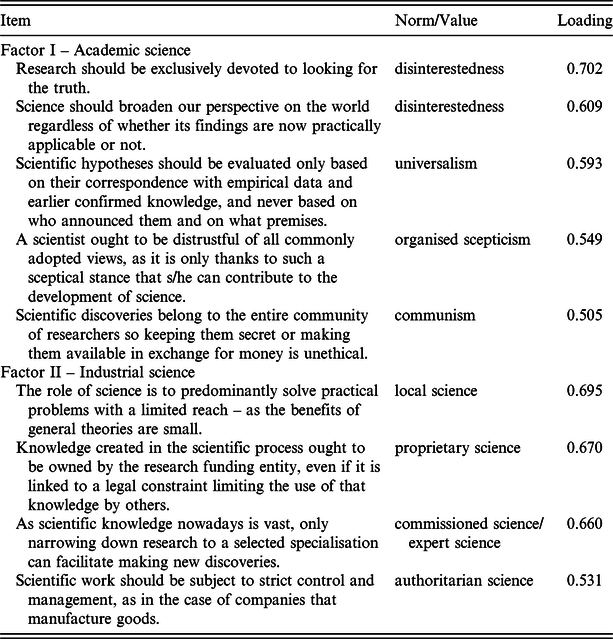
In order to measure the level of approval of the norms and values characteristic of the academic and industrial ethoses, the respondents were asked to rate 16 statements concerning both systems. The respondents evaluated the statements on a scale from 0 to 11, where 0 meant ‘I definitely disagree’ and 10 ‘I definitely agree’. Then we conducted a factor analysis with the use of the principal component analysis and Varimax rotation with Kaiser normalisation. The best result of the procedure in terms of the statistical parameters and interpretation of the subject-matter was achieved with two factors. The acquired factors accounted for 41% of the variance: 20.7% for factor I and 20.3% for factor II. Taking into account the items that fed into each of the factors, we called them: academic science and industrial science. Detailed assignment of items to the scales is presented in Table 2.
Results of factor analysis: characteristics of the items with two separate factors.

KMO = 0.669; Bartlett’s sphericity test: chi2 = 654.807, df = 36, p < 0.001
Source: data from authors’ analyses.
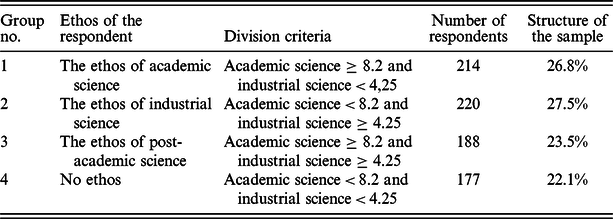
For each respondent, we computed arithmetic averages from the answers to the items on each of the scales. The results were contained in the range of 0 to 10. Then we divided the respondents into groups based on the results from the scales. The criterion for the division was the median, which for academic science amounted to 8.2 and for industrial science to 4.25. Eventually, each of the respondents was classified to one of the groups in line with the ethos that s/he identified with. Detailed criteria of the division and the structure of the sample according to the ethoses represented are shown in Table 3.
Criteria of division and the structure of the sample according to the ethos that the respondents identify with.

Source: data from authors’ analyses.
In order to meet the objective of the study, we also asked the respondents to express their opinions on four statements pertaining to the system of financing science in Poland. They put their answers on a scale from 1 to 4, where 1 meant ‘I definitely disagree’ and 4 meant ‘I definitely agree’.
6. Findings
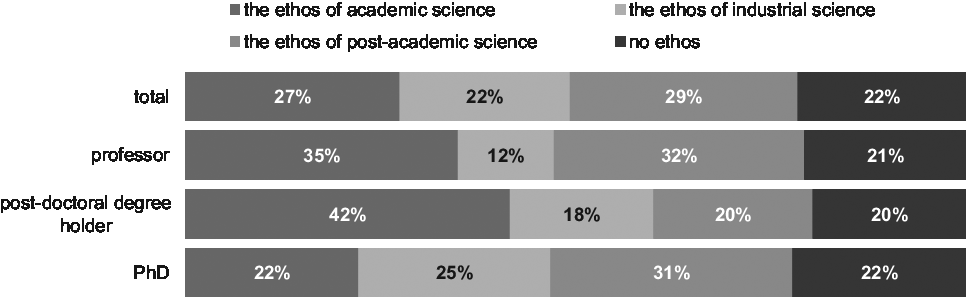
The traditional ethos of academic science is most widespread among post-doctoral degree holders and least popular among PhD degree holders (see Figure 2). The latter identify most frequently with the ethos of post-academic science. In turn, approval for the ethos of industrial science decreases with higher academic degrees or titles. Although the industrial ethos does not dominate in any of the groups in this study, it is appreciated most by PhD degree holders, and by professors. Regardless of their academic titles or degrees, on average one in five respondents does not identify with any of the ethoses of science.
The percentage of researchers who identify with a particular ethos of science.

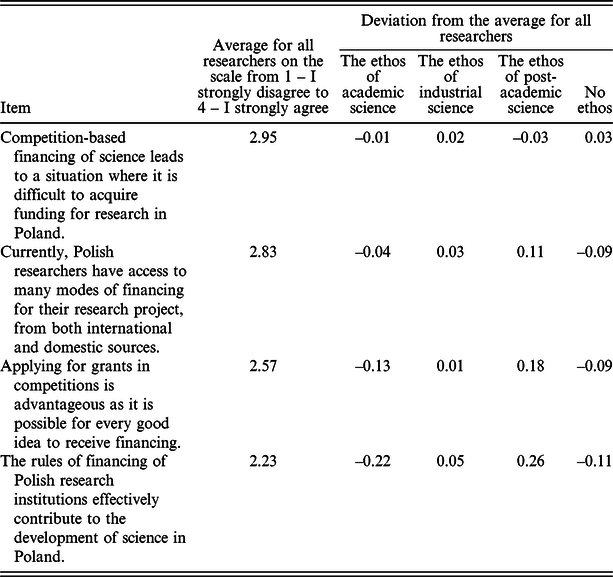
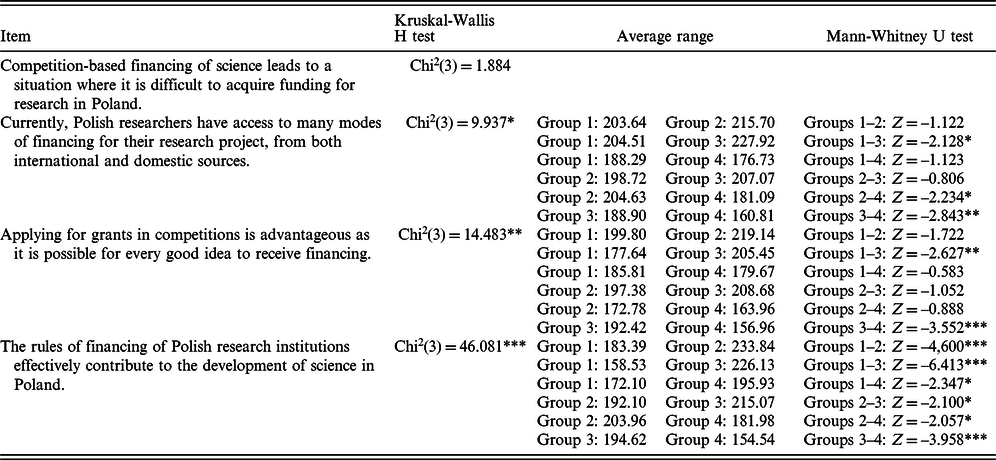
There are statistically significant differences between the groups identifying with the particular ethoses (see Tables 4 and 5). This is indicated by the assessment of three out of four studied items on the system of financing science in Poland. However, all the respondents, regardless of their preferred ethos, support the following view: competition-based financing of science leads to a situation where it is difficult to acquire funding for research in Poland.
Approval of items pertaining to the system of financing science in accordance with the ethos of science represented by the respondents: averages and deviations.

Source: data from authors’ analyses.
Approval of items pertaining to the system of financing science in accordance with the ethos of science represented by the respondents: Kruskal-Wallis H test and Mann-Whitney U test.

Group 1: researchers who identify with the ethos of academic science.
Group 2: researchers who identify with the ethos of industrial science.
Group 3: researchers who identify with the ethos of post-academic science.
Group 4: researchers who do not identify with any ethos of science.
Source: data from authors’ analyses.
*** The correlation is significant at 0.001.
** The correlation is significant at 0.01.
* The correlation is significant at 0.05.
The results of Mann-Whitney U test indicate that there are statistically significant differences between all of the groups as regards their approval of the statement: the rules of financing of Polish research institutions effectively contribute to the development of science in Poland. Those who are strongly convinced that the above statement is true are the respondents who identify with the ethos of post-academic science, whereas the lowest degree of identification was found among the scientists who identify with the ethos of academic science.
Moreover, statistically significant differences appeared between the three pairs of groups as regards their approval of the item: currently, Polish researchers have access to many modes of financing for their research project, from both international and domestic sources. The scientists who identify with the ethos of post-academic science take a more positive approach to the number of available financing opportunities than the respondents who identify with the ethos of academic science and those who do not identify with any of the ethoses. Along similar lines, the respondents who identify with the ethos of industrial science have a more positive attitude to the existing opportunities than the scientists who don’t identify with any ethos of science.
Furthermore, the scientists in favour of the post-academic ethos agree significantly more frequently than the respondents who represent the academic ethos or the respondents who do not identify with any ethos with the following statement: applying for grants in competitions is advantageous as it is possible for every good idea to receive financing.
Based on the results, we can claim that the hypothesis that stipulates that the scientists who identify with different ethoses of science have different levels of acceptance of the system of science financing in Poland, can be regarded as partially proven. The differences are particularly strongly visible between those who are in favour of the post-academic ethos of science and those who identify with the ethos of academic science or no ethos at all. The differences between the remaining groups of respondents pertain only to some aspects of the system of financing, particularly the consequences of the application of the current rules of financing research institutions.
7. Interpretation and Discussion
The changes introduced in Poland in 2010 defined new rules of financing science and emphasised the importance of research as well as international resonance of the effects of research implemented by Polish scientists. The changes were triggered by the apparently low level of use of the research potential of both Polish researchers and research institutions.
The mode of distribution of public funds for research defines the governance of science. The level of acceptance for the rules that govern the order depends on the attitudes and approaches of academia. Researchers can, on the one hand, follow a defined pattern or scientific ethos but, on the other hand, they can also choose not to accept the mechanisms of financing research (Kwiek Reference Kwiek2015b). That is why it is worthwhile considering whether the system of financing science where quality research is gaining importance reflects the attitudes of Polish researchers.
The results of the study partially confirm that the perception of the current system of financing science by researchers depends on their varied systems of values and the ethoses they identify with. Polish researchers are aware of the fact that the obligation to meet the new system requirements changes the rules of the scientific game. It is the group of scientists who are in favour of the post-academic approach (combining the extreme features of academic and industrial science) that seem to be best adapted to the changing rules in the world of science. Compared with the scientists with deeply-rooted academic values, those in favour of the post-academic ethos recognise a positive impact of the rules of financing research institutions and universities in Poland on the development of science to a large extent. They also appreciate the available funding opportunities and the features of competition-based research funding.
The researchers who take the least favourable view of the system are those who identify with the academic tradition. The representatives of the academic ethos, i.e. looking for objective truth and implementing ‘pure science’, are less convinced of the favourable impact of the current system of financing science in Poland than the researchers who highly appreciate the practical applicability of their knowledge. Moreover, the ‘pure’ academics provide a negative evaluation of the system which promotes commercialisation and requires team work in addition to expertise (Kalleberg Reference Kalleberg2007; Ziman Reference Ziman2000). Consequently, they also disagree with the regulations that lead to a situation where their authority, based on the canon of universalism and disinterestedness, is no longer an autotelic value.
Despite the higher level of competition-based financing, the respondents who identify with the academic ethos of science are convinced that poor involvement in research projects does not pose a threat to their position within the academia. This conviction seems to be especially marked among those who identify with the academic ethos particularly strongly, i.e. post-doctoral degree holders and professors who are well-rooted in the structure of the academia. Their approach is predominantly linked to the period of transformation that led to the development of mass-scale tertiary education and, consequently, to the phenomenon of academics working full-time at a number of universities or institutions. A strong drive for university education among young Poles triggered a dynamic growth of the non-public education sector. In these new circumstances, academic staff, in particular in the humanities and social sciences, often chose to use the opportunities offered by the market and devoted much of their working time to teaching rather than research. The focus of Polish universities (initially non-public universities, then also public universities) on education and teaching changed the identity of the academia in Poland. Teaching, with its effort-consuming character, for many became a way to function in academia. Marek Kwiek (Reference Kwiek2015b) underlines that there has been an identity crisis caused by institutional under-investment of research, insufficient levels of remuneration for academic staff and a focus on teaching rather than research.
Currently, however, the most prestigious achievements for researchers come with disruptive and innovative research and publications (Altbach Reference Altbach2007; Becher and Kogan Reference Becher and Kogan1992). What is clearly visible worldwide is the transformation of scientific institutions, particularly universities, from ‘communities of scholars’ into ‘communities of professionals’ (Gordon and Whitchurch Reference Gordon and Whitchurch2007). Science is also becoming international. That is why one of the aims behind the reform of the Polish system of science is to gradually change the beliefs and attitudes in academia in order to shift it towards a model promoting more active participation in the global research market. Some Polish researchers (see Kwiek Reference Kwiek2015b) are clearly aware of the international competition in science whereas others do not recognise it or do not wish to recognise it. The first group is more inclined to look favourably on the processes leading to the internationalisation of Polish science and enabling researchers to compete globally. Their approach is significant, as an increase in the participation of Polish researchers in global science will only be possible if the number of Polish publications recognised internationally grows and if international research cooperation involving Polish researchers is strengthened. This process, however, will not take place unless optimal means and diverse forms of funding are made available (Aghion et al. Reference Aghion, Dewatripont, Hoxby, Mas-Colell and Sapir2007).
In light of the quoted facts, it is important to note that the rules imposed by the system of financing science determine the behaviours and motivations of researchers (Butler Reference Butler2003; Moed Reference Moed2008). This means that there is need for thoroughly re-thinking how the distribution of funds may be aligned with the defined goals of scientific policy.
8. Conclusion
Researchers are constantly adapting to the changing functions of scientific institutions. Institutions in charge of creating knowledge, in turn, adapt to the new rules that define their role in economic and social development, both locally and nationally (Kwiek Reference Kwiek, De Groof and Lauwers2003). Academic careers are becoming increasingly multi-dimensional, and researchers need to find their place in the world of science driven by the growing effectiveness of research. This is accompanied by the growing expectations of decision-makers as well as institutions concerning the acquisition of funds and the implementation of projects with significant international and economic resonance.
The construction of the modern forms of distribution of public funds for science corresponds with the post-academic ethos of science. We can therefore observe more emphasis on competitiveness and promotion of the leading institutions and researchers. This is implemented through the introduction of competition-based funding, which increases the effectiveness of research in comparison with traditional forms of funding (Bolli and Somogyi Reference Bolli and Somogyi2011).
Apart from organising competitions, it is also important to ensure stable financing (e.g. in the form of subsidies) for the implementation of autonomous research plans by scientific institutions (van Dalen et al. Reference Van Dalen, Mehmood, Verstraten and van der Wiell2014). Financing day-to-day operations of scientific institutions also creates conditions for research and competition for funds from other sources. Competitions and calls for proposals, in turn, provide incentives for scientific institutions to activate their research missions and encourage the researchers to set themselves ambitious scientific goals.
The Polish system of distribution of funds as well as the forms of financing applied in Poland do not differ from European standards and are perceived as indispensable in the contemporary world of science (Auranen and Nieminen Reference Auranen and Nieminen2010; Kwiek Reference Kwiek2015a). From the perspective of the Polish system it is important to restore a larger significance of research. This requires focusing on the competition mechanisms that facilitate funding internationally recognised research. Insufficient research funds and a strong conviction about the uncontested position of the researchers who have worked for many years result in Polish scientists not keeping pace with legislative changes. Some of them choose to enter the debate with the legislative power and hamper the introduction of systemic reforms that emphasise the importance of research aimed at satisfying economic and social goals (Gornitzka and Maassen Reference Gornitzka, Maassen, Maassen and Olsen2007).
Reconciling the interests of the representatives of the world of science with different sets of values is one of the key challenges faced by decision-makers. Time will show to what extent representatives of Polish academia will follow the organisational changes to the model of financing research.
About the Authors
Marzena Feldy, PhD, is Manager of the Laboratory of Statistical Analysis and Evaluation and Assistant Professor at the National Information Processing Institute. She graduated from Warsaw School of Economics and the Faculty of Psychology at the University of Warsaw. Her research interests focus on the science and higher education sector as well as consumer behaviours and marketing communication. She applies interdisciplinary approaches in her research harnessing knowledge from both management and psychology.
Barbara Kowalczyk, PhD, is Chief Researcher at the Laboratory of Statistical Analysis and Evaluation at the National Information Processing Institute. She graduated from Poznań University of Economics and Business. Her research interests focus on the higher education sector, innovativeness, research and development. She has participated in several research projects financed by European Commission and Polish government agencies.