





Introduction
Gathering detailed information on rare species in situ can be difficult due to their small population sizes and subsequently low detectability (Lu and Samways Reference Lu and Samways2001; Williams et al. Reference Williams, Richardson, Postlethwaite, Garcia, Wright and Griffiths2023). Immature stages of lepidopterans can be especially challenging to locate, as they are generally much less conspicuous than the winged adults; consequently, these life stages tend to be understudied (Klockmann and Fischer Reference Klockmann and Fischer2017). In cases where in situ studies are not feasible, insights into an organism’s biology can be obtained through studying ex situ individuals reared in human care (Lu and Samways Reference Lu and Samways2001; Koi and Daniels Reference Koi and Daniels2015; Williams et al. Reference Williams, Richardson, Postlethwaite, Garcia, Wright and Griffiths2023). Ex situ conservation programmes have been initiated by many zoos and similar institutions in response to the growing number of species threatened with extinction and are typically integrated with in situ conservation action (Pritchard et al. Reference Pritchard, Fa, Oldfield and Harrop2011; McGrath et al. Reference McGrath, Cleave, Elgar, Silcocks and Magrath2017). Zoos can provide unique opportunities to study endangered species and fill knowledge gaps surrounding species’ behavioural patterns (Williams et al. Reference Williams, Richardson, Postlethwaite, Garcia, Wright and Griffiths2023), reproductive physiology (Durgavich et al. Reference Durgavich, Harwell and Knott2023), and food preferences (McGrath et al. Reference McGrath, Cleave, Elgar, Silcocks and Magrath2017). This detailed information on biology and life history is necessary for species-at-risk recovery planning (Department of Justice 2002).
In the case of endangered insects, investigating life history traits may require noninvasive techniques that minimise the risk of harm to the species. For example, instar number can be determined by measuring the width of the insect species’ head capsule and assigning it to an instar based on the regular size progression documented in many insect species, also known as Dyar’s rule (Dyar Reference Dyar1890; Logan et al. Reference Logan, Bentz, Vandygriff and Turner1998; Calvo and Molina Reference Calvo and Molina2008; Son et al. Reference Son, Mo, Yang, Shin and Cho2009). Because insect development is highly temperature-dependent, it is common to quantify development in units of physiological time known as degree-days (Allen Reference Allen1976; Tauber et al. Reference Tauber, Tauber and Masaki1986; Caicedo et al. Reference Caicedo, Torres and Cure2012). Degree-day estimates are widely used in pest management (Ward et al. Reference Ward, Moon and Aukema2019; Mo and Stevens 2021; Régnier et al. Reference Régnier, Legrand and Rebaudo2022) or included as a component in species distribution models (Buckley et al. Reference Buckley, Waaser, MacLean and Fox2011; Tremblay et al. Reference Tremblay, MacMillan and Kharouba2021). Head capsule measurements are sometimes used in conjunction with degree-day estimates to gain insight into insect phenology (Wardlaw et al. Reference Wardlaw, Perrault, Roe, Dedes, Irwin, MacQuarrie and Candau2022), and these methods can be adapted for insects of conservation concern. The ability to infer larval age is a useful tool for reintroduction programmes in which insects are reared ex situ, given that the programme’s success depends on individuals in human care developing at the same rate as their wild counterparts (Aardema et al. Reference Aardema, Scriber and Hellmann2011). Head capsule measurements of lepidopteran larvae can inform husbandry decisions, such as accelerating or decelerating development to ensure an individual ecloses during the normal flight period.
The Poweshiek skipperling, Oarisma poweshiek Parker, 1870 (Lepidoptera: Hesperiidae), is a small butterfly native to tallgrass prairie and prairie fens (Committee on the Status of Endangered Wildlife in Canada 2014). Once common across the midwestern United States of America and in southeastern Manitoba, Canada, populations have sharply declined and now fewer than 1000 mature individuals are thought to exist globally (Royer Reference Royer2020). As a result, the Poweshiek skipperling is listed as critically endangered globally (Royer Reference Royer2020) and is designated as endangered in both the United States of America and Canada (Committee on the Status of Endangered Wildlife in Canada 2014; United States Fish and Wildlife Service 2014). As of 2024, isolated populations exist only in Michigan, United States of America and in Manitoba, Canada (Belitz et al. Reference Belitz, Monfils, Cuthrell and Monfils2020; Burns et al. Reference Burns, Eckhardt, Hesketh-Jost, Keber, Wuerz and Petersen2025; Runquist et al. Reference Runquist, Nordmeyer and Stapleton2025). In the decade since their endangered listing, research on Poweshiek skipperling has focused primarily on the species’ habitat requirements (Pogue et al. Reference Pogue, Monfils, Cuthrell, Heumann and Monfils2016; Westwood et al. Reference Westwood, Westwood, Hooshmandi, Pearson, LaFrance and Murray2020; Dupont-Morozoff et al. Reference Dupont-Morozoff, Westwood and Henault2022), host plant preferences (Henault and Westwood Reference Henault and Westwood2022), population genetics (Saarinen et al. Reference Saarinen, Reilly and Austin2016), and flight period timing (Dearborn and Westwood Reference Dearborn and Westwood2014). However, crucial aspects of Poweshiek skipperling biology and life history remain unknown, in part due to the cryptic nature of the larvae (Westwood et al. Reference Westwood, Westwood, Hooshmandi, Pearson, LaFrance and Murray2020).
Poweshiek skipperling are univoltine and nonmigratory, spending 11 months as immatures before emerging as adults in late June or in July (Committee on the Status of Endangered Wildlife in Canada 2014; Eckhardt Reference Eckhardt2024). Like most nonmigratory insects in temperate regions, Poweshiek skipperling survive the unfavourable temperatures and food scarcity associated with winter by entering a state of metabolic suppression known as dormancy (Danks Reference Danks1987; Kostal Reference Kostal2006). Larvae in Manitoba undergo winter dormancy under the snowpack, presumably near the base of the grass, from late September until approximately late May (Henault and Westwood Reference Henault and Westwood2022). It has been assumed that Poweshiek skipperling overwinter in the fifth-instar stage (Committee on the Status of Endangered Wildlife in Canada 2014; Belitz et al. Reference Belitz, Monfils, Cuthrell and Monfils2020). This is based on an account by McAlpine (Reference McAlpine1972), who collected eggs and reared two larvae in his home near Grand Rapids, Michigan nearly 30 years before publishing his account. McAlpine (Reference McAlpine1972) observed seven instars for the species, noting that the fifth instar was inactive outdoors from September to April. However, deviations from this timeline might exist for the Manitoba population due to the province’s higher latitude and shorter growing season, both of which can affect insect phenology (Scriber Reference Scriber and Danks1994; Verspagen et al. Reference Verspagen, Ikonen, Maes, Stefanescu, DiLeo and Saastamoinen2023). Furthermore, in the 75 years since McAlpine’s study, climate change has profoundly affected insect phenological events (e.g., Altermatt Reference Altermatt2010; Esbjerg and Sigsgaard Reference Esbjerg and Sigsgaard2014; Van Dyck et al. Reference Van Dyck, Bonte, Puls, Gotthard and Maes2015).
More recently, Henault and Westwood (Reference Henault and Westwood2022) studied immature stages of Poweshiek skipperling in situ and hypothesised that larvae in Manitoba overwinter in the fourth-instar stage, due to the limited number of degree-days remaining in the autumn after the third moult. Those authors were unable to test this theory because no larvae could be located later in the autumn (Henault and Westwood Reference Henault and Westwood2022). Degree-day estimates have been calculated for the first three Poweshiek skipperling instars in situ (Henault and Westwood Reference Henault and Westwood2022), but degree-day accumulations and larval behaviour prior to winter dormancy remain poorly characterised (but see Savage Reference Savage2024). The overwintering instar and total number of instars for Poweshiek skipperling in Manitoba have yet to be determined.
Range-wide declines in Poweshiek skipperling abundance and distribution began in the late 1990s and accelerated in the early 2000s (Belitz et al. Reference Belitz, Hendrick, Monfils, Cuthrell, Marshall and Kawahara2018, Reference Belitz, Monfils, Cuthrell and Monfils2020). This occurred decades after the greatest losses in North American prairie land cover occurred (Samson and Knopf Reference Samson and Knopf1994), suggesting factors other than land-use changes may be driving the most recent Poweshiek skipperling population declines. Climate warming has been linked to a negative probability of Poweshiek skipperling occurrence (Belitz et al. Reference Belitz, Monfils, Cuthrell and Monfils2020), and butterflies in general are highly sensitive to the effects of climate change (Kharouba et al. Reference Kim, Kim, Hong, Lee, Park, Yeon-Ho and Lee2014; Zipf et al. Reference Zipf, Williams, Primack and Stichter2017). Documenting Poweshiek skipperling larval development could potentially aid in explaining the rapid, widespread declines in this species over the past 30 years and enable predictions of this species’ phenology in response to climate change. Given that Poweshiek skipperling spend the majority of their lives as larvae, research focused on the growth and development of the larval stage is critical.
In 2017, Assiniboine Park Zoo in Winnipeg, Manitoba joined an international ex situ rearing programme to prevent the extinction of the butterfly (Nature Conservancy of Canada 2021). Since then, the zoo has reared the immature stages to increase survival to adulthood and has released adult Poweshiek skipperling back into the wild to augment natural populations in southern Manitoba (Burns et al. Reference Burns, Eckhardt, Hesketh-Jost, Keber, Wuerz and Petersen2025). The ex situ rearing programme offers a rare opportunity to observe closely the cryptic larval stage of this insect and to pursue the following objectives: (1) to develop a reference data set that defines the relationship between head capsule width and developmental life stage of ex situ larvae, (2) to determine the overwintering instar and retroactively assess overwintering instar of other Poweshiek skipperling reared ex situ, and (3) to determine the degree-day requirements for ex situ larvae prior to winter dormancy.
Methods
Study population
Poweshiek skipperling are reared at Assiniboine Park Zoo in Winnipeg, Manitoba (49.87°, −97.24°; Burns et al. Reference Burns, Eckhardt, Hesketh-Jost, Keber, Wuerz and Petersen2025). Since 2017, eggs have been collected annually from wild-caught and zoo-bred females; as of 2026, the lineages maintained at the zoo are one to four generations removed from a wild ancestor. Hatched larvae are placed and reared singly on prairie dropseed, Sporobolus heterolepis Gray (Poaceae), a grass species native to tallgrass prairie and propagated for the project by the Living Prairie Museum (Winnipeg, Manitoba). Individual potted grasses are fitted with a wire frame and covered by a thin, beige nylon sock and moved to an outdoor hoop house with mesh walls and ceiling. Staff at the zoo headstart prairie dropseed grasses in late March under grow lights indoors so that larvae are immediately provided with a food source in the spring to complete their development.
To simulate the winter conditions larvae would experience under snowpack, larvae at the zoo are maintained in a Fisherbrand™ Isotemp™ incubator (Thermo Fisher Scientific, Waltham, Massachusetts, United States of America) – hereafter referred to as overwintering chambers – at –4 °C from mid- to late October until late April or early May. The dates that larvae are transferred into the overwintering chambers are determined each year based on when the seven-day weather forecast predicts minimum daily temperatures below 0 °C for multiple consecutive days. It is unlikely that moving larvae into overwintering chambers arrests their development prematurely, because larvae cease moulting and feeding by late September even when daytime temperatures are still mild (unpublished data). Larvae are removed from overwintering chambers and placed back outside when the seven-day weather forecast does not include any days with minimum temperatures below 0 °C (Burns et al. Reference Burns, Eckhardt, Hesketh-Jost, Keber, Wuerz and Petersen2025). An essential aspect of ex situ insect conservation is to replicate natural conditions as closely as possible to ensure individuals in human care are developmentally synchronised with their wild counterparts (Aardema et al. Reference Aardema, Scriber and Hellmann2011). Annual flight periods are highly correlated between wild and human-reared Poweshiek skipperling, suggesting that individuals follow similar developmental timelines (Eckhardt Reference Eckhardt2024). Full ex situ rearing protocols can be requested from the Assiniboine Park Zoo.
We monitored two univoltine cohorts of Poweshiek skipperling larvae at the zoo with a sample size of 25 individuals per cohort. The study subjects were descended from 16 unrelated (zoo-bred) or presumed unrelated (wild-caught) females and were 1–3 generations removed from a wild female ancestor. Because this species is univoltine, ‘cohort’ in the present study refers to the hatch year, which is one year before the adults are released (e.g., the 2021 cohort was released in 2022). Individuals in the 2021 cohort were monitored after winter until eclosion. Individuals in the 2022 cohort were monitored through all immature stages from the time they hatched in July 2022 until they eclosed in the summer of 2023.
Head capsule measurements
All analyses were conducted using R statistical software, version 4.3.3 (R Core Team 2024), in RStudio, version 2023.12.1.402 (Posit Team 2024). Figures 1, 2, and 3 were produced using the ‘ggplot2’ package, version 3.5.1 (Wickham Reference Wickham2016). Over the course of the butterfly’s larval stage, we monitored larvae for major changes in head capsule width that would indicate a new instar. Small changes in width (<5%) within an instar were assumed to be due to human error rather than growth because head size within an instar is constant (Dyar Reference Dyar1890; Hutchinson et al. Reference Hutchinson, McNamara, Houston and Vollrath1997). Our measurement error rates were typically less than 1% and did not exceed 3%. Increases in head capsule width greater than 10% were indicative of a new instar and were supported by the presence of exuviae. Head capsule width measurements were tested for adherence to Dyar’s rule by taking the mean width of any given instar’s head capsule and dividing it by the mean width of the previous instar’s head capsule (Gaines and Campbell Reference Gaines and Campbell1935; Castañeda-Vildózola et al. Reference Castañeda-Vildózola, González-Hernández, Equihua-Martínez, Valdez-Carrasco, Peña, Cazado and Franco-Mora2016). If Dyar’s rule applies, the resulting growth ratios are constant from one instar to the next.
Histogram and fitted density curves of head capsule widths of Poweshiek skipperling (n = 43) at Assiniboine Park Zoo, Winnipeg. This figure includes only individuals that exhibited a six-instar developmental pathway. Instars 1–3 are represented by individuals sampled from cohort 2022. Instars 4–6 are represented by individuals sampled from cohorts 2021 and 2022.

Figure 1. Long description
A histogram and fitted density curves of head capsule widths of Poweshiek skipperling (n = 43) at Assiniboine Park Zoo, Winnipeg. The histogram includes only individuals that exhibited a six-instar developmental pathway. Instars 1-3 are represented by individuals sampled from cohort 2022. Instars 4-6 are represented by individuals sampled from cohorts 2021 and 2022. The horizontal axis represents head capsule width in millimeters, ranging from 0.50 to 2.30 mm. The vertical axis represents density. The histogram is divided into six colored sections, each representing a different instar. The colors are teal for instar 1, orange for instar 2, blue for instar 3, pink for instar 4, green for instar 5, and yellow for instar 6. Each section shows the distribution of head capsule widths for that specific instar, with density peaks indicating the most common widths. The density curves are fitted to the histogram bars, showing the overall trend of the data.
Head capsule widths and associated overwintering instar of Poweshiek skipperling larvae (n = 977) in cohorts 2021–2024 reared at Assiniboine Park Zoo, Winnipeg. This figure excludes individuals in cohort 2021 and 2022 samples whose growth histories were tracked. Measurements were made immediately before placing larvae in overwintering chambers.

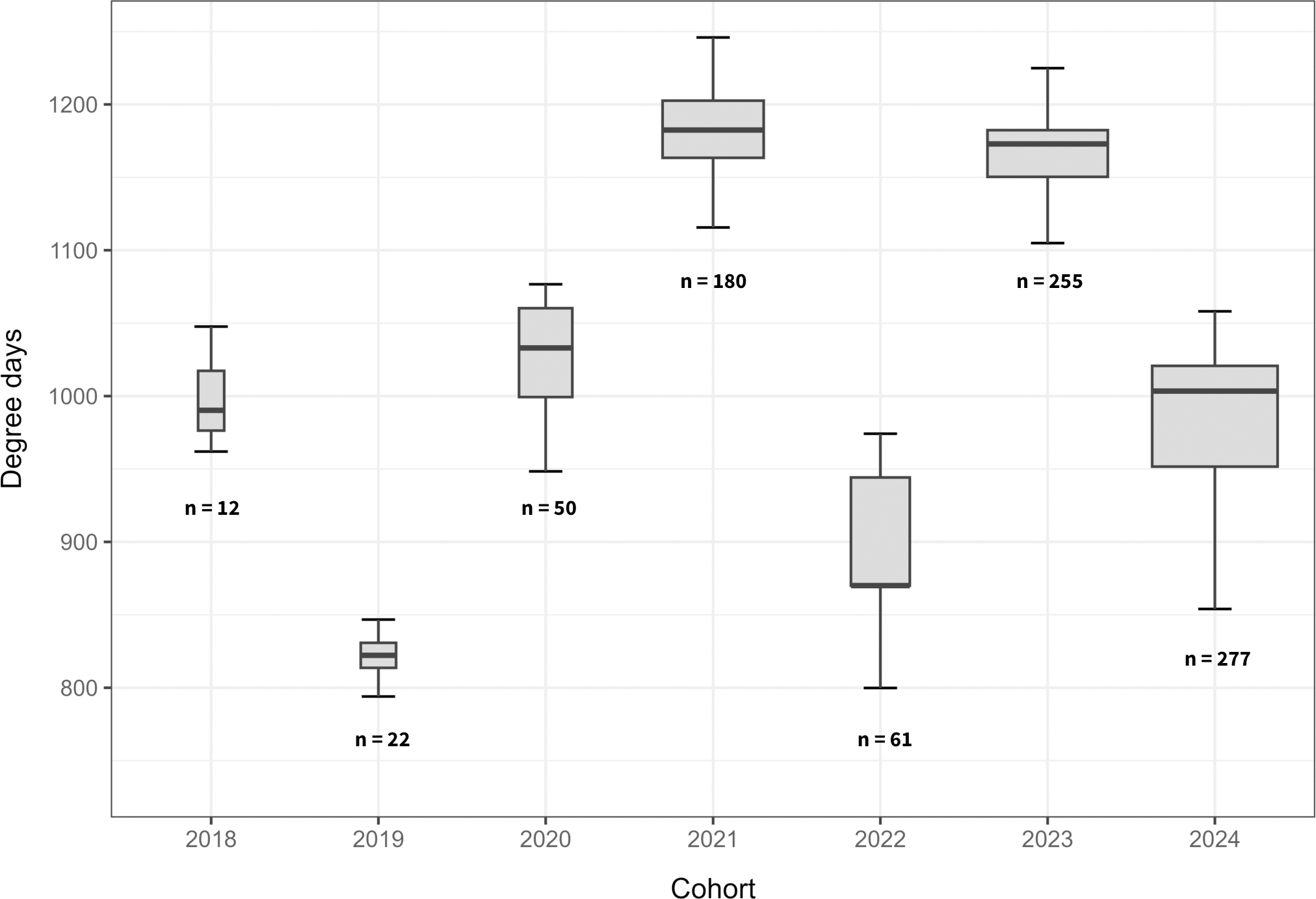
Pre-winter degree-day accumulations of ex situ Poweshiek skipperling cohorts reared at Assiniboine Park Zoo, Winnipeg. Pre-winter includes the period from egg hatch until larvae were placed in overwintering chambers. Cohort 2017 is excluded from this figure due to its small sample size.

To measure head capsule width, we photographed larvae on their grasses using a Nikon D7500 camera (Tokyo, Japan) fitted with an 85-mm macro lens and an external camera flash set to the lowest power required. A ruler, held parallel to and in the same plane of focus as the larva, served as a scale in each photograph. We measured the width of the head capsule with ImageJ software (Schneider et al. Reference Schneider, Rasband and Eliceiri2012) by digitally drawing a straight line across the ruler to provide a known distance and then drawing a second line across the widest point of the head capsule (Fig. 4). ImageJ then converted the width from pixels into millimetres (±0.01 mm standard error).
Head capsule measurement procedure for Poweshiek skipperling larvae reared at Assiniboine Park Zoo, Winnipeg. Yellow lines were digitally drawn in ImageJ (Schneider et al. Reference Schneider, Rasband and Eliceiri2012).

We photographed larvae twice per week in 2022: in May–June for the 2021 cohort and in July–September for the 2022 cohort. In 2023, we checked larvae daily until the fifth instar and then every 1–2 days during the sixth instar until pupation. In addition to measurements, the presence of exuviae or shed head capsules provided confirmation that a larva had moulted. A green plastic plant tray was installed around the base of each potted grass plant to facilitate locating exuviae. Although larvae in 2023 were checked more frequently, they were photographed only when evidence of a moult was detected via change in head capsule colouration or when exuvia were found in the plant trays. A photograph was then taken to document the new instar’s head capsule width. Due to the lower sampling frequency in 2022, the duration of the fourth instar (cohort 2021) and the duration of the first instar (cohort 2022) are likely shorter than reported. Due to natural mortality, or in cases where larvae were not found for several weeks in a row and were presumed deceased, the total number of larvae in our cohort samples varied over time. Larvae that died were excluded from analysis in the instar in which they died, but their data from previous instars were retained.
We then retroactively assessed the overwintering instar of other larvae reared ex situ at Assiniboine Park Zoo. Beginning in 2021, zoo staff have collected head capsule measurements, using a procedure similar to that described above, immediately before placing larvae in overwintering chambers. Measurements from our samples demonstrated minor overlap between third- and fourth-instar head width. To classify individuals of unknown instar whose head capsule widths fell between instars 3 and 4, we assessed the effect of width on the likelihood of instar. We used measurements from individuals in the 2022 cohort (n = 20) because these larvae were measured through all instars. We used the glm function from the ‘stats’ package, version 4.3.3 (R Core Team 2024), to build a logistic regression model to predict the binary outcome of instar – 1 for instar 4, and 0 for instar 3 – based on the independent variable of head capsule width. We used the or_glm function from the ‘oddsratio’ package, version 2.0.1 (Schratz Reference Schratz2017), to extract odds ratios and confidence intervals.
Degree-day estimates
We used life history data for individuals in cohorts 2017–2024 (n = 863) to calculate total degree-day accumulations from the time the eggs hatched until larvae were placed in overwintering chambers (hereafter referred to as the pre-winter period). We excluded from this analysis two larvae in cohort 2023 that were placed into overwintering chambers several weeks earlier than others in the same cohort. Weather data were downloaded from the Winnipeg Richardson International Airport weather station (49.91°, –97.24°; Environment and Climate Change Canada 2023). We calculated degree-days using the degreedays function from the TrenchR package, version 1.1.1 (Buckley et al. Reference Buckley, Ortiz, Caruso, John, Levy and Meyer2023), using the double-sine method because this has been used in annual predictions of wild Poweshiek skipperling emergence in Manitoba (Dearborn and Westwood Reference Dearborn and Westwood2014; Henault and Westwood Reference Henault and Westwood2022). The double-sine method fits a sine wave to the daily maximum and minimum temperatures and calculates the area under the curve between the species-specific lower and upper developmental thresholds (Allen Reference Allen1976; University of California Natural Resources 2012). To our knowledge, developmental thresholds for Poweshiek skipperling have not been experimentally tested using typical methods (i.e., rearing larvae at series of fixed temperatures near their hypothesised thermal limits). We therefore selected 5 °C (Eckhardt Reference Eckhardt2024) as the hypothesised lower threshold and 32 °C (Dearborn and Westwood Reference Dearborn and Westwood2014) as the hypothesised upper threshold, as have been used in previously published research on Poweshiek skipperling (Dearborn and Westwood Reference Dearborn and Westwood2014; Eckhardt Reference Eckhardt2024).
To test for differences in pre-winter degree-day accumulation between years, we used the glm function from the ‘stats’ package, version 4.3.3 (R Core Team 2024), to construct a general linear model with degree-days as the response variable and year as a predictor. To determine if overwintering instar was correlated to degree-day accumulation, we used the lmer function from the ‘lmerTest’ package, version 3.1.3 (Kuznetsova et al. Reference Kuznetsova, Brockhoff and Christensen2017), to construct a linear mixed-effects model with degree-days as the response variable, instar as a fixed effect, and year as a random effect.
Results
Larval behaviour and body colouration
Poweshiek skipperling larvae are light green, with a central, longitudinal dark green stripe. One to two days before moulting, the entire head capsule became translucent, and the longitudinal body stripe no longer extended to the head capsule (Fig. 5). Head colour varied from light green to brown, usually becoming brown preceding a moult. Some individuals also exhibited a brown line directly behind the head, a brown terminal abdominal segment, or both. Individuals with such colouration returned to green shortly after moulting, and the brown pigment was visible on the exuvia (Fig. 5).
Poweshiek skipperling larva body colouration: A, 1–2 days before moulting – the longitudinal body stripe does not extend to head capsule; this individual has brown colouration on the head and terminal abdominal segment; B, less than 1 day after moulting – the head and terminal body segment are green, and brown pigment is visible on the exuvia.

With the exception of an individual that moulted in the last week of September, most larvae ceased moulting by early to mid-September, at which point, they positioned themselves head-down at the base of the grass and appeared to cease feeding for the remainder of the fall until being placed in overwintering chambers. The following spring, most larvae began moving within minutes of being removed from overwintering chambers into room temperature (approximately 21 °C). They did not begin feeding until 7–10 days after being placed outdoors in the hoop house, despite having host plants to consume and daytime temperatures rising above the estimated lower developmental threshold. After winter dormancy, larvae required an average of 16 days to moult to the next, usually fifth, instar.
Overwintering instar
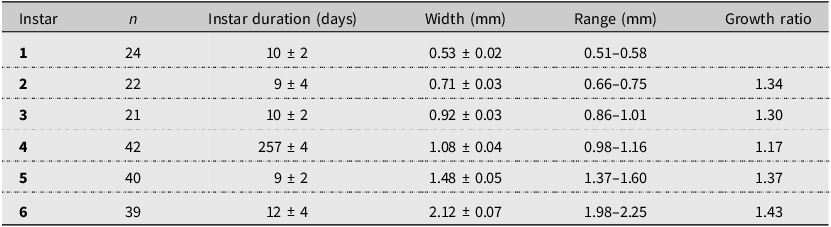
Instar durations were between nine and 12 days, apart from the overwintering instar (Table 1). The 2022 cohort hatched in July 2022, and most larvae developed through instars 1–4 from July to September before being moved into overwintering chambers in late October 2022. In May 2023, this cohort was removed from the chambers, completed instars 4–6, and pupated in June. All larvae in the 2022 cohort sample overwintered in the fourth instar, apart from one individual that moulted to the fifth instar on or shortly after 23 September 2022.
Head capsule widths and instar durations (mean ± standard deviation) of sampled Poweshiek skipperling reared at Assiniboine Park Zoo, Winnipeg. These measurements are from individuals exhibiting a six-instar developmental pathway. Instar durations are presented for individuals in the cohort 2022 sample. Head capsule width data from individuals in the cohort 2021 and cohort 2022 samples are pooled for instars 4–6.

Table 1. Long description
A table comparing instar durations, widths, and growth ratios of Poweshiek skipperling. The table has six rows and six columns. The columns are labeled Instar, n, Instar duration (days), Width (mm), Range (mm), and Growth ratio. Row 1: Instar 1, n 24, Instar duration 10 ± 2 days, Width 0.53 ± 0.02 mm, Range 0.51-0.58 mm. Row 2: Instar 2, n 22, Instar duration 9 ± 4 days, Width 0.71 ± 0.03 mm, Range 0.66-0.75 mm, Growth ratio 1.34. Row 3: Instar 3, n 21, Instar duration 10 ± 2 days, Width 0.92 ± 0.03 mm, Range 0.86-1.01 mm, Growth ratio 1.30. Row 4: Instar 4, n 42, Instar duration 257 ± 4 days, Width 1.08 ± 0.04 mm, Range 0.98-1.16 mm, Growth ratio 1.17. Row 5: Instar 5, n 40, Instar duration 9 ± 2 days, Width 1.48 ± 0.05 mm, Range 1.37-1.60 mm, Growth ratio 1.37. Row 6: Instar 6, n 39, Instar duration 12 ± 4 days, Width 2.12 ± 0.07 mm, Range 1.98-2.25 mm, Growth ratio 1.43.
Most larvae developed through six instars, with the exception of a single larva (known as ‘P220403’) from the 2022 cohort sample that underwent a seven-instar developmental pathway. This individual’s head capsule widths for instars 1–4 fell within the expected ranges, the head capsule widths for instars 5 and 6 were abnormally small, and the head capsule width for instar 7 was larger than that of a typical instar 6 (Supplementary material, Table S1). The growth ratio between the overwintering instar (5) and penultimate instar (6) for P220403 was smaller than the growth ratio between the overwintering instar (4) and penultimate instar (5) for larvae exhibiting the normal number of instars (Supplementary material, Table S1). However, growth ratios for the final instar (either 6 or 7) were identical (Supplementary material, Table S1). After completing an extra, seventh instar in the spring of 2023, larva P220403 pupated (on 12 June) and eclosed as a healthy adult female (on 26 June) in synchrony with the rest of the 2022 cohort.
Head capsule widths for instars 1–6 ranged from 0.53 mm to 2.25 mm (Table 1). The distribution of head capsule widths formed discrete peaks for instars 1, 2, 5, and 6, and those for instars 3 and 4 had slightly overlapping distributions (Table 1; Fig. 1). The largest growth ratios were observed for instars 5 and 6, and there were smaller size increases in head capsule widths between instars 3 and 4 (Table 1). Due to the variable growth ratios between instars, Poweshiek skipperling larval growth was inconsistent with Dyar’s rule.
Using measurement results from the 2021 and 2022 cohort samples, we assessed the overwintering instar for 977 additional individuals in the ex situ program from cohorts 2021 to 2024 that were not included in the previous analysis. Logistic regression was performed to separate individuals with head capsule widths in the range of overlap between instars 3 and 4. As expected, the regression revealed a significant correlation between head capsule width and instar (β = –65.60, z = 2.47, P = .01). The odds of instar 4 increased by a factor of 1.9 (95% confidence interval [1.38, 4.68]) for every 0.01-mm increase in head capsule width over 1.00 mm, and the probability of instars 3 and 4 was equal at a head capsule width of 1.00 mm. Based on the regression results, we categorised individuals of unknown instar into the fourth instar if their head capsule width was 1.00–1.16 mm and into the third instar if their head width was 0.86–0.99 mm.
Of the additional larvae we assessed, most (n = 846) pre-winter head capsule widths were within the range expected for fourth instars (Fig. 2). Thirty-four (3.49%) individuals had head capsule widths between 1.17 and 1.39 mm (mean = 1.24 mm), indicating they overwintered as small fifth instars. Two (0.21%) individuals had head capsule widths consistent with the sixth instar (Fig. 2). A total of 95 (9.72%) larvae had head capsule widths that suggested they overwintered as third instars (Fig. 2). Of the 131 larvae that overwintered in instars other than the fourth, only four individuals did not survive the winter: this comprised two third instars, and two sixth instars.
Degree-day estimates
We were able to determine the degree-day requirements for the larval stage preceding winter dormancy. Larvae in ex situ cohorts 2017–2024 accumulated 822–1181 degree-days (mean = 1071.56 ± 3.88 standard error) before being moved into overwintering chambers in late autumn (Fig. 3). A generalised linear model revealed significant differences in degree-day accumulations between all cohorts apart from cohort 2018 (Supplementary material, Table S2). A linear-mixed effects model demonstrated no significant differences in pre-winter accumulations for larvae that overwintered in instar 3 (β = 4.36, t = 0.86, P = 0.39) or instar 5 (β = 14.77, t = 1.76, P = 0.08; Table 2).
Linear mixed-effects model results for overwintering instar effects on pre-winter degree-day accumulation of ex situ Poweshiek skipperling. Year was treated as a random effect, and the model’s reference group is instar 4. Significant P-values are shown in bold (α = 0.05).

Table 2. Long description
A table titled ‘Linear mixed-effects model results for overwintering instar effects on pre-winter degree-day accumulation of ex-situ Poweshiek skipperling.’ The table has four rows and four columns. The columns are labeled Estimate, Standard error, t-value, and P-value. The rows are labeled Intercept, Instar three, and Instar five. The values in the table are as follows: Intercept: Estimate 1050.39, Standard error 73.76, t-value 14.24, P-value <0.001; Instar three: Estimate 4.36, Standard error 5.04, t-value 0.86, P-value 0.39; Instar five: Estimate 14.77, Standard error 8.40, t-value 1.76, P-value 0.08.
Discussion
Poweshiek skipperling larval head capsule widths formed discrete size categories with minimal overlapping occurring only between instars 3 and 4 (Fig. 1). Growth ratios between instars decreased as winter dormancy approached and increased again the following spring (Table 1), indicating that Dyar’s rule of geometric growth did not clearly emerge in the individuals reared under the conditions of this study (Dyar Reference Dyar1890). Other studies have similarly documented nonstatic growth rates in insect larvae, and in cases where larval development is inconsistent with Dyar’s rule, growth ratios usually decrease with increasing instar (Jobin et al. Reference Jobin, Hebert and Bourassa1992; Hutchinson et al. Reference Hutchinson, McNamara, Houston and Vollrath1997; Calvo and Molina Reference Calvo and Molina2008). For Poweshiek skipperling, the decrease in growth ratios resulted in some overlap between third- and fourth-instar head capsule widths. This overlap represents actual variation rather than statistical uncertainty because we documented individual growth histories for samples of cohorts 2021 and 2022. The results presented here demonstrate that most Poweshiek skipperling larvae can be categorised into instars based on head capsule width alone.
We measured head capsule sizes of live larvae using macro photography. Typically, head capsule measurements involve destructive sampling by which the insect specimen is slide-mounted and measured with either an ocular micrometer or by digital photography (Gaines and Campbell Reference Gaines and Campbell1935; Richardi et al. Reference Richardi, Rebechi, Aranha and Navarro-Silva2013; Castañeda-Vildózola et al. Reference Castañeda-Vildózola, González-Hernández, Equihua-Martínez, Valdez-Carrasco, Peña, Cazado and Franco-Mora2016). However, to investigate individual growth trajectories, larvae must be measured alive and be allowed to develop through all instars (Garcia-Barros Reference Garcia-Barros2006). Continuous observation of individual larvae was necessary, as a seventh instar was recorded in one specimen – a deviation from the typical six-instar development trajectory reported for the species. The noninvasive methods for head capsule measurements presented here are ideal for instar determination of species-at-risk where survival of all individuals is prioritised.
This research identified at least two distinct developmental pathways for Poweshiek skipperling in Manitoba. The six-instar pathway, with larvae overwintering in the fourth instar, was the most common (Fig. 2). A small number of larvae overwintered in the fifth instar, and at least one of these individuals is known to have exhibited a seven-instar developmental pathway. Intraspecific variability in instar number is not uncommon in insects (Esperk et al. Reference Esperk, Tammaru and Nylin2007; Abarca et al. Reference Abarca, Lill and Weiss2020). As noted in the literature for other insects (Garcia-Barros Reference Garcia-Barros2006; Abarca et al. Reference Abarca, Lill and Weiss2020), Poweshiek skipperling larvae that added an additional instar prior to winter had head capsule widths intermediate in size between ‘normal’ fourth and fifth instars, which made them identifiable in retrospect because fourth- and fifth-instar head capsule width distributions do not normally overlap. It is likely that, after winter, all larvae that overwintered as small fifth instars underwent at least one supernumerary instar as a compensatory strategy to achieve adequate size for pupation (Nijhout and Williams Reference Nijhout and Williams1974; Kingsolver Reference Kingsolver2007; Etile and Despland Reference Etile and Despland2008). Interestingly, a substantial number of third instars also successfully overwintered. It is unknown whether these individuals had a six- or seven-instar developmental trajectory, but it is probable they required longer time to develop due to overwintering at a less developed stage (Ward et al. Reference Ward, Moon and Aukema2019).
The cause or causes of variation in developmental pathway within the Manitoba Poweshiek skipperling population remain to be determined. Earlier egg hatch in the summer, warmer summer and fall temperatures, or a combination of these conditions, would have resulted in extended time for development, but no significant differences in degree-day accumulations were detected for larvae that overwintered in the third or fifth instar compared to those that overwintered in the fourth instar (Table 2). However, it is notable that the 2023 cohort had the greatest number of overwintering fifth and sixth instars and the second-highest degree-day accumulations (Figs. 2 and 3). Moulting to the fifth instar before winter dormancy may be an adaptive response to favourable conditions in the autumn (Garcia-Barros Reference Garcia-Barros2006). For example, the supernumerary pathway in the small heath butterfly, Coenonympha pamphilus Linnaeus, 1758 (Lepidoptera: Nymphalidae), was hypothesised to occur as the mechanism by which larvae could continue to develop in warm, extended autumns when host plants were still available without foregoing larval diapause (Garcia-Barros Reference Garcia-Barros2006). Variability in instar number can also occur in response to reduced host plant quality (Esperk et al. Reference Esperk, Tammaru and Nylin2007; Abarca et al. Reference Abarca, Lill and Weiss2020). Diet quality in the tobacco hornworm, Manduca sexta Linnaeus, 1763 (Lepidoptera: Sphingidae), affects growth rate more than developmental rate (Kingsolver Reference Kingsolver2007): inadequate nutrition in the fourth instar resulted in fifth instars below a critical weight threshold, which in turn induced a supernumerary instar instead of pupation (Nijhout Reference Nijhout1975; Kingsolver Reference Kingsolver2007). If variation in instar number exists in wild Poweshiek skipperling populations as well, it could be an adaptive response to variation in food quality (Kingsolver Reference Kingsolver2007). Although all ex situ Poweshiek skipperling larvae at Assiniboine Park Zoo were reared on the same host species, differences in plant quality may have occurred between individuals and may have contributed to variation in the rate of larval development. Perhaps an interaction between mild autumn temperatures, combined with potentially poorer host plant quality, resulted in the greater number of overwintering fifth and sixth instars in the Poweshiek skipperling 2023 cohort.
The account by McAlpine (Reference McAlpine1972), which found that Poweshiek skipperling in Michigan overwintered as fifth instars and completed seven instars in total, is interesting in light of the instar plasticity presented in our study. Winter dormancy can occur in different instars within the same species (Danks Reference Danks1987; Belozerov Reference Belozerov2009), and latitudinal differences in insect phenology can be due to the greater number of degree-days available for development in southern latitudes (Scriber Reference Scriber and Danks1994; Cayton et al. Reference Cayton, Haddad, Gross and Diamond2015). For example, intraspecific variation in the overwintering instar has been documented in the Glanville fritillary butterfly, Melitaea cinxia Linnaeus, 1758 (Lepidoptera: Nymphalidae), wherein larvae from northern latitudes overwintered in an earlier instar than their southern counterparts did (Verspagen et al. Reference Verspagen, Ikonen, Maes, Stefanescu, DiLeo and Saastamoinen2023). Overwintering instar likewise appears to be plastic in Poweshiek skipperling. The seven-instar pathway we observed in larva P220403 may be the more typical developmental schedule in southern populations, such as those found in Michigan, as a response to a longer growing season. The developmental trajectory of larvae in the last remaining ‘southern’ population of Poweshiek skipperling should therefore be assessed.
Despite significant between-year variation in pre-winter degree-day accumulation (Supplementary material, Table S2), most larvae (92%) overwintered in the fourth instar. In addition, degree-days were not correlated with overwintering in instars 3 or 5 (Table 2). Because advanced development was not correlated with greater degree-day accumulation, it is possible that Poweshiek larvae typically become nonresponsive to temperature at some point in the autumn as a result of short day length (Tauber et al. Reference Tauber, Tauber and Masaki1986; Nylin Reference Nylin and Danks1994). Temperate insects most commonly rely on late-summer day length for diapause induction because photoperiod is consistent between years, whereas temperature can be highly unpredictable (Denlinger 2002; Saikkonen et al. Reference Saikkonen, Taulavuori, Hyvonen, Gundel, Hamilton and Vanninen2012). If Poweshiek skipperling rely primarily on day length to time their winter dormancy, most larvae would be expected to overwinter in the appropriate instar (Van Dyck et al. Reference Van Dyck, Bonte, Puls, Gotthard and Maes2015; but see Kim et al. Reference Kim, Kim, Hong, Lee, Park, Yeon-Ho and Lee2014). The details of the species’ winter dormancy in both extant populations (in Manitoba and Michigan) should be investigated to understand the influence of photoperiod and temperature on the overwintering stage. The remaining disjunct populations may be locally adapted to latitudinally varying diapause cues (Roy et al. Reference Roy, Oliver, Botham, Beckmann, Brereton and Dennis2015; Kerr et al. Reference Kerr, Wepprich, Grevstad, Dopman, Chew and Crone2020), and translocating individuals to aid in the species’ recovery could introduce larvae to novel climate conditions. Translocated individuals should therefore be monitored ex situ for a generation to determine any effects of the novel climate on larval development.
The overwintering method employed at Assiniboine Park Zoo terminated degree-day accumulation, although this was in line with low external temperatures in late autumn where additional degree-day accumulation would have been minimal. We recognise that in situ populations may respond differently than individuals reared ex situ do due to microclimatic differences and untested behavioural or physiological responses to environmental conditions. We also recognise that degree-days for ex situ larvae were calculated based on data from an off-site weather station and that actual microclimate conditions within the larval rearing setup may differ from temperatures reported by the weather station. Due to the endangered status of this species and the ex situ rearing protocol at the zoo to ensure larvae safety, sample sizes and methodological approaches for our study are inherently limited.
Two larvae that were placed into the overwintering incubator in the sixth instar did not survive the winter. Overwintering survival rate for cohort 2023 was high (99%), so it is unlikely that these two mortalities occurred by chance and instead were the result of failing to initiate the physiological steps required for diapause before prolonged cold exposure. Diapause in most insects is stage- or even instar-specific, and attempting to overwinter at an inappropriate point in development can result in high mortality (Tauber et al. Reference Tauber, Tauber and Masaki1986; Esberg and Sigsgaard Reference Esbjerg and Sigsgaard2014; but see Schebeck et al. Reference Schebeck, Hansen, Schopf, Ragland, Stauffer and Bentz2017). In addition to the accelerated development reported here for some ex situ Poweshiek skipperling, Savage (Reference Savage2024) experimentally accelerated the developmental rate of a closely related taxon, Oarisma garita Reakirt, 1866 (Lepidoptera: Hesperiidae). Oarisma garita larvae reared at high, static temperatures under natural photoperiods invariably eclosed before winter (Savage Reference Savage2024). At some point in the late summer, Poweshiek skipperling likely become committed to direct development and no longer respond to photoperiod cues that would normally induce diapause (Friberg et al. Reference Friberg, Haugen, Dahlerus, Gotthard and Wiklund2011; Grevstad and Coop Reference Grevstad and Coop2015).
Although some insects can take advantage of warmer, longer growing seasons to complete an extra generation (Altermatt Reference Altermatt2010), it appears that, like O. garita (Savage Reference Savage2024), Poweshiek skipperling are more likely to experience a developmental trap (Van Dyck et al. Reference Van Dyck, Bonte, Puls, Gotthard and Maes2015; Kerr et al. Reference Kerr, Wepprich, Grevstad, Dopman, Chew and Crone2020). Developmental traps are predicted to become more common under a changing climate as warmer temperatures accelerate larval development and promote asynchrony between photoperiod and the diapause-sensitive life stage (Esbjerg and Sigsgaard Reference Esbjerg and Sigsgaard2014; Van Dyck et al. Reference Van Dyck, Bonte, Puls, Gotthard and Maes2015). Species with robust population sizes may initially be negatively affected until the thermal window in the autumn increases to the extent that individuals in the second generation again reach the correct stage for successful overwintering (Esbjerg and Sigsgaard Reference Esbjerg and Sigsgaard2014; Kerr et al. Reference Kerr, Wepprich, Grevstad, Dopman, Chew and Crone2020). However, Poweshiek skipperling populations are small, and any loss of individuals to developmental traps likely would have severe consequences for the species’ survival (Kerr et al. Reference Kerr, Wepprich, Grevstad, Dopman, Chew and Crone2020). Across the Canadian prairie provinces from 1948 to 2016, mean annual temperature has increased by nearly 2 °C, and the growing season now extends eight days later into the autumn (Vincent et al. Reference Vincent, Zhang, Mekis, Wan and Bush2018). It is possible that extended, warm autumn temperatures were a factor in the widespread, abrupt declines in Poweshiek skipperling populations in the early 2000s because warming trends are correlated with negative abundance of other butterfly species (Forister et al. Reference Forister, Halsch, Nice, Fordyce, Dilts and Oliver2021).
Understanding the biology of endangered butterflies is important for their conservation. The present study addresses previously unanswered questions regarding Poweshiek skipperling biology, with the intention of supporting ongoing recovery efforts. We document two different developmental trajectories and find that third, fourth, and fifth instars can successfully overwinter, whereas sixth instars did not survive. The head capsule measurements provided here for larvae in Manitoba allow future comparisons of Poweshiek skipperling larval development in Manitoba and Michigan and will assist with husbandry decisions of larvae reared ex situ. We found that pre-winter degree-day accumulation for ex situ larvae varied by year, but overwintering instar stage was not correlated with accumulated degree-days, suggesting that, as with many other temperate insects (Tauber et al. Reference Tauber, Tauber and Masaki1986; Denlinger 2002; Kim et al. Reference Kim, Kim, Hong, Lee, Park, Yeon-Ho and Lee2014), environmental variables other than temperature likely influence Poweshiek skipperling winter dormancy. Future work should focus on determining the factors regulating the species’ winter dormancy, which may help predict impacts to Poweshiek skipperling phenology and subsequent persistence under climate change. Our study highlights the role that ex situ conservation programmes can play in advancing research for species of conservation concern.
Supplementary material
The supplementary material for this article can be found at https://doi.org/10.4039/tce.2026.10075.
Acknowledgements
The authors thank staff at the Assiniboine Park Zoo for their continuing efforts rearing Poweshiek skipperling ex situ to aid in the recovery of the species in Canada. Stephen Petersen, Assiniboine Park Zoo, was instrumental in providing guidance and logistical support for this research. Richard Westwood, University of Winnipeg, and Neil Holliday, University of Manitoba, provided guidance throughout this research. Research was supported by the Assiniboine Park Zoo, a University of Manitoba Graduate Fellowship awarded to Kirstyn Eckhardt, and a National Sciences and Engineering Research Council of Canada Discovery Grant RGPIN-2018-05353 (principal investigator: Jason Gibbs).
Competing interests
The authors declare that they have no competing interests.







 Open access

