FOCUS POINTS
• Self-criticism plays a key role in most psychological disorders and anticipates poor outcome in psychotherapy.
• Core beliefs (CBs) are inflexible, absolute, and generalized beliefs that people hold about themselves, others, the world, and/or the future.
• Trial-based thought record (TBTR) is a 7-column thought record conducted as the simulation of a “judicial trial” in order to weigh evidence for and against negative, unhelpful CBs (e.g., “I'm a failure” or “I'm weak”), and activate more helpful ones (e.g., “I'm a normal person” or “I'm capable”).
• TBTR is a clinical strategy that uses common cognitive therapy techniques incorporated as a metaphor of a legal trial.
• TBTR may at least temporarily help patients constructively reduce self-criticism by changing negative CBs and their corresponding emotions.
Introduction
Self-criticism, considered a central aspect of many forms of psychological distress, is the propensity to bitterly and punitively judge and scrutinize oneself. It plays a key role in most psychological disorders and anticipates poor outcome in psychotherapy. As a transdiagnostic process, it is found in depression, social anxiety, post-traumatic stress disorder, borderline personality disorder, self-injurious behaviors, suicidality, bipolar disorder, schizophrenia, and eating disorders.1
Core belief (CB) is a term used in cognitive-behavioral therapy (CBT) to describe a fundamental, inflexible, absolute, and generalized belief that a person holds about him or herself, others, the world, and/or the future, usually resulting from messages received, over time, during a person's formative years, but also during times of significant stress during adulthood.Reference Wenzel2 Thus, the greatest amount of change and the best prevention against relapse result when patients are taught to consistently identify and restructure their negative CBs.Reference Wenzel2, Reference Beck3 (The word “negative” here does not intend to have a judgmental connotation; it means that the belief is unhelpful or dysfunctional, but in certain circumstances, “negative” core beliefs may be helpful and functional.) When unhelpful negative CBs are activated, people process information in a circular and biased manner,Reference De-Oliveira4 in such a way that they attend to, assign importance to, encode, and retrieve information that is consistent with such CBs, and overlook information that is inconsistent with them.Reference Wenzel2 Thus, there is a reciprocal influence between information processing biases and CBs, so that information biases strengthen a person's CBs, and the CBs strengthen information processing biases.Reference Wenzel2, Reference De-Oliveira4
Inspired by Franz Kafka,Reference Kafka5 De OliveiraReference De-Oliveira6–8 has proposed a psychological approach, called the trial-based thought record (TBTR), or, in short, “the Trial,” designed to make patients aware of their negative CBs about themselves, conceptualized as self-accusations, and to restructure them. In Kafka's book, The Trial,Reference Kafka5 Joseph K., for reasons never disclosed, is arrested and finally condemned and executed without even knowing the crime of which he was accused. The rationale for proposing the TBTR was that it could be useful in making patients aware of their self-accusations (negative CBs) and, differently from Joseph K.'s process, engaging them in a constructive trial to develop more functional and helpful CBs.Reference De-Oliveira9
It was recently proposed that TBTR could be used both in its conventional restructuring format and also in a more experiential format, by means of the empty chair approach.Reference De-Oliveira9 The empty chair, sometimes called two-chair, approach was first used by Carstenson,Reference Carstenson10 and stimulates the patient to dialogue between two or more aspects of the self—one aspect expressed while sitting in one chair and the other expressed while sitting in the other one—switching as needed from one chair to the other.11 The purpose of this intervention is the emotional transformation and integration of unconnected aspects of the self.1 It is largely accepted that the self-critical split may be resolved only when it is enacted and experienced. The emotions of each part of the self, in order to undergo transformation, should actually be experienced. Therefore, merely talking about and intellectually understanding the split process may not be sufficient.1
The purpose of this study was (1) to assess the efficacy of TBTR in decreasing the attachment of the patients to their self-critical negative CBs and corresponding emotions; (2) to assess the differential efficacy of the TBTR employed in the empty chair format versus its originally described conventional format; and (3) to compare the differential efficacy of TBTR conducted by therapists exposed to short-term vs. long-term training.
Material and Methods
Design
This study is a naturalistic observation of the first use of TBTR by cognitive therapists in their natural and habitual settings in several large Brazilian cities.
Description of the intervention
TBTR is a 7-column thought record conducted by the therapist and the patient as the simulation of a “judicial trial” during a 1-hour session, in order to weigh evidence for and against negative, unhelpful CBs (e.g., “I'm a failure” or “I'm weak”), and activate more helpful ones (e.g., “I'm a normal person” or “I'm capable”). Patients’ adherence to negative CBs and the intensity of corresponding emotions, shown in percentages, are assessed after each cognitive therapy technique incorporated by TBTR.
This approach incorporates, in a structured format and sequence, several techniques commonly used in CBT and other approaches: downward arrow,Reference Beck12, Reference Burns13 examining the evidence,Reference Greenberger and Padesky14 defense attorney,Reference Cromarty and Marks15–Reference Leahy, Tirch and Napolitano18 thought reversal,Reference Freeman and DeWolf16, Reference De-Oliveira19 identifying cognitive distortions,Reference Beck3, Reference De-Oliveira4, Reference Leahy17 upward arrow,Reference De-Oliveira7, Reference Leahy17, Reference De-Oliveira19 developing a more positive schema,Reference Leahy17 and positive self-statement logs.Reference Beck3
A description of TBTR and a case vignette are available online, at http://www.commonlanguagepsychotherapy.org/fileadmin/user_upload/Accepted_procedures/trial-based.pdf.8
Therapists
Therapists (n = 32) had two levels of exposure regarding TBTR, namely short-term and long-term exposure.
Short-term exposure to TBTR involved therapists (n = 25) who attended 1 or 2 of the 3-day workshops on TBCT, each workshop comprising 24 hours of training that included mostly video and role-play demonstrations, and practice with peers. Their experience as cognitive therapists ranged from 1 to 22 years (5.8 ± 5.1). Nineteen (79.2%) were certified cognitive therapists.
Long-term exposure (n = 7) included psychologists who, besides attending 1 or 2 of the same training workshops described above, had also attended a 2-year cognitive therapy specialization course organized by 2 of us (IRO and VBP) in which they had extensive practice in the use of TBTR. Their experience as cognitive therapists ranged from 2 to 6 years (4.1 ± 1.3). All were certified cognitive therapists.
Thus, the expressions “short-term” and “long-term” do not account for their experience as cognitive therapists, but solely for their familiarity with TBTR. All therapists participating in this study attended 1 or 2 of the 3-day training workshops held between August 19 and November 20, 2011, in several Brazilian cities, namely São Paulo, Cuiabá, Salvador, Recife, and Florianópolis. Those who accepted the invitation to participate were told that any patient with any psychiatric diagnosis, aged 18 years or older, could be included in this naturalistic observation, no matter in which session of the therapy process the TBTR was used for the first time, and regardless of the outcome. A conservative attitude was emphasized, and therapists were repeatedly informed that any incomplete use of TBTR with any patient should be considered for inclusion in this study. For instance, if the therapist proposed using TBTR to a patient, identified a negative CB by means of the downward arrow technique and its corresponding emotion (investigation phase), and assessed its percentage, but interrupted it for any reason, this patient should still be included in this research. This strategy intended to avoid any selection bias and would be analyzed with the intent to treat (ITT) method.
Participants
To be included in the study, participants could be adults of any age, be able to read and write, and be able to understand and sign the informed consent form. The only exclusion criteria were patients with whom TBTR was previously used and the inability to read and write. Use of psychotropic medications were accepted and recorded.
Assessments
As therapists use different ways to assess mood in their clinical practice, and this protocol did not involve any interference in their habitual clinical settings (except for the use of the TBTR), the only outcome measures assessed in this study were the percentage of credit the patients attributed to their CBs, and the percentage of the intensity of corresponding emotional reactions. Thus, participants were asked to inform how much they believed in the CB (e.g., “I believe 80% that I am a failure”), and how much the corresponding emotion was, from 0 to 100% (e.g., “85% sad”). Such information is part of the TBTR approach.
Statistical analyses
All patients who provided at least the initial TBTR assessment (step 1) between September 1 and December 31, 2011, were included in the analyses, with last observed data carried forward (LOCF). The data that were collected, including investigation of the CB by means of the downward arrow (step 1), prosecutor's first plea (step 2), defense attorney's first plea (step 3), prosecutor's second plea (step 4), defense attorney's second plea (step 5), jury's verdict (step 6), and initial preparation for the appeal (step 7), were used for statistical analyses.
We used nonparametric tests to identify differences between the groups in demographic and clinical variables. A Friedman nonparametric test for several related samples was used to assess whether there were differences among the mean ranks during the intervention. The Wilcoxon signed ranks test was used to assess differences among the contrasting pairs. In this case, a Bonferroni correction on alpha was made. Analyses involving treatment modality (empty chair vs. conventional format) and exposure of therapists to TBTR were made by means of the Mann–Whitney test. Unless stated otherwise, the level of significance was set at 0.05. All analyses were conducted with SPSS 17.0.
Results
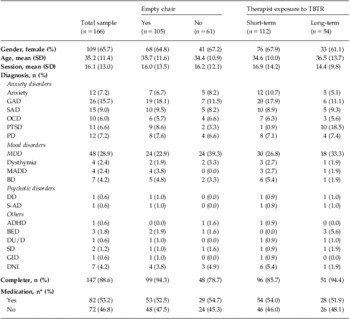
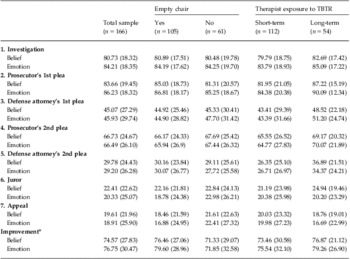
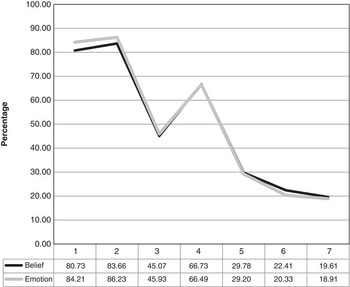
Table 1 provides information regarding gender, age, session, diagnosis, and medication use, and Table 2 presents the mean (SD) percentage of credit given to the CBs by the patients and the percentage of the intensity of emotions derived from the first application of TBTR (n = 166). Figure 1 shows that there were shifts in how much the patients believed in their self-accusations/CBs, and in the intensity of the corresponding emotions after each procedure, from steps 1 through 7.
Demographic features, diagnosis, and use of medication

ADHD: attention deficit/hyperactivity disorder; BED: binge eating disorder; BD: bipolar disorder; DD: delusional disorder; DNI: diagnosis not informed; DU/D: drug use/dependence; GAD: generalized anxiety disorder; GID: gender identity disorder; MADD: mixed anxiety-depressive disorder; MDD: major depressive disorder; OCD: obsessive-compulsive disorder; PD: panic disorder; PTSD: posttraumatic stress disorder; SAD: social anxiety disorder; S-AD: schizoaffective disorder; SD: somatoform disorder; TBTR: trial-based thought record.
*Sample reduced to n = 154 because of missing data.
Sample and group means (SD) in the ITT analysis

TBTR: trial-based thought record.
*Percentage improvement is calculated according to the following formula: Improvement = (step 1 – step 7/step 1) × 100.
Results of the first use of trial-based thought record (TBTR) in 166 outpatients. Mean percentage change in outcomes (credit in core belief and intensity of the emotion) are illustrated during different steps of a TBTR session: 1 = inquiry/investigation; 2 = prosecutor's first plea; 3 = defense attorney's first plea; 4 = prosecutor's second plea; 5 = defense attorney's second plea; 6 = jury's verdict; and 7 = initial preparation for the appeal.

All but one of the patients (99.4%) reached the prosecutor's second plea. The exception was a depressed patient whom, after the identification and assessment of the negative CB, did not accept continuation of this approach. One hundred sixty patients (96.4%) reached the defense attorney's second plea, 158 (95.2%) reached the jury's decision, and 147 (88.6%) reached the initial preparation for the appeal, the latter being considered completers.
In the LOCF analysis, a significant overall difference (p < 0.001) between the mean ranks of the TBTR steps, both in the percentage credit attributed to CBs and the intensity of emotions, relative to baseline (step 1), was observed. As there was a large number of comparisons that would prevent them from being independent from one another,Reference Leech, Barret and Morgan20 and 8 comparisons post hoc were made, we made a Bonferroni correction on alpha, such that p would need to be .05/8 = .006 to be significant. There were significant decreases between values after the defense attorney's pleas (steps 3 and 5), jury's verdict (step 6), and initial preparation for the appeal (step 7) relative to the investigation (all p < 0.001). Statistically significant reductions were also shown between the defense attorney's first and second pleas, between the defense attorney's second plea and jury's verdict, and between the defense attorney's second plea and initial preparation for the appeal (all p < 0.001). A highly significant increase was shown between values after the prosecutor's second plea (step 4) relative to the defense attorney's first plea (p < 0.001).
No significant differences were found between the mean ranks of percentages presented by patients submitted to TBTR that was performed in the empty chair format relative to the conventional format, nor were there differences between outcomes according to the therapists’ exposure to TBTR (all p > 0.05). However, significantly more patients who were submitted to the empty chair approach concluded all the steps of TBTR (completers), compared to those not submitted to the empty chair approach (χ 2 = 9.26, df = 1, p = 0.004).
Discussion
This article conveys a naturalistic observation of the first use of TBTR by therapists in different levels of training. In this approach, after the patient has accumulated considerable evidence not supporting the negative view of him/herself, it is dismissed because of discounting and/or minimizing “but” statements that are driven by activated dysfunctional negative CBs. TBTR is a clinical strategy that uses common cognitive therapy techniques incorporated as a metaphor of a legal trial. In this approach, patients are encouraged to tackle the evidence supporting and not supporting the self-critical view of him/herself, expressed as negative CBs, essentially “butting the buts.” The final goal is to address the dysfunctional negative CB in a structured format, restructuring and replacing it with a new positive CB, activated by means of the upward arrow strategy explored after the defense attorney's second plea and the jury's verdict (steps 5 and 6 in Figure 1), and maintained by a daily “evidence journal” as homework,Reference De-Oliveira6 which is started in the same session as the initial “preparation for the appeal” (step 7).
This study replicates a previous preliminary small study conducted by the first author of this article,Reference De-Oliveira6 in which the patients (n = 30) participated in a similar simulation of a trial and exhibited shifts in their adherence to CBs and in the intensity of corresponding emotions after each TBTR step during a session. In that study, significant mean reductions existed between percent values after investigation and the defense attorney's plea (p < 0.001), and after the jury's verdict, either in beliefs (p < 0.001) or in intensity of emotions (p < 0.001). Significant differences also emerged between the defense attorney's first and second pleas (p = 0.009) and between the defense attorney's second plea and the jury's verdict concerning core beliefs (p = 0.005) and emotions (p = 0.02). The present study confirms these results, with the clear advantage that the TBTR method was used by therapists not involved in the development of the technique, and working in their own offices. It was shown that, regardless of the level of exposure of therapists to TBTR, the results were essentially the same.
Because the results shown in the present study were obtained in just one session, they do not allow us to conclude that CB change is long lasting after TBTR use. However, TBTR has been shown to have durable results in social anxiety disorder (SAD).21 In that trial, there were significant reductions (p < 0.001) in the following assessments of both TBTR (n = 17) and conventional cognitive therapy (n = 19): Liebowitz social anxiety scale, fear of negative evaluation scale, social avoidance and distress scale, and Beck anxiety inventory. Also, TBTR was significantly more effective than conventional cognitive therapy in reducing the scores of the fear of negative evaluation scale at mid-treatment (p = 0.01) and at post-treatment (p = 0.004), and the social avoidance and distress scale at post-treatment (p = 0.03). It was concluded that there was preliminary evidence showing that TBTR was at least as efficacious as conventional cognitive therapy in reducing symptoms of SAD, supporting additional studies of TBTR in SAD and other psychiatric disorders. One of the issues raised in the discussion of the above-mentioned trial was that, although the traditional standard thought record used in the contrast group as a comparator did not necessarily work for every patient, one of the concerns to be resolved was whether this was a function of the tool itself or the individual clinician who was using the tool. In the present study, TBTR was used both by therapists with short-term and long-term exposure to the approach, showing that a good outcome may be obtained with TBTR after a short training period. However, as most therapists in this study (79.2% in the short-term group vs. 100% in the long-term group) were certified cognitive therapists, a study including inexperienced therapists and specifically designed to test this hypothesis should be conducted.
Despite self-criticism being a feature in many psychological disorders, research on psychotherapy designed to reduce this common clinical problem is scarce.1 Compassion-focused therapy has been proposed by GilbertReference Gilbert22 to deal with shame. Nonetheless, aside from Shahar etal.1 work and the present study on treatment strategies that directly target self-criticism, no other studies seem to have been done. Both Shahar etal.'s and this one use the empty chair approach in their protocols. Despite the limitation of including just one session, and therefore not being able to generalize its results, the present study compares the empty chair approach to a conventional psychotherapy format of TBTR. Both methods seem to work well, significantly reducing self-criticism to a very low level, as demonstrated by a decrease in the credit attributed to the negative CB at the end of the session. This was also shown in the recently published study on social anxiety disorder.21 In any event, a clinical trial comprising a multisession treatment period, specifically designed to test this hypothesis, is warranted.
Significantly more patients treated with the empty chair approach concluded all steps in this study. This finding is somewhat difficult to explain. A possible explanation is that the more experiential character of the empty chair format further engaged the patients. However, as the outcome measures were not different in the two groups, this explanation is not totally convincing.
This study is limited by the short duration of observation (just one session). However, this was the only way to proceed, because TBTR is not necessarily repeated in subsequent sessions in a clinical setting by different therapists, precluding any additional comparison. Furthermore, the sample is heterogeneous, comprising patients with many different diagnoses. These are important aspects to be investigated in future studies with more homogeneous samples in order to determine the precise role of TBTR in helping patients to modify their negative CBs, and to reduce self-criticism.
Conclusion
TBTR may at least temporarily help patients constructively reduce self-criticism, by changing negative CBs and their corresponding emotions. This study demonstrated a highly significant decrease in the attachment to negative CBs, regardless of the format of its use (empty chair vs. conventional) and the therapists’ level of exposure to TBTR (short-term vs. long-term).
Disclosures
Dr. de Oliveira has received grant support/honoraria from AstraZeneca, Bristol-Myers-Squibb, Eli Lilly, Janssen-Cilag, Pfizer, Servier, and Roche. Mr. Hemanny, Mrs. Powell, Mrs. Bomfim, Mrs. Duran, Mrs. Novais, Mrs. Velasquez, Mrs. Di Sarno, Mr. Alves, and Mrs. Cesnik report no affiliation with or financial interest in any organization that may pose a conflict of interest.
Acknowledgments
Thanks are due to Olivia Haun de Oliveira, MD, for important assistance during statistical analyses and preparation of the manuscript. Thanks are also due to the therapists who composed the Brazilian TBTR Study Group, namely Adriani F. Zadrozny, Ana Claudia Knackfuss, Ana Claudia Lubitz, Camila Seixas, Claudia Fagundes França, Claudia Luísa Sena, Cristiane Maluhy Gebara, Deise Abegão de Camargo, Elaine Di Sarno, Elenita Domingues Ribeiro da Silva, Érica Panzani Duran, Ericka Martha Alves de Oliveira Dias, Felipe Quinto da Luz, Fernanda Belli, Gabriela Oltramari, Gledson Lima Alves, Iolanda D'Araripe, Isabel Cristina Napolitano, Joici Adriane Cesnik, Luciane Dacol Molim, Maria Claudia Gomes, Maria Lúcia Rossi, Michella Lopes Velasquez, Mylene Kachani Dratwa, Nilma Novais, Patrícia Skolaude Dini, Peterdione Menerich, Rilzeli M. Gomes, Rosália Lima Morosi, Taísa Moschini Moraes Cotrim Dias, Thaís Delavechia Bonfim, Talita Moschini Moraes.