Introduction
Given the established relationship between dairy herd management and reproductive performance, reproductive management decisions seem to have critical economic implications (Olynk and Wolf, Reference Olynk and Wolf2008). Reproductive performance in dairy animals affects farm profitability directly through daily milk production per cow, number of replacements available and voluntary/involuntary culling rates. Despite advances made in genetic engineering and the global progress witnessed in high-producing dairy herd management practice, reproductive efficiency seems to have suffered a dramatic decrease since the mid-1980s (Lucy, Reference Lucy2001). A major component of most economic indices used in the selection of dairy cows is productive life that can only be enhanced through maximizing number of parturitions during the animal's economic lifetime. Any factor causing delays or failures in pregnancy will result in reductions in the total milk produced and the calves born, ultimately leading to an increase in involuntary replacements in the herd (Sewalem et al., Reference Sewalem, Miglior, Kistemaker, Sullivan and Van Doormaal2008). Fertility is a multi-factorial trait whose deterioration results from an array of genetic, environmental and managerial factors. Moreover, the complex interactions of these factors make it next to impossible to determine the exact reason underlying the deteriorating traits. However, the key factors with adverse impacts on reproductive efficiency during the productive life of dairy cows have been identified (Walsh et al., Reference Walsh, Williams and Evans2011). Low reproductive efficiency has been found to be the main cause underlying economic losses in many dairy farms (Sewalem et al., Reference Sewalem, Miglior, Kistemaker, Sullivan and Van Doormaal2008). This, in turn, is the result of a myriad of factors such as the nutrition system (Garnsworthy et al., Reference Garnsworthy, Lock, Mann, Sinclair and Webb2008), herd management (Olynk and Wolf, Reference Olynk and Wolf2008; Schefers et al., Reference Schefers, Weigel, Rawson, Zwald and Cook2010), milk yield level (Lucy, Reference Lucy2001), timing of artificial insemination (AI) (Dransfield et al., Reference Dransfield, Nebel, Pearson and Warnick1998), accuracy of oestrus detection (Schefers et al., Reference Schefers, Weigel, Rawson, Zwald and Cook2010), insemination process and inseminator's skills (Lima et al., Reference Lima, Risco, Thatcher, Benzaquen, Archbald, Santos and Thatcher2009), genital diseases such as retained placenta (López-Gatius et al., Reference López-Gatius, García-Ispierto, Santolaria, Yániz, Nogareda and López-Béjar2006), climate (De Vries and Risco, Reference De Vries and Risco2005) and stress (Dobson and Smith, Reference Dobson and Smith2000). The costs imposed on breeders due to poor reproduction in cows include increased costs of re-insemination, reduced milk yield and high costs of involuntary culling (Hou et al., Reference Hou, Madsen, Labouriau, Zhang, Lund and Su2009). It is, therefore, of high economic value to improve the reproductive traits of the herd. In this regard, heat stress (HS) is likely to be a major factor underlying declining productivity and low fertility in high-producing dairy herds, especially in countries with warm weather conditions. Additionally, to the best of our knowledge, there is no study relating the timing effect of AI in pre- and post-milking on conception rate (CR). Hence, the current study was designed and implemented to explore possible management practice that could alleviate or eliminate the adverse effects of heat stress on dairy cows. For this purpose, the current study strives to test the following three hypotheses:
Hypothesis 1:
Conception rates are not different with regards to timing of (pre- or post-milking) AI in Holstein dairy cows.
Hypothesis 2:
The timing (pre- or post-milking) effect of AI is independent of the milk yield level.
Hypothesis 3:
The interaction of artificial insemination timing (pre- or post-milking) and temperature-humidity index (THI) has no effect on CR.
Materials and methods
Cows and herd management
Data were collected from a commercial Holstein dairy farm located 20 km NE of Sari, Mazandaran Province, northern Iran, (36‒42.5′N latitude and 53‒10.7′E longitude at an altitude of ‒8 m). Characterized by a generally warm and temperate climate with an annual average temperature of 16.7 °C, Sari receives most of its precipitation as rain in the winter with sporadic rainfall in the summer to yield an annual average precipitation of 690 mm (CDCW, 2013). According to the Köppen-Geiger system (Kottek et al., Reference Kottek, Grieser, Beck, Rudolf and Rubel2006), the climate in Sari is classified as warm temperate with hot dry summers when the average temperature in the warmest month reaches above 22 °C (CSA).
The farm milked around 2500 Holstein cows three times a day (at 06:00, 14:00 and 22:00 h) in a double 40 milking parlour. The cows were fed a total mixed ration without access to pasture. Feeds consisted of about 0.45 forage (maize silage, alfalfa hay and wheat straw) and 0.55 concentrate (barley, maize meal, soybean meal, sunflower meal, canola, cottonseed, wheat bran, sugar beet pulp, supplements and di-calcium phosphate). National research council recommendations were used to balance the rations (NRC, 2001).
For the purposes of the current study, dry cows were kept in a separate group to be transferred to a ‘transition group’, depending on their body condition score and age, 20‒30 days prior to parturition. An early postpartum group was established as ‘fresh cows group’ for postpartum nutrition and controls, and 21-day postpartum primiparous and multiparous lactating cows were transferred to separate groups based on their daily milk production and days in milk (DIM). All animals were tested to ensure they were free of tuberculosis and brucellosis. The vaccination programmes included foot-and-mouth disease, anthrax and blackleg vaccines, regularly administered every 4 months, every 10 months and once a year, respectively. The voluntary waiting period from calving to first AI was 42 days for this herd. Lactating cows were maintained in a facility with shade, fans, sprinklers and a concrete slatted floor. Cows were housed in free stall barns bedded with sand and cleaned by scrapers three times a day. Heat detection was accomplished by visual observation three times a day for 30 min for each group of cows.
Time of insemination was recorded relative to that of milking (pre- or post-milking). Both groups were bred with frozen semen by a technician. Almost all cows were bred in the morning, such that some of the cows were inseminated within 2 h before milking and some within 2 h after milking (depending on the oestrous detection time). Any cows with metabolic and reproductive disorders and those milked ⩾3 h before or after AI were excluded from the study.
Reproductive health management, insemination and pregnancy diagnosis
Uterine discharges of cows were monitored for odours and appearance during the first 21 days of lactation. Postpartum checks (daily control) involved treatment of the following puerperal diseases until resolved or until culling: metabolic diseases such as hypocalcaemia and ketosis (the latter diagnosed during the first or second week postpartum), retained placenta (foetal membranes retained longer than 12 h after parturition) or primary metritis (diagnosed during the first or second week postpartum). The herd was maintained on a weekly reproductive health programme, involving examination of the reproductive tract of each animal by palpation per rectum within 28–30 days postpartum to check for normal uterine involution and ovarian structures. Reproductive disorders diagnosed at this time (including incomplete uterine involution, pyometra or ovarian cysts) were treated until resolved. Involution of the uterus was defined as incomplete when the uterine horns and/or cervix were larger than those in non-pregnant cows. Detectable intrauterine fluid was interpreted as pyometra. An ovarian cyst was diagnosed when a structure 20 mm or larger in diameter in either or both ovaries persisted for at least 7 days in the absence of a palpable corpus luteum. Boluses containing oxytetracycline were always administered into the uterus for cows suffering retained placenta or primary metritis. Pregnancy diagnosis was performed 38–45 days after insemination by palpation per rectum. Pregnancy was reconfirmed after 4 months and pregnant animals were re-examined after 7 months for drying.
Data structure
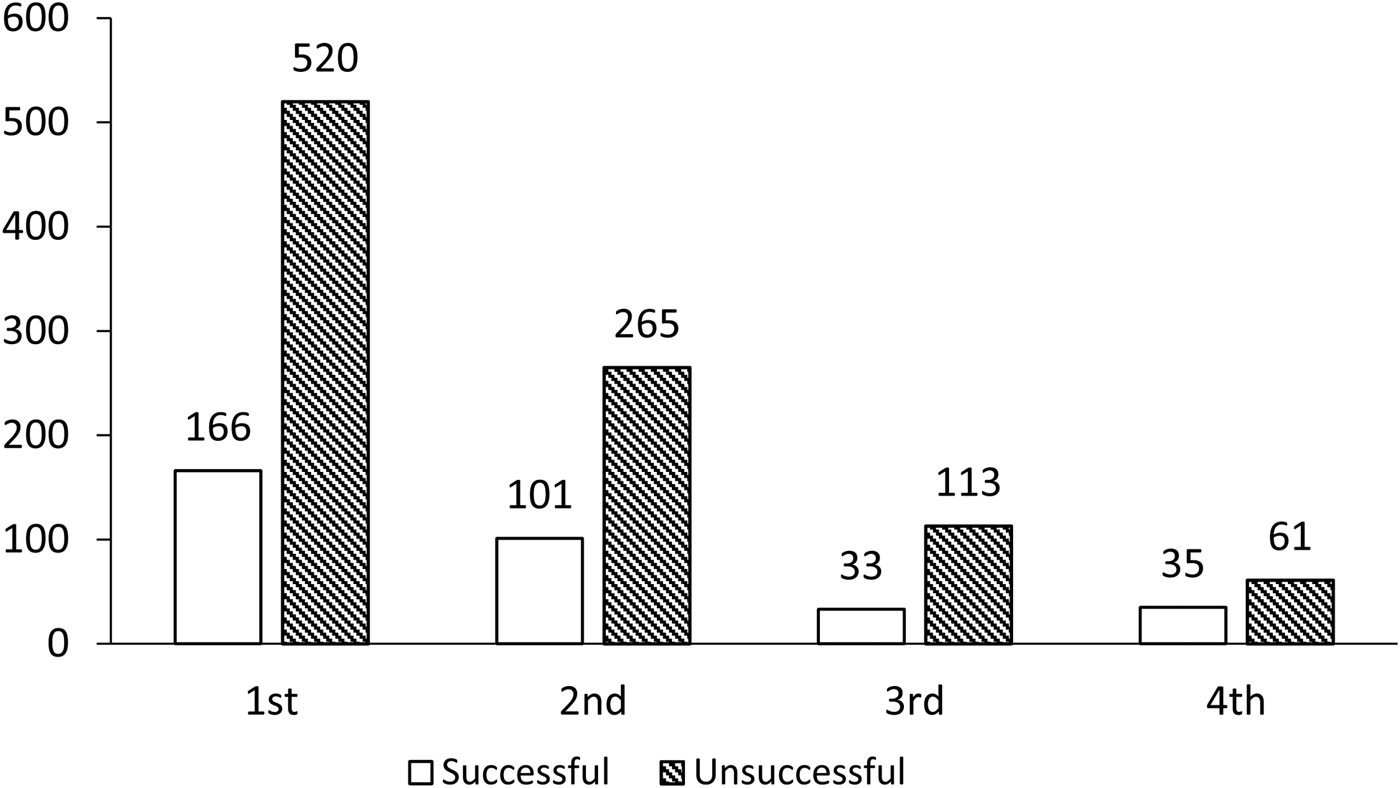
In the current study, information on AI treatments i.e. pre- and post-milking was gathered after the fact. The number of parturitions from July to January and the number of services from October to April were more than those in any other months of the year. A total number of 1294 inseminations (either successful or failed) were performed in 708 cows from 22 May 2011 to 21 March 2012. All the cows were from parities of one to five. Of the 1294 inseminations, 583 were administered before milking and 711 after milking. The frequency of successful and unsuccessful inseminations at each service attempt is shown in Fig. 1.
Frequency distribution of successful and unsuccessful inseminations at different services.

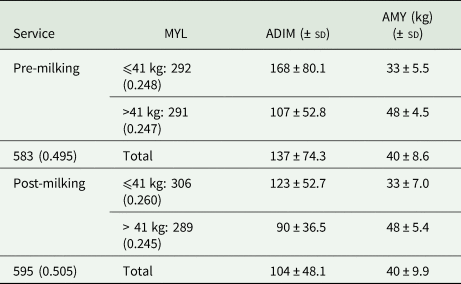
The mean and standard deviations for service numbers in the two pre- and post-milking groups were 2 ± 1.3 and 1.6 ± 0.87, respectively. Average daily milk yield during the 30 days up to the insemination ranged between 10 and 67.5 kg, with a mean of 41 ± 9.3 kg. There were 116 missing data for this trait in the post-milking insemination group. Average 30-day milk yield observations were divided into two groups of more and less than the median as low (⩽41.0 kg) and high (>41.0 kg) milk producing cows. DIM at insemination time ranged from 42 to 305 days with the mean and standard deviation of 119 ± 63.6 days, that was ultimately introduced into the final analysis as months in milk (MIM with nine levels DIM < 60 as MIM = 1 to 270 < DIM ⩽ 305 as MIM = 9). Table 1 reports the frequency of cows in the two milk yield groups, the pre- and post-milking insemination times and the means for DIM and milk yield.
Frequency of services in the pre- and post-milking insemination groups and the associated milk yield levels

MYL, milk yield level: low (⩽41 kg); high (>41 kg); ADIM, average days in milk; AMY, average milk yield; sd, standard deviation
Climate data such as daily temperature and relative humidity were taken from a meteorological station located 22 km away from the herd. The maximum THI for each day was calculated using the following equation (García-Ispierto et al., Reference García-Ispierto, Lopez-Gatius, Bech-Sabat, Santolaria, Yaniz, Nogareda, De Rensis and Lopez-Bejar2007a):

where T max is the maximum temperature and RHmin is the minimum relative humidity. For each insemination record, a THI value was assigned which was the average of the day prior to, the day of and the day after the insemination. The average THI values thus obtained were divided into two sets of below and above 70.
Statistical analysis
In the current retrospective study, all statistical analyses were conducted using the SAS package, version 9.2 (SAS Institute Inc., 2011). Descriptive statistics were determined using the UNIVARIATE and FREQ procedures. The GLIMMIX model procedure with a generalized linear mixed model methodology was used to analyse the results of insemination (success = 1 and failure = 0) as a binomial distribution with the logit link function. The model included the fixed effects of insemination time relative to milking (pre- and post-milking), parity (including the two levels of primiparous and multiparous), insemination month (six levels), MIM (nine levels), interaction effect of insemination time and parity, interaction effect of insemination time and milk yield level (less or more than the average; i.e. 41.0 kg), interaction effect of insemination time and THI levels (normal or HS conditions), and the random effect of cow. The results were presented as odds ratios (OR) and 95% confidence intervals (95% CI).
Results
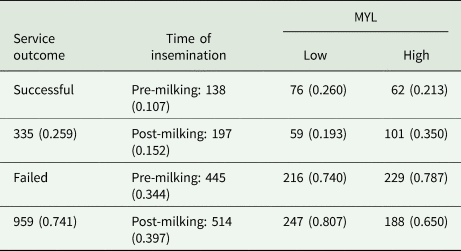
The frequencies of successful and failed services for cows according to insemination times (pre- or post-milking) and milk yield levels are reported in Table 2.
Frequency distributions (with proportions in parentheses) of successful and failed services for cows with different insemination times within different milk yield levels

MYL, milk yield level: low (⩽41 kg); high (>41 kg).
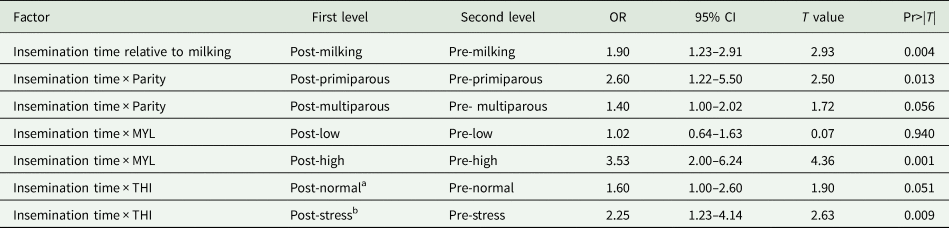
The results of the statistical analysis indicated that insemination time (after v. before milking), cow's milk yield level (high v. low), parity classification (primiparous v. multiparous), THI level (normal v. stressful) and their interactions with insemination time had significant effects on insemination outcome (P < 0.05). The comparative ORs (Table 3) indicated that cows inseminated after milking recorded a higher CR than those inseminated before milking.
ORs obtained for binary comparisons of some levels of the factors involved

OR, odds ratio; CI, confidence interval; MYL, milk yield level: low (⩽41 kg); high (>41 kg); THI, temperature-humidity index.
a Normal: THI < 70.
b Stress: THI ⩾ 70.
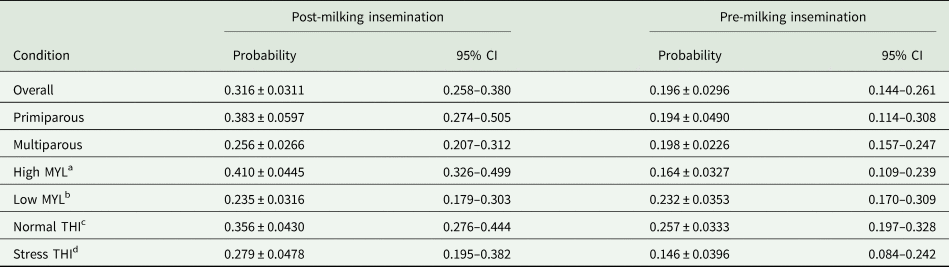
The ORs of conception for post- v. pre-milking insemination in primiparous cows (2.6, 95% CI of 1.22‒5.50), high-producing cows (3.53, 95% CI of 2.0‒6.24) and cows' tolerance of stressful THI (2.24, 95% CI of 1.23‒4.14) were significantly high (P < 0.05), demonstrating that these cows had a greater chance of conception when inseminated after milking. Conception probability (Table 4) as predicted by the statistical model revealed noticeable differences between post- and pre-milking inseminations.
Predicted CR probability under different conditions

CI, confidence interval.
a High MYL = high milk yield level: >41 kg.
b Low MYL = low milk yield level: ⩽41 kg.
c Normal THI = normal temperature-humidity index: <70.
d Stress THI = stress temperature-humidity index: ⩾70.
Discussion
For many years, insemination timing in cattle has been a subject of controversy over an absolute optimum time of insemination relative to ovulation, accurate determination of oestrus onset and the logistics of observing and handling animals. The current study evaluated the effects of pre- and post-milking insemination on CR in lactating Holstein dairy cows under ambient heat stress. The results showed that the cows inseminated after milking recorded higher CRs than those inseminated before milking. Previous study of conditions at milking revealed elevated cortisol concentrations; increased heart-beat rates; reduced pain sensitivity, increased incidences of vocalization, kicking and stepping behaviour; as well as reduced milk yields (Van Reenen et al., Reference Van Reenen, Van der Werf, Bruckmaier, Hopster, Engel, Noordhuizen and Blokhuis2002; Wenzel et al., Reference Wenzel, Schönreiter-Fischer and Unshelm2003). The differences observed in CR between pre- and post-milking inseminated groups was greater among the high-producing cows.
Although little is known about the physiological factors involved in higher CR levels in post-milking inseminated cows, the oxytocin-induced stress during milking seems to be an effective parameter. Many studies have shown that oxytocin concentration rises immediately by more than 60-fold relative to its base concentration following stimulation of the teats before it declines again to its base level at the end of the milking process (Hopster et al., Reference Hopster, Bruckmaier, Van der Werf, Korte, Macuhova, Korte-Bouws and van Reenen2002; Lollivier et al., Reference Lollivier, Guinard-Flament, Ollivier-Bousquet and Marnet2002; Negrao, Reference Negrao2008). The higher level of oxytocin receptor in the oviduct during pro-oestrus and oestrus phases induced by its higher level during milking might alter (Kotwica et al., Reference Kotwica, Kurowicka, Franczak, Grzegorzewski, Wrobel, Mlynarczuk and Kotwica2003) or even inhibit (Wijayagunawardane et al., Reference Wijayagunawardane, Miyamoto, Taquahashi, Gabler, Acosta, Nishimura, Killian and Sato2001) the contraction of different parts of the oviduct. These events may disturb local motility and secretions that are responsive to the need of the gamete transport and fertilization. However, post-milking insemination is conducted after these likely disturbances and might, hence, result in higher CRs.
The effect of HS on fertility in dairy cows is multidimensional and operates through several mechanisms that probably involve both direct physiological and reproductive effects as well as indirect metabolic and nutritional ones. Heat stress affects reproductive success in cows through its direct effects on the ovary, uterus, embryo and early foetus. These effects include diminished steroidogenesis, delayed follicle selection and a modified follicular wavelength with adverse effects on the quality of oocytes (Sartori et al., Reference Sartori, Sartor-Bergfelt, Metens, Guenther, Parrish and Wiltbank2002) as well as luteal (Bech-Sàbat et al., Reference Bech-Sàbat, López-Gatius, Yániz, García-Ispierto, Santolaria, Serrano, Sulon, de Sousa and Beckers2008) and uterine (Thatcher et al., Reference Thatcher, Guzeloglu, Mattos, Binelli, Hansen and Pru2001) functions. Implantation requires intricate signalling interactions between the conceptus and the mother for embryo attachment so any stress factor, including HS, can disrupt this process (Garbayo et al., Reference Garbayo, Serrano and López-Gatius2008). Previous studies reported reductions of 20‒30% in CR (Morton et al., Reference Morton, Tranter, Mayer and Jonsson2007) and pregnancy rate (El-Tarabany and El-Bayoumi, Reference El-Tarabany and El-Bayoumi2015; Khan et al., Reference Khan, Prasad and Gupta2013) during the warm season. The adverse effect of high temperatures is exacerbated by high humidity, especially in high-producing dairy cows (García-Ispierto et al., Reference García-Ispierto, Lopez-Gatius, Santolaria, Yaniz, Nogareda and Lopez-Bejar2007b). Complex indexes, which combine some of the above climatic parameters, have been proposed to monitor the effects of HS. Thermal heat index, combining maximum temperature and minimum relative humidity, is the index most commonly used. The values obtained for this index indicated that higher differences in CRs were observed between the post- v. pre-milking inseminations during days with higher THI values (⩾70). Thus, heat stress seems to fortify the oxytocin-induced stress during milking so that pre-milking insemination leads to more stressful conditions during heat stress compared to pre-milking insemination under non-heat stress conditions. Greater difference in CRs are, therefore, not unexpected between post- and pre-milking inseminations under heat stress conditions. This difference may be partially attributed to the interaction between milk yield level and insemination time, as confirmed by the results obtained in the current study.
In summary, the current observational study showed increased CR levels during days with high THI values in post-milking inseminated cows relative to those observed in pre-milking inseminated ones, especially in high-producing cows. However, no decisive physiological evidence was detected to explain this improvement. Hence, further carefully designed physiological studies are recommended to gain a deeper insight and to take advantage of this herd management practice towards enhanced reproduction performance
Acknowledgements
The authors express their gratitude to the management team of Mahdasht Dairy Farm (Sari, Iran) for their generous support in providing the required data. Mohammad Ali Roodbari and Abolfazl Molaei (Mahdasht Dariy Farm, Sari, Iran) also deserve our thanks for their assistance during the study. The authors also extend their thanks to Mahdi Zhandi and Hamid Kohram (University of Tehran, Karaj, Iran) and Alireza Nejati (Fisher and Paykel Healthcare, Aukland, New Zealand) for assistance in editing the manuscript. Ezzatollah Roustazadeh from ELC, IUT, is also sincerely acknowledged for editing the final English manuscript.
Financial support
This research received no specific grant from any funding agency, commercial or not-for-profit sectors.
Conflict of interest
None.