Introduction
In many countries, especially in Asia, informal (family or friend) caregivers are intimately involved in providing care to older adults with limitations in activities of daily living (ADL). Such caregiving emanates from a combination of cultural or societal norms and limited institutional infrastructure for providing care to older adults with ADL limitations. Research over the past three decades has documented the negative psychological impact of caregiving on such informal caregivers, including a high prevalence of depression or depressive symptoms (Redinbaugh et al., Reference Redinbaugh, MacCallum and Kiecolt-Glaser1995; Nieboer et al., Reference Nieboer, Schulz, Matthews, Scheier, Ormel and Lindenberg1998), which in turn has implications for both care recipients and caregivers. Depression or depressive symptoms among caregivers have been linked to discontinuation of caregiving, resulting in institutionalization of care recipients (Arai et al., Reference Arai, Sugiura, Washio, Miura and Kudo2001). Among caregivers, depressive symptoms are associated with an increase in physical illness, healthcare utilization, and mortality (Vitaliano et al., Reference Vitaliano, Zhang and Scanlan2003; Pinquart and Sorensen, Reference Pinquart and Sorensen2007). In order to mitigate the prevalence and incidence of depression or depressive symptoms among informal caregivers of older adults, it is important to identify care recipient and caregiver characteristics and caregiving dimensions that have the maximum impact on depressive symptoms among caregivers.
Our hypothesized model for studying depressive symptoms among caregivers is based on previous conceptual models proposed by Pearlin (Pearlin et al., Reference Pearlin, Lieberman, Menaghan and Mullan1981), Lawton (Lawton et al., Reference Lawton, Moss, Kleban, Glicksman and Rovine1991), Yates (Yates et al., Reference Yates, Tennstedt and Chang1999), and Clyburn (Clyburn et al., Reference Clyburn, Stones, Hadjistavropoulos and Tuokko2000) for the development of adverse psychological outcomes, including depression, among caregivers in the context of their caregiving situation. Pearlin's stress process model, developed in the context of caregiving for dementia, suggests that depression is one potential outcome or manifestation of stress among caregivers. It is the result of background or contextual factors, stressors, and mediators, and the way these relationships interrelate and change over time (Pearlin et al., Reference Pearlin, Lieberman, Menaghan and Mullan1981). Lawton's caregiver appraisal model (Lawton et al., Reference Lawton, Moss, Kleban, Glicksman and Rovine1991) built on Pearlin's model and work by Lazarus and colleagues (Lazarus and DeLongis, Reference Lazarus and DeLongis1983) identifies “caregiver appraisal” as a critical mediator between primary stressors and psychological outcomes. Yates’ caregiving model (Yates et al., Reference Yates, Tennstedt and Chang1999) was built on the strengths of stress process and caregiver appraisal models. The main modification was the inclusion of the amount of caregiving provided as a primary appraisal rather than as a stressor as proposed by Pearlin, thus depicting extent of caregiver assistance to be a response to the needs of the care recipient. Additionally, Yates’ model considered subjective burden of caregiving to be a secondary appraisal rather than a primary stressor (Yates et al., Reference Yates, Tennstedt and Chang1999). Clyburn et al. (Reference Clyburn, Stones, Hadjistavropoulos and Tuokko2000) tested four different models for predicting caregiver depression and suggested the best model to be the one in which the subjective burden of caregiving predicted the caregiver's depressive symptoms.
In our hypothesized model, stressors include severity of functional disability, cognitive impairment, and behavior problems (together known as primary stressors) among the care recipients. Past studies have shown presence and severity of these primary stressors to be associated with the psychological well-being of the caregiver (Pinquart and Sorensen, Reference Pinquart and Sorensen2007). The association between primary stressors and caregiver's depressive symptoms can be either direct or mediated through the amount of caregiving provided by the caregiver and perceived caregiver burden (Yates et al., Reference Yates, Tennstedt and Chang1999). Moreover, the amount of caregiving is influenced not only by primary stressors but also by external resources, such as the presence of formal or informal (e.g. presence of foreign domestic worker) services for caregiving. Our model treats these resources as predictors rather than outcomes of the amount of caregiving provided by the caregiver, allowing for a potential reduction in the demand on caregiver's time consequent to assistance received from external sources. The amount of caregiving, in turn, influences the subjective burden/negative reaction of caregiving (Yates et al., Reference Yates, Tennstedt and Chang1999), which in turn is a precursor to depressive symptoms in the caregiver (Yates et al., Reference Yates, Tennstedt and Chang1999; Clyburn et al., Reference Clyburn, Stones, Hadjistavropoulos and Tuokko2000).
Some studies report caregiving to have positive effects, in addition to negative consequences, on the caregiver (Lawton et al., Reference Lawton, Moss, Kleban, Glicksman and Rovine1991; Cohen et al., Reference Cohen, Colantonio and Vernich2002; Pinquart and Sorensen, Reference Pinquart and Sorensen2004). Positive effects of caregiving include the perceived gain, satisfaction, or increase in self-esteem from caregiving. It has been suggested by some that the caregiving experience involves aspects that can be satisfying and rewarding and may improve the psychological well-being of the caregiver (Cohen et al., Reference Cohen, Colantonio and Vernich2002; Pinquart and Sorensen, Reference Pinquart and Sorensen2004). While Lawton's caregiver appraisal model (Lawton et al., Reference Lawton, Moss, Kleban, Glicksman and Rovine1991) views positive and negative aspects of caregiving to be independent of each other, others have shown that a positive appraisal of caregiving can reduce subjective burden/negative reaction to caregiving and caregiver's depressive symptoms (Cohen et al., Reference Cohen, Colantonio and Vernich2002). Conversely, according to Pearlin's model, a greater amount of caregiving can erode positive self-esteem of the caregiver (Pearlin et al., Reference Pearlin, Mullan, Semple and Skaff1990). Thus, we hypothesize that the amount of caregiving and assistance received from external resources reduces caregiver's self-esteem, which in turn can affect negative reaction to caregiving and caregiver's depressive symptoms. The role of social support as a mediator is also central to Pearlin's stress process model (Pearlin et al., Reference Pearlin, Mullan, Semple and Skaff1990). Social relationships are also believed to enhance self-esteem of the caregiver. Others have confirmed that caregivers with less emotional support have higher levels of distress and burden (Miller et al., Reference Miller, Townsend, Carpenter, Montgomery, Stull and Young2001), whereas those receiving more support have higher self-esteem (Robinson, Reference Robinson1990). Thus, we hypothesize that emotional support reduces the negative reaction to caregiving at the same time as it improves self-esteem of the caregiver.
While intuitively attractive, analyses using the existing conceptual models of relationship between care recipient and caregiver characteristics and caregiving dimensions to caregiver depression or depressive symptoms are relatively few in number and have several limitations. One limitation is that while acknowledging the likely importance of contextual determinants of caregiver depressive symptoms, most analyses do not control for these characteristics (Lawton et al., Reference Lawton, Moss, Kleban, Glicksman and Rovine1991; Redinbaugh et al., Reference Redinbaugh, MacCallum and Kiecolt-Glaser1995; Deimling et al., Reference Deimling, Smerglia and Schaefer2001; Losada et al., Reference Losada2006). Another limitation is that these conceptual frameworks have been developed and evaluated mostly in the context of caregiving for dementia patients (Lawton et al., Reference Lawton, Moss, Kleban, Glicksman and Rovine1991; Losada et al., Reference Losada2006). Caregiving for older adults with dementia may be distinct from caregiving for a more general population of care recipients, including older adults with limitations in ADLs due to conditions other than dementia such as frailty, stroke, advanced cancers, late-stage organ failures, and neurological disorders other than dementia such as Parkinson's disease. Dementia, for example, is often associated with behavioral features which can be particularly distressing (Swearer et al., Reference Swearer, Drachman, O'Donnell and Mitchell1988). There is a need to understand the pathways leading to adverse psychological outcomes among caregivers of older adults with ADL limitations, in general, without limiting the study to caregivers for dementia patients. A third limitation is that most previous analyses have used convenience samples of caregivers, for instance, those accessing or referred to social or medical services (Lawton et al., Reference Lawton, Moss, Kleban, Glicksman and Rovine1991; Redinbaugh et al., Reference Redinbaugh, MacCallum and Kiecolt-Glaser1995; Deimling et al., Reference Deimling, Smerglia and Schaefer2001; Losada et al., Reference Losada2006). To be relevant to public policy, it would be important to evaluate a representative group in the community. Lastly, these conceptual models have mostly been tested using data from developed western countries (Lawton et al., Reference Lawton, Moss, Kleban, Glicksman and Rovine1991; Redinbaugh et al., Reference Redinbaugh, MacCallum and Kiecolt-Glaser1995; Yates et al., Reference Yates, Tennstedt and Chang1999; Deimling et al., Reference Deimling, Smerglia and Schaefer2001; Losada et al., Reference Losada2006). In most Asian countries, the concept of filial piety is paramount and thus informal caregivers, especially adult children, view providing care to their older parents as a natural obligation. However, in recent years in some of these countries, there is an increasing trend to employ foreign domestic workers or maids to take care of older adults, thereby allowing economically productive adults to remain in the workforce, and to reduce the risk of institutionalization among their parents with ADL limitations by offsetting informal caregiver burden, allowing for care at home. The phenomenon is widespread in economically developed rapidly aging Asian countries, such as Singapore (Yeoh et al., Reference Yeoh, Huang and Gonzalez1999). Given the conflict between cultural norms and practical considerations facing family caregivers in Asia, the dynamics of the development of depressive symptoms in caregivers in Asian countries are likely to be different from those observed in western countries, both in terms of the presence and relative influence.
In addition to understanding the general determinants of depression in caregivers, it is important to consider the relative impact of these determinants on spouses and adult children separately. This is because spouses and adult children are two different groups of caregivers, with different needs and concerns, and thus are likely to be affected differently by primary stressors (Deimling et al., Reference Deimling, Smerglia and Schaefer2001). Further, studies have reported depressive symptoms to be more common among spousal caregivers than adult child caregivers (Deimling et al., Reference Deimling, Smerglia and Schaefer2001). While one suggested explanation is that spouses provide more intense caregiving compared to adult children, it is not clear whether other facets of the caregiving process, for instance self-esteem, perceived emotional support, and help received from foreign domestic workers or maids operate differently in the two groups of caregivers in contributing to or protecting against depressive symptoms. A previous study found caregiver satisfaction to reduce perceived burden among adult children but not among spouses (Lawton et al., Reference Lawton, Moss, Kleban, Glicksman and Rovine1991). However, that study was based on a convenience sample of caregivers, limited to caregivers of older adults with dementia, and did not control for demographic characteristics of the caregiver and care recipient (Lawton et al., Reference Lawton, Moss, Kleban, Glicksman and Rovine1991).
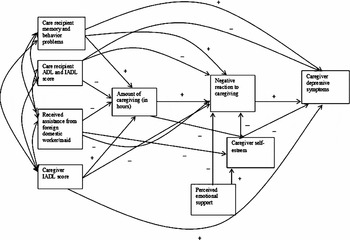
Thus, the primary objective of this analysis was to examine the factors – care recipient and caregiver characteristics and caregiving dimensions – associated with depression using path analysis. This form of modeling is used because it accounts for multiple factors in a way that restricts the number of tested relationships based on an underlying conceptual model (Ullman and Bentler, Reference Ullman, Bentler and Weiner2003). A secondary objective was to assess whether the identified path model for depressive symptoms in caregivers differs between spousal and adult child caregivers. The analysis was done using a national sample of caregivers, including spouse and adult child caregivers, of individuals with a range of conditions associated with care needs, in Singapore. The following hypotheses (Figure 1) were tested in the overall sample of caregivers as well as in the subgroups of spousal and adult child caregivers:
1. Primary stressors (more memory and behavior problems, and worse ADL and instrumental ADL (IADL) status in the care recipient) will increase the severity of caregiver depressive symptoms directly as well as indirectly by increasing the amount of time spent caregiving, which will produce a more negative reaction to caregiving.
2. Increased amounts of caregiving (hours/week spent by caregiver in assisting care recipient with ADLs and IADLs) will reduce caregiver self-esteem as well as lead to more negative reaction to caregiving.
3. Receipt of assistance by care recipient from a foreign domestic worker or maid in ADLs/IADLs will reduce the amount of caregiving, negative reaction to caregiving and caregiver self-esteem.
4. Poorer caregiver health status will reduce the amount of caregiving and increase negative reaction to caregiving and caregiver depressive symptoms.
5. Increased emotional support, as perceived by the caregiver, will reduce negative reaction to caregiving both directly and indirectly by improving caregiver self-esteem.
6. The path analysis model predicting caregiver's depressive symptoms will have a good fit, as determined by model fit indices.
7. There will be measurement invariance between spousal and adult child caregiver path models.
Hypothesized caregiving model.

Methods
Data source
The data for this analysis come from the Singapore Survey on Informal Caregiving, a national survey of community-dwelling older Singaporeans aged ≥75 years receiving human assistance for at least one ADL limitation (“care recipient”), and their primary informal caregivers, conducted in 2010–2011 by the Ministry of Community Development, Youth and Sports, Singapore. The target sample size was 1,500 care recipient–caregiver dyads. To achieve this number, a random sample of 20,000 older Singaporeans aged ≥75 years, stratified by ethnicity and age group (75–79, 80–84, 85+), based on the mid-2008 population distribution (which estimated 119,300 Singaporeans in this age range), oversampling Malays and Indians by a factor of 2, to ensure a sufficient number of respondents in these subgroups for analysis, was drawn from the national database of dwellings for administration of an ADL screener (see below).
All 20,000 older adults in the sample were sent an information letter, with an option to opt-out. While 312 (1.6%) of the older adults (or their family) refused participation by call or email, an additional 117 (0.6%) were not contactable due to returned mail. The remaining 19,571 addresses were visited at least once by trained interviewers. However, 863 (4.3%) of the older adults (or their family) refused participation upon visit, 1,840 (9.2%) were not contactable (due to reasons such as “older adult not alive or in nursing home,” “address unoccupied,” “family moved or overseas,” “unit rented out,” etc.), and 11,255 (56.3%) addresses were visited at least three times without any response. Thus, 5,613 older adults were administered the ADL screener. This screener, administered to the older adult, or if unavailable/unable to respond due to health reasons, to any adult aged ≥25 years residing in the same household (except for a foreign domestic worker/maid), enquired about the older adult's age, citizenship, and ADL status. Those who received human assistance for any one of six ADLs (taking a bath/shower, walking inside the house, dressing up, standing up from a bed/chair, using the toilet in the house, and eating; i.e. “care recipients”) were asked to name the family member or friend (but not a foreign domestic worker/maid) most involved in providing care or ensuring provision of care to them (i.e. “caregiver”). Of the 5,613 older adults administered the ADL screener, 6 (0.1%) were ineligible due to age (were <75 years) or citizenship (were non-Singaporeans) criteria, and of the remaining 5,607 older adults, 1,211 (21.6%) met the criteria of being a care recipient and identified a caregiver. However, in 21 of the care recipient–caregiver dyads either one or both members did not give consent for survey administration, resulting in a final sample of 1,190 care recipient–caregiver dyads, who were interviewed face-to-face using structured questionnaires. A total of 655 (55.0%) care recipients were unable to respond due to health reasons and their caregiver was interviewed as a proxy.
Measures
Primary Stressors
These consisted of care recipient ADL status, IADL status, and memory and behavior problems, as reported by the caregiver. Care recipient ADL and IADL status, determined using the “Older Americans Resources and Services (OARS) Multidimensional Functional Assessment Questionnaire” (Fillenbaum and Smyer, Reference Fillenbaum and Smyer1981) was based on their ability to perform seven ADL activities (eating, dressing, grooming, toileting, bathing, walking, and getting in/out of bed) and seven IADL activities (using the telephone, getting to places beyond walking distance, shopping for groceries or clothes, preparing own meals, doing housework, taking medication, handling money). The score on each activity (able to perform without any help (2), with some help (1), completely unable to perform (0)) was added to generate a total ADL score, ranging from 0 to 27 in the dataset, with a higher score indicating a greater level of ADL and IADL functioning (α = 0.93).
Care recipient memory and behavior problems were assessed using the Revised Memory and Behavior Problems Checklist (RMBPC; α = 0.89) (Teri et al., Reference Teri, Truax, Logsdon, Uomoto, Zarit and Vitaliano1992). The RMBPC consists of 24 items, assessing three content areas (memory-related problems, depression, disruptive behaviors). Caregivers reported on the frequency of occurrence of each problem in the care recipient in the past week (never occurred at all (score = 0)/not in the past week (score = 1)/1–2 times (score = 2)/3–6 times (score = 3)/daily or more often (score = 4)/do not know or not applicable). The scores from the 24 items were summed to create a total score, ranging from 0 to 96.
Caregiver health status
Caregiver IADL status, also based on the OARS (Fillenbaum and Smyer, Reference Fillenbaum and Smyer1981), was used as a proxy for caregiver health status (α = 0.90).
Receipt of assistance by care recipient from a foreign domestic worker or maid
Such assistance was deemed to be received if the caregiver reported that a foreign domestic worker or maid had assisted the care recipient in one or more ADLs and/or IADLs in the month prior to the survey.
Amount of caregiving
This was operationalized as the number of self-reported hours the caregiver spent in a typical week assisting the care recipient with ADLs and IADLs.
Negative reaction to caregiving
Four of the five subscales of the Caregiver Reaction Assessment (CRA) schedule (impact on schedule, impact on financial problems, lack of family support, and impact on health) proposed by Given et al. (Reference Given, Given, Stommel, Collins, King and Franklin1992) were used to generate a score for negative reaction to caregiving. Caregivers reported their agreement with each item on the four subscales (total of 17 items) on a five-point Likert scale (strongly disagree (1) to strongly agree (5)), and scores of the 17 items were added. The total score, with a higher value indicative of a more negative reaction to caregiving, ranged from 17 to 78 in the current dataset (α = 0.86).
Caregiver self-esteem
Seven items on the fifth subscale (caregiver's esteem) of the CRA schedule (Given et al., Reference Given, Given, Stommel, Collins, King and Franklin1992) were used to assess caregiver self-esteem. A higher score (which ranged from 13 to 35) on the subscale indicated greater caregiver self-esteem (α = 0.82).
Perceived emotional support
Caregivers responded to an eight-item perceived social support scale (Pearlin et al., Reference Pearlin, Mullan, Semple and Skaff1990). Each item on the scale was scored on a four-point Likert scale (strongly disagree (1) to strongly agree (4)). The scale score ranged from 4 to 32, a higher score reflecting higher perceived emotional support (α = 0.90).
Caregiver depressive symptoms
These were measured using the 11-item Center for Epidemiologic Studies Depression (CES-D) scale (Kohout et al., Reference Kohout, Berkman, Evans and Cornoni-Huntley1993). Caregivers rated each item on the scale as none/rarely (score = 0), sometimes (score = 1), or often (score = 2), depending on how frequently he/she felt that way during the past week (α = 0.77), with a higher total score indicative of more depressive symptoms.
Contextual variables
These included caregiver age (continuous variable), gender, ethnicity (Chinese, Malay, Indians/others), and educational status (≤primary education, lower secondary/secondary education, >secondary education), and care recipient age and gender. Caregiver living arrangement was not included since most (89.9%) co-resided with the care recipient. (Note: While these contextual variables have not been shown in the figures, they were included in each of the four path equations; see Table S2, available as supplementary material attached to the electronic version of this paper at www.journals.cambridge.org/jid_IPG).
Statistical analysis
Caregiver and care recipient characteristics were first described using simple descriptive statistics, such as mean, range, Cronbach's α coefficients (for scales). Pearson correlation coefficients were calculated to assess bivariate associations between the main variables (see Table S1, available as supplementary material attached to the electronic version of this paper at www.journals.cambridge.org/jid_IPG). Path analysis was then used to seek empirical support for the proposed model, focusing on paths represented in a priori hypotheses (Figure 1). Standardized coefficients were estimated from path analysis for each of the four outcomes in the model (caregiver depressive symptoms, negative reaction to caregiving, caregiver self-esteem, and amount of caregiving), the independent variables for each of the four equations being the variables preceding the outcome in the hypothesized path model (Figure 1) as well as all the contextual variables. The fit of the model was assessed using various model fit indices (χ2 and its p-value, Bentler comparative fit index (CFI), Bentler-Bonett normed fit index (NFI), Bentler-Bonett non-normed fit index (NNFI), Root Mean Square Error of Approximation (RMSEA), and Standardized Root Mean Square Residual (SRMSR)). Values <2 for χ2/df; ≥0.95 for CFI, NFI, and NNFI; <0.06 for RMSEA; and ≤0.08 for SRMSR are considered to represent a good fit (Schreiber et al., Reference Schreiber, Nora, Stage, Barlow and King2006). Then, the statistically insignificant (p ≥ 0.05) paths were removed and the fit of this revised model reassessed. In addition to the overall sample, the fit of the revised model was also assessed separately by type of caregiver (spouse or adult child). Measurement invariance of the revised model across spousal caregivers and adult child caregivers was also tested as suggested by Vandenberg and Lance (Reference Vandenberg and Lance2000). This was done to assess the degree to which the items comprising the model had the same meaning and measured the same constructs similarly across the two caregiver groups (Vandenberg and Lance, Reference Vandenberg and Lance2000). First, an omnibus test of the equality of covariance matrices was conducted. Then, the presence of configural invariance (i.e. same pattern of item loadings across the two groups) and metric invariance (i.e. the same magnitude of item loadings across the two groups) was sequentially assessed across the spousal and adult child groups. Equality of covariance matrices and configural invariance was assessed through values of model fit indices (χ2 and its p-value, CFI, RMSEA, and SRMR). Magnitude of difference (Δ) in CFI values, primarily, and in RMSEA and SRMSR values, secondarily, between nested CFA models was used to assess presence of metric invariance. ΔCFI of ≤–0.01, ΔRMSEA ≤0.01, and ΔSRMSR ≤0.025 between nested models were considered to indicate metric invariance (Vandenberg and Lance, Reference Vandenberg and Lance2000; Chen, Reference Chen2007). The path analysis was conducted using proc calis in SAS 9.2 (Cary, NC, USA).
Results
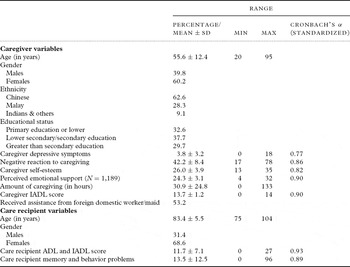
The mean age of the caregivers was 55.6 years. Most caregivers were females (60%), Chinese (63%), and lower secondary/secondary educated (38%). The average age of the care recipients was 83.5 years (75–104 years), most being females (69%). About 53% of the care recipients received assistance in ADLs/IADLs from a foreign domestic worker/maid (Table 1).
Descriptive statistics of the sample (N = 1,190)

ADL = Activities of Daily Living; IADL = Instrumental Activities of Daily Living.
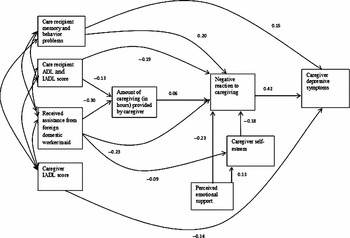
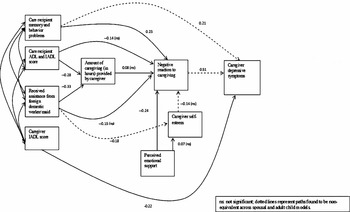
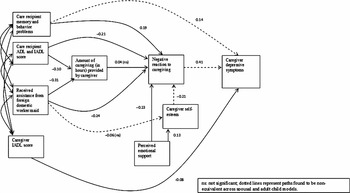
The hypothesized model had a good fit (χ2 = 25.32, p = 0.001; CFI = 0.995; NFI = 0.994; NNFI = 0.911; RMSEA = 0.047; SRMSR = 0.009). The model was re-run after removing the statistically insignificant paths. There was a very good fit of the revised model for the overall sample (Figure 2; χ2 = 32.71, p = 0.002; CFI = 0.995; NFI = 0.994; NNFI = 0.948; RMSEA = 0.036; SRMSR = 0.011), as well as spousal (Figure 3; χ2 = 16.45, p = 0.23; CFI = 0.995; NFI = 0.980; NNFI = 0.953; RMSEA = 0.038; SRMSR = 0.019) and adult child (Figure 4; χ2 = 30.99, p = 0.003; CFI = 0.994; NFI = 0.991; NNFI = 0.940; RMSEA = 0.038; SRMSR = 0.013) caregiver samples.
Revised caregiving model for the overall sample (N = 1,189).

Results of path analysis among spousal caregiver (M = 190).

Results of path analysis among adult child caregiver (N = 961).

The results for the overall sample (Figure 2) partially supported our first hypothesis. While the care recipient ADL score was associated with caregiver depressive symptoms, the relationship was indirect: greater independence in ADLs was related to less caregiving provided by the caregiver and lower negative reaction to caregiving, corresponding to fewer depressive symptoms. On the other hand, care recipient memory and behavior problems were associated with caregiver depressive symptoms directly as well as indirectly, through negative reaction to caregiving. Care recipient memory and behavior problems were not related to the amount of caregiving provided by the caregiver.
Contrary to our second hypothesis, the amount of caregiving provided by the caregiver was not related to caregiver self-esteem in the overall or stratified samples. However, a higher amount of caregiving provided by the caregiver was associated with higher negative reaction to caregiving in the overall sample.
In the overall sample, receipt of assistance by care recipient from a foreign domestic worker or maid was associated with the amount of caregiving provided by the caregiver, negative reaction to caregiving, and caregiver self-esteem, supporting our third hypothesis.
Contrary to our fourth hypothesis, caregiver health status was not related to the amount of caregiving provided by the caregiver and negative reaction to caregiving in the overall or stratified samples. However, the direct association between caregiver health status and caregiver depressive symptoms was significant.
The results from the overall sample supported our fifth hypothesis that perceived emotional support was inversely related to negative reaction to caregiving directly as well as indirectly through caregiver self-esteem.
For testing measurement invariance of the revised model across spousal and adult child caregivers, we first conducted a test of equality of covariance matrices across the spousal and adult child groups. The null hypothesis of invariant covariant matrices was rejected (χ2 = 743.6, p = <0.0001). The test for configural invariance between the two groups was also supported by fit indices (χ2 = 46.84, p = 0.01; CFI = 0.994; RMSEA = 0.037; SRMSR = 0.015) (Model 1). Then, we tested for metric invariance, with the null hypothesis that item loadings for like items were invariant across the two groups. Fit indices for this revised model (Model 2) (χ2 = 138.2, p = <0.0001; Bentler CFI = 0.981; RMSEA = 0.043; SRMSR = 0.0301) were calculated. The difference in values of model fit indices between Model 2 and Model 1 (χ2 = 91.36, p = 0.000; ∆CFI = –0.013; ∆RMSEA = 0.006; ∆SRMSR = 0.015) suggested non-invariance between the two models (Chen, Reference Chen2007).
Consequently, we removed equality constraints on item loadings from (i) “negative reaction to caregiving” to “caregiver depressive symptoms,” (ii) “care recipient memory and behavior problems” to “caregiver depressive symptoms,” (iii) “caregiver self-esteem” to “negative reaction to caregiving,” and (iv) “received assistance from foreign domestic worker” to “caregiver self-esteem,” based on modification indices provided in Model 2 (Lagrange multiplier statistic values for these paths was >7). The revised model (Model 3) showed good fit (χ2 = 108.9, p = 0.0003; CFI = 0.988; RMSEA = 0.036; SRMSR = 0.024). Differences in fit indices for Model 3, relative to Model 1 (∆χ2 = 62.1, p = 0.006; ∆CFI = –0.006; ∆RMSEA = 0.001; ∆SRMSR = 0.009), supported partial weak factorial invariance between the groups (Chen, Reference Chen2007).
Discussion
To summarize, path analysis was used to examine the conceptual pathways relating to caregiver depressive symptoms in the overall sample of caregivers as well as in subsamples of spousal and adult child caregivers. Most of the hypothesized relationships were supported in the overall sample, and were consistent across spouses and adult child caregivers, though there were some variations. These results are discussed below.
Primary stressors
As predicted, more memory and behavior problems in the care recipient were associated with greater severity of caregiver depressive symptoms directly as well as indirectly through a more negative reaction to caregiving. However, more impairment in caregiver ADL and IADL was only indirectly associated with caregiver's depressive symptoms, mediated by amount of caregiving and negative reaction to caregiving.
While the association between care recipient memory and behavior problems and negative reaction to caregiving/subjective caregiver burden has been shown by others (Clyburn et al., Reference Clyburn, Stones, Hadjistavropoulos and Tuokko2000), our findings are contrary to previous reports that care recipient memory and behavior problems affect depressive symptoms among caregivers only indirectly through the caregiver's perception of being burdened (Lawton et al., Reference Lawton, Moss, Kleban, Glicksman and Rovine1991; Clyburn et al., Reference Clyburn, Stones, Hadjistavropoulos and Tuokko2000; Deimling et al., Reference Deimling, Smerglia and Schaefer2001). The presence of a direct association may be because witnessing loved ones suffer from memory and behavior problems (possibly indicative of underlying dementia) may induce feelings of loneliness and loss among caregivers, not unlike bereavement, resulting in depressed mood. And, possibly due to greater attachment of spouses than children to the care recipient, this underlying mechanism is stronger for spouses, resulting in a greater magnitude of the direct association among spouses (β = 0.21) than adult child caregivers (β = 0.14). Invariance testing between spousal and adult child models also showed this parameter to vary between the two models.
The presence of a direct relationship between care recipient memory and behavior problems and caregiver depressive symptoms, and variation in its strength by type of caregiver, and only an indirect relationship between care recipient ADL and IADL limitations and caregiver depressive symptoms has implications for services that aim to support caregivers. First, a reduction in, or alleviation of, care recipient behavior problems through appropriate pharmacological or non-pharmacological treatment (Doody et al., Reference Doody2001) will be useful in reducing depressive symptoms as well as negative reactions to caregiving among caregivers, in general, and possibly more so among spousal caregivers. Second, the impact on caregiver depressive symptoms of external care services, such as home help services, foreign domestic workers or maids, which aim to provide assistance to care recipients mainly for ADLs and IADLs, is likely to vary by care recipient memory and behavior problem status. For caregivers of those with such problems (mostly dementia patients), such external care services may not result in substantial reduction in depressive symptoms, though the mental health benefit of such services will be more for adult child caregivers than spousal caregivers. On the other hand, caregivers of older adults with only ADL or IADL limitations, with no memory and behavior problems, may benefit more from such external care services.
Amount of caregiving
As suggested by our second hypothesis, increase in amount of caregiving was associated with a more negative reaction to caregiving, though the strength of association was weak. However, there was no significant association between amount of caregiving and caregiver self-esteem.
Previous studies have acknowledged that negative reaction or subjective burden of caregiving is predicted by amount of caregiving provided by the caregiver (Lawton et al., Reference Lawton, Moss, Kleban, Glicksman and Rovine1991; Nieboer et al., Reference Nieboer, Schulz, Matthews, Scheier, Ormel and Lindenberg1998). However, the weak association between amount of caregiving and negative reaction to caregiving in our study further reinforces the finding that it is not the actual caregiving provided that is detrimental for the caregiver, but the feeling of being burdened by caregiving which negatively affects the caregiver's well-being the most (Lawton et al., Reference Lawton, Moss, Kleban, Glicksman and Rovine1991; Savundranayagam et al., Reference Savundranayagam, Montgomery and Kosloski2011).
The relationship between negative reaction to caregiving and caregiver's depressive symptoms differed between spousal and adult child caregivers, with a stronger association present among spousal caregivers, suggesting psychological health of spousal caregivers to be more sensitive to subjective burden of caregiving compared to that adult children.
Assistance from foreign domestic worker
As hypothesized, we found that receipt of assistance from a foreign domestic worker or maid was associated with reduced amount of caregiving provided by the caregiver, a lower negative reaction to caregiving and lower caregiver self-esteem. However, the association between assistance from a foreign domestic worker and caregiver self-esteem differed between spousal and adult child caregivers, as shown by results of invariance testing. Assistance from a foreign domestic worker significantly reduced the self-esteem of spousal caregivers only, suggesting that adult children may benefit more from assistance from a foreign domestic worker in their caregiving tasks than spousal caregivers do.
Emotional support to the caregiver and caregiver self-esteem
The path model suggests that one important way of reducing negative reaction to caregiving, and subsequently depressive symptoms, among both spousal and adult child caregivers is by provision of emotional support to caregivers. Such emotional support may be provided by friends and family members or by caregiver support groups, though the relative effectiveness of support from friends and family members versus support groups on psychological well-being of the caregivers needs to be evaluated.
Results of invariance testing analysis suggest that the association between self-esteem and negative reaction to caregiving differs between spousal and adult children. From parameter estimates, self-esteem appears to be more important for adult children than for spousal caregivers. Greater self-esteem may, in turn, reduce negative reaction to caregiving because adult child caregivers may feel that their caregiving role exceeds their primary obligation of caring for their spouse and children, and thus is more rewarding (Raschick and Ingersoll-Dayton, Reference Raschick and Ingersoll-Dayton2004). On the other hand, self-esteem does not play an important role in spousal caregiving since they are likely to consider caregiving to be an expected duty and part of the marital commitment (Lawton et al., Reference Lawton, Moss, Kleban, Glicksman and Rovine1991).
Strengths and limitations
This study has considerable strengths. First, the findings are derived from a large population-based national survey of informal caregivers of older adults with ADL limitations, not limited to dementia. Second, the findings provide a comprehensive understanding of the correlates of caregiver depressive symptoms among informal caregivers of older adults with physical and cognitive impairments. Third, the findings suggest differences in pathways for depressive symptoms among spousal and adult child caregivers.
The study is, however, not without limitations. The study is not nationally representative of all informal caregivers in Singapore given the high non-response rate. Further, even though the structural model appears causal, the data are cross-sectional, thus, limiting causal inferences. For instance, while the structural model hypothesizes caregiver negative reaction to predict depressive symptoms, it is possible that caregivers, who were depressed before the onset of caregiving, may perceive their situation more negatively and hence provide a lower amount of caregiving compared to caregivers who were not depressed. It is also possible that more depressive symptoms may lead to greater IADL limitations, rather than vice-versa. Further, the behavioral and memory problem of the care recipients have been reported by the caregiver. While studies have shown caregiver reports of these symptoms to be valid (Teri et al., Reference Teri, Truax, Logsdon, Uomoto, Zarit and Vitaliano1992), it is possible that caregivers who are depressed may assess care recipient's symptoms to be worse than they are.
Nevertheless, the study adds to the existing literature on caregiving for older adults as the study has been conducted in an Asian country, where there have been few studies on depressive symptoms among caregivers, in spite of the fact that informal caregivers take on the primary responsibility of caring for older adults with ADL limitations. The results also provide insights into the factors associated with depressive symptoms among spousal and adult child caregivers – and help to identify targeted interventions for improving caregivers’ mood.
Conflict of interest
None.
Description of authors’ roles
C. Malhotra formulated the research question, conducted the statistical analysis, and wrote the paper. R. Malhotra designed the study questionnaire and assisted in writing the paper. T. Østbye participated in designing the study and writing the paper. D. Matchar participated in writing and editing the paper. A. Chan designed the study and participated in writing the paper.
Acknowledgments
The data for this paper were collected through a project funded by the Ministry of Community Development, Youth and Sports, Singapore. The analyses were funded by an A*STAR infrastructure grant to Duke-NUS Graduate Medical School.