Introduction
Fruit/seed set in a high percentage of angiosperms is pollen limited (Burd, Reference Burd1994; Larson and Barrett, Reference Larson and Barrett2000; Knight et al., Reference Knight, Steets, Vamosi, Mazer, Burd, Campbell, Dudash, Johnston, Mitchell and Ashman2005). Pollen limitation occurs when plants that are open-pollinated plus hand-cross pollen supplemented (treatment) produce more fruits and seeds than those that are open-pollinated and not pollen supplemented (control). Ideally, all flowers on the plant should receive supplemental cross pollen (i.e. whole-plant supplementation) in order to avoid the problem of resource allocation to flowers on plants that are pollen supplemented from those that have not been supplemented. Furthermore, perennial plants should be monitored in successive years to determine if they incurred costs of reproduction, i.e. reduction in growth, survival and reproduction, which would indicate limitation of resources caused by pollen supplementation (Bierzychudek, Reference Bierzychudek1981; Zimmerman and Pyke, Reference Zimmerman and Pyke1988; Snow and Whigham, Reference Snow and Whigham1989; Primack and Hall, Reference Primack and Hall1990; Ramsey, Reference Ramsey1997; Ashman et al., Reference Ashman, Knight, Steets, Amarasekare, Burd, Campbell, Dudash, Johnston, Mazer, Mitchell, Morgan and Wilson2004). Pollen limitation includes both pollen quantity and quality (e.g. Byers, Reference Byers1995; Ramsey and Vaughton, Reference Ramsey and Vaughton2000; Ashman et al., Reference Ashman, Knight, Steets, Amarasekare, Burd, Campbell, Dudash, Johnston, Mazer, Mitchell, Morgan and Wilson2004; Colling et al., Reference Colling, Reckinger and Matthies2004; Aizen and Harder, Reference Aizen and Harder2007; Castro et al., Reference Castro, Silveira and Navarro2008), which cannot be separated in pollen supplementation studies (Aizen and Harder, Reference Aizen and Harder2007). However, pollen limitation generally has referred to the number of fruits and/or seeds produced, and thus pollen quality limitation has not been measured (Zimmerman and Pyke, Reference Zimmerman and Pyke1988).
The effects of pollen limitation (PL) on various plant life history traits (other than the number of fruits and seeds produced) have been measured in studies on pollen limitation (Knight et al., Reference Knight, Steets and Ashman2006). Some of these studies have measured its effects on seed germination. The primary aims of this review are twofold: firstly to evaluate two indices used to measure pollen limitation, giving special attention to situations in which the value of PL is higher for open pollinated (Po) than for open pollinated plus pollen-supplemented plants (Ps); and secondly to review the studies that have included the effect of pollen limitation on seed germination. The results of the second objective will provide some basis for an opinion about the effect of pollen limitation on population dynamics.
Pollen limitation indices
The following index often has been used to calculate pollen limitation (Larson and Barrett, Reference Larson and Barrett1999, Reference Larson and Barrett2000; Kasagi and Kudo, Reference Kasagi and Kudo2003; Asikainen and Mutikainen, Reference Asikainen and Mutikainen2005; Ward and Johnson, Reference Ward and Johnson2005; Lázaro and Traveset, Reference Lázaro and Traveset2006; Vanhoenacker et al., Reference Vanhoenacker, Ågren and Ehrlén2006; Duan et al., Reference Duan, Zhang and Liu2007; Merrett et al., Reference Merrett, Robertson and Peterson2007; Robertson et al., Reference Robertson, Ladley, Kelly, McNutt, Peterson, Merrett and Karl2008; González-Varo et al., Reference González-Varo, Arroyo and Aparicio2009; Spigler and Chang, Reference Spigler and Chang2009; González-Varo and Traveset, Reference González-Varo and Traveset2010; Kelly et al., Reference Kelly, Ladley and Robertson2007, Reference Kelly, Ladley, Robertson, Anderson, Wotton and Wiser2010; Marten-Rodriguez and Fenster, Reference Marten-Rodriguez and Fenster2010; Cursach and Rita, Reference Cursach and Rita2012; Delmas et al., Reference Delmas, Escaravage, Cheptou, Charrier, Ruzafa, Winterton and Pornon2014; Suarez-Gonzalez and Good, Reference Suarez-Gonzalez and Good2014; Shabir et al., Reference Shabir, Nawchoo, Wani and Banday2015; Van Etten et al., Reference Van Etten, Tate, Anderson, Kelly, Ladley, Merrett, Peterson and Robertson2015):
 $${\rm PL = 1} - \left( {{\rm P}_{\rm o}{\rm /}{\rm P}_{\rm s}} \right) \left[ { = \left( {{\rm P}_{\rm s} - {\rm P}_{\rm o}} \right){\rm /}{\rm P}_{\rm s}, \hbox{see below}} \right]{\rm,} $$
where Po is fruit (or seed) set in open-pollinated and not pollen supplemented plants (control) and Ps is fruit (or seed) set in open-pollinated plus pollen supplemented plants (treatment). Using this index, there are three possible outcomes regarding fruit and seed production and other life history traits such as germination of seeds produced by control vs treatment plants: Ps > Po, Ps = Po and Ps < Po. As used in the often-cited paper by Larson and Barrett (Reference Larson and Barrett2000), PL = 0.00 when there is no pollen limitation (i.e. Po/Ps = 1.00 and 1.00–1.00 = 0.00) and 1.00 when fruit set with natural (open) pollination (Po) is 0.00 (i.e. Po/Ps = 0.00 and 1.00–0.00 = 1.00). However, although Larson and Barrett (Reference Larson and Barrett2000) gave the index a lower bound of 0.00, the lower bound will be <0.00 (i.e. negative) when fruit/seed production is greater in natural (open) than in natural plus supplemental pollination [Po/Ps > 1.00 and 1.00 – (>1.00) = <0.00)], i.e. when there is a negative effect of pollen supplementation on female reproduction (Campbell and Husband, Reference Campbell and Husband2007; Garcia-Camacho and Totland, Reference Garcia-Camacho and Totland2009; Spigler and Chang, Reference Spigler and Chang2009). Thus, Larson and Barrett (Reference Larson and Barrett2000) ignored Ps < Po, equating it with Ps = Po. Young and Young (Reference Young and Young1992) suggest several possible reasons why PL may be negative, including (1) pollen-supplemented flowers having a lower diversity of pollen donors (and thus pollen) than those that are open-pollinated; (2) negative effects of pollen tube growth in the style associated with high pollen density on the stigma; (3) removal of pollen from or damage to pollen-supplemented stigmas by pollen consumers; and (4) damage of stigma during supplemental pollinations.
Index (1) is appropriate for calculating pollen limitation when Ps ≥ Po but not when Po > Ps. Thus, whereas the bounds of the index are 0 to + 1 when Ps ≥ Po, they are 0 to –∞ when Po > Ps. In which case, the values are not an equal distance from 0 when the same highest fruit (or seed) set is achieved by best the producer (either Ps or Po) and the same lowest fruit (or seed) set by the worst producer (either Ps or Po). This is illustrated in the following example, in which the worst producer has a value of 75 and the best produced a value of 100.
(a) Po (worst producer) = 75 and Ps (best producer) = 100
 $$1- \left( {{\rm P}_{\rm o}{\rm /}{\rm P}_{\rm s}} \right) = 1 - \left( {75/100} \right) = + 0.25$$
(b) Po (best produced) = 100 and Ps (worst produced) = 75
$$1 - \left( {{\rm P}_{\rm o}{\rm /}{\rm P}_{\rm s}} \right) = 1 - \left( {100/75} \right) = 1- 1.33 = - 0.33$$


A more meaningful way to compare pollen supplemented and open-pollinated plants is to use the following index, which gives equal weight to the best producer (Ps or Po) and the worst producer (Ps or Po):
 $${\rm PL} = \left( {{\rm P}_{\rm s} - {\rm P}_{\rm o}} \right){\rm /}{\rm P}_{{\rm max}}\,\left[ {{\rm P}_{\rm s}\,{\rm or}\,{\rm P}_{\rm o}} \right]$$
(a) Po (worst producer) = 75 and Ps (best producer) = 100
$$\left( {{\rm P}_{\rm s} - {\rm P}_{\rm o}} \right)/{\rm P}_{\rm s} = \left( {100 - 75} \right)/100 = 25/100 = + 0.25$$(b) Po (best producer) = 100 and Ps (worst producer) = 75
$$\left( {{\rm P}_{\rm s} - {\rm P}_{\rm o}} \right)/{\rm P}_{\rm o} = \left( {75 - 100} \right)/100 = - 25/100 = - 0.25$$


Index (2) will give the same answer as PL = 1 – (Po/Ps), when Po ≤ Ps and the same as PL = (Ps/Po) – 1, when Po > Ps.
(a) Po ≤ Ps
$${\rm PL} = 1 - \left( {{\rm P}_{\rm o}{\rm /}{\rm P}_{\rm s}} \right) = 1 - \left( {75/100} \right) = 1 - 0.75 = + 0.25$$(b) Po > Ps
$${\rm PL} = \left( {{\rm P}_{\rm s}{\rm /}{\rm P}_{\rm o}} \right) - 1 = \left( {75/100} \right) - 1 = 0.75 - 1.0 = - 0.25$$$$\left( {{\rm If}\;{\rm P}_{\rm o} = {\rm P}_{\rm s}{\rm, PL = 1} - \left( {{\rm P}_{\rm o}{\rm /}{\rm P}_{\rm s}} \right)\,\hbox{and PL} = \left( {{\rm P}_{\rm s}{\rm /}{\rm P}_{\rm o}} \right)\! -1 = 0{\rm. 00}.} \right)$$


In addition to germination percentage, one may also wish to compare time for Psg and Pog seeds to germinate or for seedlings to emerge (see Equation 7). In calculating time to germination or seedling emergence, such as number of days for a given percentage, e.g. 20% (t20) or 50% (t50) to do so (Bewley et al., Reference Bewley, Bradford, Hilhorst and Nonogaki2013; Soltani et al., Reference Soltani, Ghaderi-Far, Baskin and Baskin2015), the equation to use is 1 – (Psg/Pog) when Psg takes fewer days to germinate or emerge than Pog and (Pog/Psg) – 1 when Pog takes fewer days, as illustrated below.
(a) Psg (3 days) > Pog (4 days), i.e. pollen supplemented seeds germinate or emerge in fewer days than control seeds
$$1 - \left( {{\rm P}_{{\rm sg}}{\rm /}{\rm P}_{{\rm og}}} \right)$$$$1 - \left( {3/4} \right) = + 0.25$$(b) Psg (4 days) < Pog (3 days), i.e. control seeds germinate or emerge in fewer days than pollen supplemented seeds
$$\left( {{\rm P}_{{\rm og}}{\rm /}{\rm P}_{{\rm sg}}} \right) - 1$$$$\left( {3/4} \right) - 1 = - 0.25$$


Whereas the time (t) to 50% germination or emergence of viable seeds is t50, 1/t50 is germination rate for the 50th percentile (Joosen et al., Reference Joosen, Kodde, Willems, Ligterink, van der Plas and Hilhorst2010; Bewley et al., Reference Bewley, Bradford, Hilhorst and Nonogaki2013), e.g. 1/3 days = 0.33 day–1, which is faster than 1/4 days = 0.25 day–1.
Another way by which pollen limitation has been calculated is the pollen percentage limitation (PPL) index (Jules and Rathcke, Reference Jules and Rathcke1999; Castro et al., Reference Castro, Silveira and Navarro2008):
 $${\rm PPL} = \left[ {100 \times \left( {{\rm PS - C}} \right)} \right]{\rm /PS,}$$
where PS (=Ps) is fruit set in open-pollinated plus pollen supplemented plants and C (=Po) is fruit set in open-pollinated plants that were not pollen supplemented (control). Moeller (Reference Moeller2004), Campbell and Husband (Reference Campbell and Husband2007), Eckert et al., (Reference Eckert, Kalisz, Geber, Sargent, Elle, Cheptou, Goodwillie, Johnston, Kelly, Moeller, Porcher, Ree, Vallejo-Marín and Winn2010), Moeller et al. (Reference Moeller, Geber, Eckhart and Tiffin2012) and Hove et al. (Reference Hove, Mazer and Ivey2016) used a slightly modified version of Index (3), i.e. without the 100, and of Index (1) to calculate pollen limitation (PL):
 $${\rm PL} = \left( {{\rm P}_{\rm s} - {\rm P}_{\rm o}} \right){\rm /}{\rm P}_{\rm s}\left[ {= 1 - \left( {{\rm P}_{\rm o}{\rm /}_{}{\rm P}_{\rm s}} \right)} \right]$$
Using Indices (3) and (4) to calculate PL has the same problem as described above when PS (Ps) < C (Po), i.e. equal weight is not given to the best [either PS (Ps) or C (Po)] and worst [either PS (Ps) or C (Po)] performer.
(a) C (worst performer) = 75 and PS (best performer) = 100
$$\eqalign{\left[ {100 \times \left( {{\rm PS - C}} \right)} \right]{\rm /PS} & = \left[ {100 \times \left( {100 - 75} \right)} \right]{\rm /100 = 2500/100} \cr & = + 25}$$(b) C (best performer) = 100 and PS (worst performer) = 75
$$\eqalign{\left[ {100 \times \left( {{\rm PS - C}} \right)} \right]{\rm /PS} & = \left[ {100 \times \left( {{\rm 75 - 100}} \right)} \right]{\rm /75 = - 2500/}75 \cr & = - 33}$$


For Index (4), values would be 0.25 and –0.33, respectively.
The way to give equal weight to PS > C (Ps > Po) (above 0) and C > PS (Po > Ps) (below 0) is to put the highest of the two values (PS [Ps] or C [Po]) in the denominator.
 $${\rm PPL} = \left[ 100 \times ({\rm PS} - {\rm C}) \right] / \left[\hbox{PS or C} \right]_{\rm max}$$
 $${\rm PL} = \left( {{\rm P}_{\rm s} - {\rm P}_{\rm o}} \right){\rm /}{\rm P}_{{\rm max}}\,\left[ {{\rm P}_{\rm s}\;{\rm or}\;{\rm P}_{\rm o}} \right]$$
In which case, the range for PPL will be –100 to + 100 and for PL –1 to + 1.
Methods
We used the following index to measure the effect of pollen limitation on seed germination (PLgerm):
 $${\rm PL}_{{\rm germ}} = \left({{\rm P}_{{\rm sg}} - {\rm P}_{{\rm og}}} \right){\rm /}\;{\rm P}_{{\rm max}}\,\left[ {{\rm P}_{{\rm sg}}\;{\rm or}\; {\rm P}_{{\rm og}}} \right]{\rm,} $$
where Psg is germination percentage of seeds from pollen supplemented plants, Pog is germination percentage of seeds from open pollinated (control) plants and Pmax is the larger of the two values (Psg or Pog). A positive value indicates that Psg seeds germinated to a higher percentage and a negative value that Pog seeds germinated to a higher percentage. When Psg = Pog, PLgerm = 0.0. The closer the value is to 1.0 (Psg) the greater the benefit of pollen supplementation, and the closer the value is to –1.0 the greater the benefit of open pollination without pollen supplementation. We used three categories to compare germination of Psg and Pog seeds: Psg > Pog, Psg = Pog and Psg < Pog. For assignment to Psg > Pog, PLgerm had to be ≥0.10, and for assignment to Psg < Pog, PLgerm had to be ≤ –0.10, i.e. –0.10 or more negative than –0.10. Thus, for PLgerm values between –0.10 and 0.10, Psg = Pog.
A criticism of using this index to calculate/evaluate PLgerm is that for low germination percentages differences of a few percentage points between Ps and Po can give high values (negative or positive) for PLgerm that may not be statistically significant. In any case, our results for PLgerm are based on the values for the three categories of PLgerm outlined above.
The results of a study by Dogterom et al. (Reference Dogterom, Winston and Mukai2000) on the effects of pollen tetrad load on germination and on fruit and seed production in highbush blueberry cv. ‘Bluecrop’ (Vaccinium corymbosum, Ericaceae) are discussed in Appendix A. This particular study indicates, overall, that high pollen tetrad loads are advantageous for germination compared with low pollen tetrad loads. However, the study is not a pollen limitation study per se, primarily in that it does not compare Ps with Po. There was no open pollination control (Po). Thus, the results are not included in Table 2.
The results of a study by Gargano et al. (Reference Gargano, Fenu and Bernardo2017) on germination of seeds of the perennial herb Dianthus balbisii (Caryophyllaceae) produced via open-pollination vs hand-pollination over a forest-open habitat gradient at five levels of illuminance in southern Italy are briefly described in Appendix B. The authors indicate that illuminance along the ecotone gradient ranges from <500 klux to >4000 klux. However, it seems that the level of illuminance is lux rather than klux. Maximum illuminance of full sun (mid-day summer) in the middle latitudes is around 100 to 110 klux. We did not include the results of this study in Table 2, because the crossing scheme does not exactly fit the requirements for determining pollen limitation. That is, the hand-cross plants were castrated (anthers removed) before shedding pollen.
In Appendix C, we give the results of a study by Pico and Retana (Reference Pico and Retana2003) that included the effect of hand-cross pollination vs open-pollination on seed germination of the short-lived Mediterranean perennial herb Lobularia maritima (Brassicaceae), i.e. ‘PLgerm’ = (Pcross(g) – Pog)/Pmax. We did not include the results of this comparison in Table 2, because the hand-cross flowers were bagged and thus not also allowed to receive pollen by open pollination.
In Appendix D, we give the results of a study by Ramsey (Reference Ramsey1995) on hand-cross pollination vs open-pollination in January and March on seed germination in the wet heathland species Blandfordia grandiflora (Blandfordiaceae) of eastern Australia. We did not include this comparison in Table 2 for the same reason given for not including Lobularia maritima in the Table, i.e. hand-crossed flowers were bagged and thus not allowed to receive pollen by open pollination.
Results and Discussion
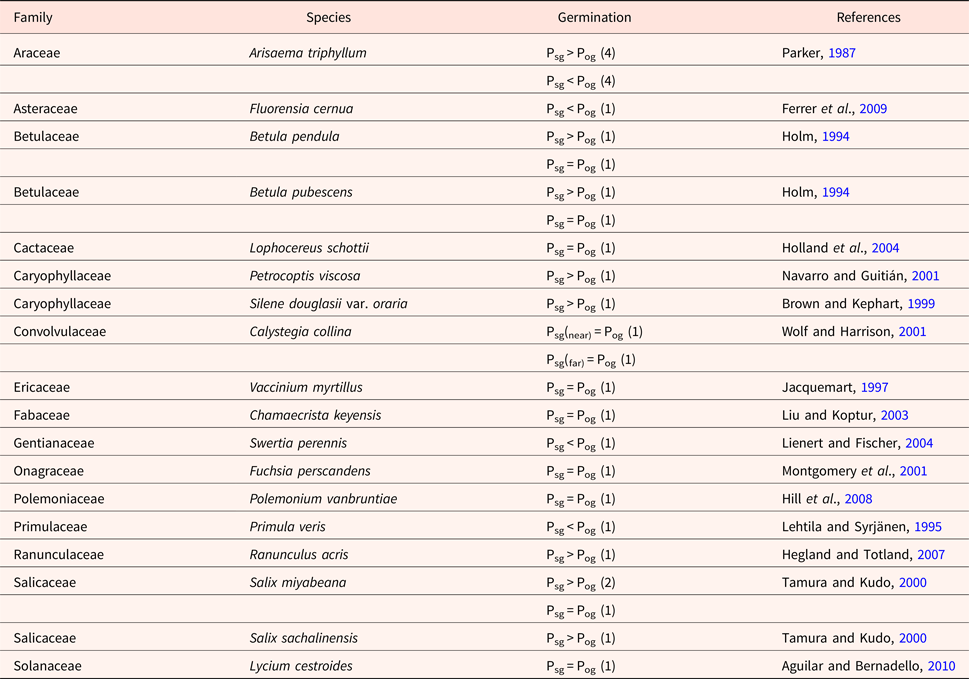
We are aware of a total of 18 species whose germination has been studied in relation to pollen supplementation. One of these species is a monocot, and 17 are eudicots. For the mesic deciduous forests perennial herbaceous monocot Arisaema triphyllum (Araceae), Parker (Reference Parker1987) compared seed germination in eight treatment combinations [2 cross types (pollen supplemented, open pollinated) × 2 seed parent vigour states (healthy, infected with fungal pathogen) × 2 pollen parent vigour states (healthy, infected with fungal pathogen)] = 8 case studies. In four of the eight case studies, Psg > Pog and in the other four Psg < Pog (Table 1). Lehtila and Syrjänen (Reference Lehtila and Syrjänen1995) compared germination percentages of Psg and Pog seeds of Primula veris (Primulaceae). Psg seeds germinated to 10.1% and Pog seeds to 14.8%. Although these differences were not statistically significant, PLgerm was –0.32, which meets our criterion, i.e. ≤ –0.10, for Psg < Pog. Psg and Pog seeds of Swertia perennis (Gentianaceae) germinated to 34.24 and 40.83%, respectively (P < 0.05; Lienert and Fischer, Reference Lienert and Fischer2004). Thus, PLgerm was –0.21, i.e. Psg < Pog. The authors concluded that lower quality of the hand-outcrossed pollen (one donor, but stigma surface pollen-saturated, mostly with pollen from the donor) than of pollen from open pollination (most likely from several donors) accounted for the higher germination of Pog seeds; and also for the fact that Pog > Psg (although not always statistically so) for several other components of fitness. One hundred and seventy-six achenes of Psg plants of Ranunculus acris (Ranunculaceae) sown in field plots germinated (produced seedlings), but only 107 of Pog plants did so. Thus, PLgerm = 0.39, i.e. Psg > Pog (Hegland and Totland, Reference Hegland and Totland2007). Pollen supplementation did not increase the number of viable seeds per flower or the total number of seeds per plant in R. acris, but it did increase achene mass and percentage of sown seeds that germinated (produced seedlings). Thus, the authors suggested that pollen quality may be a stronger element of pollen limitation in this species than pollen quantity.
Effect of pollen supplementation and parent plant fungal disease status on PL values [(Ps – Po)/Pmax] of seed germination in Arisaema triphyllum (based on data in Table 4 of Parker, Reference Parker1987)

aNaturally (open) pollinated healthy seed parent; bnaturally (open) pollinated infected seed parent; chealthy seed parent supplemented with cross pollen from healthy donor; dhealthy seed parent supplemented with cross pollen from infected donor; einfected seed parent supplemented with cross pollen with healthy donor; finfected seed parent supplemented with cross pollen from infected donor.
PL for germination percentage of seeds of Silene douglasii var. oraria (Caryophyllaceae), a narrow endemic of coastal grasslands of western Oregon, USA, was 0.38 and 0.43 at 15 and 40 days, respectively, after planting in a greenhouse, i.e. Psg > Pog (Brown and Kephart, Reference Brown and Kephart1999). In a study of the California serpentine endemic Calystegia collina (Convolvulaceae), germination percentage of scarified (to break physical dormancy) seeds of Psg supplemented with nearby pollen, Psg supplemented with far-off pollen and Pog did not differ (Wolf and Harrison, Reference Wolf and Harrison2001). As germination percentages are not given, we cannot compute PLgerm values. Thus, based on lack of statistical differences among the three pollination categories, Psg(near) = Pog and Psg(far) = Pog, i.e. no benefit of supplementation by either pollen from nearby or far-off plants. For Petrocoptis viscosa (Caryophyllaceae), endemic to crevices in limestone outcrops in the northwest of the Iberian Peninsula, pollen supplemented seeds germinated to 100% and open-pollinated control seeds to 94%. Days to germination for Psg seeds was 8 and for Pog seeds was 11 (Navarro and Guitián, Reference Navarro and Guitián2002). Thus, whereas PLgerm for germination percentage was 0.06 and that for days to germination was 0.27. Overall, then, Psg > Pog. Scarified seeds of Psg and Pog plants of the south Florida pine rocklands endemic species Chamaecrista keyensis (Fabaceae subfam. Caesalpinioideae) germinated to about 98 and 97%, respectively (Liu and Koptur, Reference Liu and Koptur2003). Thus, PLgerm = 0.01, i.e. Psg = Pog. Polemonium vanbruntiae (Polemoniaceae) is a globally threatened rhizomatous herb endemic to wetlands from southern Quebec, Canada, to West Virginia, USA (extirpated from New Brunswick, Canada). Mean germination percentage of Psg seeds of this species cold stratified at 4°C for 40 day was 23.7% and that of Pog seeds was 23.8% (Hill et al., Reference Hill, Brody and Tedesco2008); thus, PLgerm = –0.004, i.e. Psg = Pog. There also was no difference in survival or seedling height/number of leaves from Psg and Pog seeds of this species.
Eight of the 18 species are woody plants, i.e. shrubs or trees, and one is a tree-like cactus. In a pollen limitation study of two shrub species of Salix in northern Japan, PLgerm was 0.29 and 0.15 for seeds of S. miyabeana (Salicaceae) from site 1 in 1996 and 1997, respectively, and –0.05 at site 2 in 1997 (Tamura and Kudo, Reference Tamura and Kudo2000). PL for germination of S. sachalinensis at site 1 in 1996 was 0.19. Although none of the four Psg vs Pog germination percentages was statistically significant, three of them meet our criterion for Psg > Pog. The other value of PL for germination, i.e. –0.05, agrees with the statistical test that Psg = Pog. In the southwestern North American hot desert shrub Flourensia cernua (Asteraceae), Pog seeds germinated to 23% and Psg seeds to 13%; thus, PL = –0.43 and Psg < Pog (Ferrer et al., Reference Ferrer, Good-Avila, Montana, Dominguez and Eguiarte2009). Germination for Psg and Pog seeds of the South American shrub Lycium cestroides (Solanaceae) were only 2.7 and 2.5%, respectively (Aguilar and Bernadello, Reference Aguilar and Bernardello2001). Thus, PL for germination was 0.07, which meets our criterion for Psg = Pog, and also the percentages did not differ statistically. In general, seed germination for coastal populations of the tree-sized birches Betula pendula and B. pubescens (Betulaceae) were not pollen limited, whereas mountain populations were more pollen limited, especially B. pubescens (Holm, Reference Holm1994). Thus, for B. pendula Psg = Pog and Psg > Pog, respectively, and for B. pubescens Psg= Pog and Psg > Pog, respectively. Seed germination of neither Vaccinium myrtillus (Ericaceae), a clonal heathland bog plant of the Northern Hemisphere, nor that of Fuchsia perscandens (Onagraceae), a gynodioecious species endemic to New Zealand, were pollen limited. Seeds of open-pollinated and pollen-supplemented flowers of V. myrtillus germinated to 42.0 and 44.4 %, respectively (PLgerm = 0.054, Psg = Pog) (Jacquemart, Reference Jacquemart1997), and those of F. perscandens to 82.5 and 90.5% (Montgomery et al., Reference Montgomery, Kelly and Ladley2001), respectively (PLgerm = 0.088, Psg = Pog). Seeds from open-pollinated flowers of the Sonoran Desert tree-like cactus Lophocereus schottii germinated to 87.0% and those of pollen-supplemented plants to 84.3%; (Holland et al., Reference Holland, Bronstein and DeAngelis2004), thus PL = –0.03 and Psg = Pog.
Altogether, then, the 30 case studies of the effect of pollen limitation on seed germination of 18 species in 16 genera and one monocot and 14 eudicot families yielded the following results: Psg > Pog, 12; Psg = Pog, 11; and Psg < Pog, 7 (Table 2). Thus, pollen supplementation had a positive or negative effect on 63.3% (19) of the 30 case studies. These mixed results of studies on the effect of pollen supplementation on seed germination are in general agreement with those on the effect of pollen competition, i.e. small vs large pollen load placed at same position on stigma or equal pollen loads placed on stigma at different distances from the ovules (Baskin and Baskin, Reference Baskin and Baskin2015a), and pollen source, i.e. outcross vs self (Baskin and Baskin, Reference Baskin and Baskin2015b), on this life history trait. That is, seeds resulting from pollen supplementation, pollen competition and outcrossing may or may not germinate better than those resulting from open pollination (not pollen supplemented), lack of pollen competition and selfing, respectively. Furthermore, seeds from chasmogamous flowers (open, potentially outcrossed) may or may not germinate better than those from cleistogamous flowers (closed, obligately selfed) (Baskin and Baskin, Reference Baskin and Baskin2017). In general, then, these results seem to suggest that neither amount of pollen (pollen supplementation), quality of pollen (pollen competition) nor outcross vs selfing mating system has a definite influence on germination of the resulting seeds.
Comparison of germination of seeds produced by flowers that were pollen supplemented plus open-pollinated (Psg) with that of seeds produced by flowers that were open-pollinated only (Pog) (number of case studies is shown in parentheses)
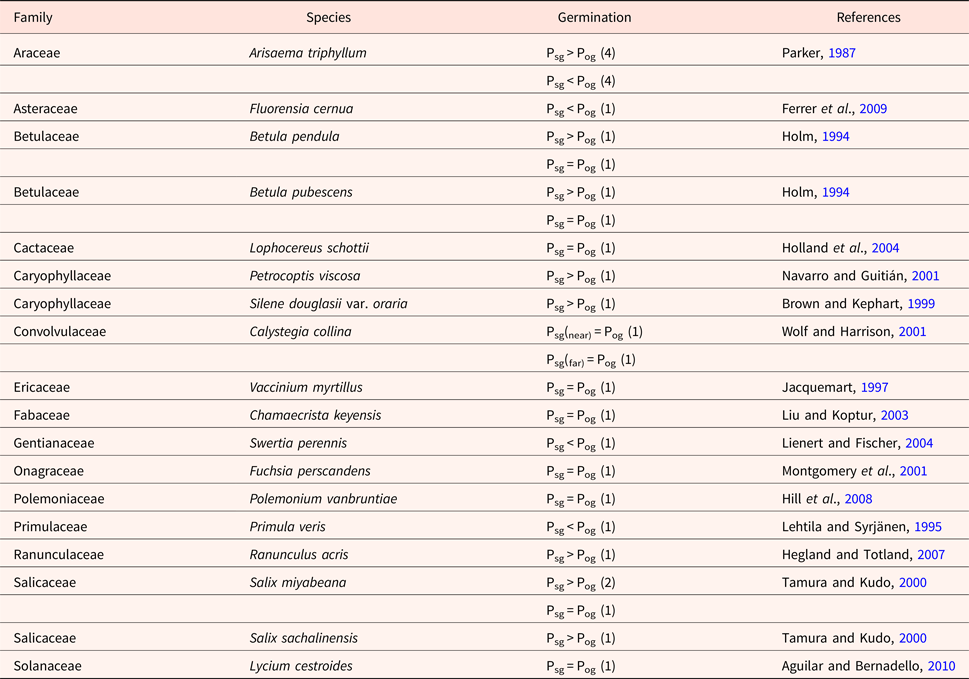
Summary: Psg > Pog, 12; Psg = Pog, 11; Psg < Pog, 7.
Plant populations are demographically dependent on seeds (Bond, Reference Bond1994), and a species may or may not be seed- or microsite (= establishment)-limited. It would also seem that a decrease in PL would matter (i.e. have an effect on population dynamics) only if a species is limited by seeds and not be microsites. Even then, and assuming that a decrease in PL translates into an increase in number of seedlings, the ‘effective’ size of the population (i.e. number of reproductive individuals) will not increase unless some of the seedlings survive to adulthood. So, whether pollen limitation matters depends on its role in population growth (λ, as discussed below) [see Clark et al. (Reference Clark, Poulsen, Levey and Osenberg2007) for a review and meta-analysis of seed limitation in plant populations].
Concluding remarks and recommendations
The indices PL = 1 – (Po/Ps) and PPL = [100 × (PS – C)]/PS are not the most appropriate ones for measuring pollen limitation when the value for Po (or C) is larger than that of Ps (or PS). Thus, we recommend use of the following index for calculating pollen limitation: (Ps – Po)/Pmax. Studies on the effect of pollen limitation on the life history trait seed germination have yielded mixed results; thus, seeds from pollen supplemented plants may be greater than, equal to or less than those from open pollinated controls.
As pointed out by Baskin and Baskin (Reference Baskin and Baskin2015b) for studies on inbreeding depression, descriptions of procedures for germinating seeds in most of the 16 studies discussed in the present paper were incomplete/inappropriate for giving results that can be interpreted to the real world. Neither the study by Montgomery et al. (Reference Montgomery, Kelly and Ladley2001) on Fuchsia perscandens nor the one by Holland et al. (Reference Holland, Bronstein and DeAngelis2004) on Lophocereus schottii included the light or temperature conditions under which the seeds were tested for germination. In which case, the studies cannot be repeated by others. In the study on Lycium cestroides by Aguilar and Bernadello (Reference Aguilar and Bernardello2001), seeds from open pollinated plants and open plus pollen supplemented germinated to only 2.5 and 2.7%, respectively. Assuming the non-germinated seeds were viable, the obvious reason for the very low germination percentages is that the seeds were dormant. No procedures were given for breaking dormancy or germinating the seeds. Seeds of Chamaecrista keyensis (Liu and Koptur, Reference Liu and Koptur2003) and Calystegia collina have physical dormancy, and in both studies dormancy was broken by scarification, which is an artificial (non-natural) way to overcome dormancy in seeds with water-impermeable seed coats (Baskin and Baskin, Reference Baskin and Baskin2000; Zalamea et al., Reference Zalamea, Sarmineto, Arnold, Davis and Dalling2015). For germination of both species, Ps = Po. However, one wonders if this would have been the case if dormancy had been broken naturally in the field or by a simulated natural dormancy breaking treatment such as high or fluctuating temperatures in the laboratory. In other words, did scarification equalize germination of Ps and Po seeds that otherwise differed in ability to remain dormant/germinate under natural conditions? Two studies we judge to have been appropriately done are those on Primula veris by Lehtila and Syrjänen (Reference Lehtila and Syrjänen1995) and on Ranunculus acris by Hegland and Totland (Reference Hegland and Totland2007), who sowed seeds in the field and monitored germination (seedling recruitment).
The real significance of pollen limitation is how it affects population growth rate (λ), a global measure of fitness, but this has been measured in only a few studies. In these studies, an increase in fruit and seed production via pollen supplementation did (Bierzychudek, Reference Bierzychudek1982; Parker, Reference Parker1997; Price et al., Reference Price, Campbell, Waser and Brody2008; Law et al., Reference Law, Salick and Knight2010) or did not (Ehrlén and Eriksson, Reference Ehrlén and Eriksson1995; Knight, Reference Knight2004) translate into an increase in λ. In Primula veris, pollen supplementation had no effect on fruit weight and seed weight or λ (Garcia and Ehrlén, Reference Garcia and Ehrlén2002). Pollen limitation appears to be influencing the demographics of Brunsvigia radulosa (Amaryllidaceae). Thus, with an increase in population size there was a significant decrease in PL and a significant increase in proportion of juveniles and also in number of non-predated seeds per plant (Ward and Johnson, Reference Ward and Johnson2005). Taken together, these correlations suggest that pollen supplementation is having an influence on the structure of the population. However, in none of the studies on population growth rate was the effect of pollen supplementation on the life history trait seed germination considered. Differences in germination between Psg and Pog seeds were also not considered in a study by Jules and Rathcke (Reference Jules and Rathcke1999) on edge effects (resulting from fragmentation of old-growth forests) on recruitment of Trillium ovatum (Melanthiaceae). However, as pollen limitation values in the 16 studies on seed germination included in our opinion paper (Table 2) ranged from −0.65 to +0.47 (–65% to +47%) for this life history trait, it seems reasonable that pollen limitation for germination of Psg and Pog seeds could have a significant effect on λ for some species.
The results of a field-sowing experiment on germination of achenes of Ranunculus acris by Hegland and Totland (Reference Hegland and Totland2007) suggests that Psg and Pog seeds can influence population dynamics differently, albeit via seed size. One-hundred and seventy-six seedlings/juveniles appeared in field plots in 2004 into which three densities of Psg achenes had been sown in 2003, whereas only 107 appeared in plots into which three densities of Pog achenes had been sown. Thus, germination of the heavier (by 18%) Psg achenes was 64% higher than that of the Pog achenes. Only four seedlings/juveniles were found in background plots in which the contribution from the persistent seed bank was monitored. In 2005, there were about 10% more vegetative individuals in the plots into which Psg achenes had been sown than in those into which Pog achenes had been sown, but the difference was not significant. As the quantity of achenes produced by pollen supplemented and control plants did not differ, the authors concluded that ‘… pollen limitation may affect germination through seed quality [seed size], and thereby affect population dynamics’.
A long-term study by Van Etten et al. (Reference Van Etten, Tate, Anderson, Kelly, Ladley, Merrett, Peterson and Robertson2015) in New Zealand illustrates the magnitude of the negative effects of pollinator/pollen limitation can potentially have on a long-lived tree species. Pollen limitation in Sophora microphylla (Fabaceae) is due to reduction in native bird pollinators caused by human impact on the landscape. Consequently, reduction of pollen transfer between individuals of the species (outcrossing), together with a high selfing rate and high inbreeding depression, is having a dramatic negative impact on quality of the progeny of this self-compatible New Zealand endemic (also see Robertson et al., Reference Robertson, Kelly and Ladley2011).Van Etten et al. (Reference Van Etten, Tate, Anderson, Kelly, Ladley, Merrett, Peterson and Robertson2015) stated that the high level of low quality of progeny ‘… could lead to cryptic recruitment failure, i.e. a decline in successful reproduction in spite of high progeny production’.
Appendix A. Effect of outcross pollen load on seed germination in Vaccinium corymbosum
The study by Dogterom et al. (Reference Dogterom, Winston and Mukai2000) includes results on the effect of a number of outcross pollen tetrads on germination. Ten, 25, 125 and 300 pollen tetrads were added to the stigmas of Vaccinium corymbosum cv. ‘Bluecrop’ plants and germination percentages and days to germination determined for the viable (large) seed progeny produced, which overall was 85%. Small and flat seeds were not viable.
We used the following index to compare all combinations of the four pollen loads on seed germination percentage:
 $${\rm P}_{{\rm q(germ)}} = ({\rm P}_{{\rm s}+} - {\rm P}_{{\rm s-}} {\rm /}{\rm P}_{{\rm max}}\,\left[ {{\rm P}_{{\rm s}+} \,{\rm or}\, {\rm P}_{{\rm s-}}} \right],$$
where Pq(germ) is the effect of pollen (P) quantity (q) on germination percentage (germ), Ps+ is germination percentage at the highest pollen load in the two-load comparison, and Ps– is germination percentage at the lowest pollen load.
We compared all possible two-load combinations of the four pollen tetrad loads on days to germination (a) when Ps+ resulted in the fastest germination (i.e. fewer days to germinate):
 $${\rm P}_{{\rm q}({\rm germ})} = 1 - \left({{\rm P}_{{\rm s}+} / {\rm P}_{{\rm s}-}} \right),$$
and (b) when Ps– resulted in the fastest germination:
 $${\rm P}_{{\rm q}({\rm germ})} = \left( {{\rm P}_{{\rm s}+} {\rm /}{\rm P}_{{\rm s-}}} \right){\rm - 1}.$$
In both indices, notations are the same as those in (A1).
Three categories (Ps– < Ps+, Ps– = Ps+, Ps– > Ps+) of the effect of pollen tetrad load on both germination percentage and days to germination were defined as described in the ‘Methods’ section of the present paper. The results are as follows: (a) germination percentage: Ps– < Ps+, 4; Ps– = Ps+, 2; and Ps– > Ps+, 0; and (b) days to germination: Ps– < Ps+, 1; Ps– = Ps+, 3; and Ps– > Ps+, 2. Thus, in five of the 12 two-load comparisons, seeds produced with the highest pollen tetrad load germinated best [Pq(germ) ≥ 0.10]; in five of 12 comparisons seeds produced with the highest and lowest pollen tetrad load germinated equally well [Pq(germ) between –0.10 and 0.10]; and in two of the 12 comparisons seeds produced with the lowest pollen tetrad load germinated best [Pq(germ) ≤ –0.10].
Based on statistical analysis, Dogterom et al. (Reference Dogterom, Winston and Mukai2000) showed that pollen tetrad load size had no effect on number of days to germination, whereas seeds produced from 125 and 300 tetrads germinated to significantly higher percentages than those produced by 10 tetrads. Seeds produced from 25 tetrads germinated to a slightly higher percentage (ca 81) than those produced with 10 tetrads (ca 75), but the differences were not statistically significant.
Overall, the study by Dogterom et al. (Reference Dogterom, Winston and Mukai2000) suggests that pollen tetrad loads of 125 per stigma enhanced seed germination in highbush blueberry. The authors stated that, ‘… these data do suggest that pollen transfer is related to at least one fitness characteristic of highbush blueberry, percentage germination’.
Appendix B. Germination of Dianthus balbisii seeds produced by open-pollinated and castrated, hand-crossed flowers
The study by Gargano et al. (Reference Gargano, Fenu and Bernardo2017) described in ‘Methods’ compared the germination percentages of seeds of open-pollinated and castrated, hand-crossed flowers of Dianthus balbisii at five levels of illuminance along a forest-to-open vegetation ecotone. We used the same Index (7) and criteria for comparing germination of Psg and Pog but with Psg meaning seeds derived from castrated, hand-crossed flowers.
In three of the five comparisons, germination of seeds from hand-crossed pollination was greater than that of seeds from open-pollination, and in two of the five comparisons germination of seeds from open-pollination was equal to germination of seeds from hand-crossed pollination. It is interesting that even though only outcross pollen was used to fertilize the ovules in hand-pollinated plants, in two of the five levels of illuminance seeds from open-pollinated plants (probably a mix of self and outcross pollen) germinated equally as well as those from hand-crossed flowers.
Appendix C. Germination of seeds of Lobularia maritima produced by open-pollinated and bagged, hand-cross flowers
Germination of seeds produced by open-pollinated flowers was 94.9% and that of seeds produced by bagged, hand-crossed flowers was 97.9% (Pico and Retana, Reference Pico and Retana2003), i.e. ‘PLgerm’ was 0.03 and thus not different.
Appendix D. Germination of seeds of Blandfordia grandiflora produced by open-pollinated and bagged, hand-crossed flowers
The extent of ‘pollen limitation’ (seed set) was much greater for plants that flowered in March (autumn) than it was for those that flowered in January (summer). However, there was no difference in germination (or seedling growth and survival) between January- and March-produced seeds (Ramsey, Reference Ramsey1995).