Introduction
The genetically diverse, obligate-outcrossing species rigid ryegrass poses a marked threat to the long-term sustainability of weed control in cropping regions across southern Australia. Grown widely as a pasture species, its wide adaptation, prolific seed production, and persistence, influenced by differences in seed dormancy (Goggin et al. Reference Goggin, Powles and Steadman2012), has allowed rigid ryegrass to become widely distributed across the grain-growing regions in southern Australia (Blanco‐Moreno et al. Reference Blanco‐Moreno, Chamorro, Masalles, Recasens and Sans2004). In addition, continuous cropping practices have favored this species, allowing late-germinating individuals to produce viable seed and replenish the seed bank (Goggin et al. Reference Goggin, Powles and Steadman2012). Previous studies by Gill (Reference Gill1996) have shown rigid ryegrass capable of producing >45,000 seeds m−2 in infested wheat fields. During, the 1980s and 1990s, the control of rigid ryegrass was achieved with selective POST herbicides diclofop-methyl [1(A)––inhibitors of acetyl CoA carboxylase) and chlorsulfuron [2(B)––inhibitors of acetolactate synthase (ALS)]. However, resistance evolved rapidly, and Heap and Knight (Reference Heap and Knight1986) first reported the evolution of field-selected cross-resistance to these herbicides.
Preplant-incorporated (PPI) herbicides have been repeatedly used in response to resistance in rigid ryegrass to POST herbicides, but more recently, frequent resistance to the PPI dinitroaniline herbicide trifluralin [3(K1)––inhibitors of microtubule assembly] has evolved (Boutsalis et al. Reference Boutsalis, Gill and Preston2012). The release of prosulfocarb provided an effective option for the selective control of rigid ryegrass and other grasses in winter cereals across southern Australia (Boutsalis et al. Reference Boutsalis, Gill and Preston2014). However, repeated use of the thiocarbamate herbicides triallate and prosulfocarb [8(N)––inhibitor of fat synthesis] over the last 10 yr has resulted in resistance selection (Brunton et al. Reference Brunton, Boutsalis, Gill and Preston2018). Even though the number of resistant populations across southern Australia remains low, managing these populations by increasing herbicide dose is no longer a viable option, as several populations of rigid ryegrass are now resistant to doses greater than the recommended field rate (2,400 g ai ha–1). Resistance evolution to triallate and prosulfocarb has been documented in wild oat (Avena fatua L.) in Canada (Beckie et al. Reference Beckie, Warwick and Sauder2012) and blackgrass (Alopecurus myosuroides Huds.) in Denmark (Keshtkar et al. Reference Keshtkar, Mathiassen, Moss and Kudsk2015).
As a result of increasing incidence of thiocarbamate-resistant rigid ryegrass, Australian growers are likely to rely even more heavily on the sulfonylisoxazoline herbicide pyroxasulfone [15(K3)––inhibitors of very-long-chain fatty acid synthesis]. Pyroxasulfone is a relatively new herbicide in Australia and currently remains the most effective control option for multiple-resistant rigid ryegrass (Boutsalis et al. Reference Boutsalis, Gill and Preston2014; Walsh et al. Reference Walsh, Fowler, Crowe, Ambe and Powles2011) in wheat. However, Brunton et al. (Reference Brunton, Boutsalis, Gill and Preston2018) recently reported the first case of field-evolved resistance to pyroxasulfone in a population of rigid ryegrass from South Australia, highlighting the major challenge involved in prolonging the effectiveness of PPI herbicides. Australian growers are applying, in addition to PPI herbicides, the glycine herbicide glyphosate [9(G)––inhibitors of 5-enolpyruvyl shikimate-3 phosphate (EPSPS)] as a late-season POST weed seed set control application in wheat to reduce the amount of viable seed returning to the seedbank and aid uniform crop ripening (Kleemann et al. Reference Kleemann, Preston and Gill2016). Given the increasing evolution of thiocarbamate resistance in rigid ryegrass in southern Australia, there is an urgent need to identify alternative strategies for its control. The objective of this field study was to identify effective herbicide options for the control of thiocarbamate-resistant rigid ryegrass in wheat in southern Australia.
Materials and Methods
Plant Material
Seed heads of rigid ryegrass populations from the two fields T1 and A18 used in this study were randomly collected in 2017 from two different experimental sites at Paskeville (T1) and Arthurton (A18), Yorke Peninsula, South Australia (Table 1). Populations were initially screened with multiple PPI herbicides to confirm resistance. Dose–response experiments were then conducted to determine the level of resistance. Both resistant (R) populations were collected from areas with a long history of crop production and use of herbicides. A well-characterized herbicide-susceptible rigid ryegrass population SLR4 (S) was also used in this study to characterize the level of resistance in the selected field populations (Boutsalis et al. Reference Boutsalis, Gill and Preston2012).
Summary of rainfall, cropping history, harvest, and herbicide application dates for the two study sites.

a Growing season (April to October 2018) rainfall.
b Weed seed set treatments were applied to wheat at 28% grain moisture content and rigid ryegrass soft dough stage (i.e., seed embryo soft but not dry, fingernail impression not held).
Seeding, Growth, and Herbicide Application
Seed from SLR4, T1, and A18 was weighed (0.2 g = 50 to 60 seeds) and spread onto the surface of 9.5-cm by 8.5-cm by 9.5-cm punnet pots (Masrac Plastics, South Australia, Australia) containing cocoa potting mix as described by Boutsalis et al. (Reference Boutsalis, Gill and Preston2012). Herbicides were applied using a laboratory spray cabinet equipped with flat-fan nozzles (Hardi ISO F-110-01, Hardi, Adelaide, Australia) delivering 118 L ha–1 water at a pressure of 2.54 kPa. Control pots were not treated with any herbicide. The experiment was conducted and repeated outdoors under natural growing conditions in winter during the normal growing season (May through July 2018). Pots were watered as needed to maintain potting mix near field capacity. There were three replicates for each herbicide dose, and pots were arranged in a randomized complete block design.
Dose–Response Experiment
PPI herbicides were applied following the method described by Boutsalis et al. (Reference Boutsalis, Gill and Preston2012). The PPI herbicide triallate was applied to the S biotype at 50, 100, 200, 400, 800, and 1,600 g ai ha–1 and to the R biotypes at 400, 800, 1,600, 3,200, 6,400, and 12,800 g ai ha–1; in Australia the recommended rate of triallate for rigid ryegrass control is 1,500 g ai ha–1. Prosulfocarb was applied to the S biotype at 75, 150, 300, 600, 1,200 and 2,400 g ai ha–1 and to the R biotypes at 600, 1,200, 2,400, 4,800, 9,600, and 19,600 g ai ha–1, with the recommended rate for rigid ryegrass control being 2,400 g ai ha–1. Pyroxasulfone was applied to the S biotype at 3.2, 6.4, 12.8, 25.5, 51, and 102 g ai ha–1 and to the R biotypes at 25.5, 51, 102, 204, and 408 g ai ha–1, with the recommended rate for rigid ryegrass control being 100 g ai ha–1. Trifluralin was applied to the S biotype at 7.81, 15.62, 31.25, 62.5, 125, 250, and 500 g ai ha–1 and to the R biotypes at 125, 250, 500, 1,000, 2,000, and 4,000 g ai ha–1, with the recommended rate for rigid ryegrass control being 500 g ai ha–1. Pots were assessed 28 d after herbicide treatment, and plants that had emerged and grown to the two-leaf stage were counted. Percentage survival was assessed as the number of plants growing in the treated pots compared to the average number present in the control pots.
Field Experiments
Two field experiments were conducted at Paskeville and Arthurton, located on the northern Yorke Peninsula, South Australia (Table 1). The soil at the Paskeville site was a calcareous gradational clay loam, whereas the Arthurton site consisted of a loam over poorly structured red clay. Soil pH (calcium chloride) at both sites was 6.5 to 7.5 at 0 to 20-cm depth. Prior to planting, each site was treated with glyphosate (1,080 g ai ha–1) + saflufenacil (18.2 g ai ha–1) to control any existing weeds present.
Wheat was sown at a depth of 3 cm at a seeding rate of 80 kg ha–1 (to achieve 180 plants m–2) and PPI herbicides incorporated by the sowing operation (Table 2) using the growers’ knife-point seeder. Herbicides were applied using a hand-held CO2-pressurized spray boom delivering 100 L ha–1 spray volume at a pressure of 150 kPa. Plots were 10 m long and contained six crop rows spaced 25 cm apart. Monoammonium phosphate (10 kg N and 21.9 kg P ha–1) fertilizer was applied at the rate of 80 kg ha–1 banded below the seed. Both experimental sites were established in a randomized complete block design with four replicates.
Active ingredients, formulations, and manufacturers of herbicides used in dose–response experiments.

Rigid ryegrass plant density was assessed at 8 wk after seeding using a 0.4-m2 quadrat placed at four random locations in each plot. Spike density was assessed 18 wk after seeding in October when all spikes had emerged by placing a 0.4-m2 quadrat at four random locations in each plot. Seed production was determined by collecting 20 rigid ryegrass plants randomly from each plot. The number of seeds produced was calculated by multiplying the number of spikes by the average number of seeds in each spike. The seeds produced per unit area were estimated based on the weed density present in each plot. Wheat grain yield was determined with a small-plot harvester when the crop had reached physiological maturity. Total grain weight for each plot was recorded.
Seed Viability Assessment
Rigid ryegrass samples collected from both experimental sites after being treated with a seed set control application of glyphosate were subjected to viability testing using the tetrazolium test following a modified method as described by Soares et al. (Reference Soares, Elias, Gadotti, Garay and Villela2016). In summary, four replications of 50 seeds each were used for each test. A subsample of seed collected from each experimental replicate was used in seed viability assessments. In addition, seeds collected from all untreated replicates at both experimental sites were used as a control. Seeds from both experimental sites were placed on wetted filter paper for 24 h at 25 C and then soaked in 1% (w/v) 2,3,5-triphenyltetrazolium chloride solution for ∼16 h at 25 C. Following staining, the solution was drained and samples were left to sit for an additional 1 h to enhance the clarity of the embryo under the seed coat. A seed was considered viable when the entire embryo was evenly stained red.
Statistical Analysis
Weed control data (plant, spike, and rigid ryegrass seed production) and crop data (seed yield) were subjected to ANOVA with the use of GenStat version 15.3 (VSN International Ltd. UK). A square-root transformation was used for rigid ryegrass plant density data before analysis to normalize the distribution of residuals. Original means are reported, but the means of the transformed data were compared using Fisher’s Protected LSD at P = 0.05. Following an ANOVA. both experimental runs of the dose–response experiment were pooled, as there was no statistical difference between the two runs. The data were analyzed using a log-logistic equation (GraphPad Prism v7.0; GraphPad Software, San Diego, CA) fitted to the percentage emergence data (Sakuma Reference Sakuma1998). To estimate that there was no difference between estimated LD50 values, a t-test was conducted under the null hypothesis of no difference between resistant versus susceptible populations, or their ratio was equal to 1 (Ritz et al. Reference Ritz, Kniss and Streibig2015). LD50 (dose required to reduce survival by 50% of individuals in the population) parameter estimates from the log-logistic analysis were used to calculate the resistance index (RI), which is the ratio of resistant to susceptible of the LD50. The model fitted was as follows:
 $$y = {\rm{ }}{{100} \over {1 + {{10}^{(\log \,{\rm{I}}{{\rm{C}}_{50}} - x) \times b}}}}$$
where y represents plant survival (%) or biomass reduction (%), x is the log-dose of the herbicide used, IC50 is the herbicide dose required to cause 50% reduction in plant emergence (LD50), and b denotes the slope of the curve.
Results and Discussion
Dose–Response Experiment
Field populations T1 and A18 displayed resistance to both thiocarbamate herbicides tested, as well as to trifluralin and pyroxasulfone (Table 3).
Pooled dose–response data of triallate, prosulfocarb, trifluralin, and pyroxasulfone required for 50% mortality (LD50) of resistant and susceptible rigid ryegrass populations.

a A18 and T1 are rigid ryegrass field populations with confirmed resistance to the herbicides tested. SLR4 is the standard susceptible population.
b LD50 for each population is given with 95% confidence intervals in parentheses.
c Resistance index (RI) is as compared to the standard susceptible population (SLR4).
d Probability value (P) indicates significant differences in LD50 values between rigid ryegrass populations treated with a particular herbicide.
Triallate completely controlled the SLR4 (S) population at the recommended rate of 1,500 g ai ha–1, but resistant populations T1 and A18 (R) showed no mortality at this rate. The rate required for 50% mortality (LD50) for the population SLR4 was 186 g ai ha–1. In contrast, T1 and A18 had LD50 values of 3,326 g ai ha–1 and 4,838 g ai ha–1, respectively. The RI for triallate was 17.9- to 26-fold greater than the S population SLR4 (Table 3) and similar to levels previously reported in the population EP162 from the Eyre Peninsula, South Australia (Brunton et al. Reference Brunton, Boutsalis, Gill and Preston2018). The SLR4 population was completely controlled by prosulfocarb at the recommended rate of 2,400 g ai ha–1 and had an LD50 of 358 g ai ha–1. T1 showed a lower LD50 of 2,122 g ai ha–1 than A18 with 4,332 g ai ha–1. Both populations also showed lower RI values for prosulfocarb (5.9- and 12.1-fold) compared to triallate.
Trifluralin completely controlled the SLR4 population at the recommended rate of 500 g ai ha–1. The LD50 values for SLR4, T1, and A18 were 39, 1,082, and 1,471 g ai ha–1, respectively (Table 3). The R populations were 27.7-fold (T1) and 37.7-fold (A18) more resistant to trifluralin than the S population. The SLR4 population was completely controlled by pyroxasulfone at the recommended rate of 100 g ha–1. The LD50 values for SLR4, T1, and A18 populations were 10, 40, and 78 g ai ha–1, respectively. These results show that the R populations T1 and A18 were 4- and 7.8-fold more resistant to pyroxasulfone than the S population.
Significant differences between herbicide susceptibility (P < 0.05) were observed (Table 3). Both sites exhibited high levels of resistance to trifluralin and triallate. Resistance to prosulfocarb was higher for A18 compared to T1 with the recommend field rate of 2,400 g ai ha–1. Similarly, resistance to pyroxasulfone was greater at A18 compared to T1, but below the recommended field rate of 100 g ai ha–1. Greater susceptibility at site T1 to prosulfocarb and pyroxasulfone would result in a higher percentage of rigid ryegrass being controlled compared to A18. A higher number of surviving rigid ryegrass plants at A18 would probably return a large amount of seed back into the seed bank.
Effect of Herbicides on Rigid Ryegrass Density and Seed Production
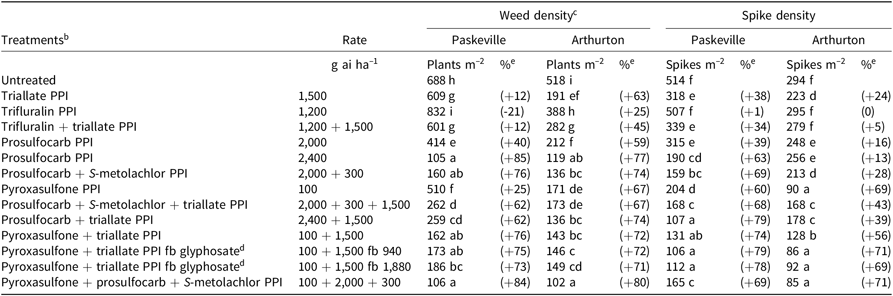
Rigid ryegrass density was affected (P < 0.05) by herbicide treatments at both experimental sites (Table 4). At Paskeville, all treatments were significantly different from the control; indeed, trifluralin showed higher weed density compared to the untreated. The highest reductions in rigid ryegrass density occurred at Paskeville with PPI prosulfocarb (2,400 g ai ha–1) and pyroxasulfone + prosulfocarb + S-metolachlor (Table 4). At Arthurton all treatments significantly reduced weed density compared to the control, with pyroxasulfone + prosulfocarb + S-metolachlor giving the greatest reduction in weed density (Table 4). The grower standard treatment of pyroxasulfone (100 g ai ha–1) failed to provide adequate control (25%) at Paskeville and showed only 67% reduction in rigid ryegrass density at Arthurton. Prior to seeding, the site had received rainfall; however, no follow-up rainfall was recorded for 3 wk following PPI herbicide application at Paskeville.
Effect of herbicide treatments on rigid ryegrass plant and spike density in wheat grown at Paskeville and Arthurton in 2018. a

a Means within the same column followed by the same letter are not significantly different according to LSD at P = 0.05.
b Abbreviations: fb, followed by; PPI, preplant incorporated.
c Annual ryegrass weed density (plants m–2) data were square-root transformed before mean comparisons. Data presented are the nontransformed means.
d Weed seed set control treatment when wheat grain moisture content = 28%.
e Values presented in parentheses represent percentage decrease compared to the untreated.
In Australia, PPI herbicides are typically applied to the soil surface and incorporated by a narrow-point seeding system that throws soil out of the crop row and onto the inter-row with no other mixing of soil (Kleemann et al. Reference Kleemann, Desbiolles, Preston and Gill2014). For most PPI herbicides, rainfall is required to activate the herbicide and move it into the root zone of the weeds where it can be absorbed by the germinating seedling (Preston Reference Preston2014). This is particularly true of pyroxasulfone, where the low water solubility of the product generates a stronger requirement for rainfall following application (Preston Reference Preston2014). This rainfall helps to activate the product and move it into the soil, allowing uptake by the shoots and roots of germinating weed seeds (Preston Reference Preston2014; Walker Reference Walker1971). Reduced rainfall following herbicide application would therefore most likely be the cause of pyroxasulfone failure. Although thiocarbamate herbicides still have a rainfall requirement following application, they require less rainfall following application than pyroxasulfone (Mangin et al. Reference Mangin, Hall, Schoenau and Beckie2017). The uptake of thiocarbamate herbicides is also through both the shoots and roots (Fuerst Reference Fuerst1987).
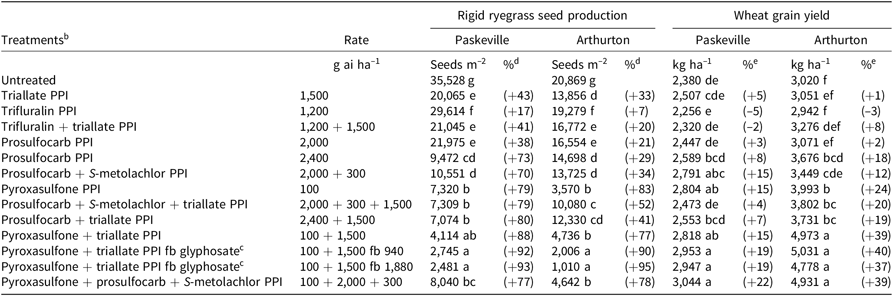
The spike density and seed production of rigid ryegrass were significantly (P < 0.05) influenced by herbicide treatments at both experimental sites (Tables 4 and 5). At both sites all treatments significantly reduced weed seed production. At Paskeville all treatments except trifluralin and at Arthurton all treatments except trifluralin and trifluralin + triallate significantly reduced rigid ryegrass spike density. The most effective PPI herbicide treatments were able to reduce rigid ryegrass spike density by 69% to 79% and seed production by 77% to 88%. Pyroxasulfone + triallate followed by a seed set control application of glyphosate at the low rate (940 g ai ha–1) reduced seed set by 92% at Paskeville and 90% at Arthurton, compared to pyroxasulfone + triallate alone, at the two sites respectively (Table 5). Increasing glyphosate to the high rate (1,880 g ai ha–1) reduced the amount of seed set at Arthurton by an additional 5%, but not at Paskeville (Table 5). This result suggests that seed set control application of glyphosate in wheat is an effective management option to reduce seed set in rigid ryegrass, when applied at the correct timing (Kleemann et al. Reference Kleemann, Preston and Gill2016).
Effect of herbicide treatments on rigid ryegrass seed production and wheat grain yield grown at Paskeville and Arthurton in 2018. a

a Means within the same column followed by the same letter are not significantly different according to LSD at P = 0.05.
b Abbreviations: fb, followed by; PPI, preplant incorporated.
c Weed seed set control treatment when wheat grain moisture content = 28%. Seed production values shown are based on reduction in viable seed as shown in Figure 1.
d Values presented in parentheses represent percentage decrease compared to the untreated.
e Values presented in parentheses represent percentage increase compared to the untreated.
Prosulfocarb is registered for use at two rates in Australia: 2,000 and 2,400 g ai ha–1.Prosulfocarb at the higher rate (2,400 g ai ha–1) was significantly better at reducing rigid ryegrass weed density at both sites and spike density at Paskeville. This resulted in prosulfocarb at 2,400 g ai ha–1 reducing seed production at Paskeville to less than half that for the low rate of prosulfocarb; however, there was a limited effect at Arthurton (Table 5). The population at Arthurton (A18) was considerably more resistant to prosulfocarb compared to the population at Paskeville (T1). Triallate and trifluralin either applied alone or mixed were ineffective in reducing rigid ryegrass weed density, spike numbers, and seed numbers at either site. This is consistent with the high resistance to these herbicides in both populations.
Effect of Glyphosate on Rigid Ryegrass Seed Viability
Seed viability of rigid ryegrass was affected (P < 0.05) by the application of glyphosate as a weed seed set control treatment at both sites (Figure 1). Seed from untreated rigid ryegrass had high viability at both Paskeville (93%) and Arthurton (97%). Application of 940 g ai ha–1 glyphosate reduced this by 16% at Paskeville and 44% at Arthurton (Figure 1). The higher rate of 1,880 g ai ha–1 reduced seed viability further by 31% at Paskeville and 75% at Arthurton. The differences between sites are due to lower rainfall at Paskeville, resulting in rigid ryegrass reaching physiological maturity earlier than the maturity of wheat at 28% grain moisture content when glyphosate can be applied. In contrast, higher rainfall and delayed rigid ryegrass maturity at the Arthurton site increased (P < 0.05) the effectiveness of glyphosate at this site (Figure 1). The wheat seed treated with glyphosate showed no significant effect on viability at either rate or either site (data not shown).
Viability of rigid ryegrass seed treated with glyphosate weed seed set control treatments at Paskeville and Arthurton in 2018. Each column is the mean of four replicates, and bars represent SEM. Means with the same letter are not significantly different according to Fisher’s Protected LSD at P = 0.05.

Effect of Herbicides on Grain Yield of Wheat
There were significant differences between herbicide treatments on grain yield of wheat (P < 0.05) at both experimental sites (Table 5). Treatment with triallate, trifluralin, trifluralin + triallate, and prosulfocarb at the low rate had no significant effect on wheat yields at either site. At Paskeville, prosulfocarb + S-metolachlor + triallate also did not significantly increase wheat yields; however, this treatment did do so at Arthurton. The most effective treatments at Paskeville, pyroxasulfone + prosulfocarb + S-metolachlor, increased wheat yield by more than 20% compared with the untreated control. At Arthurton, the most effective treatments, pyroxasulfone + triallate (with or without late glyphosate), increased wheat yields by >35% (Table 5). Failure to control rigid ryegrass can have considerable impacts on wheat yields (Poole and Gill Reference Poole and Gill1987), and in these trials, mixtures of PPI herbicides with different sites of action were the most effective at controlling herbicide-resistant rigid ryegrass, leading to higher crop yields. This has been shown as an effective strategy in managing clethodim [1(A)––inhibitors of acetyl CoA carboxylase]–resistant rigid ryegrass in triazine-tolerant canola [Brassica napus (L.)] through mixtures of PPI herbicides with different sites of action (Saini et al. Reference Saini, Kleemann, Preston and Gill2015). With resistance to three PPI herbicide sites of action, mixtures of pyroxasulfone with other site-of-action herbicides provided the best crop yields (Table 5) compared to the untreated. Research by Saini et al. (Reference Saini, Kleemann, Preston and Gill2017) reported ineffective control of rigid ryegrass in faba bean (Vicia faba L.) treated with mixtures of two thiocarbamate herbicides––a result that is consistent with our findings of considerably less control with two similar site-of-action herbicides, compared to mixtures with pyroxasulfone (Kleemann et al. Reference Kleemann, Desbiolles, Preston and Gill2014).
The results from this study clearly demonstrate that no PPI herbicide treatment was able to prevent seed production of rigid ryegrass resistant to PPI herbicides. Even though resistance was confirmed to multiple PPI herbicides in the rigid ryegrass populations (T1 and A18), the use of thiocarbamate herbicides prosulfocarb and triallate in combination with pyroxasulfone provided acceptable levels of weed control and grain yield in wheat. Among the PPI treatments, pyroxasulfone combined with prosulfocarb + S-metolachlor provided the best weed control. The application of glyphosate to control weed seed set at the highest rate in combination with PPI pyroxasulfone + triallate was also effective and also reduced rigid ryegrass seed viability. The effectiveness of thiocarbamate herbicides is likely to decrease over time as rigid ryegrass populations evolve greater levels of resistance (Brunton et al. Reference Brunton, Boutsalis, Gill and Preston2018). Currently, in Australia, pyroxasulfone remains the only PPI herbicide left for the control of thiocarbamate-resistant rigid ryegrass in wheat (Boutsalis et al. Reference Boutsalis, Gill and Preston2014). Current management of multiple-resistant rigid ryegrass in pulse and oilseed crops is achieved using the benzamide herbicide propyzamide [3(K1)––inhibitors of microtubule assembly] (Saini et al. Reference Saini, Kleemann, Preston and Gill2015, Reference Saini, Kleemann, Preston and Gill2017). However, alternative management strategies, such as harvest weed seed control and nonherbicidal tactics, would have to be used in wheat (Borger et al. Reference Borger, Riethmuller and D’Antuono2016; Walsh and Powles Reference Walsh and Powles2007). This research has shown options available to growers to manage thiocarbamate-resistant rigid ryegrass through the use of different site-of-action PPI herbicides in combination with effective weed seed set control (Kleemann et al. Reference Kleemann, Preston and Gill2016).
Acknowledgments
The authors acknowledge the Grains Research and Development Corporation for funding this research and to Alicia Merriam and Tijana Petrovic for technical assistance with herbicide application. Special thanks to growers Sam and Ben Bussenschutt, Danny Allen and staff from YPAG Kadina for providing trial sites and harvesting assistance. Additional thanks to Chris Davey of YPAG for organizing grower involvement and trial site discussion groups. No conflicts of interest have been declared.