INTRODUCTION
Strongyloides stercoralis, a soil-transmitted nematode found worldwide (Genta, Reference Genta1989; Bethony et al. Reference Bethony, Brooker, Albonico, Geiger, Loukas, Diemert and Hotez2006), is arguably the most neglected of all neglected helminth infections (Olsen et al. Reference Olsen, van Lieshout, Marti, Polderman, Polman, Steinmann, Stothard, Thybo, Verweij and Magnussen2009; Schär et al. Reference Schär, Trostdorf, Giardina, Khieu, Muth, Marti, Vounatsou and Odermatt2013). Infectious S. stercoralis (L3) larvae are found in humid soil contaminated with fecal material. From there, the larvae penetrate the intact skin of the human host. In resource-poor countries, environmental, socio-economic and behavioural factors, and inadequate sanitary conditions provide the ideal circumstances for high S. stercoralis transmission rates.
Parasitological diagnosis of S. stercoralis infection relies on identifying larvae in stool. The Baermann technique (Baermann, Reference Baermann1917) and Koga Agar culture (Koga et al. Reference Koga, Kasuya, Khamboonruang, Sukhavat, Ieda, Takatsuka, Kita and Ohtomo1991) are recommended for diagnosis, preferably used in combination and carried out on multiple stool samples (Khieu et al. Reference Khieu, Schär, Marti, Sayasone, Duong, Muth and Odermatt2013). Infections with low numbers of excreted larvae are particularly challenging to diagnose and can easily be missed. For other intestinal helminths, detailed egg excretion pattern studies have been performed, e.g. for liver flukes (Lovis et al. Reference Lovis, Mak, Phongluxa, Aye Soukhathammavong, Vonghachack, Keiser, Vounatsou, Tanner, Hatz, Utzinger, Odermatt and Akkhavong2012), but information is missing for S. stercoralis.
The efficacy of ivermectin in treating S. stercoralis has been demonstrated many times (Marti et al. Reference Marti, Haji, Savioli, Chwaya, Mgeni, Ameir and Hatz1996; Toma et al. Reference Toma, Sato, Shiroma, Kobayashi, Shimabukuro and Takara2000; Adenusi et al. Reference Adenusi, Oke and Adenusi2003; Heukelbach et al. Reference Heukelbach, Wilcke, Winter, Sales de Oliveira, Saboia Moura, Harms, Liesenfeld and Feldmeier2004; Igual-Adell et al. Reference Igual-Adell, Oltra-Alcaraz, Soler-Company, Sanchez-Sanchez, Matogo-Oyana and Rodriguez-Calabuig2004; Ordonez and Angulo, Reference Ordonez and Angulo2004; Suputtamongkol et al. Reference Suputtamongkol, Premasathian, Bhumimuang, Waywa, Nilganuwong, Karuphong, Anekthananon, Wanachiwanawin and Silpasakorn2011; Khieu et al. Reference Khieu, Schär, Marti, Sayasone, Duong, Muth and Odermatt2013). However, little is known about the parasite clearance time and cessation of larvae excretion after ivermectin treatment (Uparanukraw et al. Reference Uparanukraw, Phongsri and Morakote1999) in endemic settings. Yet, this information is crucial for planning and executing follow-up examinations after treatment.
We assessed the excretion pattern of S. stercoralis larvae by examining stool samples daily for 7 days before and for 21 days after ivermectin treatment (200 μg kg−1 BW, single oral dose (SOD)) in 38 and 44 infected patients, respectively.
MATERIALS AND METHODS
Ethical considerations
This study was undertaken in Preah Vihear (March 2010) and Takeo provinces (March 2011) in Cambodia. The study protocol was approved by the Ethics Committee of the Canton of Basel (EKBB, 21/09 dated 29 January 2009), Switzerland and by the National Ethics Committee Health Research (NECHR; 033 dated 20 March 2009), Ministry of Health, Cambodia. All participants were informed of the purpose and process of the study. Written informed consent was obtained from all individuals prior to enrolment. All diagnosed infections were treated at the end of the study, according to the National Cambodian treatment guidelines.
Enrolment
Individuals diagnosed with S. stercoralis during a community-based helminth survey were randomly selected. Either the examined person alone (in Preah Vihear) or the examined person and all persons living in the same household (in Takeo) were enrolled.
Field procedures
Participants provided a stool sample each morning, for 7 days (Fig. 1). Each day they received a new labelled stool container to use for the following day. The collected samples were transported at ambient temperature and within 1 h to a health centre field laboratory where the laboratory examinations were conducted (2–3 h after defecation).
Flowchart: enrolment and follow-up of study participants.

Participants that tested positive for S. stercoralis at least once during the 7 days were treated with a SOD of ivermectin (200 μg kg−1 body weight) on day 7. Daily stool collection continued for another 21 days after treatment was given.
Laboratory procedures
Upon the sample's arrival in the laboratory, a quantitative Baermann test was performed (Baermann, Reference Baermann1917). In brief, the stool container with the sample was weighed. A Baermann test was set up and the container was weighed again. The stool sample (about 15–25 g) was placed in a wire-mesh in a funnel filled with tap water. Artificial light was used to stimulate larval migration out of the stool into the funnel. After 2 h, the water containing the larvae was collected and centrifuged for 5 min at 2000 rpm. The sediment was examined under a microscope (400× magnification) and S. stercoralis larvae were counted.
For each stool sample, a Koga Agar culture (Koga et al. Reference Koga, Kasuya, Khamboonruang, Sukhavat, Ieda, Takatsuka, Kita and Ohtomo1991) was also performed. In brief, a hazelnut-sized piece of stool was placed on a soft Agar plate. It was then incubated for 48 h at 28 °C. The plates were then rinsed and the liquid centrifuged for 2 min at 2000 rpm. The sediment was examined under a microscope for the presence of larvae and adults.
Statistical analysis
Data were entered in Microsoft Excel, cross-checked against original data sheets and analysed using the statistical software, R. Strongyloides stercoralis infection intensity was calculated as larvae per gram stool (LPG). The relationship between diagnostic sensitivity and infection intensity (i.e. the mean LPG per individual) was visually assessed using a LOWESS smoother. Diagnostic sensitivity was calculated for both examining a stool sample on a single day and for examining samples collected on 2 consecutive days. Data from participants providing samples on 6 or more days before treatment were analysed for periodicity in the excretion pattern. Algorithms to detect periodicity of unknown time intervals usually require longer time series. However, every harmonic excretion pattern would have fewer local maxima compared with random noise. We compared the observed local maxima in the larvae excretion counts within individuals with the number of local maxima in randomly generated numbers. A local maximum was identified when the LPG on a certain day was higher than the counts of the previous day and the following day.
After treatment, the infection rate was calculated for each day as the number of patients in which at least one S. stercoralis larva was observed divided by the number of patients treated and followed-up. For each observation day, the larvae reduction rate (LRR) was calculated. We used the mean number of larvae excreted by each individual before treatment as the reference value. The overall LRR was calculated by first dividing the mean LPG for each day post treatment by the overall LPG. The result of the division was subtracted from 1 to get the LRR.
RESULTS
Enrolment and compliance
Altogether, 65 people were enrolled in the study (Fig. 1). First, a baseline examination was performed. Individuals testing positive for S. stercoralis were randomly selected, as were individuals who tested negative (to form a control group). The overall mean age of participants was 26·7 years (range: 3–81 years). There were 32 (49·2%) males and 33 (50·8%) females. A total of 800 stool samples with an average weight of 19·7 g (range: 4·3–44·7 g) were examined with the Baermann method. All diagnostic results obtained by the Baermann method were confirmed by Koga Agar culture.
Larval excretion pattern before treatment
Thirty-nine (60·0%) people were infected with S. stercoralis. During the baseline examination, 18 (27·7%) provided 7 samples each, 14 (21·5%) provided 6 samples each and 32 (49·2%) provided 2–5 samples each. One person (2·6%) provided only 1 sample and was excluded from the excretion pattern analysis. The mean number of stools provided by healthy individuals was significantly lower than that provided by infected persons (4·2 vs 5·6 stool samples, P = 0·008). Altogether, 26 participants were negative, yet one person who tested negative at the initial examination presented a S. stercoralis infection on the third day. That person was subsequently moved into the treatment group.
For the larval excretion pattern analysis, the 38 infected individuals who provided more than one sample (median: 6 samples) were included. Considerable variation in larvae excretion densities was observed in the pre-treatment examinations. The highest and lowest average densities per person observed were 151·2 LPG (range: 28·8–410·6 LPG) and 0·03 LPG (range 0–0·07 LPG), respectively.
Twenty-three patients (60·5%) tested positive for larvae each day before treatment, 9 (23·7%) had 1 day where no larvae were excreted, 4 (10·5%) had 2 days with no larvae present and 2 (5·3%) had 3 negative examinations.
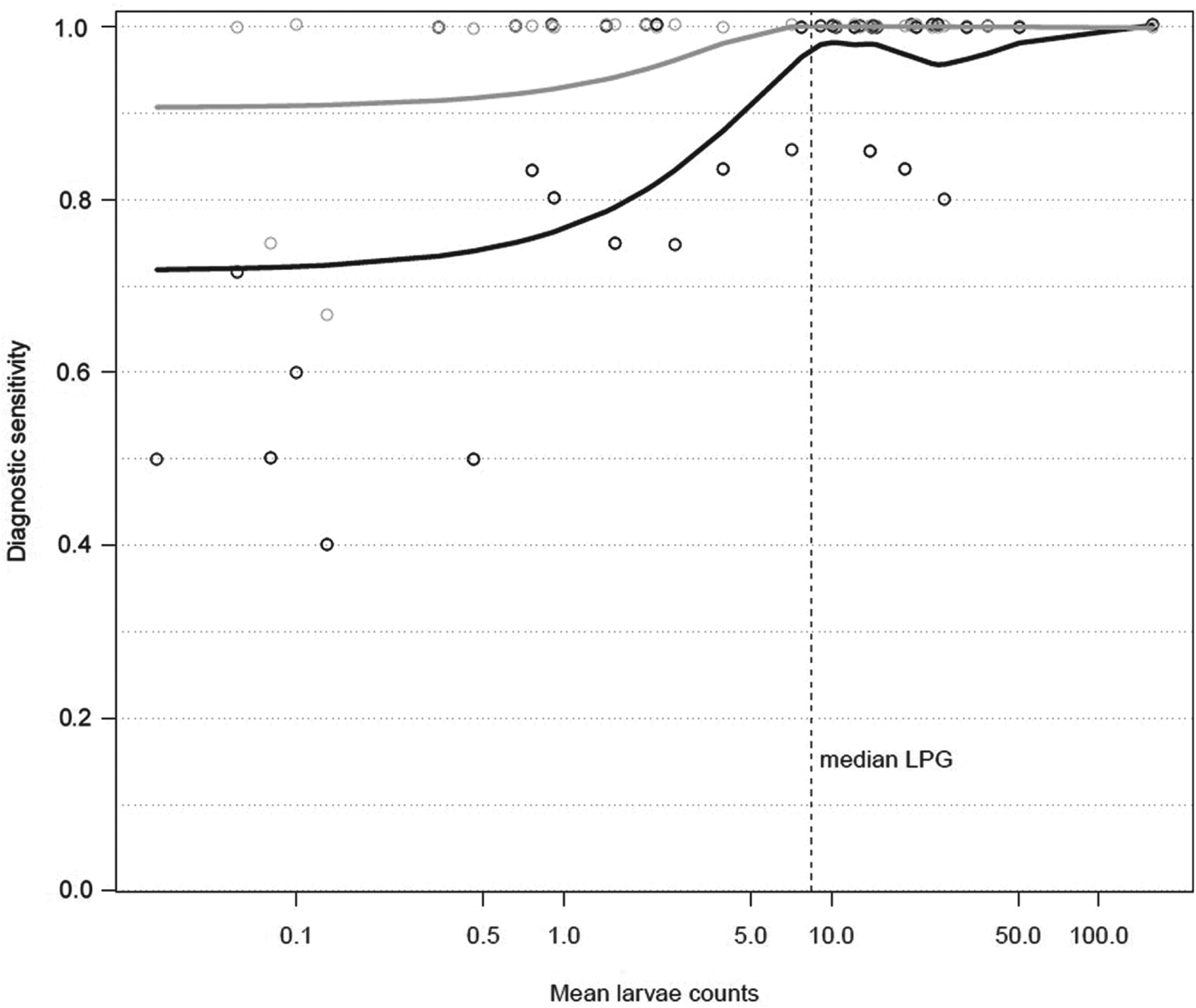
The diagnostic sensitivity of a single-day examination was 75% for individuals with an average LPG of 1 or less. Higher average LPGs increased diagnostic sensitivity. An LPG of 10 or more resulted in sensitivities of more than 95% (Fig. 2). When stool samples collected on 2 consecutive days were analysed, the sensitivity increased remarkably. The sensitivity of two samples collected on consecutive days was 97·0% (LPG≤1) and close to 100% (LPG⩾10), respectively.
Diagnostic sensitivity of examining a single stool sample (black dots) and two samples collected on consecutive days (grey dots) by mean LPG count. Small random noise was added to alleviate overplotting. Lines represent the corresponding locally weighted scatterplot smoothing (LOWESS) curves.

We found a total of 65 local maxima in the 26 individuals with 6 or more stool examinations before treatment, which corresponds exactly to the expected number of local maxima in randomly generated numbers (median 65, 95% CI: 60–71), indicating no cyclic larvae release.
Larval excretion pattern after ivermectin treatment
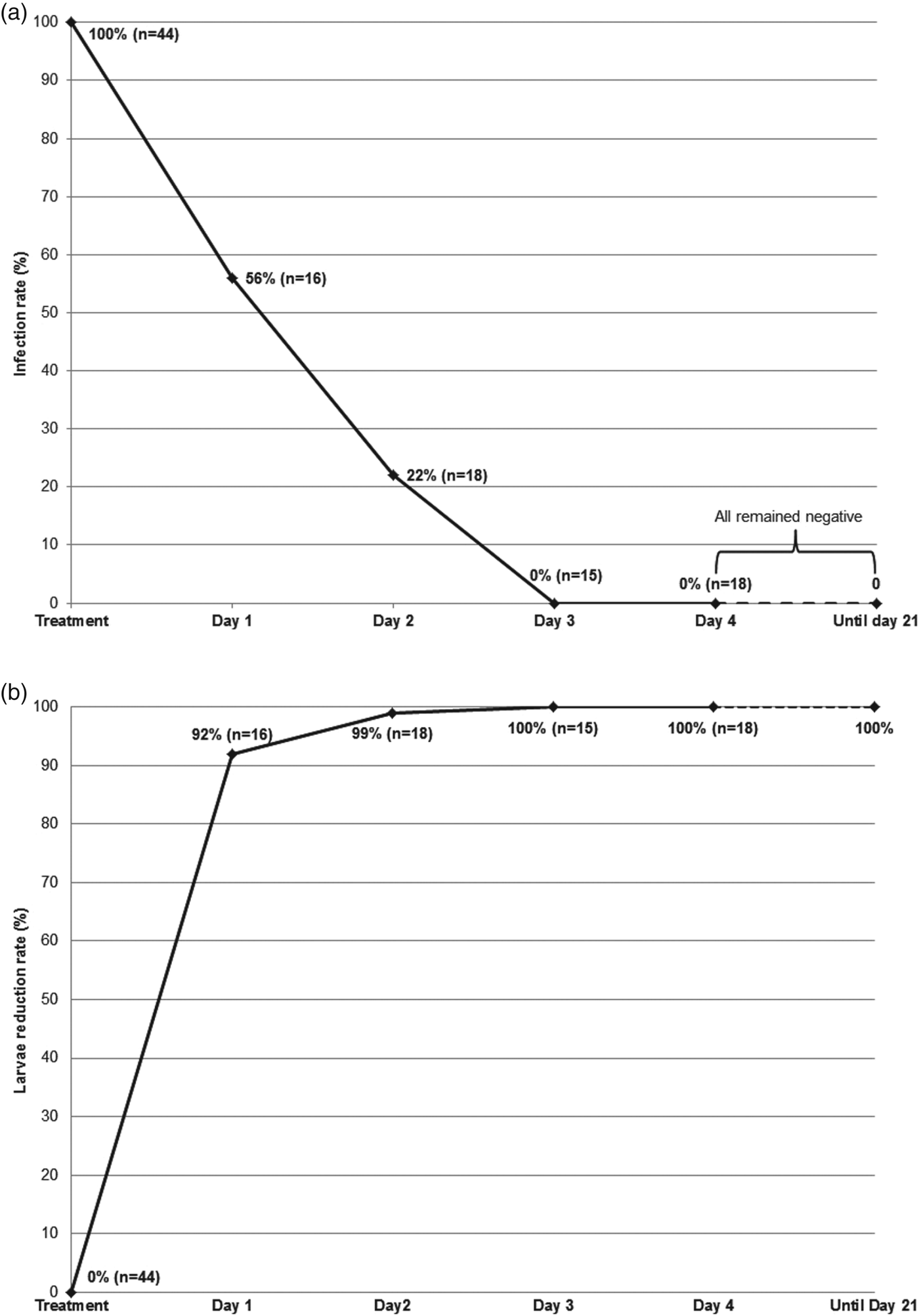
On the first day of follow-up after treatment, 16 (33·3%) participants provided a stool sample, 9 (56·3%) of which were found to be positive for larvae (Fig. 3a). On the second day, 18 (37·5%) provided a sample, of which 4 (22·2%) still tested positive. On the third day, none of the 15 (31·3%) samples provided yielded any S. stercoralis. From day 3 to 21 days after treatment, an average of 17 samples (35·4%) was returned each day, with a range of 11 to 24 samples per day. A total of 310 stool samples were received and analysed with Baermann and Koga Agar culture. Not a single larva was detected. All the results obtained by Baermann method were confirmed by the Koga Agar culture method.
(a) Strongyloides stercoralis infection rate after ivermectin treatment. (b) Larvae reduction rate after ivermectin treatment.

From all the samples provided post-treatment, the LRR was calculated. The LRR increased dramatically to 92 and 99%, 24 and 48 h after treatment, respectively (Fig. 3b). From the third day onwards, all stool examinations remained negative.
DISCUSSION
Strongyloides stercoralis remains one of the most neglected and under-reported helminthic infections (Olsen et al. Reference Olsen, van Lieshout, Marti, Polderman, Polman, Steinmann, Stothard, Thybo, Verweij and Magnussen2009; Schär et al. Reference Schär, Trostdorf, Giardina, Khieu, Muth, Marti, Vounatsou and Odermatt2013). The irregular excretion of larvae, as well as the very low sensitivity of standard O&P examination procedures for S. stercoralis, requiring time-consuming special methods, are the main factors contributing to this under-reporting. Our results show that there is considerable variation in the numbers of S. stercoralis larvae excreted. Individuals with high-intensity infections (more than 10 larvae per gram stool) tended to present a positive result on all days of examination. Uparanukraw and colleagues (Uparanukraw et al. Reference Uparanukraw, Phongsri and Morakote1999) also documented variation of larval excretion, yet the underlying mechanisms accounting for this variation remain unclear (Jones, Reference Jones1950; Jones and Abadie, Reference Jones and Abadie1954; Leighton and MacSween, Reference Leighton and MacSween1990). As expected, we showed that diagnostic sensitivity increases with higher infection intensity. Diagnosing low-intensity chronic infections remains a major challenge and are likely to be missed by a single examination.
To further increase diagnostic sensitivity and to minimize false-negative results, it is important to analyse multiple stool samples on consecutive days. We demonstrated that sensitivity increases substantially if 2 samples are analysed. For several other helminthic infections, others have recommended that at least 3 samples on consecutive days be examined (Marti and Koella, Reference Marti and Koella1993; Dreyer et al. Reference Dreyer, Fernandes-Silva, Alves, Rocha, Albuquerque and Addiss1996; Knopp et al. Reference Knopp, Mgeni, Khamis, Steinmann, Stothard, Rollinson, Marti and Utzinger2008). For S. stercoralis, it is essential to target eradication of the pathogen rather than reducing infection intensity, as the ability of auto-infection can sustain the infection in the host. Grove reported patients testing positive after 2 years, even if the initial follow-up after treatment failed to show an S. stercoralis infection (Grove, Reference Grove1982).
When comparing the local maxima of larvae excreted with the maxima of random numbers, we could not establish a difference, which indicates that there is no cyclic pattern underlying the excretion of larvae. We also compared the diagnostic sensitivity of analysing 2 samples on consecutive days with the diagnostic sensitivity of analysing 2 samples with a sampling-free day in-between. As we did not detect a cyclic pattern, we expected the sensitivities to be approximately the same. This is reflected in our results. The diagnostic sensitivity of two samples with a sampling-free day in-between was 99% (compared with 97% on consecutive days). This difference is likely due to chance, given the small sample size. Another possible explanation might be the number of low-intensity infections, of which some had 2 consecutive days with no larvae excreted. Consequently, one would expect a further increase in sensitivity when analysing stool samples obtained on 3 consecutive days.
Ivermectin treatment proved to be very effective. In all infected participants, larvae excretion subsided. We investigated, for the first time, what happens directly after treatment. In our study, all individuals who received treatment (200 μg kg−1, SOD) stopped excreting larvae 72 h after treatment, at the latest. Larvae could not be detected in any of the participants during the remaining 19 days following treatment. However, the absence of larvae does not ensure that the parasite has been eradicated from the host, which, in contrast to other helminths, should be the target of S. stercoralis treatment, as a few surviving larvae may lead parthenogenetically again to high infection densities (Satoh and Kokaze, Reference Satoh and Kokaze2004; Requena-Mendez et al. Reference Requena-Mendez, Chiodini, Bisoffi, Buonfrate, Gotuzzo and Munoz2013). However, current diagnostic parasitological methods do not allow us to verify this and prolonging the follow-up period is not an option in endemic areas, as the possibility of re-infection will still exist.
The standard Baermann method does not quantify the infection and only reports the presence or absence of the pathogen. We modified the Baermann method to calculate larvae per gram stool. Counting larvae in a Baermann examination can be challenging, especially in cases of heavy infections, with many larvae present. As the larvae are alive and moving, there is a possibility of missing or double-counting larvae. The counts might, therefore, differ slightly from the true number, yet this difference is likely to be small and the calculated LPG values reflect the intensity of infection appropriately.
Compliance tends to be an issue in these studies, as very often participants are not able to defecate every day. It is very important to ensure that the stool samples provided are from the same person. If the person was not able to defecate, the stool container was returned empty. Furthermore, it was important that the stool samples provided were fresh to ensure that the larvae would still be alive.
Studies that focus on soil-transmitted helminths, including S. stercoralis, should apply the best available coprological diagnostic methods, like the Baermann method and/or Koga Agar culture. This combination of diagnostic methods, although work- and material-intensive, would help to get more accurate numbers on the global prevalence of S. stercoralis. Today, most studies on helminths either do not include S. stercoralis or use unsuitable diagnostic approaches, which, due to the factors stated above, leads to a severe under-reporting of S. stercoralis worldwide (Schär et al. Reference Schär, Trostdorf, Giardina, Khieu, Muth, Marti, Vounatsou and Odermatt2013).
In our study, we showed the importance of examining multiple stool samples on consecutive days because of the irregular excretion of larvae and the danger of missing low-intensity infections. Furthermore, we showed that treatment with ivermectin leads to the absence of larvae excreted within 3 days after treatment. This has implications for planning and conducting follow-up studies. Our data indicate that the clearance of larvae is rapid. Even if a possible biological variability in excretion is taken into account, follow-up periods in ivermectin trials can be short, i.e. 4 days.
ACKNOWLEDGEMENTS
The authors would like to thank the staff at the National Center for Parasitology, Entomology and Malaria Control for all of their valuable help, as well as the participants who took part in this survey. We thank Mrs Amena Briët for the English editing of this manuscript.
AUTHOR CONTRIBUTIONS
FS, HPM and PO conceived and designed the study; FS and VK collected data under the supervision of SM; FS and HPM coordinated the field laboratory activities; VK, MCC and SM coordinated the field work in Cambodia; JH, FS, HPM and PO analysed data and interpreted the results; FS wrote the manuscript with PO; PO supervised the first author in all aspects of the study; all authors have read and approved the final version of manuscript.
FINANCIAL SUPPORT
This study was supported by the UBS Optimus Foundation.
CONFLICT OF INTEREST
The authors declare no conflict of interest.