


Introduction
Comparative politics scholars have found that candidate-centered electoral procedures contribute to more legislative particularlism (Ashworth and Bueno de Mesquita Reference Ashworth and de Mesquita2006; Carey and Shugart Reference Carey and Shugart1995; Cox and McCubbins Reference Cox and McCubbins1993), defined as benefits given to specific constituencies in a discretionary manner. At the same time, legislators seem to have a lower need for particularism in party-centered electoral systems. Candidate-centered electoral systems lead to more legislative particularism because promising and delivering targeted benefits is fundamental for incumbents cultivating their bases in order to be reelected. Therefore, being able to run for reelection is critical in shaping legislative incentives to pursue particularism. When legislators do not have this option, usually because they have reached the end of their term or they are retiring members of Congress, their enthusiasm for particularism recedes unless they are seeking another elective office (Bagashka and Clark Reference Bagashka and Clark2016; Carey, Niemi, and Powell Reference Carey, Niemi and Powell1998; Herron and Shotts Reference Herron and Shotts2006).
This article studies the case of Mexico, where elections center around parties, whose dominance over candidate selection and campaign resources is undisputed, and examines how reelection incentives affect legislative particularism when an 80-year old constitutional ban on reelection is lifted. As explained in more detail below, the 2014 Electoral Reform, which lifted the ban on consecutive reelection, was not designed to weaken party control and shift towards a more candidate-centered system. Both before and after the ban was lifted, candidates were subject to similar degrees of party control over their careers: candidates needed to submit to their party for nomination (and renomination) and depended on their party for campaign funds. Therefore, the reform, agreed by Mexico’s three main parties at the time via the Mexican Pact Accord, allows to estimate the effect of introducing consecutive reelection as the essential feature changing legislative incentives to provide particularism.
With party-centered elections, because parties do the heavy lifting in getting legislators elected, the marginal benefit that they get from legislative particularism is considered substantially smaller (Primo and Snyder Reference Primo and Snyder2010).Footnote 1 However, introducing consecutive reelection presents legislators to a new principal: the voters. Ultimately, even when parties decide who runs, voters determine who stays in office. Results show that even in the context of a highly centralized party system, being able to seek reelection increases the amount of attention devoted to particularistic legislation. These findings suggest that legislators use particularized benefits to cultivate their personal bases, even when they seem to have little incentive to do so.
The study of reelection incentives has mostly compared office holders facing binding term limits with those who are not (Dal Bó and Rossi Reference Dal Bó and Rossi2011; Lott Reference Lott1990; Snyder and Ting Reference Snyder and Ting2003; Tien Reference Tien2001). Because elections select for more competent types (Dal Bó et al. Reference Bó, Ernesto, Folke, Persson and Rickne2017; Samuelson Reference Samuelson1984), incumbents who have won more elections have, on average, a higher-quality type than those who have not. Thus, this approach confounds the effect of reelection with that of political types. Because type affects performance (Besley and Reynal-Querol Reference Besley and Reynal-Querol2011; Hirano and Snyder Reference Hirano and Snyder2014), electoral selection is problematic for scholars seeking to disentangle the effect of reelection incentives using term limits.
Important steps have been made by scholars to address this concern. For example, Ferraz and Finan (Reference Ferraz and Finan2011) study the effect of reelection on corruption practices of Brazilian mayors. To address the problem of electoral selection, the authors compare second-term mayors with a subset of first-term mayors who were then able to get reelected. They find that mayors with reelection incentives are significantly less corrupt. To avoid the confounding effect of different political types, Alt, Bueno de Mesquita, and Rose (Reference Alt, Bueno de Mesquita and Rose2011) hold the tenure in office constant to estimate the effect of reelection on the performance of American governors. By comparing incumbents in the same term, they find that economic growth is higher while taxes, spending, and borrowing costs are lower under reelection-eligible governors. Most recently, Hall and Fouirnaies (Reference Hall and Fouirnaies2018) hold individual types fixed by using a within-person, within-state difference-in-differences design to examine the change in productivity of US representatives serving in state legislatures. They find that legislators who can no longer seek reelection are less productive in terms of sponsored bills, committee service, and attendance to floor votes.
Building upon this research, this article leverages the 2014 Mexican Electoral Reform, which provides a unique opportunity to study reelection incentives in a party-centered electoral system, overcoming the problem of electoral selection. To test the hypothesis, that introducing reelection incentives encourages legislators to focus more on particularistic legislation, the author employs a difference-in-differences estimator that leverages the staggered implementation of this one-of-a-kind reform and cross-state variation in the number of consecutive terms that legislators can serve. To estimate the proportion of legislative discussion devoted to particularistic legislation, the author applies a correlated topic model to a new collection of transcripts of 6,890 legislative sessions in 20 Mexican states from 2012 to 2018. Results show that reelection incentives increase the attention allocated to particularistic legislation and that the effect is larger when the legislators’ political horizons are longer. Moreover, the findings document the emergence of an electoral cycle in which legislators focus on legislation that enhances their personal vote closer to the next election.
The findings contribute to multiple literatures in political science. For comparative politics, this article lends strong support to previous research focusing on candidate-centered systems that documents a positive relationship among reelection incentives and legislative particularism. The article shows that, even in the context of a highly centralized party system, introducing consecutive reelection increases the amount of attention that legislators devote to particularistic legislation. Results suggest that legislators use particularized benefits to cultivate their personal bases, even when parties control candidate selection and campaign resources. These results provide evidence that the increased focus on legislation with higher electoral yield can be attributed to the new electoral rules and not merely to changes in legislator’s preferences.
At least 10 countries in Latin America since the early 2000s have attempted to reform or have succeeded in reforming their constitutions to extend, limit, remove, or impose term limits. Whereas arguments favoring consecutive reelection maintain that it foments accountability and responsiveness, arguments in favor of term limits claim that unlimited reelection engenders corruption and the perpetuation of political elites. The author contributes to this debate showing that the type of electoral incentives is crucial to understanding legislative behavior. Results show that political horizons matter and the expected length of the term in office influences how legislators respond to reelection incentives. Legislators with short-term reelection incentives (being able to contest up to two consecutive terms in office) appear to be less responsive to reelection incentives than legislators with long-term reelection incentives (up to four consecutive terms in office).
For the methodological literature, this study contributes to the research that uses legislative discussions to evaluate parliamentary and legislative behavior (Lauderdale and Herzog Reference Lauderdale and Herzog2016; Proksch and Slapin Reference Proksch and Slapin2012; Reference Proksch and Slapin2014). In particular, this article advances the use of causal inference to examine substantive quantities of interest generated with text analysis. In addition, it offers insight on how to overcome common challenges that crop up when applying text analysis to documents in the Spanish language.
Finally, the article offers two main takeaways for Mexican politics scholars. One, it addresses a heated debate in Mexico regarding the party-switching ban, the clause that prevents legislators from switching parties when running for reelection.Footnote 2 Whereas parties claimed that the ban aimed to halt party-switching, a widespread phenomenon among Mexican politicians (Kerevel Reference Kerevel2014; Reference Kerevel2017), Mexican civil society organizations argued that it would hinder the reform from having the desired effect in making legislators more responsive to voters. Results show that, despite the inclusion of the party-switching ban, designed to enhance the party-centric system, legislators with reelection incentives increase their focus on legislation that caters to their new principal, revealing a surging link between legislators and their bases. Two, because federal legislators will be able to run for reelection in 2021, characterizing the changes that occurred at the state level will stand us in good stead to anticipate what might happen at the national level when the new rules go into effect.
Theoretical Expectations
Reelection and Particularistic Legislation
The classic theory of legislative particularism suggests that reelection-seeking legislators cater to their constituents with particularized benefits that they can credit-claim (Mayhew Reference Mayhew1974) because they enhance the legislator’s personal vote (Fiorina Reference Fiorina1977; Hicken and Simmons Reference Hicken and Simmons2008), which corresponds to the proportion of a candidate’s vote that we can attribute to their individual popularity, personal record, reputation, and characteristics (Cain, Ferejohn, and Fiorina Reference Cain, Ferejohn and Fiorina1987). Particularized benefits are usually given to specific constituencies in a discretionary and nonprogrammatic fashion. Construction projects, such as dams and bridges, are the typical example of particularistic projects. Legislation that delivers group benefits also falls in this category, as legislators can easily claim credit for legislation that benefits organized voters, who can use their resources to reward legislators that support their agenda. An example of group benefits is legislation that favors labor unions. When particularistic legislation is considered to increase electoral returns, legislators are induced to focus on policies that can be directly credit-claimed given their restrictions on time and resources. The central assumption is that officeholders need to cultivate and maintain their personal base to get reelected.
Reelection makes office-seeking legislators cultivate their personal reputation even in party-centered electoral systems because party fortunes are uncertain. Even when legislators depend on their party for campaign funds and need to submit to their party for renomination, introducing a new principal allows them to diversify their risk. Therefore, it makes sense for legislators to pursue votes based on their individual popularity to insure themselves from their party’s potential reputation misfortunes. Leveraging the staggered implementation of the 2014 Mexican Electoral Reform, this article tests the effect that introducing reelection incentives has on the attention that legislators give to particularistic legislation.
H1: The introduction of reelection incentives increases the proportion of speech that legislators allocate to particularistic legislation.
Legislative Particularism and the Electoral Cycle
Research on political-business cycles suggests that reelection-motivated incumbents behave differently in election years and that shifts in policies are connected to the cyclical nature of elections (Rogoff Reference Rogoff1990). Political cycles endogenous to the electoral calendar emerge when there is voter bias towards impending elections and retrospective voting. Scholars studying legislative behavior and elections usually assume that voters have short-term memories, that their attention to the incumbent’s behavior is greatest closer to the election and lowest at the beginning of the term (Muthoo and Shepsle Reference Muthoo and Shepsle2010; Shepsle et al. Reference Shepsle, Van Houweling, Abrams and Hanson2009). Election proximity changes legislative behavior because of this voter bias. Moreover, retrospective voting, when voters evaluate their representative’s behavior in office and incorporate their past actions into their voting decisions, induces incumbents to behave according to the preferences of their constituents in anticipation of otherwise being punished at the polls. Because voters give more weight to their perceptions of incumbents’ actions as an election approaches, incumbents have incentives to design and pursue policies strategically to their electoral advantage.
Previous research has explored how election proximity affects ideology and fiscal opportunism. Senators in the United States become more ideologically moderate as an election approaches (Bernhard and Sala Reference Bernhard and Sala2006; Elling Reference Elling1982), and incumbents increase visible expenditures in electoral years (Klein and Sakurai Reference Klein and Sakurai2015). Contributing to this research, this article examines the effect that reelection incentives have on legislative particularism, the most electorally attractive behavior, as elections approach. I hypothesize that if the introduction of reelection incentives increases the proportion of speech that legislators allocate to particularistic legislation, then the effect will tend to be higher leading up to elections.
H2: The effect of reelection incentives on the proportion of speech that legislators allocate to particularistic legislation is synchronized with the electoral cycle and increases as the next election approaches.
Political Horizons and Legislative Particularism
Term lengths create incentives that affect individual legislative behavior and policy outcomes by providing legislators with a time horizon to achieve their goals (Barro Reference Barro1973; Titiunik Reference Titiunik2015). Previous research examining term lengths has shown that longer terms increase legislative effort. For example, Dal Bó and Rossi (Reference Dal Bó and Rossi2011) exploit a natural experiment, where the duration of terms was randomly assigned among senators in Argentina, and show that legislative effort is higher when terms are longer. Similarly, Titiunik (Reference Titiunik2015) analyzes the effect of term length in the Texas, Arkansas, and Illinois Senates, where after redistricting senators were randomly assigned into two-year or four-year terms. She finds fewer bills introduced and more abstentions when terms were shorter.
A similar argument would apply to expected term lengths, which correspond to the maximum number of terms that legislators can expect to be in office if they win reelection every time they run. If holding office generates the legislator positive utility, then more and longer terms generate a higher expected utility of being in office than shorter and fewer terms. Thus, expected term length provides legislators with the time horizon of their political careers as representatives, affecting how much they value running for reelection. Legislators with longer political horizons may be more responsive to reelection incentives than legislators with shorter ones. This article seeks to address this question by analyzing the variance on expected term lengths that the 2014 Mexican Electoral Reform created. Because longer horizons are more valuable than shorter ones, I expect legislator’s efforts to get reelected to be higher in the former case. Thus, I hypothesize more legislative particularism when legislators have longer political horizons.
H3: The effect of reelection incentives is larger when the political horizons of legislators in office are longer. The effect on the proportion of speech allocated to particularistic legislation is larger for legislators with long-term reelection incentives compared with those with short-term reelection incentives.
The 2014 Electoral Reform
In December 2013, the Mexican Federal Congress lifted an 80-year old constitutional ban on reelection for federal and state legislators and municipal mayors.Footnote 3 Reelection was initially banned to ensure the subordination of all office-holders to the ruling hegemonic party, the PRI (former PNR) (Nacif Reference Nacif1997) after the Mexican Revolution. The subsequent Electoral Reform, approved in February 2014, was part of the Mexican Pact Accord, a set of structural reforms negotiated by the three main political parties in Mexico at the time (PRI, PAN, and PRD) (Torres-Ruíz Reference Torres-Ruíz2014). The pact sought to accomplish reforms that had been obstructed by political gridlock. Arguments in Congress in favor of introducing consecutive reelection claimed that it would increase legislative efficiency, facilitate long-term projects, improve accountability, and professionalize political careers. The reform imposed some federal restrictions, but states had discretion to determine how and when to introduce consecutive reelection.
A common misconception is to characterize the reelection ban as a mere legacy of the Mexican Revolution. While the revolutionary slogan was “Effective suffrage, No-reelection,” it was only intended against the unlimited reelection of the president. Initially, local parties (the PNR was comprised by 148 local parties), legislators, and senators were in favor of reelection (Nacif Reference Nacif1997). The constitutional ban at the federal level was introduced by PNR leadersFootnote 4 to centralize and consolidate the power of the ruling party. Banning reelection was part of PNR’s strategy to weaken “local political bosses” and consolidate itself as the main driver of political careers in the three levels of government (Weldon Reference Weldon and Dworak2003).
The Electoral Reform imposed a federal mandate on states to introduce consecutive reelection for local legislators (Congreso de la Unión Reference de la Unión2014) and gave them restrictions on how the laws modifying their local electoral codes regarding reelection needed to be enacted. First, the constitutional amendment determined that once the ban on reelection was lifted, consecutive reelection for local legislators could be attainable for up to four terms with a maximum of 12 years. This gave state legislatures discretion to define the number of terms within the 12-year restriction. Short-term incentives (being able to contest up to two consecutive terms in office) imply that legislators are only able to face their constituents in the polls one time before concluding their tenure in the legislature. On the contrary, long-term reelection incentives (up to four consecutive terms in office) involve three elections where voters can reward or punish their legislators.
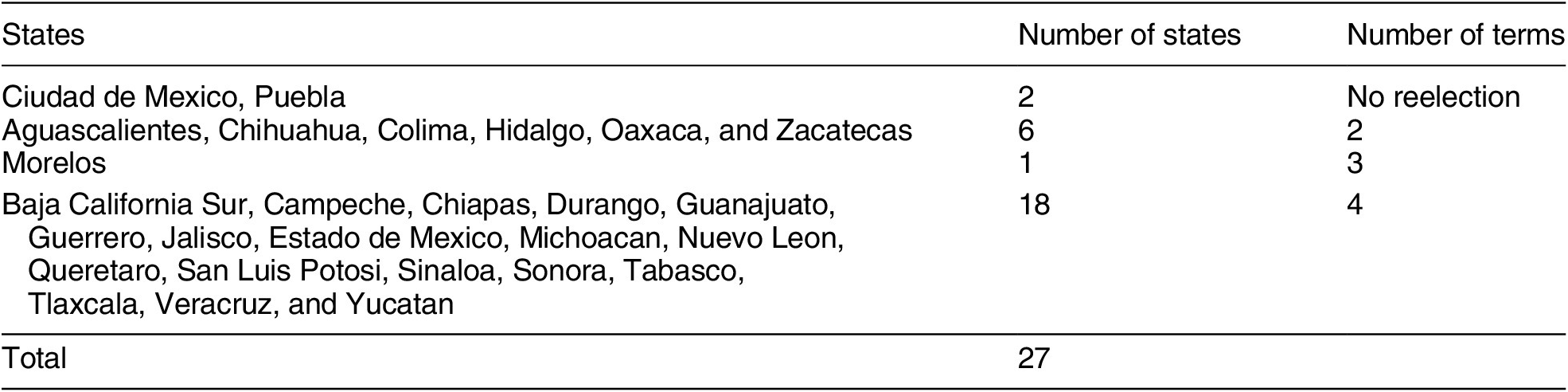
Second, the constitutional amendment dictated that the possibility of reelection would not apply to those state legislators in office when the reform was enacted in 2014. While the reform stipulated that federal legislators elected in 2018 would be eligible for reelection, it did not determine when reelection was to be implemented for local legislators. Thus, some states determined that legislators elected in 2015/16 could already run for reelection in 2018, whereas in other states, only those elected in 2018 will able to run for reelection in 2021. Table 1 shows the distribution of states by the maximum number of terms local legislators facing elections in 2018 can contest and the distribution of states by the first year local legislators can run for reelection.
Variation in Reelection Incentives: Maximum Number of Terms Local Legislators Facing Elections in 2018 Can Run for Office

Note: Data are drawn from the state’s constitutions and electoral codes.
Third, legislators interested in running for reelection can only do so with the same party (or any party in the electoral coalition) that got the legislator elected in the first place. The law establishes that this restriction does not apply to legislators who renounced or lost their party membership before half of their term.Footnote 5 This party-switching ban, introduced in Commission negotiations in the Senate, was designed to ensure party control over renomination. It has been referred to by Mexican Civil Society Organizations as the “parties’ lock” (México Evalúa Reference Evalúa2013) because they argued it would undermine the link between constituents and local legislators, who need to be responsive to partisan interests if they aspire to run for reelection.
The variance in the number of terms seems to come from differences in negotiations in the state legislatures. The less contentious model, implemented by most states, was to follow the federal example: introduce the possibility of reelection for up to four terms, starting with legislators elected in the next immediate term. States that selected only one additional term had PRI governorsFootnote 6 who controlled on average 62.5% of the local legislatures.Footnote 7 The PRI had historically been against lifting the reelection ban.Footnote 8 In contrast, states that followed the federal example had governors from all parties who, on average, controlled only 55.8% of their legislatures.
On balance, the available evidence suggests that the variation in timing is in part a function of the staggered calendar of gubernatorial elections. When the reform was discussed in 2014 at the state legislatures, some governors were at the beginning of their term, whereas others were at the end. Because sitting governors have considerable influence in their party’s selection of candidates (Rosas and Langston Reference Rosas and Langston2011), for governors whose term ended in 2015/16, introducing reelection in 2018 was the longest that they could exert political influence after leaving office through people of their choosing, who owed them their political careers. Similarly, governors who were finishing their terms in 2018 preferred delaying reelection until 2021, as it enables them to place candidates of their choosing at the end of their term. This agrees with interviewed politicians that were involved in the negotiations.Footnote 9 Thus, states with gubernatorial elections in 2018 were more likely to delay the introduction of reelection to 2021, while all states that held gubernatorial elections in 2015/16 introduced reelection in 2018.
Legislative Behavior and the Party-Centered System
Local legislators in Mexico, much like federal legislators, provide policy direction through legislation and oversee the implementation of regulatory acts of the executive (Casar Reference Casar, Morgenstern and Nacif2002). The Mexican Constitution also grants state legislatures authority to introduce legislation in the federal congress. Governors can designate and depose cabinet members without congressional approval. However, state legislatures need to approve the appointment of magistrates to state courts, the state’s electoral institute board members, the state’s human rights commissioner, and the state’s transparency institute board members. Local legislators have exclusive control over the negotiation and approval of the state’s budget. State legislatures are also endowed with the power to supervise and audit other government agencies and can convoke special commissions to investigate the activities of independent and decentralized entities. So far, research on legislative behavior in Mexico has mostly focused on the federal congress, with less attention being paid to local legislators. Relevant studies that focus on state legislatures have mainly addressed the dynamics of divided governments (Lujambio Reference Lujambio and Casar2002); the influence of governors in legislative productivity (López Lara Reference Lara, Otero and de Hoyos2016; Pérez Vega Reference Pérez Vega2009); and the ideological positioning of legislators, party identity, and party discipline (López Lara Reference López Lara2012).Footnote 10
Previous research on legislative particularism in Mexico suggests that before the reform legislators had few incentives to cater to their constituents because of their lacking electoral connection (Casar Reference Casar, Morgenstern and Nacif2002; Freidenberg Reference Freidenberg, Sáez and Rincón2013; Weldon Reference Weldon, Morgenstern and Nacif2002). However, no conclusive evidence has been presented on the matter. Most relevant are the studies of Ugues, Vidal, and Bowler (Reference Ugues, Vidal and Bowler2012) and Kerevel (Reference Kerevel2015), who leveraged Mexico’s MMM (mixed-member majoritarian) system to compare the legislative behavior of federal legislators elected by PR (proportional representation) with those elected in SSDs (single-seat districts). Ugues, Vidal, and Bowler (Reference Ugues, Vidal and Bowler2012) hypothesize that SSD legislators would be more likely to focus on committees that influence the allocation of funds that could benefit their districts. The authors find no significant difference in the types of committees term-limited legislators serve irrespective of how they were elected. In contrast, Kerevel (Reference Kerevel2015) finds that SSD deputies who do not seek a future elected position sponsor more budget amendments than PR deputies. Yet, the author finds no significant difference among SSD deputies who seek a future elected office and those who do not, which he suggests is because even when term-limited, legislators face pressures to represent local interests.Footnote 11
Research on the candidate-selection process in Mexico has consistently pointed out that parties hold centralized control over candidate selection rules (Kerevel Reference Kerevel2013; Langston Reference Langston2006; Wuhs Reference Wuhs2006). Before the reelection ban was lifted, all nominations were party-based (Bruhn and Wuhs Reference Bruhn and Wuhs2016). Because the constitution also barred independent candidacies,Footnote 12 candidates had to run with one of the political parties officially registered at the state’s electoral institute. Even though independent candidacies are now permitted, laws still favor parties over independent candidates, who generally have a higher bar to register as such than new political parties and get less public funding. Legislators in Mexico are career-oriented politicians (Kerevel Reference Kerevel2015). About 72% of term-limited legislators in the data got a party-appointed job, either as a public or party official (42.7%) or a candidacy for another elective office (29.3%), which were mostly for municipal president or federal legislator.
Even with the introduction of reelection, parties still hold control over renomination. Interviews with local deputies and party leaders suggest that most legislators that could run for reelection wanted to do so,Footnote 13 but parties were very selective in their renomination strategies, especially in highly competitive districts. This is consistent with the incentives that the electoral system generates. In single-ballot MMMs, where a single vote is used to determine both the SSD winner and the allocation of seats in PR, parties benefit from popular candidates. Parties can win PR votes only by running SSD candidates (Catalinac and Motolinia Reference Catalinac and Motolinia2020). The more votes the candidate gets in the SSD race, the more votes her party gains in PR. Thus, popular legislators have higher chances of being reselected to run.
Thus, office-seeking local legislators have incentives to increase their popularity with their constituents. Media reports indicate that local legislators aiming to cultivate their personal vote engaged in constituency service (Cambio Digital Reference Digital and Redacción2020; Campos Reference Campos2020) and credit-claiming particularized benefits (Linea de Contraste Reference de Contraste and Redacción2020; Llave-Anzures Reference Llave-Anzures2020) in their districts.Footnote 14 Only 25% of SSD legislators in the data that could run for reelection in 2018 were able to pursue it. A difference-in-means test shows that legislators who ran for reelection were elected with significantly higher vote shares than those who were not renominated by their parties, which confirms that popular legislators were reselected to run again.Footnote 15 The pattern is particularly relevant in the context of the 2018 election when MORENA represented a substantial threat of loss for the three traditional main parties (PRI, PAN, and PRD).
Mexican parties also control campaign resources. Political parties finance electoral campaigns through public funding allocated by the National Electoral Institute (INE)Footnote 16 and its state counterparts. Private funding is limited and subject to strict regulations. Public funding was set to thwart undue influence from wealthy individuals and to guarantee a minimum level of fairness among parties in the electoral race. Public funding is allocated to parties proportionally based on their previous electoral returns, which favors Mexico’s biggest parties. When parties are extremely centralized in terms of resources, candidate selection, and office appointments, political competition is oriented towards parties rather than candidates (Chong et al. Reference Chong, De La O, Karlan and Wantchekon2015; Langston Reference Langston2003; Larreguy, Marshall, and Snyder Reference Larreguy, Marshall and Snyder2017). By keeping these structures intact, the 2014 Electoral Reform was designed to introduce consecutive reelection while preserving the party-centered system.
Data
This article applies quantitative text analysis to a new collection of transcripts from 6,890 legislative sessions between 2012 and 2018 in 20 Mexican states out of the 27 states that held elections in 2018 when some state legislators were able to run for reelection for the first time.Footnote 17 I include the near universe of states where data were available in an electronic format, either through the state’s online repositories or by request through the transparency portal.Footnote 18 Because each state’s legislature independently manages the transcripts, there is little consistency on their format and how they are stored online. The author collected all the available transcripts in each state.
Accessibility, format, and the quality of the transcripts vary widely across states. The online Appendix shows examples of differences in format and quality between the transcripts, as well as the distribution of documents across states. Discussions are organized in legislative sessions; each document in the data corresponds to the transcript of one session. The unit of observation corresponds to the document, the full discussion during one legislative session. Thus, it is not possible to identify each legislator’s individual interventions. The author digitized the original scanned transcripts using an optical character recognition reader. Because some documents are formatted in two columns or include plenty of watermarks, headers, and footers, thorough cleaning of the texts had to be done before the analysis.
When in office, keeping the levels of effort constant, legislators face a choice regarding their legislative agendas: to push for particularistic legislation or to address more general public policy needs. Research on this matter has mostly used data on earmarks (Crespin and Finocchiaro Reference Crespin and Finocchiaro2013) and on the content of introduced bills (Bagashka and Clark Reference Bagashka and Clark2016; Gamm and Kousser Reference Gamm and Kousser2010). Using this type of data in Mexico runs into two main problems. First, earmarks are not universally employed. Second, subnational data in Mexico on bills introduced in state legislatures is only available for a handful of states. Even when accessible, it is usually in inconvenient formats that make the task of linking bills to legislators very laborious.Footnote 19 Thus, I get around these data challenges by analyzing the transcripts of legislative discussions.
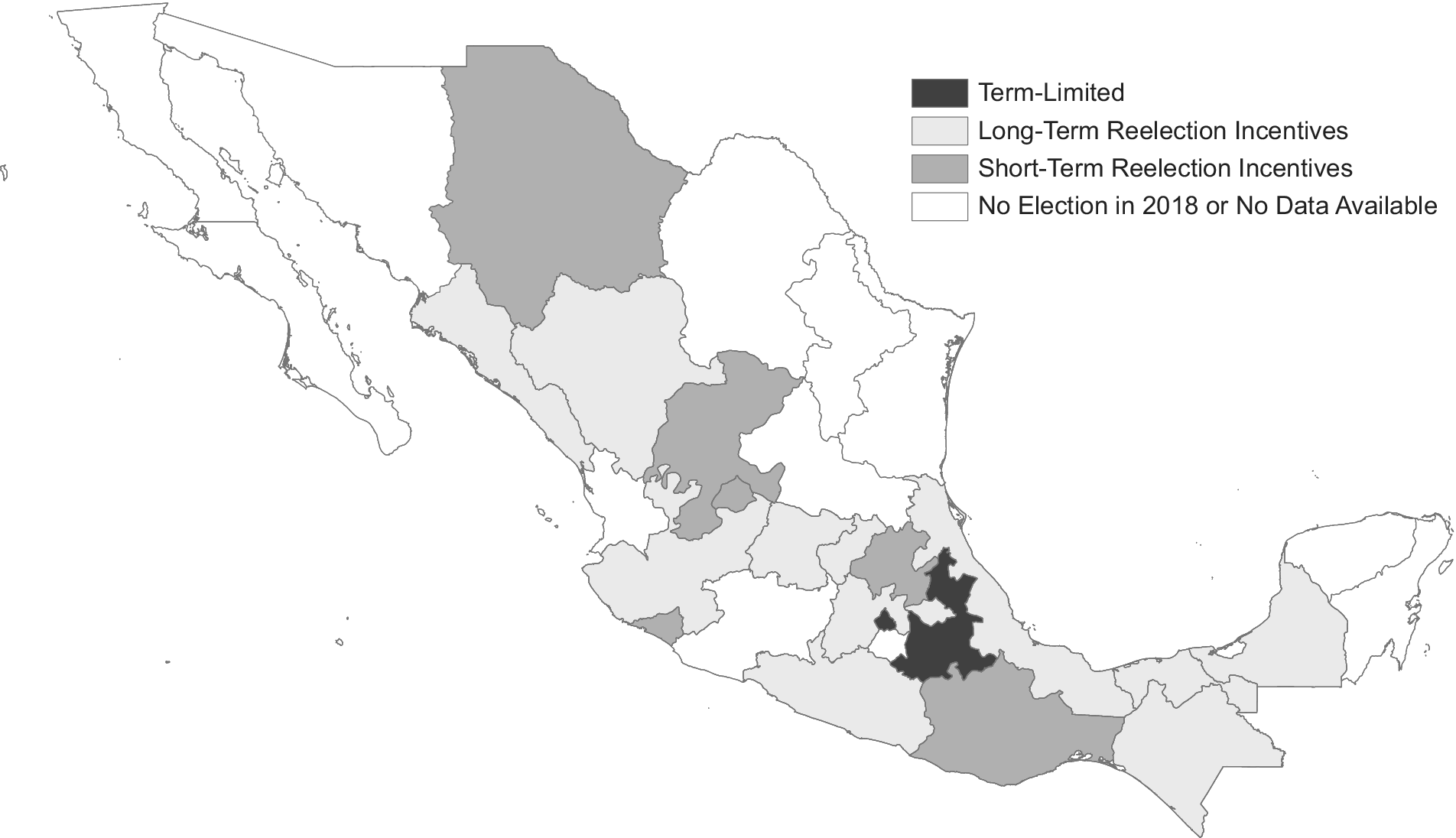
This article exploits the different types of reelection incentives that legislators elected in 2015/16 had, as determined by the 2014 Electoral Reform. I consider that legislators had short-term reelection incentives when they were able to run for one additional term in the 2018 election. I regard as long-term reelection incentives when legislators elected in 2015/16 would be able to run for reelection in up to three occasions, starting in the 2018 election. In states where reelection was deferred to start in 2021, legislators elected in 2015/16 were term-limited and had no reelection incentives in the 2018 election. The geographical distribution of the type of reelection incentives is displayed in Figure 1.
States by Type of Reelection Incentives

To test the hypotheses, I first estimate the proportion of each legislative session devoted to discussing particularistic legislation using a correlated topic model. Second, I use this proportion as the dependent variable and apply various difference-in-differences estimators that leverage the staggered implementation of the 2014 Mexican Electoral Reform and cross-state variation in the number of consecutive terms that legislators can serve. The key identifying assumption of the research design is that the trends of the proportion of discussion allocated to particularistic legislation in the term-limited group are a good counterfactual for the trends in the treatment group. Because the difference-in-differences focuses on change, the treatment and control groups can differ in levels of the outcome as long as their trends are the same. The parallel trends analysis, presented in the results section, shows that this is the case.
Methodology: Correlated Topic Model (CTM)
The quantity of interest is the proportion of each legislative session devoted to discussing particularistic legislation. I obtain it using a correlated topic model (Blei and Lafferty Reference Blei and Lafferty2007). I chose a CTM over supervised-learning-based approaches because CTM does not require the researcher to have prior knowledge of which topics are to be observed in the collection of documents. For example, construction projects that benefit a certain constituency classify as particularistic legislation; the universe that includes these projects is, however, not known. Because this article studies legislation, the author would have to know in advance how to recognize the universe of legislation that classifies as particularistic. Thus, I use CTM to discover the distribution of topics discussed in the documents. The model estimates for each document and each word the probability that each topic is composing them. A correlated topic model is more appropriate than other unsupervised topic models because it allows for topic correlation via the logistic normal distribution. Thus, CTM is able to model that a session discussing teachers is more likely to also discuss education than energy.
The model uses the frequencies with which words appear in each document to make inferences about the topics in the collection of documents that determined the use of those words. I applied a dictionary-based lemmatizer to group words referring to the same basic concept. This reduces the conjugated verbs into their infinitive form and the nouns into their singular masculine form. Following Catalinac (Reference Catalinac2016b), Denny and Spirling (Reference Denny and Spirling2018), and Grimmer (Reference Grimmer2013), I removed punctuation, stop words, numbers, names, municipality names, less common words (words that do not occur in at least 1% of the sessions), and most common words (words that occur in over 90% of the sessions). Most work that uses text analysis to analyze legislative and parliamentary discussions has focused on the English language (Herzog and Benoit Reference Herzog and Benoit2015; Lauderdale and Herzog Reference Lauderdale and Herzog2016; Proksch and Slapin Reference Proksch and Slapin2012; Reference Proksch and Slapin2014).Footnote 20 This article expands on this literature by focusing on legislative discussions in Spanish.
To fit the model, CTM requires selecting the number of topics. Previous research has usually selected the number of topics based on whether the topics produced were substantively meaningful (Catalinac Reference Catalinac2016b; Grimmer Reference Grimmer2010; Quinn et al. Reference Quinn, Monroe, Colaresi, Crespin and Radev2010). Conceptually, when analyzing legislation, fitting fewer topics produces broader themes (e.g., education). Whereas, the more topics are fitted, the narrower the themes that the model produces (e.g., scholarships for students) (Blei Reference Blei2012). According to Grimmer and Stewart (Reference Grimmer and Stewart2013), the substance of topics is determined by reading the words and documents with a high probability of belonging to each topic and using relevant information of the documents to ensure coherence. I adopt the same approach in choosing the number of topics. I fit the CTM with 450 topics, the lowest specification that produced topics with enough nuance to resemble legislation that could be classified into general or particularistic. With fewer topics, it was not always possible to determine into which category each topic fell. Because the sum of probabilities of topics composing each document equals one, I am able to interpret these probabilities as proportions.
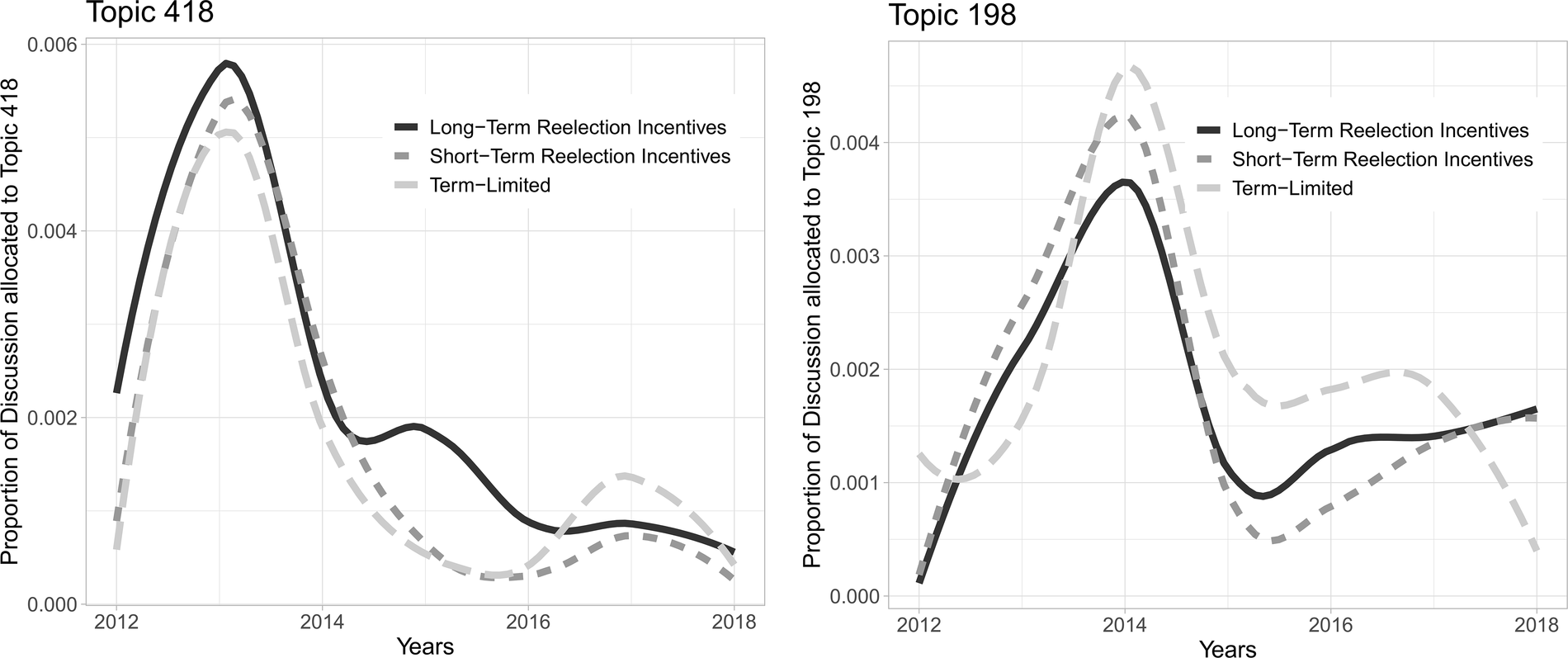
As a way to validate the specification, I conduct in-depth qualitative interpretations of each topic by reading the 15 words and five to 10 sessions with the highest probabilities of belonging to each topic. I used the characteristics of states and the timing of certain nationally relevant events to show that topics are substantively meaningful. For example, Figure 2 displays the proportion of discussion allocated to two federally approved laws/programs: the 2014 Safe School ProgramFootnote 21 and the 2013 Energy Reform.Footnote 22 Because state legislators were reacting to events happening at the federal level, I expect them to be discussed the most around 2014 and 2013, respectively. Figure 2 shows the distribution of the proportions of these topics. Results suggest that the estimates are face valid and the specification has discovered substantively meaningful topics.
Validation Checks for Topics Discussing the 2013 Energy Reform (Left) and the 2014 Safe School Program (Right)

After the topic model was estimated, validated, and interpreted, the author proceeded to classify topics into types of legislation following Bagashka and Clark (Reference Bagashka and Clark2016). To implement the classification, I first classified the 450 topics into either policy or procedural. I classified every not strictly procedural topic as policy. Because the unit of observation is the legislative session (document), protocol and procedures make a substantial part of the proportion of the discussion in a document. About 33% of the topics (147 topics) were classified as procedural. These include topics on protocol, voting, and internal rules. For example, the top five words of a topic on voting procedures are “ballot box, to place, alphabetical, count, and tally,”Footnote 23 whereas the top five words of a topic referring to the intonation of the Mexican National Anthem are “intonate, anthem, protocol, intonation, and message.”Footnote 24
Next, the author classified topics identified as nonprocedural into either general or particularistic. This article takes a broad approach to identifying topics that classify as particularistic (Gamm and Kousser Reference Gamm and Kousser2010). I include all topics that pertain to only a fraction of the state constituents regardless of whether they contain distributive benefits. I adhere to the following criteria: topics representing policies that reasonably affect only a fraction of the population were labeled as particularistic (this criterion has been used previously by Catalinac [Reference Catalinac2016a; Reference Catalinac2016b] to classify candidate manifestos), whereas all other policies were considered general.Footnote 25
The author classified 249 topics (55%) as general and 54 topics (12%) as particularistic. Examples of topics classified as particularistic are those referencing the renovation of a highway section,Footnote 26 the construction of an aqueduct,Footnote 27 and repaving of certain streets.Footnote 28 I classified as general legislation all topics that fell into neither procedural nor particularistic. General legislation concerns most of the state’s population and is not considered to target individual constituents.
Examples of topics that refer to general legislation are those addressed in the validation check, as well as topics regarding the militaryFootnote 29 and the custody and guardianship of children.Footnote 30 English language translation of the five words with the highest probabilities of belonging to each topic, their policy classification, and the descriptive labels assigned to the topics are reported in the online Appendix. There is considerable variation in the proportion of discussion allocated to particularistic and general legislation across states and legislatures. The mean proportion of discussion devoted to particularistic legislation in Zacatecas is around 12.8%, whereas it is only 3.6% in Aguascalientes. The online Appendix presents the proportion of discussion allocated to the different types of legislation by state.
To clarify the process used to classify topics into policies, the online Appendix includes snippets of the original texts translated to English for topics on health, education, and unions. These include general and particularistic topics, depending on the reach of the policies they are capturing. As an example, let us take two topics, one regarding school bullyingFootnote 31 and another concerning scholarships.Footnote 32 While both topics discuss issues on education, the former is classified as general, and the latter is classified as particularistic. The first one focuses on discussions about the prevention of school violence and bullying; the quoted snippet corresponds to Tlaxcala’s law initiative to combat bullying. In contrast, the second topic focuses on policies regarding scholarship programs; the quoted law corresponds to Durango’s legislators seeking to extend scholarship programs.
Analyzing legislative discussions is relevant because the structure of policy discourse constrains the set of feasible policy actions (Schmidt Reference Schmidt2008). There is a low probability of implementing a policy that was never discussed. Previous research has noted the consequential nature of speech for policy making and points to the relevance of legislative speech as a form of legislative behavior (Grimmer Reference Grimmer2013; Harris Reference Harris2005; Maltzman and Sigelman Reference Maltzman and Sigelman1996; Morris Reference Morris2001). Because legislators tend to spend a great deal of their time preparing, delivering, and listening to speeches, they clearly think that legislative debates matter to voters (Proksch and Slapin Reference Proksch and Slapin2014). Legislative debates provide information and interpretation to constituents (Grimmer Reference Grimmer2013), and even when discussions are just cheap talk, they may influence decision making through information revelation (Austen-Smith Reference Austen-Smith1990). Moreover, scholars have shown that legislative speeches influence citizen’s political engagement, mainly political knowledge, partisanship, and turnout (Salmond Reference Salmond2014).
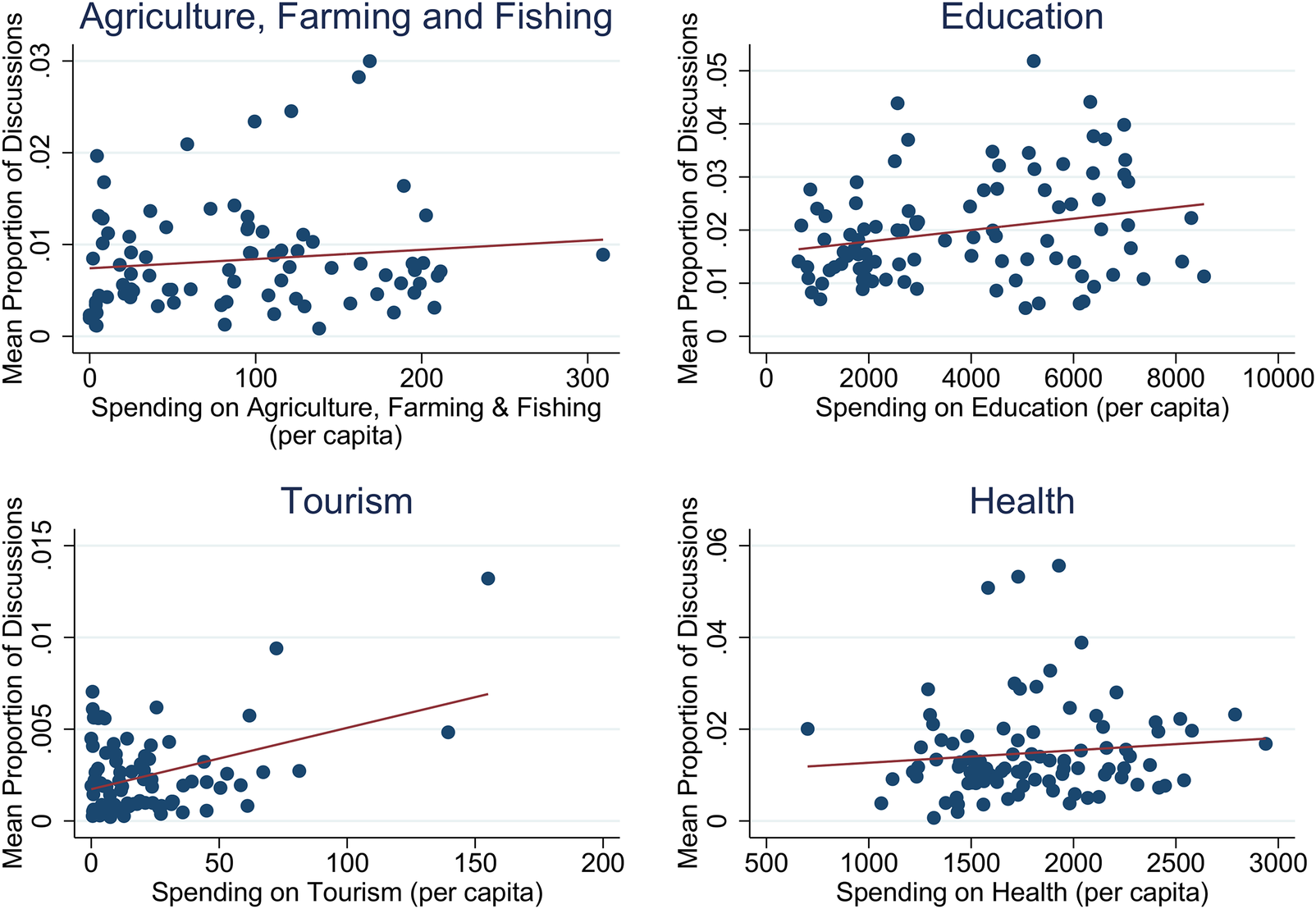
As a form of validation, to determine whether discussing certain legislation translates into policy outcomes, this article evaluates whether a higher proportion of discussions on certain topics leads to more spending in the same topics. The author collected data on state spending per year from Mexico’s national statistical office (INEGI 2018). Legislators influence state spending because each state’s expenses budget is exclusively negotiated and approved by local legislatures. First, I identified and classified topics from the CTM into four subjects that I could map into spending: agriculture, farming and fishing,Footnote 33 health,Footnote 34 education,Footnote 35 and tourism.Footnote 36 Second, I calculated the mean proportion of discussion allocated to each subject per state-year. Third, I merged the CTM estimates with state spending on programs and institutions on the selected subjects.
Figure 3 plots the correlation of the mean proportion of discussion per state-year and spending on each subject. The plots reveal different levels of positive correlations. The patterns suggest that legislators are putting the money where their mouth is. Overall, this advances the proposition that allocating a larger proportion of discussions to specific policies has real policy consequences.
Correlation Plots between the Average Proportion of Discussion and Spending for Different Subjects

Empirical Strategy
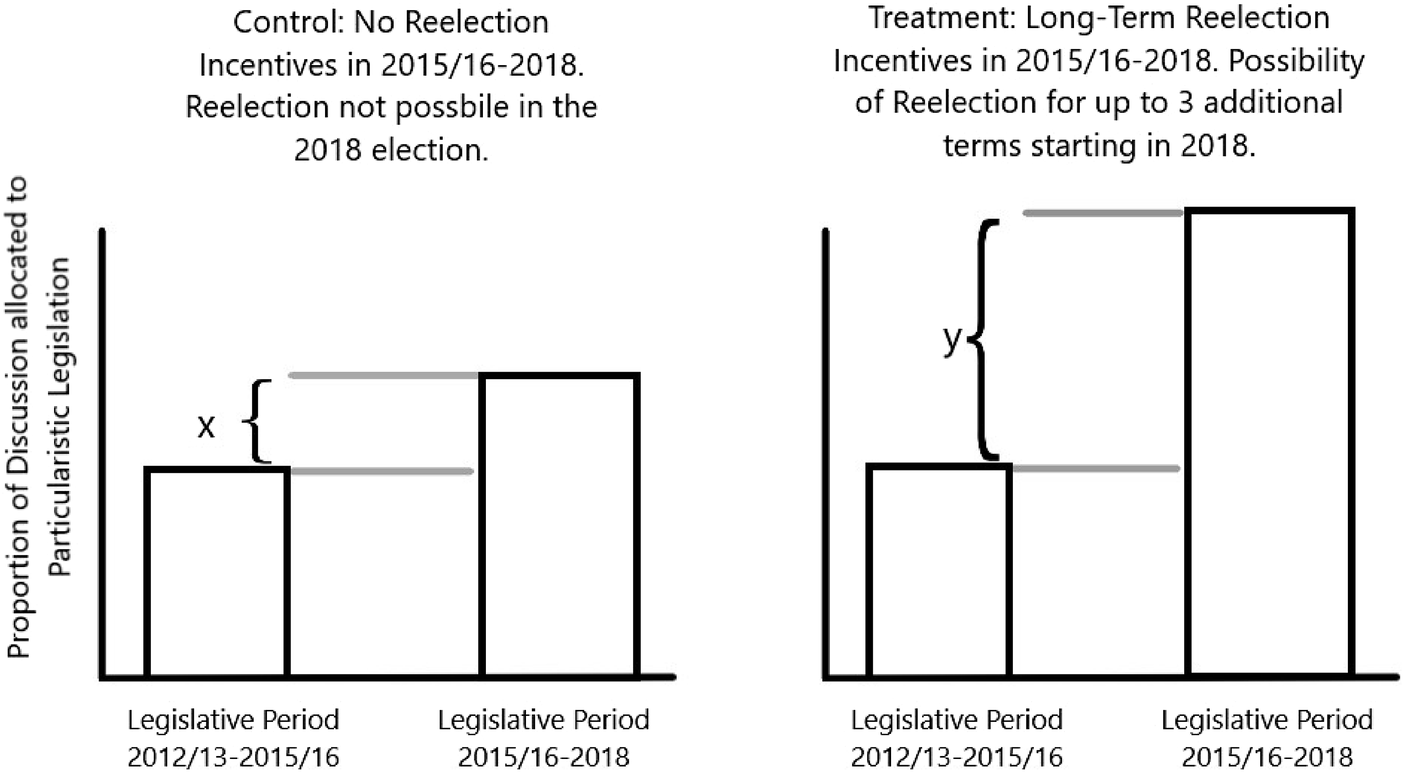
To examine the effect of long-term reelection incentives in the proportion of speech allocated to particularistic legislation, this article employs a difference-in-differences estimator. Figure 4 shows a visual representation of the difference-in-differences design. The author identifies
 $$ \beta $$
by comparing within-state changes in the proportion of particularistic legislation being discussed. If the average proportion of discussion allocated to particularistic legislation in the treatment group (long-term reelection incentives) changed by
 $$ y $$
between the two legislative periods and the average proportion of discussion devoted to particularistic legislation in the control group (no reelection incentives) changed by
 $$ x $$
, then
 $$ \beta =y-x $$
corresponds to the average treatment effect of long-term reelection incentives over time. This article hypothesizes that
 $$ \beta >0 $$
(H1). Causal identification of the treatment effect
 $$ \beta $$
relies on the parallel trends assumption. Thus, I show that estimates obtained from placebo treatments during the 2012/13–2015/16 legislative period, before the constitutional ban on reelection was lifted, are consistent with the assumption of no differential trends.
Visual Representation of the Difference-in-Differences Design

I implement the difference-in-differences estimator using the following specification:
 $$ {Y}_{i_s,t}=\alpha +\beta {T}_t\times {R}_s+{\gamma}_t+{\mu}_s+{\epsilon}_{i_s,t,} $$
where
 $$ i $$
denotes an individual session,
 $$ s $$
represents a State, and
 $$ t $$
indicates the month-year when the session was discussed. The outcome variable,
 $$ {Y}_{i_s,t}, $$
corresponds to the proportion of discussion allocated to particularistic legislation during session
 $$ i $$
in state
 $$ s $$
at the month-year
 $$ t $$
. On the right side of Equation 1, the main independent variable of interest is the interaction of two variables:
 $$ {R}_s $$
, whether legislators in state
 $$ s $$
got long-term reelection incentives, and
 $$ {T}_t $$
, whether the session took place in the 2015/16–2018 legislative period. The variable
 $$ {R}_s $$
represents the state’s time-invariant relative assignment of treatment. It is a dummy that equals 1 for all sessions
 $$ i $$
in state
 $$ s $$
where legislators discussing them that were able to run for reelection in 2018 had long-term reelection incentives and 0 for all sessions
 $$ i $$
in state
 $$ s $$
where legislators could not run for reelection in the 2018 election. The variable
 $$ {T}_t $$
is a dummy that equals 1 for all sessions that took place during the legislative period 2015/16–2018 when reelection incentives were introduced for those in the treatment group and 0 otherwise. I also refer to
 $$ {T}_t $$
as the post-election dummy. The estimation includes two fixed effects, one for each state (
 $$ {\mu}_s $$
) and another for each month-year (
 $$ {\gamma}_t $$
). These fixed effects control for all time-invariant state
 $$ s $$
attributes, such as the state-specific rules that govern the legislative discussion, as well as state-specific time trends that could confound the estimate of
 $$ \beta $$
. All standard errors are clustered at the state level.
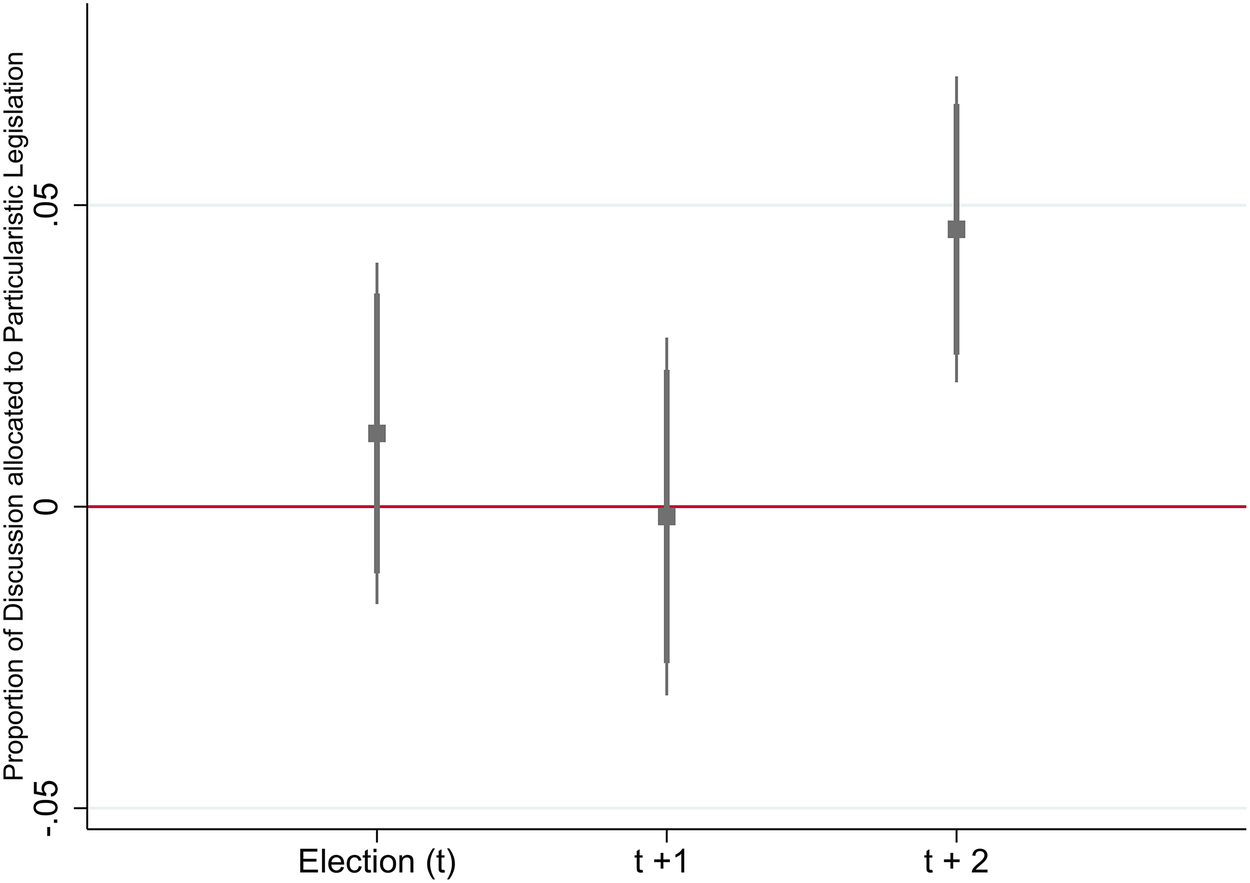
To address H2, this article examines the dynamic pattern of the treatment effect
 $$ \beta $$
over time. I want to determine whether the effect of long-term reelection incentives increases as the 2018 election approaches. Thus the election date, July 2018, is used as a reference for this analysis. I present the results for all states that had long-term reelection incentives in the 2015/16–2018 legislative period. I employ the difference-in-differences estimator in Equation 1 in three different regressions, one per year in office, where the sample in each regression is restricted to compare only analogous years in each of the legislative periods.Footnote
37
By focusing only on analogous years, I compare legislators with the same experience in office and avoid confounding the effect of reelection with general increases in activity at the end of the terms.Footnote
38
This article hypothesizes
 $$ \beta $$
to be positive and largest in
 $$ t+2 $$
.
Finally, this article tests whether long-term reelection incentives have a larger effect than short-term reelection incentives in the proportion of discussion allocated to particularistic legislation (H3). For this analysis, I drop from the sample all sessions where legislators could not run for reelection in the 2018 election, and I restrict the analysis to compare states with long-term reelection incentives and states with short-term reelection incentives. I construct the variable
 $$ L{S}_s $$
, which is a dummy variable that represents the state’s time-invariant relative assignment to either long-term or short-term reelection incentives. The variable
 $$ L{S}_s $$
equals 1 for all sessions where legislators had long-term reelection incentives and 0 for all sessions where legislators had short-term reelection incentives. I substitute the variable
 $$ {R}_s $$
in Equation 1 with the variable
 $$ L{S}_s $$
. I expect the estimated coefficient on
 $$ {T}_t\times L{S}_s $$
to be positive. Identification of this coefficient also relies on the parallel trends assumption. Thus, I show that the difference in outcomes has the same trend among states with long-term reelection incentives and states with short-term reelection incentives. Descriptive statistics for all variables in the analysis are available in the online Appendix.
Results
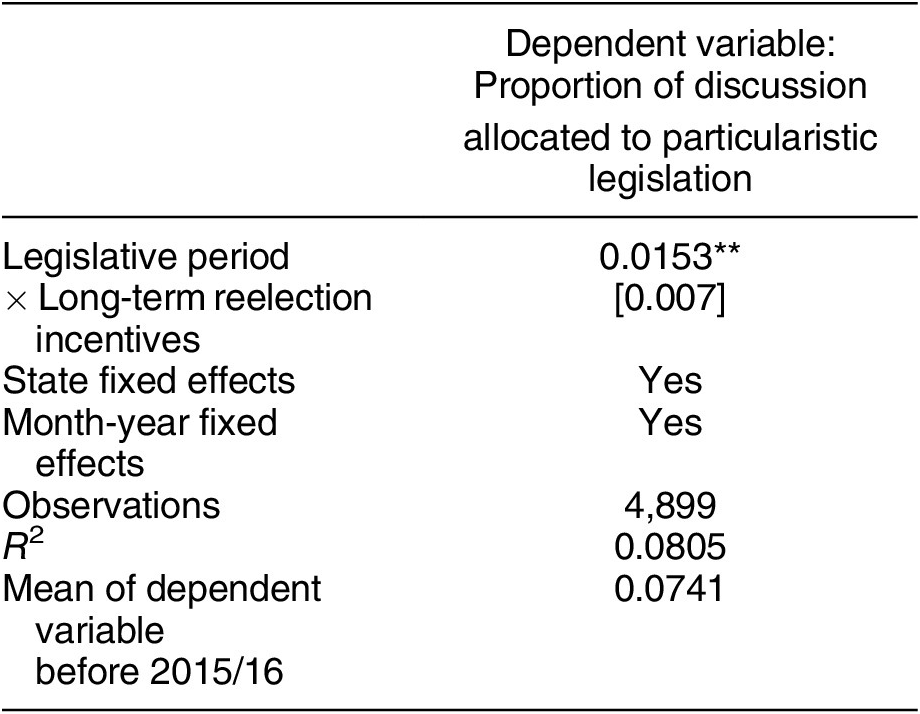
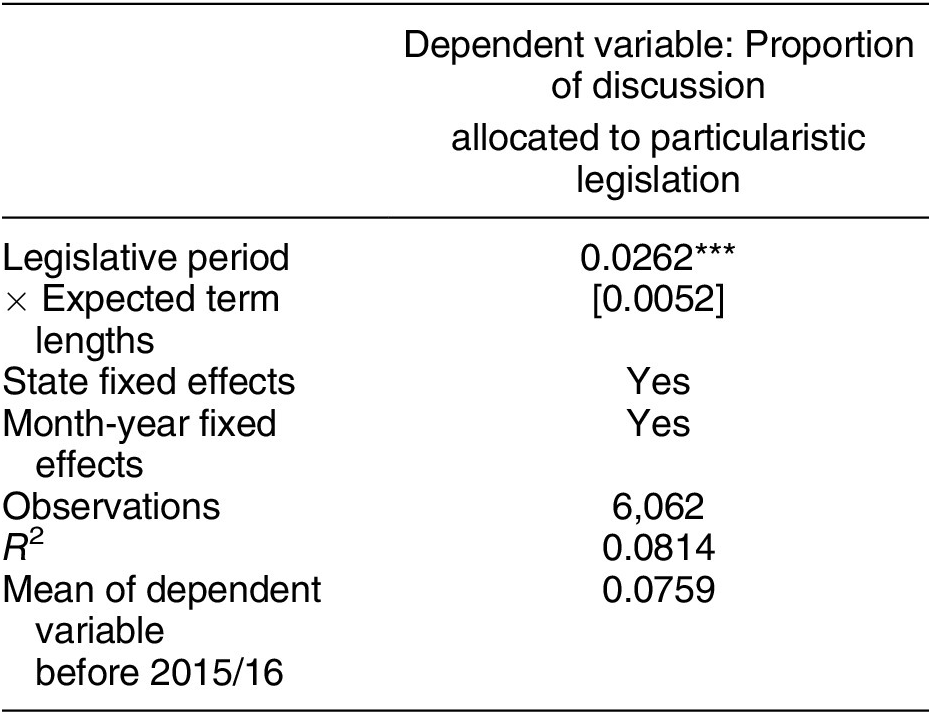
First, this article examines whether the proportion of legislators’ discussion devoted to particularistic legislation increased in states where legislators had long-term reelection incentives compared with term-limited legislators in the states where reelection remained banned during the legislative period 2015/16–2018. The mean value of the dependent variable before 2015/16 provides context for the size of the effect. The positive, significant coefficient on the interaction of long-term reelection incentives and the legislative period in Table 2 is consistent with the hypothesis. Results show that long-term reelection incentives increase the proportion of discussion allocated to particularistic legislation by around 1.5 percentage points. Because legislators in the sample devoted on average around 7.4% of the sessions to discussing particularistic legislation before 2015/16, a 1.5 percentage point increase represents around a 21% increase from the average time allocated to particularistic legislation. The effects found here confirm H1, suggesting that long-term reelection incentives increase the legislators’ attention to legislation that enhances their personal vote. The identification strategy lets us estimate the effect of reelection without the confounding effect of electoral selection. However, a source of concern might be that different types of legislators ran in 2015/16 compared with those who ran in 2012/13. The online Appendix shows that there is no significant difference among legislators in terms of their education and political experience in both cycles.
Difference-in-Differences Estimator of Long-Term Reelection Incentives on the Proportion of Discussion Allocated to Particularistic Legislation
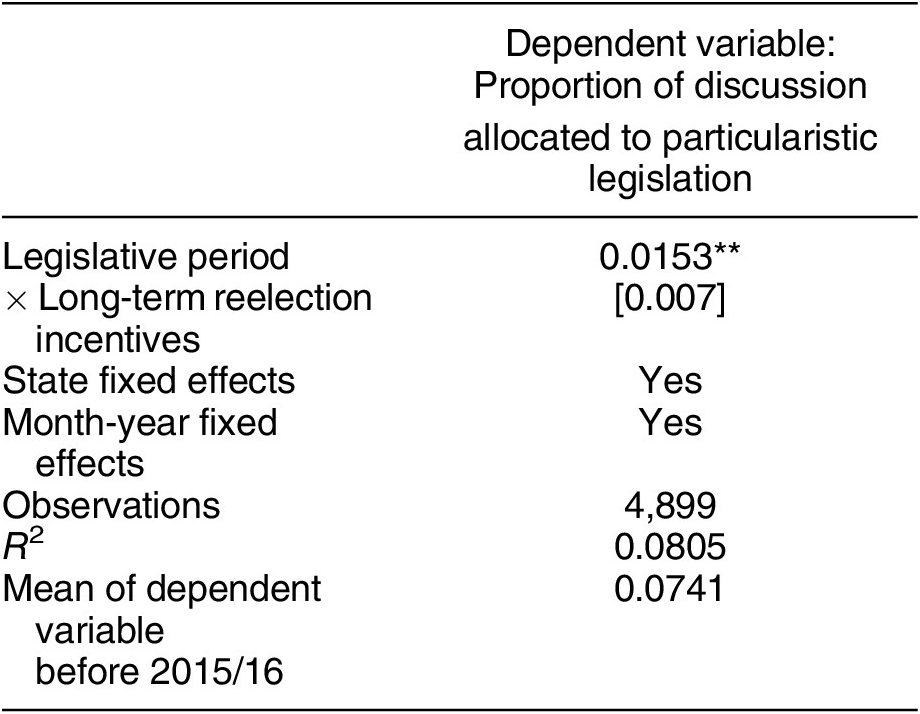
Note: Long-term reelection incentives significantly increase the proportion of legislative discourse devoted to particularistic legislation compared with term-limited legislators. Robust standard errors clustered on the state level in brackets. ** p < 0.05.
To test the mechanism, that legislators elected in SSDs seeking to cultivate their personal vote in order to get reelected drive the effect, I conduct three additional tests presented in the online Appendix. The first test shows that the average marginal effect of the difference-in-differences estimator increases as the percentage of the legislature elected in SSDs is larger. Because a greater proportion of legislators elected in SSDs implies more legislators looking to cultivate their personal vote, this suggests that legislators elected in SSDs drive the effect. The second test shows that the type of particularistic policies driving the effect are fiscal transfers and the provision of programs/goods, which correspond to the two forms most suggested by media accounts of how local legislators cater to their constituents. Because there is no reason to believe that the introduction of reelection made parties more responsive to particularistic demands,Footnote 39 the third test shows that the effect disappears when restricting the sample to the licencias period, the time before elections when candidates holding public office need to take a temporary leave from their posts. By the start of the licencia period, parties have already selected which legislators are running for reelection. If engaging in particularistic discussions was a party strategy, engendered by the introduction of reelection, results would show a positive significant effect during this period, which is not the case. This suggests that legislators seeking to run for reelection are driving the effect.
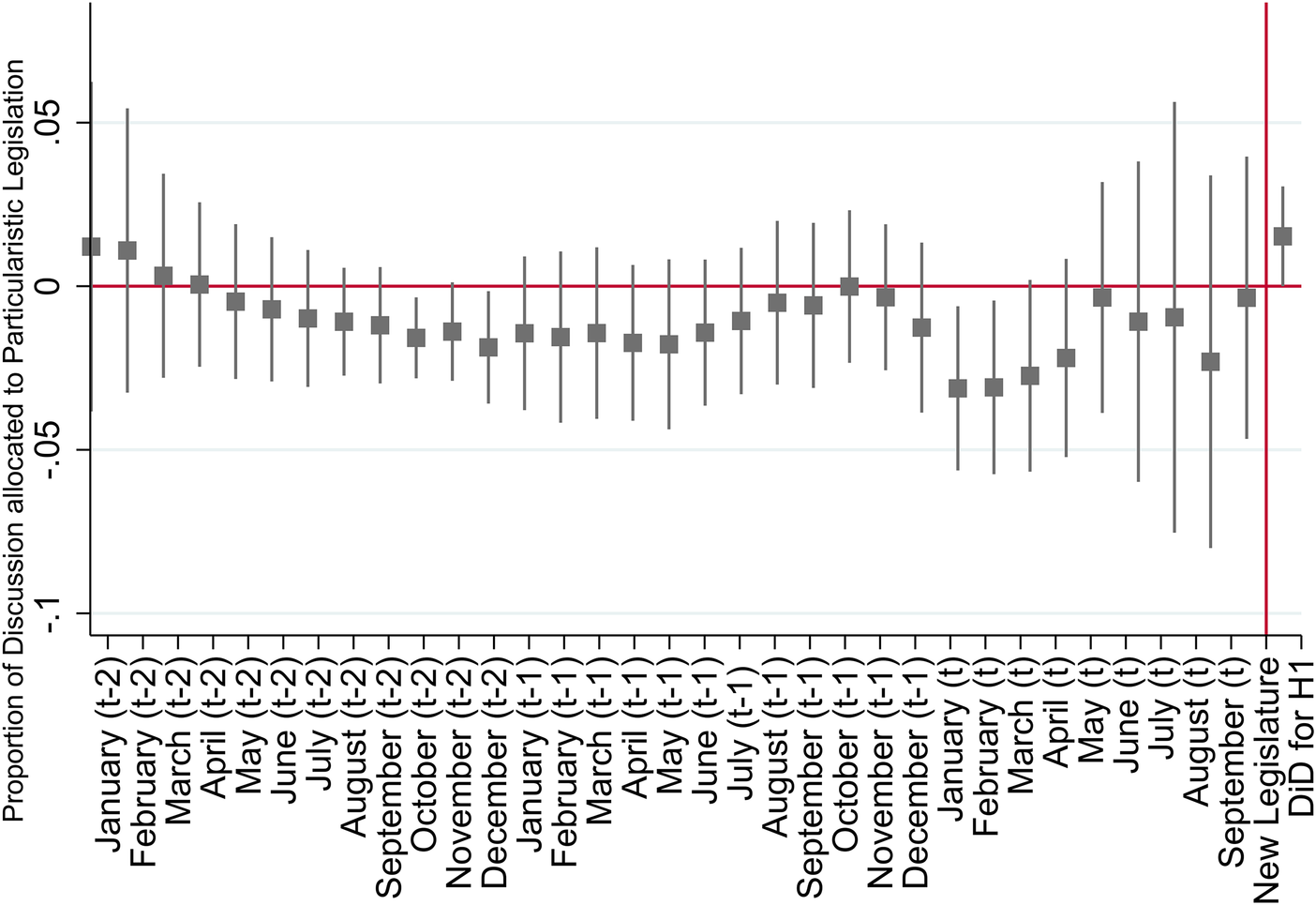
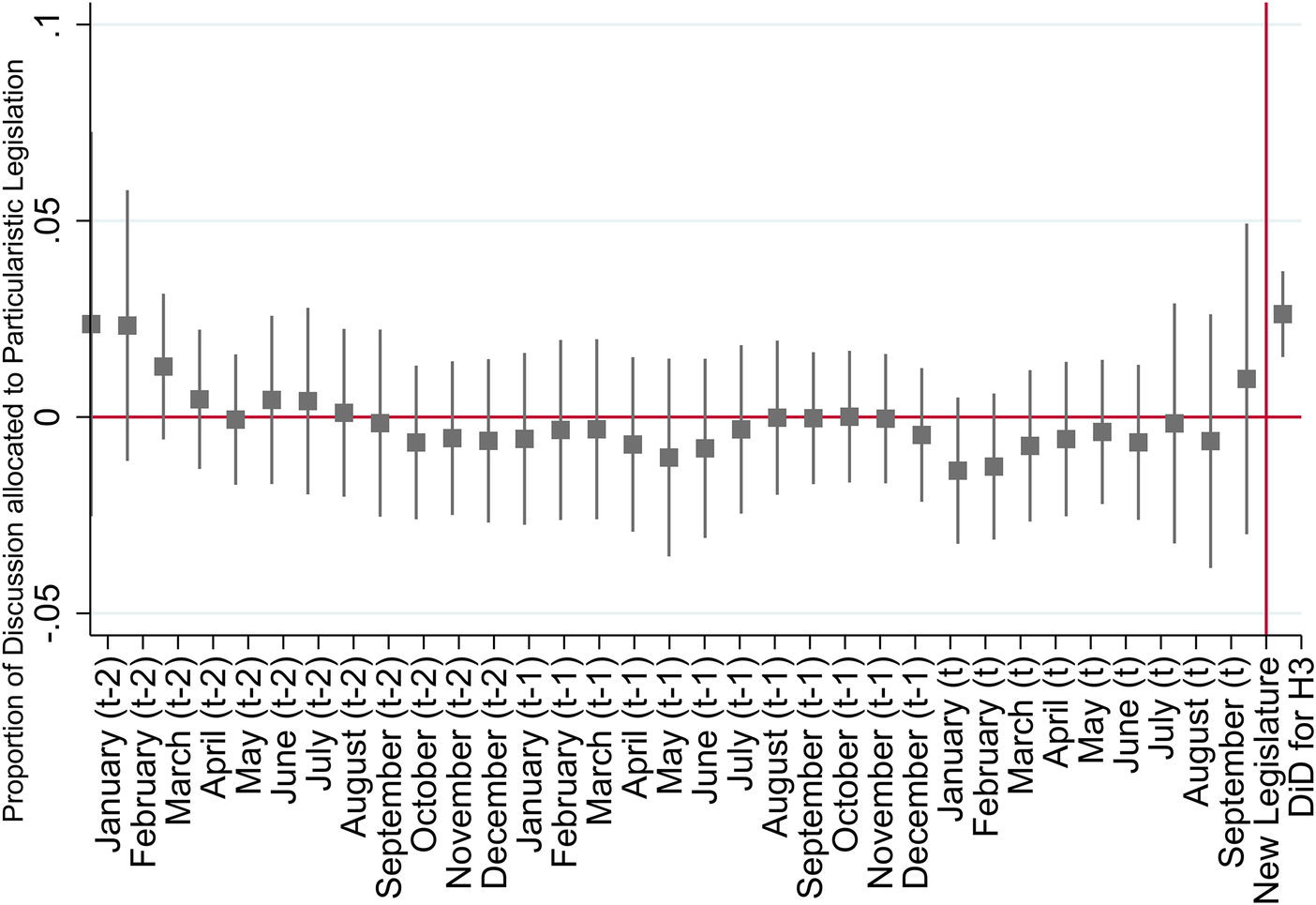
The difference-in-differences estimator identifies the effect of treatment under the assumption that the difference between the treatment and control groups is time-unvarying before the implementation of treatment. To show the validity of results for H1, this article needs to probe that states in the control group serve as a proper counterfactual for the treatment group had the reform not been implemented. Thus, results need to show that there are no differential trends in outcomes between groups in the direction of the treatment effect during the legislative period 2012/13–2015/16.
I test the parallel trends assumption by running placebo treatments before the ban on reelection was lifted.Footnote 40 Figure 5 plots the placebo tests by month and year and presents the difference-in-differences estimator to show the size of the effect in the context of the parallel trends. Only two out of the 33 point estimates are significant at the 95% level. However, the direction of the effect is negative, which would only make it more challenging to identify the effect of treatment during the 2015/16–2018 legislative period. Overall, without treatment, the differences in outcomes have the same trend in both groups. In addition, the online Appendix shows that, in terms of legislator characteristics, observed relevant covariates are very similar in the treatment and control groups. Legislators with long-term and no reelection incentives are virtually the same in their years of education and political experience. Therefore, it is not a concern that these characteristics are driving the differential change.
Parallel Trends by Month and Difference-in-Differences Estimator in Table 2 (H1)

As previously mentioned, selection into the term-limited group could be correlated with having gubernatorial elections in 2018. This would be a threat to the identification strategy only if having gubernatorial elections in 2018 explains the differential change in the proportion of discussion allocated to particularistic legislation after 2015/16. To ease this concern, the online Appendix shows that the coefficient in Table 2 is robust to controlling for a dummy indicating whether the state had gubernatorial elections in 2018 interacted with a post-2015/16 election dummy. In addition, although it is unlikely that other state characteristics explain the differential change in the dependent variable after 2015/16, the online Appendix shows that the effect is robust to controlling for a wide range of state indicators set at a pretreatment baseline interacted with a post-2015/16 election dummy. Finally, to address the empirical concern that the effect is simply the result of a spurious correlation, I repeat the analysis evaluating the effect of treatment at other points in time. The results, presented in the online Appendix, show that none of the other positive outcomes is significant and that none of the other specifications reaches the size of the effect, which supports the validity of the findings.
Next, this article examines whether the effect found for long-term reelection incentives increases as the 2018 election approaches. Figure 6 presents the results. The coefficient estimates show that the effect of long-term reelection incentives is largest as legislators get closer to the 2018 election. This pattern suggests that, as an election approaches, incumbents running for reelection have incentives to pursue policies strategically and favor legislation that can get them rewarded at the polls. Thus, an electoral cycle emerges in which legislators pay more attention to legislation that enhances their personal vote when closer to the electoral period.Footnote 41 Results show not only that reelection is consequential for particularism but also that it is the most consequential just before an election.
Difference-in-Differences Estimator of Long-Term Reelection Incentives on the Proportion of Discussion Allocated to Particularistic Legislation at Diverse Periods of the Electoral Cycle (H2)

Finally, this article examines how the expected length of tenure in office affects the manner in which legislators respond to reelection incentives. I do this by analyzing the effect of long-term reelection incentives compared with short-term reelection incentives. The type of reelection incentives takes the value of 1 when legislators have long-term reelection incentives and 0 when legislators have short-term reelection incentives. Table 3 presents the results. Findings show that long-term reelection incentives increase the proportion of discussion allocated to particularistic legislation compared with short-term reelection incentives by around 2.6 percentage points. The effect represents a 35% increase from the average time allocated to particularistic legislation and is consistent with the theoretical expectations (H3). Results show that legislators with longer political horizons are more responsive to reelection incentives than are those with shorter ones. Therefore, expected term lengths are important determiners of legislative effort.
Difference-in-Differences Estimator of Expected Term Lengths on the Proportion of Discussion Allocated to Particularistic Legislation

Note: Long-term reelection incentives significantly increase the proportion of legislative discourse devoted to particularistic legislation compared with short-term reelection incentives. Robust standard errors clustered on the state level in brackets. ** p
 $$ < $$
0.05.
As I did before, to show that the difference-in-differences estimator for H3 is unbiased, we should observe that states with short-term reelection incentives and states with long-term reelection incentives had no differential trends in outcome in the direction of the treatment effect. None of the 33 interactions in Figure 7 is significantly different from zero at the 95% level. Because selection into the short-term group could be correlated with having a PRI governor, the online Appendix shows that the coefficient in Table 3 is robust to controlling for a dummy indicating whether the state had a PRI governor interacted with a post-2015/16 election dummy. When comparing the distribution of covariates in terms of legislator characteristics, legislators with short-term reelection incentives had significantly more years of political experience than those with long-term reelection incentives. Thus, the online Appendix shows that the effect is robust to controlling for these legislator covariates and a large battery of state indicators set at a pretreatment baseline interacted with a post-2015/16 election dummy, which probes that these characteristics are not driving the differential change after 2015/16. Finally, the reader should be cautious of giving a substantive interpretation to the difference in magnitude of coefficients in Tables 3 and 2 because we cannot reject the null hypothesis that the coefficients are equal to each other.Footnote 42
Parallel Trends by Month and Differences-in-Differences Estimator in Table 3 (H3)

Conclusion
Reelection is considered fundamental to the concept of electoral accountability. We expect incumbents eligible for reelection to behave differently in office than those who are term-limited. This article examined whether incumbents eligible for reelection focus on policies that have the highest electoral yield in the context of a highly centralized party system. Applying quantitative text analysis to a new collection of 6,980 transcripts of Mexican legislative sessions, the author estimated a CTM to discover the distribution of topics in the collection of documents. Topics were classified into types of legislation to get the proportion of discussions devoted to particularistic legislation. Non procedural topics were classified into general or particularistic. Leveraging the staggered implementation of the 2014 Mexican Electoral Reform, this article identified a quasi-natural experiment and implemented a difference-in-differences design to estimate the effect of reelection incentives using the proportion of discussions allocated to particularistic legislation as dependent variable.
Results showed that, despite the party-centered electoral system, politicians in office prioritize particularistic legislation when eligible for reelection. The findings presented evidence on the emergence of an electoral cycle, where legislators focus on legislation that enhances their personal vote as the electoral period approaches. Finally, results showed the effect that political horizons have on reelection incentives. The article identified that the difference in expected term length in office is an important determiner of how responsive incumbents are to reelection incentives.
Understanding how reelection incentives interact with other institutional dynamics and affect incumbent behavior is crucial and highlights several avenues for future research. The first is to evaluate how reelection affects party dynamics, incentives, performance, and electoral strategies. If reelection is shifting legislative attention at the expense of party priorities, we can expect parties to change their behavior, to maintain their members disciplined, and keep their policy concerns a priority.
The second line of research is to better understand the underlying link between reelection and accountability and address how changes in incumbent behavior affect the quality of democracy and governance. First, it seems worth noting that particularistic legislative debate does not equate to constituent service, and the follow-through to service is where the real substance of democratic accountability lies. Second, the author does not consider legislative particularism to be necessarily bad for democracy. Even when particularistic legislation represents only a small fraction of the discussions and budget, it could have a nontrivial effect in the targeted district. Legislators focusing on local or targeted legislation can generate positive spillovers benefiting beyond the population receiving the particularized benefits. Future work should address this question and examine how electoral rules can increase legislative responsiveness and accountability more broadly, for which micro-level data would be extremely helpful.
Supplementary Materials
To view supplementary material for this article, please visit http://dx.doi.org/10.1017/S0003055420000672.
Replication materials can be found on Dataverse at: https://doi.org/10.7910/DVN/NOMC0H.






Comments
No Comments have been published for this article.