Conditions have long been and continue to be pervasive in aid agreementsFootnote 1 and scholars argue that foreign aid's effectiveness depends on whether recipients comply with aid agreements.Footnote 2 Yet many countries flout the conditions laid out in their agreements while continuing to receive promised disbursements as well as further grants and loans. For example, the World Bank offered Kenya twenty-one loans between 1980 and 2000 during which the Kenyan government repeatedly failed to comply with conditions on those loans.Footnote 3 Scholars and practitioners alike have long questioned the link between the fulfillment of conditions by recipients and the disbursement of subsequent aid.Footnote 4
Existing research explains why some countries comply by pointing to their strategic importance: the International Monetary Fund (IMF), for example, has a trigger mechanism to insure against future disbursements without a minimum level of compliance. This trigger mechanism appears to work when countries lack strategic importance to the IMF's major shareholders.Footnote 5 That is, strategically important countries continue to receive disbursements regardless of compliance levels.
The strategic-importance theory is, of course, well documented in the literatureFootnote 6 but the story does not end here: many strategically important countries comply with the conditions in their aid agreements whereas many strategically unimportant countries fail to comply. In fact, a data set on compliance with World Bank aid agreements (that we detail) documents substantial variation in compliance rates across countries regardless of their strategic importance to donors. Some governments lacking strategic importance to major shareholders at the Bank appear to ignore the conditions laid out in aid agreements. For example, after the Cold War, when the Democratic Republic of the Congo was no longer strategically important to the United States, it failed to comply with 90 percent (twenty-six out of twenty-nine) of its monitored World Bank aid agreements. Similarly, over the same period, Guinea Bissau and Equatorial Guinea—neither strategically important to the major Bank shareholders—failed to comply with more than 70 percent of their aid agreements (Guinea Bissau failed to comply with 70 percent and Equatorial Guinea failed to comply with a single one of its five monitored agreements). During the same time, many countries with strategic importance to Bank shareholders strictly complied with their agreements. For example, Latvia and Panama remained strategically important to the Bank's major shareholders between 1964 and 2010, and yet complied with more than 80 percent of their aid agreements during this period (Latvia complied with 94 percent and Panama with 84 percent). In other words, the strategic-importance theory may explain only part of the variation in compliance.
We argue that major sources of income for the recipient government further contribute to an explanation of compliance. Developing country governments can access a number of sources of income to fund their budgets, and thus to maintain power.Footnote 7 We conjecture that governments desiring to maximize revenue sources that benefit from compliance with conditions are likely to comply with these conditions, and conversely, governments that desire to maximize revenue from sources that may decline as a result of compliance are unlikely to comply.Footnote 8 We focus on two of the largest budgetary sources in developing countries beyond foreign aid: foreign direct investment (FDI) and natural resource rents.Footnote 9
Leaders of developing country governments are likely to conclude that compliance will maintain or increase FDI. Conditions represent policies that protect and grow foreign investment, such as policies that stabilize the macroeconomic or political environment, including reform of public finances, improvements to the electoral system, or projects to rehabilitate health, water, or sanitation infrastructure. Because foreign investors are known to favor these sorts of policies, governments that seek to optimize the environment for FDI are likely to comply, with the hope of maintaining and attracting further FDI.Footnote 10
In contrast, leaders with access to rents from natural resources for government revenues are less likely to comply because compliance is unlikely to affect (and may even reduce) these rents. Resource extraction can be sustained without linkages to the local economy.Footnote 11 Moreover, leaders of resource-rich governments may steer clear of compliance because compliance might reduce the income available to pay off elites. Compliance with public-finance reforms attached to aid agreements means redirecting resource rents from the leader's coffers to pay for programs that benefit the poor.Footnote 12
In short, from the perspective of aid recipients, compliance should maintain or increase income for governments that depend on FDI, whereas compliance may reduce income for governments that depend on rents from natural resources. Governments that desire FDI are therefore likely to comply with aid agreements, whereas governments that seek to maximize resource rents are likely to take the aid money and run.
To test the empirical implications of our model we focus on the World Bank that, to our knowledge, is the only donor (bilateral or multilateral) that has collected large-scale data on compliance with its aid agreements.Footnote 13 Using previously unavailable data on government compliance with more than 4,500 World Bank aid agreements between 1964 and 2010, we test agreement-level and country-level determinants of compliance and find strong support for our theory. Specifically, we find that a one standard deviation increase in FDI as a percent of gross domestic product (GDP) increases compliance rates by 3 percent. The same increase in rents from natural resources as a percent of GDP reduces compliance rates by 3 percent. These results are robust to a host of alternative model specifications, different measures of the key variables, and potential endogeneity issues.
Determinants of Compliance
Because governments require income to remain in power, a primary reason for a government to create new policy is that the policy promises to increase government revenues.Footnote 14 Because developing countries depend on few sources of income, their leaders are likely to seek to optimize precisely those policies.
Although it is difficult to gather data on sources of government finance in developing countries, most countries appear to rely on a few sources for the bulk of their financing, including foreign aid, FDI, and rents from natural resources.Footnote 15 The role of foreign aid is addressed in the literature through the strategic-importance theory: countries that lack strategic importance to donors tend to comply with aid agreements, whereas countries with strategic importance to donors often fail to comply.Footnote 16 In this study, we focus on FDI and rents from natural resources, two of the main sources of income that fund a significant portion of government revenue in developing countries and can therefore influence whether a government survives politically.Footnote 17 For example, natural resources rents in Papua New Guinea accounted for 59 percent of GDP in 2007 and 58 percent of GDP in Mongolia in 2010. FDI can also be substantial. In 2007, FDI stocks accounted for more than 90 percent of Bulgaria's GDP and more than 60 percent in Djibouti and Belize.Footnote 18
Because these sources of income represent a significant portion of developing-country economies, they are likely to play a large role in government budgets, and are therefore crucial for regime survival. Aid recipients face incentives to maximize either of these sources of income if it is available. When complying with the conditions on aid agreements appears likely to maximize one of the aid recipient's main revenue sources, we expect that recipients will be more likely to comply (the converse is also true).
Conditions on Aid
By conditions, we refer to policies that aid recipients agree to implement in exchange for aid.Footnote 19 Many scholars and policy–makers associate the idea of conditionality with the stabilization and structural adjustment policies of the 1980s.Footnote 20 But conditionality as used by both multilateral and bilateral donors—with different degrees of institutionalization—is as old as foreign aid itself, and includes more than the standard set of macroeconomic reforms. It includes broad development goals (such as infrastructure and health improvements), political reform (such as strengthening legislatures or political parties), human rights protection (such as improving prison conditions), rule-of-law promotion (such as professionalizing police), and social inclusion (such as gender quotas in public or private enterprises). Some of these conditions—particularly those regarding social reform—became popular after the end of the Cold War, but others, such as those associated with infrastructure development, precede the macroeconomic conditionality of the 1980s.
Although some conditions may be good in themselves (for example, improving health or education), many are also business friendly. In particular, stabilizing the macroeconomic environment, building dependable infrastructure, improving governance, and deepening social well-being are all associated with attracting international sources of capital.Footnote 21
FDI: Incentives to Comply
Many aid recipients desire to optimize the environment for FDI. Although some FDI targets natural-resource sectors, the preponderance (between 88 and 93 percent from 1990 to 2005) targets nonextractive sectors.Footnote 22 Thus, our discussion builds on research that focuses on aggregate FDI. FDI is an investment to obtain or control companies in a country that is foreign to the investor. Beyond the tax revenue that FDI brings to governments, FDI expands domestic investment and the private sector, further fostering economic growth, all of which yields a larger tax base and increased revenue for the government.Footnote 23 Thus, governments that desire FDI are likely to implement policies that increase and protect FDI to attract and keep foreign investors.Footnote 24 Foreign investors specifically prefer to do business in environments with well-enforced property rights, human capital, and an overall strong institutional structure, the sorts of institutions that donors call for in aid agreements.Footnote 25
Foreign investors and donors are likely to favor the same policies for two reasons. First, policies that benefit human development as an end in itself can simultaneously benefit FDI. As defined by the United Nations “standard formulation,” human development refers to “a process of enlarging people's choices. The most critical ones are to lead a long and healthy life, to be educated and to enjoy a decent standard of living.”Footnote 26 To achieve human development, aid agreements have aimed to stabilize macroeconomic environments, improve governance, and expand access to education, health, water, roads, and other basic services. Investors value these policies because they worry about governments arbitrarily changing policies once investments are made, being at risk of expropriation, or at risk of political instability, where rebel groups loot or destroy the investment.Footnote 27 Investors also benefit from stronger infrastructure to facilitate local business practices and expanded education and health care to enhance the skills and capacities of their workforce. Thus, aid agreements that aim to improve human development as an end in itself are also likely to benefit foreign investment.Footnote 28
Second, foreign investors and donors are likely to share similar interests because donors generally want to protect and increase FDI in developing countries. According to the Monterrey Consensus of 2002, which included the bilateral and multilateral donors, “private international capital flows, particularly foreign direct investment, along with international financial stability, are vital complements to national and international development efforts.”Footnote 29 Western donors have long maintained this position. Indeed, the World Bank contains institutions aimed at protecting and promoting FDI, including the Investment Climate Advisory Services and the Multilateral Investment Guarantee Agency.
Although donors believe that foreign investors, in general, favor certain policies (such as a stable macroeconomic environment), donors also sometimes seek to identify investor concerns in a country or region-specific context, and they do so by employing a variety of tools.Footnote 30 For example, donors have funded detailed analyses of foreign investors in certain countries, including the World Bank-USAID study to map regulatory hurdles affecting investors across sixteen African countries;Footnote 31 the United Kingdom's Department for International Development funded study of foreign investors in Egypt, India, South Africa, and Vietnam in the early 2000s;Footnote 32 and perhaps most important are the World Bank's Doing Business surveys and reports that focus on understanding regulation to promote investment in developing countries. Thus, donors' desire to protect and increase FDI to developing countries leads them to insert specific conditions into aid agreements in support of this goal.
To be clear, foreign investors may not be aware of specific aid agreements within the developing countries where they operate. Our argument is that policies that satisfy the interests of foreign investors generally correspond with policies in aid agreements, either because donors and investors happen to share common interests or because donors actively seek to identify investor concerns. Two examples serve to illustrate our argument. In both, we see the following: (1) a government seeking to maintain or attract FDI, (2) World Bank aid agreements that address investor interests, and (3) compliance with these agreements.
In the early 2000s, the government of Mozambique sought to maintain and increase its FDI (which already constituted nearly 47 percent of its GDP in 2003).Footnote 33 The national poverty-reduction plan covering 2001–2005 specifically called for increases in investment.Footnote 34 In a 2004 interview, Mozambican Prime Minister Luisa Diogo expressed her interest in reform to achieve greater investment, particularly in light of the serious problems with red tape facing investors: “We are aware of these problems [with red tape],” she said, “and are working hard to reduce them.”Footnote 35
At this time, the World Bank sought to prioritize policies that would attract investment to Mozambique. In fact, “improving the investment climate” was the “first pillar” of the Bank's Country Assistance Strategy for 2004–2007 for Mozambique.Footnote 36 As part of this strategy, the Bank offered two Poverty Reduction Support Credits that aimed to support the government in stabilizing the macroeconomic environment, bolstering financial institutions, and deepening service delivery, especially in education and health.Footnote 37
The Mozambican government complied with both credit agreements to a satisfactory degree.Footnote 38 The Bank said that “the government played a central role in choosing the priority areas of its development strategies … It also took the lead … in implementing the specific measures.”Footnote 39 Although the Bank also pointed out that significant red tape remained and that the Bank sought greater government commitment to reform, the government at least complied satisfactorily.Footnote 40
Given the apparent government interest in attracting FDI, it seems reasonable to conclude that Mozambican government officials complied at least in part because they sought to optimize the environment for FDI. However, Mozambique's compliance is also consistent with the strategic-importance theory. That is, another reason for Mozambique's compliance is that the country depended on donors who had leverage over the government.Footnote 41 It is therefore worth further illustrating our argument with an example from Panama, a country that desired FDI while also being strategically important to major shareholders at the Bank.Footnote 42
FDI was an important potential source of income to reconstruct the Panamanian economy in the early 1990s, following the capture of Panamanian dictator Manuel Noriega. Panama's economy had previously depended on FDI, with FDI stocks peaking at nearly 65 percent of GDP in the 1980s.Footnote 43 But investors had fled as Noriega fostered political and economic instability.Footnote 44
In an effort to rehabilitate the economy, in 1992, the World Bank approved an Economic Recovery Loan for Panama that sought to reform the macroeconomic environment, impose fiscal austerity, and improve governmental capacity. Specifically, the loan-backed program attempted to “facilitate the flow of external financing and foreign investment.”Footnote 45 According to Bank staff, despite domestic resistance, the government ultimately met every condition associated with the aid agreement,Footnote 46 receiving a satisfactory compliance rating.
Why did the Panamanian government comply with the aid agreement? Why pay back arrears and eliminate government jobs instead of immediately addressing the country's high unemployment rate? Although direct evidence of government officials' actual beliefs is generally unavailable, in an interview, Panama's Economic Planning Minister, Guillermo Ford addressed why the government was choosing to pay back arrears. He explained that foreign investors would likely respond positively to the move. “Not paying is suicide. Paying is painful but it's the only way to develop a future for Panama.”Footnote 47 Although paying back arrears was partly meant to secure more loans from international organizations, he added, “Many countries which would back corporate, private investment in Panama, won't look at us until we have our house in order.”Footnote 48 Ford appears to have believed that policies in the Bank aid agreement corresponded with the interests of foreign investors.
Thus, the experiences of Panama and Mozambique suggest that compliance can be explained by government income sources such as FDI. In both examples, we see that the government desired to maintain or attract FDI, that the World Bank offered aid agreements with conditions that aimed to optimize the environment for FDI, and that the government complied with those conditions.
Summing up, the more important FDI is for an economy, the more likely an aid recipient should be to comply with aid agreements because the aid recipient hopes to maintain and/or increase FDI. This leads to our first hypothesis:
H1
Compliance is more likely as the desire to maintain and increase FDI increases.
Natural Resources: Disincentives to Comply
In contrast, aid agreements should not increase (and may even reduce) government income when the government has access to another major source of finance: natural resources. Resource-rich leaders enter aid agreements to receive initial aid disbursements but they lack the incentive to comply with these agreements. By natural resources, we refer to resources that can be extracted using little labor or technology (that is, oil, gold).Footnote 49 Governments receive rents from natural resources directly from state-owned or private companies involved in extraction.
Resource-rich leaders are unlikely to comply with aid agreements for two reasons. First, compliance is unlikely to significantly increase (and may even decrease) these leaders' access to rents. Second, resource-rich leaders are unlikely to suffer major financial losses if donors withdraw from the country because resource-rich leaders can always turn to their resource rents. Thus, instead of complying, these leaders are likely to take the aid money and run.
Aid agreements are unlikely to benefit resource rents.Footnote 50 Policies that aim to stabilize the social or economic environment are unlikely to affect profits from resource extraction as much as profits from other sectors because natural resource extraction and production require minimal linkages to the broader economy.Footnote 51 Indeed, offshore drilling and diamond mining can continue even if the country is in the midst of civil war.Footnote 52 In addition, resource profits are unlikely to increase as much as profits from other sectors with secure property rights, another goal of conditionality policies. Returns to investment in natural resources are sufficiently high that investors who target the resource sector worry less about expropriation than other investors.Footnote 53 Further, when natural resource companies are state-owned, the companies are not at risk of expropriation by a state that (by definition) already owns them.Footnote 54
Some aid agreements may in fact reduce government income in resource-rich countries. Aid agreements with resource-rich countries emphasize public-finance reform, as in other developing countries, but with the goal to encourage resource-rich governments to use some of their own rents to reduce poverty.Footnote 55 Compliance with these reforms means giving up control over how natural resource wealth is spent domestically and therefore threatens to reduce leaders' access to rents.Footnote 56 Further, by diversifying the economy, development threatens to generate new industries and new elites who would likely reduce the power of existing elites.Footnote 57 Resource-rich leaders are thus likely to reject calls from donors to spend government income on development that benefits the general population and are instead likely to choose to spend on patronage and regime security.
Donors might withdraw to punish noncompliance, but the threat of punishment is unlikely to worry resource-rich leaders because they can always turn to their rents.Footnote 58 A resource-rich government that chooses not to comply is likely foregoing some aid income, but the government can still meet budget shortfalls with resource revenues. By failing to comply with aid agreements, the government also can avoid creating the transparency and accountability that would reduce elite control of rents. Thus, resource-rich leaders face incentives to sign aid agreements for the initial disbursement, but then they lack incentive to comply with the agreement because they fear the costs of compliance.
Two examples illustrate the choice by governments seeking to maximize rents from natural resources not to comply with aid agreements. First, we consider Zaire (now the DRC) during the 1980s. In 1986, minerals in the formal economy alone added US $1.15 billion to the large amounts of foreign aid (US $448 million) available to Zairian president Mobutu Sese Seko.Footnote 59 By the early 1980s, minerals already constituted 90 percent of export taxes, which accounted for 70 percent of government revenues.Footnote 60
Mobutu's government failed to comply with all but one World Bank aid agreement in the 1980s. In Zaire, the Bank sought reform of public finances so that the population at large could benefit from the mineral wealth. But, as an analysis by the Bank itself points out, such public-finance agreements “clashed with the political realities of an increasingly voracious regime … Mobutu paid lip service to the adjustment program, but continued his raids on the Treasury, the Central Bank, GECAMINES [the state minerals company], and other institutions.”Footnote 61 The government also failed to comply with Bank agreements aiming to improve highways, education, and health.
Mobutu may have chosen not to comply with aid agreements in part because he was strategically important to the West and believed donors would not enforce the agreements (the strategic-importance theory).Footnote 62 An additional possible reason for noncompliance, however, is that Mobutu believed compliance would not significantly increase revenues from natural resources. In fact, he may have calculated that compliance would reduce resource rents by redirecting resource wealth out of presidential coffers and into the hands of ministries targeting the poor. By 1992, 95 percent of government expenditures were allocated to Mobutu's discretionary accounts, according to the Bank of Zaire.Footnote 63 Mobutu's government expenditures suggest that he desired to maximize access to resource rents, and thus he faced disincentives to comply with the Bank's aid agreements.
Because Mobutu was strategically important to donors, we also offer an example of a resource-rich country that lacked strategic importance to donors, where strategic aid does not confound the influence of resource rents on compliance. As in Zaire, the government of Equatorial Guinea had access to natural resources in the 1990s, with oil rents constituting 77 percent of GDP by 1998.Footnote 64 Also like Zaire, the government of Equatorial Guinea did not comply with Bank aid agreements. For example, with regard to an agreement to improve health in the country, the Bank staff stated that the government “was non-compliant of DCA [Development Credit Agreement] clauses.”Footnote 65
As a country expert points out, donors had little leverage over the government: “Like other petro-states with expanding oil production such as Angola and Nigeria, Equatorial Guinea's oil revenues make it less reliant on foreign donors, as compared with non-oil rich states. The actual oil revenues are much larger than the alternative foreign development assistance (the biggest bargaining weapon of foreign donors) and can be spent without strings being attached.”Footnote 66 In fact, resource rents offered income for President Teodoro Obiang's patronage networks and for regime security.Footnote 67
Natural resources appear to have informed leader decision making in Zaire and Equatorial Guinea. Although the Zairian regime was also strategically important to Western donors, Equatorial Guinea was not, highlighting the value of incorporating alternative government income sources, such as natural resources, into existing models of compliance. We expect that leaders seeking to maximize resource wealth in general are unlikely to comply with aid agreements. This leads to our second hypothesis:
H2
Compliance is less likely as the importance of resource rents in the economy increases.
To fully understand compliance, we must look beyond the strategic importance of recipients to donors and must also understand the incentive to maximize different types of revenue—and whether optimizing country policies for such revenue calls for compliance.
Measuring Compliance
Our theoretical framework aims to explain the dynamics between recipient countries and any donor, whether bilateral or multilateral. In our data analysis, however, we focus on the World Bank because it has collected data on compliance with aid agreements. According to the Bank, these data represent “perhaps the longest-running and most comprehensive project performance data collection of its kind.”Footnote 68 The data—known as the Project Performance Ratings—come from the Bank's auditing group, the Independent Evaluation Group (IEG), and offer a rare opportunity for research about compliance using a direct measure of compliance.Footnote 69
Specifically, the data on compliance measure “the extent to which the borrower complied with covenants and agreements. The following criteria are taken into account: government ownership and commitment to achieving objectives, adequacy of stakeholder involvement, timely resolution of implementation issues, adequacy of M&E [Monitoring and Evaluation] arrangements and relationship with donors/partners.”Footnote 70
The data begin as self-evaluations by Bank staff, and are then assessed (and sometimes changed) by IEG staff.Footnote 71 The Bank's leadership has taken steps to secure IEG independence from the rest of the Bank. For example, IEG staff is subject to guidelines that prevent personal and professional conflicts of interest.Footnote 72 Adding confidence to the notion that the IEG is unbiased, a panel of external evaluators of the IEG concluded that
The model of evaluation independence at the Bank is coherent, criteria based and has been subject to review. It is widely regarded as the “quality standard” by other IFIs [international financial institutions] … [It] is a sound model that strikes a delicate balance between impartiality and usefulness; and between organizational separateness without isolation that would prevent access to essential data sources and confidence in data quality.Footnote 73
Our discussions with Bank management officials corroborate this by revealing that the IEG is not well loved among Bank staff. As the panel evaluating the IEG put it, a “long-term external observer” stated that IEG's “willingness … to speak out … has been a salient characteristic of the unit since its inception.”Footnote 74
From a total of nearly 8,000 agreements in the Project Performance Ratings database, we have data on compliance rates with a little more than 4,500 agreements. That is, the data include the majority of World Bank aid agreements, but not all are rated for compliance.Footnote 75 We therefore examined whether bias exists in those projects selected for evaluation.Footnote 76
It appears that the Bank has been able to evaluate more projects for compliance over time. Between 2004 and 2010 at least 95 percent of all agreements were evaluated for compliance. Between 1992 and 2003, the percent of agreements evaluated for compliance ranges between 83 and 98 percent of all agreements. But for agreements initiated before 1992, very few have been evaluated for compliance. Thus, it appears that the selection of projects to evaluate for compliance is a function of timing more than of any deliberate selection.Footnote 77
In addition, we read the conditions laid out in aid agreements to assess whether conditions reflected the sector of the agreement as opposed to trends in certain regions or countries. We randomly (making certain to get a mixture across regions, project sector, and time) selected and examined 100 agreement documents. We found that the conditions in these agreements consistently reflected the needs of the sector of the country in question, and not trends specific to place. In other words, African countries were no more likely to receive a specific set of conditions than were Latin American countries, however, two countries receiving a loan for an agricultural agreement were likely to see similar conditions laid out in their agreement documents. Thus, conditions do not appear to be biased by region or country.
Another potentially troubling source of bias is whether the World Bank systematically changes conditions to make compliance easier or harder for particular countries. If this were the case, it would likely have the most impact on strategically important countries or countries going through difficult economic episodes. For example, Dreher, Sturm, and Vreeland find that the Bank indeed offers lighter conditions to recipients with strategic importance to the United States.Footnote 78 To deal with this possibility, we control for strategic importance and economic conditions in our econometric estimations (described in detail later).
Our analysis suggests that the IEG does seem to be unbiased in assessing compliance with aid agreements and that we can mitigate potential threats to the validity of results with control variables. We can therefore proceed with some confidence that our results are not an artifact of bias in evaluations.
Research Design
To test the empirical implications of our model we constructed a new data set with agreement- and country-level data on 117 developing countries from 1974 to 2010.Footnote 79 Our data set relies on the World Bank's Project Database,Footnote 80 a resource that compiles information on World Bank-funded aid agreements since 1947, as well as a measure of agreement-level compliance.
Dependent Variable
To assess how well governments comply with Bank aid agreements, we use the degree of compliance with the agreement from the Bank's evaluations database. Compliance is rated on a scale of 1 to 6 from a low of 1 for highly unsatisfactory, 2 for moderately unsatisfactory, 3 for unsatisfactory, 4 for satisfactory, 5 for moderately satisfactory, and 6 for highly satisfactory. This rating scale was established in 1993, with a four-point scale in use before that (omitting the moderate categories).Footnote 81 To deal with potential problems from the change of scale during evaluations, the fact that Bank staff verified only the hard line between satisfactory and unsatisfactory in updating the scale, and most important, the fact that the nature of the differences between categories within satisfactory and within unsatisfactory are not well delineated, we combine the categories into a dummy variable equal to 0 for highly unsatisfactory, moderately unsatisfactory, or unsatisfactory and equal to 1 for satisfactory, moderately satisfactory, or highly satisfactory.
Independent Variables
We argue that two sources of government finance will influence an aid recipient's decision-making process regarding compliance with aid agreements: FDI (H1) and natural resources (H2).
To test H1 (desire to maintain/attract foreign investment), we focus on a measure of the importance of FDI in a country, assuming that this importance correlates with a country's desire to maintain and increase FDI: FDI stock as a proportion of GDP in a given year.Footnote 82 FDI stock is accrued investment in a country over time, a proxy for a country's desire to maintain and augment its benefits from FDI.Footnote 83 Because we want to analyze compliance as a result of the desire to maintain and increase FDI, we take the five-year average of FDI stocks prior to the start of the project.Footnote 84 By measuring FDI prior to the start of the project, we are able to consider the desire for FDI before a country complies (or not) with an aid agreement. To test H2 (dependence on natural resources), we again focus on a measure of the importance of the revenue source in the economy: natural resource rents as a percentage of GDP.Footnote 85
Both of our independent variables are standardized by centering them on their means and dividing by their standard deviations. This eases interpretation and allows us to compare across the variables that should have the greatest influence on compliance.
Control Variables
In addition to our main independent variables, we include a set of country- and agreement-level variables to control for the determinants of a government's decision to comply with aid agreements based on the existing literature. First, we account for the possibility of a country's strategic importance as a determinant of compliance because donors should face disincentives to enforce compliance when recipients have immediate strategic importance. We measure strategic importance with former colonial status and alliances. Because studies find that donors seek to maintain political influence over their former colonies,Footnote 86 we include colony, a dummy variable equal to 1 if the recipient was ever a colony of one of the major donors to the World Bank,Footnote 87 and 0 otherwise.Footnote 88 Alliance relationships are also associated with the strategic disbursement of aid.Footnote 89 Alliances represent agreements between states that commit to help at defense, offense, or consultation over military conflict, as well as to maintain neutrality or nonaggression.Footnote 90 We code alliance equal to 1 in any year where a recipient had an alliance with a major World Bank donor, and 0 otherwise.Footnote 91
Second, we account for the economic and institutional capacity of the recipient country. Countries with better-performing economies are more independent financially and thus may be less likely to follow conditions set out by a donor. We measure economic capacity with per capita income (logged).Footnote 92 Alternatively, economic strength may also proxy for institutional capacity—countries with stronger economies may also have stronger institutions (that is, better administrative tools and technical know-how) and may therefore be more likely to comply with aid agreements.Footnote 93 But because per capita income can grow in countries with weak governmental institutions, we incorporate two other explanatory variables that help us to measure institutional strength: infant mortality, which measures a recipient's motivation to offer basic services,Footnote 94 and political constraints. Infant mortality is correlated with a number of variables associated with institutional capacity, but that lack data across our sample, such as caloric intake and water quality.Footnote 95 If state institutions are working effectively in developing countries, infant mortality should decline.Footnote 96 Additionally, we employ Henisz's index of political constraints as another measure of institutional quality.Footnote 97 This measure is designed to gauge a government's ability to craft a credible commitment to an effectual policy regime. The index ranges from 0 to 1 and measures the number of veto players and their alignment across branches of government, such that the higher the level of constraint on the government (based on a combination of veto points and political affiliation), the more likely they are to maintain consistent policies.Footnote 98
Next, we control for the natural log of a country's population.Footnote 99 It is likely that in countries with larger populations, the larger tax base insulates leaders from foreign powers, thereby making them less likely to comply with aid agreements.Footnote 100
In addition, we include three agreement-level measures that may affect a country's willingness to comply: the agreement's duration (project duration), project disbursement, and sector. It is possible that the larger the aid-funded initiative, the more Bank attention on the agreement (and pressure on the country) and therefore an increased likelihood of compliance.Footnote 101 On the other hand, the longer the duration of the agreement, the more that the Bank's attention may diminish and the less likely a country would be to comply with the agreement. Finally, as we discussed in the previous section, the sector may increase (decrease) attention on the agreement, or, perhaps more important, may result in harder (softer) conditions and therefore more difficult (easier) conditions. We thus include dummy variables for twelve different sectors (excluding the thirteenth sector) as categorized by the Bank.Footnote 102
Finally, we account for temporal variation by including year as a random coefficient in our multilevel model (explained in the next section).
Econometric Specification
Our main econometric model employs the following multilevel logistic specification:
 $$\log \left[ {{\,p_{ijt}}/\left( {1 - {\,p_{ijt}}} \right)} \right] = {\beta _0} + {\beta _1}{X_{ijt}} + {u_{1jt}}{X_{ijt}} + {v_{0t}} + u_{0jt},$$
where X is a vector of our explanatory variables, i indexes the agreement, j indexes country, and t indexes time. u 0jt is a random intercept for country, v 0t is a random intercept for year, and u 1jt is a random coefficient for the vector of explanatory variables X ijt . Our vector of explanatory variables includes two independent variables and ten control variables. Each of our country-level variables is measured as an average over the five-year period prior to the completion of the aid agreement except FDI,Footnote 103 which is measured over the five-year period prior to the start of the agreement.Footnote 104 The primary hypotheses that we are evaluating through this model are (1) increases in FDI as a percentage of GDP will increase the probability that a recipient will comply with Bank aid agreements (FDI > 0), and (2) increases in natural resource rents as a percentage of GDP will decrease the probability that a recipient will comply with Bank aid agreements (natural resources < 0).
Our estimates measure the probability that a country will comply with a World Bank aid agreement under the assumptions of the logistic multilevel model. The contextual and temporal structure of our data set necessitates a multilevel econometric framework. Specifically, the standard assumptions of the logistic model are that individual observations are independent. In our data set, this is unlikely to be the case. Instead, it is likely that compliance rates within the same countries or even within the same year are highly correlated. The correlation between agreements at the country level and year level is therefore likely to be higher than the average correlation across agreements. In other words, we have nested data where we must take into account that agreements are nested within countries and the countries are nested within years. Estimating our model under a standard framework where each observation was considered to have equal correlation would underestimate the uncertainty of the causal effects in the model, and our standard errors would not be valid. Controlling for this variation through fixed country and year effects could, in part, solve this issue, but while allowing us to control for differences across countries and years, it would not allow us to explain these differences.Footnote 105
The multilevel estimation technique allows us to assess whether variation exists across countries and years and assesses the importance of this variation in determining the model's estimation. Specifically, it breaks the total error in the model into a constant component that deals with unobserved heterogeneity in the model overall, as well as a component that varies according to the levels of the model—in our case, countries and years.Footnote 106 Our multilevel model thus deals with country- and year-level variation through a random coefficient added to the model.
One might nevertheless wonder if the multilevel model generates correlations between the error term and our key independent variables that would bias our results. For example, our estimates would be inconsistent if the Bank evaluated those agreements where the recipient was more (less) likely to comply, if the Bank initiated agreements where the recipient was more likely to comply, or if conditions were biased making compliance easier (harder). Our investigation on these potential sources of bias leads us to believe that none of these potential endogeneity problems are the case.Footnote 107
Finally, for diagnostic purposes, in each model we include a likelihood-ratio (LR) test comparing our two-level model with a standard logistic regression. We include both the Chi-square value and its associated p-value. The p of zero for each of our multilevel models indicates that our random-effects parameters are not jointly equal to zero, indicating that the multilevel model is a stronger fit than a standard logistic regression.
Results
The results of our estimations lend support to both of our hypotheses. We find that the more important FDI is to a country's economy prior to the start of the agreement, the more likely a country is to comply with the agreement. At the same time, the more important resource rents are to a country, the less likely a recipient is to comply with the aid agreement.
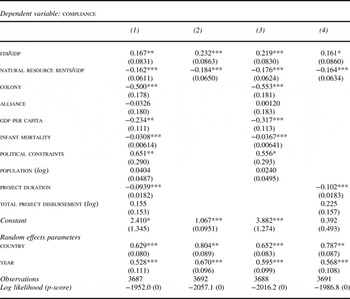
Table 1 summarizes the results of equation (1) where both of our hypotheses are tested. Table 1 presents the change in log odds for our variables of interest—we first look at only the direction and significance of the results before turning to the marginal effects. Model 1 is our baseline specification (equation 1). To confirm the robustness of this model, we include additional specifications that exclude the country-level effects and agreement-level effects: Model 2 excludes all control variables, Model 3 excludes agreement-level controls, and Model 4 excludes country-level controls. To save space we do not show the results for any of the sector-specific effects, but these estimates are available on request.
Equation (1) by mixed effects logistic regression

Notes: Robust standard errors are in parentheses. * p < .10; ** p < .05; *** p < .01.
First, we examine the relationship between the importance of FDI and compliance with aid agreements. The coefficient estimates on FDI stock as a proportion of GDP have a strong, positive influence on the probability that a country will comply with Bank aid agreements. This lends support to our hypothesis that governments that desire to maintain and increase FDI are more likely to comply with aid agreements. Second, we look at the relationship between natural resource rents and compliance. Here, the coefficient estimates are negative and statistically significant, implying that higher levels of natural resource rents decrease compliance with aid agreements. These results offer strong support for our hypotheses. Because the log-odds ratios are difficult to interpret, we now examine these results in more detail.
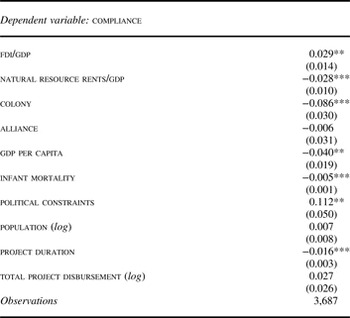
Table 2 presents the average marginal effects for equation (1). Focusing on our two variables of interest, we see that a one standard deviation increase in a country's FDI stock as a percentage of GDP results in an average increase in the probability of compliance of 3 percent. Additionally, a one standard deviation increase in a country's natural resource rents as a percentage of GDP results in an average decrease in compliance of 3 percent.
Average marginal effects: Equation (1) by mixed effects logistic regression

Notes: Robust standard errors are in parentheses. * p < .10; ** p < .05; *** p < .01.
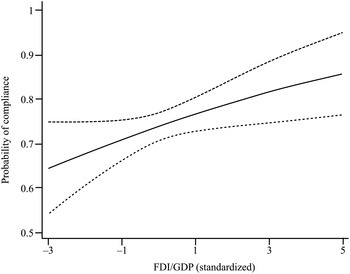
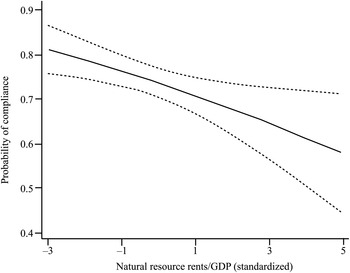
To better understand the magnitude of our effects, we next examine the marginal effect of a one standard deviation increase in both of our variables of interest on the probability of a country satisfactorily complying with Bank aid agreements for various levels of each of our independent variables of interest. Figures 1 and 2 use the results of equation (1) (Table 1, column 1) and hold all other variables at their means while varying either FDI as a proportion of GDP (Figure 1), or natural resource rents as a proportion of GDP (Figure 2).
Predicted probability of compliance as the proportion of FDI to GDP increases

Predicted probability of compliance as the proportion of natural resource rents to GDP increases

Figure 1 examines our first hypothesis, that compliance becomes more likely as FDI becomes more important for a country's economy. The upward sloping line offers support for this hypothesis: as a country's FDI stock (as a percentage of GDP) increases, compliance increases as well. Holding all other variables at their means, for a recipient country with a mean level of FDI in our sample (Romania or Costa Rica in 2001) the predicted probability of compliance is about 74 percent. At the same time, a recipient with FDI stock one standard deviation above the mean (Honduras or Laos in 2007) has a predicted probability of compliance of 77 percent, and a recipient with FDI stocks one standard deviation below the mean (Chad or Yemen in 2005) has a predicted probability of compliance of 71 percent.
The downward-sloping line in Figure 2 gives credence to H2—that compliance becomes more likely as the importance of resource rents declines. Here we see that a country at the mean level of resource rents in our sample (Ghana or Yemen in 2003) has a predicted probability of compliance of just under 74 percent. This drops to 70 percent for a country with resource rents one standard deviation above the mean (Mongolia and Azerbaijan in 2005) and rises to 76 percent for a country one standard deviation below the mean (Cape Verde or Lebanon in 2010).
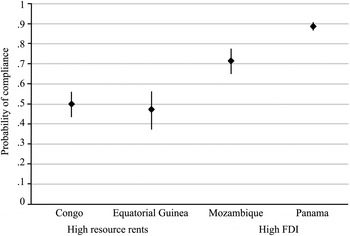
These results lend support to our hypotheses regarding the importance of domestic interests for determining compliance with aid agreements. However, these results focus on countries at the average level of all variables included in the estimations—a status where few countries are likely to exist. Therefore, we take our marginal effects one step further and examine specific countries that depend heavily on FDI or on natural resource rents in Figure 3. We then estimate the predicted probability of compliance for each country based on their actual values for FDI, natural resource rents, and each of the control variables (if a country had multiple agreements ending in that year or period we averaged the agreement-level variables across all agreements that year).
Predicted probability of compliance for sample countries

The findings for the country estimates are consistent with our hypotheses. For example, in the two high natural resource countries we discussed, the Democratic Republic of the Congo (DRC) and Equatorial Guinea, both at least one standard deviation above the mean for natural resource rents, we expect few demands for compliance and therefore lower levels of compliance. Indeed, as Figure 3 shows, using DRC's actual values averaged during the 1980s, and Equatorial Guinea's actual values averaged during the 1990s, we obtain estimates of 0.50 and 0.47, respectively, for the predicted probability of compliance, well below the mean of 0.72 of compliance in the overall sample. If we look at actual compliance with Bank agreements during the same time period, the DRC failed to comply with all but one of its rated agreements, whereas Equatorial Guinea was rated as failing to comply with a single agreement during that period. In contrast, we turn to the two countries with high levels of FDI that we discussed earlier: Mozambique and Panama. As we see in Figure 3, both countries have higher predicted probabilities of compliance (0.71 and 0.89, respectively) when using their actual values averaged during the 2000s and 1990s. In fact, Mozambique complied with twenty-six of its twenty-nine rated agreements in the 2000s (90 percent) and Panama complied with three of its four rated agreements (75 percent).
Finally, our control variables offer important insight into the compliance process within countries. Our variables controlling for strategic importance are both negative (though alliance is insignificant), lending support to the existing research that shows how strategically important countries are less likely to comply with aid agreements. Gdp per capita income is negative, indicating that wealthier countries are less likely to comply with aid agreements. The coefficient estimate on infant mortality is negative and significant, indicating that increases in infant mortality are correlated with lower levels of compliance. Political constraints is positive, indicating that greater constraints on the government are correlated with higher levels of compliance. Taken together, the estimates on infant mortality and political constraints indicate that greater government capacity is associated with increased compliance. Population is insignificant across our models. Looking at agreement-level variables, we see that the duration of the agreement has a significant, negative relationship with the probability of compliance, indicating that the longer an agreement lasts, the less likely a country is to comply with the agreement. Finally, the size of the aid agreement has a positive but insignificant effect on compliance.
Combined, these results provide strong support for our theory. We take a step beyond the current literature by showing that compliance with aid agreements depends on government income sources beyond strategic aid. The importance of varied sources of government income and the influence these income sources have on government policy also appear to affect whether governments comply with aid agreements.
Potential Threats to Validity
Although we address concerns with potential bias in evaluations, other major threats to the validity of our results remain. We therefore conduct a series of checks on our main econometric model (equation 1). We find that our main results hold across differences in econometric model and specification.
First, one might be concerned that FDI may be endogenously determined in our model. That is, although foreign investment might influence governments to comply with aid agreements (as we predict), it could also be that foreign investors are attracted to countries that are likely to comply with aid agreements. Compliance could attract investors (especially early investors) by signaling a more profitable investment environment and, relatedly, by improving the government's reputation. We believe that our FDI measure (an average over the five years before the start of the project) minimizes this possibility. Although current values of FDI may be endogenous to current compliance, it is unlikely that past values of FDI suffer this same issue. In fact, in studies dealing with the relationship between FDI and economic growth, the lagged value of FDI is used as an exogenous instrument to the endogenous FDI regressors.Footnote 108 Nevertheless, to further mitigate this possibility, we run a two-stage multilevel logit model (IV). Although there are few studies that examine the availability of an instrument for FDI (beyond lagged FDI) and none that offer an instrument where the dependent variable is compliance with aid agreements, the FDI literature does point to an additional valid instrument for endogenous FDI: total world FDI (world fdi).Footnote 109
The world fdi variable satisfies the criteria of a strong instrument in that it is both correlated with our endogenous variable (fdi) and does not have a direct causal effect on our dependent variable, compliance. We measure world fdi as the total FDI inflows from all countries in the world to all countries in the world. There are two factors behind world FDI that theoretically make it correlated with individual country FDI stocks. First, FDI flows are inherently connected to FDI stocks. Second, as FDI flows grow in volume they also become more dispersed among host countries and more concentrated in developing countries. Thus, when the overall flow of world FDI increases (or decreases) in a given year, the stock of FDI in a given country is also likely to change.Footnote 110 Although overall world flows will cause fluctuations in individual countries' stock of FDI, these world flows are unlikely to have an effect on the likelihood that a country complies with Bank aid agreements, thus meeting the exclusion criterion. Using world fdi as an instrument should identify our IV equation with FDI as a potential endogenous regressor.
To implement the IV model, we first regress FDI stock on world fdi. Aside from the theoretical reasons for believing that world fdi is a strong instrument, the F-test from the first stage regression is equal to 11.93 (p = 0.005). An F-test greater than 10 indicates that world fdi is indeed a strong instrument. Next, we implement the second stage of our regression. Model 1 in Appendix F in the online appendix presents the results of the second stage of the model using a multilevel model and substituting the predicted values from a linear estimation of FDI for our original measure of FDI.Footnote 111 The results are consistent with our baseline specification. Further, the coefficient on FDI/GDP in the second stage is smaller than the coefficient in the main model, indicating that we are likely addressing potential endogeneity.
One may also be concerned that because certain countries have many projects in particular years, while others have no projects in that year, that we may be overemphasizing a few countries. To address this possibility, Model 2 in Appendix F averages all observations for any country with more than one project in a certain year. In averaging the dependent variable, it is no longer a dummy variable, but is now bounded between 0 and 1. In this case, we estimate a generalized linear model with a logit link. Our results remain substantively the same.
As we mentioned earlier, although the Bank has evaluated thousands of projects that were conducted during the Cold War, its evaluation of compliance is mainly limited to the post–Cold War period. To ensure that the inclusion of Cold War observations does not substantially affect our results, we include these observations in Model 3 in Appendix F.
A further concern might be how countries abundant in both FDI and natural resources might react to the incentives to comply with aid agreements. Although we leave full exploration of this question to further research, Model 4 in Appendix F reestimates equation (1) including an interaction between FDI stock and resource rents. This interaction tests whether the relationship between FDI and compliance is conditional on resource rents or conversely whether the relationship between resource rents and compliance is conditional on FDI. The interaction term is insignificantly different from 0, indicating that there is not a conditional relationship. Where there is overlap (high stocks of FDI and high resource rents), FDI and resource rents may still work as we hypothesize but governments face a tradeoff between the desire to maintain and increase FDI and the importance of resource rents in the economy.Footnote 112
Although our main model aims to estimate both the desire to maintain and increase FDI, we test whether either the desire to maintain or the desire to increase can individually predict compliance. First, we include the square of our FDI stock variable to test whether the relationship between FDI and compliance is nonlinear, such that very high and very low recipients of FDI comply at similar rates. Those with very high FDI stocks may seek to maintain FDI whereas those with low FDI stocks may seek to attract it. Model 5 in Appendix F shows that the squared term is insignificant in the model and its inclusion does not affect our other variables. This indicates that the relationship between FDI and compliance is indeed linear, and that our baseline model is correctly specified. Second, we ran a standard time series fixed effect regression to predict FDI flowsFootnote 113 into our sample countries and calculated the difference between predicted and actual FDI flows.Footnote 114 We then used this difference as an independent variable in our main model hypothesizing that the relationship would be negative: countries with FDI flows below what they should be receiving should be more likely to comply with aid agreements out of a desire to receive greater FDI flows, whereas those with flows above what they should be receiving should be less likely to comply with aid agreements that would improve the environment for FDI. Model 6 in Appendix F shows that this is the case, with the difference between predicted and actual FDI flows significant at the 10 percent level. Importantly, FDI stock is not substantively affected by its inclusion, suggesting again that a model of compliance should capture both the desire to maintain and increase FDI. Taken together, we believe that these two tests support our hypothesis that compliance is more likely as the desire to maintain and increase FDI rises.
In Appendix G in the online appendix, we substitute variables in our main model: (1) we substitute population for GDP in the denominators of FDI and resource rents, (2) we substitute an oft-used measure of strategic importance (affinity scores)Footnote 115 for two of our main measures of strategic importance: alliance and former colony, and (3) we substitute FDI flows for FDI stocks.
Finally, in Appendix H in the online appendix, we include four additional controls: a measure of democracy (Model 1),Footnote 116 a dummy variable for whether a project was a development policy loan or an investment loan (Model 2), a dummy variable for whether the country suffered a financial crisis in the given year (Model 3),Footnote 117 and a country's total foreign aid inflows measured as total bilateral and multilateral inflows per capita (Model 4).Footnote 118 Our main results do not substantively change across these robustness checks. Thus, these models increase our confidence in the empirical findings.
Conclusion
Although the literature on compliance with conditions on aid agreements has focused on a donor's ability to enforce conditions or the effects of conditions on political and economic development, the question of who complies remains unanswered. We study this question using data on compliance from the World Bank.
Compliance depends on more than donor willingness to enforce conditions arising from strategic considerations. The incentive to comply also depends on pressures from other major sources of government income. Aid recipients sometimes face incentives to comply with aid agreements independent of whether donors can credibly threaten to withdraw aid. Recipients are more likely to comply when they desire to maintain or attract FDI, and less likely to comply when they seek to maximize elite access to natural resource rents. Importantly, our findings imply that although continued aid flows may reward those implementing the conditions on aid agreements, some recipients comply for reasons other than the promise of foreign aid. We find that recipients also have domestic reasons to comply (or not).
Our findings also have important policy implications. In response to criticisms in the late 1980s that aid conditionality is insensitive to the needs of developing countries,Footnote 119 donors began to emphasize recipient ownership of reform. To increase recipient ownership, starting in the 1990s, some aid agreement negotiations involved consultation beyond the government, including civil society and the private sector. Our results suggest that donors who want compliance with aid agreements should expand this group of stakeholders even more. When domestic demand for reform is sufficiently strong, governments are more likely to comply with aid agreements.
Supplementary Material
Supplementary material for this article is available at http://dx.doi.org/10.1017/S0020818315000326.