

INTRODUCTION
A concern for altruism, as a responsibility fundamental to professional orders, exists within legal professions globally as indicated by formalized codes of professional ethics (Reference HansfordHansford, 2014; Reference MaldonadoMaldonado, 2019), a generalized concern for the common good and access to justice (Reference Cummings and SandefurCummings & Sandefur, 2013; Reference MonahanMonahan, 2019), and through aspirations toward public service in the form of “pro bono” work (i.e., free legal services) (Reference Dignan, Grimes and ParkerDignan et al., 2017; Reference FeltmanFeltman, 2019). Characteristics of altruism seem to resonate especially with the duty of public service. Altruism is motivated foremost by concern or regard for others above oneself (Reference Batson and DanielBatson, 1991). Altruism involves actions that are voluntary and intentional (i.e., meant to help another person), and these actions are performed without the expectation that they will be rewarded (Reference HealyHealy, 2004). An important form of altruism is volunteering (Reference MitaniMitani, 2014). Consistent with the general basis of altruism, volunteering is not aimed directly at the material gain and nor is it mandated or coerced by others (Reference Haski-LeventhalHaski-Leventhal, 2009). However, pure altruism is not required for people to volunteer since individuals may benefit themselves to a degree from volunteering through a good conscience (Reference PetrovskiPetrovski, 2017), reputation (Reference Scholnick and PrignanoScholnick & Prignano, 2013), and knowledge of meeting professional responsibilities (Reference Bartlett and TaylorBartlett & Taylor, 2016)—as in the case of lawyers giving free legal services to those in need (Reference MaldonadoMaldonado, 2020). Yet, a current of altruism runs through lawyers' volunteering of their professional skills to help marginalized individuals and organizations advocating for the public good. This current establishes the profession as dedicated to the ideal of justice and to ensuring that the disadvantaged in society have access to the law. Void of altruism, law practice appears as a business enterprise—failing to embody the virtues of professionalism (Reference FriedsonFriedson, 1994).
But what happens when volunteering is encouraged, even mandated, by organizations—a form of “voluntold” (Reference Kelemen, Mangan and MoffatKelemen et al., 2017, p. 1239)? And what about instances where altruism is compensated, for example in the case of law firms where lawyers are paid to perform pro bono services? In these cases, has volunteering become a work assignment, and has genuine altruism vanished from public service? Do the processes that shape freely volunteered pro bono also shape compensated pro bono? These questions demand that we further develop our understanding of altruism, and pro bono as a form of altruism, in the context of lawyers' professional work where “helping others” is sometimes stipulated and even remunerated.
In this article, we strive to address these questions through three strategies. First, we draw from the literatures on lawyers' pro bono work and altruism more broadly to develop an integrated theoretical model that is sensitive to organizational schemas that shape volunteering of legal services. Recent research calls for such a multidisciplinary approach to the study of volunteerism generally (Reference Kelemen, Mangan and MoffatKelemen et al., 2017). We assess our theoretical approach empirically using a large-scale survey of legal professionals. Second, we introduce two-stage statistical modeling techniques to distinguish between the probability of participating in pro bono work and the extent of time involvement. Third, we break new ground in pro bono research by differentiating between those who perform voluntary work within the firm (i.e., paid) versus outside of work (i.e., unpaid) and the factors motivating each form of volunteering. Our study sheds new light on the social conditions that encourage pro bono work and what happens when this work that appears altruistic in nature is remunerated. We begin by exploring how volunteering of legal services is endorsed by professional orders and law schools and incentivized within law firms.
PRO BONO WORK IN THE LEGAL PROFESSION
Public service as professional responsibility
Public service is a central feature of professions (Reference FriedsonFriedson, 1994). This feature signals that professions are not strictly in pursuit of economic gain, but rather the professions are moral associations that undertake principled activities (Reference DurkheimDurkheim, 1992). In the context of the legal profession, public service takes the form of pro bono work. “Pro bono” is short for the Latin phrase “pro bono publico” meaning “for the public good” (Reference ErichsonErichson, 2004, p. 2109). The term is generally used to describe professional work undertaken voluntarily to provide free services to persons of limited means or to clients seeking to advance the public interest (Reference Cummings and SandefurCummings & Sandefur, 2013). A range of legal services can be provided pro bono, including: legal advice to those of limited means, court representation, legal assistance to nonprofit organizations, community legal education, efforts to improve the legal system, and other kinds of legal work, such as the drafting of contracts (Reference Anderson and RenoufAnderson & Renouf, 2003; Reference DowneyDowney, 2010).
Lawyers' pro bono publico obligation arises from the profession's tradition of service before gain (Reference BoutcherBoutcher, 2017; Reference Granfield, Veliz, Granfield and MatherGranfield & Veliz, 2009). Pro bono is also part of the expression of a lawyer's commitment to the rule of law and to access to justice (Reference Maguire, Shearer and FieldMaguire et al., 2014). Bar associations' rules of professional conduct do not require pro bono service, although they strongly recommend about 50 hours per year (Reference HansfordHansford, 2014) or 2% of lawyers' work year dedicated to pro bono efforts (Reference SuyesSuyes, 2014), particularly to aid the indigent in their use of the legal system (Reference MarreroMarrero, 2014).Footnote 1 Debates rage over how to encourage more pro bono work, whether pro bono should be mandated by bar associations, and to what degree the profession is responsible for assuring access to justice (see e.g., Reference CooperCooper, 2012b; Reference HansfordHansford, 2014; Reference HoffmanHoffman, 2007).
Incentives
Motivational factors
Research on pro bono work has focused largely on motives for participation, communities of practice, and economic benefits. Studies of motives for public service underscore the importance of personal characteristics (Reference RhodeRhode, 2004b), including professional identity (Reference McleayMcleay, 2008), sense of morality (Reference Bartlett and TaylorBartlett & Taylor, 2016), and personal satisfaction (Reference ErichsonErichson, 2004). For example, in an American survey of lawyers, Reference RhodeRhode (2004b) found the most common factors encouraging pro bono work were intrinsic satisfaction derived from the work and a sense of obligation. Of secondary importance were professional benefits such as referrals, training, and trial experience (Reference RhodeRhode, 2003, Reference Rhode2004b). Some writers even refer to a “pro bono personality” where lawyers articulate a personal sense of morality and a sense of passion that moves them into action when a client comes to them with a compelling case (Reference Bartlett and TaylorBartlett & Taylor, 2016). Others suggest lawyers pursue pro bono service mostly as a way to experience meaningful work—in particular, pro bono compensates for what may be lacking in the routine work junior lawyers perform in large law firms (Reference Dinovitzer, Garth, Granfield and MatherDinovitzer & Garth, 2009; Reference Sandefur, Granfield and MatherSandefur, 2009).
Communities of practice
Pro bono commitment often hinges on the norms of one's social networks or community of practitioners (Reference Heinz, Nelson, Sandefur and LaumannHeinz et al., 2005; Reference RhodeRhode, 2003). For example, minority lawyers feel a greater obligation to serve their communities (Reference GranfieldGranfield, 2007b). Studies show that pro bono work is undertaken by racial, ethnic, and other disadvantaged groups as a way of “giving back” and affirming identity (Reference GranfieldGranfield, 2007b; Reference Rhode, Granfield and MatherRhode, 2009; Reference WilkinsWilkins, 2004).
Broader professional communities also foster pro bono. Although Canadian law societies and the American Bar Association have rejected the idea of making pro bono mandatory (Reference WoolleyWoolley, 2008), their accreditation standards require that law schools encourage students and faculty to participate in pro bono work. Certainly, many law schools encourage a professional ethic that embraces pro bono work (Reference Wizner and AikenWizner & Aiken, 2004). This is accomplished through mandatory professional responsibility courses that mention pro bono service (not all do) and the requirement of supervised pro bono work (Reference ColbertColbert, 2011; Reference GranfieldGranfield, 2007a; Reference HoffmanHoffman, 2007). These programs are believed to cultivate a commitment among aspiring lawyers entering the profession to make pro bono an integral part of their practice (Reference CooperCooper, 2012a; Reference Dignan, Grimes and ParkerDignan et al., 2017; Reference Granfield, Veliz, Granfield and MatherGranfield & Veliz, 2009).Footnote 2 Law student organizations have also mobilized students to promote and provide pro bono opportunities (Reference Juergens and GalatowitschJuergens & Galatowitsch, 2016). In the Canadian context, the Pro Bono Students of Canada (PBSC), the world's only national pro bono student organization, formed in 1996 to enhance pro bono services within the Canadian legal profession and to ensure “that each new generation of lawyers enters the profession already schooled in and committed to pro bono philosophy and practice” (PBSC, 2008). In Ontario, Pro Bono Law Ontario, a nonprofit organization, formed in 2002, matches lawyers with pro bono projects (Reference TylerTyler, 2008). Thus, pro bono work is cultivated through “communities of practice” when ethnic minority lawyers give back to their communities, bar associations affirm the value of pro bono through recommended hours of service, and law schools, student associations, and nonprofit organizations foster opportunities for pro bono work.
Economic drivers
Although various communities cultivate commitment and occasions for pro bono service, it is undeniable that pro bono is also attractive for economic reasons. For example, pro bono work helps lawyers to maintain control over the supply of legal services—preventing other occupations from stepping in to provide services at reduced fees (Reference Rhode, Granfield and MatherRhode, 2009; Reference SandefurSandefur, 2007). Somewhat more cynically, Juergens and Galatowitsch argue: “Such volunteer efforts are held up by legal publications, bar associations, courts, and firms as examples of good citizenship to encourage more volunteering, to enhance the reputation of the profession, and, perhaps to assuage its guilt” (2016, p. 97).
Pro bono benefits junior lawyers economically by providing applied training, hands-on experience with clients, court and tribunal work, and control of a case from start to finish (Reference McColl-Kennedy, Patterson, Brady, Cheung and NguyenMcColl-Kennedy et al., 2015; Reference Sandefur, Granfield and MatherSandefur, 2009). At any stage of career, pro bono work is good for marketing and reflects positively on a lawyer's skill and character (Reference Scholnick and PrignanoScholnick & Prignano, 2013; Reference SuyesSuyes, 2014). Pro bono can also bring recognition, contacts, and expertise in a field in which a lawyer would like to obtain paid work (Reference GranfieldGranfield, 2007b; Reference RhodeRhode, 2005). Lacking informal social networks in communities that could lead to potential clients, ethnic minority lawyers often turn to pro bono opportunities as a method to enhance professional reputation and to make contacts that could advance their career (Reference Granfield and KoenigGranfield & Koenig, 2003). Sole practitioners acquire clients and gain negotiation skills through pro bono work. For junior lawyers in large law firms, nonpaying cases can offer litigation experience, intellectual challenge, and responsibility beyond what is available in their own work (Reference CummingsCummings, 2004; Reference Dinovitzer, Garth, Granfield and MatherDinovitzer & Garth, 2009; Reference Rhode, Granfield and MatherRhode, 2009). Pro bono work can be especially attractive for young lawyers in large law firms who rarely get the chance to work directly with clients in their regular practice (Reference GranfieldGranfield, 2007b). At more senior levels, among equity partners, pro bono work may represent a type of cultural capital that elite lawyers use to enhance their status, rather than reflecting a sense of altruism and selflessness on the part of the lawyer (Reference Dinovitzer, Garth, Granfield and MatherDinovitzer & Garth, 2009). Therefore, pro bono work is traded off for superior professional status, skill, and earning power (Reference Bartlett and TaylorBartlett & Taylor, 2016).
Undoubtedly, a “business case” can be made for pro bono in law firms (Reference RhodeRhode, 2004c). Pro bono activities provide marketing or branding opportunities (Reference DowneyDowney, 2010), enhancing the firm's reputation and visibility in the community (Reference TylerTyler, 2008). Pro bono lends the firm credibility and respect among client groups (Reference DreyerDreyer, 2009). Large firms, in particular, stand to gain. Large law firms have the resources to attract and underwrite high-profile cases and their pro bono performance is ranked by The American Lawyer magazine (Reference Cummings and RhodeCummings & Rhode, 2010; Reference Rhode, Granfield and MatherRhode, 2009). Pro bono has also become an important mechanism through which law firms recruit new lawyers. Firms with pro bono opportunities compete more readily for new recruits and lateral hires (Reference DowneyDowney, 2010). Pro bono is inviting to young lawyers seeking to serve causes that are important to them and to assume major responsibility in matters years earlier than expected in large firm practice (Reference Sandefur, Granfield and MatherSandefur, 2009). Pro bono can also help to retain productive firm partners seeking new challenges. Generally, pro bono may encourage a positive work atmosphere and firm culture, making lawyers, of all ranks, less likely to look elsewhere (Reference Boutcher, Estreicher and RadiceBoutcher, 2016; Reference McleayMcleay, 2008).
Attention to economic drivers certainly highlights the importance of organizational settings in “setting the stage” for pro bono work. The pro bono literature focuses squarely on the work environments of lawyers that shape opportunities for and barriers to pro bono service (Reference BoutcherBoutcher, 2010; Reference Granfield, Veliz, Granfield and MatherGranfield & Veliz, 2009). For lawyers working in small firms and solo practice, pro bono work is both routine (Reference Anderson and RenoufAnderson & Renouf, 2003) and a strategy in recruiting clients (Reference Mather, McEwen and MaimanMather et al., 2001). In these contexts, legal work can be deliberately undertaken as pro bono from the start or as hours deemed pro bono when clients prove unable to pay (Reference Levin, Granfield and MatherLevin, 2009) or when clients of low income are refused grants of legal aid because of stringent means and merits tests (Reference Bartlett and TaylorBartlett & Taylor, 2016). In larger law firms, pro bono activity has shifted from an individual responsibility of lawyers to a collective responsibility of the firm (Reference BoutcherBoutcher, 2013; Reference CummingsCummings, 2004; Reference Epstein, Granfield and MatherEpstein, 2009). Large firms use pro bono services strategically, to facilitate junior lawyers' learning of skills and to gain proprietary knowledge about junior lawyers' quality as potential partners (Reference Burbano, Mamer and SnyderBurbano et al., 2018). Many large firms now hire coordinators to oversee their firm-wide pro bono practices (Reference BoutcherBoutcher, 2010; Reference Cummings and RhodeCummings & Rhode, 2010; Reference Juergens and GalatowitschJuergens & Galatowitsch, 2016) and some firms appoint dedicated pro bono lawyers and secondment of staff to select causes or organizations (Reference Maguire, Shearer and FieldMaguire et al., 2014). Empirical studies demonstrate the importance of these organizational features in promoting pro bono work. For example, in an analysis of large law firms in the United States, Reference Boutcher, Estreicher and RadiceBoutcher (2016) found that pro bono policies—such as the presence of a coordinator and having a formal written policy—positively affect how much time a firm commits to pro bono work. Thus, workplace environment sets the conditions that make pro bono work feasible (Reference GranfieldGranfield, 2007b). This organizational framing draws our attention to incentives for altruism nested in the workplace (Reference Dur and TichemDur & Tichem, 2015). We incorporate into our survey measures of law firm infrastructure that potentially support or curb pro bono work.
METHODS
Data collection and variables
Our study utilizes data from a large-scale survey of lawyers in Ontario, Canada. Ontario is an apt setting in which to study pro bono service because the province is home to the largest proportion of lawyers (46%) in the country (Federation of Law Societies of Canada, 2021). Canada's most populated city and financial capital, Toronto, is situated in central Ontario on the shores of Lake Ontario and is headquarters for the nation's largest corporate law firms. The Federal Government, Department of Justice, Supreme Court, and Canadian Bar Association are based in Ottawa, the nation's capital situated in eastern Ontario by the border with Quebec. Beyond these two prominent cities, sole practitioners and law firms of various sizes are sprinkled across Ontario in smaller cities and towns. Our survey aimed to reach lawyers working in a variety of practice settings and geographic locations through a random sample of lawyers drawn from the Ontario Law Society membership records. Our sample was restricted to lawyers called to the Ontario Bar between 1990 and 2009 and in good standing with the Law Society. We further stratified our sample by gender to include equal numbers of women and men.Footnote 3 We selected this near-20-year span of law graduates to pay attention to formative career years. These are years where one would expect to see considerable pro bono engagement fostered by law school clinics (Reference CooperCooper, 2012a; Reference Juergens and GalatowitschJuergens & Galatowitsch, 2016) and by law firms pro bono programs aimed at providing junior lawyers with skill development and client contact (Reference DowneyDowney, 2010; Reference MaldonadoMaldonado, 2020).
We conducted our survey in September 2009. We mailed questionnaires directly to respondents' places of employment. The survey, with two reminders, received a 47% response rate (N = 1270). This is a favorable rate of response, consistent with recent surveys of lawyers in North America (Reference DinovitzerDinovitzer, 2015; Reference Dinovitzer and HaganDinovitzer & Hagan, 2014; Reference Wilkins, Fong and DinovitzerWilkins et al., 2015).Footnote 4 In addition, the demographic characteristics of the sample and distribution across sectors of practice and firm size are consistent with population data (Law Society of Upper Canada, 2009). We restrict our sample to lawyers working in private practice (N = 845). We focus our study on private practitioners for several reasons. First, this selection allows us to compare results with studies conducted in the United States and these studies often focus on private practice or law firm lawyers more specifically (e.g., Reference BoutcherBoutcher, 2017; Reference Epstein, Granfield and MatherEpstein, 2009; Reference Levin, Granfield and MatherLevin, 2009). Second, private practitioners take on pro bono more often than lawyers in nonprivate practice: 61% versus 24%, respectively, in our study. Third, we focus attention on the remuneration of pro bono work—something that happens more often in law firm settings. In our study, 46% of private practitioners reported receiving compensation for their pro bono hours compared with only 11% of lawyers in nonprivate practice (e.g., government, business).
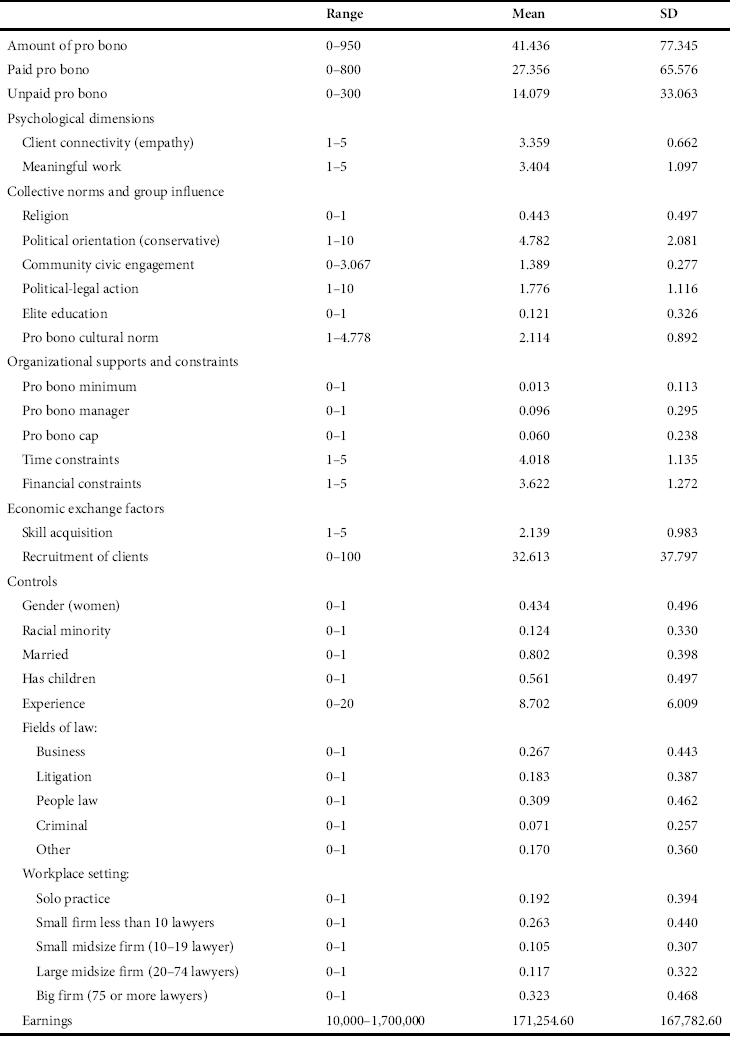
Table 1 displays descriptive statistics for our variables (Appendix A details measurement of variables). In our survey, we asked all lawyers—whether or not they do pro bono work—about their views on pro bono work. Prior to asking questions on the topic of pro bono, we defined pro bono as: “activities undertaken without expectation of fees” and “consisting of the delivery of legal services to persons of limited means or to charitable, religious, civil, community, governmental or educational organizations.”Footnote 5 Similar to the United States, Canadian pro bono applies to legal work or work that facilitates legal processes, with an emphasis that these services be provided to people of limited means or nonprofit organizations that serve the poor (see Reference Cummings and SandefurCummings & Sandefur, 2013; Reference Granfield, Kay, Cummings, Silva and TrubekGranfield & Kay, 2022). We inquired about the number of hours during the past year that the respondent devoted to pro bono legal work. Two categories were provided: “(a) as part of your job (where firm or employer was not compensated but your time was considered by your firm or employer to be a legitimate part of your total workload)?” and “(b) not as part of your job?” The average total number of hours lawyers devoted to pro bono work was 41.4 h in the last year (This average includes lawyers who worked no pro bono hours). Lawyers report working more pro bono hours, on average, that are compensated (mean = 27 h) than pro bono hours that are unpaid (mean = 14 h) (see Table 1).
Descriptive statistics of study variables (N = 845)

Note: Unstandardized scales reported. Standardized scales used in regression analysis.
In our study of private practice, 46% of lawyers reported doing paid pro bono, while 34% reported doing unpaid pro bono. This difference is even more striking when we restrict the sample to only those private practitioners: 56% report doing pro bono that was unpaid and an astonishing 75% report doing pro bono that was paid. Similarly, American studies report that most pro bono hours are compensated with earnings and credited toward billable hours in firms (Reference SandefurSandefur, 2007). As Sandefur has remarked: “This represents a substantial organizational subsidy of individual lawyers' volunteer behavior” (2007, p. 103). We wish to note that the division between lawyers working paid and unpaid pro bono is not a mutually exclusive one—many lawyers who work unpaid pro bono contribute these hours on top of pro bono work that is compensated: 41% of lawyers providing paid pro bono also provide unpaid pro bono.Footnote 6
The independent variables draw from our multidisciplinary framework, building from internal motivators (psychological traits) to external pressures (collective norms), and incorporating organizational level supports and constraints, as well as economic exchange factors. The core of this approach incorporates explanatory factors from psychology, sociology, and economics, together with organizational characteristics identified in the legal scholarship on pro bono work. We discuss the disciplinary foundations of our integrated theoretical approach in greater detail elsewhere (e.g., Kay & Granfield, Reference Kay and Granfieldn.d.). Below we highlight our key independent variables stemming from these disciplinary roots.
To assess internal motivators, we employ two indices: empathy and meaningful work. We drew on psychological measures of empathy and benevolence (Reference FechterFechter, 2012; Reference Haski-LeventhalHaski-Leventhal, 2009) to develop a measure of lawyers' empathy in terms of their attitude toward clients. To the degree that lawyers feel a strong connection to, and appreciation for their clients, they are likely to be motivated to provide pro bono service. Our client connectivity index consists of six items that ask lawyers about the extent to which these statements describe their experiences working with clients (α = 0.803). We also construct a meaningful work index based on two items adapted from research by Reference Schieman and YoungSchieman and Young (2015): (1) “my work is important to society” and (2) “by practicing law, I am making a difference to people's lives” (α = 0.906).
To understand collective norms, we draw on a set of six variables. Religion is a dummy variable measuring whether the respondent self-identified with a religion (13 religions were listed, including “other religion not listed”) (see Reference TaniguchiTaniguchi, 2012). Political orientation is a two-item index that builds on existing measures (Reference LaustsenLaustsen, 2017). Respondents were asked to circle the number on the scale that best describes their political leaning on (1) social issues and (2) taxation, spending, and social welfare issues (Scale 1–10, from liberal to conservative) (α = 0.762). Community civic engagement is a scale developed using items from Reference Son and LinSon and Lin (2008). Respondents were asked to indicate whether and at what level they had participated in each of 15 organizations. Levels of participation ranged from 1 to 4 (1 = not a member, 2 = current member, 3 = active participant, and 4 = leader) (α = 0.689). Political-legal action is a seven-item scale we designed specifically for this study. Respondents reported the extent to which they had (either through their job or by volunteering their time) participated in the following activities: (1) served in advisory roles to government ministries; (2) served in advisory roles to municipal councils; (3) lent their legal skills on behalf of social issues (e.g., violence against women, aboriginal rights, and children's rights); (4) been involved in the defense of basic legal freedom (e.g., defense of prisoners and human rights); (5) drafted statutes amendments or regulations for government; (6) been involved in programs that offer legal advice to other countries or international organizations (e.g., Canadian Bar Association's work in China, World Trade Organization, International Tribunals); (7) engaged in collaborative efforts to improve the law (e.g., with judges, prosecutors, legal academics, civil servants). Items were scored from 1 (never) to 10 (often) (α = 0.730).Footnote 7
Elite education is coded as a dummy variable based on the Maclean's law school rankings (2013; see also Reference Dinovitzer, Garth, Granfield and MatherDinovitzer & Garth, 2009). The ranking places the University of Toronto first, and by a wide margin, among Canadian law schools based on a combined score of graduate quality (based on elite firm hiring, national reach, Supreme Court clerkships, and faculty hiring) and faculty quality (based on faculty journal citations). We employ this ranking as our metric of elite education (1 = University of Toronto).Footnote 8 Pro bono cultural norm is an index composed of nine items adapted from work by Reference GranfieldGranfield (2007a). Respondents were asked to identify the extent to which various factors influence them to do pro bono work. The Likert-style response categories ranged from 1 (strongly disagree) to 5 (strongly agree) (α = 0.869).
Our review of the pro bono literature drew our attention to organizational features that act to support and/or constrain pro bono involvement. A set minimum of pro bono hours and the provision of a pro bono manager are supportive (Reference Cummings and RhodeCummings & Rhode, 2010), while a pro bono cap (limit) and the lawyer's claim of time and financial constraints against pro bono participation are constraining (Reference SandefurSandefur, 2007). The first three variables are dummy variables (1 = yes), while the last two variables, time and financial constraints, are composed of Likert-style scales ranging from 1 to 5 (strongly disagree to strongly agree).
We examine economic exchange factors through two variables: skill acquisition and recruitment of clients. Skill acquisition is adapted from an index by Reference Granfield, Veliz, Granfield and MatherGranfield and Veliz (2009) that taps the degree to which the respondent believes pro bono work contributes to: (1) improving interview skills; (2) improving litigation skills; (3) negotiation; (4) dealing with people; (5) drafting documents; (6) selecting a jury; (7) acquiring contacts; (8) acquiring clients; (9) enhancing professional reputation; and (10) career mobility (α = 0.902). Recruitment of clients consists of the proportion of clients represented over the last year that are clients the lawyer brought in rather than clients of the firm (Reference Kay and HaganKay & Hagan, 2003).
We also incorporate several control variables. These include sociodemographic variables: gender (women = 1), racial minority, marital status, children, and years of work experience. Additional controls include work setting variables: fields of law (business, litigation, people law, and criminal law), practice setting (solo practice and firm size), and earnings.
Data analysis
Our analysis proceeds in two steps. First, we examine factors predicting the probability of doing pro bono work and the hours lawyers devote to pro bono. Second, we examine factors predicting pro bono when those hours are compensated (i.e., remunerated) versus unpaid (i.e., freely given). We employ the Heckman two-stage procedure to correct for sample selection bias.
In econometrics, sample selection is typically connected to the idea of sample truncation (e.g., Reference WooldridgeWooldridge, 2010). Truncated samples exist when values of the independent variable are unknown because the dependent variable is unobserved for a portion of the population. Thus, sample selection involves incidental truncation (Reference Certo, Busenbark, Woo and SemadeniCerto et al., 2016). Incidental truncation occurs when the dependent variable is “observed only if other variables take on particular values” (Reference WooldridgeWooldridge, 2010, p. 777). Extending our example of pro bono service, samples of hours dedicated to pro bono work are based on the result of an earlier process: the decision to engage in pro bono activity in the first place. For those lawyers not engaging in pro bono activity, there are no corresponding reports of hours devoted to pro bono service.
Scholars describe the logic of sample selection bias as requiring a two-stage approach (Reference Forbes and ZampelliForbes & Zampelli, 2011; Reference PetrovskiPetrovski, 2017; Reference WooldridgeWooldridge, 2010). Determining whether or not an observation in an overall population appears in a final representative sample is the first stage and modeling the relation between the hypothesized dependent and independent variables in the final sample is the second stage (Reference Certo, Busenbark, Woo and SemadeniCerto et al., 2016). When an omitted variable (i.e., an unmeasured variable not included in a model) creates a correlation between the error terms in the two stages, traditional techniques such as ordinary least squares (OLS) regression may report biased coefficient estimates. To resolve this potential bias, Reference HeckmanHeckman (1976) introduced the Heckman mode, a two-stage process for data analysis. The first stage in this process uses a probit model to estimate the probability of an observation's entering a sample, and a second stage uses OLS to predict the ultimate dependent variable. To account for potential bias that may result from nonrandomness, the process creates a selection parameter, the inverse Mills ratio. The selection parameter is then included in the OLS regression, where the coefficient is referred to as Lambda, to account for potential sample selection bias.
RESULTS
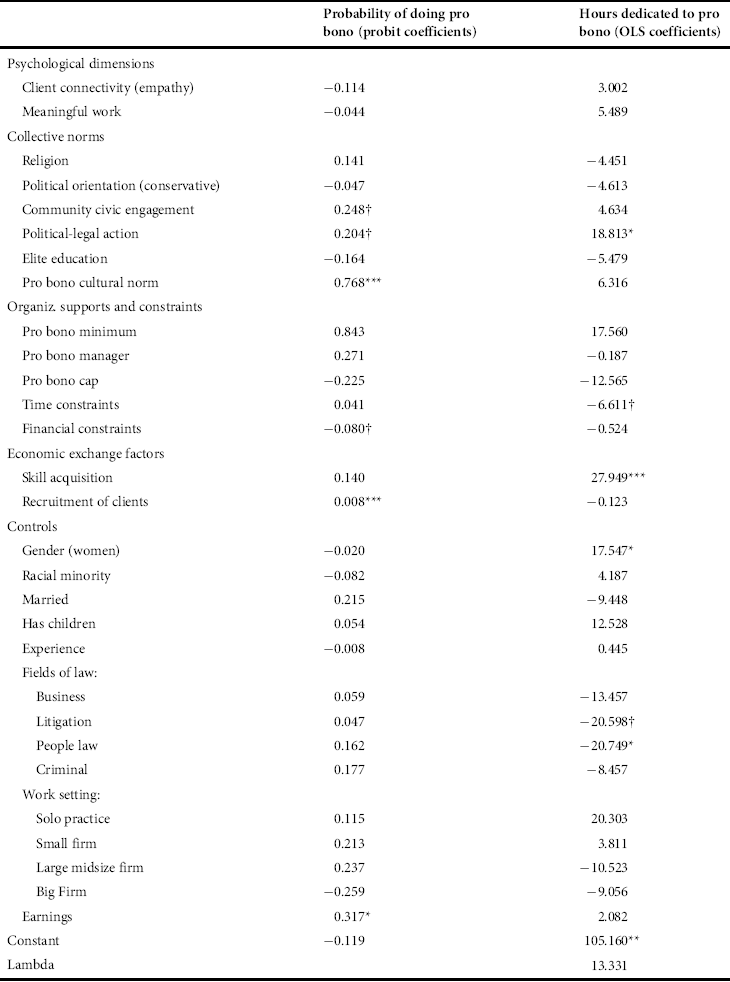
Table 2 presents the estimates from the Heckman selection two-stage model. The first column displays the coefficients within the probit prediction (e.g., the selection equation). The second column displays the conditional marginal effects of the second stage OLS regression model (e.g., the outcome equation) and incorporates a term for the inverse Mill's ratio to control for the selection bias under the full sample (Reference Brunel and GuironnetBrunel & Guironnet, 2017).
Heckman two-stage models predicting probability and hours of pro bono work (N = 845)

Abbreviation: OLS, ordinary least squares.
† p < 0.10; *p < 0.05; **p < 0.01; ***p < 0.001 (two-tailed test).
The probit selection model (see Column 1) reveals that collective norms play a key role in prompting pro bono work. Lawyers holding cultural norms favorable toward pro bono work are significantly more likely to take on pro bono work (b = 0.768, p < 0.001). Civic community engagement and political-legal action also increase the likelihood of doing pro bono, though the effects are at a reduced level of statistical significance (b = 0.248 and b = 0.204, respectively, p < 0.10). Organizational constraints, specifically financial constraints, curb pro bono though at a reduced level of statistical significance (b = −0.080, p < 0.10). Economic exchange factors are relevant. Lawyers who are successful recruiters of new clients are more likely to take on pro bono work (b = 0.008, p < 0.001). Interesting results surface among the control variables. Consistent with the broader literature on volunteering (Reference MitaniMitani, 2014), lawyers in the top quartile of earnings are more likely to take on pro bono work (b = 0.317, p < 0.05).
Turning to the second stage OLS regression model (see Column 2), we present the conditional marginal effects of covariates on the dependent variable, pro bono hours worked annually. Here we detect nuances in the processes generating the decision to enter pro bono versus the depth of involvement. Indeed, factors shaping whether to take on pro bono are not necessarily the same ones that influence the extent of time investment in pro bono. For example, pro bono cultural norms are a powerful driver of whether to do pro bono, and yet these cultural norms do not significantly influence how many hours lawyers devote to pro bono. An exception is political-legal action. Engagement with political-legal action is at borderline statistical significance in relation to doing pro bono, yet this variable emerges as a strong predictor of the time lawyers dedicate to pro bono (b = 18.813, p < 0.05).
Other factors also surface with reference to time dedicated to pro bono work. Gender is not related to the probability of doing pro bono but matters for the hours invested: women who do pro bono devote fewer hours than their male colleagues (b = −17.547, p < 0.05). Similar gender differences between participation and extent of involvement have been observed in studies of charitable giving that apply two-stage models (e.g., Reference Forbes and ZampelliForbes & Zampelli, 2011; Reference PetrovskiPetrovski, 2017). We also find that the different groupings of legal fields are not related to the probability of doing pro bono but influence hours invested. Lawyers working in the field of people law (i.e., estates, wills and trust, family law and divorce, employment and labor relations, and real estate) devote fewer hours to pro bono than lawyers in other fields (b = −20.749, p < 0.05). An interesting twist occurs among economic exchange factors. Lawyers who are successful at client recruitment are more likely to take on pro bono (b = 0.008, p < 0.001), but it is the lawyers who tout pro bono builds skills and reputation that are likely to invest greater hours in pro bono service (b = 27.949, p < 0.001).
Table 2 (Column 2) also includes a coefficient for Lambda. The coefficient for Lambda is positive but not statistically significant. Some researchers suggest a nonsignificant Lambda coefficient indicates that there is not a strong presence of sample selection bias and a need for correction in our models (Reference Qin, Brown, Padmadas, Li, Qi and FalkinghamQin et al., 2016; Reference Rubera and TellisRubera & Tellis, 2014). However, Reference Certo, Busenbark, Woo and SemadeniCerto et al. (2016, p. 2655) reveal that Lambda can be nonsignificant even when sample selection bias exists. Furthermore, recent research (see Reference PetrovskiPetrovski, 2017) demonstrates that whether to give and how much to give (as charitable giving) are theoretically distinct decisions. Certainly, for lawyers considering pro bono work, the second decision (i.e., how much time to give) is more financial in nature than the first (i.e., whether to participate at all). By adopting a two-stage approach, it is possible to uncover whether determinants of volunteering may affect the two decisions at hand very differently (Reference PetrovskiPetrovski, 2017). Therefore, we proceed with the Heckman model that accounts for the conditional probability of engaging in pro bono work and we explore alternative modeling strategies as robustness checks.Footnote 9
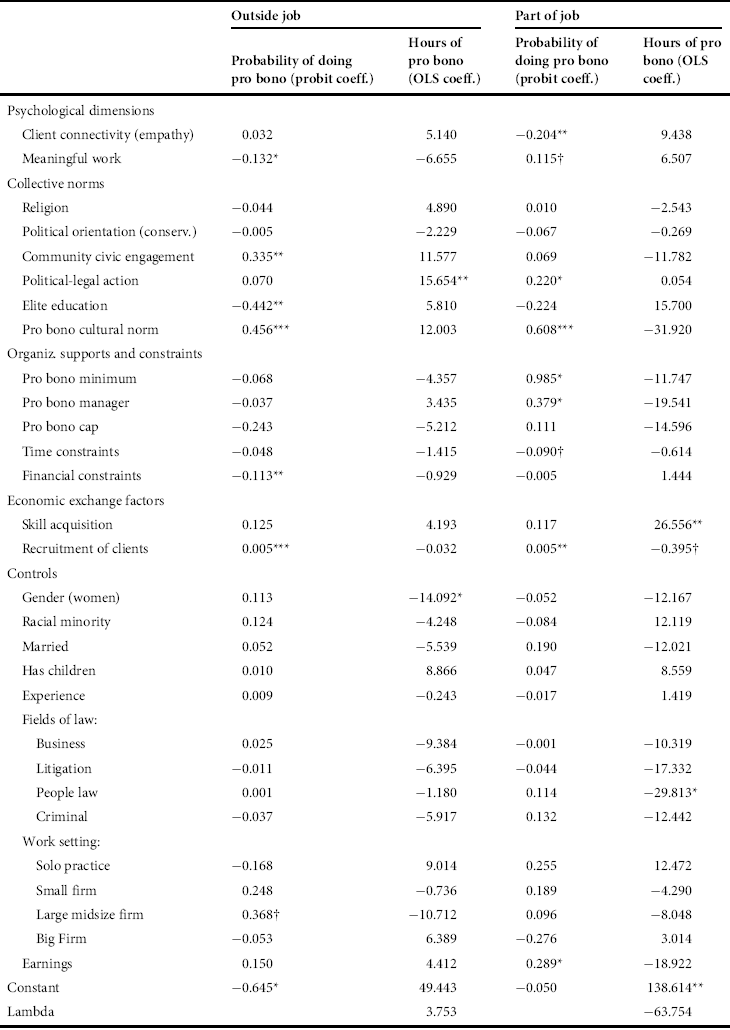
Substantively, an important distinction is the difference between hours devoted to pro bono as part of one's job (e.g., pro bono hours that are paid by a law firm) versus hours undertaken outside of one's job (without pay). This distinction raises two questions: What happens when pro bono is remunerated? Is the process underlying the extent of pro bono service different for hours that are compensated (paid) as part of the job versus hours that are freely volunteered outside the job (i.e., unpaid)? In Table 3, we address these questions. We present factors predicting the number of pro bono hours outside one's job (left panel) and as part of one's job (right panel). Again, we examine first the probability of doing pro bono (unpaid and paid) and second, the hours conditional on that decision.
Heckman two-stage models predicting probability and hours of pro bono work (N = 845)

Abbreviation: OLS, ordinary least squares.
† p < 0.10; *p < 0.05; **p < 0.01; ***p < 0.001 (two-tailed test).
Results show that to the extent that lawyers experience meaningful work in the practice of law, they are less likely to take on pro bono outside the job (i.e., unpaid) (b = −0.132, p < 0.05) but more likely to perform paid pro bono (b = 0.115, p = 0.07), though the latter effect is at borderline statistical significance. This is suggestive of the argument that lawyers may take on pro bono to gain a sense of meaning and fulfillment in legal work that is at times tedious, lackluster, and uninspiring (Reference Sandefur, Granfield and MatherSandefur, 2009)—though with the refinement that compensating pro bono offers lawyers opportunities to find new meaning in their work. Interestingly, lawyers' level of client connectivity, a proxy for empathy or responsiveness toward clients, has a negative effect on the probability that lawyers will take on paid pro bono (b = −0.204, p < 0.01).
In our earlier analysis (see Table 2), we found that community civic engagement and a strong pro bono cultural norm, factors typically associated with acts of altruism (Reference Hustinx, Cnaan and HandyHustinx et al., 2010), encourage pro bono work. Table 3 shows that a pro bono cultural norm persists as a powerful motivator of both unpaid and paid pro bono (b = 0.456 and b = 0.608, respectively, p < 0.001); whereas community civic engagement matters only for pro bono outside the job (b = 0.335, p < 0.01). Perhaps involvement in one's local community introduces lawyers to people in a range of contexts where legal services are needed. In this way, community civic engagement offers a fertile ground where pro bono commitment is seeded—especially when pro bono is freely given and more exemplar of altruism. A second divergence lies with political-legal action. Lawyers deeply engaged in political-legal action are more likely to do paid pro bono (b = 0.220, p < 0.05) than lawyers less engaged in political-legal action, but this engagement has little bearing on unpaid pro bono. Meanwhile, a collective norm variable not observed to influence pro bono hours surfaced with reference to unpaid pro bono: elite law school graduates are less likely to do unpaid pro bono compared with graduates of other law schools (b = −0.442, p < 0.01).
Various organizational factors play out in different ways, depending on whether pro bono is compensated or not. For instance, financial constraints reduce the probability that lawyers will do unpaid pro bono (b = −0.113, p < 0.01). In contrast, time constraints reduce the probability lawyers will do paid pro bono, though the effect is at borderline significance (b = −0.090, p = 0.06). Pro bono that is compensated is deeply shaped by organizational characteristics. For example, a pro bono minimum and the presence of a pro bono manager increase the likelihood lawyers will undertake paid pro bono (b = 0.985 and b = 0.379, respectively, p < 0.05). Past studies contend that pro bono is becoming institutionalized with embedded structural arrangements to facilitate pro bono (Reference Boutcher, Granfield and MatherBoutcher, 2009). Furthermore, pro bono managers in large law firms have become ubiquitous (Reference Bartlett and TaylorBartlett & Taylor, 2016). Our analysis suggests this institutionalization of pro bono is particularly important for pro bono hours that are compensated within law firms.
Economic exchange factors also play a role in predicting whether lawyers take on pro bono—paid or unpaid. Lawyers who are successful “rainmakers” are more likely to take on pro bono—both unpaid (b = 0.005 p < 0.001) and paid (b = 0.005, p < 0.01). Yet, lawyers who are active in recruiting clients give fewer hours to pro bono than lawyers less active in client recruitment, though the effect is at borderline statistical significance (b = −0.395, p < 0.10). This suggests active client recruitment may not lead to greater time invested in pro bono. Consistent with research on volunteering more generally (e.g., Reference MitaniMitani, 2014), lawyers whose earnings are in the top quartile of the income distribution are more likely to do paid pro bono (b = 0.289, p < 0.05), though this not the case for unpaid pro bono.
DISCUSSION AND CONCLUSION
In this article, we set out to explore why lawyers engage in pro bono work—volunteering their expertise without charge to clients in need of legal services. More specifically, we sought to uncover what happens when volunteering is remunerated within law firms. We proposed a theoretical understanding, drawing on the pro bono law literature and broader social science perspectives on altruism. Our analysis revealed that different factors generate pro bono service depending on whether we are interested to examine participation (i.e., probability of doing pro bono), overall time commitments (i.e., hours dedicated to pro bono), or compensation of hours. Below, we summarize our findings along each of the theoretical threads of our model of pro bono service.
Collective norms play a key role in promoting pro bono work. Lawyers holding cultural norms favorable toward pro bono were significantly more likely to take on pro bono work. Yet, these cultural norms did not influence the extent of pro bono involvement. Rather, another collective norm, engagement in political-legal action, was a driver of hours dedicated to pro bono. Collective norms also played out in different ways for unpaid and paid pro bono. For example, community civic engagement encouraged pro bono work outside the job (unpaid), while engagement with political-legal action prompted paid pro bono work. Overall, collective norms are important, though their influence lies more with the probability lawyers will take on pro bono work, than with the extent of involvement (i.e., hours committed).
Psychological factors also influenced lawyers' pro bono work. The extent to which lawyers experience their work as meaningful did not directly impact the probability that they will take on pro bono work. However, the experience of meaningful work surfaced in our analysis of uncompensated versus compensated pro bono. Lawyers who reported their work is meaningful were less likely to take on pro bono outside their job, but more likely to undertake pro bono that is compensated. We suggest that for lawyers working in law firms where they are incentivized to take on pro bono as part of their job, their experience of practicing law becomes more fulfilling as a result. At minimum, participating in compensated pro bono reinforces lawyers' attitudes about how meaningful they find their legal work to be. Recent work (Reference Haski-Leventhal, Kach and PournaderHaski-Leventhal et al., 2019) suggests corporate volunteering (though unpaid) satisfies psychological needs that raise levels of job satisfaction and commitment. Similarly, the relationship between compensated pro bono and lawyers' perception of their work as meaningful may have implications for lawyer retention within law firms.
Organizational factors played out in different ways, depending on whether pro bono is compensated or not. For example, financial constraints reduced the probability lawyers will take on unpaid pro bono, while time constraints dampened the probability lawyers will take on paid pro bono. In addition, we found that institutionalized pro bono practices were most salient to pro bono that is treated as part of the job and compensated. For instance, a pro bono minimum expectation and the presence of a pro bono manager both increased the probability that lawyers will take on paid pro bono work. As Healy remarks, with reference to altruism more generally: “Altruism is structured, promoted, and made logistically possibly by organizations and institutions with a strong interest in producing it” (2004, p. 387). Large law firms are the settings more likely to have these institutionalized pro bono practices, such as pro bono managers or coordinators. In contrast, research on smaller law firms finds that pro bono is “performed in these settings on a more ad hoc basis and often conducted outside formally coordinated referral pathways” (Reference Bartlett and TaylorBartlett & Taylor, 2016, p. 276).
Economic exchange factors are important determinants of whether lawyers take on pro bono—compensated or not. Lawyers who are successful at client recruitment were more likely to participate in pro bono work. Yet, when it came to overall time investment, lawyers successful at client recruitment dedicate fewer hours to paid pro bono than lawyers less active in client recruitment. Another economic exchange factor, perceived skill and reputational gains associated with pro bono, played a pivotal role. Lawyers who claimed that pro bono helps to build skills and reputation were more likely to take on pro bono work and then to invest greater hours. It may be that junior lawyers, more often the target of law firm incentivized pro bono (Reference MaldonadoMaldonado, 2020), recognize the acquired skills and enhanced professional reputation gained through pro bono engagement (Reference Burbano, Mamer and SnyderBurbano et al., 2018). Meanwhile, more senior lawyers, those largely responsible for client recruitment, may find their time demands crowd out occasions for heavy pro bono time commitments. This possibility suggests future studies should include measures of years of tenure at the law firm and professional position within the firm.
Further nuances were detected when we examined compensation. Lawyers reporting pro bono offers skills and reputational gains performed more paid pro bono than those who did not hold this view, while there was no statistically significant impact on unpaid hours. It appears that skill acquisition through pro bono takes place primarily in the context of lawyers' jobs—that is, through hours that are compensated by the law firm. In this case, it may be that lawyers acknowledge the benefits of pro bono, in terms of skill acquisition, as a result of pro bono work incentivized by the law firm. The acknowledgment is consistent with an “investment” model to volunteering. This model claims that there is some form of exchange or benefit that derives from the act of volunteering (Reference Hustinx, Cnaan and HandyHustinx et al., 2010; Reference MantellMantell, 2018)—in this case, the act is performing pro bono work required by one's law firm.
Finally, our control variables contributed to the analysis of the dynamics of pro bono work in interesting ways. For example, consistent with research on volunteering (Reference MitaniMitani, 2014), lawyers with high incomes were more likely to take on pro bono. More specifically, lawyers in the top-earning quartile were more likely to do paid pro bono but not unpaid pro bono. Our two-stage models revealed a further distinction. Gender varies in its effect across our two-stage models. Women were no less likely than men to participate in pro bono but, consistent with past studies on charitable giving (Reference Wiepking and BekkersWiepking & Bekkers, 2012), women gave fewer hours outside their job as pro bono.
FUTURE RESEARCH
Past studies have examined lawyers' pro bono involvement in terms of participation (i.e., incidence) (Reference Cummings and RhodeCummings & Rhode, 2010; Reference SandefurSandefur, 2007) and extent (i.e., hours) (Reference BoutcherBoutcher, 2017; Reference Burbano, Mamer and SnyderBurbano et al., 2018; Reference Granfield, Veliz, Granfield and MatherGranfield & Veliz, 2009), but the exploration of probability of participation and level of involvement as a two-stage process is novel to research on lawyers' pro bono work. We contend that level of involvement is contingent on the first decision: whether to do pro bono work at all. These are distinct decisions that are influenced in unique ways by our theoretical model (see also Reference Forbes and ZampelliForbes & Zampelli, 2011; Reference PetrovskiPetrovski, 2017). A two-stage model, as used in this study, is necessary to gain a correct understanding of how specific determinants that are central the research literature—such as cultural norms, organizational structures, and economic factors—affect pro bono service. Future research could advance two-stage models of pro bono in two ways. First, research should explore possible instrumental variables. These are variables present in the selection equation that are excluded from the second-stage regression equation on theoretical grounds. For example, in econometric analyses of earnings, age of youngest child, affects participation in the labor market, but not wages of women (Reference Qin, Brown, Padmadas, Li, Qi and FalkinghamQin et al., 2016). Instrumental variables often cannot be found in research on charitable giving and volunteering and therefore robustness checks are recommended (Reference PetrovskiPetrovski, 2017). However, we suggest researchers introduce as possible instrumental variables: prior pro bono involvement in law school and “exogenous shocks” (Reference Wolfolds and SiegelWolfolds & Siegel, 2019) such as state (or provincial) bar association requirements for pro bono service as a condition for licensure.Footnote 10
Scholars analyzing US surveys have voiced concern at the lack of pro bono contribution devoted by lawyers toward helping the poor in civil or criminal matters (Reference Rhode, Granfield and MatherRhode, 2009; Reference SandefurSandefur, 2007). In the Canadian context, these same concerns have been raised by legal scholars. An acute lack of access to civil justice for lower- and middle-income earners persists (Reference Trebilcock, Duggan, Sossin, Trebilcock, Duggan and SossinTrebilcock et al., 2018) and in recent years the Legal Aid system has faced significant funding cuts (Reference Churchman and SteinChurchman & Stein, 2019), further straining the system. At the same time, pro bono in Canadian law firms has gained momentum and is seen as an essential part of a modern, cutting-edge law practice (Reference Derrick and WeinsteinDerrick & Weinstein, 2019; Reference LuskyLusky, 2005). A similar uptake in pro bono within law firms has been documented in the United States. For example, research documents a dramatic increase in pro bono hours provided by large US law firms—a trend that took off in the early 1990s (Reference BoutcherBoutcher, 2010, Reference Boutcher2017; Reference Cummings and SandefurCummings & Sandefur, 2013)—and some studies suggest that the big firms of over 250 lawyers are heavily involved in contributing pro bono hours (Reference Sandefur, Granfield and MatherSandefur, 2009). A concern raised among scholars is that large firms may direct their lawyers' pro bono work away from controversial areas like abortion, consumer law, labor rights, environmental law, or other issues that might aggravate existing or potential clients (Reference Granfield, Mather, Granfield and MatherGranfield & Mather, 2009; Reference MarguliesMargulies, 1999; Reference Sandefur, Granfield and MatherSandefur, 2009) or away from cases that pose “positional conflicts” with the perceived interests of the firm's clients (Reference CummingsCummings, 2004; Reference SandefurSandefur, 2007). Future work should take up the call to examine how law firm size may influence the selection of cases, legal fields, and clients for pro bono service. To date research has examined pro bono in large firms (Reference Boutcher, Estreicher and RadiceBoutcher, 2016), in small firms, and among sole practitioners (Reference Gocker, Granfield and MatherGocker, 2009; Reference Levin, Granfield and MatherLevin, 2009), however, no study has systematically compared the nature of pro bono work between sole practitioners and small and large firm lawyers.
Future research also needs to refine our understanding of what constitutes compensated pro bono versus that which is uncompensated. In our study, we used pro bono work that is undertaken as “part of the job” as a proxy for “paid” and that which is “outside the job” as a proxy for “unpaid” pro bono work. Lawyers in our survey appeared to have little difficulty distinguishing the two and providing estimated hours in response. We further note that paid and unpaid pro bono are not mutually exclusive—41% of lawyers in our study provided both types of pro bono hours. Yet, among the 59% of our study's lawyers who did not do both paid and unpaid pro bono, we do not know how many lacked the option to do paid pro bono. This information matters because where pro bono remuneration is offered, one might expect lawyers to use up their compensated hours before taking on unpaid hours. We might also expect sole practitioners and small firms to not afford compensation of pro bono work. Improved understanding of the relationship between the two types of hours will require data on pro bono options available within law firms of various sizes and other settings where lawyers work.
Finally, research needs to examine how pro bono commitments change over time. We know little about the likelihood of continuing pro bono engagements (Reference McColl-Kennedy, Patterson, Brady, Cheung and NguyenMcColl-Kennedy et al., 2015) or whether lawyers commit their pro bono efforts toward specific charities or social causes over several years (Reference RodellRodell, 2013). Does commencing pro bono early in a legal career lead to greater personal commitment, as some suggest (Reference MayoMayo, 2013, p. 13)? Does the experience of paid pro bono give lawyers a “taste” for helping behaviors that then cascades over into further pro bono engagements that are genuinely free (i.e., without compensation by the firm)? Or does the investment in paid pro bono either drain lawyers' energies for helping others or simply fulfill their desire (and mandate) to do good by helping those in need? Do these remunerated pro bono hours lead to a “knifing off” of additional and genuinely free (i.e., unpaid) pro bono work?
CONCLUSION
In his writings on the professions, Émile Durkheim, portrayed the professions as corporative associations holding collective expressions of morality and civic responsibility. He argued: “It is only through the corporative system that the moral standard of economic life can be raised” (Reference DurkheimDurkheim, 1992, p. 27). At the level of bar associations in the United States (and law societies in Canada) the moral standard is expressed through the ideal of professionals committed to public service, specifically to ensuring the rule of law and access to justice (Reference Maguire, Shearer and FieldMaguire et al., 2014). Conventionally, public service has taken the form of pro bono work. The voluntary nature of this work has defined pro bono as principled (Reference Cummings and SandefurCummings & Sandefur, 2013), even altruistic and prosocial behavior (Reference Bartlett and TaylorBartlett & Taylor, 2016). When organizations, such as law firms, mandate pro bono and offer compensation, the voluntary nature of pro bono is eroded. In these circumstances, we could expect theories that conceptualize the volunteering of professional services as an act of altruism to be less applicable. Indeed, in our study, we find that collective norms known to foster altruistic behavior appear most relevant to volunteering that is outside the job (i.e., unpaid); while organizational supports and constraints as well as economic exchange factors appear most salient to volunteering that is compensated within law offices. This suggests that compensated pro bono may be more transactional in nature and molded by organizational considerations. Meanwhile, unpaid pro bono may be influenced by the broader social milieu—through lawyers' civic, political, and community engagements—and thus more consistent with theories of altruism. That economic transactional aspects play a role in paid pro bono will not be surprising to those who hold a cynical view that pro bono is ultimately tied to profitability.
Undoubtedly, the shift in pro bono from a voluntary effort undertaken by individual lawyers to an organizational imperative “institutionalized” within law firms (Reference BoutcherBoutcher, 2013) represents a major transformation in the way many lawyers carry out public service. The responsibility of public service has become a collective responsibility—one that is incentivized through law firm compensation systems. Has altruism completely vanished from pro bono in these settings? Three factors suggest no. First, the fact that law firm leaders decided to encourage, coordinate and compensate their lawyers' engagement in pro bono work does not expunge all altruism from pro bono. Recall that altruism is foremost motivated by regard for others (i.e., the professional virtue of protecting rule of law and access to justice). Pure altruism (i.e., no benefits expected in return) is not required for the volunteering of professional services (Reference Bartlett and TaylorBartlett & Taylor, 2016; Reference PetrovskiPetrovski, 2017). It is acknowledged that pro bono programs help to recruit promising new lawyers to the firm; pro bono benefits junior lawyers with meaningful work and skill acquisitionFootnote 11; and pro bono signals to potential clients the law firm's “commitment for giving back” to the community, “making a difference,” and “corporate responsibility.”Footnote 12 What has changed is that, in the context of law firms with compensated pro bono, the volunteering of legal services is no longer on the part of the lawyer, but on the part of the law firm.
Second, traces of altruism remain through the choice of causes, charities, nonprofit organizations, and court challenges supported by law firms' pro bono commitments. Altruism is about identifying people in need and offering help without the expectation that they will pay or reciprocate in some way (Reference HealyHealy, 2004). When law firms offer pro bono work to “charities, community organizations and individuals who are marginalized or disadvantaged, and without means to obtain legal counsel” or when they “perform legal services at no charge in support of organizations that advocate for the public good in matters of broad public concern,”Footnote 13 law firms and their lawyers are participating in principled activities that reflect the moral obligations of the profession of law. Traces of altruism would seem firmly rooted in public service—“pro bono publico” or “for the public good” (Reference ErichsonErichson, 2004, p. 2109)—and not entirely expunged by law firms' compensation of lawyers.
Finally, if all trace of altruism has vanished from pro bono work, then one might expect compensated (i.e., paid) pro bono to absorb all efforts by lawyers and law firms to fulfill the professional mandate of public service. And yet, in our study, many lawyers continued to do unpaid pro bono in addition to their paid pro bono commitments; other lawyers do pro bono without any opportunity for compensation by a law firm. These observations lend support to Durkheim's view that an individual's involvement in the profession, including their responsibility to perform public service, is as much a moral act as it is an economic activity (see Reference HallHall, 1982, p. 57). In the final analysis, when large law firms endorse public service through compensation to their lawyers for pro bono commitments, firms weaken the altruistic basis of pro bono at the level of individual lawyers, while simultaneously signaling both the moral responsibility to perform public service and the economic value pro bono work holds for the law firm.
Funding information
This work was supported by the Social Sciences and Humanities Research Council of Canada (grant awarded to the first author).
APPENDIX A: MEASUREMENT OF STUDY VARIABLES