


Why do people oppose or favor immigration? Recent scholarly work examining survey data on individual attitudes toward immigration has generated inconsistent findings and no clear consensus view. Many studies suggest that opposition to immigration is primarily driven by noneconomic concerns associated with cultural and ethnic tensions between native and immigrant populations (Bauer, Lofstrom, and Zimmerman Reference Bauer, Lofstrom and Zimmerman2000; Burns and Gimpel Reference Burns and Gimpel2000; Chandler and Tsai Reference Chandler and Tsai2001; Citrin et al. Reference Citrin, Green, Muste and Wong1997; Dustmann and Preston Reference Dustmann and Preston2007; Espenshade and Hempstead Reference Espenshade and Hempstead1996; Fetzer Reference Fetzer2000; Gang, Rivera-Batiz, and Yun Reference Gang, Rivera-Batiz and Yun2002; Lahav Reference Lahav2004; McLaren Reference McLaren2003). These studies emphasize noneconomic differences between individuals in terms of ethnocentrism and ideology in explaining attitudes toward immigrants and connect to an extensive body of empirical research indicating that material self-interest rarely plays a role in shaping people's opinions about major policy issues (Kinder and Sears Reference Kinder and Sears1981; Sears and Funk Reference Sears and Funk1990; Sears et al. Reference Sears, Lau, Tyler and Allen1980).
A very different set of studies argue that material economic concerns lie at the heart of anti-immigrant sentiment and that individual attitudes toward immigration are profoundly shaped by fears about labor market competition (Kessler Reference Kessler2001; Mayda Reference Mayda2006; Scheve and Slaughter Reference Scheve and Slaughter2001) and/or the fiscal burden on public services (Facchini and Mayda Reference Facchini and Mayda2009; Hanson Reference Hanson2005; Hanson, Scheve, and Slaughter Reference Hanson, Scheve and Slaughter2007). Borjas (Reference Borjas1999) identifies these as the two critical economic issues that have dominated the debate over immigration policy in the United States. Simon (Reference Simon1989) has identified them as the two key concerns motivating anti-immigrant sentiment in Britain. But there is no agreement among scholars about the relative impact of these different types of economic concerns or how they compare in importance with noneconomic considerations that also motivate anti-immigrant sentiment. Resolving these questions is critical for understanding public opposition to immigration and the growth of extremist, often violent, anti-immigrant political movements.
One reason there is no consensus on why people support or oppose immigration is that the data on individual attitudes are ill-suited to testing the theoretical relationships at issue. Studies examining economic concerns about immigration typically begin with a general equilibrium model and derive predictions about how native citizens who own different types of productive factors, and who have different levels of income, will differ in their views regarding highly skilled and low-skilled immigration (Facchini and Mayda Reference Facchini and Mayda2009; Hanson, Scheve, and Slaughter Reference Hanson, Scheve and Slaughter2007; Mayda Reference Mayda2006; Scheve and Slaughter Reference Scheve and Slaughter2001). However, due to data constraints, none of these studies have been able to test these specific predictions directly. They rely instead upon indirect tests that leave the interpretation of the results wide open. In particular, no study to date has been able to distinguish between attitudes toward highly skilled immigrants and attitudes toward low-skilled immigrants, even though this distinction is a critical feature of the theoretical story about how economic concerns affect attitude formation and policy preferences with respect to immigration.
To test claims about how economic concerns shape attitudes toward immigration, we conducted a unique survey experiment that, for the first time, explicitly and separately examines individuals' attitudes toward highly skilled and low-skilled immigrants. In a nationwide U.S. survey, we randomly assigned respondents to answer questions about immigrants with different skill levels, thereby obtaining an unbiased comparison between the distributions of attitudes toward highly skilled and low-skilled immigrants. This comparison, and how it varies with respondent characteristics, allows us to directly test the predictions of the theoretical models about how economic concerns affect attitudes toward immigration.
The experiment yields results that present a major challenge for existing political-economic models and the conclusions reached in many well-cited studies of attitudes toward immigration. The prominent labor market competition model predicts that natives will be most opposed to immigrants who have skill levels similar to their own. This is rejected by the data. We find that both highly skilled and low-skilled respondents strongly prefer highly skilled immigrants over low-skilled immigrants, and this preference is not decreasing in respondents' skill levels. Support for both highly skilled and low-skilled immigration is strongly increasing in respondents' skill levels. In addition, these relationships are similar for the subsamples of respondents that are currently in or currently out of the labor force. The results suggest that, among natives generally, labor market competition is not a significant motivator of anti-immigrant sentiment.
The fiscal burden model anticipates that rich (high-income) natives oppose low-skilled immigration and favor highly skilled immigration more than do poor (low-income) natives, and that this difference should be more pronounced in states with greater fiscal exposure in terms of immigrant access to public services. We find instead that rich and poor natives both equally prefer highly skilled over low-skilled immigration most of the time. In addition, the premium attached to highly skilled versus low-skilled immigration is decreasing with the income levels of natives in states with high fiscal exposure, where the welfare effects are expected to be strongest. Rich natives are actually less opposed to low-skilled immigration in states with high fiscal exposure than they are elsewhere. These results are inconsistent with claims that rich natives are opposed to low-skilled immigrants because they anticipate a heavier tax burden associated with the provision of public services. Moreover, we do find evidence that poor natives are more opposed to low-skilled immigration in states with greater fiscal exposure than they are elsewhere, suggesting that concerns about access to or overcrowding of public services contribute to anti-immigrant attitudes among poorer native citizens.
Overall, the results indicate that existing political-economic models do not provide reliable guides to individual attitudes toward immigration. Material self-interest, at least as currently theorized, does not appear to be a powerful determinant of anti-immigrant sentiment. The results are more consistent with alternative arguments about attitude formation that emphasize noneconomic concerns among voters, associated with ethnocentrism or sociotropic considerations about how the local economy as a whole may be affected by immigration.
ECONOMIC CONCERNS AND ATTITUDES TOWARD IMMIGRATION
Although immigration may impact the native economy in many ways, recent research has emphasized two critical economic concerns that could generate anti-immigrant sentiment among native citizens: concerns about labor market competition and fears about the fiscal burden on public services. General equilibrium models of the native economy generate a variety of predictions about how natives with particular skill and income characteristics should be affected by inflows of immigrants.
Labor Market Competition
Analysis of the income effects of immigration typically begins with a closed-economy “factor-proportions” (FP) analysis (Borjas Reference Borjas1999; Borjas, Freeman, and Katz Reference Borjas, Freeman and Katz1996; Reference Borjas, Freeman, Katz, Perry and Brainard1997). The FP model derives the distributional effects in the native economy from the impact that immigration has on the relative supplies of factors of production. If immigrants have low skill endowments compared with natives, immigration will raise the supply of low-skilled labor relative to other factors (including highly skilled labor). These changes in relative factor supplies translate into changes in real factor returns: wages of native low-skilled workers will fall as new (low-skilled) immigrants price themselves into employment; and, as more low-skilled labor is applied to fixed amounts of the other factors, the real wages of highly skilled workers will rise. The reverse effects are expected in the case of inflows of highly skilled immigrants, which will drive up the real wages of low-skilled natives while reducing real returns for highly skilled natives. Depending on what one assumes about wage flexibility, the impact of competition with similarly skilled immigrants may also be manifested in higher rates of unemployment among natives.Footnote 1 The FP model generates a clear prediction about attitudes toward immigration: natives should oppose immigrants with similar skill levels but favor immigrants with different skill levels.Footnote 2
Empirical studies have found mixed results when testing this model (Burns and Gimpel Reference Burns and Gimpel2000; Citrin et al. Reference Citrin, Green, Muste and Wong1997; Dustmann and Preston Reference Dustmann and Preston2006; Fetzer Reference Fetzer2000; Gang, Rivera-Batiz, and Yun Reference Gang, Rivera-Batiz and Yun2002; Harwood Reference Harwood1986), although two prominent articles have recently reported strong supporting evidence. Drawing upon data from the National Election Studies (NES) surveys in the United States in the 1990s, Scheve and Slaughter (Reference Scheve and Slaughter2001) find a strong positive correlation between respondents' skill levels, as measured by years of education, and stated support for immigration. This correlation is interpreted as evidence that low-skilled (less educated) natives fear being forced to compete for jobs with low-skilled immigrants. In a similar study Mayda (Reference Mayda2006) examined cross-national survey data from the 1995 National Identity Module of the International Social Survey Programme (ISSP), as well as data collected between 1995 and 1997 by the World Values Survey (WVS) and finds that the probability of voicing pro-immigration opinions is positively associated with the skill levels of survey respondents (measured by years of education). Again, this correlation is presented as confirmation that concerns about labor market competition are a powerful motivator of attitudes toward immigrants.
There are four main reasons to be wary of these reported findings. First, it is unclear whether respondents can plausibly observe and correctly attribute the income effects of immigration that are anticipated in the FP model. A growing set of empirical studies has examined the effect of immigration on native wages and unemployment, but the evidence remains hotly debated.Footnote 3 Some studies claim large, adverse wage and employment effects of immigration on less educated workers (Borjas Reference Borjas1999; Reference Borjas2003, Reference Borjas2005; Borjas, Freeman, and Katz Reference Borjas, Freeman and Katz1996, Reference Borjas, Freeman, Katz, Perry and Brainard1997), whereas others conclude that the immigration effects are at most very small, and possibly insignificant (Card Reference Card1990, Reference Card2001, Reference Card2007; Lewis Reference Lewis2005). In a recent study Ottaviano and Peri (Reference Ottaviano and Peri2008) find a net positive long-term effect of immigration on average wages of natives. The inconclusiveness of the empirical research on the labor market effects of immigration suggests the need for caution in using the simple FP model to make predictions about attitude formation and interpreting the evidence on attitudes.
Second, in line with the mixed empirical evidence on the impact of immigration, many scholars have pointed out that when we move away from the FP analysis and consider more sophisticated economic models, it becomes very difficult to make clear predictions about the equilibrium effects of immigration on wages and employment opportunities among native workers (see Friedberg and Hunt Reference Friedberg and Hunt1995; Gaston and Nelson Reference Gaston and Nelson2000; Scheve and Slaughter Reference Scheve and Slaughter2001, 135–37). In an open-economy Heckscher–Ohlin model, trade can offset the impact of immigration as the output mix of tradable goods changes in line with changes in factor supplies. Assuming that the local economy is not large relative to the rest of the world and/or that inflows of immigrants are small relative to the local labor supply, local wages will not be affected—the “factor price insensitivity” result (Leamer and Levinsohn Reference Leamer, Levinsohn, Grossman and Rogoff1995). In an amended open-economy model in which skills of workers are highly specific to particular industries (Grossman and Helpman Reference Grossman and Helpman1994; Jones Reference Jones1971), the predictions match those from the FP analysis only as long as all goods are traded (then natives will be disadvantaged by immigrants of similar skills levels, regardless of industry specificity among the highly skilled). But the real income effects are sensitive to the inclusion of nontraded goods. Immigration can lead to a reduction in the price of nontraded goods (by raising the output of such goods more rapidly than it raises aggregate demand for them), and so it becomes unclear whether native workers with skills similar to those of immigrants will be worse off in real terms (this will depend in part on their consumption tastes).Footnote 4 In alternative types of open-economy models that allow for economies of scale in production in the industries employing immigrants, inflows of new workers can be shown to generate higher real wages for native workers with similar skills (Brezis and Krugman Reference Brezis and Krugman1993). There is, in short, a great deal of theoretical ambiguity about the labor market effects of immigration and the related concerns we should expect to observe among native citizens.
Third, a variety of alternative explanations can account for the positive correlation between education and pro-immigration attitudes. Several studies have shown that more educated respondents tend to exhibit higher levels of ethnic and racial tolerance, stronger preferences for cultural diversity, and more economic knowledge, all of which can lead them to favor immigration more than their less educated counterparts (Chandler and Tsai Reference Chandler and Tsai2001; Citrin et al. Reference Citrin, Green, Muste and Wong1997; Dustmann and Preston Reference Dustmann and Preston2007; Fetzer Reference Fetzer2000; Gang, Rivera-Batiz, and Yun Reference Gang, Rivera-Batiz and Yun2002; Hainmueller and Hiscox Reference Hainmueller and Hiscox2007). Existing tests are not equipped to discriminate between these claims and the argument that the association between education and views about immigrants is due to concerns about labor market competition.Footnote 5
Fourth and finally, all the above-mentioned tests that have examined attitudes toward immigration and tried to link them to concerns about labor market competition have relied upon responses to survey questions that ask individuals about their attitudes toward immigration in general and do not differentiate between highly skilled and low-skilled immigrants.Footnote 6 This is highly problematic because the key prediction of the simple FP model is that natives should oppose immigrants with skill levels similar to their own but support immigrants with different skill levels. Previous tests rely on the assumption that respondents have low-skilled immigrants in mind when answering questions about immigration in general. This assumption is questionable, given that respondents are likely to have systematically varying information about and perceptions of the skill attributes of immigrants. More educated respondents may be better informed about current immigration flows, for instance, and are likely to recognize the considerable share of inflows accounted for by skilled foreigners entering many Western nations (often because immigration policies are aimed explicitly at selecting immigrants based on their skill levels). It is well known that such varying perceptions can lead to biased estimates in survey research (Bertrand and Mullainathan Reference Bertrand and Mullainathan2001; King et al. Reference King, Murray, Salomon and Tandon2004). And of course, employing this questionable assumption still does not allow one to examine whether the skill levels of natives affect their attitudes toward highly skilled immigrants in the expected way. A complete and direct test would ask respondents about their attitudes toward low-skilled immigrants and highly skilled immigrants specifically and separately.
The only previous study that comes close to such a test actually reports results at odds with the recent claims that labor market concerns are powerful shapers of attitudes. Hainmueller and Hiscox (Reference Hainmueller and Hiscox2007) investigate survey data for 22 European countries from the European Social Survey, in which respondents were asked about their attitudes toward immigration from “richer” and “poorer” countries, a difference plausibly associated with the expected average skill levels of immigrants. They find that in all 22 countries people with higher education levels (and/or higher levels of occupational skills) are more likely to favor immigration regardless of where the immigrants come from and their likely skill attributes. In addition, the positive link between education and support for (all types of) immigration is almost identical between those in the labor force and those not in the labor force. Taken together, the existing theory and evidence on whether concerns about labor market competition are a strong motivator of anti-immigrant sentiment remain ambiguous. At the very least, more complete and direct empirical tests are necessary.
The Fiscal Burden of Public Services
The second critical economic concern associated with immigration involves the immigrants' use of public services (including public education and health services and various types of welfare assistance, as well as basic services such as police and fire protection, roads, parks, and amenities) and their contribution to tax revenues. The standard approach to the analysis is to incorporate a simple model of public finance into the FP analysis of immigration (Facchini and Mayda Reference Facchini and Mayda2009; Hanson Reference Hanson2005; Hanson, Scheve, and Slaughter Reference Hanson, Scheve and Slaughter2007). This approach allows immigration not only to affect the pretax incomes of native individuals, but also to separately affect after-tax incomes via taxes and transfers. The predictions depend on two key assumptions about (1) the net contributions of low-skilled and highly skilled immigrants to the tax coffers and (2) the institutional mechanism in place to adjust taxes and transfers in response to fiscal imbalances. It is assumed that low-skilled immigrants impose a substantial net burden on public finance, whereas highly skilled immigrants are net contributors in terms of taxes. There are two plausible institutional mechanisms that have been considered, assuming the government must balance its budget: a change in tax rates and a change in per capita transfers (see Facchini and Mayda Reference Facchini and Mayda2009).Footnote 7 In the most commonly studied scenario, assuming the government adjusts tax rates while keeping per capita transfers constant, the prediction is that rich (high-income) natives should prefer highly skilled over low-skilled immigrants more than do poor (low-income) natives, because the skill levels of immigrants determine their fiscal impact, and progressivity in taxation implies that the rich benefit (lose) more from any associated reduction (increase) in taxes. In the alternative scenario, assuming the government adjusts per capita transfers but holds tax rates constant, the prediction is the opposite: poor natives prefer highly skilled over low-skilled immigrants more than rich natives, because low-skilled immigrants tend to crowd out poor natives in terms of access to public services and erode their welfare benefits, whereas rich natives are unaffected.
Two recent empirical studies have examined these claims. Hanson, Scheve, and Slaughter (Reference Hanson, Scheve and Slaughter2007) use NES survey data to compare individual attitudes toward immigration in different U.S. states and find that rich individuals are less likely to support immigration in states that are highly exposed to fiscal costs as a result of immigration (i.e., states with generous public services and high rates of immigrant settlement) than in states with lower exposure. This finding is interpreted as confirmation that, as expected in the scenario in which the government adjusts taxes to meet new spending obligations, rich natives fear being burdened with higher taxes as a consequence of low-skilled immigrants drawing on public services and draining government coffers. Facchini and Mayda (Reference Facchini and Mayda2009) examine the cross-national survey data from the ISSP and find that respondent income is negatively correlated with support for immigration in countries where low-skilled immigrants are a larger share of total immigration inflows. This finding is also regarded as evidence that fears about higher taxes among rich natives, linked to use of public services by low-skilled immigrants, lead to anti-immigrant sentiments.
Again, there are reasons to treat these findings with considerable caution. While there is some evidence that immigrants rely more on welfare programs than do native citizens (Borjas Reference Borjas1999; Fix and Passel Reference Fix and Passel2002; Hanson Reference Hanson2005; Zimmerman and Tumlin Reference Zimmerman and Tumlin1999), as immigrant households tend to be larger and poorer than native households, there is more disagreement over the extent to which immigrant inflows increase net tax burdens on natives (Fix, Passel, and Enchautegui Reference Fix, Passel and Enchautegui1994; Smith and Edmonston Reference Smith and Edmonston1997). A U.S. study conducted by the National Research Council (NRC) reported that the average immigrant to the United States could be expected to impose a tax burden on natives in the short term, but would be a net contributor to tax coffers in the long term, to the tune of $80,000 (see Smith and Edmonston Reference Smith and Edmonston1997).Footnote 8 Estimating the long-term fiscal consequences of immigration in a dynamic model of public finance is very difficult, of course, and requires taking into account fiscal contributions made by successive generations of immigrant and native families. For countries with aging work forces, in particular, the long-term public finance gains from importing young workers likely outweigh the costs (Krugman and Obstfeld Reference Krugman and Obstfeld2000). Perhaps short-term fiscal effects dominate longer-term effects in shaping attitudes among native citizens, but the evidence is complicated enough to suggest caution in claiming that fears about the tax effects of immigration are a strong motivation for anti-immigrant sentiments.
Quite separately, the finding that tax considerations among natives play a strong role, and actually trump concerns about cuts in per capita welfare benefits, seems especially surprising in the United States. Evidence on recent fiscal experiences of U.S. states seems inconsistent with this claim. Although states gained broad discretion over welfare policies following the welfare reform of 1996, they have not systematically raised taxes in recent years even though immigration has increased. In fact, as shown in the left panel of Figure 1, looking across the states, there exists, if anything, a negative correlation between changes in state income tax rates and levels of immigration. States that experienced greater increases in their foreign-born populations between 1990 and 2004 had smaller increases (or larger cuts) in the average marginal tax rates than states with smaller immigrant inflows over the same time period.Footnote 9 It seems unlikely, then, that U.S. survey respondents could be drawing on personal experience to attribute tax hikes to immigration.
Changes in Average Marginal State Income Tax Rate, Public Welfare Spending Per Capita, and Percent Foreign-born Population: 2004 to 1990

On the other hand, a recent study that looks at the link between immigration and U.S. state welfare expenditures has found stronger support for the so-called “erosion hypothesis.” Hero and Preuhs (Reference Hero and Preuhs2007) examine data on welfare spending for all U.S. states in 1998 and find that states with larger noncitizen populations tend to provide smaller cash benefits in their welfare programs, and this effect is larger the more accessible the welfare programs are to immigrants. In the right panel of Figure 1 we plot changes in state public welfare expenditures per capita against changes in the immigrant population. There is a negative correlation between the two. Although all states have expanded per capita welfare expenditures over time, the increases have been smaller in states that experienced larger increases in the share of immigrants in their population.Footnote 10 This pattern, taken together with the evidence on state taxes discussed above, suggests that fears about the erosion of welfare benefits as a result of immigration may actually be more relevant and plausible than worries about tax hikes.
Finally, it should be noted that the survey-based tests summarized above are indirect and incomplete. Like the studies that examine concerns about labor market competition, existing tests of the fiscal burden model rely upon data on responses to NES and ISSP survey questions that ask individuals about their attitudes toward immigration in general, not about their attitudes toward highly skilled or low-skilled immigrants specifically. They rest on the problematic assumption that all respondents actually have low-skilled immigrants in mind when answering these survey questions about immigration. And employing this assumption still only allows a partial test of the theory: it does not allow one to test whether the incomes of natives affects their attitudes toward highly skilled immigrants in the expected way.
In sum, the existing research examining whether attitudes toward immigrants are strongly shaped by concerns about labor market competition and fears about the fiscal burden on public services does not provide convincing conclusions. Most importantly, as a result of data constraints, these studies have not been able to provide direct tests of the relevant theoretical propositions. No study to date has been able to distinguish between attitudes toward highly skilled immigrants and attitudes toward low-skilled immigrants, even though this distinction is a critical feature of the theoretical story. Below we describe a survey experiment aimed at addressing this shortcoming and providing an explicit test of arguments about how economic concerns shape attitudes toward immigration.
THE SURVEY EXPERIMENT
Design
Our experiment was embedded in the Cognitive Styles Survey (CSS), a survey instrument designed to study opinions regarding trade and immigration. The CSS was administered by the research firm Knowledge Networks (KN) and fielded between December 2007 and January 2008 to some 2,285 panelists who were randomly drawn from the KN panel. Of these, 1,601 responded to the invitation, yielding a final stage completion rate of 70.1 %.Footnote 11 The KN panel is a probability-based panel where all members have a known probability of selection. It covers both the online and offline U.S. populations aged 18 years and older. The sampling procedure for the CSS thus constitutes a two-stage probability design.Footnote 12 The recruitment rate for this study, reported by KN using the AAPOR Response Rate 3 (RR3) guidelines, was 24.6%. and the profile rate was 50.9 percent, for a cumulative response rate of 8.8 percent.Footnote 13 The final respondent data were adjusted for the common sources of survey error (nonresponse, coverage error, etc.) using poststratification weights.Footnote 14 The rate of item nonresponse was very low, below 1% for the questions we use in the analysis below.
For the core experiment, we randomly allocated respondents to two groups of equal size and presented each group with one of two versions of the survey question about immigration:
Version 1: Do you agree or disagree that the US should allow more highly skilled immigrants from other countries to come and live here? (emphasis added)
Version 2: Do you agree or disagree that the US should allow more low-skilled immigrants from other countries to come and live here? (emphasis added)
Answer options (both versions):
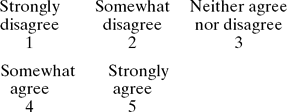
The two question versions differed only in that they described the immigrants' skill level as either highly skilled or low-skilled.Footnote 15 Accordingly, for half the respondents, referred to as the treatment group, we measured preferences over highly skilled immigration, whereas for the other half, referred to as the control group, we measured preferences over low-skilled immigration. Randomization ensured that the two groups of respondents were (in expectation) identical in all other observed and unobserved characteristics that may confound a comparison across groups.Footnote 16
The general distribution of preferences over both highly skilled and low-skilled immigrants is displayed in Figure 2. For both types of immigration the barplots show the fraction of respondents answering each of the five answer categories; the superimposed whiskers decode the upper .95 confidence interval derived from the design-based variance estimator. Two features stand out in this graph. First, in line with previous studies, our survey once again confirms the profound divide among the American public in opinions on immigration. Pooling over both types of immigration, about 50% of the respondents oppose an increase in immigration, whereas about 25% favor it. Second and more importantly, our findings for the first time document the fact that preferences over immigration vary rather dramatically depending on the immigrants' skill levels. Although more than 60% of the respondents (in the control group) state that they strongly disagree or somewhat disagree with an increase in low-skilled immigration, only 40% of the respondents (in the treatment group) are opposed to an increase in highly skilled immigration.Footnote 17 Because of the randomization, we know that this statistically significant difference between the two distributions is entirely driven by the perceived differences in the skill attributes of the immigrants.Footnote 18
Support for Highly Skilled and Low-skilled Immigration

In an additional experiment we replicated all our tests based on within-group variation by using a cross-over design. For this follow-up test, we contacted a random subset of the respondents two weeks after they had completed the main survey. Half of these respondents we randomly selected to receive the alternate version of the question they had received in the original survey two weeks prior. This approach allowed us to compare the responses to both questions from the same individual while minimizing the danger of “consistency bias.”Footnote 19 The results from the analysis of this follow-up experiment, which strongly confirm the results from the main experiment reported below, are described in Appendix A.
EMPIRICAL TEST I: THE LABOR MARKET COMPETITION MODEL
Skill Levels of Natives
If concerns about labor market competition are important in shaping attitudes toward immigration, we expect, in line with the FP model of attitude formation, that natives should oppose immigrants with similar skill levels but favor immigrants with different skill levels. That is, we expect that the skill levels of our survey respondents should have a large and positive relationship with support for low-skilled immigrants and a large and negative effect on support for highly skilled immigrants.
To conduct an explicit test of this argument, we follow previous studies and employ educational attainment as our measure of respondent skill levels (Facchini and Mayda Reference Facchini and Mayda2009; Hanson, Scheve, and Slaughter Reference Hanson, Scheve and Slaughter2007, Reference Hanson, Scheve, Slaughter, Bhagwati and Hanson2008; Mayda and Rodrik Reference Mayda and Rodrik2005; Scheve and Slaughter Reference Scheve and Slaughter2001). This measure, which we label EDUCATION, is a categorical indicator of the highest level of education attained by the respondent. The coding is: 1 = Not completed high school education, 2 = High school graduate, 3 = Some college, 4 = Bachelor's degree or higher. Alternatively, we also use a set of binary indicator variables called HS DROPOUT, HIGH SCHOOL, SOME COLLEGE, and BA DEGREE that are coded one if a respondent belongs to the respective category of EDUCATION and zero otherwise. Summary statistics for all variables used in the analysis are provided in Appendix B.
Attitudes toward Highly and Low-skilled Immigrants and Natives' Skill Levels
Figure 3 plots the distributions of preferences conditional on respondents' skill levels. The results suggest two key findings. First, regardless of the respondents' skill level, highly skilled immigrants are strongly preferred over low-skilled immigrants. Second, in stark contrast to the predictions based on the theoretical model, we find that support for both types of immigration is increasing (at a roughly similar rate) with respondents' skill level. For example, whereas only 7% of the least skilled respondents (those who did not finish high school) favor an increase in low-skilled immigration, 29% favor an increase in highly skilled immigration. However, we find a similar preference differential among the most highly skilled respondents (those with at least a bachelor's degree): only 31% prefer an increase in low-skilled immigration but more than 50% prefer an increase in highly skilled immigration.
Support for Highly Skilled and Low-skilled Immigration by Respondents' Skill Level

Taken together, these results are at odds with the claim that concerns about labor market competition are a driving force in shaping attitude toward immigration. Instead, the results are consistent with previous findings indicating that people with levels of higher education are more likely to favor immigration (for a variety of other economic and noneconomic reasons) regardless of immigrants' skill attributes (Hainmueller and Hiscox Reference Hainmueller and Hiscox2007).
Formal Tests of the Labor Market Competition Model
We created a binary indicator variable, HSKFRAME, coded one if the respondent i received the question about highly skilled immigrants and zero if he or she received the question about low-skilled immigrants. The observed support for immigration is measured by the categorical variable PROIMIG, which takes on the integer value associated with one of the five answer categories j = (1, 2,. . . ,5) from “strongly disagree” to “strongly agree.” We model PROIMIG using an ordered probit model with poststratification weights. For all uncertainty estimates we employ the robust linearized variance estimator that yields the valid design based inferences.Footnote 20
To explicitly test the labor market competition argument, we estimate the systematic component of the ordered probit model with the specification.

where the parameter γ is the lower-order term on the treatment indicator that identifies the premium that natives attach to highly skilled immigrants relative to low-skilled immigrants. The parameter δ captures how the premium for highly skilled immigration varies conditional on the skill level of the respondent.
The key predictions based on the standard model of labor market competition are as follows: For the least skilled respondents with EDUCATIONi = 1 (those who did not finish high school), we expect strong support for highly skilled over low-skilled immigration, so that γ + δ · 1 > 0. For the most highly skilled respondents with EDUCATION = 4 (those with a bachelor's degree or higher), we expect the exact opposite, γ + δ · 4 < 0. In other words, low-skilled immigration is preferred over highly skilled immigration. Taken together this implies that δ is negative, fairly large in magnitude (|γ| > δ/4), and statistically significant.
In our second test specification we relax the assumption of linearity in the premium for highly skilled immigration and estimate
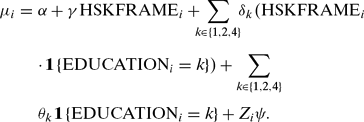
This specification allows a different premium conditional on each of the four skill categories HS DROPOUT, HIGH SCHOOL, SOME COLLEGE, and BA DEGREE. Notice that we use SOME COLLEGE (respondents who have some college education but did not graduate) as our reference category, so that γ identifies the premium estimated for this skill level. Accordingly, γ + δ1, γ + δ2, and γ + δ4 identify the premia estimated for those respondents in the categories HS DROPOUT, HIGH SCHOOL, and BA DEGREE. The key prediction is that γ + δ1 is positive and significant whereas γ + δ4 should be negative and significant.
We also enter a basic set of sociodemographic covariates Z including the respondent's age (in seven age brackets), gender (female = 1, male = 0), and race (four dummies for white, Hispanic, black, and other) in all specifications. The covariates are simply included here to increase the comparability of some of the coefficients with previous studies (Facchini and Mayda Reference Facchini and Mayda2009; Hanson, Scheve, and Slaughter Reference Hanson, Scheve and Slaughter2007; Mayda Reference Mayda2006; Scheve and Slaughter Reference Scheve and Slaughter2001). Notice that because the randomization orthogonalizes HSKFRAME with respect to Z, the exact covariate choice does not affect the results of the main coefficients of interest.Footnote 21
Results for Tests of the Labor Market Competition Model
Results for the tests are shown in Table 1. In the first two columns we separately regress attitudes toward highly skilled and low-skilled immigration on respondents' skill level (measured by educational attainment) and the set of covariates. Following the labor market hypothesis we would expect that the support for low-skilled (highly skilled) immigration should increase (decrease) in respondents' skill level. In contrast, we find that the correlation between respondents' skill level and support for immigration is positive and significant for both types of immigration (columns one and two). In fact, we cannot reject the null hypothesis that the effect of respondents' skill on support for increased immigration is identical for highly skilled and low-skilled immigrants (p-value .21).
Individual Support for Highly Skilled and Low-skilled Immigration—Test of the Labor Market Competition Model

Order Probit Coefficients shown with standard errors in parentheses. All models include a set of the covariates age, gender, and race (coefficients not shown here). The reference category for the set of education dummies is SOME COLLEGE (respondents with some college education).
The next three models implement our main experimental tests. To identify the premium attached to highly skilled relative to low-skilled immigrants, we use PROIMIG as our dependent variable and regress it on the indicator HSKFRAME that denotes whether a respondent received the frame about highly skilled immigrants rather than the question about low-skilled immigrants. Results are shown in column three. The high-skill frame indicator enters positive and highly significant, indicating that on average highly skilled immigrants are strongly preferred to low-skilled immigrants. Column four includes the interaction of HSKFRAME with respondents' skill level, measured by EDUCATION. The interaction term enters with the expected negative sign, but it is statistically insignificant and the point estimate is very small in substantive terms. This result suggests that, in contrast to expectations based on the labor market competition model, the premium attached to highly skilled immigration does not vary significantly with respondents' skill level. In column five we also drop the linearity assumption regarding the effect of respondents' skill level and replace EDUCATION with our set of dummy variables that indicate the highest level of educational attainment (SOME COLLEGE is the reference category) plus all interactions with the high-skill question frame. We find that not one of the interaction terms is significantly different from zero. A Wald test against the null that all interaction terms are jointly zero yields a p-value of .61, indicating that the variation in the premium attached to highly skilled immigration among differently skilled respondents is not significant.
Taken together, these results reveal several striking features regarding the dynamic of respondents' skill levels and immigration preferences. To give some sense of the substantive magnitudes involved, we simulate the predicted probability of supporting an increase in immigration (answers “somewhat agree” and “strongly agree” that the U.S. should allow more immigration) for the median respondent (a white woman aged 45) for all four skill levels and both immigration types based on the least restrictive model (model five in Table 1). Figure 4 shows the results and summarizes our key findings for the tests of the labor market competition argument.
Support for Highly Skilled and Low-skilled Immigration by Respondents' Skill Level

First, in contrast to the predictions from the labor market competition model, support for both low- and highly skilled immigration is steeply increasing in respondents' skill levels. This increase in the probability of supporting immigration is very large in substantive terms. For example, for highly skilled immigration it ranges from .23 [.18; .26] among respondents who did not finish high school to .40 [.35; .45] among college graduates (the numbers in square brackets give the .95 percent confidence interval). Furthermore, the increase is not linear, but instead is particularly pronounced for the gap between respondents who have a college education and those who do not. This plateau effect is in line with findings in some previous studies (Chandler and Tsai Reference Chandler and Tsai2001; Hainmueller and Hiscox Reference Hainmueller and Hiscox2007) showing that exposure to university education seems to be the critical contributor to the generally positive relationship between education and support for immigration.
Second, regardless of the respondents' skill level, highly skilled immigrants are much preferred over low-skilled immigrants. This finding is at odds with the expectation from the standard model of labor market competition that highly skilled natives should oppose inflows of highly skilled immigrants and support inflows of low-skilled immigrants. On the average (i.e., across the four skill levels), the predicted probability of supporting highly skilled immigration is about 0.15 higher than the probability of supporting low-skilled immigration and this difference is highly statistically significant.
Third, there seems to be no systematic variation in the premium attached to highly skilled immigrants across respondents' skill level. As clearly indicated by the dashed lines that connect the predicted probabilities for each type of immigration, the step function that describes increased support for immigration with rising skill levels among respondents is quite similar for the two types of immigration. The relative differences in predicted probabilities of supporting highly skilled versus low-skilled immigration are .17 [.13; .20] for respondents who did not complete high school, .12 [.10; .14] for high school graduates, .15 [.12; .18] for those with some college education, and .17 [.13; .21] for college graduates. The differences are not significantly different and do not have opposite signs, as predicted by the labor market competition model. The two dotted lines that connect the predicted support for the lowest and highest skill levels are almost exactly parallel in slope. This suggests that there is very little interaction between respondents' and immigrants' skill types in accounting for immigration preferences. These results are sharply at odds from the expectation if labor market concerns were exercising a powerful influence—we would see a scissoring of these two slope lines. (The same figure based on our follow-up test that uses the within-group variation is presented in Figure A.1 in Appendix A. It mirrors the results obtained in Figure 4.)
Finally, columns 7 and 8 in Table 1 present the results for the split sample tests that compare the relationship between respondents' skill levels and attitudes toward highly skilled and low-skilled immigrants in the in-labor-force and the out-of-labor-force samples. Previous tests of the labor market competition model (Hainmueller and Hiscox Reference Hainmueller and Hiscox2007; Mayda Reference Mayda2006; Scheve and Slaughter Reference Scheve and Slaughter2001) have relied on similar tests, based on the idea that if labor market concerns are a driving factor in attitudes toward immigration, we should see marked differences across the two samples.Footnote 22 We find that the results are almost identical across the two subsamples; in both cases highly skilled immigrants are preferred over their low-skilled counterparts and this premium does not vary significantly with respondent skill level. This pattern is again inconsistent with what we would expect if concerns about labor market competition are shaping attitudes toward immigration.Footnote 23
EMPIRICAL TEST II: THE FISCAL BURDEN MODEL
Income and Fiscal Exposure to Immigration across U.S. States
Although the effect of immigration on natives via the labor market is modeled as a function of natives' skill levels, the impact of immigration via public finance is modeled as a function of natives' income (Facchini and Mayda Reference Facchini and Mayda2009; Hanson, Scheve, and Slaughter Reference Hanson, Scheve and Slaughter2007). Progessitivity in tax systems means that richer natives pay more as a result of tax hikes (or benefit more from tax cuts) than do poorer natives; in addition, many types of public services and assistance are means-tested programs accessible only to poorer individuals. We construct a categorical variable called INCOME, which indicates a respondent's position in the income distribution. This coding ranges from 1 to 4 depending on whether a respondent belongs to the first, second, third, or fourth quartile of the household income distribution.Footnote 24
The most prominent test of the fiscal burden model in the U.S. context focuses upon cross-state variation in exposure to the effects of immigration on government taxes and expenditures (Hanson, Scheve, and Slaughter Reference Hanson, Scheve and Slaughter2007). In the case of U.S. natives, exposure to the fiscal effects of immigration will depend upon the state in which they reside (and pay taxes). In general, the fiscal impact of immigrants should be highest in states that have both a relatively large share of welfare-reliant immigrants and a relatively generous welfare system. Hanson et al. (Reference Hanson, Scheve and Slaughter2007) note that measuring fiscal exposure to immigration is difficult, however, because individuals use public services in many forms: they use public safety, roads, parks, transportation, education, and health care, for example, as well as welfare programs. Furthermore, immigrants will contribute taxes and use public services and assistance to various degrees depending on both state policies and the characteristics of the immigrant population (e.g., income levels, family size, age, legal status). Hanson, Scheve, and Slaughter (Reference Hanson, Scheve and Slaughter2007) construct two simple measures of fiscal exposure that focus only on state-level welfare spending, setting aside other types of spending and also immigrant tax contributions. In order to keep the analysis consistent with previous work, we have reconstructed these two measures. We use the same data sources and the same coding approach, but employ data for the most recent years available (the 2006 American Community Service and the 2006 U.S. Census of Governments) to stay as close as possible to the time when our survey was fielded. Here we briefly describe the two measures.
Their first measure, FISCAL EXPOSURE I, is equal to one for all states that meet two conditions: first, high total public welfare spending per native household by state and local governments (states are coded as high–welfare spending if they are above the national median on this measure);Footnote 25 second, a high ratio of immigrant to native households (states are coded as high if they exceed the mean ratio across all the states). Our reconstructed measure for 2006 is summarized in the left panel of Figure 5, where the superimposed dotted lines indicate the cutoff values for both axes. The nine states in the upper right corner are classified as having a high level of fiscal exposure to immigration.Footnote 26 Following Hanson, Scheve, and Slaughter (Reference Hanson, Scheve and Slaughter2007), we also code a binary indicator called IMMIGHIGH that just identifies states that have a high ratio of immigrant to native households: IMMIGHIGH is coded as one if the ratio is above the mean state immigrant-to-native household ratio and zero otherwise.Footnote 27 Notice that (by definition of FISCAL EXPOSURE I) all high–fiscal exposure states are also high-immigration states, but there are a few states with high immigration that are coded as having low fiscal exposure.
Measures of Fiscal Exposure

The second measure used by Hanson, Scheve, and Slaughter (Reference Hanson, Scheve and Slaughter2007), FISCAL EXPOSURE II, is equal to one for states in which the ratio of immigrant households receiving cash forms of public assistance to the total number of native households exceeds a specified threshold (.012).Footnote 28 Our measure for 2006 is reported in the right panel of Figure 5. In our data, exactly the same threshold (.012) provides the natural break in the distribution. Seven states are marked as facing high fiscal pressure; Texas is the state just below the cutoff point. Overall the two fiscal exposure measures are highly correlated (r = .64) and agree on 46 of the 51 states. The classifications are almost identical to the ones originally used by Hanson, Scheve, and Slaughter (Reference Hanson, Scheve and Slaughter2007).Footnote 29 Notice that conceptually FISCAL EXPOSURE I is the preferred measure of Hanson, Scheve, and Slaughter (Reference Hanson, Scheve and Slaughter2007) because in contrast to FISCAL EXPOSURE II it includes noncash benefits. However, it is important to note that FISCAL EXPOSURE I is based on a measure of general welfare spending and does not account for actual welfare uptake by immigrants and natives (captured, at least in part, by FISCAL EXPOSURE II).Footnote 30
Attitudes toward Highly and Low-skilled Immigrants, Natives' Income, and Fiscal Exposure
Figure 6 plots the distribution of attitudes toward both highly skilled and low-skilled immigration conditional on respondent income and the first measure of immigrant fiscal exposure (FISCAL EXPOSURE I).Footnote 31 To avoid cluttering the plot we focus on the fraction of respondents who are opposed to immigration (answers “somewhat disagree” and “strongly disagree” that the U.S. should allow more immigration) in each of the subsets defined by income, fiscal exposure, and immigration type. Two main findings emerge from the data.
Attitudes Toward Highly Skilled and Low-skilled Immigration by Respondents' Income Level and Immigrant Fiscal Exposure of Respondents' State

First, the relationship between natives' income levels and attitudes toward highly skilled immigration is quite similar in high– and low–fiscal exposure states. Opposition to highly skilled immigration seems to be slightly lower among the richest natives than among the poorest natives, but this is true for both high– and low–fiscal exposure states. This finding seems at odds with what one would expect based upon the standard fiscal burden model, as opposition to highly skilled immigration should fall at a higher rate with income in those states that face a high fiscal exposure (given that highly skilled immigrants would relax the budget constraint through their net contributions to the tax coffers).
Second, the relationship between natives' income levels and attitudes toward low-skilled immigration does vary dramatically between high– and low–fiscal exposure states. Opposition to low-skilled immigration is increasing with respondent income in low-exposure states, but the opposite is true for high-exposure states where the richest natives are more welcoming of low-skilled immigration than the poorest natives. This pattern is fundamentally inconsistent with the conventional wisdom that rich natives fear being burdened with higher taxes as a consequence of low-skilled immigrants drawing on public services and draining government coffers. Instead, the results are more consistent with the alternative argument that poor natives should be the most vocal opponents of low-skilled immigration in high–fiscal exposure states because they fear increasing competition for public services and the erosion of welfare benefits.
Formal Tests of the Fiscal Burden Model
In order to formally test the fiscal burden model, we estimate a series of ordered probit estimations with the specification

where the parameter γ is the lower-order term on the treatment indicator that identifies the premium that natives attach to highly skilled immigrants over low-skilled immigrants and φ captures how the premium for highly skilled immigration varies conditional on the income level of the respondent. We estimate the models separately for the high– and low–fiscal exposure states and enter our basic set of sociodemographic covariates including the respondent's age (in seven age brackets), gender (female = 1, male = 0), and race (four dummies for white, Hispanic, black, and other) in all specifications. We also include respondent's education in each model, although the results are substantially identical if education is excluded.Footnote 32
The key prediction from the standard fiscal-burden model is that rich (high-income) natives should attach a larger premium to highly skilled relative to low-skilled immigrants than do poor natives. In addition, following Hanson, Scheve, and Slaughter (Reference Hanson, Scheve and Slaughter2007), we can expect that this difference should be larger in states with high fiscal exposure to immigration than in states with low exposure. This means that we should expect φ to be positive and significant. In addition, φ should be larger in states with high fiscal exposure to immigrants than in low-exposure states. This standard model assumes that taxes are adjusted to balance budgets, so native's attitudes reflect their concerns about tax rates. The alternative argument assumes that states adjust per capita transfers but hold tax rates constant, and makes an opposite prediction: rich natives prefer highly skilled over low-skilled immigrants less than poor natives, and the difference should be larger in states with high fiscal exposure to immigrants than in states with low exposure. Accordingly we would instead expect φ to be negative and significant. And in the states with a high fiscal exposure to immigrants, φ should be larger (in absolute terms) than in low–fiscal exposure states.
Finally, we also reestimate all models relaxing the linearity assumption, using the following specification:
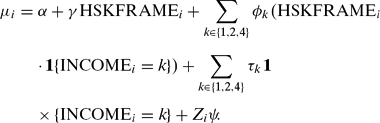
This specification allows a different premium conditional on each of the four income quartiles, which we label INCOMEQ1 to INCOMEQ4. Notice that we use INCOMEQ3 (respondents that fall into the third quartile of the income distribution) as our reference category.
Results for the Tests of the Fiscal Burden Model
The upper panel in Table 2 presents the estimation results. In the first column we estimate the model for all states. We find that income is associated with increased support for immigration. However, the premium attached to highly skilled over low-skilled immigrants does not systematically vary across respondents' income levels; the coefficient for the interaction term between the high skill frame and the income variable enters insignificant and small in magnitude. In columns 2 and 3 we restrict the estimation to the subsamples of states that are characterized by a high level of fiscal immigrant exposure according to the two measures FISCAL EXPOSURE I and II. Strikingly, the interaction terms in both subsamples now enter negative and fairly large in magnitude. For FISCAL EXPOSURE II the negative interaction term is also highly statistically significant, and for FISCAL EXPOSURE I it is almost significant at conventional levels (p-value .11). This indicates that in high–fiscal exposure states the premium attached to highly skilled immigration relative to low-skilled immigration is decreasing in respondents' income level. This finding is clearly inconsistent with the conventional fiscal burden argument and the findings reported in previous studies. The finding is consistent, however, with the alternative argument, according to which low-income natives in high–fiscal exposure states are likely to fear the erosion of welfare benefits as a consequence of low-skilled immigration. We find no such interaction in low–fiscal exposure states, as shown in columns 4 and 5. In fact, the interaction terms are almost exactly zero. As a further check, we also ran a combined model where we pooled the data from high– and low–fiscal exposure states and included the three-way interaction between FISCAL EXPOSURE (I or II), INCOME, and HSKFRAME, all lower-order terms, and our baseline set of covariates. This test confirmed that in states with high fiscal exposure to immigration, poor natives are significantly less likely to support low-skilled immigrants than they are in states with low fiscal exposure. For example, for the median respondent in our lowest income category (white women aged 45 with some college education), the predicted probability of strongly opposing an increase in low-skilled immigration is .49 in high–fiscal exposure states and .37 in low–fiscal exposure states (using FISCAL EXPOSURE I); the difference is significant at conventional levels (p-value .05).Footnote 33
Individual Support for Highly Skilled and Low-skilled Immigration—Test of the Fiscal Burden Model
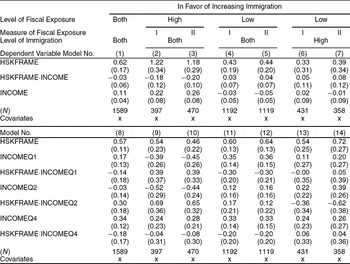
Order probit coefficients shown with standard errors in parentheses. All models include a set of the covariates age, gender, and race, and education (coefficients not shown here). The reference category for the set of income quartile dummies is INCOMEQ3 (respondents in the third quartile of the income distribution).
In the last two columns, 6 and 7, we further restrict the subsamples to states with low fiscal exposure but high levels of immigration (as measured by the IMMIGHIGH variable). Again, we find no interaction between the high-skilled question frame and respondents' income levels. Taken together, these two results suggest that the negative relationship between respondent income and the premium attached to highly skilled immigrants relative to low-skilled immigrants is indeed driven by the levels of fiscal exposure and not by levels of immigration per se.
The lower panel of Table 2 presents the results when we also relax the linearity assumption in the interaction between respondents' income and preferences toward highly skilled and low-skilled immigration. The findings are broadly similar to our previous findings, although they suggest that the main dividing line in attitudes toward highly skilled relative to low-skilled immigrants seems to be the transition from the second to the third quartile of the income distribution. In the high–fiscal exposure states (models 9 and 10), the interaction terms for both the lowest and the second lowest income dummies enter positive and with large magnitudes and are (jointly) highly significant, indicating that these two groups of respondents attach a larger premium to highly skilled relative to low-skilled immigrants than respondents in the third quartile (the reference category). The interaction for the highest-income dummy is almost zero, indicating that for the richest respondents the premium is roughly similar to the premium for those in the third quartile. Again, we find no such interaction in the states with low fiscal exposure (columns 11 and 12) and the subset of states with low exposure but high levels of immigration (columns 13 and 14).
To give a substantive interpretation to the results, we simulate predicted probabilities for supporting an increase in immigration (answers “somewhat agree” and “strongly agree” that the United States should allow more immigration) for the median respondent (white women aged 45 with some college education). We compute the predicted probabilities for all four income levels, for both immigration types, and for both high– and low–fiscal exposure states (based on FISCAL EXPOSURE I) using our least restrictive models (10 and 12).Footnote 34Figure 7 shows the results and summarizes our key findings regarding the fiscal burden model.
Support for Highly Skilled and Low-skilled Immigration by Respondents' Income Level and Immigrant Fiscal Exposure of Respondents' State

The figure suggests that the way in which fiscal concerns interact with respondents' income in forming attitudes toward highly skilled and low-skilled immigrants is inconsistent with the conventional wisdom. In states with high fiscal exposure to immigration, poor respondents are significantly less likely to support low-skilled immigrants than they are in states with low exposure. Moreover, in high-exposure states, poor natives attach a much larger premium to highly skilled relative to low-skilled immigrants than they do in low-exposure states. Taken together, these results are much more consistent with the alternative argument about the fiscal concerns raised by immigration, according to which poor natives fear competition with low-skilled immigrants for access to public services.Footnote 35 Rich respondents, meanwhile, are if anything more supportive of low-skilled immigrants in high–fiscal exposure states than they are states with low exposure, and the premium they attach to highly skilled immigrants is unaffected by fiscal exposure, findings that are completely at odds with the standard argument that rich natives are primarily concerned about tax hikes that could be triggered by low-skilled immigration. (The same figure, based on our follow-up test that uses the within-group variation, is presented in Figure A.2 in Appendix A. It mirrors the results obtained in Figure 7).Footnote 36
CONCLUSION
To date, no empirical study has been able to distinguish between the attitudes that native citizens have toward highly skilled immigrants and their attitudes toward low-skilled immigrants. This distinction is a critical feature of the theoretical models that link economic concerns with attitude formation and policy preferences with respect to immigration. In our survey experiment we were able to explicitly and separately examine individuals' attitudes toward highly skilled and low-skilled immigrants, randomly assigning respondents to answer questions about immigrants with different skill levels.
The results from the survey experiment challenge the predictions made by the standard political-economic models and the conclusions reached in several recent, well-cited (non-experimental) studies. The labor market competition model predicts that natives will be most opposed to immigrants who have similar skill levels to their own. We find instead that both highly skilled and low-skilled respondents strongly prefer highly skilled immigrants over low-skilled immigrants, and this preference is not decreasing in respondents' skill levels. Support for both highly skilled and low-skilled immigration is strongly increasing in respondents' skill levels. We also find that these relationships are similar for respondents currently in or currently out of the labor force. Overall, the results indicate that, in general, concerns about labor market competition are not a powerful driver of anti-immigrant sentiment in the United States—or, at least, not in the simple ways so far imagined.
According to the standard fiscal burden model, rich natives oppose low-skilled immigration more than do poor natives, and this difference should be larger in states with greater fiscal exposure in terms of immigrant access to public services. We find instead that rich and poor natives are equally opposed to low-skilled immigration in general, and rich natives are actually less opposed to low-skilled immigration in high-exposure states than in low-exposure states. These results are clearly inconsistent with claims that concerns about a heavier tax burden associated with the provision of public services are driving rich natives to oppose low-skilled immigration.
We do find evidence, however, that provides some support for an alternative argument about public finance and immigration. We find that poor natives are markedly more opposed to low-skilled immigration in states with high fiscal exposure than in states with low fiscal exposure. This lends support to an argument that concerns about access to or overcrowding of public services may contribute to anti-immigrant attitudes among poorer citizens. Across the states over the past 25 years or so, although immigration has had no discernable impact on tax rates, per capita welfare expenditures have grown the slowest in states that experienced larger increases in the share of immigrants in their population. The evidence thus suggests that concerns among poor natives about constraints on welfare benefits as a result of immigration are more relevant than concerns among the rich about increased taxes.
In general, however, our findings indicate that economic self-interest, at least as currently theorized in the standard models, does not have a strong impact on the immigration policy preferences of surveyed individuals. Our results are instead consistent with a substantial body of research covering a variety of policy issues that has demonstrated that the attitudes formed by individuals about government policies rarely reflect calculations of self-interest (Citrin and Green Reference Citrin, Green and Shapiro1990; Kinder and Sears Reference Kinder and Sears1981; Sears and Funk Reference Sears and Funk1990; Sears et al. Reference Sears, Lau, Tyler and Allen1980).Footnote 37
If not material self-interest, what is shaping attitudes toward immigration? Our results are broadly consistent with two types of alternative arguments emphasizing noneconomic concerns associated with ethnocentrism or sociotropic considerations about how the local economy as a whole may be affected by immigration. A broad variety of previous studies have focused on deep-seated cultural and ideological factors, including ethnocentrism, racism, and nationalism, and how they affect attitudes toward immigrants in the United States. (Burns and Gimpel Reference Burns and Gimpel2000; Chandler and Tsai Reference Chandler and Tsai2001; Citrin et al. Reference Citrin, Green, Muste and Wong1997; Espenshade and Hempstead Reference Espenshade and Hempstead1996), in Europe (Bauer, Lofstrom, and Zimmerman Reference Bauer, Lofstrom and Zimmerman2000; Dustmann and Preston Reference Dustmann and Preston2007; Fetzer Reference Fetzer2000; Gang, Rivera-Batiz, and Yun Reference Gang, Rivera-Batiz and Yun2002; Lahav Reference Lahav2004; McLaren Reference McLaren2003; McLaren and Johnson Reference McLaren and Johnson2007), and elsewhere (Betts Reference Betts1988; Goot Reference Goot and Jupp2001). Although our experiment is not aimed at testing these kinds of arguments, our core results fit well with much of this work. We find that support for all immigration is strongly increasing in the education level of respondents. Many authors have suggested that the observed association between education and support for immigration is driven by cultural and ideational mechanisms (Citrin et al. Reference Citrin, Green, Muste and Wong1997; Gang, Rivera-Batiz, and Yun Reference Gang, Rivera-Batiz and Yun2002; Hainmueller and Hiscox Reference Hainmueller and Hiscox2007). Education is strongly associated with higher levels of racial tolerance and stronger preferences for cultural diversity among individuals (see Campbell et al. Reference Campbell, Converse, Miller and Stokes1960, 475–81; Erikson, Luttbeg and Tedin Reference Erikson, Luttbeg and Tedin1991, 155–56). School and college curricula often explicitly promote tolerance, improve knowledge of and appreciation for foreign cultures, and create cosmopolitan social networks, all of which should be associated with more pro-immigrant sentiment among more educated individuals (Case, Greeley, and Fuchs Reference Case, Greeley and Fuchs1989; Chandler and Tsai Reference Chandler and Tsai2001). This line of argument has added credence once we rule out self-interested considerations relating respondents' education (skill level) to labor market competition with immigrants.
Another type of argument suggests that attitudes toward immigration, like attitudes toward other major policy issues, stem largely from people's perceptions of the collective impact of policy on nation as a whole. According to this view, personal experience matters less than sociotropic or collective-level information (Kiewiet and Kinder Reference Kiewiet and Kinder1981; Mansfield and Mutz Reference Mansfield and Mutz2009; Mutz Reference Mutz1992). We do not test this type of argument here, but it is worth noting again that our results reveal a strong general preference for highly skilled rather than low-skilled immigrants among respondents at all levels of education and income. Common perceptions almost certainly hold that highly skilled immigrants contribute more to government coffers than they consume in government services, and are also likely to generate larger efficiency gains for the local economy than low-skilled immigrants who bring less human capital, and these perceptions should be associated with a clear general preference for highly skilled over low-skilled immigrants in order to benefit the nation as a whole. Again, this is a line of argument that can be given more weight once we set aside claims that self-interested concerns about competition for jobs or fiscal burdens are playing major roles in shaping attitudes toward immigrants.
We must be careful to note the limitations of the analysis. It would be good to replicate the experiment in other countries with high rates of immigration to examine whether the results are generally applicable outside the American context. Ideally, too, new tests should be designed to examine the degree to which respondents focus on economic issues when they think about the skill levels of immigrants and whether they connect highly skilled and low-skilled immigration with distinct cultural and social impacts in ways that shape their views. The current test leaves it up to the respondents to make the connection between the skill levels of immigrants and any economic concerns they might have about labor market competition and fiscal burden. Future tests could make this connection more explicit and examine the effects of issue framing or priming.
Last, here we have only tested the predictions of the standard political-economic models of labor market competition and fiscal burden. It is possible that these models do not adequately capture the precise mechanisms by which the material self-interest of individuals is affected by immigration. Perhaps more sophisticated theoretical models would generate different predictions. It may be interesting to examine whether the specific types of skills of highly skilled immigrants (that is, their specific professions or the particular industries to which they are attached) make a difference, especially among respondents with similar types of specialized skills. As we pointed out above, however, models of the distributional effects of immigration that incorporate skill specificity do not generate clear predictions that differ markedly from the standard model, so it seems unlikely that this approach will yield better insights into the way people form opinions about immigration. A much more fruitful approach, we think, would be for political-economic analysis to focus less on people's responses to opinion surveys about immigration and more on self-interested actors operating as organized groups to lobby policymakers and frame public debates in ways that benefit them.
APPENDIX A: WITHIN-GROUPS ANALYSIS
This Appendix summarizes the results from the within-groups analysis of immigration attitudes. Two weeks following the implementation of the main survey (module 1), we contacted the respondents with a second survey (module 2). The final-stage response rate in the second survey was 85% with 1,356 completed interviews. In module 2 we asked respondents about their attitudes toward immigration using the same two question versions that we used in module 1, one referring to highly skilled immigration and the other referring to low-skilled immigration. We randomly allocated the module 2 questions among the respondents according to a split-sample cross-over design: Of the respondents that received the highly skilled immigration question in module 1, half received the highly skilled immigration question and half received the low-skilled immigration question in module 2. Similarly, of the respondents that received the low-skilled immigration question in module 1, half received the highly skilled immigration question and half received the low-skilled immigration question in module 2. The allocation and frequencies are summarized in Table A1.
Split-sample Cross-over Design for Within-groups Test

This design allows us to examine both the stability of attitudes over time and the degree to which the same respondents prefer highly skilled versus low-skilled immigration. Because the groups are randomly assigned in both modules, each group comparison—within and across modules—in principle provides unbiased estimates. Notice that in contrast to the between-group comparisons for module 1 that are the focus in the main text, the across-module within-group comparisons that we focus on in this Appendix may be affected by carry-over effects if the respondents' answer to the module 1 question affects her answer to the module 2 question. However, given the two-week “wash out” period between the modules, this may seem unlikely (see tests in the next section).
Stability of Attitudes and Skill Premium
Table A2 summarizes the mean support for the two types of immigration for the subset of respondents who participated in both module 1 and module 2. The observed support for immigration in each module is measured by the categorical variable PROIMIG, which takes on the integer value associated with one of the five answer categories j = (1,2,. . . ,5) from “strongly disagree” to “strongly agree.” We find that attitudes toward both highly skilled and low-skilled immigration are fairly stable between module 1 and module 2. The first row suggests that among those who are asked about low-skilled immigration in both modules, we cannot reject the null that the mean level of support is the same in both modules (using paired tests with sampling weights). The second row suggests that the same is true for those who are asked about highly skilled immigration in both modules.
Mean Support for Immigration by Module and Immigrants' Skill Type

The third row looks at the within-groups differences for those who were asked about low-skilled immigration in module 1 and highly skilled immigration in module 2. We find that highly skilled immigrants are much preferred over their low-skilled counterparts: on average the support is about 0.5 higher (on the five-point scale) and this difference is highly significant. Row four indicates that the same is true when the question order is reversed (highly skilled in module 1 and low-skilled in module 2): Support is about 0.66 higher and the difference is highly significant. We cannot reject the null that the premium attached to highly skilled versus low-skilled immigration does not differ depending on the question order (the confidence intervals of the two differences in row 3 and 4 overlap widely). This suggests that the two-week “wash out” period between the two survey modules was presumably sufficient to eliminate carry-over effects that may result from the fact that respondents try to make their answers consistent to avoid the impression of skill-based discrimination between the two types of immigrants.
Tests of the Labor Market Competition Model
To test the labor market competition model based on within-groups differences, we focus on the 673 respondents who were asked about different skill types in module 1 and 2. We fit ordered probit models as described in the main text, regressing attitudes toward highly skilled and low-skilled immigration on a set of highest–educational attainment dummies and our basic set of covariates. Again, we simulate the predicted probability of supporting an increase in immigration (answers “somewhat agree” and “strongly agree” that the United States should allow more immigration) for the median respondent (white women aged 45) for all four skill levels and both immigration types. Figure A1 shows the results and summarizes our key findings for the tests of the labor market competition argument based on the within-groups analysis. Full regression results are available upon request.
Within-groups Test: Support for Immigration by Respondents' Skill Level

The findings are virtually identical to the results obtained from the between-groups test presented in the main text, except that the confidence intervals are slightly larger due to the fact that our sample size is now cut in half. In contrast to the predictions from the labor market competition model, support for both low- and highly skilled immigration is steeply increasing in respondents' skill levels. Moreover, there seems to be no systematic variation in the premium attached to highly skilled immigrants across respondents' skill level.
We also replicated the tests comparing the support for highly skilled and low-skilled immigration among those respondents who are in and out of the labor force. The results are very similar to those for the between-groups test reported in the paper. We find that going from the lowest to the highest educational attainment category the probability of supporting an increase in highly skilled immigration increases by .25 [.17; .33] among those who are currently in the labor force and by .30 [.22 ; .39] among those who are out of the labor force. Similarly, the probability of supporting an increase in low-skilled immigration rises by .18 [.13 ; .22] among those in the labor force and by 0.12 [0.08; 0.17] among those out of the labor force. These results are again inconsistent with the idea that labor market concerns are a driving factor in attitudes toward immigration. If that were the case, we should see marked differences across the two labor market subsamples. Full regression results are available upon request.
Tests of the Fiscal Burden Model
To test the fiscal burden model based on within-groups differences we again focus on the 673 respondents who were asked about different skill types in module 1 and 2. For both high– and low–fiscal exposure states we fit ordered probit models as described in the main text, regressing attitudes toward highly skilled and low-skilled immigration on a set of dummies that indicate a respondent's quartile in the income distribution, our basic set of covariates, and educational attainment. Again, we simulate the predicted probability of supporting an increase in immigration (answers “somewhat agree” and “strongly agree” that the United States should allow more immigration) for the median respondent (white women aged 45) for all four skill levels, both immigration types, and fiscal exposure levels. Figure A2 shows the results (based on FISCAL EXPOSURE I) and summarizes our key findings for the tests of the fiscal burden model based on the within-groups analysis. The results are substantively identical if FISCAL EXPOSURE II is used instead. Full regression results are available upon request.
Within-groups Test: Support for Immigration by Respondents' Income Level

The findings are again very similar to the results reported in the main text based on the between-groups analysis. In high–fiscal exposure states, the premium attached to high-versus low-skilled immigrations is small among the richest natives, but large among the poorest natives. This indicates that tax concerns are unlikely to be an important driver of anti-immigrant sentiments, because in states with high exposure the richest natives should be the ones who attach the highest premium to high-skilled immigration. The results are supportive of the alternative scenario that highlights fears about the erosion of public services. In high-exposure states where competition for public services is most severe, the poorest natives exhibit the highest premium for highly skilled versus low-skilled immigrants. Similarly, comparing low– and high-exposure states, the results are inconsistent with the tax hike argument. Rich (poor) respondents, meanwhile, are if anything more supportive of low (high)-skilled immigrants in high–fiscal exposure states than they are states with low exposure. These findings are again completely at odds with the standard argument that rich natives are primarily concerned about tax hikes that could be triggered by low-skilled immigration. The findings support the alterative scenario, which anticipates that fear of competition with low-skilled immigrants for access to public services, especially among the poorest natives, is critical for anti-immigrant sentiment.
APPENDIX B: DESCRIPTIVE STATISTICS
Summary Statistics

 be the score function where

 . Following a first-order Taylor series expansion, the linearized variance estimator is given by
 , where
 .
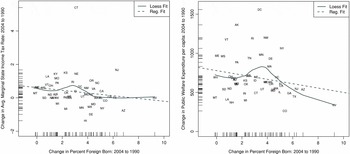
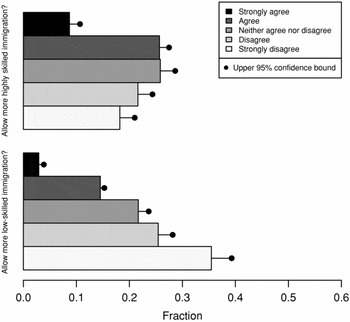
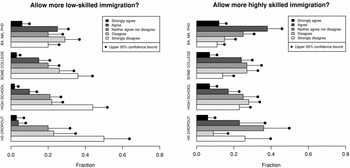
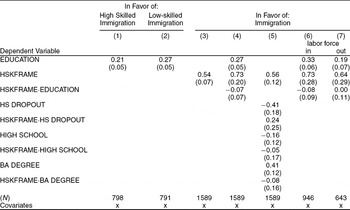
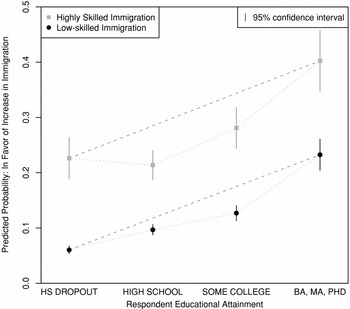
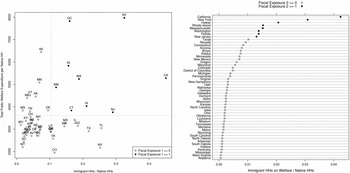
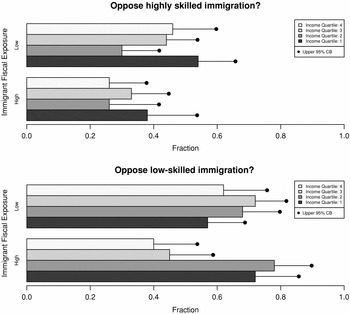
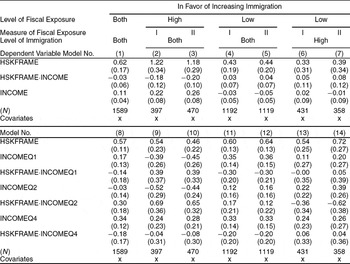
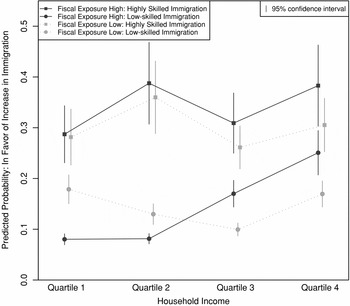
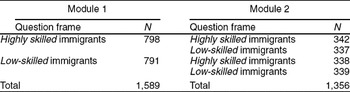

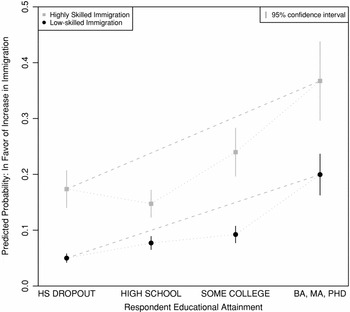
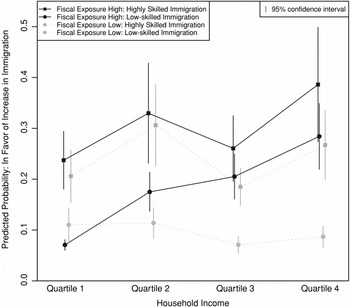
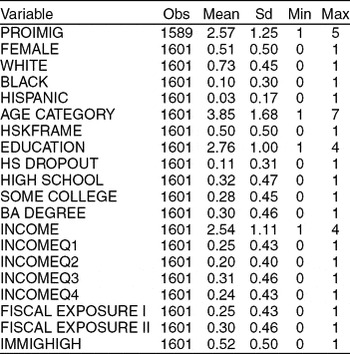



Comments
No Comments have been published for this article.