Introduction
Injection laryngoplasty is a treatment aimed to restore glottic competence by medialisation of the vocal fold. Brünning first introduced this technique over a century ago, to correct unilateral vocal fold immobility by injecting paraffin into the paraglottic space.Reference Brünning 1 This procedure has since been used for the treatment of other causes of glottic insufficiency (paresis, scarring, bowing and atrophy).Reference Courey 2
Injection laryngoplasty in the awake patient was first reported by Dedo et al. in 1973, who used Teflon™ injected via the per oral approach with indirect laryngoscopy.Reference Dedo, Urrea and Lawson 3 In 1985, Ward et al. introduced the transcutaneous injection technique; these authors reported injecting Teflon under local anaesthesia (LA) in the office-based setting.Reference Ward, Hanson and Abemayor 4 Given its long-term complications, such as foreign body reaction, granuloma formation and migration of polytetrafluoroethylene particles, Teflon has since been replaced by various other, safer injectables.Reference Ellis, McCaffrey, Desanto and Reiman 5 – Reference Dedo and Carlsöö 7
Over the decades, general anaesthesia (GA) has become the preferred anaesthetic modality, as it provides a more controlled environment allowing technical precision in patients with poor tolerance or difficult anatomical visualisation. However, there has been a recent shift in trend to perform injection laryngoplasty in the awake, unsedated patient under LA. This approach has distinct advantages, such as avoidance of risks inherent to GA and the ability to dynamically titrate injection material with immediate feedback of result. Significant cost savings have also been reported in office-based injection laryngoplasty compared to those procedures performed in the operating theatre.Reference Bové, Jabbour, Krishna, Flaherty, Saul and Wunar 8 Despite the various benefits of each anaesthetic modality, studies have demonstrated comparable voice outcomes between injection laryngoplasties performed under GA and LA.Reference Bové, Jabbour, Krishna, Flaherty, Saul and Wunar 8 – Reference Mathison, Villari, Klein and Johns 10
With majority of studies performed overseas, the paucity of data in Australia warrants further research in this area. This study aimed to compare the voice outcomes and clinical efficacy of injection laryngoplasty performed under GA versus LA, and to consider its complications within a tertiary health institution in Australia.
Materials and methods
This study was approved by the Southern Adelaide Clinical Human Research Ethics Committee. The study entailed a retrospective review of patients who underwent injection laryngoplasty performed by a single laryngologist at Flinders Medical Centre (a tertiary health institution) and Adelaide Voice Specialists (a private practice), between February 2013 and December 2014.
Seventy-five cases were identified from the operating theatre records (via the Operating Room Management Information System (‘ORMIS’)) using the International Classification of Diseases, 10th revision, codes. All procedures were performed in the operating theatre regardless of the mode of anaesthesia. The procedures conducted under LA were performed via the transcutaneous cricothyroid submucosal approach and those conducted under GA were performed via the transoral approach. The surgical technique used to perform this procedure under GA and LA has been described in other publications.Reference Dedo, Urrea and Lawson 3
Patient records (both in-patient and out-patient) were retrieved using individual patient medical record numbers. The medical record numbers of patients who underwent injection laryngoplasty were identified from the operating theatre database using laryngoplasty procedure codes. Data were collected from patient records, operating theatre records and the hospital database (Oasis). Inclusion criteria were: all injection laryngoplasty procedures performed by a single laryngologist (TA). The exclusion criteria were: documented evidence or history of an allergic reaction to the injection material, documented evidence or history of complications associated with previous LA procedures, and more than one procedure performed concurrently. Data collected included: patient demographics, aetiology, diagnosis, anaesthetic modality (GA or LA), injection site and injection agent used. Injection site was defined as right, left or bilateral. The injection materials used were Restylane (Galderma, Lausanne, Switzerland), Perlane (Galderma) or Radiesse (Merz Pharmaceuticals, Frankfurt, Germany).
The clinical outcome was measured by comparing pre- and post-injection Voice Handicap Index (‘VHI-10’) scores and Grade, Roughness, Breathiness, Asthenia, Strain (‘GRBAS’) scale scores; these data were collected prospectively. The pre-injection data were collected during the initial assessment at the voice clinic and the post-injection data were collected during the first post-operative out-patient follow-up appointment at three weeks post-procedure. The Voice Handicap Index 10 is a validated abbreviated voice handicap instrument shown to be equivalent to the Voice Handicap Index.Reference Jacobson, Johnson, Grywalski, Silbergleit, Jacobson and Benninger 11 The Grade, Breathiness, Roughness, Asthenia, Strain scale is a validated auditory perceptual scale used to assess the degree and severity of dysphonia.Reference Hirano 12 The latter scale was scored by an experienced speech pathologist and the treating laryngologist at the voice clinic. Grade of hoarseness, roughness, breathiness and asthenia are described as: nil, mild, moderate or severe (scores of 0, 1, 2 or 3 respectively).
All patients underwent pre- and post-injection videostrobolaryngoscopy. Any complications related to the procedure (including injection material and anaesthesia) were recorded.
Statistical analysis
A multilevel mixed-effects linear regression model was used to analyse the continuous Voice Handicap Index data, and multilevel mixed-effects ordered logistic regression models were employed for analysis of the ordinal scaled grade, roughness, breathiness and strain data, using Stata software, version 13.0 (StataCorp, College Station, Texas, USA). A maximum likelihood estimation procedure was used to compare the significant differences of outcome measures over time and between groups. The within-subject factor was the outcome of interest (i.e. Voice Handicap Index, and Grade, Breathiness, Roughness, Asthenia, Strain scale), and the between-subject factor was group (GA vs LA), with a random intercept for individuals to account for repeated measurements between pre- and post-injection. The model was used to determine the treatment effects (adjusted mean change of two groups at each time point) and interaction effects (overall effects on the two groups post-injection). Age and gender were adjusted in the multivariate missed effect regression models. Two-sample independent t-tests and chi-square tests were also performed to determine the significant differences of baseline characteristics between the two groups. All analysis was performed with two-tailed tests and the level of significance was set at p < 0.05. Where appropriate, 95 per cent confidence intervals (CIs) are reported along with p values.
Results
Demographics
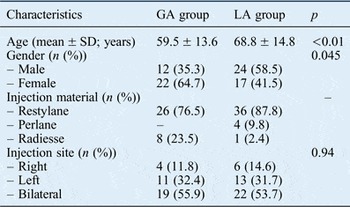
Seventy-five injection laryngoplasty procedures were performed on 70 patients, with more than 50 per cent being in the LA group (45.3 per cent in the GA group vs 55.7 per cent in the LA group) (Table I). The number of females was significantly higher in the GA group. Patients in the LA group were significantly older (mean ± SD = 68.8 ± 14.8 years) compared to the GA group (mean ± SD = 59.5 ± 13.6 years). Restylane was used in 62 cases (76.5 per cent in the GA group vs 87.8 per cent in the LA group), followed by Radiesse (used in 9 cases) and Perlane (used in 4 cases). Unilateral injections were performed in 34 cases (44.2 per cent in the GA group vs 46.3 per cent in the LA group) and bilateral injections in 41 cases (55.9 per cent in the GA group vs 53.7 per cent in the LA group). No significant difference in laterality of injection site was seen between the GA and LA groups (Table I).
Demographics, injection materials and injection site

Seventy-five injection laryngoplasties were performed on 70 patients (34 laryngoplasties in the GA group and 41 in the LA group). GA = general anaesthesia; LA = local anaesthesia; SD = standard deviation
Clinical efficacy
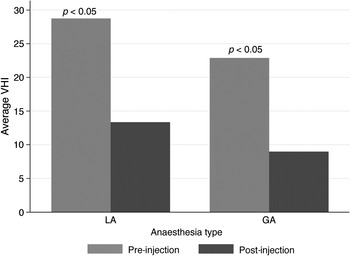
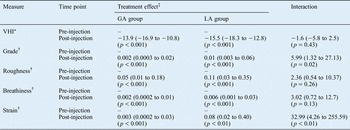
Voice Handicap Index 10 scores were available for 73 of the 75 procedures performed (33 in the GA group and 40 in the LA group). The respective mean pre- and post-injection Voice Handicap Index 10 scores were 28.7 and 12.9 for the LA group (p = 0.047), compared to 22.9 and 9.0 in the GA group (p = 0.06). A significant improvement in voice handicap after injection laryngoplasty was observed when pre- and post-injection Voice Handicap Index 10 scores were compared for both GA and LA groups (p < 0.001; Figure 1, Table II). For example, the Voice Handicap Index scores improved by 13.9 (95 per cent CI = −16.9 to −10.8) and 15.5 (95 per cent CI = −18.3 to −12.8) at post-injection for the GA and LA groups respectively. However, there was no significant difference in the mean improvement of the Voice Handicap Index 10 score for the GA group compared to the LA group (p = 0.43) (Table II).
Average Voice Handicap Index (VHI) baseline and post-injection measurements across the general anaesthesia (GA) and local anaesthesia (LA) groups.

Pre- and post-intervention data for voice handicap index, and grade, breathiness, roughness, asthenia, strain scale

*Data values for this measure represent marginal mean differences (95% confidence interval (CI)), with p values. †Data values for this measure represent odds ratios (95% CI), with p values. ‡Models were adjusted by age and gender. GA = general anaesthesia; LA = local anaesthesia; VHI = Voice Handicap Index
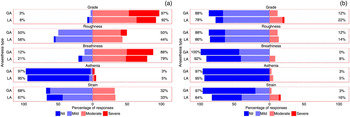
All parameters of the Grade, Roughness, Breathiness, Asthenia, Strain scale, except asthenia, showed significant improvement post-injection; the data for asthenia were recorded but not analysed because of the very small number of patients who presented with this condition. Comparison of the magnitude of improvement between LA and GA procedures demonstrated significant differences in the grade (p = 0.02) and strain (p < 0.01) categories (Table II). Further analysis revealed a higher proportion of GA patients with improvements in these categories compared to the LA group. Overall, improvements were observed post-injection for all aspects of the Grade, Breathiness, Roughness, Asthenia, Strain scale, as illustrated by the right panel in Figure 2.
Percentages of responses for the Grade, Breathiness, Roughness, Asthenia, Strain scale, for both the general anaesthesia (GA) and local anaesthesia (LA) groups, at (a) baseline (pre-injection) and (b) post-intervention.

Complications
The complication rates were 14.7 per cent (n = 5) and 4.9 per cent (n = 2) in the GA and LA cohorts respectively, with an overall rate of 9.3 per cent. There was no significant difference in complication rates between the groups.
There were two cases of trauma to the oral cavity in the GA group, involving trauma to the gum and tongue laceration. These minor injuries were sustained during suspension microlaryngoscopy and settled spontaneously. The other complications seen within the GA cohort were post-operative oedema, vocal fold haematoma and post-operative infection. The oedema settled spontaneously without any medical treatment. The vocal fold haematoma resolved without any intervention. The patient with post-operative infection presented in the post-operative period with neck pain. On assessment, swelling in the pyriform fossa was observed, which required admission and intravenous antibiotics and steroids, with the symptoms resolving within 48 hours.
In the LA group, two cases were converted to GA, both a result of poor tolerance from excessive gag reflex representing technical failure on these occasions. Another technical failure included inadequate injection because of significant adipose tissue in the anterior neck making the cricothyroid approach challenging. Two separate complications of intra-operative bleeding and airway restriction due to oedema occurred in the LA group. The intra-operative bleeding occurred in a patient on warfarin and aspirin, with the case being aborted because of poor laryngeal visibility. The procedure was postponed and successfully performed a week later after warfarin had been withheld. The patient with airway oedema had some inspiratory stridor lasting just over 1 hour; they were treated with intravenous dexamethasone 4 mg and their oxygen saturation levels were monitored overnight. This patient made a full recovery without any airway restriction observed the following morning clinically or on direct laryngoscopy.
Discussion
The development of medical technology over the century has revolutionised various imaging methods, surgical techniques, medications and materials in the field of laryngology. The emergence of flexible fibre-optic and digital laryngoscopy has not only provided clinicians with superior anatomical visualisation of the larynx in the awake patient, but also catalysed the shift of procedures from the operating theatre to the office-based setting. This shift in trend has spurred the recent resurgence of injection laryngoplasty performed under LA from the traditional method of suspension laryngoscopy performed under GA.
This study compared the clinical outcomes and complication rates of injection laryngoplasty performed under GA versus LA. The results demonstrated significant improvement in Voice Handicap Index 10 scores post-injection, regardless of the anaesthetic modality. Importantly, analysis of the Voice Handicap Index 10 score showed comparable clinical efficacy between GA and LA procedures. The clinical efficacy of injection laryngoplasty assessed by these scores has been reported in various other studies.Reference Bové, Jabbour, Krishna, Flaherty, Saul and Wunar 8 , Reference Birkent, Sardesai, Hu and Merati 13 An outcome analysis of office-based versus operating theatre injection laryngoplasty reported no significant difference in Voice Handicap Index 10 score reduction between GA and LA groups.Reference Bové, Jabbour, Krishna, Flaherty, Saul and Wunar 8 Similar findings were noted in another retrospective case–control study, in which the Voice-Related Quality of Life measure (a vocal outcome measure with a high correlation to Voice Handicap Index 10) was employed to determine outcomes post-injection laryngoplasty. That study demonstrated comparable Voice-Related Quality of Life results in both awake and asleep patients undergoing injection laryngoplasty.Reference Portone, Hapner, McGregor, Otto and Johns 14 However, there was a slightly higher complication rate in the awake patients.Reference Mathison, Villari, Klein and Johns 10
Our study also showed significant improvement post-injection in all aspects of the Grade, Breathiness, Roughness, Asthenia, Strain scale, except for asthenia. This was because only one patient in the cohort had mild asthenia pre-injection. When GA and LA groups were compared, the magnitude of improvement was slightly higher in the GA group. Birkent et al., in a prospective case series, assessed vocal outcomes after in-office percutaneous injection laryngoplasty with the Grade, Breathiness, Roughness, Asthenia, Strain scale and reported significant improvement in all categories, except for roughness.Reference Birkent, Sardesai, Hu and Merati 13 However, they only reviewed the outcomes of office-based LA procedures, and did not include a control or GA group for comparison. Our study was limited by the lack of blinded review for assessment of grade, breathiness, roughness, asthenia and strain categories, which was instead conducted by the treating team. This may have allowed bias to enter the results of this particular assessment tool.
Although comparable vocal outcomes have been demonstrated between GA and LA cases, there are advantages and limitations associated with each anaesthetic modality. The most distinct advantage of injection laryngoplasty performed under LA is the avoidance of risks associated with GA.Reference Bové, Jabbour, Krishna, Flaherty, Saul and Wunar 8 Studies have also reported cost savings and increased effectiveness of injection laryngoplasty when performed under LA.Reference Bové, Jabbour, Krishna, Flaherty, Saul and Wunar 8 , Reference Andrade Filho, Carrau and Buckmire 15 The LA procedure provides additional advantages, including phonological assessment of the vocal outcome during the procedure, allowing titration of the amount of injection material required.Reference Bové, Jabbour, Krishna, Flaherty, Saul and Wunar 8 , Reference Sulica, Rosen, Postma, Simpson, Amin and Courey 9 , Reference Damrose 16 Furthermore, trial vocal fold augmentation can be utilised as a diagnostic tool, and gives the patient the opportunity to experience the degree of improvement prior to any decision regarding permanent medialisation.Reference Sulica, Rosen, Postma, Simpson, Amin and Courey 9 , Reference Carroll and Rosen 17 The potential limitations of injection laryngoplasty performed under LA are: poor patient tolerance, high anxiety levels and brisk gag reflex.
The complication rates in this study were approximately three times lower in LA cases compared to GA cases (4.9 per cent vs 14.7 per cent). Sulica et al., in a retrospective review, demonstrated no significant difference in complication rates between injections conducted in awake or asleep patients.Reference Sulica, Rosen, Postma, Simpson, Amin and Courey 9 However, Mathison et al. found higher complication rates amongst LA cases (19.1 per cent), with inadvertent injection of material into the superficial lamina propria being the most common complication (33.3 per cent).Reference Mathison, Villari, Klein and Johns 10 This was attributed to inferior visualisation and inadvertent vocal fold movement in an awake patient undergoing flexible laryngoscopy compared to the intubated patient.
In the current series, apart from the technical failures which required conversion to GA as a result of excessive gag reflex, all complications were successfully managed conservatively. One of the 75 procedures was aborted because of poor visibility from bleeding, and the procedure was successfully performed a week later after withholding anticoagulant. In our centre, we do not cease anticoagulants or antiplatelet agents prior to procedures unless a significant bleeding history or disorder is noted. A retrospective study comparing bleeding complication rates associated with microlaryngeal surgery showed no significant difference between patients naïve to and on baseline antiplatelet or anticoagulation therapy.Reference Francis, Dang, Fritz and Garrett 18 Furthermore, Luu et al. also demonstrated the safety of injection laryngoplasty in patients on warfarin, without the need to discontinue medication beforehand.Reference Luu, Tsai, Mangunta, Berke and Chhetri 19 It may be prudent, however, to consider withholding an agent for those patients who are on multiple anticoagulant medications.
Over the years, various studies have reviewed and reported complications associated with specific injection materials. These complications include extrusion, foreign body inflammatory reactions, migration, granuloma formation and poor long-term durability.Reference Mallur and Rosen 20 We found no injectable-related complications. The injectables used were: Restylane and Perlane (both hyaluronic acid gels), and Radiesse (calcium hydroxylapatite). Hyaluronan-based injection agents have been reported to be both safe and clinically efficacious, with maximal clinical effects lasting up to 12 months.Reference Hertegård, Hallén, Laurent, Lindström, Olofsson and Testad 21 , Reference Molteni, Bergamini, Ricci-Maccarini, Marchese, Ghidini and Alicandri-Ciufelli 22 Studies on calcium hydroxylapatite have also demonstrated good vocal outcomes with low complication rates, and an average length of benefit of 18.6 months.Reference Rosen, Gartner-Schmidt, Casiano, Anderson, Johnson and Reussner 23 – Reference Hughes and Morrison 25
The limitations of this study are those inherent to a retrospective review, a short follow-up period and the lack of objective vocal outcome measures. Our study instead utilised a clinician-led auditory perceptual assessment tool (the Grade, Breathiness, Roughness, Asthenia, Strain scale) and determined the effects of voice handicap on quality of life from a patient's point of view (using the Voice Handicap Index 10).
-
• Injection laryngoplasty aims to restore glottic competence
-
• Injection laryngoplasty is a safe and clinically effective procedure performed under general or local anaesthesia (GA or LA)
-
• The majority of research has been conducted overseas, with a paucity of data in Australia
-
• This study shows comparable vocal outcomes, with overall low complication rates, in injection laryngoplasty performed under GA and LA in a tertiary Australian laryngology centre
Given the current regulatory constraints in our centre, all injection laryngoplasty procedures performed under LA are currently carried out in the operating theatre. Factors considered when determining the mode of anaesthesia include co-morbidities, age, anaesthetic history and patient preference. We predict significant cost and time savings to both the health system and patient if injection laryngoplasties performed under LA are conducted in the out-patient setting instead. A structured risk stratification strategy utilising score-based criteria to determine suitability of LA may be useful to ENT surgeons at a national level in Australia. An individual surgeon's experience and preference, and patient factors such as anticoagulation, strong gag reflex and anatomy, are important factors to consider when selecting cases to be performed under LA.
Conclusion
Injection laryngoplasty remains a safe and clinically effective procedure, with comparable voice outcomes and low complication rates when performed under GA or LA. Injection laryngoplasties could therefore be performed under LA in an appropriate office-based setting in our centre. Risk stratification guidelines may be of some use in determining the suitable anaesthetic modality for injection laryngoplasty for each patient.