Introduction
Detentions of adults for treatment of mental disorders remain an integral part of many countries' mental health policies. In 2008, the World Health Organization's regional office for Europe issued a report on a survey of the policies and practices relating to mental health within 42 European states and recorded diversity in practice (World Health Organization, 2008). Of the 42 countries, 47% have adopted new mental health legislation or updated their legislation since 2005, and 33% have legislation in place that is less than 10 years old. The trends of the newer legislation are to minimize restrictions on patient freedom, enhance patients' advocacy and to increase opportunities for community-based care and treatment for patients with mental disorders. This is true of the United Kingdom (UK) where new mental health legislation was introduced in both England and Wales in 2007, and in Scotland in 2003. The UK has also benefited in the past decade from new capacity legislation, with, in Scotland, the introduction of the Adults with Incapacity (Scotland) Act 2000 which includes provisions for medical treatment designed to safeguard or promote physical or mental health of the incapable adult, but excludes placing the adult against his will in hospital for treatment of mental disorder (Stevenson et al., Reference Stevenson, Ryan and Anderson2009).
Rates of civil detentions of adults under mental health legislations vary across several European countries (Zinkler and Priebe, Reference Zinkler and Priebe2002) with increasing rates of detentions noted in the UK (Aitkinson and Patterson, Reference Aitkinson and Patterson2001; Lelliott and Audini, Reference Lelliott and Audini2003; Keown et al., Reference Keown, Mercer and Scott2008) and elsewhere in Europe (Zinkler and Priebe, Reference Zinkler and Priebe2002; Mulder et al., Reference Mulder2008). Despite variability in the presence of mental health legislation (Carney, Reference Carney2007; Shah and Heginbotham, Reference Shah and Heginbotham2008) and the potential for restrictions on personal liberties and human rights (Akuffo, Reference Akuffo2004; Niveau and Materi, Reference Niveau and Materi2007; World Health Organization, 2008), the published literature on civil mental health detentions remains sparse. Recent reviews on the topic focus on the general adult population and exclude various subgroups, including older adults (Katsakou and Priebe, Reference Katsakou and Priebe2006; Kallert et al., Reference Kallert, Glockner and Schutzwohl2008). Detentions in England are distributed bimodally with peaks at 25–34 years of age and over 80 years (Audini and Lelliott, Reference Audini and Lelliot2002), with evidence of increasing rates of detentions for those with a diagnosis of dementia (Lelliott and Audini, Reference Lelliott and Audini2003; Mulder et al., Reference Mulder2008) and for the elderly (Mental Welfare Commission for Scotland, 2007). The interaction between mental health issues in older adults and legal measures (Jacoby, Reference Jacoby2002) is no less important than that for their general adult counterparts, although the issue appears to have attracted less attention in the older adult population, reinforcing the “impression (is) of bias against old people” (World Health Organization, 2008).
In the UK, publications on the use of mental health legislation in the detention of older adults have primarily focused on the Mental Health Act (1983) of England and Wales, and were often retrospective studies (Feehan, Reference Feehan1994; Gilmore et al., Reference Gilmore, Wood and Rigby1994; Morris and Anderson, Reference Morris and Anderson1994; Salib et al., Reference Salib, Tadros, Ambrose and Allington2000) with fewer prospective studies (McPherson and Jones, Reference McPherson and Jones2003), and with more recent studies concentrating on appeals by the elderly against compulsory detention (Rimmer et al., Reference Rimmer, O'Connor and Anderson2002; Shah and Joels, Reference Shah and Joels2006; Deshpande et al., Reference Deshpande, Morton, Haque and Oyebode2007). Concerns have been raised previously about the lack of research on, or audit of, mental health legislation in Scotland (Aitkinson and Patterson, Reference Aitkinson and Patterson2001). In the past decade there have been only a limited number of retrospective (Stevenson, Reference Stevenson1999) and prospective studies (Taylor and Idris, Reference Taylor and Idris2003; Stevenson, Reference Stevenson2003) of emergency detentions, with evidence of difficulties in the application of such detentions in more rural areas (Begum et al., Reference Begum, Helliwell and MacKay2004), and concerns about the knowledge base of non-psychiatric medical staff in relation to the emergency detention legislation (Baig et al., Reference Baig, Walker, Crowe, MacHale, Aditya and Potts2008). These studies, however, do not focus specifically on the older adult population and all relate to the previous Mental Health (Scotland) Act 1984 (“the 1984 Act”), with no published reports on detention issues under the current Mental Health (Care and Treatment) (Scotland) Act 2003 (“the 2003 Act”), except for the annual reports of the Mental Welfare Commission for Scotland.
The 1984 Act provided medical practitioners with powers to admit or detain in hospital persons suffering from mental disorder. Applications for compulsory admission to hospital (for up to six months) under Section 18 required two medical recommendations and a judicial decision in a Sheriff court. In an emergency, the time required for the full compulsory procedure would usually mean an unacceptable delay in view of the need for immediate admission and treatment, and emergency orders (Sections 24 and 25) became the route of admission in the vast majority of cases (Lyons, Reference Lyons2008). These orders provided for admission to, and detention in, a hospital for up to 72 hours on a recommendation signed by a doctor. The consent of a relative or a mental health officer (MHO), who were social workers with additional training in mental health law and who had prescribed duties under the legislation, was preferable but not mandatory. If required, Section 26 of the 1984 Act, when authorized by an approved doctor who had “special experience in the diagnosis or treatment of mental disorder,” allowed for further detention and treatment for a maximum duration of 28 days. Where possible, consents similar to the emergency orders were obtained. It was not possible to invoke a Section 26 order without first detaining the person on an emergency order.
The 2003 Act became operational in October 2005. It contains a set of principles to which people performing functions under the Act must have regard, which includes maximizing patient participation through provision of information and support, while providing the maximum benefit that involves the minimum restriction on patient freedom. Under the 2003 Act, there are essentially five tests that have to be satisfied to allow for compulsory care and treatment of the patient: (i) the person must have a mental disorder; (ii) medical treatment is available; (iii) the person's ability to make decisions about medical treatment must be significantly impaired because of the mental disorder; (iv) without detention or treatment there would be a significant risk to the person's health, safety or welfare, or the safety of another; and (v) the making of an order is necessary.
Similar to the superseded 1984 Act, the civil detention procedures under the 2003 Act consist of emergency detention orders (EDOs) lasting for up to 72 hours, short-term detention orders (STDOs) lasting for up to 28 days, and compulsory treatment orders (CTOs) that last for up to six months. Detention under an EDO requires an examination and a certificate issued by any fully registered medical practitioner and preferably with the consent of an MHO. Only urgent treatment is authorized under an EDO. Unlike the superseded Act, detention under an STDO can occur de novo without the requirement of an initial emergency order, and was envisaged as the main initial detaining authority under the 2003 Act. An STDO requires an examination by an approved medical practitioner (AMP) (defined in the 2003 Act as practitioners having “special experience in the diagnosis and treatment of mental disorder”) and consent of an MHO and, unlike the EDO, the STDO authorizes both detention in hospital and administration of medical treatment.
This study aimed to address the evidence gap by comparing all emergency detentions during a 12-month period in 1994/1995 of adults aged 65 years and older under the 1984 Act with all emergency and initial short term detention orders during 2008 under the 2003 Act in the same defined Scottish health board region. The aim was then to determine whether (i) there had been an increase in the initial rate of detentions among this older population over this period; (ii) more patients with organic diagnoses particularly dementias were now being detained; and (iii) the change in the legislation impacted on the speciality or grade of the detaining medical practitioner.
Data for the population aged over 65 years in 1994/1995 are a subset from data published previously (Stevenson, Reference Stevenson2003). The study was conducted within the east-central Scottish county of Fife, which has a total population now of over 360,400. The mid-year population of over-65 year-olds in 1994 is estimated at 54,515, and 61,753 in 2008 (15.6% and 17.1% of the total populations respectively) (General Register Office for Scotland, 2010). Fife has three elderly psychiatric admission wards with a total of 55 beds based in two district general hospitals and one Victorian-era mental health asylum, which together are served by 5.5 whole-time equivalent consultant old age psychiatrists and a complement of junior staff.
Methods
Information was collected prospectively on all emergency detention orders (Sections 24 and 25) of the 1984 Act during a one-year study period (August 1994–July 1995; the “1994 cohort”) and all initial emergency and short-term detention orders of the 2003 Act during 2008 (the “2008 cohort”) for adults aged 65 years and older in the Scottish health board region of Fife. Prior to study commencement, local ethical approval was obtained, and all medical records officers in the three psychiatric hospital locations and all consultants for old age psychiatry in Fife were contacted and provided with information on the study. Each new relevant detention was notified to the researcher by either clinical staff and/or the medical records officers. The names of patients detained, the identities of the detaining clinicians and a copy of the order papers were obtained from medical records. The detaining practitioners were contacted, usually by telephone, within three days of the detention and were asked to provide information regarding the circumstances of the detention. At the end of each study month, details of all detentions were forwarded to the medical records officers and consultants in old age psychiatry for scrutiny and cross-referencing.
A questionnaire sheet was utilized to record the data from both the order papers and the interviews with the detaining doctors. For the patient demographic data, location and time of detention, previous psychiatric contact, admissions and detentions, alcohol and substance misuse, the main psychopathology, psychiatric diagnoses classified according to the International Classification of Mental and Behavioral Disorders (ICD), versions 9 (for the 1994 cohort) and 10 (World Health Organization, 1992), police involvement, antisocial behaviors, self-harm, and outcome of the detention were all recorded. For the detaining clinicians, details of their specialty or psychiatric grade were recorded, whether they had prior knowledge of the patient, felt under pressure from family members of the patient or from nursing or other clinical staff, involvement of an MHO, whether they sought psychiatric advice prior to detention, their previous experience of detention under the 1984 and 2003 Acts, and additional comments on the detention or the detention process were also recorded.
A conversion table was utilized to compare the ICD-9 and ICD-10 clinical diagnoses (World Health Organization, 1992). “Organic” diagnoses were ascribed for the clinical diagnostic categories F00–F09, and “functional” or non-organic diagnoses for the clinical diagnostic categories F10–F99 according to the ICD-10, or equivalent ICD-9, criteria. Statistical analyses were performed using the Statistical Package for Social Sciences (SPSS) version 17.0 and Microsoft Excel to carry out the data manipulation, validation and analyses. SPSS was used specifically to create cross-tabulations and carry out χ2 tests. A Bonferroni correction for multiple comparisons was applied with statistical significance at the 5% level for p-values less than 0.00166.
Results
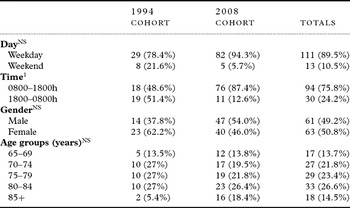
There were a total of 124 initial detentions, with 37 detentions in the 1994 cohort and 87 detentions in the 2008 cohort, giving a rate of 68 and 141 detentions per 100,000 of the respective over-65 age populations. All the 1994 detentions were emergency detentions; of the 2008 detentions, 24 (27.6%) were emergency detention orders and 63 (72.4%) were initial short-term detention orders. More daytime detentions (p = 0.000) occurred in the 2008 group (Table 1).
Day and time of detention, gender and age groups for the 1994 (N = 37) and 2008 (N = 87) cohorts, as patient numbers and percentages

1Variable displays significant inter-cohort differences at the 5% level.
NS Variable displays non-significant inter-cohort differences.
Patient characteristics
Age groups and gender distributions are given in Table 1. There were no significant differences between these patient variables in a comparison of the 1994 and 2008 cohorts. A total of 46 (37.1%) patients had previous admissions to psychiatric hospitals, with 25 (20.2%) being previously detained under mental health legislation (not significant).
Lack of significant differences was also highlighted in the comparison of 1994 and 2008 detainee populations, respectively, at the time of detention for the following: detention in a hospital (37.8% v 64.4%); diagnoses of organic mental disorders particularly dementias (56.8% v 74.7%); use of alcohol (5.4% v 4.6%); substance misuse; evidence of psychotic features (37.8% v 46.0%); creating a public disturbance (16.2% v 26.4%); damaging property (13.5% v 11.5%); displaying violence to others (35.1% v 52.9%,); exhibiting self-injurious behaviors (8.1% v 8.0%); police involvement (10.8% v 10.3%); whether the patient was previously known to the detaining doctor (58.6% v 67.8%); or in relation to hospital of detention or admission.
Detaining practitioners
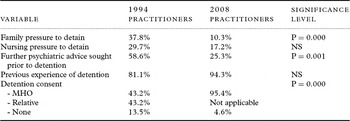
The detaining medical practitioners differed between the two cohorts (p = 0.000): the 2008 cohort were more likely to be consultant psychiatrists (73.6% v 18.9%) than general practitioners (16.1% v 45.9%) or sub-consultant grade psychiatrists (10.3% v 35.1%). Further comparisons are shown in Table 2, which includes consent to detention.
Comparison of detaining practitioner experiences, and consents to detention for the 1994 (N = 37) and 2008 (N = 87) cohorts, as percentages

MHO = mental health officer
Detention outcomes
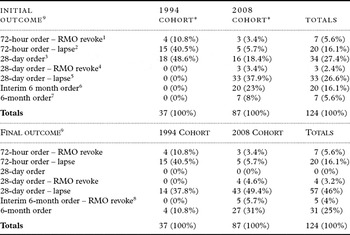
The outcomes of the detentions for the two periods differed (p = 0.000) (Table 3). The initial outcomes are for the immediate outcome of the index detention; the final outcomes record the ultimate detention record for that patient during the admission.
Initial and final outcome of detentions for the 1994 (N = 37) and 2008 (N = 87) cohorts, as patient numbers and percentages

*Both the initial and final outcomes differed significantly between the two cohorts (p = 0.000).
1 72-hour detention order (s24/s25 (1984 MHA) or emergency detention order (2003 MHA)) revoked prior to the full detention period by the responsible medical officer, or equivalent.
2 72-hour detention order (s24/s25 (1984 MHA) or emergency detention order (2003 MHA)) expired at the end of the allowed detention period.
3 28-day detention order (s26 (1984 MHA) or short term detention order (2003 MHA)).
4 28-day detention order (s26 (1984 MHA) or short term detention order (2003 MHA)) revoked prior to the full detention period by the responsible medical officer, or equivalent.
5 28-day detention order (s26 (1984 MHA) or short term detention order (2003 MHA)) expired at the end of the allowed detention period.
6 6-month detention order (s18 (1984 MHA) or compulsory treatment order (2003 MHA)) granted by the MHTS for an interim period (maximum 56 days).
7 6-month detention order (s18 (1984 MHA) or compulsory treatment order (2003 MHA)) granted by the MHTS.
8 6-month detention order (s18 (1984 MHA) or compulsory treatment order (2003 MHA)) granted by the MHTS for an interim period (maximum 56 days) revoked prior to the full detention period by the responsible medical officer, or equivalent.
9 For example, an index 72-hour order progressed to a 28-day order (“initial outcome”), then to an interim 6-month order, then finally to a 6-month order (“final outcome”).
RMO = responsible medical officer; MHA = Mental Health Act; MHTS = Mental Health Tribunal for Scotland.
Variable comparisons
There were no significant differences in terms of gender for the examined variables in the 1994 and 2008 cohorts of patients.
When the younger (65–79-year-old) detainee group was compared to the older (80 years and older) group, there were no significant differences noted for the 1994 cohort. However, the 2008 cohort had higher levels of organic diagnoses in the older group (92.3% v 60.4%, p = 0.001) who, in addition, had lower rates of previous psychiatric admissions (15.4% v 47.9%, p = 0.001) compared to the younger group.
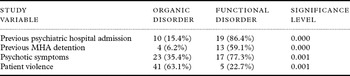
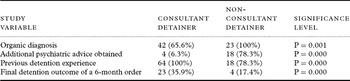
There were no statistically significant findings for “organic” diagnoses compared with functional diagnoses in the 1994 cohort, with the few significant findings for the 2008 cohort given in Table 4. The few significant comparisons for detentions by psychiatric consultants and all other detaining physicians in the 2008 cohort are indicated in Table 5. There were no significant findings in this regard for the 1994 cohort.
Significant differences between “organic” and “functional” mental disorders for the 2008 (N = 87) cohort, as patient numbers and percentages

Significant differences between consultant and non-consultant grade detaining clinicians for the 2008 (N = 87) cohort, as patient numbers and percentages

Discussion
This study confirms reports of increased rates of detentions for older adults over time (Mental Welfare Commission for Scotland, 2007; Mulder et al., Reference Mulder2008), with a recorded two-fold increase in the rate of initial detentions for the over 65-year-old population in the Scottish region of Fife. This increase may reflect changes in clinical attitude, legal precedent and legislative reform, including the recent legislation dealing with incapable adults, which may be of particular relevance to individuals with dementia. This would also likely include a response to the “Bournewood judgment” (HL v UK, 2004), in which the European Court of Human Rights found that the informal admission to a psychiatric hospital of a compliant but incapacitated adult was in contravention of Article 5 of the European Convention on Human Rights, and noted that the common law doctrine of necessity did not provide the requisite safeguards for informal detention of compliant but incapacitated patients.
The “Bournewood” case resulted in changes to the admission procedures for incapacitated adults to care homes and hospitals in the UK where they are, or may be, deprived of their liberty, with practitioners now being more persuaded to apply for formal detention orders for hospitalized incapable adults if there is significant deprivation of liberty (Kearney and Treloar, Reference Kearney and Treloar2000). The Mental Welfare Commission for Scotland (2008) found that people with dementia had better human rights safeguards when the 2003 Act was used.
The mental capacity of older adult psychiatric inpatients to consent to admission and treatment continues to be questioned, with 30% of patients over the age of 65 years being placed on a 72- hour emergency detention order within 24 hours of their admission (Jacob and Freer, Reference Jacob and Freer2005), and 75% of patients without capacity for admission reported not to be detained legally (Maxmin et al., Reference Maxmin, Cooper, Potter and Livingston2009). An earlier study reported a 48% prevalence of lack of capacity to consent to psychogeriatric admission that was associated with a diagnosis of dementia, increased severity of cognitive impairment, reduced insight and detention under mental health legislation (Mukherjee and Shah, Reference Mukherjee and Shah2001).
In Scotland, placing an incapable adult in hospital for treatment for mental disorder against his will can only be carried out by making an application formally to detain the adult in hospital under the 2003 Act. However, where it is not against the patient's will, treatment by way of admission to hospital may be permitted under the Adults with Incapacity (Scotland) Act 2000 (the “2000 Act”). It is not always necessary to detain an adult formally under the 2003 Act because he is unable to consent to treatment for mental disorder. If an adult with incapacity who is not formally detained under the 2003 Act requires treatment for a mental disorder, this may be given under the 2000 Act, with exceptions (Scottish Government, 2010). If the adult resists that treatment, consideration should be given to whether it would be appropriate for him to be formally detained under the 2003 Act in order that he might benefit from the added protections which that Act offers. Clinicians have, however, expressed confusion regarding this interplay of the 2003 Act and the Adults with Incapacity (Scotland) Act 2000 (Stevenson, in press).
The current study does report higher, although non-significant, levels of detentions in hospitals of patients with organic mental disorders, mainly dementias, for the 2008 cohort (74.7%) compared to the 1994 cohort (56.8%); both figures are much higher than the reported 12% in an English study reporting 61 emergency sections in an elderly inpatient series (Salib et al., Reference Salib, Tadros, Ambrose and Allington2000). This level of organic diagnoses compares with the 48.3% of over-65s with organic illnesses assessed under Section 2 or 3 of the 1983 Mental Health Act in England during a three-month period in 1999 (McPherson and Jones, Reference McPherson and Jones2003), the 56% of elderly detentions with a diagnosis of Alzheimer's disease in an earlier inpatient study (Neville et al., Reference Neville, Boyle and Baillon1999), the 53% with an organic illness during a six-year retrospective review (Gilmore et al., Reference Gilmore, Wood and Rigby1994), and the 36% with dementia in an English district old age psychiatry service covering a mixed rural and urban population with about 60,000 people aged over 65 years (Morris and Anderson, Reference Morris and Anderson1994), similar to the current study population.
Other studies report a near three-fold rise in the rate of formal admissions of people with dementia (Lelliott and Audini, Reference Lelliott and Audini2003), with increases of emergency involuntary admissions for patients with dementia (59%) and other organic mental disorders (40%) in the Netherlands in the period 2000–2004 (Mulder et al., Reference Mulder2008).
The non-significant swing to higher levels of male detentions in the 2008 cohort reflects previous findings in which, until 1994–1995, more women than men were detained under Part II of the English Mental Health Act, and after that time, slightly more men were detained (Department of Health, 1999; Audini and Lelliott, Reference Hatfield, Huxley and Mohamad2002). Between 33% and 46% of the two cohorts had experienced previous admission to psychiatric hospital care, higher than the reported 25% of 16 detainees in an English hospital study (Neville et al., Reference Neville, Boyle and Baillon1999).
The 2003 Act produced a shift in detention patterns, including the majority (73.6%) of detentions being made now by consultant mental health practitioners compared to general practitioners (45.9%) under the 1984 Act, and with the majority of detentions now occurring during “normal” working hours (87.4% v 48.6%). As a consequence, there was reduced requirement for emergency detention procedures and a greater level of appropriate clinical knowledge and experience of mental health detentions brought to focus on the appropriateness and necessity of detention. While previous studies have recorded a deficiency in the understanding of Scottish emergency detention procedures among non-psychiatrists (Baig et al., Reference Baig, Walker, Crowe, MacHale, Aditya and Potts2008), the current process is aided by the absolute requirement of MHO consent to a STDO in the 2003 Act, reducing the potential for inappropriate detentions (Stevenson, Reference Stevenson1999; Reference Stevenson2003). This shift has, however, resulted in an increased workload as predicted (Taylor and Idris, Reference Taylor and Idris2003) and altered clinical prioritization for many consultant psychiatrists and MHOs, possibly at the expense of informal clinical care (Atkinson et al., Reference Aitkinson, Lorgelly, Reilly and Stewart2007), although here the authors note limitations to their study, notably the low response rate. In addition, involuntary detention may correlate poorly with levels of need (Carney, Reference Carney2007).
The responsible medical officer (RMO) revoked (prior to the 72-hour order expiring) 13.3% and 13% respectively of the 72-hour orders of the 1994 and 2008 cohorts issued by non-consultant clinicians, suggesting possible ongoing inappropriate application of the legislation, particularly when many (21.7%–23.3%) of the non-consultant clinicians have no prior experience of detention or do not obtain (13%–63.3%) MHO consents to detention. Differences in community psychiatric care and provision can influence both detention requirement and outcomes (Hatfield et al., Reference Hatfield, Huxley and Mohamad1997; Stevenson, Reference Stevenson1999). In addition, a greater importance of the situational context over professional role in emergency detentions has been suggested (Stevenson, Reference Stevenson2003). The 48.6% conversion rate from a 72-hour detention order to a 28-day order in the 1994 cohort is similar to the 54% conversion rate in a previous study (Salib et al., Reference Salib, Tadros, Ambrose and Allington2000) but lower than a reported 78% conversion rate (Jacob and Freer, Reference Jacob and Freer2005), although both of these English studies examined elderly inpatient populations.
There was a significant change to the final outcome of detention between the two periods examined, with higher levels of progression to 6-month detention orders in the 2008 cohort (31% v 10.8%), and reduced levels of revocation or lapsing of 72-hour orders (9.1% v 51.3%). Higher levels of progression to longer-term detentions were also noted for general adult psychiatric admissions following the introduction of the 2003 Act (Smith and White, Reference Smith and White2007). Thus the 2003 Act appears to have contributed to both higher rates and longer periods of detention of the older adult population, which appears counterintuitive to international trends in ethical, legal and civil rights which promote patient autonomy with less infringement on freedom as well as improved community care. The longer periods of detention may again reflect on clinicians' perspectives on the appropriateness or validity of the common law doctrine of necessity. It may also reflect changes in the administrative function of the 2003 Act, with the responsibility for determining longer periods of detention having been removed from the Sheriff courts to a mental health tribunal service where there have been concerns regarding the number of interim CTOs being granted, particularly in the earlier years of its operation (Mental Health Tribunal for Scotland, 2010).
The longer periods and higher rates of detention are possibly also a reflection of the changing nature of the types of patients brought to the attention of mental health services, although this study demonstrated relatively few significant differences between the two patient cohorts. The 2008 cohort had higher levels (44.8% v 32.4%) of over 80-year olds with greater levels of organic diagnoses and recorded violence, reflecting this changing nature. The non-significant shifts to greater levels of violence between the 1994 and 2008 cohorts overall (35.1% v 52.9%) may be due to greater acknowledgement and recording, or possibly due to less tolerance, by clinicians of such behavior. Violence against others is a recognized risk factor for involuntary admission of older adults (Blank et al., Reference Blank, Vingiano and Schwartz1989; Salib et al., Reference Salib, Tadros, Ambrose and Allington2000), and in the current study the levels of recorded violence (35%–53%) were of a similar magnitude to a prospective English study recording risk of assault among older adults (63%) being assessed under the relevant mental health legislation (McPherson and Jones, Reference McPherson and Jones2003).
The place of detention did not change significantly between the cohorts although was primarily domiciliary-based (59.5%) in the 1994 cohort and hospital-based (64.4%) in the 2008 cohort, reflecting perhaps the influence of the “Bournewood” effect and office location of the consultant psychiatrists who were responsible for the majority of detentions in 2008. The higher level of domiciliary-based detentions in the earlier cohort was lower than that recorded in an English study examining 132 episodes of detention in patients over 65 years of age, in which 79.5% of the patients were detained after assessment at home (Gilmore et al., Reference Gilmore, Wood and Rigby1994).
This study may have been limited by the relatively small number of detentions (124 overall) and by restricting the study to one health board region. Examination of several Scottish regions may have provided more robust information. The practice of the detaining clinicians may have altered in the knowledge that detentions were being studied. However, this Hawthorne effect is likely to have been similar for both cohorts, although it was unlikely that the same clinicians were involved during the two study periods.
In conclusion, this study has demonstrated an increased rate of detentions among the older adult population in this Scottish health board region during the period of investigation. There has been an increase in detentions of patients with organic diagnostic categories in the over-80s age group, with a reduced rate of “emergency” detentions, longer overall detention periods, and greater involvement of relevant consultant-grade psychiatrists in the detention process. Such clinical involvement should ensure that “a thorough understanding of the Act should be matched with an equal ability for its correct application and implementation” (Stevenson, Reference Stevenson2003), which is of particular importance when acknowledging that overriding patient autonomy under the auspices of mental health legislation is a serious restriction of an individual's civil liberties. The recorded higher rates and longer periods of civil detention may reflect changes in clinical and legal attitudes from a previous paternalistic view held in medicine, when clinicians were possibly more reliant on the common law doctrine of necessity in management of incapacitated older adults, to the demands for a more transparent and legalistic framework. This in turn may signal future clinical requirements, not only in terms of clinical staffing given the projected demographic swing to an older population, but may also point towards the need for greater emphasis on earlier identification, intervention and management of clinical issues in an attempt to minimize the development of further problems that may ultimately result in the “necessity” of clinico-legal intervention.
Conflict of interest
None.
Acknowledgments
I gratefully acknowledge the assistance of Andrew Elders, Statistician, Health Services Research Unit, University of Aberdeen, UK.