High-throughput determination of the composition-dependent interdiffusivities in the ternary and higher-order alloy systems has been a long-standing difficulty in the field of materials science, and attracts a wide range of research interests,[ Reference Dayananda and Sohn 1 – Reference Belova, Sohn and Murch 6 ] especially with the boost of the Materials Genome Initiative (MGI)[ Reference Kaufman and Ågren 7 , Reference Olson and Kuehmann 8 ] and/or Integrated Computational Materials Engineering (ICME)[ Reference Gottstein 9 ] projects nowadays. In 2014, two of the present authors proposed a pragmatic numerical inverse method for determining the composition-dependent interdiffusivities in ternary systems by means of a single diffusion couple.[ Reference Chen, Zhang, Du, Huang and Tang 10 ] Based on the measured composition–distance profiles in a single diffusion couple, the ternary interdiffusivities along the entire diffusion path can be efficiently acquired via the proposed pragmatic numerical inverse method. The reliability of the pragmatic method has been validated in several ternary diffusion couples, including Co–Cr–Nb, Co–Cr–Ta, Co–Nb–Ta, Co–Fe–Ni, and Cu–Ag–Sn,[ Reference Chen, Zhang, Du, Huang and Tang 10 , Reference Xu, Chen, Zhang, Du and Tang 11 ] by comprehensively comparing with the limited results of the traditional Kirkaldy–Matano method.[ Reference Kirkaldy and Young 12 ] However, during more than 1-year continuous development of the proposed numerical inverse method, several problems appeared when it was either employed to obtain the high-quality datasets or applied to multicomponent alloys. Therefore, it is necessary to first list those problems and their possible solutions as follows.
Problem 1: The determined interdiffusivities at the common intersection points along the diffusion paths of different diffusion couples might be different.
Such slight differences truly exist when different sets of adjustable parameters are utilized for different groups of diffusion couples. One of the solutions to completely eliminate such differences is to employ one set of adjustable parameters in the pragmatic numerical inverse method for different diffusion couples at one or more temperatures. With the only one set of adjustable parameters, the obtained interdiffusivities at the same composition must be the same. Moreover, if the experimental information is sufficient, the interdiffusivity plane over the investigated composition range can be nicely constructed.
Problem 2: When the thermodynamic description for the target alloy is absent, is the proposed numerical inverse method still applicable?
The answer is “Yes”. In the spirit of numerical inverse method, the quality of the obtained interdiffusivities is only determined by the fit degree of the model-predicted concentration profiles to the experimental ones. Whether the thermodynamic factor is accurate or not does not affect the reliability of the finally obtained interdiffusivities. Thus, the proposed numerical inverse method is still applicable when the thermodynamic description for the target alloy is absent. In this case, the thermodynamic factors and mobility parameters in the numerical inverse method are only treated as the numerical parameters without any physical meaning.
Problem 3: Is the proposed numerical inverse method applicable in multicomponent alloys?
The answer is also “Yes”. As already mentioned in our previous paper,[ Reference Chen, Zhang, Du, Huang and Tang 10 ] one of the advanced features in the proposed numerical inverse method lies in that it can be easily extended to evaluate the composition-dependent interdiffusivities in multicomponent systems. Actually, the proposed numerical inverse method can cover the cases ranging from binary, ternary to any multicomponent alloys.
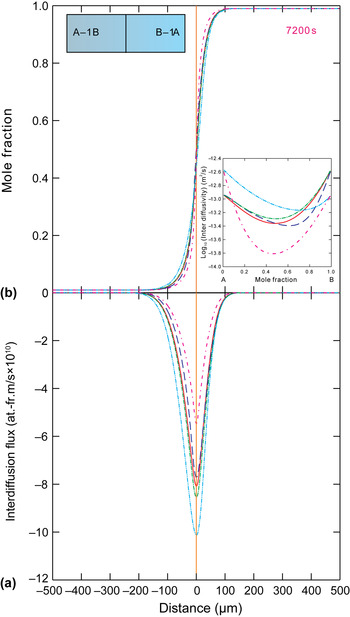
In addition to the above-mentioned three problems, there is also one point which can be improved in the proposed numerical inverse method. Figure 1 shows the model-predicted composition profiles of solute B and the corresponding interdiffusion fluxes in a hypothetical A–0.01B/A–0.99B (in mole fraction) binary diffusion couple based on five sets of binary interdiffusivities (also shown in the plot). As can be seen, different sets of interdiffusivities lead to different composition profiles and interdiffusion fluxes. However, the differences among composition profiles are not so apparent as those among interdiffusion fluxes, indicating that the interdiffusion flux is more sensitive to the variation of the composition-dependent interdiffusivities than the composition profile. Therefore, it should be not enough to use the fit degree of the model-predicted composition profile to the experimental data as the only criteria to judge the quality of the obtained composition-dependent interdiffusivities. The fit degree of the model-predicted interdiffusion fluxes to the experimental data also needs to be considered.
(color on web) Model-predicted composition profiles and interdiffusion fluxes of solute B in a hypothetical A–0.01B/A–0.99B (in mole fraction) binary diffusion couple annealed at a certain temperature for 7200 s based on five different sets of binary interdiffusivities.

Consequently, an augmented numerical inverse method which can solve all the above-mentioned problems is to be developed in the present work. Moreover, the application of the augmented numerical inverse method in different binary, ternary, and quinary alloys will be also demonstrated.
In a phase with N components, the composition evolution of component i is governed by Fick's second law,
 $$\displaystyle{{\partial c_i} \over {\partial t}} = \displaystyle{\partial \over {\partial x}}\left( {\sum\limits_j^{N - 1} {\tilde D_{ij}^N \displaystyle{{\partial c_j} \over {\partial x}}}} \right)\quad (i = 1,2, \ldots, N - {\rm 1}),$$
where c
i
is the composition of component i, x is the diffusion distance, t is the diffusion time,
 $$\tilde D_{ij}^N $
is either main or cross-interdiffusivity with component N chosen as the solvent. According to Manning's random alloy model,[
Reference Manning
13
] the interdiffusivity
 $$\tilde D_{ij}^N $
(i, j = A, B,…, N – 1) can be related to the mobility M
i
via[
Reference Chen, Zhang, Du, Huang and Tang
10
,
Reference Chen, Zhang, Du and Huang
14
]
 $$\eqalign{\tilde D_{ij}^N & = RT\left( {M_i\Phi _{ij}^N - c_i\sum\limits_m {M_m\Phi _{mj}^N } } \right) \cr & \quad + s\left[ {M_i - \sum\limits_m {(c_mM_m)} } \right]\left[ {\displaystyle{{2c_iRT\sum\nolimits_m {(M_m\Phi _{mj}^N )} } \over {A_0\sum\nolimits_m {(c_mM_m)} }}} \right],} $$
where R is the gas constant, and T is the temperature. The second term on the right-hand side of Eq. (2) denotes the vacancy-wind effect, and its contribution is determined by the parameter s (i.e., equals either 0 or 1). The parameter A
0 is a factor depending only on crystal structure, and for instance equals to 7.15 for face centered cubic (fcc) crystals.[
Reference Manning
13
] The thermodynamic factor
 $\Phi _{ij}^N $
is expressed by
 $$\Phi _{ij}^N = \displaystyle{{c_i} \over {RT}} \cdot \left( {\displaystyle{{\partial \mu _i} \over {\partial c_j}} - \displaystyle{{\partial \mu _i} \over {\partial c_N}}} \right),$$
where the chemical potential μ i can be obtained from the corresponding thermodynamic descriptions. Following the treatment in our previous paper,[ Reference Chen, Zhang, Du, Huang and Tang 10 ] the composition-dependent M i in a N-component phase can be given in CALPHAD formalism as
 $$\eqalign{& M_i = \displaystyle{1 \over {RT}}\exp \cr & \qquad \times\left( {\displaystyle{\matrix{\sum\nolimits_{\,j = A}^N {c_j\Delta G_i^j} + \sum\nolimits_j {\sum\nolimits_{k \ne j} {c_jc_k\Delta G_i^{\,j,k}}} \hfill \cr + \sum\nolimits_j {\sum\nolimits_{k \ne j} {\sum\nolimits_{l \ne j,k} {c_jc_kc_l\Delta G_i^{\,j,k,l}}}} + \cdots \hfill} \over {RT}}} \right),} $$
where
 $\Delta G_i^j $
,
 $\Delta G_i^{\,j,k} $
, and
 $\Delta G_i^{\,j,k,l} $
are the end-members and interaction parameters for diffusion of element i in element j and in the binary and ternary systems, respectively. By combining Eqs. (1)–(4), the composition profile of component i can be nicely simulated.
Moreover, the more sensitive interdiffusion flux needs to be considered, as mentioned above. The interdiffusion flux for component i in a phase with N components can be calculated on the basis of Fick's first law:
 $$\tilde J_i^{{\rm cal}} = - \sum\limits_j^{N - 1} {\tilde D_{ij}^N \displaystyle{{\partial c_j} \over {\partial x}}\quad} {\rm} (i = 1,2, \ldots, N - {\rm 1}),$$
while the experimental interdiffusion flux at any section x′ can be obtained from the experimental concentration profiles by introducing a normalized composition variable Y
i
 $\left( {Y_i = (c_i - c^{\rm L})/(c^{\rm R} - c^{\rm L})} \right)$
,[
Reference Dayananda
15
]
 $$\eqalign{& \tilde J_i^{\exp} = \displaystyle{{c_i^{\rm L} - c_i^{\rm R}} \over {2t}} \left[ {Y_i^{\prime} \cdot \int_{ - \infty} ^{x{\prime}} {(1 - Y_i)} \,{\rm d}x + (1 - Y_i^{\prime} ) \cdot \int_{x^{\prime}}^\infty {Y_i} \,{\rm d}x} \right],} $$
where c L and c R are the compositions at the far left and far right ends of the diffusion couple, respectively.
Following the similar strategy in the previous paper,[
Reference Chen, Zhang, Du, Huang and Tang
10
] a house-made C++ program consisting of three modules (i.e., “read-in”, “fitting-check”, and “write-out”) was compiled to determine the composition-dependent interdiffusivities from a single diffusion couple. In the “fitting-check” module, an optimal set of adjustable parameters in Eq. (4), such as
 $\Delta G_i^j $
,
 $\Delta G_i^{\,j,k} $
, and
 $\Delta G_i^{\,j,k,l} $
, are carefully chosen by iterative fitting until the minimization of the error between the measured and the calculated composition and interdiffusion flux profiles is achieved
 $$\eqalign{&\min \left\langle {\rm error} \right\rangle \cr & = \min \left\langle w_{\rm c} \cdot \sum\limits_{i = A}^N \sum\limits_{j = 1}^{\rm Num} \displaystyle{(\vert c_{ij}^{\rm cal} - c_{ij}^{\exp} \vert ) \over c_{ij}^{\exp}} + w_{\rm J} \cdot \sum\limits_{i = A}^N \sum\limits_{j = 1}^{\rm Num} \displaystyle{(\vert \tilde{J}_{ij}^{\rm cal} - \tilde{J}_{ij}^{\exp} \vert ) \over \vert \tilde{J}_{ij}^{\exp}\vert} \right\rangle,} $$
where
 $c_{ij}^{{\rm cal}} $
,
 $\tilde J_{ij}^{{\rm cal}} $
,
 $c_{ij}^{{\rm exp}} $
, and
 $\tilde J_{ij}^{{\rm exp}} $
are the calculated and the experimental composition and interdiffusion flux of component i at the jth point, respectively, and “Num” is the number of the experimental data. In general, the weights of composition and interdiffusion flux in the minimization, w
c and w
J, are set to 0.5.
Thus, one can evaluate the composition-dependent interdiffusivities in the target via Eqs. (1)–(7). The corresponding standard deviation (SD) can be calculated by using the scientific statistical method.[ Reference Ben Abdellah, Gasser, Bouziane, Grosdidier and Busaidi 16 , Reference Lechelle, Noyau, Aufore, Arredondo and Audubert 17 ] Before the application of the presently proposed augmented numerical inverse method in real cases, some notes should be presented. The purpose of Eq. (2) is to express interdiffusivity by introducing some adjustable parameters, i.e. mobility and thermodynamic factor here. Actually, the expression for Eq. (2) can be either physical or purely mathematic, and cannot affect the quality of the interdiffusivities evaluated from Eqs. (1) and (5)–(7). If the thermodynamic factors in Eq. (2) are reliable (like those due to the critical CALPHAD assessment), the evaluated mobilities from Eq. (4) should be with physical meaning. While the reliable thermodynamic description for the target phase is absent, the thermodynamic factors and the evaluated mobilities are treated as numerical parameters.
In order to validate the augmented numerical inverse method developed in the present work, the binary fcc Ni–Os, ternary fcc Cu–Ag–Sn, and quinary fcc Co–Nb–Ta–Ti–W systems are chosen as the target. The originally experimental composition profiles for the three systems are directly taken from the previous publications in our research group.[
Reference Xu, Chen, Zhang, Du and Tang
11
,
Reference Chen, Zhang, Wang, Chen, Tang, Zhang and Du
18
,
Reference Zhang
19
] To demonstrate the advance features of the presently proposed numerical inverse method, the ideal solution model was adopted to describe fcc phases in all the binary Ni–Os, ternary Cu–Ag–Sn and quinary Co–Nb–Ta–Ti–W systems. For the simple ideal solution model,
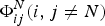 $\Phi _{ij}^N (i,j \ne N)$
equals to 1 if i is j, while this equals to 0 if i is not j. In addition,
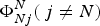 $\Phi _{Nj}^N (\,j \ne N)$
equals to –1. For a direct comparison with the results due to ideal solution model, the real thermodynamic description for a fcc phase in the ternary Cu–Ag–Sn system[
Reference Xu, Chen, Zhang, Du and Tang
11
] was also utilized to evaluate the interdiffusivities in fcc Cu–Ag–Sn system in parallel.
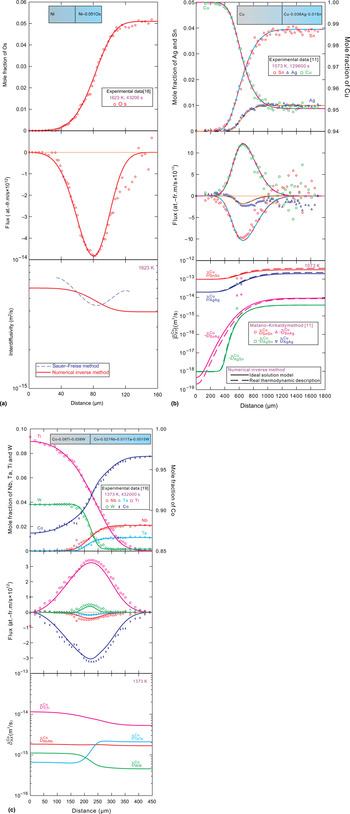
The model-predicted composition profile and interdiffusion flux of Os in the binary Ni/Ni–0.051Os (in mole fraction) diffusion couple annealed at 1623 K for 12 h are presented in Fig. 2(a), together with the corresponding experimental data.[ Reference Chen, Zhang, Wang, Chen, Tang, Zhang and Du 18 ] As can be seen, the model-predicted properties agree well with the experimental data.[ Reference Chen, Zhang, Wang, Chen, Tang, Zhang and Du 18 ] The presently evaluated interdiffusivities in the fcc Ni–Os phase at 1623 K along the entire diffusion path are also displayed in Fig. 2(a). The relative average uncertainty of the presently obtained interdiffusivities for the binary Ni–Os system is evaluated to be 5.27%. Moreover, the interdiffusivities evaluated due to the Sauer–Freise method[ Reference Chen, Zhang, Wang, Chen, Tang, Zhang and Du 18 ] are also superimposed in the plot for a direct comparison. As shown in the plot, the interdiffusivities in fcc Ni–Os alloys at 1623 K obtained by using the present augmented numerical inverse method are close to the results of the Sauer–Freise method over the diffusion region, further validating the reliability of the interdiffusivities obtained by the augmented numerical inverse method. In addition, the unreasonable interdiffusivities at two sides of the diffusion couple resulting from the Sauer–Freise method and other traditional methods can be nicely avoided in the present augmented numerical inverse method. It should be noted that the interdiffusivity is equivalent to the assessed impurity diffusivity[ Reference Chen, Zhang, Wang, Chen, Tang, Zhang and Du 18 ] when the composition of element Os approaches zero, which is due to the fact that the end-members, including self- and impurity diffusivities are directly from the assessed values.
(color on web) Measured and model-predicted composition profiles, interdiffusion fluxes as well as the evaluated interdiffusivities along the entire diffusion paths for (a) binary Ni/Ni–0.051Os (in mole fraction) diffusion couple annealed at 1623 K for 12 h, (b) ternary Cu/Cu–0.038Ag–0.01Sn (in mole fraction) diffusion couple annealed at 1073 K for 36 h, and (c) quinary Co–0.09Ti–0.038W/Co–0.021Nb–0.011Ta (in mole fraction) annealed at 1373 K for 120 h. Symbols are due to the experimental measurement,[ Reference Xu, Chen, Zhang, Du and Tang 11 , Reference Chen, Zhang, Wang, Chen, Tang, Zhang and Du 18 , Reference Zhang 19 ] while solid lines are the results based on the present augmented numerical inverse method. The results due to the Sauer–Freise method for binary system and the Matano–Kirkaldy method for ternary systems are also superimposed for comparison. The relative average uncertainties of the presently obtained interdiffusivities for binary Ni–Os, ternary Cu–Ag–Sn, and quinary Co–Nb–Ta–Ti–W systems are 5.27%, 27.5%, and 32.9%, respectively.

The results for the ternary Cu/Cu–0.038Ag–0.01Sn (in mole fraction) diffusion couple annealed at 1073 K for 36 h are displayed in Fig. 2(b). It can be clearly seen in the figure that the model-predicted composition profiles and interdiffusion fluxes of Cu, Ag, and Sn in the ternary Cu/Cu–0.038Ag–0.01Sn (in mole fraction) diffusion couple agree well with the corresponding experimental data.[
Reference Xu, Chen, Zhang, Du and Tang
11
] The slight deviation between the simulated interdiffusion fluxes and the experimental ones near the side of ternary alloy is caused by the scattered experimental compositions at this far-end and the effect of initial value at the boundary on the calculation of interdiffusion flux. In addition, the comparison between the presently evaluated interdiffusivities of ternary fcc Cu–Ag–Sn system at 1073 K along the entire diffusion paths and the interdiffusivities obtained by using the Matano–Kirkaldy method due to Xu et al.[
Reference Xu, Chen, Zhang, Du and Tang
11
] is made in Fig. 2(b), and a good consistency is clearly obtained, indicating that the interdiffusivities of ternary fcc Cu–Ag–Sn system at 1073 K evaluated using the present augmented numerical inverse method are reliable. It can also be seen from the figure that the cross-interdiffusivities
 $\tilde D_{{\rm SnAg}}^{{\rm Cu}} $
and
 $\tilde D_{{\rm AgSn}}^{{\rm Cu}} $
are more sensitive to the composition variations than the main interdiffusivties. It should be noted here that the model-predicted composition profiles and interdiffusion fluxes due to both ideal solution model and real thermodynamic description agree very well with each other. Moreover, the composition-dependent interdiffusivities evaluated due to the two different sets of thermodynamic treatments also agree with each other in general, except for a slight deviation in the cross-interdiffusivity
 $\tilde D_{{\rm SnAg}}^{{\rm Cu}} $
. This fact strongly supports the above statement that the proposed numerical inverse method can be still applicable generally when the thermodynamic description for the target alloy is missing. Furthermore, the other four ternary Cu–Ag–Sn diffusion couples originally reported in Ref. Reference Xu, Chen, Zhang, Du and Tang
11
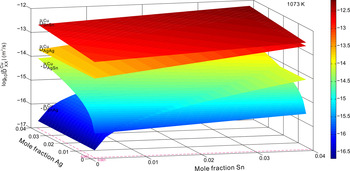
were also included to evaluate the interdiffusivities, and one set of adjustable parameters were successfully obtained on the basis of totally five ternary Cu–Ag–Sn diffusion couples, from which the interdiffusivity planes for fcc Cu–Ag–Sn alloys at 1073 K over the investigated composition region are constructed in Fig. 3. The relative average uncertainty of the presently obtained interdiffusivities for ternary Cu–Ag–Sn system is evaluated to be 27.5%.
(color on web) Interdiffusivity planes for ternary fcc Cu–Ag–Sn alloys at 1073 K.

Figure 2(c) presents the results of one quinary Co–Nb–Ta–Ti–W diffusion couple, Co–0.09Ti–0.038W/Co–0.021Nb–0.011Ta, annealed at 1373 K for 120 h. The model-predicted composition profiles and interdiffusion fluxes based on the present augmented numerical inverse method agree very well with the experimental data,[ Reference Zhang 19 ] indicating that the presently obtained interdiffusivities in quinary Co–Nb–Ta–Ti–W system at 1373 K along the entire diffusion path are reliable. In addition, the relative average uncertainty of the present results for quinary Co–Nb–Ta–Ti–W system is 32.9%. The corresponding cross-interdiffusivities are presented in supplemental online materials for a clear demonstration.
In summary, the three problems existing in the previous pragmatic numerical inverse method were first pointed out and the possible solutions were given. By further including the more sensitive interdiffusion flux as the criteria, an augmented numerical inverse method for high-throughput determination of the composition-dependent interdiffusivities in different alloy systems via a single diffusion couple was then carefully developed and realized in a house-made code. After that, the proposed augmented numerical inverse method was successfully applied in three different solid solution alloys, ranging from binary, ternary to multicomponent systems. The advance features of the proposed augmented numerical inverse method were further demonstrated. It is anticipated that the present augmented numerical inverse method and the corresponding code can be emerged as a powerful tool for the current MGI and ICME projects.
Supplementary material
The supplementary material for this article can be found at http://dx.doi.org/10.1557/mrc.2016.21.
Acknowledgments
The financial support from the National Natural Science Foundation of China (Grant No. 51474239), National Natural Science Foundation for Youth of China (Grant No. 51301208) and the Hunan Provincial Natural Science Foundation for Youth of China (Grant No. 2015JJ3146) is acknowledged. Lijun Zhang acknowledges financial support from the project supported by State Key Laboratory of Powder Metallurgy Foundation, Central South University, Changsha, China. Weimin Chen acknowledges support by the outstanding graduate project of Advanced Non-ferrous Metal Structural Materials and Manufacturing Collaborative Innovation Center, Changsha, China.