INTRODUCTION
Orangutans belong to the family Pongidae and represent the only great ape in Asia. Wild populations are restricted to the islands of Borneo (Pongo pygmaeus) and Sumatra (Pongo abelii), in Indonesia and Malaysia (Rijksen and Meijaard, Reference Rijksen and Meijaard1999). Currently, 3 subspecies of Bornean orangutans are recognized (P. p. pygmaeus, P. p. wurmbii and P. p. morio) (Xu and Arnason, Reference Xu and Arnason1996; Groves, Reference Groves and Yeager1999). In the last few decades, the total number and distribution of orangutans have reduced drastically, primarily as a result of habitat loss (Wich et al. Reference Wich, Meijaard, Marshall, Husson, Ancrenaz, Lacy, Van Schaik, Sugardjito, Simorangkir, Traylor-Holzer, Doughty, Supriatna, Dennis, Gumal, Knott and Singleton2008). In 1997, the population estimate for Bornean orangutans was only 7% of that in 1900 (Rijksen and Meijaard, Reference Rijksen and Meijaard1999), and the species is now classified as endangered by the International Union for Conservation of Nature (IUCN, 2008).
Infectious diseases caused by parasites can pose a severe threat to great ape survival. Parasites can be transmitted between wild and rehabilitant populations, between both of these and other wildlife species, and between great apes and humans and/or their livestock (Hira and Patel, Reference Hira and Patel1980; Ashford et al. Reference Ashford, Reid and Butynski1990; Landsoud-Soukate et al. Reference Landsoud-Soukate, Tutin and Fernandez1995; Michaud et al. Reference Michaud, Tantalean, Ique, Montoya and Gozalo2003; Hope et al. Reference Hope, Goldsmith and Graczyk2004; Appelbee et al. Reference Appelbee, Thompson and Olson2005; Nunn and Altizer, Reference Nunn and Altizer2006; Garber, Reference Garber2008; Pusey et al. Reference Pusey, Wilson and Collins2008). Since orangutans share ~96·4% of their genetic information with humans (see Miyamoto, Reference Miyamoto, Koop, Slightom, Goodman and Tennant1988; Chen and Li, Reference Chen and Li2001), zoonotic diseases are of major significance. Certain viral diseases and parasite infections have already been well documented in African great apes (Eberle and Hilliard, Reference Eberle and Hilliard1989; Brooks et al. Reference Brooks, Rud, Pilon, Smith, Switzer and Sandstrom2002; Grimm et al. Reference Grimm, Beer, Hirsch and Clouse2003; Whitfield, Reference Whitfield2003; Karesh and Reed, Reference Karesh and Reed2004; Graczyk et al. Reference Graczyk, Lowenstine and Cranfield1999, Reference Graczyk, DaSilva, Cranfield, Nizeyi, Kalema and Pieniazek2001, Reference Graczyk, Bosco-Nizeyi, Ssebide, Thompson, Read and Cranfield2002; Sleeman et al. Reference Sleeman, Meader, Mudakikwa, Foster and Patton2000; Freeman et al. Reference Freeman, Kinsella, Cipolletta, Deem and Karesh2004; Van Heuverswyn et al. Reference Van Heuverswyn, Li, Neel, Bailes, Keele, Liu, Loul, Butel, Liegeois, Bienvenue, Ngolle, Sharp, Shaw, Delaporte, Hahn and Peeters2006; Kaur et al. Reference Kaur, Singh, Tong, Humphrey, Clevenger, Tan, Szekely, Wang, Li, Muse, Kiyono, Hanamura, Inoue, Nakamura, Huffman, Jiang and Nishida2008; Williams et al. Reference Williams, Lonsdorf, Wilson, Schumacher-Stankey, Goodall and Pusey2008). Although the occurrence of various pathogenic gastrointestinal parasites has been described in captive, rehabilitant and wild orangutans (Cummins et al. Reference Cummins, Keeling and McClure1973; Collet et al. Reference Collet, Galdikas, Sugarjito and Jojosudharmo1986; Leeflang and Markham, Reference Leeflang and Markham1986; Foitová et al. Reference Foitová, Huffman, Wisnu, Olsansky, Wich, Utami Atmoko, Setia and Van Schaik2009), the distribution and transmission of parasites of orangutans are still poorly understood compared with African great apes.
Captive orangutans are often kept under unnatural conditions and in close contact with humans and/or other animal species, which allows pathogens to be readily transmitted from humans to orangutans (Chitwood, Reference Chitwood1970; Ott-Joslin, Reference Ott-Joslin and Fowler1993) and vice versa. Intestinal parasites that have already been described in orangutans (Rijksen, Reference Rijksen1978; Collet et al. Reference Collet, Galdikas, Sugarjito and Jojosudharmo1986; Wells et al. Reference Wells, Sargeant, Andrews, Anderson and Wells1990; Djojosudharmo and Gibson, Reference Djojosudharmo and Gibson1993; Warren, Reference Warren2001; Kilbourn et al. Reference Kilbourn, Karesh, Wolfe, Bosi, Cook and Andau2003; Mul et al. Reference Mul, Paembonan, Singleton, Wich and Van Bolhuis2007; Foitová et al. Reference Foitová, Huffman, Wisnu, Olsansky, Wich, Utami Atmoko, Setia and Van Schaik2009) have also been identified in humans in Indonesia (Cross et al. Reference Cross, Clarke, Durfee, Irving, Taylor, Partono, Joesoef, Hudojo and Oemijati1975, Reference Cross, Clarke, Cole, Lien, Partono, Djakaria, Joesoef and Oemijati1976; Putrali et al. Reference Putrali, Carney, Stafford and Tubo1977; Joseph et al. Reference Joseph, Carney, Van Peenen, Russell and Saroso1978) and include various genera of Protozoa (Entamoeba, Endolimax, Iodamoeba, Balantidium and Giardia), nematodes (Strongyloides, Ascaris, Enterobius, Trichuris and hookworms), cestodes (Hymenolepis) and trematodes (dicrocoeliids). However, only few studies of orangutan health have been published in recent years (Warren, Reference Warren2001; Kilbourn et al. Reference Kilbourn, Karesh, Wolfe, Bosi, Cook and Andau2003; Mul et al. Reference Mul, Paembonan, Singleton, Wich and Van Bolhuis2007; Foitová et al. Reference Foitová, Huffman, Wisnu, Olsansky, Wich, Utami Atmoko, Setia and Van Schaik2009), and most studies include only small numbers of free-ranging orangutans (see Rijksen, Reference Rijksen1978; Collet et al. Reference Collet, Galdikas, Sugarjito and Jojosudharmo1986; Djojosudharmo and Gibson, Reference Djojosudharmo and Gibson1993; Warren, Reference Warren2001; Mul et al. Reference Mul, Paembonan, Singleton, Wich and Van Bolhuis2007), probably due to the difficulty of acquiring faecal samples from wild individuals. Furthermore, although transmission pathways of parasitic infections should differ between wild and captive populations, factors influencing the infection risk for specific parasites in wild populations compared with those living in captivity have not yet been elucidated.
Conservation efforts that focus on the health management of wild and captive orangutan populations should not only consider parasite prevalence, but also identify parameters that may increase infection risk and the anthropogenic influence on pathogen infections. Therefore, data from larger groups of wild individuals are needed, particularly since orangutans differ profoundly in their biology from African great apes (e.g., Knott, Reference Knott and Ellison2001, Reference Knott, Brockman and Van Schaik2005; Yamagiwa, Reference Yamagiwa, Russon and Begun2004).
In this study, wild Bornean orangutans from 3 distinct populations were compared with captive individuals and groups from 2 re-introduction centres. All sites were located in Kalimantan, Borneo. Differences in parasite prevalence were investigated with respect to ecological and behavioural factors as well as husbandry. The aim of the study was to identify factors that significantly influence the infection risk of individuals for specific parasites under different conditions. Gaining information in this context would provide a first step in understanding whether similar underlying factors influence infection risk in wild and captive orangutan populations, or whether these factors differ.
MATERIALS AND METHODS
Study site
Samples were collected at 2 re-introduction centres, both of which are managed by the Borneo Orangutan Survival Foundation (BOS), Indonesia. The Nyaru Menteng Orangutan Re-introduction Centre (centre 1) was founded in 1998 and is located 28 km north of Palangka Raya (2°21′56·27′′S, 113°55′12·48′′E), the capital of the province of Central Kalimantan. The centre covers 1·5 ha and neighbours the Nyaru Menteng Arboretum, a 62·5 ha lowland swamp forest. The Wanariset Orangutan Reintroduction Centre (centre 2) was founded in 1991 and is located 35 km north of Balikpapan (1°16′01·03′′S, 116°50′01·46′′E), East Kalimantan. Centre 1 is regularly accessed by long-tailed macaques (Macaca fascicularis) and domestic dogs roaming for food. Domestic cats from the neighbourhood are often seen at both centres. Both centres occasionally receive other wild animals through confiscations, including Mueller's gibbons (Hylobates muelleri muelleri), proboscis monkeys (Nasalis larvatus), Bornean slow lorises (Nycticebus menagensis) and sun bears (Helarctos malayanus).
Faecal samples from free-ranging (wild) orangutans were collected from 3 geographically isolated populations at the Tuanan Research Station (site 1) in the Mawas area (2°09′06·1′′S, 114°26′26·3′′E), the Sungai Lading Research Station (site 2), separated from the Mawas area by artificial water channels, and the Natural Laboratory of Peat Swamp Forest, Sabangau (2°19′40·72′′S, 113°54′39·74′′E) (site 3), a protected research area 20 km southwest of Palangka Raya. Orangutan density ranged from 4·25 to 4·5 individuals/km2 in Tuanan (Van Schaik et al. Reference Van Schaik, Wich, Utami and Odom2005), 2·3 individuals/km2 in Sabangau (Ley-Vela, Reference Ley-Vela2005) and 7·74 individuals/km2 at Sungai Lading (Bastian, Reference Bastian2008). All field sites are located in the province of Central Kalimantan and consist of disturbed peat-swamp forest habitat that had previously been subject to selective commercial and informal logging.
Subjects
Investigations at centre 1 were carried out between November 2005 and January 2006, during which time a total of 404 orangutans lived at the centre. Sample collection and analysis at centre 2 was carried out between March and May 2006, when the centre took care of a total of 191 orangutans. Individuals were either captive (confiscated) or semi-captive (wild-caught individuals, living in degraded forest fragments that had entered oil-palm or other plantations, from which they were rescued) and kept under the same husbandry conditions. Because of their different geographical locations, centre 1 had more orangutans of the subspecies P. p. wurmbii, whereas centre 2 had more P. p. morio. Both centres applied the same programme of rehabilitation, aiming to release the apes into protected forest habitat. The field sites were inhabited by 3 distinct populations of P. p. wurmbii. Samples from habituated individuals in field sites were collected over one wet season between November 2005 and April 2006.
Sample collection
A total of 567 faecal samples were collected from orangutans at both the re-introduction centres and the field sites. Between 1 and 4, or 1 and 9 samples, respectively, were collected per individual and group. The number of samples per individual and group depended on different factors; e.g., housing system and social rehabilitation programme in captive and semi-captive orangutans, and monitoring restrictions in wild individuals. To guarantee the same sensitivity for each subgroup of the multivariate analyses, we included only the first sample of each individual (n=224) and group (n=61). Therefore, all prevalences recorded herein must be considered as minimal prevalence rates.
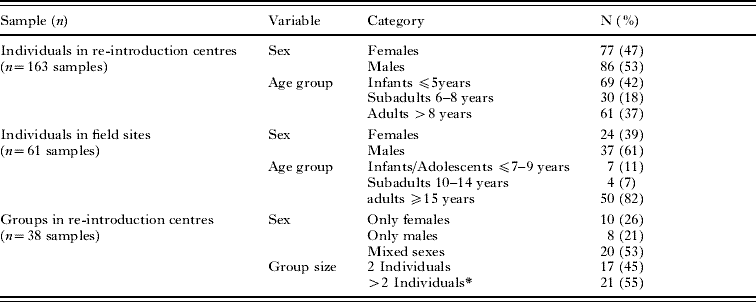
The age of the individuals was estimated by experienced staff at the re-introduction centres and biologists at the field sites, respectively. However, young orangutans, in particular, develop at a different rate in re-introduction centres compared with those in the wild. Following Rijksen (Reference Rijksen1978), and in order to avoid incorrect age classifications, individuals in the re-introduction centres and in the field sites were divided into different age groups (Table 1). The age of 3 individuals was unknown (2%). Thirty-eight faecal samples from orangutans kept in groups (21 and 17 in centres 1 and 2) were collected as blind samples and analysed for intestinal parasites. These groups did not include orangutans that had been investigated individually.
Number of investigated samples with respect to sex, age classes and group size
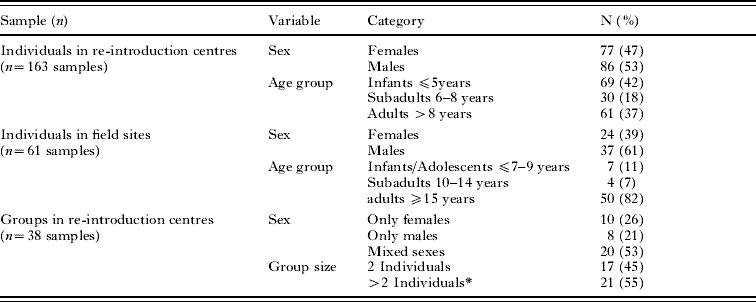
* 3–24 individuals per group.
Sample analysis
The cages in the centres were installed between 20 and 80 cm above the ground. Thus, faeces dropped down between the cage bars, and samples were collected from the ground before the cages were cleaned early in the morning. At the field sites, samples were collected immediately after defaecation. All samples were homogenized thoroughly and examined using different coproscopic techniques to ensure the detection of all parasite stages potentially present in the samples. For the detection of protozoa, the sodium acetate-acetic acid-formalin-concentration (SAFC) technique was applied using 1 g of each sample (Marti and Escher, Reference Marti and Escher1990). Ziehl-Neelsen staining of a faecal smear was used additionally to identify Cryptosporidium spp. (Current, Reference Current and McAdam1989). The Baermann-technique (Garcia and Bruckner, Reference Garcia and Bruckner1997; 10 g) and a combined sedimentation and flotation (Garcia and Bruckner, Reference Garcia and Bruckner1997) were used to detect helminth larvae and eggs (10 g). Egg counts were performed by a modified McMaster technique (Schmidt, Reference Schmidt1971; 4 g). Parasites were identified microscopically on the basis of the morphological characteristics (size, shape, colour and contents) of eggs, cysts and larvae. An ocular micrometer was used to measure the sizes of parasite eggs, cysts and larvae. Identification was mainly made to the genus level, because specific identification was usually not possible.
Statistical analysis
To identify specific factors affecting infection risk of orangutans, multivariate logistic regression modelling was applied, which avoids the pitfalls of univariate analyses. For modelling of the prevalence of identified intestinal parasites in individuals, only parasites with an overall prevalence of ⩾10% were included in the analysis. The variables ‘origin’, ‘age’ and ‘sex’ were selected as the most promising, independent variables for the modelling procedure of each the reintroduction centres and the field sites. Although the majority of orangutans at centres 1 and 2 were either P. p. wurmbii or P. p. morio, respectively, it was not possible to classify each individual to the subspecies level with certainty, because of the possibility of hybrids. For this reason, the variable ‘origin’ primarily includes the geographical location of centres 1 and 2, but also considers the corresponding subspecies.
In order to distinguish infections that were most probably present before entry into the centre and those acquired after arrival, a distinction was made between orangutans depending on how long they had been at the centre before the first sample was collected (new arrivals within 1 week before sampling: n=33 [20%]; arrivals 8–21 days before sampling: n=31 [19%]; and arrivals >21 days before sampling: n=132 [81%], respectively. In addition, the variables ‘group contact’ (with or without tactile contact to neighbouring conspecifics) and ‘captive status’ (captive vs. semi-captive) were included for the reintroduction centres. For the field sites, the variable ‘flanged’ versus ‘unflanged males’ was included because the development of cheek pads is considered a dominance sign in adult male orangutans (Utami et al. Reference Utami, Goossens, Bruford, De Ruiter and Van Hooff2002). Differences in hormonal profiles (flanged males have higher concentrations of testosterone) and specific costs incurred (higher energetic demands due to increased size and injuries from fights) may also lead to decreased immuno-competence in flanged males (Maggioncalda et al. Reference Maggioncalda, Sapolsky and Czekala1999) and, thus might relate to their susceptibility to parasitic infections. This variable was not considered for captive male orangutans, because its effect in situations in which individuals are caged is difficult to measure and the sample size in the study was too small. Finally, the variable ‘mother’ versus ‘non-mother’ was considered for females. For the groups, only the variables ‘origin’, ‘captive status’, ‘group contact’ and ‘group size’ were included in the analysis. The variable ‘group size’ included the absolute number of individuals per group.
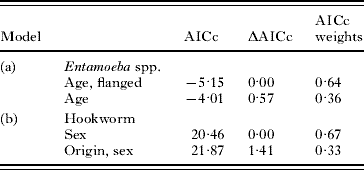
Logistic regression models were calculated for each selected parasite individually. Models were fitted using all possible combinations of the selected predictor variables, but only models that significantly explained variation in the data set (log-likelihood ratio test) were considered for the model-selection process. Best models were selected using Akaike′s information criterion (AIC, Akaike, Reference Akaike, Petrov and Csaki1973; Burnham and Anderson, Reference Burnham and Anderson1998) corrected for small sample sizes (AICc). The model with the lowest AICc was considered the most parsimonious and only models with ΔAICc<2 compared to the model with the lowest AICc were selected. Akaike model weights were calculated (Burnham and Anderson, Reference Burnham and Anderson1998) to determine the degree to which a model was supported by the data. By definition, weights of selected models sum to 1, and higher weights indicate better explanatory power. To evaluate the relative importance of each explanatory variable, the AICc weights were summed over all models where that variable was present. A variable sums to 1 when it is included in all selected models, whereas a variable present in just one model is assigned the value of the corresponding model. The variables were then ranked according to the resulting AICc weight sums. Finally, effect sizes of parameters of the selected models were calculated using model averaging: parameter estimates are multiplied by the weight of the particular model and summed over all selected models containing the particular parameter to give the weighted average of parameter estimates (Johnson and Omland, Reference Johnson and Omland2004). Standard errors were calculated for parameter estimates following Burnham and Anderson (Reference Burnham and Anderson1998). Parameter estimate and 1·96*standard errors were exponentially transformed to express odds ratios and their 95% confidence intervals. An event is equally likely in both groups when the odds ratio is 1. Odds ratios with 95%-CI's that include 1 were not interpreted. Statistical analyses were performed using SPSS 13.0 (Norusis, Reference Norusis1986). The fit of the logistic regression models were tested by likelihood ratio tests. Maximal P values for the likelihood ratio tests are given for the selected models.
RESULTS
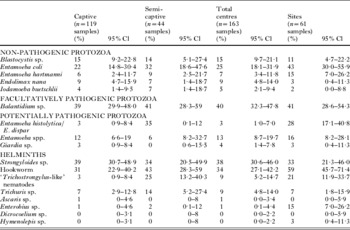
A total of 163 faecal samples from the 2 re-introduction centres (centre 1; 118 samples, centre 2; 45 samples) and 61 wild individuals (sites 1–3; 34, 14 samples and 13, respectively) were examined. Cysts and trophozoites of 6 genera of Protozoa, as well as eggs and larvae of various nematodes were identified (Table 2). In individuals, 3 genera of Protozoa, as well as Strongyloides sp., hookworms and a trichostrongylid nematode had prevalence rates of ⩾10%. Subsequently, parasites whose prevalence was ⩾10% were included in the modelling procedure. Eggs from hookworms measured 62·0±2·0×37·7±2·5 μm and were not identified to genus-level. Other strongylid eggs, measuring 74·4±3·6×45·8±4·0 μm in size, tapered at one end, thin-shelled and colourless, were consistent with Trichostrongylus (and thus termed “Trichostrongylus-like”). The germinal mass did not fill the shell of the eggs.
Prevalence of parasites identified in faecal samples from individuals at re-introduction centres and field sites

The samples of 5 individuals contained Dicrocoelium-like eggs. The eggs were 43±2·4×27·8±2·1 μm in size and had a thick, brown shell, possessing an inconspicuous operculum and a miracidium. The individuals included 3 female and 1 male semi-captive orangutans at centre 1 and 1 captive male at centre 2. Two males and 1 female infant at the Tuanan Research Station tested positive for Hymenolepis. Eggs were 66±6·3 μm in diameter, subspherical, with a firm egg shell and a brown-coloured hue. The eggs lacked polar filaments and contained a hexacanth embryo.
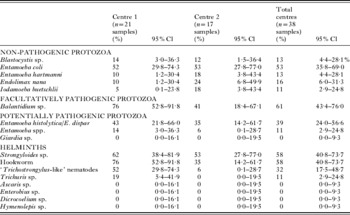
Overall prevalence of intestinal parasites in samples from orangutans housed in groups was much higher than in those housed individually (Table 3). The range of identified parasites did not generally differ between groups and individuals. E. coli, E. histolytica/dispar, Balantidium sp., Strongyloides sp., hookworms and Trichostrongylus-like nematodes had significantly higher prevalences in samples collected from orangutans kept in groups than in individually-housed orangutans and were subsequently selected for the statistical analysis. Only 33 (20·3%) samples from individuals at the centres, the sample from 1 group (2·6%) and 6 (9·8%) samples from wild orangutans tested negative for parasites. All other samples tested positive for between 1 and 9 intestinal parasite species.
Prevalence of parasites identified in faecal samples from groups at re-introduction centres

Except for 6 samples, all collected at centre 1, the number of helminth eggs identified in individuals was always <50 eggs/g (epg) faeces. Higher egg counts were recorded for 2 males ⩽5 years of age with tactile contact to conspecifics (Trichuris sp.: 300 epg, Strongyloides sp.: 50 epg), 1 female of the same age group but without tactile contact (Strongyloides sp.: 10 700 epg, hookworms: 13 350 epg, Trichostrongylus-like nematodes: 400 epg, Trichuris sp.: 150 epg) and one 6 to 8-year-old male without tactile contact (Strongyloides sp.: 1100 epg). The samples of two >8-year-old males without tactile contact to conspecifics had higher egg counts for 3 (Strongyloides sp.: 50 epg, hookworms: 600 epg, Trichostrongylus-like nematodes: 650 epg) and 2 helminths (Strongyloides sp.: 750 epg, hookworms: 250 epg), respectively. All samples from groups contained <50 epg with the exception of 1 sample with 1050 epg for Strongyloides sp. and 500 epg for hookworms, and 1 sample with 100 epg for Trichuris sp., both from centre 1.
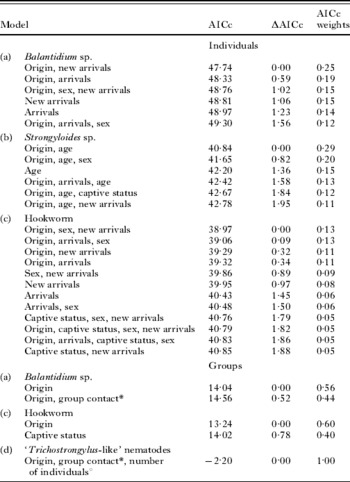
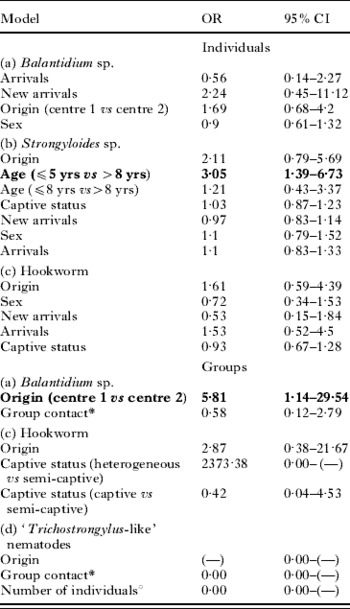
The model selection procedure revealed significant models for several parasites (individuals in re-introduction centres: Balantidium sp., Strongyloides sp., hookworm; groups in re-introduction centres: Balantidium sp., hookworm, Trichostrongylus-like nematodes; wild individuals: Entamoeba spp., hookworm). For these parasites, several models with similar explanatory power were selected (ΔAICc<2; Tables 4 and 5).
Results from logistic-regression model selection to explain prevalence rates of Balantidium sp., Strongyloides sp. and hookworm in Bornean orangutans at re-introduction centres (individuals: n=163; groups: n=38)

* Group contact=without tactile contact vs with tactile contact.
° Number of individuals=number of individuals per group.
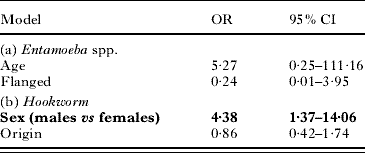
Results from logistic-regression model selection to explain prevalence rates of Entamoeba spp. and hookworm in Bornean orangutans at field sites (n=61)
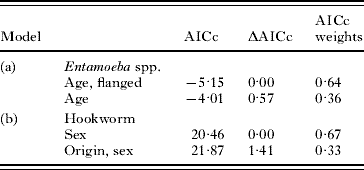
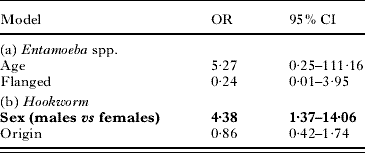
The averaged models comprised all factors that were added to the model-selection procedure. With 2 exceptions, the 95% CI for all odds ratios included 1 and were therefore not discussed. In individuals, only age for Strongyloides sp. at the centres and gender for hookworms at the field sites were found to be significant (Tables 6 and 7). Total prevalence for individuals ⩽5 years was 53·6% (95% CI 41·2–65·7), 6–8 years 26·7% (95% CI 12·3–45·9) and >8 years 27·9% (95% CI 17·1–40·8). Wild males had an overall prevalence of 73% (95% CI 55·9–86·2) and females of 38% (95% CI 18·8–59·4). There was no significant difference between the 3 field sites. In groups, only ‘origin’ for Balantidium sp. yielded a significant result in that the infection risk was higher in centre 1 than in centre 2 (Table 6).
Odds ratios (OR) and 95% confidence intervals (CI) for the averaged models for individuals and groups at re-introduction centres

* Group contact=without tactile contact vs with tactile contact.
° Number of individuals=number of individuals per group.
Odds ratios (OR) and 95% confidence intervals (CI) for the averaged models for individuals at field sites
DISCUSSION
Our analysis yielded 3 significant results, 1 for the field sites and 2 for the re-introduction centres. For the field sites, the ranking of the variables according to the AICc weight sums resulted in a significantly higher infection risk for hookworms in wild males than in females. No significant difference was found between flanged and unflanged males, indicating that the rank status does not influence infection risk in Bornean males. In humans, hookworms include Ancylostoma duodenale and Necator americanus, which produce eggs that cannot be distinguished morphologically (Muller, Reference Muller2002). Hookworms are geohelminths, transmitted through oral, percutaneous and/or transmammary pathways. Mul et al. (Reference Mul, Paembonan, Singleton, Wich and Van Bolhuis2007) found a significantly higher total prevalence for intestinal parasites in wild females than in males, and interpreted this to be a result of females and their offspring having more frequent physical contact with conspecifics, compared with males. The percentage of wild individuals infected with Strongyloides, another soil transmitted nematode, was 33% in this study and 47% in the study by Mul et al. (Reference Mul, Paembonan, Singleton, Wich and Van Bolhuis2007). Parameters such as the level of arboreality or terrestriality influence parasite occurrence and prevalence in wild animal populations (Loehle, Reference Loehle1995; Vitone et al. Reference Vitone, Altizer and Nunn2004). Male Bornean orangutans are less territorial than females and frequently forage and travel over long distances on the ground, whereas this behaviour is rare for Sumatran orangutans (Delgado and Van Schaik, Reference Delgado and Van Schaik2000). Male home ranges are also much larger than those of females (Singleton and Van Schaik, Reference Singleton and Van Schaik2001; Setia et al. Reference Setia, Delgado, Utami Atmoko, Singleton, Van Schaik, Wich, Utami Atmoko, Setia and Van Schaik2009), probably 3–5 times the size of female ranges, which are estimated to vary between 250 and 600 ha for P. p. wurmbii (see Utami Atmoko et al. Reference Utami Atmoko, Singleton, Van Noordwijk, Van Schaik, Mitra Setia, Wich, Utami Atmoko, Setia and Van Schaik2009a). As a result, males will come into contact with both a greater number and more distant individuals than females. Therefore, males have more occasions for direct contact with soil and faeces from other orangutans, animal species and humans, and may play an important role in the transmission of pathogens to other orangutans (and wildlife species) over large areas. For soil-transmitted nematodes, these males may be suitable distributors. Since Bornean males have more contact with females than male competitors (Van Schaik, Reference Van Schaik1999), infections are probably most frequently passed from males to these females and subsequently to their infants. Dominant males and receptive females can travel together for days or even up to months (Utami Atmoko et al. Reference Utami Atmoko, Mitra Setia, Goossens, James, Knott, Morrogh-Bernard, Van Schaik, Van Noordwijk, Wich, Utami Atmoko, Setia and Van Schaik2009b). Sumatran orangutans almost never leave the trees, probably because of terrestrial predators in their habitat (Delgado and Van Schaik, Reference Delgado and Van Schaik2000; Van Schaik, Reference Van Schaik1999), but form larger temporary groups in which all individuals, and especially infants, have more tactile contact with each other (Delgado and Van Schaik, Reference Delgado and Van Schaik2000). In this study, no significant difference was found between females with or without offspring, indicating that offspring does not increase infection risk in females. Bornean orangutans only form small temporary social units of 2 or 3 individuals (Delgado and Van Schaik, Reference Delgado and Van Schaik2000; Harrison, Reference Harrison2009), and females spend much less time in associations than Sumatran females (Van Schaik, Reference Van Schaik1999; Wich et al. Reference Wich, Sterck and Utami1999). Infection risk in these units may be lower for a soil-transmitted nematode than in larger groups.
However, from the perspective of disease risk, spatial isolation could be viewed as an adaptive strategy of the primate host to avoid soil-transmitted parasites. Spatial isolation of social groups or individuals is known to be an effective strategy in preventing transmission or attack of pathogens (Loehle, Reference Loehle1995). The different results of Mul et al. (Reference Mul, Paembonan, Singleton, Wich and Van Bolhuis2007) and this study therefore indicate that the level of arboreality and ranging patterns of this ape may be linked to avoidance of faecal-contaminated pathways, as suggested by Freeland (Reference Freeland1980) for Mangabeys (Cercocebus albigena). Thus, in addition to the predator hypothesis mentioned above, these results may also represent a link between orangutan socioecology and disease risk, reflecting the consequences of variation in the social structure of these two orangutan species for infection risk from at least one important nematode group.
To our knowledge, this is the first record of Hymenolepis eggs in the faeces from orangutans. Eggs of these cestode species were found in 2 male and 1 female orangutans from the Tuanan site. The eggs were morphologically indistinguishable from eggs of H. diminuta which is widely distributed in rats, with arthropods serving as intermediate hosts. No proglottids of Hymenolepis sp. were found in the faeces. Similarly, eggs of a dicrocoeliid were found in 5 orangutans, 4 of which were rescued from oil-palm plantations. The eggs morphologically resembled those of D. dendriticum. The genus Dicrocoelium has been described previously in Bornean orangutans (Collet et al. Reference Collet, Galdikas, Sugarjito and Jojosudharmo1986; Djojosudharmo and Gibson, Reference Djojosudharmo and Gibson1993). Its life cycle includes ants as intermediate hosts and mammals, including humans, as final hosts. In this study, the infected individuals most probably acquired the eggs of both genera through accidental ingestion of infected invertebrate hosts, which are frequently consumed by orangutans in peat swamps (e.g. Harrison, Reference Harrison2009). However, to what extent both parasites may be infectious to orangutans, giving the ape a role in the parasites' life cycle, can neither be inferred from the findings of this nor from previous studies (see Collet et al. Reference Collet, Galdikas, Sugarjito and Jojosudharmo1986; Djojosudharmo and Gibson, Reference Djojosudharmo and Gibson1993).
The ranking of the variables according to the AICc weight sums resulted in 2 significant differences for the re-introduction centres. Whereas age had the strongest influence on infection risk for Strongyloides in individuals, the centres themselves significantly influenced the infection risk for Balantidium in captive groups. In individuals, infants ⩽5 years of age had a significantly higher risk of infection with Strongyloides than orangutans >8 years. The reproductive cycle of Strongyloides sp. is almost unique among nematode parasites of vertebrates, in that it includes a free-living adult generation, which mates to produce eggs and progeny (Viney and Lok, Reference Viney, Lok, Hodgkin and Anderson2007). Tropical climate conditions favour sexual reproduction and thereby provide a relatively high number of infective larvae for host invasion. Infected young individuals in captivity easily pass the infection to group members. Prevalence in young individuals is generally typically higher than in adults (Viney and Lok, Reference Viney, Lok, Hodgkin and Anderson2007), with captive infant and juvenile orangutans being particularly susceptible to developing hyperinfection and strongyloidosis (Cummins et al. Reference Cummins, Keeling and McClure1973; Wells et al. Reference Wells, Sargeant, Andrews, Anderson and Wells1990). This high susceptibility in comparison to other great apes may have an immunological basis, because arboreal orangutans in the wild have fewer occasions to acquire an infection (Harper et al. Reference Harper, Rice, London, Sly and Middleton1982). With 42% of all orangutans kept at the two centres being ⩽5 years of age, the age composition in the centres resulted in a shift towards a higher percentage of immature individuals compared to natural conditions. Captive situations can afford to keep young individuals in groups and on the ground, meaning that the adaptive strategies of the species to prevent infection cannot come to effect. In contrast, age does not seem to have a significant influence on the prevalence of Strongyloides sp. in wild orangutans (see Foitová et al. Reference Foitová, Huffman, Wisnu, Olsansky, Wich, Utami Atmoko, Setia and Van Schaik2009). Furthermore, in an internal survey carried out by centre 1, only 3 of 15 examined caretakers tested negative and the identified parasites were identical to those found in the orangutans. Infant orangutans regularly defecated onto the centre's lawn and other grounds. The caretakers had daily physical contact with about 60 infant orangutans, but did not wear any protective clothing (boots, gloves), allowing intestinal parasites to be transferred back and forth between orangutans and staff. The animals and their environment on one side, and the human caretakers on the other, may therefore represent a relevant source of infection for each other. The potential risk of contact with humans on parasite prevalence in nonhuman primates has also been described by other authors (for an overview see Foitová et al. Reference Foitová, Huffman, Wisnu, Olsansky, Wich, Utami Atmoko, Setia and Van Schaik2009). Prevalence for Strongyloides sp. was also higher in captive compared to wild orangutans in other studies, although the difference was not significant (see Warren, Reference Warren2001; Mul et al. Reference Mul, Paembonan, Singleton, Wich and Van Bolhuis2007). The results of this study clearly indicate an anthropogenic influence on parasite prevalence, bolstered by unnatural husbandry conditions (shift of age composition, dense groups, time spent on the ground), and supports the contention that in communities comprised of closely related species, cross-species interaction may be an important source of infection (Ezenwa, Reference Ezenwa2003).
The infection risk for Balantidium sp. was significantly higher in centre 1 than centre 2. Balantidium sp. is the only facultative pathogenic ciliate. B. coli are widely distributed in monkeys in the tropics (Garcia and Bruckner, Reference Garcia and Bruckner1997) which are considered a reservoir for humans. Under humid conditions, B. coli cysts can stay infectious for weeks and therefore survive for a long time within a host population. In this study, 16 (76%) of 21 groups at centre 1 tested positive for Balantidium sp., of which 13 also tested positive for Strongyloides sp., hookworms and/or Trichostrongylus-like nematodes. Balantidium sp. may have functioned as a secondary infection, although no correlation with signs of diarrhoea was found. Highest prevalence for Balantidium sp. in the centres was found in groups of >2 animals with tactile contact to conspecifics outside of their group and/or access to a neighbouring forest, staying at the centre for >21 days, and in groups consisting of mothers with their infants. Captive groups can easily be infected through various sources, including newly-arriving individuals, contaminated food or water, insects, and other primates or animal species in the forest. In combination with the physical contact between the infected groups, which were of young age, this most probably contributed to the result for centre 1. In addition, this centre took care of 7 semi-captive mothers with their infants, of which 5 tested positive for Balantidium sp. Being rescued from plantations and protecting their offspring while in captivity, these mothers were constantly susceptible to stress and subsequently to infections with this parasite. The synergistic relationship between stress and Balantidium infections has been shown in several studies (Anargyrou et al. Reference Anargyrou, Petrikkos, Suller, Skiada, Siakantaris, Osuntoyinbo, Pangalis and Vaiopoulos2003; Ho-Seong et al. Reference Ho-Seong, Sung-Shik and Nam-Yong2006). A study on red colobus by Chapman et al. (Reference Chapman, Wasserman, Gillespie, Speirs, Lawes, Saj and Ziegler2006) supports the hypothesis that stress weakens the immune system and leads to a higher prevalence of parasite infection. Host density positively correlates with parasite prevalence and diversity (Packer et al. Reference Packer, Altizer, Appel, Brown, Martenson, O'Brian and Roelke-Parker1999), not only in the field, and host density is positively linked to the spread of directly transmitted parasites (Arneberg, Reference Arneberg2002). The unnatural density of the investigated groups and possible rank competition in those with older individuals should have increased the stress level of the group members, thereby increasing their susceptibility to infection.
In the present study, we examined specific parameters that influence infection risk for intestinal parasites in wild and captive orangutans. Our results have relevance for conservation and management plans for Bornean orangutans, as well as Indonesian public health programmes. Further investigations of factors, such as life history, social contact, range-use intensity, diet and habitat diversity on infectious disease dynamics, are needed in order to better understand the influence of these factors in reducing or increasing infection risk from intestinal parasites in orangutan populations. Molecular tools should assist in conducting future epidemiological investigations of the parasites.
ACKNOWLEDGEMENTS
We would like to thank the Indonesian Institute of Science (LIPI) and the Indonesian Nature Conservation Service (PHKA) for permission to work in Indonesia. We thank the Borneo Orangutan Survival Foundation in Indonesia for their support and the permission to work in their reintroduction centres. We also thank the field staff at the Tuanan Research Station, the Natural Laboratory of Peat Swamp Forest, Sabangau, and the Sungai Lading Research Station as well as the staff of BOS' two reintroduction centres Nyaru Menteng and Wanariset for their assistance. We thank the Laboratory of Parasitology, University Gadjah Mada, for offering their facilities. We also acknowledge the Centre for the International Cooperation in Management of Tropical Peatlands for permission to work in Sabangau and are thankful to Helen Morrogh-Bernard and Suwido Limin for their support. This work was supported by a grant from the Messerli Foundation, Switzerland.