Surgical, obstetric, and anaesthesia care is increasingly recognised as an indispensable component of health care, yet over five billion people worldwide remain without access to safe, timely, and affordable surgical care when needed.Reference Meara, Leather and Hagander1 Nearly 18 million people die each year due to surgically treatable conditions representing one-third of the global burden of disease and resulting in a potential loss of $12.3 trillion in economic growth for low- and middle-income countries by 2030.Reference Meara, Leather and Hagander1 Similarly, 85% of the world’s population, or 93% of people living in low- and middle-income countries, lack safe access to surgical or interventional cardiac care when needed, despite cardiovascular diseases causing over 17.5 million deaths per year worldwide.Reference Neirotti2,Reference Roth, Johnson and Abajobir3 Whereas, surgical access was once considered the “neglected stepchild of global health” given the lack of attention for emergency and essential surgical care on the global health agenda, cardiac surgery has become the invisible or unborn child, barely acknowledged within the global health and global surgery discourse.Reference Farmer and Kim4,Reference Zheleva and Atwood5
CHDs affect approximately one newborn per every one hundred live births with a relatively stable incidence around the world.Reference Hoffmann6 While a significant proportion of these newborns will require either medical or surgical care within the first year of life, the vast majority of them (90%) are born in low- and middle-income countries where treatment is either suboptimal or unavailable. As a result, CHD is responsible for 66% of preventable deaths and 58% of preventable disability-adjusted life years due to congenital malformations in low- and middle-income countries.Reference Mock, Donkor and Gawande7 Disturbingly, the global distribution of the paediatric cardiac surgical workforce does not correlate with the largest demand for access to cardiac surgical care. Globally, there is a density of 1.99 paediatric cardiac surgeons per million paediatric population under 15 years of age.Reference Vervoort, Meuris, Meyns and Verbrugghe8 Density among regions varies from 0.19 paediatric cardiac surgeons per million paediatric population in sub-Saharan Africa to 11.1 paediatric cardiac surgeons per million in North America, indicating large regional disparities. Consequently, low- and middle-income countries have the largest absolute need but possess the lowest numbers of cardiac surgeons per population.
Despite the high upfront costs and perceived complexities of congenital heart surgery, paediatric cardiac surgical care in low- and middle-income countries has been found to be cost effective, comparing favourably to other well-funded public health interventions such as antiretroviral therapy for human immunodeficiency virus/acquired immune deficiency syndrome or oral rehydration therapy.Reference Cardarelli, Vaikunth and Mills9,Reference Grimes, Henry, Maraka, Mkandawire and Cotton10 Additionally, early results of cardiac centres in low- and middle-income countries indicate the feasibility of achieving high-quality of care and low rates of complications comparable to high-income countries.Reference Vervoort, Meuris, Meyns and Verbrugghe8 Little, however, is known on the met and unmet needs of congenital cardiac care around the world.
This study aims to assess the global unmet need of congenital cardiac care and the resulting excess in morbidity and mortality considering the global burden of cardiovascular disease.
Materials and methods
Burden of CHD
The publicly available Institute for Health Metrics and Evaluation Global Burden of Disease Results Tool database is used to obtain data and calculate the incidence and excess morbidity (disability-adjusted life years) and mortality (number of deaths) due to CHD in all countries around the world.11 The Institute for Health Metrics and Evaluation Global Burden of Disease represents a systematic, descriptive epidemiological effort to quantify the health loss due to diseases and risk factors across the world and populations over time.12 Global Burden of Disease data are compiled by extraction from scientific publications and grey literature (e.g., national health reports and censuses) on a continuous basis. Specifically, for CHD, data are extracted for countries’ vital registries and the World Health Organization mortality database, in addition to official country-level reports and literature. Statistical modelling is used to impute missing data, rather than omission of these countries, diseases, or age groups from the Global Burden of Disease.
The extracted data were analysed for 2006, 2011, and 2016 to assess interval changes. Per year and category (disability-adjusted life years, deaths, and age group), the best performing country (defined as having the lowest rates of disability-adjusted life years or deaths for a given age group and year) is identified and used as a benchmark for other countries. Differences between individual countries and the best performing country are considered excess. A detailed description of the calculations is available in the Supplementary Materials. Based on the World Bank Country and Lending Groups classification using Gross National Income per capita, countries were categorised as low- and middle-income countries (Gross National Income per capita of $12,375 or less) versus high-income countries (Gross National Income per capita of $12,376 or more).13 Accordingly, 138 low- and middle-income countries and 80 high-income countries were identified. Low- and middle-income countries are home to 6.4 billion people, or approximately 84% of the world’s population.14
Results
CHD morbidity
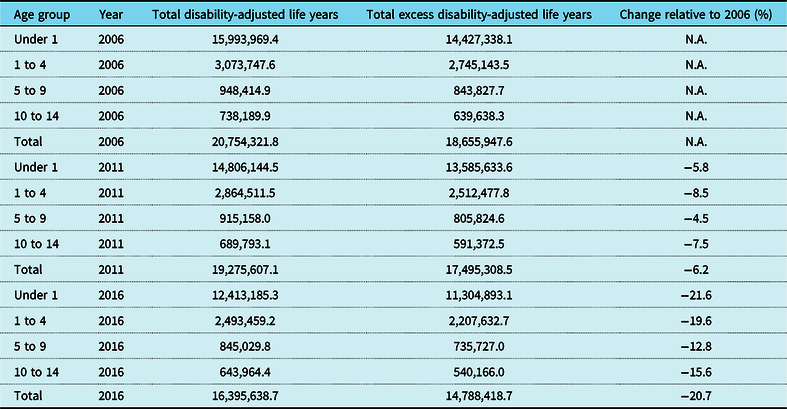
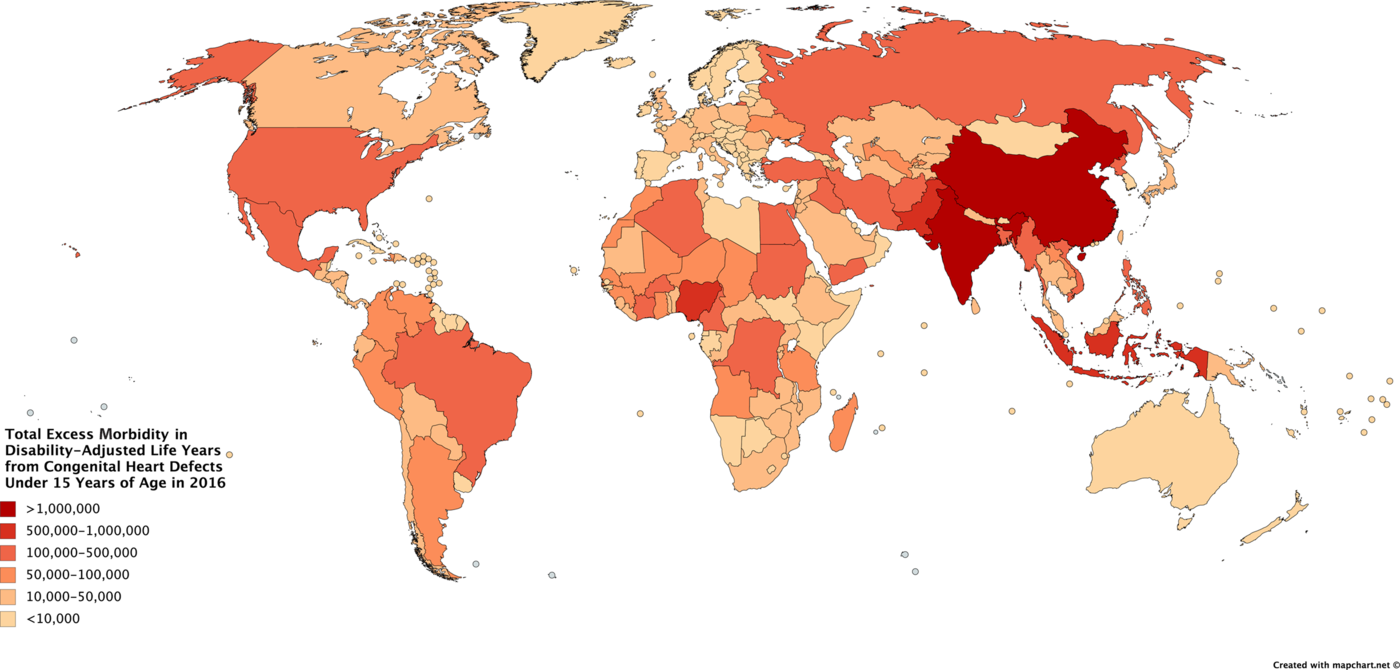
Total disability-adjusted life years due to CHD in the paediatric population gradually decreased (−21.0%) from 2006 (20,754,321.8) to 2016 (16,395,638.7). Excess disability-adjusted life years decreased by 20.7% from a total of 18,655,947.6 in 2006 to 14,788,418.7 in 2016, with the biggest reduction seen in children younger than 1 year of age (21.6% decrease). In 2016, 90.2% of disability-adjusted life years among children under 15 years old were excess morbidity. Table 1 and Figure 1 summarise the data.
Total global excess morbidity in disability-adjusted life years due to CHDs for children under 15 years of age in 2006, 2011, and 2016

Global distribution of excess morbidity in disability-adjusted life years due to CHDs for children under 15 years of age in 2016.

India (2.8 million excess disability-adjusted life years), China (1.9 million), Nigeria (0.7 million), Indonesia (0.5 million), Pakistan (0.5 million), Sudan (0.5 million), the Philippines (0.4 million), Afghanistan (0.4 million), Brazil (0.4 million), and Mexico (0.4 million) jointly constituted the largest burden of preventable morbidity with 8,631,184.4 excess disability-adjusted life years, or 58.4% of total in 2016. Low- and middle-income countries comprised 96.3% (14,234,778.3 disability-adjusted life years) of total excess disability-adjusted life years in 2016.
CHD mortality
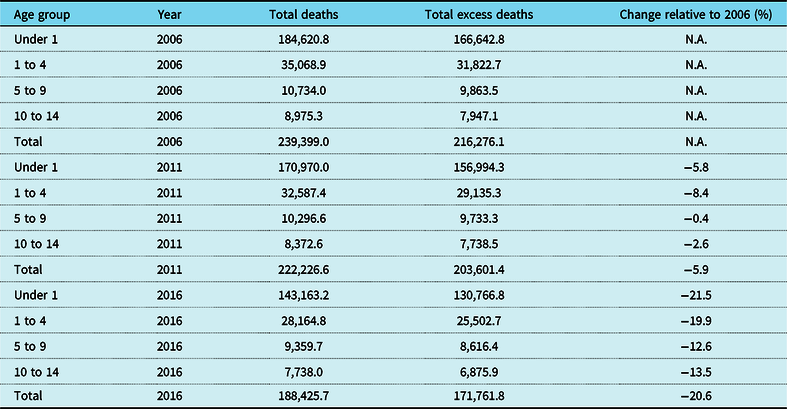
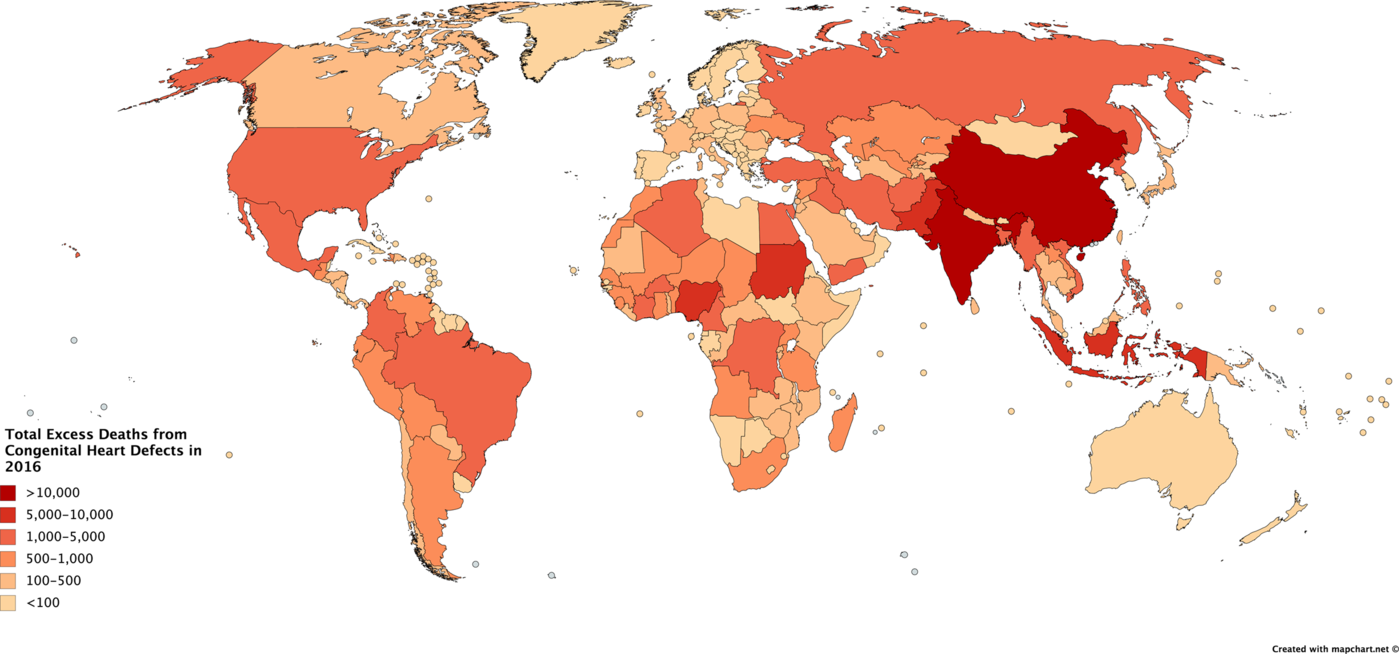
Total number of deaths due to CHD in the paediatric population gradually decreased (−21.3%) from 2006 (n = 239,399.0) to 2016 (n = 188,425.7). Excess mortality decreased by 20.6% from a total of 216,276.1 deaths in 2006 to 171,761.8 in 2016, with the largest reduction seen in children younger than 1 year of age (21.5% reduction). In 2016, 91.2% of deaths were excess mortality. Table 2 and Figure 2 summarise the data.
Total global excess mortality due to CHDs for children under 15 years of age in 2006, 2011, and 2016

Global distribution of excess mortality due to CHDs for children under 15 years of age in 2016.

As with excess disability-adjusted life years, India (33,015 excess deaths), China (21,565), Nigeria (8,683), Indonesia (6,349), Pakistan (6,105), Sudan (5,686), the Philippines (4,976), Afghanistan (4,882), Brazil (4,804), and Mexico (4,490) made up the largest absolute burden of excess CHD mortality in 2016, together responsible for 100,557 excess deaths, or 58.5% of total excess mortality. Low- and middle-income countries made up of 165,609 excess deaths, or 96.4% of total excess mortality in 2016.
Discussion
Between 2006 and 2016, there has been a 20.7% reduction in excess disability-adjusted life years and 20.6% reduction in excess deaths due to CHD for children under 15 around the world. In 2016, excess global morbidity and mortality due to CHDs remained high with 14,788,418.7 disability-adjusted life years and 171,761.8 paediatric deaths, respectively. In total, 90.2% of disability-adjusted life years and 91.2% of deaths were considered excess, highlighting the need to invest in paediatric cardiac care with a particular emphasis on congenital heart surgery. In particular, 10 countries account for nearly 60% of the total excess of CHD morbidity and mortality worldwide, posing avenues for increased investments in paediatric cardiac care as part of these countries’ health systems strengthening interventions. Together, low- and middle-income countries made up 96.3 and 96.4% of total excess morbidity and mortality in 2016.
The collective contribution of the 10 main countries to the total excess morbidity and mortality is, in large part, due to the large populations present in these countries and the proportionally higher share of paediatric populations within several of these countries. This is also reflected by the high total excess morbidity and mortality in the United States, where, in addition to a large overall population, substantial barriers to care and socioeconomic and racial disparities exist in the care for children with CHD.Reference Jackson, Morack, Harris, DeSalvo, Daniels and Chisolm15–Reference Chan, Pinto and Bratton17 In addition, Afghanistan, India, Indonesia, Nigeria, Pakistan, the Philippines, and Sudan represent low- or lower-middle-income countries, where access to cardiac surgical services or any other specialty care (e.g., paediatric cardiology) is seriously limited.Reference Vervoort, Meuris, Meyns and Verbrugghe8 Furthermore, substantial disparities have been reported within larger countries such as Brazil, China, and Mexico, limiting access to care due to geographical barriers (e.g., rural populations), financial barriers (e.g., lack of comprehensive health insurance), and infrastructural and workforce maldistribution.Reference Vervoort, Ma and Luc18,Reference Sandoval, Kreutzer and Jatene19
As children around the world live longer than ever before due to advances in medicine, global public health, and worldwide socioeconomic development, previously neglected paediatric conditions become more visible. Between 1990 and 2017, child and adolescent deaths were reduced from 13.77 million to 6.64 million worldwide.20 However, a parallel increase in total morbidity was observed with an increase of 4.7% in the total years lived with disability worldwide, owing to the pervasive impact of, for example, congenital anomalies and injuries on child and adolescent health. A recent analysis of the Global Burden of Disease Study highlighted that prevalence rates of CHD were stable around the world, but a 34.5% decrease was observed in the total CHD mortality for all ages between 1990 and 2017.Reference Zimmerman, Smith and Sable21 This can be explained in large part as a result of advances in paediatric cardiac surgery in high-income countries, timely screening and earlier detection among adults with CHD, and increased investments in paediatric cardiac surgical mission trips and capacity in low- and middle-income countries.
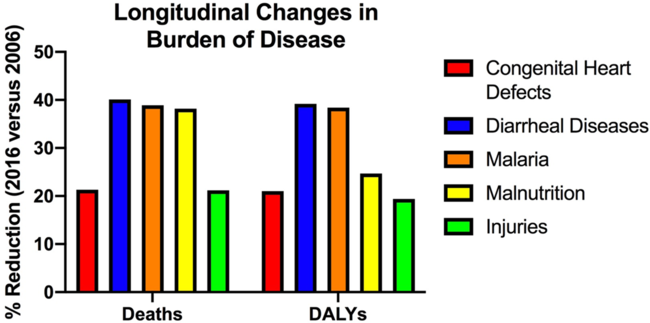
Nevertheless, from 2006 to 2016, diarrhoeal diseases (−40.1% deaths, −39.2% disability-adjusted life years), malaria (−38.9% deaths, −38.4% disability-adjusted life years), and malnutrition (−38.2% deaths, −24.7% disability-adjusted life years) saw larger proportional decreases compared to CHD (−21.3% deaths, −21.0% disability-adjusted life years), whereas the decrease in injuries (−21.2% deaths, −19.4% disability-adjusted life years) was comparable.11 In 2016, diarrhoeal diseases (0.6 million deaths, 55 million disability-adjusted life years), malaria (0.4 million deaths, 36.5 million disability-adjusted life years), injuries (0.5 million deaths, 45 million disability-adjusted life years), and malnutrition (0.2 million deaths, 36.6 million disability-adjusted life years) continued to represent a larger burden in terms of both morbidity and mortality among children; however, the slower proportional decrease and substantial burden of CHD in 2016 (0.2 million deaths, 16.4 million disability-adjusted life years) illustrate the important potential socioeconomic argument to address the global burden of CHD. Figure 3 visually summarises these longitudinal burden of disease changes.
Longitudinal changes in the predominant burden of disease in paediatric (under 16 years old) populations worldwide between 2006 and 2016. DALYs = disability-adjusted life years.

Cardiac surgery and interventional cardiology have traditionally been perceived as health care interventions too complex or too expensive to be implemented in low- and middle-income countries. Nonetheless, the delivery of services in low- and middle-income countries with several available cardiac programs has been found to be at or near-equal quality and at lower costs than those in high-income countries. In sub-Saharan Africa and the Asia-Pacific, visiting teams have operated on paediatric cardiac cases with surgical mortality rates as low as 2–4%.Reference Yankah, Fynn-Thompson and Antunes22,Reference Davis, Wainer, O’Keefe and Nand23 Similarly, the Narayana Hrudayalaya Heart Hospital has introduced high-quality, low-cost cardiac surgery across India using economies of scale.Reference Henry, Price, Park and Price24 Likewise, low costs for congenital heart surgery have been observed in Vietnam and China, amongst other countries.Reference Pezzella25,Reference Mo, Yu and Shu26 These results suggest the feasibility of implementing successful and sustainable paediatric cardiac surgical services in low- and middle-income countries, at minimum for less complex surgical CHD (e.g., lower RACHS-1 scores) such as, for example, ventricular and atrial septal defects, tetralogy of Fallot, and rheumatic heart defects. As new and growing local centres achieve higher volumes, the necessary clinical experience, and appropriate post-operative care (e.g., intensive care) capacity, more complex procedures (e.g., higher RACHS-1 scores) such as single ventricle and truncus arteriosus can be added with good outcomes. Currently, we assume that these more complex CHD make up a smaller but still substantial part of the excess mortality and morbidity.
Sub-Saharan Africa, despite being home to 14.1% of the world’s population, holds only 1.1% of the cardiac surgical workforce.Reference Vervoort, Meuris, Meyns and Verbrugghe8 In strong contrast, North America (4.8% of the world’s population) holds 32.8% of the total cardiac surgical workforce. The disparities in the availability of paediatric cardiac surgeons in low- and middle-income countries further indicate the urgent need to address shortages around the world, in particular in the light of the existing surgical backlog of CHD and rheumatic heart disease cases. The need for trained paediatric cardiac surgeons goes along with the need for specialised paediatric cardiac anaesthesiologists, paediatric cardiologists, technicians, perfusionists, nurses, and other allied health care professionals. To date, little is known regarding the availability and distribution of non-surgical health care professionals to care for CHD patients in low- and middle-income countries, although it is to be expected that the scarcity is as high, if not higher.
As low- and middle-income countries establish and expand comprehensive (paediatric) cardiac surgical services and centres, it is likely to see a trickle-down effect on the health system and facilities as a whole.Reference Vervoort27 The delivery of cardiac surgical care poses substantial pre-requisites for pre- (e.g., imaging modalities and referral systems), intra- (e.g., blood banks and efficient surgical supply chains), and post-operative care (e.g., intensive care and long-term follow-up). Accordingly, the establishment of cardiac centres relies on but may also strengthen entire health systems.
Limitations of this study
Our study holds several limitations. First, we made the assumption that any country in the world could theoretically achieve similar outcomes for CHD as the best performing countries per age group and year. Even with similar resources, outcomes may, however, differ, as it is unclear to what extent outcomes are dictated by unique patient characteristics (e.g., ethnicity, culture, environment). Second, it is unclear whether the excess morbidity and mortality are due to lack of care altogether, lack of surgical care, low quality of care, inability to afford treatment, or other factors. Third, the Institute for Health Metrics and Evaluation data are based on models, albeit complex and validated, and does not dissect the underlying causes (e.g., disparities in care, procedural complexity, RACHS-1-specific mortality) but is solely based on diagnoses (i.e., CHD). As a result, it serves as an approximation of the real global burden of disease. Accordingly, our results serve as an estimate, rather than conclusive data. Future studies should distil the underlying factors of the excess morbidity and mortality around the world to identify priority areas to tackle. Lastly, we acknowledge that holistic, high-quality healthcare delivery encompasses not only deaths and disability-adjusted life years but also quality of life, patient-reported outcome measures, and patient-reported experience measures. While research regarding patient-reported outcome measures and patient-reported experience measures is growing in high-income countries, the current applications and knowledge thereof in the field of paediatric cardiac surgery in low- and middle-income countries are still limited; however, future research and health system interventions in low- and middle-income countries ought to recognise the importance of patient experience and self-reported outcomes as an integral part of healthcare delivery.
Conclusion
Although progress has been made to reduce the morbidity and mortality due to CHDs in low- and middle-income countries, untreated cases remain highly prevalent and largely treatable around the world. Preliminary cost-effectiveness data and high-quality outcomes of congenital heart surgery suggest the feasibility and importance of strengthening paediatric cardiac surgical care around the world, able to significantly impact individuals and society as a whole. Comprehensive care delivery for CHDs may serve as a marker of health system performance and growth in low- and middle-income countries.
Acknowledgements
None.
Financial Support
This research received no specific grant from any funding agency, commercial, or not-for-profit sectors.
Conflicts of Interest
None.
Ethical standards
Not applicable.