INTRODUCTION
Infectious disease is a major cause of death for managed species and human populations (Murray and Lopez, Reference Murray and Lopez1997; Smith et al. Reference Smith, Acevedo-Whitehouse and Pedersen2009), and the relationship between nutrition and disease susceptibility is complex. The effects of nutrition and food availability have been well studied in vertebrates where limited access to food has been shown to have negative impacts on a host's ability to fight infections (Hughes and Kelly, Reference Hughes and Kelly2006; Schmid-Hempel, Reference Schmid-Hempel2011). Overcoming infection requires energy, so a host without sufficient caloric intake is likely to be more susceptible to parasite establishment and incur greater costs over the course of the infection, due to a weakened resistance that leads to higher infection intensity and/or a longer recovery period (Ilmonen et al. Reference Ilmonen, Hakkarainen, Koivunen, Korpimaki, Mullie and Shutler1999; Lall, Reference Lall2000; Gasparini et al. Reference Gasparini, Roulin, Gill, Hatch and Boulinier2006; Brzek and Konarzewski, Reference Brzek and Konarzewski2007). On the other hand, over-nutrition can also impair immune responses and may directly or indirectly optimize conditions for the parasite (Woo, Reference Woo2006). Host food acquisition, which serves as a proxy for nutrition, and disease defence are both also related to host body condition. An individual's condition is largely determined by food intake, and may also greatly contribute to an individual's ability to defend itself against disease; likewise, the energetic costs of fighting disease may diminish host condition (Møller et al. Reference Møller, Christe, Erritzøe and Mavarez1998). Therefore, host condition is generally used as a metric for an individual's health and well-being. Among the variety of metrics for measuring body condition in ecological and epidemiological studies, this study focused on relative condition index (Kn), as it takes into account an individual's weight-length ratio relative to that of others within the general population (Peig and Green, Reference Peig and Green2010).
These basic relationships have been shown to hold true with respect to the immune system of teleost fish (Landolt, Reference Landolt1989). For example, in isolated guppies (Poecilia reticulata) infected with the ectoparasitic monogenean Gyrodactylus turnbulli, low food-intake was shown to correlate with high parasite burden early after infection, presumably due to impaired innate immunity. However, intensity over the entire course of infection was higher in fish on a high-food diet, possibly because those individuals on the high-food diet had higher energy reserves to support larger parasite populations (Poulin and Rohde, Reference Poulin and Rohde1997; Kolluru et al. Reference Kolluru, Grether, South, Dunlop, Cardinali, Liu and Carapiet2006).
Guppies are live-bearing tropical teleost fish, commonly used as a laboratory model. Their diet largely consists of unicellular algae, benthic invertebrates and zooplankton (Dussault and Kramer, Reference Dussault and Kramer1981). In the wild, guppies are infected by 2 gyrodactylid species, Gyrodactylus bullatarudis and Gyrodactylus turnbulli (see Harris and Lyles, Reference Harris and Lyles1992), that attach to the epidermis of their host via specialized hooks and feed on epithelial cells and mucus (Bakke et al. Reference Bakke, Cable, Harris, Baker and Rollinson2007). Although these ectoparasites are helminths, the guppy-gyrodactylid system provides an excellent model of microparasite epidemiology from a population dynamics perspective (Bakke et al. Reference Bakke, Cable, Harris, Baker and Rollinson2007). The parasites rapidly reproduce on individual guppies, their infection usually induces some host immunity (Scott, Reference Scott1985a), they spread quickly through the host population by jumping to a new host during direct host-host contact or indirect contact with dislodged parasites at the surface of the water (Cable et al. Reference Cable, Scott, Tinsley and Harris2002). Their external location on the fish allows infection to be monitored in a non-invasive manner (Scott and Anderson, Reference Scott and Anderson1984; Kearn, Reference Kearn1994), and parasite population dynamics on isolated guppies have been characterized under controlled conditions (Scott, Reference Scott1982, Reference Scott1985a), at different temperatures (Scott and Nokes, Reference Scott and Nokes1984) and under different feeding regimes (Kolluru et al. Reference Kolluru, Grether, South, Dunlop, Cardinali, Liu and Carapiet2006). Furthermore, the epidemic dynamics have been studied in laboratory guppy populations (Scott, Reference Scott1982; Scott and Anderson, Reference Scott and Anderson1984; Scott, Reference Scott1985a,Reference Scott, Rollinson and Andersonb, Reference Scott1987; Richards and Chubb, Reference Richards and Chubb1998; Richards et al. Reference Richards, van Oosterhout and Cable2010) and in mesocosms (Perez-Jvostov et al. Reference Perez-Jvostov, Hendry, Fussmann and Scott2012), but the impact of host condition and food availability on epidemic dynamics has not been examined.
The purpose of this study was to determine whether epidemic dynamics were influenced by pre-infection relative body condition (an indicator of health which compares individuals to the rest of the population rather than a simple weight-length ratio) and/or food availability, using the guppy-Gyrodactylus turnbulli host-parasite model. Given previous literature on condition and food intake on individual disease outcome, we predicted that both of these variables would influence epidemic dynamics.
MATERIALS AND METHODS
Fish, parasite and diet
Animal Care Approval was obtained according to McGill University Ethics Guidelines (AUP number 5759). Guppies were housed in the McGill University Department of Biology greenhouse at 26 °C ± 1 °C and a 12-h light-dark cycle. Feeder guppies obtained from a pet store in Montréal were bred in the laboratory for several generations without parasites and were therefore naïve to G. turnbulli infection and presumed to be genetically similar. Gyrodactylus turnbulli obtained initially from a Montréal pet store and identified following Harris (Reference Harris1986) was maintained at high intensity in a laboratory population of feeder guppies by adding naïve fish on a regular basis according to Scott and Anderson (Reference Scott and Anderson1984). For each experimental population, 10 adult guppies (5 males and 5 females) were placed in a 6 L tank (21 × 6×14 cm, water-level 12 cm) within a flow-through Aquaneering Inc. system (San Diego, CA, USA) designed to eliminate waste accumulation and maintain a steady flow of treated, filtered water through the system, thus homogenizing environmental conditions (except for food availability) in all treatments.
Experimental design
In order to test the effect of both excessive and insufficient food availability, 3 food availability treatments (high, low, and medium as a control) were replicated 7 times, for a total of 21 populations (each of 10 fish). Fish were fed TetraMin® (Tetra Werke, Melle, Germany) Tropical Food Flakes ground into a paste and distributed through a precision syringe (Hamliton Company, Reno, NV, USA) once daily. Based on preliminary observations that individual guppies of similar size to those used in our experiment consume 10 μl of flake paste before satiation, low food availability populations received 50 μl of flake paste/day, medium food availability populations received 100 μl of flake paste/day and high food availability populations received 200 μl of flake paste/day. Food availability levels were assigned to populations at random within each replicate. Our dependent variables included population level measures of infection. Our independent variables were initial relative host condition and food availability.
Experimental protocol
Fish were anaesthetized in 0·02% tricaine methanesulfonate (Finquel MS-222, Argent Laboratories, Redmond, WA, USA), buffered to a neutral pH with sodium bicarbonate. Excess water was removed with a KimWipe (Kimberly-Clark, Dallas, TX, USA) and fish were weighed to 0·001 g, and their standard length (tip of snout to end of caudal peduncle) was measured to 0·01 mm. Fish were then injected subdermally and away from major organs with visible implant elastomer dye (Northwest Marine Technologies Inc., Shaw Island, WA, USA) according to a unique marking scheme for individual identification. This marking technique does not affect fish behaviour and has low impact on mortality (Croft et al. Reference Croft, Albanese, Arrowsmith, Botham, Webster and Krause2003; Van Oosterhout et al. Reference Van Oosterhout, Mohammed, Hansen, Archard, McMullan, Weese and Cable2007; Gordon et al. Reference Gordon, Reznick, Kinnison, Bryant, Weese, Räsänen, Millar and Hendry2009). A total of 210 fish, with an average initial weight of 67·8 ± 1·4 mg and average SL of 14·7 ± 0·09 mm were used for this experiment. After weighing, measuring and marking, fish were randomly assigned to populations of 10 fish that were provided with their respective diets for a week prior to introduction of infection. All fish survived this period. Given that the length and weight of a mature guppy is unlikely to change significantly over a 17-day period, we only took these measurements prior to treatment/experimentation. While this is a limitation of our study, previous work in our laboratory has indicated no significant changes in these measurements for infected individuals over the course of 10 days, nor in uninfected fish after 1 week of altered diets (F. Dargent, unpublished data).
After 1 week, 1 female fish (the ‘source’ fish) was selected at random from each tank, anaesthetized in MS-222 and infected with 5 G. turnbulli by transferring 1 parasite at a time on a scale removed from a heavily-infected donor fish obtained from our G. turnbulli colony (Scott and Anderson, Reference Scott and Anderson1984). Within each replicate, the same donor fish was used to infect a female from the 3 food availability treatments.
Infections were then monitored every other day for 10 days. While G turnbulli may persist in a population for much longer time scales (Richards and Chubb, Reference Richards and Chubb1998), our goal was to capture only the initial spread of infection throughout the population (and therefore parasite establishment within the population), and previous literature indicated that this time frame was sufficient to reach both peak prevalence and population peak parasite burden (Scott, Reference Scott, Rollinson and Anderson1985b). Each anaesthetized fish was examined using a Leica 18X dissecting microscope (Leica Microsystems GmbH, Wetzlar, Germany) and cold light source. Parasites were counted by scanning both sides of the fish beginning at the caudal fin and working towards the head and opening the fins. If a fish died, it was left in the tank for 1 day (Gheorghiu et al. Reference Gheorghiu, Cable, Marcogliese and Scott2007) so that parasites had the opportunity to transfer to a live host (Scott and Anderson, Reference Scott and Anderson1984). Rather than replacing an infected (dead) fish with a naïve one, which would change not only the proportion of naïve fish but also possibly the average population Kn, we calculated the average population density for each tank (total of fish alive in a population on each day of experiment divided by 10 days of experiment) in order to account for possible differences in transmission due to lower population density. However, so few fish died during this experiment (see Results section) that there were no significant differences in this variable among populations, and this variable was not used in the final analysis. The volume of food provided to the population was adjusted according to fish density by reducing the original volume by one tenth. After recording parasite loads on the tenth day, all fish were treated with Clout® (Aquarium Products, Glen Burnie, MD, USA) and retired to a recovery aquarium.
Definition and calculation of dependent variables
Population parasite burden (the total number of G. turnbulli found in a fish population) was calculated for each sample day, and peak parasite burden (the maximum of this variable over the course of the experiment) was also recorded. Prevalence (the percentage of the population infected with G. turnbulli) was also calculated for each sample day, and its maximum over the course of the experiment was recorded. Incidence was defined as the number of initially uninfected fish within the population that became infected over the course of the 10-day experiment (Last, Reference Last2001). We defined infection establishment on a fish as parasites observed on 2 consecutive sample days on that fish. The degree of parasite aggregation within each guppy population was calculated as the variance to mean ratio of individual parasite burdens on the day of peak population burden. We noted whether or not the originally infected fish (‘source’ fish) was the most heavily infected fish on the day of peak parasite burden as an index of whether the ‘source’ fish continued to influence the epidemic dynamics after transmission had occurred. We refer to this binary variable as ‘source burden’.
Definition and calculation of independent variables
For each fish, relative condition index (Kn) was used to assess host condition at the beginning of the experiment based on the initial (pre-food availability treatment) weight (W) and standard length (SL) of all hosts in the experiment. For each sex, a least squares regression of Log(SL) and Log(W) of all of the guppies used for the entire experiment was performed, and the slope (n) and intercept (log(a)) for the line of best fit were obtained. Relative condition index (Kn) was then calculated for each individual fish using the formula: Kn = W/(a * SLn) (Le Cren, Reference Le Cren1951). Kn, SL and initial weight of all fish were compared using one-way ANOVA and Tukey-Kramer post-hoc analysis to test for homogeneity of initial fish size and body condition among the 3 food availability treatments and across all 7 replicates. Individual initial Kn differed among replicates (P < 0·0001), but not among food availability treatments, indicating that initial Kn was homogenous among experimental treatments. A similar pattern was found for fish size: neither SL nor initial weight differed significantly among food availability treatments, but significant differences among replicates were observed (P < 0·05 for both). ‘Source’ Kn did not differ significantly among food availability treatments. Average Kn was then calculated for each population by calculating the mean Kn of all individuals in each population, and the Kn of the ‘source’ fish in each population was also noted.
Statistical analysis
All analyses were done using R Language and Environment for Statistical Computing version 2.14·2 (R Development Core Team, 2011). Generalized Linear Models (GLMs) were constructed to determine the effect of host relative body condition and food availability on population peak parasite burden, incidence, aggregation and ‘source’ burden. The distribution of each response variable was measured and then models fitting that distribution were generated using all independent variables (‘source’ Kn, the average Kn of the population and food availability) and the interactions thereof. These models were tested using bi-directional step-wise model selection (stepAIC, MASS package) in order to find the combination of factors which yielded the lowest AIC value to produce the final model. In all cases, the level of significance was set at P < 0·05.
RESULTS
Gyrodactylus turnbulli infection established in all 21 populations and spread from the ‘source’ fish to at least 1 other fish. The prevalence reached 50% or more in 15 of the 21 tanks during the 10 days of the experiment. The total number of parasites also increased over time; peak parasite burden ranged from 5 to 222 and the day of maximum burden varied by tank, ranging from Day 2 to Day 10, although the day of peak did not vary significantly by food availability. In 12 of the 21 tanks, parasite burden reached a peak before day 10. The average population density did not differ among populations. Of the 11 fish that died (5·2%), 5 had been infected (2 of 6 fish from the low-food treatment, 1 of 3 fish from the medium-food treatment and 2 of 2 fish from the high-food treatment).
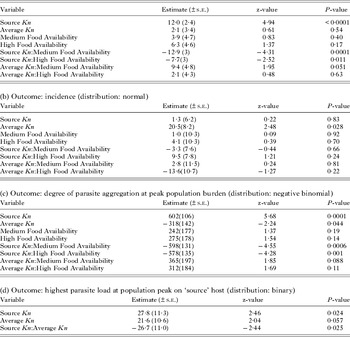
A summary of GLM outputs of the final models for population level disease outcomes can be found in Table 1.
Summary of generalized linear model outputs for measures of epidemic dynamics

Peak parasite burden
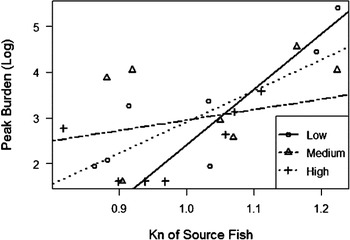
A significant interaction between ‘source’ Kn and food availability was detected. The effect of ‘source’ Kn on peak parasite burden was lower at the medium (P < 0·001) and high (P = 0·011) food availabilities compared with the low food availability. ‘Source’ Kn had a highly significant (P < 0·001) positive impact on peak parasite burden ((Table 1a; Fig. 1).
Impact of interaction between relative body condition (Kn) of the ‘source’ guppy (Poecilia reticulata) and food availability on peak Gyrodactylus turnbilli burden in experimental epidemics, as demonstrated by best fit linear regression lines for low, medium and high food availability treatments (n = 7 populations per treatment). Low food availability slope: 12·16, intercept: −9·76; medium food availability slope: 2·28, intercept: 0·67; high food availability slope: 6·82, intercept: −3·92. Note: data were not log-transformed for statistical analysis but are shown transformed here for ease of viewing.

Incidence
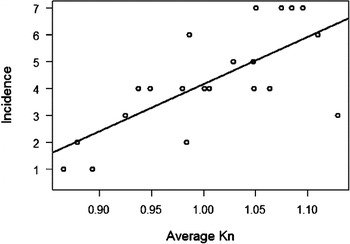
The number of non-source fish that became infected was positively related to the average Kn of the population (P = 0·028) (Table 1b; Fig. 2). No other terms were significant in the final model.
Simple linear regression between incidence (total number of naïve fish in a population that became infected during the experiment) of Gyrodactylus turnbulli and average body condition (Kn) of guppies (Poecilia reticulata) during a 10-day experimental epidemic in 21 host populations. (Slope: 17·54, intercept: −13·37).

Aggregation at peak burden
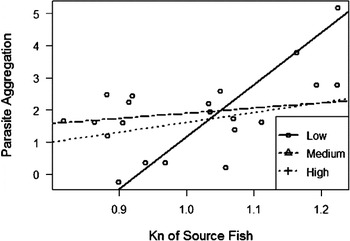
The degree of aggregation of parasites (variance to mean ratio) within a population was negatively affected by the average Kn of the population (P = 0·044) whereas ‘source’ Kn had a positive impact (P = 0·0001) on the degree of aggregation (Table 1c). However, this relationship between ‘source’ Kn and aggregation was dampened at high food availability levels, as the interaction of ‘source’ Kn with medium (P = 0·0006) and high (P = 0·001) food availability was negative (Fig. 3).
Impact of interaction between relative body condition (Kn) of the ‘source’ guppy (Poecilia reticulata) and food availability on aggregation of Gyrodactylus turnbilli (variance to mean ratio on day of peak burden) in experimental epidemics as demonstrated by best fit linear regression lines for low, medium and high food availability treatments (n = 7 populations per treatment). Low food availability slope: 16·23, intercept: −15·07; medium food availability slope: 1·63, intercept: 0·27; high food availability slope: 3·07, intercept: −1·46. Note: data were not log-transformed for statistical analysis but are shown transformed here for ease of viewing.

Source burden
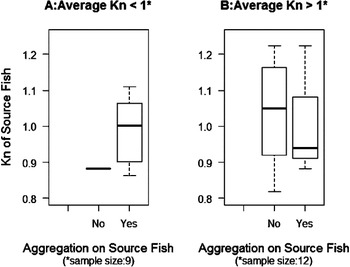
The Kn of the ‘source’ fish influenced whether it was the most heavily infected fish at the time of peak population parasite burden (Table 1d). When the average Kn of the population was less than 1, the parasite load was more likely to be highest on the ‘source’ fish whereas when the average Kn of the population was greater than 1, one of the other fish was more likely to have the highest parasite numbers at the time of population peak burden (Fig. 4). Food availability did not enter this model.
Relationship between guppies (Poecilia reticulata) harbouring the majority of Gyrodactylus turnbulli on the day of population peak burden, average relative body condition of the fish population (average Kn) and relative body condition (Kn) of the ‘source’ fish. (A) When the average Kn was low (less than 1), the parasites tend to be aggregated on the ‘source’ fish. (B) When the average Kn was high (greater than 1), the parasites are less aggregated on the ‘source’ fish.

DISCUSSION
Our results demonstrate a consistent positive relationship between body condition of the initially infected ‘source’ host and major epidemic variables, indicating that the body condition of the individual through whom the infection was introduced to the population influences population-level infection outcomes. When the body condition of the ‘source’ fish was high relative to other fish in the population, the population peak parasite burden, the degree of parasite aggregation within the population and the likelihood that the ‘source’ fish was the most heavily infected at the time of peak parasite burden were higher. This indicates that parasites not only thrive on hosts of high condition, but specifically remain on hosts of high condition, particularly when relatively fewer hosts of high condition are available. This is consistent with our observation that incidence was positively associated with average Kn but not ‘source’ Kn, implying that parasites were more likely to transfer to a new host when the surrounding fish had higher body condition. These relationships, however, were tempered by our environmental factor (food availability), as we observed lower parasite burdens at intermediate and high levels of food availability.
Introduction of an infected fish into a naïve population allows gyrodactylids to spread through the population. Whether infection reaches all fish in a population, and whether infection is sustained within a population is known to be a function of host population size and density, as well as host history of infection, and other characteristics of the host and parasite (Reno, Reference Reno1998). In this study we were able to isolate effects of host relative condition from these other variables as all fish were naïve and we standardized host population size and density. To our knowledge, a measure of the ‘quality’ of the host that brings an infection into a population has not been examined, nor has this been considered relative to the average ‘quality’ of other hosts. The effects of these ‘qualities’ on Gyrodactylus sp. behaviour have not been previously studied. However, such patterns of behaviour have been discussed in ecological theories in other systems. For example, optimal foraging theory suggests that successful foragers are those who assess the quality of the present foraging patch relative to their perception of the average patch (Pyke, Reference Pyke1984). Our data are consistent with the hypothesis that gyrodactylid parasites may also compare quality of ‘patches’ – in this case, potential guppy hosts. When arriving on a ‘quality’ host, it is to their advantage to stay on this host if the host has higher ‘quality’ than the average of other fish in the population. On the other hand, it makes sense for the parasite to move if the average quality is higher than that of the ‘source’ fish. Such a line of logic is consistent with our findings, as we observed that parasites were aggregated on a ‘source’ host of high Kn, but were more dispersed on other hosts when the average Kn of the population was high. Future research into the impact of ‘source’ host condition on epidemic dynamics and mapping parasite transmission according to host relative condition may help to further illustrate the applicability of optimal foraging theory to host-parasite models.
Our observed positive relationship between ‘source’ fish size and high population parasite burden is consistent with the findings of Cable and van Oosterhout (Reference Cable and van Oosterhout2007) where parasite burdens were shown to increase with fish size, though their metric for fish body size was standard length and their infections were run on individual fish. Presumably, this relationship was observed because larger fish (with higher relative condition index) are able to offer more living space for ectoparasites (Poulin and Rohde, Reference Poulin and Rohde1997). Our results, however, indicate that initial relative condition of the ‘source’ fish, and not simply its length, not only played a large role in determining the course of infection on this individual (as seen by ‘source burden’) but also on the course of the epidemic as a whole. The positive relationship found between condition and parasite burden is counterintuitive in many aspects, as condition is assumed to be a major indicator of health and therefore disease resistance (Beldomenico et al. Reference Beldomenico, Telfer, Gebert, Lukomski, Bennett and Begon2008), yet we saw that parasites were either aggregated on ‘source’ hosts of high condition, or had transferred to hosts of higher relative condition. Further investigation into why a high host initial relative condition translated to a greater number of parasites is required, as well as further investigation of the effects of absolute condition on disease resistance.
It is also possible that innate immunity (as all our fish were naïve to G. turnbulli infection acquired immunity could not have been an issue here) influenced epidemic dynamics within our populations. A large amount of variability in the resistance of individual guppies to Gyrodactylus sp. has been observed (Madhavi and Anderson, Reference Madhavi and Anderson1985; Van Oosterhout et al. Reference Van Oosterhout, Harris and Cable2003; Cable and van Oosterhout, Reference Cable and van Oosterhout2007), and more recent work has identified major histocompatibility (MHC) class IIB genes to be an important part of guppy innate immunity which may be impacted by parasite-mediated selection (Sato et al. Reference Sato, Figueroa, O'Huigin, Reznick and Klein1995; Fraser et al. Reference Fraser, Ramnarine and Neff2009; Fraser and Neff, Reference Fraser and Neff2010). This issue deserves further research, and we acknowledge that innate immunity may have interacted with host condition in our populations, we believe it to be unlikely that significant genetic variability existed among tanks, since all fish had been obtained from aquarium stocks bred in the laboratory for several generations, and MHC class IIB genotypes tend to have low variability in aquarium stocks when compared to wild populations (Sato et al. Reference Sato, Figueroa, O'Huigin, Reznick and Klein1995). Moreover our fish were selected for the experiment and assigned a feeding regime at random and therefore genetic variability should have been similar in all tanks.
Our study also revealed the importance of food availability in driving epidemic dynamics. The most dramatic relationship was observed at the low food treatment where both population peak burden and variance to mean ratio increased more dramatically with ‘source’ and average Kn, respectively, than at other food treatments. Although it is likely that larger fish would be able to acquire more food than the smaller ones, one can also assume that these larger fish also had greater food requirements than the smaller ones. As such, especially for the low food availability treatment, the larger fish may have been more limited in food intake on a per gramme weight basis than the smaller ones. This, together with competition among guppies for food when the average Kn was high and food availability low, may have exaggerated inter-fish differences in host suitability, thus explaining the higher variance to mean ratio among the fish at the low food treatments. Our results are consistent with those of Kolluru et al. (Reference Kolluru, Grether, South, Dunlop, Cardinali, Liu and Carapiet2006) who found that low food availability led to higher parasite burdens. However, we have shown that initial condition of the fish plays an important role in this relationship.
Furthermore, being infected may also alter the individual's appetite. It has been documented in some cases that infected hosts may reduce their food intake as a defence mechanism, and this infection-induced anorexia may increase host resistance to the disease (Exton, Reference Exton1997), as observed in guppies by Van Oosterhout et al. (Reference Van Oosterhout, Harris and Cable2003). It is also possible that infected individuals may try to increase their food intake in order to compensate for the energetic costs of fighting infection (Kolluru et al. Reference Kolluru, Grether, Dunlop and South2009). Unfortunately, the design of our study did not enable us to record food intake or weight gain of individual fish, and as such we do not know whether parasite infection, or parasite load, or host body condition altered food intake of the guppies. While it is unlikely that our host Kn would have changed significantly over the course of our short-term experiment, longer-term studies may benefit from observing how changes in Kn may alter epidemic dynamics.
This study attempted to bridge the gaps in our knowledge of the effect of individual nutritional status and body condition on basic epidemic behaviour. Our results indicate that several parameters related to the initial spread of an epidemic are determined as much by the current level of resource availability in an environment, as by individual factors such as host relative condition. Host relative condition exerted significant impacts on epidemic outcomes, especially when food availability was low. Importantly, we also found that the relative condition of the ‘source’ host was particularly important to the dissemination of infection through the host population. Further investigation into the effects of specific ‘source’ body condition on epidemics is required in order to better understand the spread of disease through naïve populations. These relationships may have significant implications for fisheries and disease management.
ACKNOWLEDGEMENTS
We are grateful to G. Fussmann for use of his laboratory space, Stanley King for help with parasite identification and to Mark Romer and Claire Cooney for assisting with administration and maintenance of our facilities.
FINANCIAL SUPPORT
Funding for this experiment was provided through a grant from the Natural Sciences and Engineering Research Council of Canada (NSERC) Special Research Opportunity Program (SRO 356373-07), awarded to G.F. (PI), M.E.S., A.P.H. and P.B. Fish flow-through aquaria system was provided through an NSERC Research Tools and Instrument grant to A.P.H.