

1. Introduction
In African societies, family solidarity – understood as material, practical, and affective exchanges between kin members – is an everyday reality, with strong historical roots. This term encompasses several types of social practices, passed down from one generation to the next, underpinned by shared norms and representations, and typically involving the transfer of goods, services, and persons between members of the same extended family [Adjamagbo (Reference Adjamagbo, Marc, Locoh, Vignikin and Patrice1997), Sow and Desclaux (Reference Sow, Desclaux, Desclaux, Lanièce, Ndoye and Taverne2002), Kuépié (Reference Kuépié2012)]. In sub-Saharan Africa, family solidarity may be brought into play by a variety of events, such as a birth, the start of a school year, agricultural activities, unemployment, illness, death, accidents, etc. These events happen recurrently in everyday life or during certain life course stages (childhood, adolescence, youth, adulthood, or old age). Family configurations are crucial for mobilizing the resources needed to cope with such events, since there are few formal transfer systems in most African societies. Family solidarity hence plays the role of a social security system, protecting individuals against life's uncertainties. Family ties are maintained on a daily basis through mutual support, visits, and participation in celebrations and ceremonies organized in the network [Ndongo Dimé (Reference Ndongo Dimé2007), Kuépié (Reference Kuépié2012), Bougma et al. (Reference Bougma, Pasquier-Doumer, Legrand and Kobiané2014)].
There is an abundant literature on extended family support in the field of education, as family solidarity plays a major role in children's schooling. Children in large families tend to have poorer educational outcomes because their parents have fewer resources to invest in each child [Becker (Reference Becker1960), Downey (Reference Downey1995), Gibbs et al. (Reference Gibbs, Workman and Downey2016)]. However, studies have shown that exchanges in family networks can reduce the negative effect of family size on children's level of education. Jæger (Reference Jæger2012) finds that the support obtained through the extended family can compensate for the biological parents' lack of resources. Bougma et al. (Reference Bougma, Pasquier-Doumer, Legrand and Kobiané2014) show that parents with many children can turn to family networks (relatives on their mother and father's side) to obtain support for their schooling. Blaabæk et al. (Reference Blaabæk, Jæger and Molitoris2019) conclude that the negative effect of family size on educational outcomes is weaker in extended families whose members meet more often and help with childcare.
In sub-Saharan Africa, solidarity within family networks may contribute to maintaining high levels of fertility, for two reasons. First, the burden of raising a child was customarily not the sole responsibility of the parents, but that of the entire family configuration. Each adult in the extended family was expected to assume an educational role for one child in particular [Cissé et al. (Reference Cissé, Fall, Adjamagbo, Attané and Laurent2017)], therefore having a large number of children was not a major burden for the biological parents. Second, reproduction was highly valued in kinship groups, since the high level of infant and child mortality threatened their very survival. Extended families tried to maintain high levels of fertility to make up for high child mortality. Moreover, the mode of production in most African economies was organized on the basis of the lineage and family labor. The largest family configurations cultivated the largest areas and were in a better position to cover the needs of their members [Locoh (Reference Locoh, Hertrich and Keïta2003)]. Accordingly, kin elders were actively involved in the transmission of, and compliance with, norms promoting early marriage for women, polygyny in certain groups, and high levels of fertility.
During recent decades, sub-Saharan Africa has gone through major changes due to the development of a market economy as well as advances in public services. Infant mortality has fallen, children's schooling has increased, and urbanization has progressed. These changes are giving rise to new reproductive behaviors (increasing age at first union, fewer arranged marriages, greater premarital sexuality, etc.) [Traoré (Reference Traoré, Hertrich and Keïta2003)]. Fertility has declined as well, especially in urban areas, which are home to the most educated and wealthiest share of the population; as in other regions of the world, parents who attain a certain socioeconomic status invest massively in the formal education of their children and reduce their family size. This change has been facilitated by growing contraceptive use [Vimard and Fassassi (Reference Vimard, Fassassi and Ferry2007)].
Certain sub-Saharan African regions are holding back, however. In particular, fertility has been slow to decline in the countries of Western Sahelian Africa (Burkina Faso, Mali, and Niger). The difference in fertility between these countries and the sub-Saharan average was small in 1970–1975 (7.3 vs. 6.8 children per woman, a difference of 0.5), but had reached 2.2 children per woman by the 2000s; this difference is still 1.3 children in 2015–2020 [Traoré (Reference Traoré, Hertrich and Keïta2003), United Nations (2019)]. The Western African Sahel thus remains, as underlined by Traoré (Reference Traoré, Hertrich and Keïta2003, p. 73), “the last bastion of high fertility, in Africa and in the world”. In addition, fertility rates have stagnated in certain African countries [Bongaarts (Reference Bongaarts2008), Schoumaker (Reference Schoumaker2019)] and in many cities on the continent, stabilizing at levels above the 2.1 children per woman which is needed for post-transitional equilibrium [Garenne (Reference Garenne2008)]. For example, fertility in Ouagadougou, the capital of Burkina Faso, remains relatively high and has changed little in the last 15 years. Between 1993 and 2003, the total fertility rate fell from 4.7 to 3.1 children per woman, and then rebounded slightly to reach 3.4 children per woman in 2010, year of the last Demographic and Health Survey [INSD and ICF International (2012)]. The current fertility level obtained from Statcompuler data (http://www.statcompiler.com) is 3.1 children per woman. This level is from the 2017–2018 Burkina Faso Malaria Indicator Survey data, which incorporated a fertility module.
A number of studies have sought to shed light on the slow and even stalling fertility declines observed to date in this African region, and notably in its urban areas. They have focused on the proximate determinants of fertility (union formation, contraception, etc.) [Wakam (Reference Wakam1992), Koné (2007), Rwenge (Reference Rwenge2007)] or on the factors that might explain the persistent high demand for children [Vimard and Fassassi (Reference Vimard, Fassassi and Ferry2007)], tackling the question from different angles: socioeconomic, cultural, gender relations, etc. The role of extended family networks in fertility stalls has not been explored yet, mainly because the data used to study fertility in Africa (drawn mainly from Demographic and Health Surveys) do not contain information on family members outside the household or on transfers between family network members. The present study makes use of an original dataset, the retrospective DemTrend survey conducted in 2012 to explore the influence of family networks on women's demand for children in Ouagadougou. It examines the following research questions: (i) What are the different types of extended family networks to which women belong? (ii) Does the extended family network to which women belong influence their desire for children?
These questions are particularly pertinent in the context of Ouagadougou, characterized simultaneously by a relatively strong desire for children—remaining unchanged for decades—and the omnipresence of solidarity networks. Many poor city dwellers in Ouagadougou, while well aware of the costs of children, still value the advantages of large families [Rossier (Reference Rossier, Rossier, Soura and Duthé2019)]. This persistent desire to have large families has been illustrated by the Demographic and Health Surveys conducted in Burkina Faso. Between 1990 and 2010, women's ideal number of children remained stable in Ouagadougou (4.1, 4.0, and 4.1 children, respectively, in 1993, 2003, and 2010) [INSD and Macro International Inc. (2000), INSD and ORC Macro (2004), INSD and ICF International (2012)]. The reasons for this stability, even as schooling and living standards are increasing, may lie in the persistence of family solidarity and in the customary values underlying such intensive exchanges of support in extended families. Rossier and Peytrignet (Reference Rossier, Peytrignet, Rossier, Soura and Duthé2019) note that networks are omnipresent among the disadvantaged populations of Ouagadougou: poor households are often supported by their extended family in case of emergency, and help their kin whenever they can; their shared representations place value on family (and other) ties.
2. Social capital and family configurations
This study is built on the notion of social capital defined as “the sum of the resources, actual or virtual, that accrue to an individual or a group by virtue of possessing a durable network of more or less institutionalized relationships of mutual acquaintance and recognition” [Bourdieu (Reference Bourdieu1980), p. 2]. Created by the economist Glenn Loury (Reference Loury1977), the concept was developed by Pierre Bourdieu (Reference Bourdieu1980, Reference Bourdieu and Richardson1986) and James Coleman (Reference Coleman1988) and has since become widely—arguably too widely—used [Portes (Reference Portes1998)]. For the latter, this concept is better used in its original network-level definition (resources available through network members). The concept has also been widely used by some authors to refer to trust (norms of reciprocity) enabling the creation of ties and the exchanges within; but Portes thinks that it is better, for the sake of precision, to keep the notion of social capital to its initial content. In the original definition adopted here, individuals' networks and the resources they contain take center stage [Lin (Reference Lin1999)]. In the present study, the network of interest is the extended family of couples in Ouagadougou, i.e., the parents from both sides (mother/father/mother-in-law/father-in-law), their brothers and sisters, and children living outside the household, who provide (or not) different forms of support.
The notion of social capital encapsulates the two mechanisms liable to explain the effects of extended family networks on women's fertility desires in Ouagadougou. The first mechanism is the transfer of economic support, important in this context for the schooling of children, as already noted. The second is normative influence, in this case norms supporting high fertility. The normative dimension of social capital was stressed by James Coleman (Reference Coleman1988), who pointed up the strength of social control in networks, especially dense ones. Beyond density (not measured in the present study), the normative content of networks is linked to the amount of cultural capital (formal education) they contain. This led Portes (Reference Portes1998) to underline the detrimental normative effects of impoverished social circles, which tend to promote downward leveling norms. Of course, normative determinism has been critiqued since then: current researchers prefer to focus on the co-construction of meanings by individuals and the people that surround them; but still, what people in their network value still matter when individuals set life objectives.
Altogether, several parameters predict the amount of economic and cultural capital transferred in a social network [Lin (Reference Lin1999)]: the number of relations (network size), the amount of economic and cultural possessed by members (their socioeconomic level), and the strength of the ties which link individuals to their network members (which can be measured through the frequency of contact, e.g.). Still another parameter, the structure of networks (density, etc.), will not be studied here, for lack of data on this dimension.
In a Bourdieusian perspective, the different forms of capital (economic, cultural, social) are interchangeable, as they are all “accumulated labor (in its materialized form or its “incorporated,” embodied form)” [Bourdieu (Reference Bourdieu and Richardson1986), p. 241]. This approach leaves out one aspect of relational transfers, that of emotional and practical support, often studied in the literature on relational resources and health [Taylor and Seeman (Reference Taylor and Seeman1999)]. Studies in wealthy countries have shown that informal family childcare contributes to fertility intentions and their realization [Kaptijn et al. (Reference Kaptijn, Thomese, Van Tilburg and Liefbroer2010)]. In Ouagadougou as well, women's fertility intentions may depend on the availability of close kin for childcare needs.
Families hold an important but far from exclusive place in individuals' networks, hence the interest in personal networks, a concept which also includes non-family members and is captured by survey questions on significant others [Widmer (Reference Widmer2016)]. However, in less developed and individualized societies with a strong ideological commitment to family, the family remains a relational pillar [Gouveia and Widmer (Reference Gouveia and Widmer2014), Aeby et al. (Reference Aeby, Widmer, Česnuitytė and Gouveia2018)], and we focus on such ties here. Another useful notion in developed countries is the distinction between active family relations and the family reservoir, a demographic entity, that refers to the list of surviving relatives, whether links exist or not [Puur et al. (Reference Puur, Sakkeus, Põldma and Herm2011), de Carlo et al. (Reference De Carlo, Aeby and Widmer2014)]. The contemporary state of the extended family institution in African societies presupposes that all kin relations remain strong and active there; this work therefore focuses on the spouses' respective family reservoir, and the strength of the ties between family members.
3. Social capital and fertility issues
The theoretical approaches for explaining reproductive behaviors in human populations rarely address the role of family networks and social capital. The microeconomic theories of fertility developed by Becker (Reference Becker1960), Easterlin (Reference Easterlin1969), and many other authors remain a reference in this domain. They assume that households adopt rational behaviors, taking their income into account when choosing their family size. According to these theories, demand for children is associated with opportunity costs, and couples choose a desired number of children by weighing the associated costs and benefits against other possible forms of investment. With economic development, the costs and benefits of children evolve: as quality becomes more valued, they become more costly because they need investments in their human capital (schooling, health care) and they are less productive than before (in agricultural work). In agricultural societies, the quantity of children is primordial, but with economic development their quality becomes important, obliging couples to arbitrate between the quantity and the quality of their children [Becker and Lewis (Reference Becker and Lewis1973)].
In other theoretical approaches, notably those stressing the role of social norms and cultural representations, family networks are slightly more prominent, with women's fertility behavior viewed as a reflection of the social norms in the context where they live, shared through social interactions [Bongaarts and Watkins (Reference Bongaarts and Watkins1996), Montgomery and Casterline (Reference Montgomery and Casterline1996), Rossier and Bernardi (Reference Rossier and Bernardi2009)]. For Lois and Arranz-Becker (Reference Lois and Arranz Becker2014), for example, a couple's desired number of children depends on the norms prevailing in their groups of affiliation, including their family configurations. For some authors, the modernization (or westernization) of the economies of developing countries fosters an individualization of society which creates the desire to tighten family links around the nucleus, leading to a reduction in fertility [Koné (2007)]; in this perspective, cultural and economic theories make the same assertions. For others, a gap is possible, with changes in representations and norms also arising independently, not only through changes in the forms of economic exchange. While the sources of such independent ideational change have rarely been studied, they are addressed in Caldwell's (Reference Caldwell1976) intergenerational wealth flow theory. Caldwell argues that fertility is high in societies or groups (whatever their level of economic development) where wealth flows are more advantageous for parents than for children, i.e., when the children, who continue to contribute to their family of origin as adults, give back more to their parents than they have taken. This situation is possible only in traditional extended families, where the elderly capture the resources of their adult offspring [Koné (2007)]. Individuals belonging to family configurations organized along customary lines are therefore likely to share the high fertility ideals upheld (and perpetuated) by the group, even if they are otherwise engaged in the modern economic sector or have attained a high educational level. The kin on the side of husbands—which benefits most in such a family system at least in patrilineal societies—may be especially influential in perpetuating high fertility norms. Existing research shows that women in sub-Saharan Africa hold a more conservative outlook on reproduction when they have close links to their husband's relatives [Helleringer and Kohler (Reference Helleringer and Kohler2005), White et al. (Reference White, Dynes, Rubardt, Sissoko and Stephenson2013)].
4. Summary
This study tests two hypotheses. The first concerns the economic capital of the extended family network and its influence on couples in Ouagadougou. Does this economic capital influence these couples' quantity-quality trade-offs, allowing women to consider larger families? We posit that the presence of strong economic capital in extended family networks has a positive effect on women's desire for additional children. Second, we posit that children will be highly valued in large family networks with a high social capital (approximated by strong ties between relatives), and especially when the family is large and tightly-knit on the husband's side, independently of the economic capital of family networks. We will use the information on the presence of public employees in the woman's (respectively her spouse's) extended family to proximate the network's potential economic resources.
5. Data and methods
The data used in this study come from the DemTrend retrospective survey undertaken in 2012 by the Institut Supérieur des Sciences de la Population (ISSP), University of Ouagadougou, on the Ouagadougou Health and Demographic Surveillance site (HDSS) (http://www.issp.bf/index.php/fr/recherche/observatoire-de-population-de-ouagadougou). The Ouagadougou HDSS covers five neighborhoods at the northern periphery of the capital, half of the population residing in zoned areas and the other half living in newer, informal areas on the outskirts of the city. The objective of this survey was to evaluate the consequences of fertility strategies and household composition on the schooling of children in an urban setting in Burkina Faso. The survey concerned all women aged 35–59 with at least one child who had survived until age 3 and residing in the area covered by the Ouaga HDSS (a total of 2,952 women), along with their spouse. Two individual questionnaires were used for data collection, one addressed to the woman and the other to her spouse. The partner questionnaire remained empty for women not married at the time of the survey. In the present study, we limit the size of the sample to 1,336 women of reproductive age (ages 35–44), with data for all variables kept in the analysis, allowing for partners' information to remain empty for unmarried women. We excluded married women whose spouse's questionnaire was empty from the analyses. DemTrend capitalized on the data already collected in the Ouagadougou HDSS, gathering additional information on fertility and family formation behaviors, the schooling of children, family networks, and their importance for child schooling. Family networks of women were captured by asking women to cite all their family members in a closed list (father, mother, brothers, sisters, non-cohabiting adult child, i.e., head of their own household) who were still alive and to detail some of their individual characteristics. The same question was asked to the women's spouses to capture their family networks.
The dependent variable in the study is the desire for additional children captured in the Demtrend survey data by the question: “Are you planning now to have other children?” The response was coded 1 if the woman planned to have another child, and 0 if not. The main independent variables are types of family networks and their potential economic capital. Network types were constructed using a hierarchical ascending classification based on network size and the frequency of close contacts (at least once a month), distinguishing between the woman's network and that of her spouse. As mentioned, the size of the woman's (respectively her spouse's) network is obtained from a restricted list of her family relatives. This list includes the father, mother, all siblings still alive at the time of the survey, and her children over the age of 17 living outside the household. For the classification analysis, the family network size was converted into a three-category qualitative variable for each of the two network types: 0–5 people, 6–10 people, and more than 10 people. The frequency of contact is measured by the following question to the woman (respectively her partner): “Are you in regular contact with X [each close relative still alive]?” Four response categories were possible: (1) at least once a month; (2) at least twice a year; (3) once a year at most; (4) very rarely. To determine the social capital (strength of ties between family network members), we selected the most frequent contacts, i.e., the “at least once a month” category. For each woman, we counted the number of people who were in contact with her (respectively, her spouse) at least once a month. This number was then divided by the woman's (respectively, her spouse's) total family network size to determine the proportion of members in close contact with the woman (respectively, her spouse). The proportions obtained were then recoded into three categories: no close contact when the proportion was zero; close contact with all members when the proportion was 1; “close contact with a share of network members” for all other women.
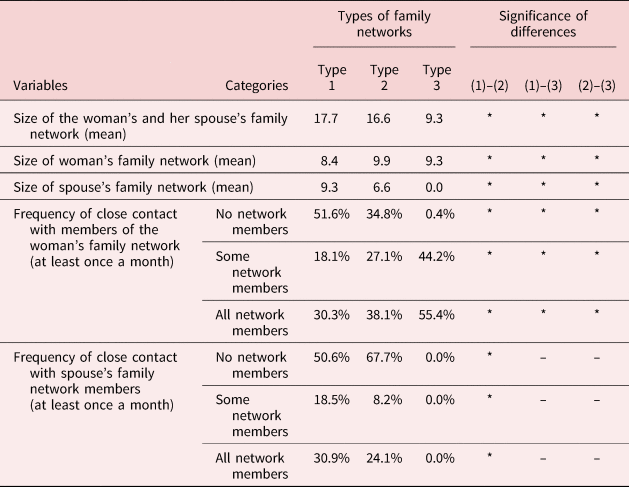
The classification method was applied to the variables presented above. As these variables are all qualitative, a multiple correspondence factorial analysis was done to obtain the principal components which served to construct the hierarchical tree. Euclidian distance was used to measure the distance between two individuals, and the Ward criterion to separate individuals into groups [Tenenhaus (Reference Tenenhaus2007)]. These two units of measurement were used to construct the hierarchical tree which was then partitioned into classes (groups of women). Three partitions (classes from classification analysis) with three, four, and five groups were analyzed. The two-class partition was not explored in order to go beyond the dichotomy, and to have the most interpretable groups possible. The partition in three groups gave interpretable results while staying within reasonable sample sizes for each group. Thus, the women were divided into three types: 32.6% of the sample were in Type 1, 49.5% in Type 2, and 17.9% in Type 3. The detailed profiles of these types are described in Table 1. The potential economic resources of the family network were captured by the presence of at least one person in public-sector employment (the most stable and well-paid jobs in this setting) in the woman's (respectively, her spouse's) network.
Distribution of women according to their family network

*Differences significant at the 5% level.
Source: Demtrend Survey, Ouagadougou, 2012, authors' calculations.
The other explanatory variables are the woman's characteristics: current place of residence (formal vs. informal district), age, educational level (none, primary, secondary, or higher), ethnic group (Mossi, non-Mossi), religion (Muslim, Christian), duration of residence in Ouagadougou (0–9 years, 10–19 years, 20+ years), marital status (married, unmarried), number of surviving children, and standard of living. This last variable is a composite indicator that is based on households' dwelling characteristics, durable goods, water supply, system of garbage disposal, and wastewater management. A principal component analysis was used and five categories of households were defined according to their living standard: very low (poorest 20% or first quintile), low (second quintile), medium (third quintile), high (fourth quintile), and very high (richest 20% or fifth quintile).
Alongside the dependent and independent variables, two other variables of interest were used: potential and actual help from the family network for the schooling of children. These two variables were captured through two retrospective questions addressed to the woman and her partner: “Has X [each close relative still alive] already helped with the schooling of one of your children?” “If you were in need, do you think that he/ she would help you with the schooling of your children?” These variables were used to test the correlation between the network characteristics (type and economic capital in particular) and the actual help received (respectively the perceived support) by the woman and/or her spouse from the extended family. While family support can take various forms (schooling, health, food, housing, etc.), support for children's schooling (a specific case of material exchange between extended family members) measured at the time of the survey provides an empirical illustration of this correlation. Given that the dependent variable is dichotomous, a logistic regression was used to estimate the effects of the network types and of the network economic capital on demand for additional children.
6. Results
6.1 Types of family networks
To which types of family networks do women belong? To answer this question, factor and classification analyses were conducted on the sample of women, yielding three partitions in three, four, and five types. The partition in two types was not explored as the aim was to move beyond a dichotomy and to obtain types which are as distant and as homogenous as possible. We kept the partition in three types, because it was the most interpretable and yielded reasonable headcounts.
Table 1 describes the cluster solutions according to the variables used to construct them. With regard to the variables used for the classification analysis, the three types of women are very different. In terms of size, the family network is larger in Types 1 and 2, though slightly more so in Type 1. This can be partly explained by the presence of both the woman's and the spouse's networks in Types 1 and 2, and the absence of the spouse's network in Type 3 due to the women's unmarried status. Distinguishing by network types, the woman's own family network is larger in Type 2 than in Type 1, while the reverse is observed for the spouse's network. Types 1 and 2 thus comprise large family networks on both sides (the woman and her husband's sides) with the woman's network predominating in Type 2 and the spouse's network in Type 1. Note that relations with their own family members are reported respectively by the woman and her spouse, so the differences are objective and not linked to the woman's perceptions.
In terms of social capital, less than half of the women in Type 1 have close contacts within either their own family network (48.8%) or that of their spouse (49.4%). Among women in Type 2, on the other hand, almost two-thirds (65.2%) have close contacts with their own network and almost one-third (32.3%) with their spouse's. Practically all the women in Type 3 have close contacts with their own network. These results show that there are more close relations between women and their own relatives in Type 2 and 3 than in Type 1.
In light of the factor analyses and classifications presented above, distinct definitions can be given for the three types of networks: women in Type 1 belong to a large family network on both her own and her husband's side and who maintain a moderate number of close relations with their own relatives. Women in Type 2 also belong to large family networks on both sides but who maintain a greater number of close relations with their own blood relatives. Women in Type 3 belong to a smaller network (their own kin only) and have numerous close relations within it. Note that we have evaluated the association between the variable “types of family networks” and the other independent variables in the study; the level of correlations is relatively weak so that the risk of multicollinearity is negligible.
6.2 Types of networks and support for schooling
Given the differences between family networks, we expect that support from relatives will also vary by types of family configuration. Support for children's schooling is a specific case of material exchange between members of the extended family which was measured at the time of the survey. Is there a link between the family network typology we constructed and this form of family support?
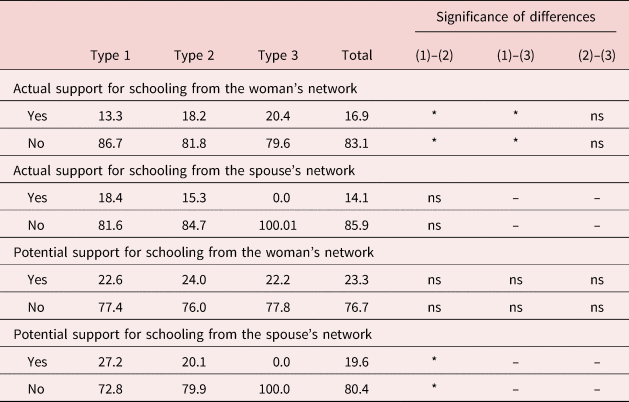
To answer this question, the network typology is matched against support from the extended family for children's schooling, taking account of the source of this support, i.e., received from the woman's family network, or from that of her spouse (Table 2). The results give a positive answer, as women who have closer contacts with their own family network (Types 2 and 3) more often receive support from this network for their children's schooling, while those with closer relations with their spouse's family network—via the spouse—(Type 1) more often receive support from his side. Among women in Type 1, 13.3% receive actual support for children's schooling from their own network, vs. 18.2% and 20.4% for women in Type 2 and 3; and 27.6% receive potential support for children's schooling from the spouse's network, vs. 20.1% for women in Type 2. Actual support from the spouse's network and potential support from the woman's network follow this same logic of proximity, although the differences are not statistically significant at the 5% level. These findings suggest that in Ouagadougou today, couples cannot count on the extended family for the children's schooling unless they have close relations with family members. Thus, women who are in networks with strong ties—also via their spouse—will be more likely to count on the members of their extended family for their children's schooling. Support for schooling being one form of transfer among many others, women who count on their network to help with schooling can certainly count on them for other childrearing costs, and are probably more likely to desire additional children.
Level of support for schooling by types of family networks (%)

*Differences significant at the 5% level; ns: not significant.
Source: Demtrend Survey, Ouagadougou, 2012, authors' calculations. We used two types of tests to check on the statistical differences: a test of the difference in proportion for proportions and a t test for means.
6.3 Potential economic resources and support for schooling from family network
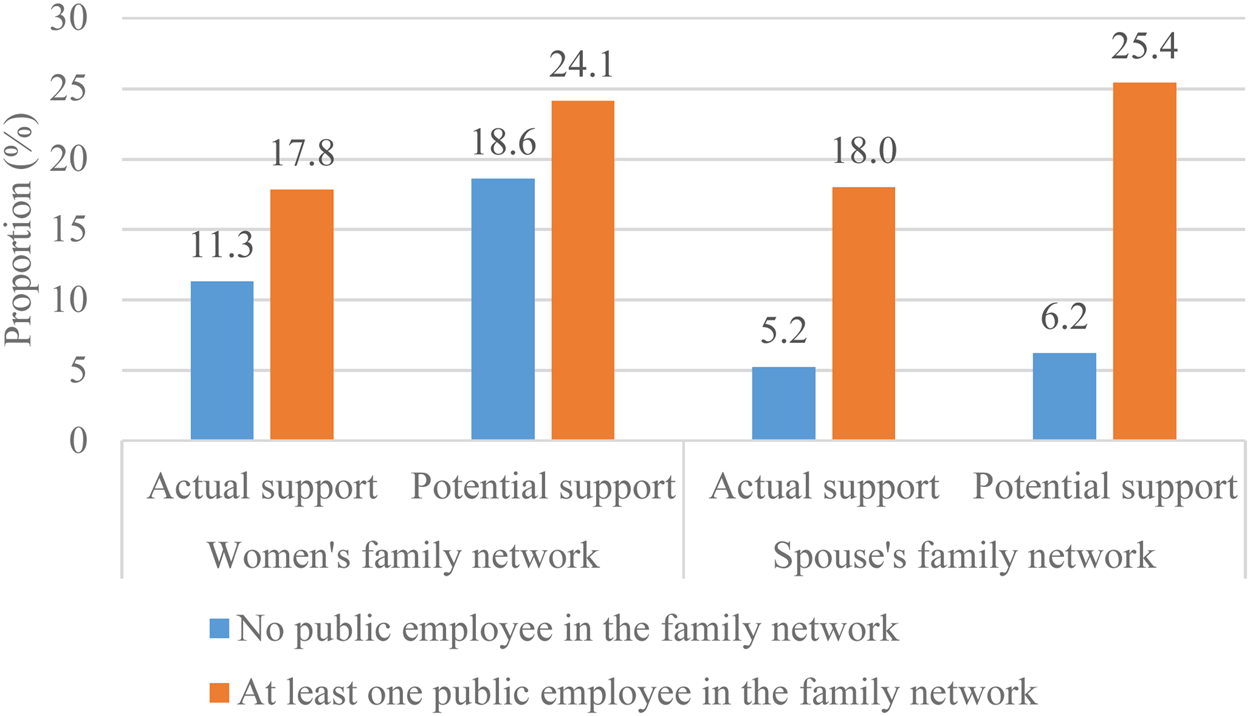
Another interesting link to examine is the relation between the economic capital of the family network and support for children's schooling. Economic resources are proxied by the presence (or not) of at least one public employee in the woman's (respectively, her spouse's) family network. We find that women who have at least one public employee in their own or their spouse's family network receive more support for schooling than women who do not (Figure 1). For those with public employee(s) in their own family network, 17.8% receive actual support and 24.1% potential support, vs. 11.3% and 18.6%, respectively, among those without. These differences are even more pronounced with respect to the spouse's family network (18% vs. 5.2% for actual support, and 25.4% vs. 6.2% for potential support). In addition to the condition of strength of ties, these results suggest that couples in Ouagadougou cannot rely on their extended family to support their children's schooling unless their network members have the necessary financial means. Women with affluent networks can rely more strongly on family members to help pay for schooling, and this may increase their demand for additional children.
Support for schooling according to the presence or absence of at least one public employee in the family network.
Note: The difference between “No public employee in the family network” and “At least one public employee in the family network” is significant at the 5% level for both the woman's and the spouse's network.
Source: Survey Demtrend, Ouagadougou, 2012, authors’ calculations.

6.4 Types of networks and women's demand for additional children
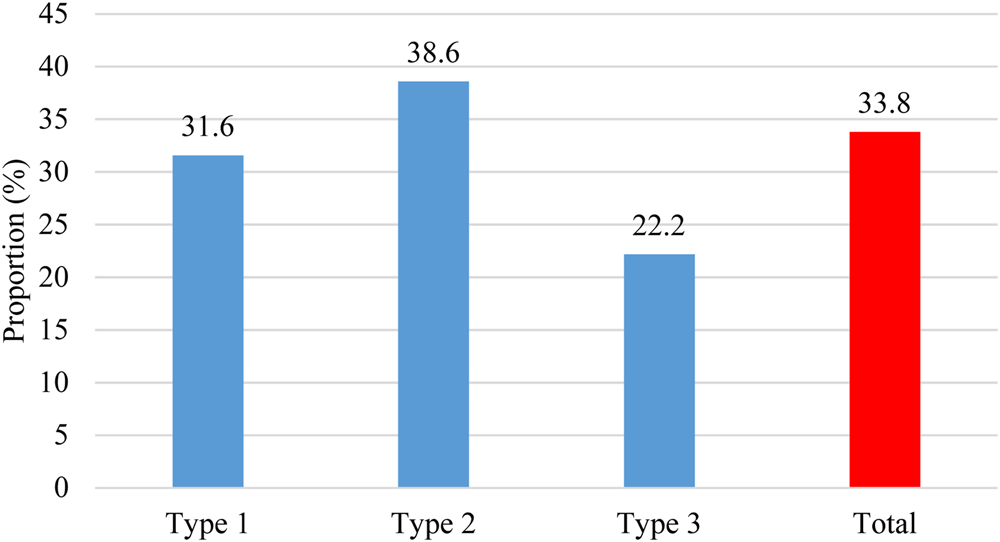
Figure 2 shows the frequency of demand for additional children among the entire sample population, and for the three types of women whose profiles are defined according to the family network structure detailed in Table 1. Overall, more than one-third of these women aged 35–44 (33.8%) intended to have more children at the time of the survey (Figure 1). The proportion differs by types of family networks, however. It is higher in Type 2 (38.6%) than in Type 1 (31.6%) and Type 3 (22.2%). These bivariate results suggest that having close ties with the family network, that of the woman especially, is associated with a stronger demand for additional children in Ouagadougou. The lower demand among women in Type 3, despite the strength of their ties with network members, probably reflects the fact they are single, widowed, or divorced. At this stage in their life (they are aged 35–44), many of them may no longer wish to form a new union and have more children.
Proportion of women wanting to have at least one additional child by types of family networks.
Note: The differences across types are significant at the 5% level.
Source: Survey Demtrend, Ouagadougou, 2012, authors' calculations.

6.5 Potential economic resources from family networks and demand for additional children
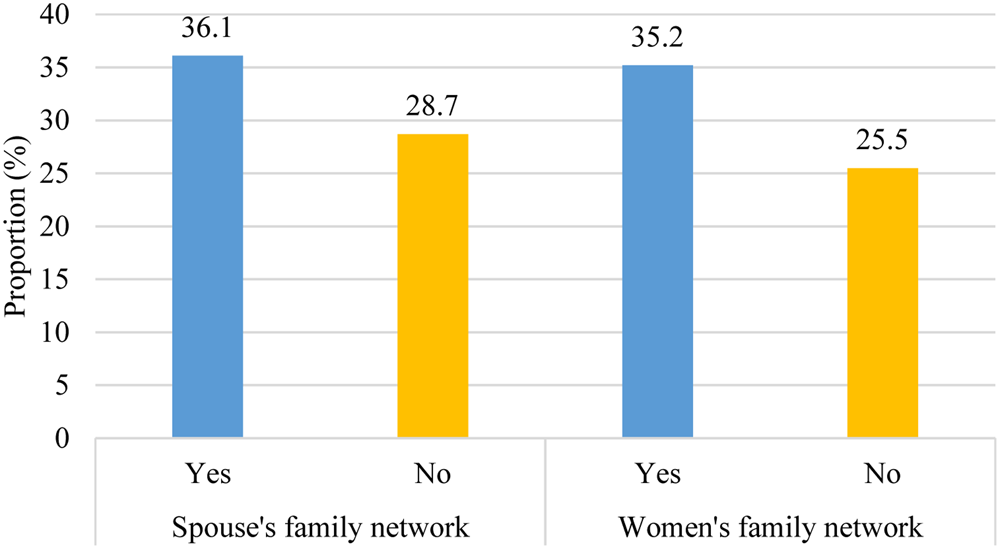
The relational structure of the family network appears to influence demand for additional children. But what role is played by its potential economic resources? To answer this question, we assessed the frequency of demand for additional children by the presence (or not) of public employees in the woman's network and in that of her spouse (Figure 3). It appears that women with at least one public employee in either their own or their spouse's network more often wish to have additional children than those without (36.1% when public employee present in the woman's network vs. 28.7% when absent; 35.2% when present in the spouse's network vs. 25.5% when absent). Hence, in addition to the strength of ties with network members, networks' economic resources are also associated with demand for additional children. To control for these and other differences in the sociodemographic profiles of the women in the various family network types liable to affect their desire for additional children, we applied multivariate methods to assess the net relation between types of family networks, potential network economic resources, and women's demand for additional children.
Proportion of women wishing to have at least one additional child by the presence or absence of at least one public employee in the family network.
Note: Differences across types are significant at the 5% level.
Source: Survey Demtrend, Ouagadougou, 2012, authors' calculations.

6.6 Effects of family networks on woman's demand for additional children
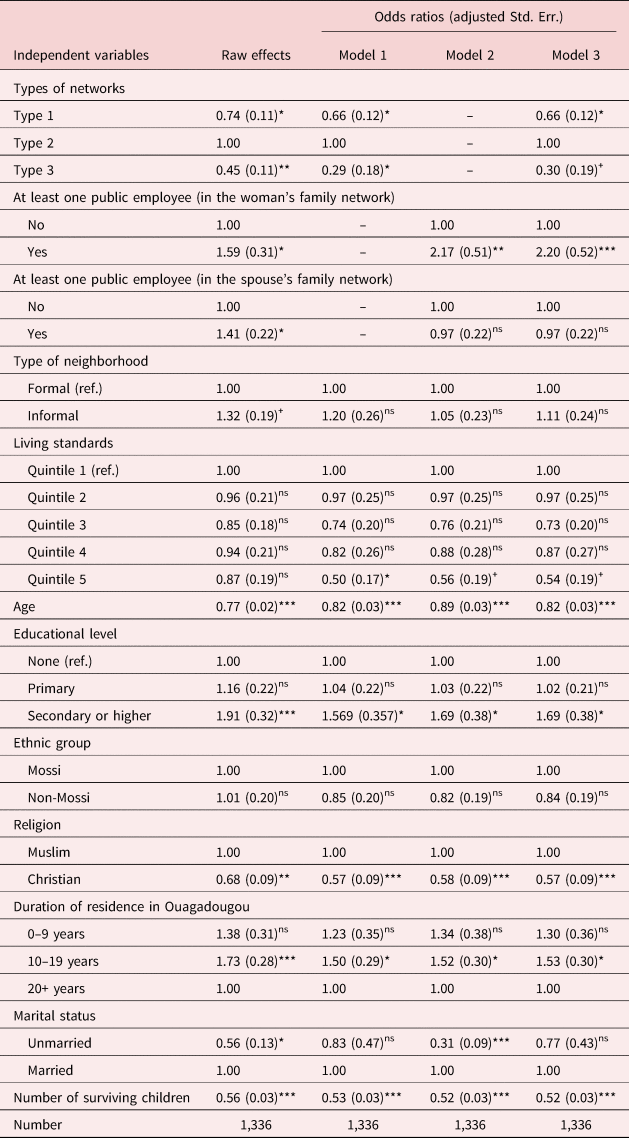
Table 3 presents the results of a multivariate analysis, taking into account all the examined variables. The effect of types of family networks on women's demand for additional children is estimated in Model 1, the effect of potential network economic resources in Model 2, and the effect of types of family networks net of potential network economic resources in Model 3. The results confirm those observed in the bivariate analysis: potential network economic resources of family network are positively correlated with the demand for additional children (Model 2). Women with at least one public employee in their own family network are around twice as likely (odds ratio = 2.17) to want additional children than those without. However, the significant difference observed in the bivariate analysis between women with and without at least one public employee in their spouse's family network disappears. These results suggest that in terms of economic resources, a woman's own family network is a greater source of support than that of her spouse. As only the women were asked about their desire for additional children at the time of the survey, this situation may arise from the fact that the woman is generally linked to her family-in-law via her spouse, while her links with her biological parents are direct. On the basis of this biological proximity, women may consider the availability of different kinds of support from their own family network (health, schooling, food, etc.) when deciding whether they want to have more children.
Odds ratios and standard errors from the regression models of types of family networks, socioeconomic resources within, on women's desire for additional children, Ouagadougou

Significance levels: ***p < 0.001; **p < 0.01; *p < 0.05; +p < 0.10; ns: non-significant.
Source : Survey Demtrend, Ouagadougou, 2012, authors' calculations.
Types of family networks influence demand for additional children, after controlling for the network's potential economic resources (Model 3). Women who have strong ties with both their own and their spouse's family networks, but who give priority to their own network (Type 2) are more likely to want additional children than those with similar numbers of close contacts with both networks (via the spouse for the family-in-law) (Type 1), and those whose frequent close contacts are limited to their own family network (Type 3). Women in Types 1 and 3 are 34% and 70% less likely, respectively, to want additional children than women in Type 2. As already mentioned, the difference observed between Types 1 and 2 can be explained by the strength of the woman's ties with her own extended family, while the difference between Types 1 and 3 is linked to the women's “unmarried” status (single, widowed, or divorced) in Type 3.
In addition to the types of networks and their potential economic resources, the woman's sociodemographic characteristics are associated with demand for additional children in the expected direction. The results of Model 3 in Table 3 show that women's age is negatively correlated with demand for additional children. A one-year increase in age decreases the likelihood of wanting another child by 23%. The number of surviving children is also negatively correlated with women's demand for additional children. Women with numerous surviving children are less inclined to have more children than those with few; having a surviving child decreases the likelihood of wanting another child by 45%.
Household socioeconomic status is also associated with demand for additional children at the 10% level: the higher the status, the lower the demand for additional children. Women living in households with very high socioeconomic status (quintile 5) are 45.7% less likely, all other things being equal, to want an additional child than women living in the poorest households (quintile 1). However, demand for additional children among women in quintiles 2, 3, and 4 is not significantly different from that of women in quintile 1. Conversely, demand for additional children increases with the woman's educational level. Women with secondary education are more than 69% more likely to want another child than women with no education. This is because women with secondary education start having children later.
Religion and duration of residence in Ouagadougou also play a role. Christian women are 43% less likely to want another child than Muslim women. Having lived in Ouagadougou for less than 10 years has a non-significant effect on women's desire for more children, while women living in the city for between 10 and 19 years are 53% more likely to want another child than those being born there.
7. Discussion
The objective of this study was to assess the role of extended family in maintaining relatively high demand for children in Ouagadougou's outlying neighborhoods. We hypothesized two effects: higher economic capital within extended families should increase women's demand for children because they alter quantity-quality trade-offs for couples. Similarly, large family networks with strong ties, especially on the husband's side, should increase women's demand for children because of their normative influence. To test these hypotheses, we measured both (i) the effects of the extended family's economic resources, proxied by the presence of public employees in the network; and (ii) the effects of the size of family networks and number of close links on both women's and their husbands' sides, in the form of family network types, on demand for additional children, net of economic resources.
The study findings show that women belong to three different types of family networks. The first type includes women who belong to large family networks on both her own and her husband's side and who maintain a moderate number of close relations with their own relatives (Type 1); the second type includes women who also belong to large family networks on both sides but who maintain a greater number of close relations with their own blood relatives (Type 2). The third type of network is smaller in size, and composed of family members on the woman's side only, with whom she maintains a large number of close relations (Type 3).
These networks contrast sharply with the family networks documented by previous research, mainly in wealthy countries. Only about a quarter of our sample of women aged 35–44 in Ouagadougou have “small” extended family reservoirs (brothers, sisters, father, mother, and adult children only), and even then, they have 9 members on average. Moreover, the entire family pool appears to be active, since annual or very infrequent contacts with family members are rarely reported in any type of network (results not shown). Conversely, frequent contacts (several times a month) with at least one member are reported in all types of networks, but with different intensities, as mentioned above; the extended African family is not a legend, even in this capital city.
The types of family networks are associated with the level of support for children's schooling. Networks more focused on women's relatives (Type 2 and 3) receive more support for children's schooling from women's relatives, and networks centered on husbands relatives (Type 1) receive more often support from the latter. These results are logical, since, as Renaut (Reference Renaut2003) underlines, material family solidarity is built around the economic resources (economic capital) in the family configuration. The same author stresses that the existence of material exchanges within family configurations is more often determined by the family members' capacity to give than by the beneficiaries' needs. Hence material transfers are larger in networks with more economic resources (those with public employees) than in networks with fewer such resources (those without public employees). Note that the educational level of network members is very much correlated to their occupational position (not included in this analysis). Material or economic transfers within families differ in this regard from practical or emotional support—not studied here, but abundantly scrutinized in family network research in wealthy countries. Affective and practical exchanges tend, for their part, to be greater when beneficiaries are in need, and to reach their limits in the conflicts spurred by over-needy or over-intrusive kin [Widmer et al. (Reference Widmer, Girardin and Ludwig2018)].
A central finding of this study is that the network's economic resources are positively associated with women's demand for children: demand for additional children is higher for women with at least one public employee in their network than for those without, taking into account the types of networks and the characteristics of the woman and her household. In the African context, the quantity-quality trade-off must be interpreted in the context of economic transfers between network members [Bougma et al. (Reference Bougma, Pasquier-Doumer, Legrand and Kobiané2014)]. The continuing desire to have a relatively large number of children, even in a capital city where living standards are rising, seems to be fueled in part by the continued existence of large and active family networks of mutual economic support.
A second important finding of this study is that large family networks with a large amount of social capital, i.e., strong ties between members, are associated with a higher demand for children among women, taking into account their socioeconomic status and the confounding effect of the network's economic resources, but only on women's side. This result runs counter the hypothesis of normative influence [Rossier and Bernardi (Reference Rossier and Bernardi2009)] because we expected to see women belonging to close-knit networks on their husbands' side to have higher fertility intentions. This result may indicate that material and emotional support from family network members plays a role in sustaining higher fertility intentions in Ouagadougou, as shown in wealthier contexts [Kaptijn et al. (Reference Kaptijn, Thomese, Van Tilburg and Liefbroer2010)]. Alternatively, these results could mean that women entertain closer relationships with their family of origin than their husbands do with their own family (at the same frequency of contacts), thus their greater opportunity to obtain support (of any sort, socioeconomic but also practical or emotional) from their relatives. While our data did not contain information on social support nor relational quality, further work should investigate these dimensions in relation to fertility outcomes in the African context.
The normative influence of networks, the importance of which is emphasized by Coleman (Reference Coleman1988) and Portes (Reference Portes1998), is more rarely studied in the literature on social networks and health, given the dominant role of emotional and instrumental support in this literature. In the present study, contrary to expectations, women embedded in family networks centering on the husband's relatives do not exhibit higher fertility intentions, after controlling for the network's economic resources. However, this could be explained by the fact that women were not asked about their own relationships with their in-laws (and their spouses were not asked about their relationships with their wife's relatives). Data collected in an ego-centered perspective are probably needed to pick up normative effects.
Further research in this area could usefully measure not only extended family networks, but also other types of relationships [Widmer (Reference Widmer2016)], as these may be particularly prevalent in urban areas [Rossier and Peytrignet (Reference Rossier, Peytrignet, Rossier, Soura and Duthé2019)]. For example, women in Type 3, who are single, widowed, or divorced, have a somewhat lower standard of living than those in Types 1 and 2 and their extended family is generally small due to the absence of a spousal network; they may rely heavily on non-family networks to survive in the city. It would also be useful to explore a broader set of actual and potential transfers in addition to support for schooling. Finally, normative aspects could be studied by asking direct questions about women's fertility desires and the family pressures exerted upon them, about family attitudes toward desired number of children and individual attitudes toward maintaining extended family ties, and by measuring the density of exchanges and contacts between network members, which are themselves predictive of normative pressure [Granovetter (Reference Granovetter1977)].