Introduction
Sweetpotato [Ipomoea batatas (L.) Lam.] in the United States has been worth an average of US$641 million annually from 2015 to 2019 (USDA-NASS 2020). The primary sweetpotato production states include North Carolina, California, Mississippi, and Louisiana, respectively (USDA-NASS 2020). In North Carolina, sweetpotato is the 4th most economically important crop following tobacco (Nicotiana tabacum L.), soybean [Glycine max (L.) Merr.], and corn (Zea mays L.) (USDA-NASS 2020). Though sweetpotato is an important crop, there are relatively few sustainable weed management options to ensure consistent yields.
Marketable sweetpotato yield can be reduced up to 95% by weed competition (Barkley et al. Reference Barkley, Chaudhari, Jennings, Schultheis, Meyers and Monks2016; Basinger et al. Reference Basinger, Jennings, Monks, Jordan, Everman, Hestir, Waldschmidt, Smith and Brownie2019; Smith et al. Reference Smith, Jennings, Monks, Chaudhari, Schultheis and Reberg-Horton2020). At low densities, Palmer amaranth (Amaranthus palmeri S. Watson) reduced total sweetpotato yield 36% to 50% from 0.5 to 1 plants m−2, respectively (Meyers et al. Reference Meyers, Jennings, Schultheis and Monks2010), compared with 18% yield loss from 5 yellow nutsedge (Cyperus esculentus L.) shoots m−2 (Meyers and Shankle Reference Meyers and Shankle2015) or 35% yield loss from 1 large crabgrass [Digitaria sanguinalis (L.) Scop.] plant m−2 (Basinger et al. Reference Basinger, Jennings, Monks, Jordan, Everman, Hestir, Waldschmidt, Smith and Brownie2019). Compared with other Amaranthus species, A. palmeri accumulated more biomass and grew taller (Horak and Loughin Reference Horak and Loughin2000; Sellers et al. Reference Sellers, Smeda, Johnson, Kendig and Ellersieck2003). Guo and Al-Khatib (Reference Guo and Al-Khatib2003) reported that A. palmeri produced lower biomass than other Amaranthus species at 15/10 C day/night, but comparatively greater biomass at 35/30 C. Amaranthus palmeri has C4 photosynthesis and a relatively high maximum net photosynthesis rate, even compared with other plants with C4 photosynthesis (Ehleringer Reference Ehleringer1983; Ward et al. Reference Ward, Webster and Steckel2013). This allows A. palmeri to quickly overcome sweetpotato in height and outcompete the crop (Meyers et al. Reference Meyers, Jennings, Schultheis and Monks2010). In addition, A. palmeri is dioecious and has high fecundity (Keeley et al. Reference Keeley, Carter and Thullen1987; Sellers et al. Reference Sellers, Smeda, Johnson, Kendig and Ellersieck2003; Ward et al. Reference Ward, Webster and Steckel2013). Large populations with high genetic diversity, combined with intensive selection pressure in rotational crops, have resulted in control failures from many important herbicides (Heap Reference Heap2020). As a result, A. palmeri competition with sweetpotato is commonplace.
‘Covington’, an orange-flesh table-stock sweetpotato, is the primary sweetpotato cultivar planted in North Carolina, because it yields similar to ‘Beauregard’ but with more consistent root sizing, resulting in more No. 1 grade roots, and has desirable insect- and disease-resistance traits (NCDACS 2015; Yencho et al. Reference Yencho, Pecota, Schultheis, VanEsbroeck, Holmes, Little, Thornton and Truong2008). Meyers et al. (Reference Meyers, Jennings, Schultheis and Monks2010) reported that higher A. palmeri densities intercepted more light from sweetpotato and that there was a strong relationship between A. palmeri light interception and sweetpotato yield loss. Likewise, other researchers have reported that light interception in the absence of weed competition results in linearly decreased sweetpotato yields (Oswald et al. Reference Oswald, Alkamper and Midmore1995).
Meyers et al. (Reference Meyers, Jennings, Schultheis and Monks2010) hypothesized that light interception is the primary cause of yield loss in Covington sweetpotato. However, a comparison of light interception with other sources of competition has not been conducted in sweetpotato. Black polyethylene cloth has been used to simulate weed competition in soybean (Stoller and Woolley Reference Stoller and Woolley1985). The authors reported that, based on the simulated weed light interception, most of the soybean yield loss from velvetleaf (Abutilon theophrasti Medik.) and jimsonweed (Datura stramonium L.) were due to competition for light, whereas around half of the soybean yield loss from common cocklebur (Xanthium strumarium L.) was due to competition for light (Stoller and Woolley Reference Stoller and Woolley1985). The response of sweetpotato to shading has been evaluated in cultivars other than Covington (Nedunchezhiyan et al. Reference Nedunchezhiyan, Naskar and Byju2008; Oswald ed at. 1995). However, because differential yield loss responses to light interception or weed competition have been observed among sweetpotato cultivars (Harrison and Jackson Reference Harrison and Jackson2011; La Bonte et al. Reference La Bonte, Harrison and Motsenbocker1999; Oswald et al. Reference Oswald, Alkamper and Midmore1995; SC Smith, personal communication), studies were conducted to compare the effects of light interception with shade cloth and by A. palmeri canopies on Covington sweetpotato.
Materials and Methods
Field studies were initiated on June 18, 2019 (35.023°N, 78.280°W), and June 10, 2020 (35.024°N, 78.279°W), at the Horticultural Crops Research Station near Clinton, NC. The soil was an Orangeburg loamy sand (fine-loamy, kaolinitic, thermic Typic Kandiudults), pH 5.3 and 0.8% organic matter in 2019, and a Norfolk loamy sand (fine-loamy, kaolinitic, thermic Typic Kandiudults), pH 6.6 and 0.5% organic matter content in 2020, respectively. Nonrooted Covington sweetpotato cuttings (slips) were mechanically transplanted to a 30-cm in-row spacing. Overhead irrigation was applied before and after planting, nutrients were applied to achieve the target sufficiency range for the crop, and insects and diseases were managed according to commercial sweetpotato growing recommendations (Kemble et al. Reference Kemble, Meadows, Jennings and Walgenbach2019).
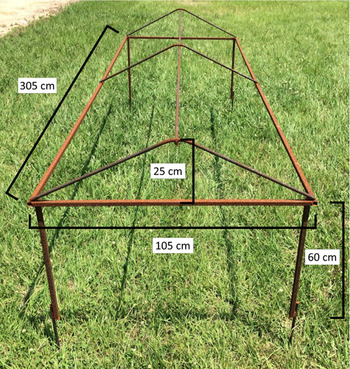
Plots consisted of two rows each 1.07-m wide by 3.05-m long; the first row was a border, and the second row received a treatment. The experiment design was a randomized complete block with treatments replicated four times. Treatments consisted of a seven by two factorial arrangement, in which the first factor included shade cloth with an average measured light interception (Equation 1) of 41%, 59%, 76%, and 94% (30%, 50%, 70%, and 90% black knitted polyethylene film, Greenhouse Megastore, Danville, IL), and A. palmeri thinned to 0.6 or 3.1 plants m−2 or a nontreated weed-free check; and the second factor included shade cloth or A. palmeri removal timing at 6 or 10 wk after planting (WAP). Before 3 WAP, plots assigned a density of A. palmeri were thinned so that the plants were evenly distributed across the plot. All other weeds in the study were hand removed weekly. Shade cloth was fit to custom-made metal (1.3- to 1.9-cm in diam) structures with the shape of a 305 by 105 by 60 cm rectangular prism topped with a 25-cm-high triangular prism (Figure 1). Shade cloth structures were placed in the field 3 WAP to coincide with A. palmeri overcoming sweetpotato in height. Shade structures were removed and replaced within 4 h at 4 WAP so that interrow weeds could be removed using cultivation.
Metal (1.3- to 1.9-cm in diam) custom-made structure to which shade cloth was fit. The structures were shaped as a 305 by 105 by 60 cm rectangular prism topped with a 25-cm-high triangular prism.

Amaranthus palmeri Height, Width, and Light Interception
Amaranthus palmeri height measured from the soil surface to the tallest part of the plant and width measured perpendicular to the sweetpotato row on the widest part of the plant were recorded on two plants per plot at 3, 4, 5, and 6 WAP for both removal timings, as well as at 7, 8, 9, and 10 WAP for the second removal timing. Amaranthus palmeri light interception was measured twice per row in non-overlapping areas between 10 AM and 2 PM at 3, 4, 5, and 6 WAP for both removal timings, as well as at 7, 8, 9, and 10 WAP for the second removal timing using a 1-m LI-191R Line Quantum Light Sensor (Li-Cor Bioscience, Lincoln, NE). The sensor was held parallel to the row at the top of the sweetpotato canopy without displacing A. palmeri leaves. Light interception was calculated using the following equation:
 $Y =1- {[(i_{1}/a_{1}) + (i_{2}/a_{2})]/2}$
where i 1 and i 2 are the photosynthetically active radiation at the sweetpotato canopy and a 1 and a 2 are the ambient photosynthetically active radiation measured before each subsample.
Soil Volumetric Water Content and Sweetpotato Internode Length and Yield
Soil volumetric water content was estimated using a Field Scout TDR 300 (Spectrum Technologies, Aurora, IL) immediately after interference source removal, at 6 or 10 WAP. The 12.2-cm-long rods were inserted into the soil perpendicular to the row between sweetpotato plants, to avoid puncturing storage roots, in four evenly spaced subsamples across the plot. Sweetpotato internode length was quantified by recording the length of five internodes on the distal end of a vine beginning with the first fully opened leaf on three randomly selected plants per plot immediately after interference source removal, at 6 or 10 WAP. Sweetpotato storage roots were harvested at 16 WAP using a chain digger; graded into canner (>2.5 to 4.4 cm in diam), number (No.) 1 (>4.4 to 8.8 cm), jumbo (>8.9 cm); and weighed (USDA 2005). Total yield was calculated as the sum of canner, No. 1, and jumbo grades. Yield for each grade was normalized over the number of plants per plot, and yield loss was calculated as a percent of the nontreated plots. Using an optical grader (Exeter Engineering, Exeter, CA), the length to width ratio (LWR) of No. 1 storage roots was calculated using estimated length and largest estimated diam of each root, and root counts were recorded for each grade.
Data Analysis
Data were checked for heteroscedasticity by plotting residuals. Log transformations were required for A. palmeri height and width data, and square-root transformations were required for soil moisture, LWR of No. 1 sweetpotato storage roots, and jumbo grade sweetpotato yield data. Back-transformed least-squares means were presented for interpretability. ANOVA was conducted using PROC MIXED (SAS v. 9.4, SAS Institute, Cary, NC). For A. palmeri height, width, and light-interception data, fixed effects included year, A. palmeri density, growing degree days (GDD), and all interactions, and random effects included replication nested within year. A REPEATED statement was included where Group = GDD to allow error variance to differ between weekly measurements for A. palmeri height, width, and light-interception data. For soil moisture and sweetpotato internode length and yield data, fixed effects included year, interference source, removal timing, and all interactions, and random effects included rep nested within year. When no significant interactions (P > 0.05) were present between interference source, removal timing, and year, the main effect least-squares means were presented. When ANOVA indicated a significant (P ≤ 0.05) effect, linear and nonlinear regression of least square means were conducted using SAS PROC REG and PROC NLIN, respectively. The following three-parameter sigmoidal equation best described the influence of GDD (base 10 C) on A. palmeri height and width:
 $Y = a/\{1 + {\rm exp}[- (GDD-c)/b]\} $
where a is the maximum growth, b is the growth rate, and c is the inflection point. The influence of GDD on Amaranthus palmeri light interception was best described by the following cubic equation:
 $Y = a + (b \times GDD) + (c \times GDD^2) + (d \times GDD^3)$
where a, b, c, and d are coefficients. The influence of shade cloth light interception on No. 1, jumbo, and total sweetpotato yield were best described by the following linear model:
 $Y = (a \times light\ interception) + b $
where a is the slope, and b is the y-intercept. When significant (P ≤ 0.05) interference source and removal timing effects were present, and no significant (P > 0.05) interaction was present between interference source and removal timing, data were presented as independent intercepts for each removal timing with a common slope (Ritz et al. Reference Ritz, Kniss and Streibig2015). Correlation of storage root counts to weights were conducted using SAS PROC CORR.
To compare the influence of A. palmeri competition with the influence of shade cloth light interception on sweetpotato yield, treatment means were regressed on light interception from shade cloth or A. palmeri for each removal timing. Differences between the two sources of competition (i.e., shade cloth vs. A. palmeri) in their effects on yield were tested via comparison of the slopes and intercepts for the two types of competition at each removal timing. The method used was an F-test for comparing a reduced model with the same slope and intercept for both types of competition against the full model with different slopes and intercepts for the two types of competition (Rawlings et al. Reference Rawlings, Pantula and Dickey1998). Lack of fit to the full model provided the Error term, or denominator mean square, for the F ratio.
Results and Discussion
Amaranthus palmeri Height and Width
Significant A. palmeri density-by-year interactions were present for A. palmeri height and width results. Graphs of interaction means were assessed, and the interactions were deemed biologically uninformative; thus, the dependent variable means were obtained by pooling data across years. Because of a significant A. palmeri density-by-GDD interactions for A. palmeri height (P < 0.004) and width (P < 0.0023), data were analyzed by density. GDD had a significant (P < 0.0001) effect on A. palmeri height and width (Figure 2). The predicted maximum height of the high (3.1 plants m−2) A. palmeri density (191 cm) was 21 cm greater than the maximum height of the low (0.6 plants m−2) weed density (170 cm); however, the predicted maximum width of the low A. palmeri density (149 cm) was 38 cm greater than the maximum width of the high weed density (111 cm). Previous research similarly reported the predicted height of A. palmeri in sweetpotato increased from 177 to 197 cm at densities of 0.5 to 3.9 plants m−2 and predicted A. palmeri width decreased linearly from 145 to 69 cm at densities of 0.5 to 6.1 plants m−2 (Meyers et al. Reference Meyers, Jennings, Schultheis and Monks2010).
The influence of growing degree days (GDD) on the (A) height and (B) width of low (0.6 plants m−2) and high (3.1 plants m−2) Amaranthus palmeri densities growing in sweetpotato in 2019 and 2020 in Clinton, NC. Data were recorded weekly from 3 to 10 wk after sweetpotato planting (WAP). Points represent means ± SE. Lines represent predicted values. Low density of A. palmeri height = 169.7/{1 + exp[ − (GDD − 568.9)/95.9]}; R2 = 0.99; P < 0.0001. High density of A. palmeri height = 191.3/{1 + exp[ − (GDD – 604.6)/112.2]}; R2 = 0.99; P < 0.0001. Low density of A. palmeri width = 148.8/{1 + exp[ − (GDD – 567.8)/122.5]}; R2 = 0.99; P < 0.0001. High density of A. palmeri width = 111.1/{1 + exp[ − (GDD – 543.4)/103.5]}; R2 = 0.98; P < 0.0001.

Amaranthus palmeri Light Interception
Significant A. palmeri density-by-year interactions were present for A. palmeri light-interception data. Graphs of interaction means were assessed, and the interactions were deemed biologically uninformative; thus, the dependent variable means were obtained by pooling data across years. A significant A. palmeri density-by-GDD interaction (P = 0.0023) was present for A. palmeri light-interception data; therefore, data were analyzed by A. palmeri density. GDD had a significant (P < 0.0001) influence on A. palmeri light interception for each density (P < 0.0001). Amaranthus palmeri light interception peaked around 710 to 840 GDD (6 to 7 WAP) (Figure 3). This corresponds with the point at which A. palmeri is approaching the maximum height and width (Figure 2). After 840 GDD, light interception begins to decrease for each A. palmeri density because of natural leaf senescence and defoliation from insects, primarily Lepidoptera. Meyers et al. (Reference Meyers, Jennings, Schultheis and Monks2010) reported the greatest light interception 10 WAP, which decreased at 13 to 14 WAP because of plant senescence and defoliation.
The influence of growing degree days (GDD) on the light interception of low (0.6 plants m−2) and high (3.1 plants m−2) Amaranthus palmeri densities growing in sweetpotato in 2019 and 2020 in Clinton, NC. Data were recorded weekly from 3 to 10 wk after sweetpotato planting (WAP). Points represent means ± SE. Lines represent predicted values. Low density of A. palmeri light interception = −156.8 + (0.669 × GDD) + (−0.0007 × GDD2) + (0.0000002 × GDD3); R2 = 0.99; P = 0.003. High density of A. palmeri light interception = −198.3 + (0.888 × GDD) + (−0.0009 × GDD2) + (0.0000003 × GDD3); R2 = 0.99; P < 0.0001.

Soil Moisture
Because of a significant (P < 0.0001) removal timing-by-interference source interaction, data were analyzed separately by removal timing. Soil volumetric water content was significantly (P < 0.026) affected by interference source for both removal timings. Soil moisture could not be appropriately described using regression analysis; therefore, means were compared using Fisher’s protected LSD, at a significance level α = 0.05 (Table 1). Except for the 41% shade cloth treatment, shade cloth structures increased soil moisture relative to the nontreated check at both removal timings. At 6 WAP, A. palmeri decreased soil moisture compared with the nontreated check, but there were no differences between treatments containing A. palmeri and the nontreated check at 10 WAP. This indicates that A. palmeri plants were competing for soil moisture 6 WAP, but competition was not detectable at 10 WAP.
The influence of shade cloth and Amaranthus palmeri on soil moisture, sweetpotato internode length, and the shape of No. 1 sweetpotato roots in 2019 and 2020, Clinton, NC.a,b

a Abbreviations: LWR, length to width ratio; no., number; WAP, wk after planting.
b Responses were not appropriately described using regression analysis; thus, means were compared using Fisher’s protected LSD, α = 0.05. Accordingly, means within a column followed by the same letter are not significantly different.
c Soil volumetric water content was estimated using a Field Scout TDR 300 immediately after interference source removal at 6 or 10 WAP. The 12.2-cm-long rods were inserted into the soil perpendicular to the row between sweetpotato plants, to avoid puncturing storage roots, in four evenly spaced subsamples across the plot.
d Sweetpotato internode length was quantified by recording the length of five internodes on the distal end of a vine beginning with the first fully opened leaf on three randomly selected plants per plot immediately after interference source removal, at 6 or 10 WAP.
e Length and greatest diam of No. 1 sweetpotato (>4.4- to 8.8-cm in diam) were estimated using an optical sorter.
f Shade cloth was fit to custom-made metal (1.3- to 1.9-cm in diam) structures shaped as a 305 by 105 by 60 cm rectangular prism topped with a 25-cm-high triangular prism and placed at 3 WAP to correspond with A. palmeri overcoming sweetpotato in height.
g Amaranthus palmeri were thinned to 0.6 and 3.1 plants m−2 spaced evenly across the plot area for the low and high density, respectively, before 3 WAP. All other weeds in the study were hand removed weekly.
Sweetpotato Internode Length
Because of a significant (P = 0.0023) removal timing-by-interference source interaction for sweetpotato internode length, data were analyzed separately by removal timing. Sweetpotato internode length was significantly (P < 0.0001) affected by interference source for both removal timings. Sweetpotato internode length could not be appropriately described using regression analysis; therefore, means were compared using Fisher’s protected LSD at a significance level of α = 0.05 (Table 1). Sweetpotato internode lengths in treatments including A. palmeri were similar to those of the nontreated check at 6 WAP but were longer than the nontreated check at 10 WAP. At each removal timing, shade cloth increased the sweetpotato internode length relative to the nontreated check. Etiolation is a common plant response to competition for light, as was observed from increased internode length for plants under high shade in this experiment. Oswald et al. (Reference Oswald, Alkamper and Midmore1995) observed that shading increased the sink size of the shoots over the roots, where some cultivars evaluated had little total shoot dry weight effects from up to 60% shading. Similarly, Page et al. (Reference Page, Tollenaar, Lee, Lukens and Swanton2010) observed that corn partitioned less biomass to the kernels in response to shade.
Sweetpotato Yield
Interactions between interference source and removal timing were not significant. Interference source and removal timing had a significant (P < 0.0001) effect on No. 1, jumbo, and total yield. The influence of shade cloth light interception on sweetpotato yield was fit to linear models with a common slope for each removal timing (Figure 4). Increasing shade cloth light interception by 1% increased yield loss by 1% for No. 1, jumbo, and total yield. Yield loss was increased by 36%, 23%, and 35% as shade cloth removal was delayed from 6 to 10 WAP for No. 1, jumbo, and total yield, respectively. Yield from 41% shade removed at 6 WAP was relatively similar to that of the nontreated check; therefore, sweetpotato may tolerate less-competitive weeds at moderate densities, as suggested by Harrison and Jackson (Reference Harrison and Jackson2011). Canner yield data were more variable compared with other grades: the use of transformations did not normalize the residuals, the data were uninformative, and the grade is typically less valuable than other grades; therefore, data are not presented.
The influence of light interception on (A) total, (B) No. 1, and (C) jumbo grade sweetpotato yield loss in 2019 and 2020 in Clinton, NC. Sweetpotato storage roots were harvested at 16 wk after planting (WAP); graded into canner (>2.5 to 4.4 cm in diam), No. 1 (>4.4 to 8.8 cm), jumbo (>8.9 cm), and total (canner + No. 1 + jumbo) grades; and weighed. Yield loss was calculated as a percent of the nontreated weed-free check. Treatments of 30%, 50%, 70%, and 90% black knitted polyethylene film (shade cloth) and Amaranthus palmeri thinned to 0.6 or 3.1 plants m−2 were plotted based on their light interception at the timing of removal, 6 or 10 WAP. High densities of A. palmeri always intercepted more light than low densities. Points represent means ± SE. Lines represent predicted values of yield influenced by shade cloth light interception. Total yield loss from the 6 and 10 WAP removal shared a common slope of 1.09 with intercepts of −42 and −7, respectively; R2 = 0.99; P = 0.007. No. 1 yield loss from the 6 and 10 WAP removal shared a common slope of 1.06 with intercepts of −38 and −2, respectively; R2 = 0.97 ; P = 0.01. Jumbo yield loss from the 6 and 10 WAP removal shared a common slope of 1.46 with intercepts of −43 and −20, respectively; R2 = 0.95; P = 0.02.

F-tests comparing reduced versus full models of yield loss were not significant for No. 1 (P = 0.3), jumbo (P = 0.3), or total (P = 0.5) yield. This provided no evidence that the presence of yield loss from A. palmeri light interception caused yield loss different than that explained by the shade cloth at similar light interception. However, more research is needed to confirm this at additional densities and removal timings of A. palmeri. Visual comparisons of plotted sweetpotato yield loss from A. palmeri light interception to predicted yield loss from shade cloth light interception appear relatively similar (Figure 4). It would be logical to expect, when comparing yield loss from the biotic versus simulated light interception, for weed competition to have caused yield reductions greater than or equal to the predicted yield loss from shade cloth at the same amount of light interception because of other factors of competition, such as the competition for water and nutrients. However, yield losses from some A. palmeri densities were slightly below the shade cloth–predicted yield loss, depending on sweetpotato grade. This observation is likely due to two factors: first, the design of the shade structures did not allow the sweetpotato vines to grow away from the competition for light, whereas the sweetpotato plants in plots containing A. palmeri were able to grow laterally into the row middles and vertically by ascending the A. palmeri to receive more solar radiation; and second, the shade cloth provided constant light interception, whereas the A. palmeri light interception was dynamic during the same GDD in competition with sweetpotato (Figure 2), though yield losses from A. palmeri were only compared with the predicted yield loss from shade cloth light interception using the light interception at each timing of removal. For these reasons, this study cannot be used to declare what portion of yield loss is due to light interception, but it can provide insight into the use of shade cloth as a model for simulating A. palmeri competition.
Percent reductions in the number of sweetpotato storage roots were strongly correlated (P < 0.0001) with yield loss from shade cloth treatments at the 6 (r = 0.74 and 0.71) and 10 WAP (r = 0.63 and 0.81) removal timings for No. 1 and total yield, respectively. Percent reductions in the number of sweetpotato storage roots were strongly correlated (P ≤ 0.0002) with yield loss from A. palmeri treatments at the 6 (r = 0.79) and 10 WAP (r = 0.9) removal timings for No. 1 yield, but only correlated (P = 0.01) with total yield 10 WAP (r = 0.62). Semidey et al. (Reference Semidey, Liu and Ortiz1987) reported that sweetpotato yield and number of roots were similarly decreased from weed competition. However, Nedunchezhiyan et al. (Reference Nedunchezhiyan, Naskar and Byju2008) reported that light interception decreased total sweetpotato yield but did not influence the total number of storage roots.
No. 1 sweetpotato is typically sold to the fresh market; therefore, the aesthetics of this grade are important for marketability. LWR gives an indication of the root shape. A lower value indicates a rounder-shaped root, which may be considered less marketable in some fresh markets (KM Jennings, personal communication). Because of a significant interference source-by-removal timing interaction (P = 0.0006) for the LWR of No. 1 sweetpotato, data were analyzed separately by removal timing. Interference source had a significant effect on the LWR of No. 1 sweetpotato at the 6 (P = 0.004) and 10 (P = 0.001) WAP removal timings. The responses could not be appropriately described using regression analysis; thus, means were compared using Fisher’s protected LSD at a significance level of α = 0.05 (Table 1). The only treatment that influenced the LWR of No. 1 sweetpotato at the 6 WAP removal timing was the 76% shade cloth treatment (Table 1). At the 10 WAP removal timing, treatments including A. palmeri and the 76% and 94% light-interception shade cloth were similar to the nontreated check, but the 41% and 59% light-interception shade cloth treatments decreased the LWR compared with the nontreated check. All recorded values were relatively similar to the typical 2.0 LWR of Covington, and all values were greater than the typical 0.4 LWR of Beauregard sweetpotato (Yencho et al. Reference Yencho, Pecota, Schultheis, VanEsbroeck, Holmes, Little, Thornton and Truong2008). Though statistical differences were reported, the responses between treatments were biologically similar.
Yield results indicate that light interception is an important contributor to yield loss from A. palmeri competition, but other aspects of A. palmeri competition cannot be disregarded. Soil samples taken from the whole study area after harvest indicated phosphorus and potassium were above recommended concentrations for NC sweetpotato (data not shown). If the experiment were to be replicated in conditions with limited nutrients, the influence of A. palmeri competition on yield loss could vary from the present experiment. Water was limited at times during the season, and A. palmeri were in competition for water with sweetpotato. At the 6 WAP removal in both years, sweetpotato growing in competition with A. palmeri had visible leaf wilting compared with the nontreated check. Limited soil moisture can negatively affect sweetpotato root development (Pardales and Yamauchi Reference Pardales and Yamauchi2003).
Sweetpotato responses varied between the shade cloth and A. palmeri treatments for some measurements, but yield responses were similar between the predicted yield loss from shade cloth and A. palmeri. Based on the present experiment in the evaluated environmental conditions, shade cloth structures could be used to simulate Covington sweetpotato yield loss from A. palmeri competition, and light interception could be used as a predictor for expected yield loss from A. palmeri competition. Amaranthus palmeri is the most common and troublesome weed in NC sweetpotato (Webster Reference Webster2010; SC Smith and LD Moore, unpublished data); however, many fields may contain an array of weed species. Therefore, the efficacy of light interception as a predictor of yield loss should be evaluated with various weed species. With additional research evaluating the relationship between light interception and weed competition in sweetpotato, shade cloth structures could be used in place of weed competition when uniform weed populations are not available, weeds cannot be seeded, or the labor required to maintain desired weed densities are not available. Using shade cloth as simulated weed competition has the potential for use in sweetpotato weed research and should be further investigated for uses such as comparing sweetpotato cultivar tolerance to weed competition. Furthermore, with additional research, measured weed light interception and duration of competition could be used to predict yield loss for informing the management decision-making process.
Acknowledgments
The authors would like to thank the North Carolina Agricultural Foundation, NC Department of Agriculture and Consumer Services, NC College of Agriculture and Life Sciences at NC State University, and North Carolina SweetPotato Commission for funding these studies and Jim Jones for providing sweetpotato slips. The authors thank Colton Blankenship, Stephen Ippolito, Kira Sims, Cole Smith, Chitra, and the staff at the Horticultural Crops Research Station for aiding in the management of this experiment. The authors also thank Cavell Brownie for help with the statistical analysis. No conflicts of interest have been declared.