Introduction
Who would have imagined that some small virus could change the world's pulse and the nature of our traditional way of life? When the media announced on 19th of December 2019, two severe cases of pneumonia and a strange virus in China, this piece of news was not considered seriously and was soon lost in the mainstream media flow of Christmas and New Year celebrations.
In less than 2 months the situation around the world became totally different due to the increasing numbers of coronavirus disease-2019 (COVID-19) cases and deaths, resulting in many countries announcing a quarantine procedure, and leading to organizations closing or moving their work online. The educational sector turned out to be one of the most affected sectors, when the study process had to be reorganized and moved totally to the virtual environment. Starting from March 2020, most educational institutions around the world moved from contact to virtual teaching and learning. The global pandemic affected around 1.54 billion school and university students throughout 185 countries in Europe, Asia, North and South America at the end of March 2020 (Schleicher, Reference Schleicher2020). At the peak of the crisis, 1.6 billion students could not study in their traditional way in 195 countries (Data.europe.eu, 2020).
The vast majority of institutions in the educational sector had not had any similar experience before. According to a survey conducted by UNESCO (Data.europe.eu, 2020), about 20% of the 61 questioned countries had digital learning resources in teaching, but only in some educational institutions. The World Bank indicated that no country had a universal digital curriculum for teaching and learning (Data.europe.eu, 2020). In such conditions, many educators started to teach virtually for the first time and faced new challenges (e.g., Reich, Buttimer, Coleman, Colwell, Faruqi, & Larke, Reference Reich, Buttimer, Coleman, Colwell, Faruqi and Larke2020).
First, during the COVID-19 lockdown, many customary boundaries between work and personal life vanished. Educators switched to deliver their tasks from home and virtual classes took place in a variety of locations, starting from the kitchens, hallways, bedrooms, living rooms to garages or even moving cars. With work seemingly coming from ‘everywhere’ and people feeling under more pressure to be continually available online, previous work and personal life regimes had to change. Therefore, as Muldong, Garcia, and Gozum (Reference Muldong, Garcia and Gozum2021) noted, new issues regarding work–life balance (WLB) emerged that directly related to well-being (Gröpel & Kuhl, Reference Gröpel and Kuhl2009).
Second, educators, including academic staff and school teachers, were not prepared for this sudden transition. Accustomed to teaching in the classroom, they had to adapt their curricula to telecommuting, use video conferencing tools to give lessons, and provide support to learners through virtual environments. Purwanto et al. (Reference Purwanto, Asbari, Fahlevi, Mufid, Agistiawati, Cahyono and Suryani2020) stressed the importance of institutional support for educators in relation to internet access, technologies for working online and reducing other obstacles during COVID-19. Moreover, during this unexpected transition to virtual teaching, educators needed help with technological and informational resources, as well as advice on the implementation of their teaching tasks. However, Kerres (Reference Kerres2020, p. 693) noted that educators ‘have turned to digital technology with little or no organizational support.’ Lack of institutional support could be demonstrated with the example presented by Anwer (Reference Anwer2020), who noted that a support group for university teachers called ‘Pandemic Pedagogy’ was created on Facebook having over 30,000 members, where educators provided suggestions and support for each other.
Summing up this situation, educators needed to adjust to a new work environment without much support and with the limited resources from their institutions. Consequently, the job demands in relation to educators' preparation, adaptation and effort increased. In terms of job demands–resources (JD-R) theory, job demands are the aspects of work that need energy, such as workload or complex tasks, effort and relevant skills; and job resources refer to those physical, psychological, social or organizational aspects necessary to deal with job demands and achieve goals (Bakker & Demerouti, Reference Bakker and Demerouti2017). Sokal, Trudel, and Babb (Reference Sokal, Trudel and Babb2020) explored teachers' work during COVID-19 using the JD-R model and found that those who had all of the required resources to meet their job demands were able to cope well with the situation. Moreover, the same study revealed that administrative support with JD-R was essential during COVID-19.
Although some authors (Daumiller, Rinas, Hein, Janke, Dickhäuser, & Dresel, Reference Daumiller, Rinas, Hein, Janke, Dickhäuser and Dresel2021; Kerres, Reference Kerres2020; Sokal, Trudel, & Babb, Reference Sokal, Trudel and Babb2020) have noted the lack and importance of institutional support for educators during the COVID-19 transition to online learning, we identified a research gap, since the majority of studies have focused on organizational support during COVID-19 in the health sector (see Lethin et al., Reference Lethin, Kenkmann, Chiatti, Christensen, Backhouse, Killett and Malmgren Fänge2021; Morgantini et al., Reference Morgantini, Naha, Wang, Francavilla, Acar, Flores and Weine2020; Zhang et al., Reference Zhang, Sun, Jahanshahi, Alvarez-Risco, Ibarra, Li and Patty-Tito2020; Zou et al., Reference Zou, Liu, Li, Chen, Ye, Yang and Ling2021).
Organizational support, corresponding to organizational support theory (Eisenberger & Stinglhamber, Reference Eisenberger and Stinglhamber2011) is understood as a general attitude of employees concerning how much the organization values their contributions and cares about their well-being. Usually, it is referred to as perceived organizational support, and according to Rhoades and Eisenberger (Reference Rhoades and Eisenberger2002), employees value it based on fairness, human resource practices, and supervisor support. Moreover, resources received from others are valued more when they are based on discretion rather than circumstances (e.g., Cotterell, Eisenberger, & Speicher, Reference Cotterell, Eisenberger and Speicher1992; Eisenberger, Cotterell, & Marvel, Reference Eisenberger, Cotterell and Marvel1987).
We argue that organizational support, which in this case explores the Education sector is named as institutional support, during this unique situation influenced by COVID-19, should have a positive effect on work circumstances and the subjective well-being of educators. Therefore, we aim to explore how institutional support during the COVID-19 lockdown influenced work and the subjective well-being of educators. Accordingly, we investigated the effect of institutional support on WLB and burnout in relation to educators' well-being.
The structure of this paper consists of a theoretical background including hypotheses. Then we present the research methodology followed by the empirical research. Finally, we discuss the results and provide a conclusion on the impact of institutional support on the subjective well-being of educators' during COVID-19 lockdown, highlighting the theoretical implications for researchers and the issues important to policymakers, organizations and educators.
Theoretical background and hypothesis formulation
While acknowledging the difficulties in defining well-being as highlighted by Dodge, Daly, Huyton, and Sanders (Reference Dodge, Daly, Huyton and Sanders2012), Clarke and Hill (Reference Clarke and Hill2012) in their analysis of the phenomenon of well-being, argued that well-being can be described as including employee morale, workplace health and safety, psychological health, job satisfaction, mental health, life satisfaction and general happiness. According to the International Labour Organization (ILO) (2020) workplace well-being relates to all aspects of working life, from the quality and safety of the physical environment, to how workers feel about their work, their working environment, the climate at work and the work organization. As Bakker and Demerouti (Reference Bakker, Demerouti, Diener, Oishi and Tay2018) note, occupational well-being is gaining momentum because it is a crucial determinant of human functioning and job performance and, according to JD-R theory, can be achieved when employees have all the required resources to meet their job demands. Therefore, well-being, according to Dodge et al. (Reference Dodge, Daly, Huyton and Sanders2012), could be described as the point of balance between individual's resources and the challenges faced.
Usually, well-being is measured by a subjective evaluation of well-being by an employee. According to Russell (Reference Russell2008), subjective well-being includes emotional well-being and positive functioning. Emotional well-being consists of life satisfaction and a balance of positive to negative affect (Keyes & Magyar-Moe, Reference Keyes, Magyar-Moe, Lopez and Snyder2003) and positive functioning consists of social well-being and psychological well-being (Keyes, Reference Keyes1998).
Being actively engaged in the job can encourage a person to feel energized and generates positive feelings of well-being (Schaufeli & Bakker, Reference Schaufeli and Bakker2004). Furthermore, people who have a high level of well-being are more likely to feel they are on the right paths in their lives and trust their relationships with other people. However, as Shuck, Reio, and Rocco (Reference Shuck, Reio and Rocco2011) and Panaccio and Vandenberghe (Reference Panaccio and Vandenberghe2009) note, employees who experience negative emotions in their work, such as a lack of peer or managerial support, lack of contribution to the organization, or a feeling that their work makes no sense, can have a negative sense of well-being. It is also argued that changes in technology could affect well-being (Guest, Reference Guest2017).
According to Cotton and Hart (Reference Cotton and Hart2003) and Folkman, Lazarus, Dunkel-Schetter, DeLongis, and Gruen (Reference Folkman, Lazarus, Dunkel-Schetter, DeLongis and Gruen1986), well-being is linked to stress. Moreover, frequent stress can result in burnout (Burke & Mikkelsen, Reference Burke and Mikkelsen2006; Levesque, Blais, & Hess, Reference Levesque, Blais and Hess2004), which could be defined as ‘‘a state of physical, emotional and mental exhaustion that results from long-term involvement in work situations that are emotionally demanding’’ (Schaufeli & Greenglass, Reference Schaufeli and Greenglass2001, p. 501).
Before the pandemic, teaching was often listed as a highly stressful profession, in which many teachers experienced serious emotional problems related to the stress of their job (Fabbro, Fabbro, Capurso, D'Antoni, & Crescentini, Reference Fabbro, Fabbro, Capurso, D'Antoni and Crescentini2020; Milfont, Denny, Ameratunga, Robinson, & Merry, Reference Milfont, Denny, Ameratunga, Robinson and Merry2008; Montgomery & Rupp, Reference Montgomery and Rupp2005). A group of studies (Fabbro et al., Reference Fabbro, Fabbro, Capurso, D'Antoni and Crescentini2020; Kyriacou, Reference Kyriacou2001; Salo, Reference Salo1995) have revealed high levels of stress and burnout experienced by teachers. Moreover, according to Herman, Prewett, Eddy, Savala, and Reinke (Reference Herman, Prewett, Eddy, Savala and Reinke2020), Milfont et al. (Reference Milfont, Denny, Ameratunga, Robinson and Merry2008) and Geving (Reference Geving2007), teacher burnout and stress has a negative influence on both teachers' and students' well-being.
A sudden shift from direct to online teaching due to COVID-19 acted as a key factor in influencing educators' emotions, burnout and well-being. This problem is consistent with Santavirta, Solovieva, and Theorell's (Reference Santavirta, Solovieva and Theorell2007) study, in which they suggest that burnout is higher among teachers who perceive their job as highly demanding and low in control. Recent studies have also supported this proposition; for instance, Eadie, Levickis, Murray, Page, Elek, and Church's (Reference Eadie, Levickis, Murray, Page, Elek and Church2021) study showed a negative impact of the COVID-19 situation on early childhood educator well-being. Varadharajan (Reference Varadharajan2020) highlighted educator well-being and stability as contributing to the well-being of their students. Daumiller et al. (Reference Daumiller, Rinas, Hein, Janke, Dickhäuser and Dresel2021) noted that many educators faced burnout problems due to the sudden change brought about by COVID-19. Bakker and Demerouti (Reference Bakker, Demerouti, Diener, Oishi and Tay2017) exploring JD-R theory noted that information technology may increase demand and create work overload. Robosa, Paras, Perante, Alvez, and Tus's's (Reference Robosa, Paras, Perante, Alvez and Tus2021) findings also showed that lack of resources, difficulties assisting students and increased workload during COVID-19 lockdown, contributed to educators' stress and burnout. Exploring factors contributing to teacher burnout during COVID-19, Pressley (Reference Pressley2021) revealed that educators faced new demands in relation to new instructional requirements and the anxieties due to education and the pandemic, as well as changes in WLB, which could be defined as an employee's responsibilities related to multiple domains of personal time, family care, and work are maintained to avoid conflicting demands of different roles (Ungerson & Yeandle, Reference Ungerson, Yeandle and Hounston2005). Speaking about WLB, researchers have used several different approaches to operationally define role balance (Greenhaus, Collins, & Shaw, Reference Greenhaus, Collins and Shaw2003). For example, according to Fisher (Reference Fisher2001), WLB could be analyzed in three ways: work interference with personal life, personal life interference with work and work enhancement/personal enhancement. Nevertheless, Marks and MacDermid (Reference Marks and MacDermid1996) encourage researchers to obtain direct measures of positive balance, negative balance, and imbalance, what is applied in our study.
Analyzing research on WLB during COVID-19, Palumbo, Mana, and Cavallone (Reference Palumbo, Mana and Cavallone2020) argued that working from home is likely to enhance the flexibility of working arrangements, paving the way for increased work–life balance. In contrast, although, other research studies support the idea of decreased WLB. Anwer (Reference Anwer2020) pointed out that with the global pandemic educators lost their life–work balance, compromising employees' ability to perform different roles and tasks related to them (McCarthy, Darcy, & Grady, Reference McCarthy, Darcy and Grady2010). Therefore, educators expressed high levels of stress and when teachers' stress exceeded their capacity to cope, some demonstrated progression to burnout (Sokal, Trudel, & Babb, Reference Sokal, Trudel and Babb2020).
The Copenhagen Burnout Inventory (CBI) (see Kristensen, Borritz, Villadsen, & Christensen, Reference Kristensen, Borritz, Villadsen and Christensen2005) highlights three dimensions of burnout. The first one – work-related burnout sub-dimension – could be defined as ‘the degree of physical and psychological fatigue and exhaustion that is perceived by the person as related to his/her work’ (Kristensen et al., Reference Kristensen, Borritz, Villadsen and Christensen2005, p. 197). During face-to-face work at educational institutions, the pre-pandemic stress that teachers in general experienced, included pressure inflicted by numerous factors including large workloads, time constraints, unbalanced work–life integration, limited autonomy, excessive administrative obligations, role conflict, managing of innovations, sensitivity and emotional labor, fear of losing control of the class and of evaluation. Indeed, it could be questioned whether any of the listed stressors has disappeared; they still exist in combination with plenty of new unique stressors emerging from the global pandemic and the reaction of education systems to addressing it (Reich et al., Reference Reich, Buttimer, Coleman, Colwell, Faruqi and Larke2020). Due to the changes caused by COVID-19, long working hours and increased complexity of work have become a crucial issue of employee well-being in many organizations (Anwer, Reference Anwer2020; Sokal, Trudel, & Babb, Reference Sokal, Trudel and Babb2020). Allen, Jerrim, and Simms (Reference Allen, Jerrim and Simms2020) explored the idea that a large proportion of teachers have failed to maintain a work–life balance while working remotely. The disparity of personal and work-related balance caused work-related burnout phenomena, which in turn affected subjective well-being. Similar results were found by Niemi and Kousa (Reference Niemi and Kousa2020) and demonstrated that increased working hours for class preparation due to obstacles created by COVID-19 increased teacher burnout.
Macintery, Gregersen, and Mercer (Reference Macintery, Gregersen and Mercer2020) present stressors of working online for educators that include among others: learning to work in a new space, understanding learning platforms, use of personal technological resources for learning, ability to manage a classroom remotely, active self-learning, IT problem solving, innovations in the presentation of tasks, and changed evaluation criteria. During the first stage of lockdown, all households had to rearrange or adapt personal working places to acquire extra computers/tablets/any other devices or extra internet power that would enable all the household members to work virtually simultaneously from home. Moreover, since education transferred to online work methods, educators' academic responsibilities became entangled with their household responsibilities, which should also be highlighted (Guy & Arthur, Reference Guy and Arthur2020; Muldong, Garcia, & Gozum, Reference Muldong, Garcia and Gozum2021). Besides these issues, fear for their health and uncertainty in relation to COVID-19 should also be taken into consideration (Delamarter & Ewart, Reference Delamarter and Ewart2020). This corresponds to another sub-dimension of CBI burnout, personal burnout, which measures a generic burnout that includes the degree of physical and psychological fatigue, and exhaustion of a person not considering the person's work (Kristensen et al., Reference Kristensen, Borritz, Villadsen and Christensen2005).
The third CBI sub-dimension is a client-related burnout that defines the degree of physical and psychological fatigue working with clients (Kristensen et al., Reference Kristensen, Borritz, Villadsen and Christensen2005), in this case, students. Purwanto et al. (Reference Purwanto, Asbari, Fahlevi, Mufid, Agistiawati, Cahyono and Suryani2020) noted that the online work atmosphere differs greatly from the one in the classroom. When face-to-face interaction disappears in online education, a sense of community in the online environment becomes one of the major challenges (Sun & Chen, Reference Sun and Chen2016) and some researchers have argued that students keeping their cameras on during synchronous classes could help to build instructor–student and student–student relationships (Castelli & Sarvary, Reference Castelli and Sarvary2021). However, Castelli and Sarvary (Reference Castelli and Sarvary2021) noted that despite other challenges, educators frequently faced the problem of students keeping their cameras turned off and some expressed their displeasure in a general feeling of ‘talking to yourself.’ Moreover, conducting lessons from home strengthened the sense of isolation, especially for those educators who were accustomed to communicating with students and colleagues on a daily basis.
Milfont et al. (Reference Milfont, Denny, Ameratunga, Robinson and Merry2008) study revealed that personal, work-related and client-related burnout each had a negative influence on the well-being of educators. Recent findings of Herman et al. (Reference Herman, Prewett, Eddy, Savala and Reinke2020) also have indicated that burnout influences educator's well-being. In addition, a new set of stressors have arisen (Macintery, Gregersen, & Mercer, Reference Macintery, Gregersen and Mercer2020; Robosa et al., Reference Robosa, Paras, Perante, Alvez and Tus2021; Varadharajan, Reference Varadharajan2020), where changes to work–life balance (e.g., Muldong, Garcia, & Gozum, Reference Muldong, Garcia and Gozum2021; Niemi & Kousa, Reference Niemi and Kousa2020) influencing burnout and well-being during COVID-19 should be highlighted. In summary, we assume that the importance of necessary resources and support helping employees achieve a balance between the demands of their work and their home lives while working online has increased during the COVID-19 pandemic.
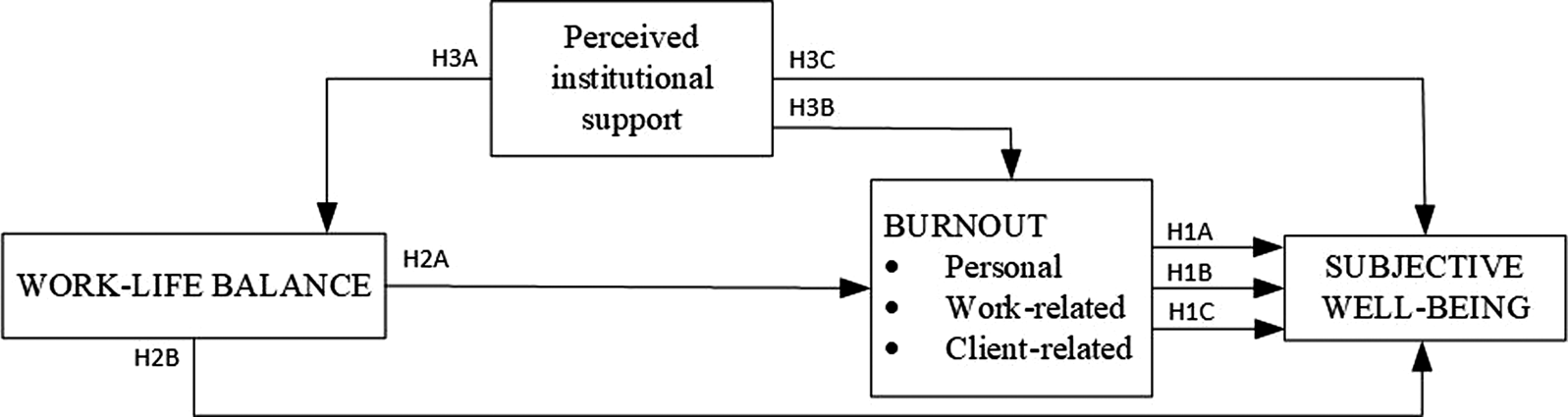
Based on the literature reviewed, we propose that direct relationships between work–life balance, burnout and well-being exist, and propose the following hypotheses:
Hypothesis 1A: Personal burnout experienced during the transition from direct to virtual teaching due to COVID-19 is linked with subjective well-being.
Hypothesis 1B: Work-related burnout experienced during the transition from direct to virtual teaching due to COVID-19 is linked with subjective well-being.
Hypothesis 1C: Client-related burnout experienced during the transition from direct to virtual teaching due to COVID-19 is linked with subjective well-being.
Hypothesis 2A: Work–life balance of educators during the transition from direct to virtual teaching due to COVID-19 is related to burnout.
Hypothesis 2B: Work–life balance of educators during the transition from direct to virtual teaching due to COVID-19 is related to subjective well-being.
As was already mentioned, many institutions and teachers did not have previous experience working virtually and not all were ready and could provide the support required for their staff (Kerres, Reference Kerres2020). However, institutional support in distance learning plays a protective role for educators (Purwanto et al., Reference Purwanto, Asbari, Fahlevi, Mufid, Agistiawati, Cahyono and Suryani2020). San-Martín, Jiménez, Rodríguez-Torrico, and Piñeiro-Ibarra (Reference San-Martín, Jiménez, Rodríguez-Torrico and Piñeiro-Ibarra2020) highlight that institutional support is essential to reassure instructors of their role as online teachers. Sokal, Trudel, and Babb (Reference Sokal, Trudel and Babb2020) identified that administrative support correlated with teacher resilience and burnout during the pandemic. In schools where teachers have better working conditions, they experience less burnout than their counterparts in schools where working conditions and institutional support are poorer (Kraft, Simon, & Lyon, Reference Kraft, Simon and Lyon2020).
According to McGill, Koppi, and Armarego (Reference McGill, Koppi and Armarego2014) the institutional support necessary for e-learning initiatives should include the financial support and the institutional recognition of the time and experience necessary to develop and maintain these initiatives. Lack of institutional support, as Shuck, Reio, and Rocco (Reference Shuck, Reio and Rocco2011) revealed, could have an impact on the negative emotions of employees. In relation to these insights, Amazue and Onyishi (Reference Amazue and Onyishi2016) argued that employees who perceived their organization to be supportive experienced more WLB than those who perceived their organization as less supportive.
Therefore, we hypothesize:
Hypothesis 3A: Institutional support during the transition from direct to virtual teaching due to COVID-19 positively influences the WLB of educators.
Hypothesis 3B: Institutional support during the transition from direct to virtual teaching due to COVID-19 decreases educators' burnout.
Hypothesis 3C: Perceived institutional support during the transition from direct to virtual teaching due to COVID-19 positively correlates with the subjective well-being of educators.
The summarized theoretical model for hypotheses testing is provided in Figure 1.
Research model.

Research methodology
Context of the empirical research
In our empirical study, we took Lithuania as an example, a Baltic State with a population of less than 3 million. The first case of COVID-19 was recorded at 4 am on the February 28, 2020. There were eight cases in Lithuania by the end of March 14th and a quarantine procedure was introduced commencing on March 16th 2020.
This requirement especially affected the teaching process, when all educational institutions moved to virtual teaching. On the first day, educational institutions in the country closed and students were given a 2-week holiday or moved to virtual teaching without any break. In the majority of cases, institutions did not have any previous experience of teaching online and they moved to this unusual form for studies with a maximum of only 2 weeks provided for preparation. During student holidays, educators participated in online training, internet seminars, and virtual consultations. After the student holidays, the teaching and learning process took place only virtually – students and educators did not meet in physical space until 2 months later when lockdown completed in the summer. When educators worked remotely, it became more difficult for the school administration and the community to provide support to their staff. These changes also led to a reorganization of the place of work and redistribution of learning resources and tools.
In Lithuania, the challenge of moving from direct to virtual teaching impacted around 800 academic staff and 27,300 teachers from 1,009 secondary schools, 60 vocational schools and 14 higher educational establishments. Therefore, we believe that Lithuania is an interesting country context to explore the well-being of educators during unexpected crises, and to answer our research question and test our hypotheses.
Measures
Well-being was measured according to the WHO well-being index (Topp, Østergaard, Søndergaard, & Bech, Reference Topp, Østergaard, Søndergaard and Bech2015), which includes five statements and measures the subjective well-being of a person during a considered period of time. We focused on the lockdown period and therefore, added the following to the original statements, such as ‘I have felt active and vigorous during lockdown,’ ‘My daily life during lockdown has been filled with things that interest me’.
This instrument was selected for two reasons: firstly, this instrument was tested by Milfont et al. (Reference Milfont, Denny, Ameratunga, Robinson and Merry2008), who analyzed the CBI and well-being among teachers in New Zealand; secondly, the lockdown and crises arrived unexpectedly and influenced work and personal life. Moreover, it was not clear how long the lockdown, work online and COVID-19 would continue. Therefore, exploring the well-being during the lockdown, approximately 1 month after it has started, enabled us to focus and explore the well-being during this unique situation.
Educators' burnout was evaluated using the CBI (Milfont et al., Reference Milfont, Denny, Ameratunga, Robinson and Merry2008). The original instrument consists of 19 questions. We reformulated the questions into statements and used a 5-point scale for measurement. The same procedure was followed throughout the whole questionnaire with most of the statements focusing on the virtual work. Burnout is measured using three sub-dimensions: personal (six statements, e.g., ‘I often feel tired,’ ‘I often think: “I can't take it anymore”,’ α = .938), work-related (seven statements; e.g., ‘My work is emotionally exhausting,’ ‘I feel that every virtually working hour is tiring for me,’ α = .904), and client (in our case student-related) (six statements; e.g., ‘I find it hard to work with students virtually,’ ‘I feel that I give more than I get back when I work with students virtually,’ α = .886). Cronbach's alpha for all instruments was .958.
According to institutional support presented by San-Martín et al. (Reference San-Martín, Jiménez, Rodríguez-Torrico and Piñeiro-Ibarra2020), we formulated seven statements about institutional support (e.g., ‘There is technical support for online teaching,’ ‘There is sufficient amount of human resource, who provide help/consult working virtually’) for institutional support measurement. A 5-point scale from 1 (totally disagree) to 5 (totally agree) was used for the above-mentioned measurements.
The work–life balance instrument was adapted from Daniels and McCarraher (Reference Daniels and McCarraher2000). It consists of 10 statements about work–life balance, with three response options: 1 – disagree, 2 – sometimes and 3 – agree. We reformulated all statements for the situation of teaching virtually (e.g., ‘At the moment because of the virtual teaching, I usually work more than teaching in the class,’ ‘Relaxing and forgetting about work issues is hard because of virtual work’).
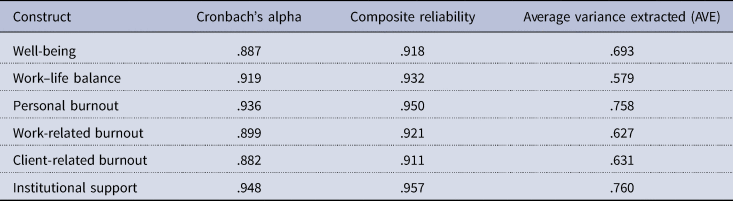
Both composed reliability and Cronbach's Alpha as measurements of internal consistency reliability were .882 and higher (see Table 1). The estimates of average variance extracted (AVE) were .579 and higher, additionally confirming convergent validity. Discriminant validity was also calculated and presented in Table 2.
Reliability and convergent validity

Discriminant validity

Sample and procedure
Based on the size of higher, vocational, and secondary schools' educators (around 28,100), the sample size should be 651 respondents, with a confidence level of 99% and a margin of error of 5% or 1,735 respondents with a confidence level of 99% and a margin of error of 3%.
The study was conducted for 3 weeks from April 28th to May 17th 2020. It was started almost a month after the beginning of online teaching, which involved all educational institutions commencing from March 30th. The link for the questionnaire and the leading letter about the research was delivered to Lithuanian educational institutions asking them to share it with educators. In total, 1,851 respondents from secondary, further and higher education institutions completed the questionnaire during the data collection period.
Results
Descriptive statistics
In total, 17.1% of respondents work at universities, 3.1% at colleges, 27.5% at high schools and 52.3% at other institutions (vocational, gymnasium, at several institutions, etc.). In total, 88.9% of all respondents were females, which corresponds with the general statistics of educators in Lithuania. In total, 69.6% of respondents are married, 55.3% have children and 27.5% of them have children up to 16 years old.
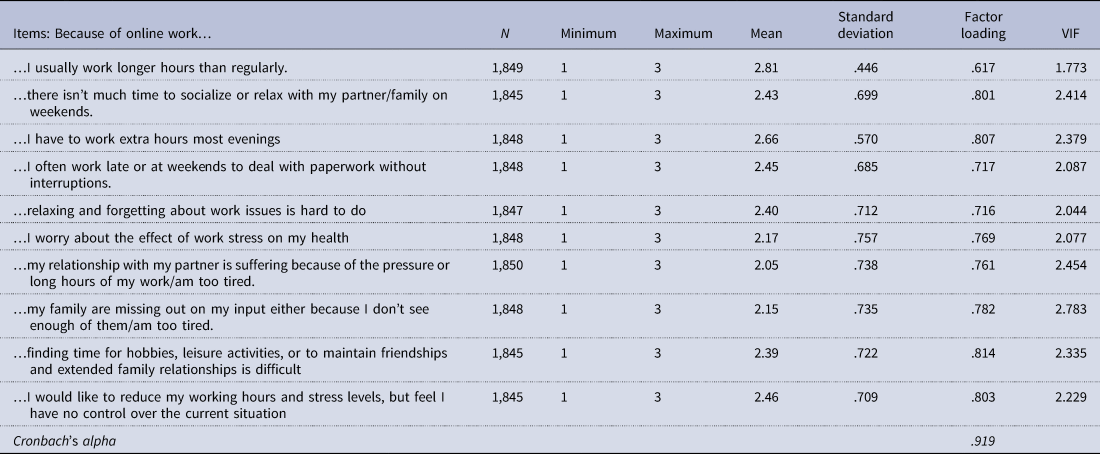
Table 3 illustrates changes to the work–life balance of educators as a result of online work due to COVID-19. All results are higher than average revealing that the work–life imbalance of respondents increased due to online work. This we interpret as meaning that the transition from direct to virtual teaching due to COVID 19 had a negative impact on educators' work–life balance. We found that the highest means were for the statements ‘I usually work longer hours than regularly’ (2.81) and ‘I often work late or at weekends to deal with paperwork without interruptions’ (2.66). This indicates that respondents had to do more work after the transition to an online environment than they did prior to the COVID-19 lockdown.
Evaluation of work–life balance working online

Hypotheses testing
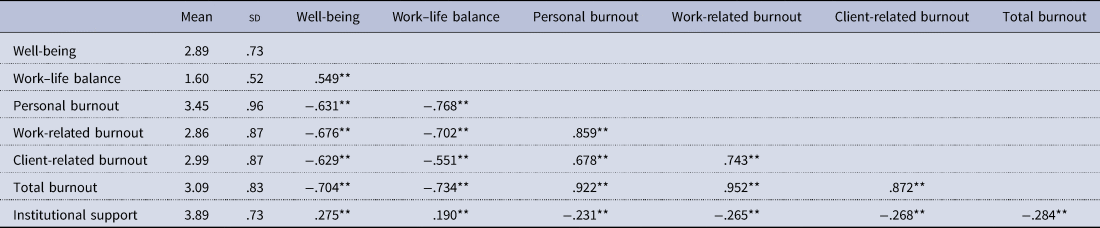
Correlation analysis (see Table 4) showed that personal burnout (r = −.631, p < .01), work-related burnout (r = −.676, p < .01) and client-related burnout (r = −.629, p < .01) are negatively correlated with the subjective well-being of educators working virtually during COVID-19 lockdown, supporting hypotheses 1A, 1B, and 1C. Work–life balance of educators during the transition from direct to virtual teaching due to COVID-19 was negatively correlated with personal (r = −.768, p < .01), work-related (r = −.702, p < .01) and client-related (r = −.551, p < .01) burnout, supporting hypothesis 2A. Hypothesis 2B was confirmed too, as the work–life balance of educators during the transition from direct to virtual teaching due to COVID-19 was positively correlated with their subjective well-being (r = .549, p < .01).
Descriptive and correlation matrix

Notes: **Correlation is significant at the .01 level (two-tailed). Pearson correlation coefficient is presented.
For institutional support, the hypotheses were supported too. Institutional support during the transition from direct to virtual teaching due to COVID-19 positively correlates with work–life balance (r = .190, p < .01) and well-being (r = .275, p < .01). Therefore, hypotheses 3A and 3C are supported. Negative associations between institutional support and personal burnout (r = −.231, p < .01), work-related burnout (r = −.265, p < .01), client-related burnout (r = −.268, p < .01) and total burnout (r = −.284, p < .01) were found and correspond with Hypothesis 3B. Therefore, higher institutional support decreases burnout and increases work–life balance and well-being.
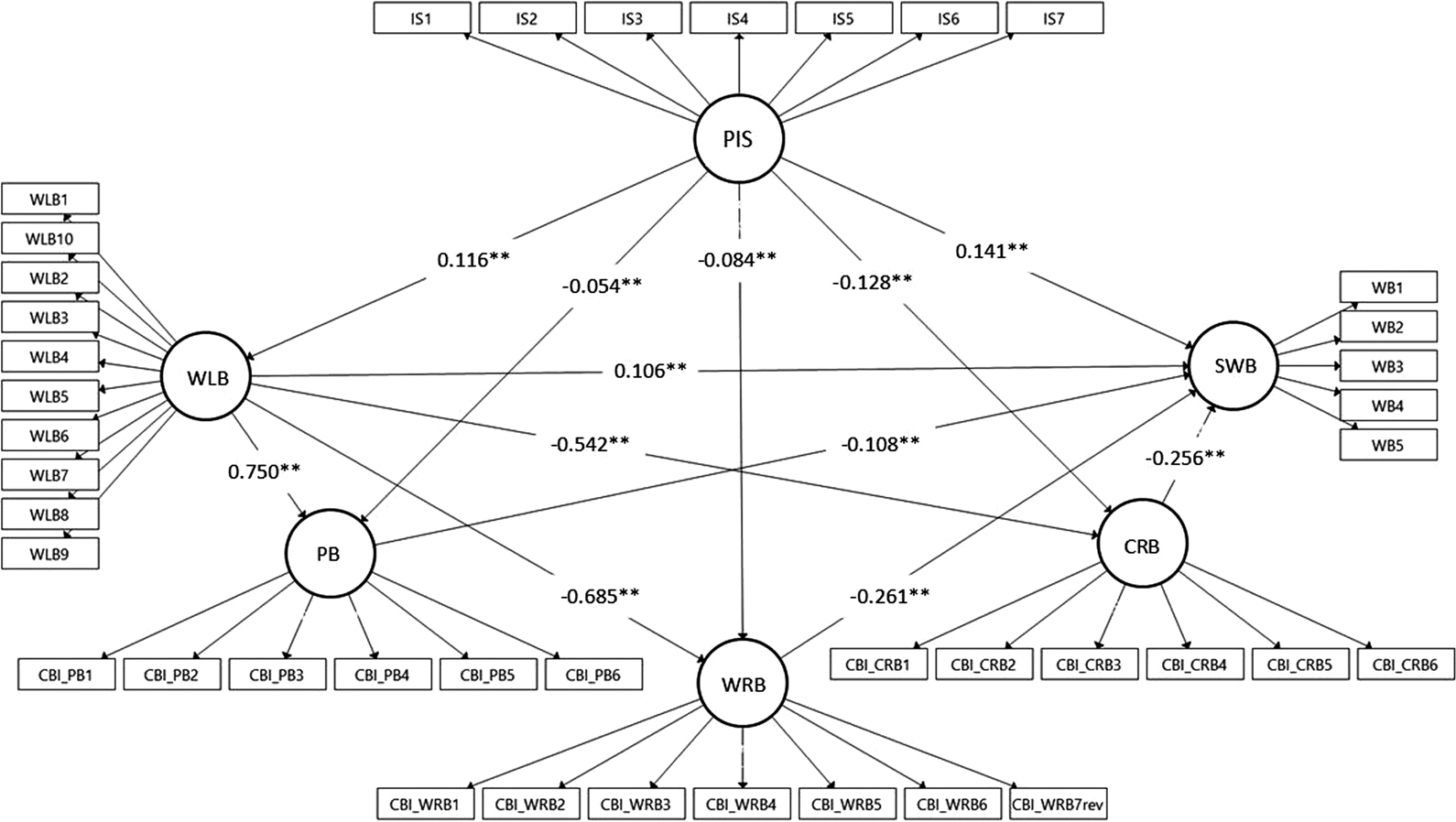
Structural equation modeling (SEM) with partial least squares (PLS) method was applied for the analysis of the influence of perceived institutional support on WLB, burnout and subjective well-being as well as the influence of WLB to burnout. The final model included institutional support, WLB, personal, work-related, client-related burnout, and perceived well-being of educators (see Figure 2).
Results of SEM. PIS, perceived institutional support; WLB, work–life balance; PB, personal burnout; WRB, work-related burnout; CRB, client-related burnout; SWB, subjective well-being.
Notes: Beta values are presented for each model path; **p < .01.

The analysis confirmed the positive influence of perceived institutional support on WLB (β = .116, p < .001) and subjective well-being (β = .141, p < .001) as well as a negative influence on personal (β = −.054, p < .001), work-related (β = −.084, p < .001) and client-related (β = −.128, p < .001) burnout, confirming Hypotheses 3A, 3B, and 3C. In addition, there was a negative impact of WLB on personal (β = −.750, p < .001), work-related (β = −.685, p < .001) and client-related (β = −.542, p < .001) burnout. The strongest impact was on personal burnout (adjusted R 2 = .575), and work-related burnout (R 2 adj. = .489), followed by client-related burnout (adjusted R 2 = .326). Impact on subjective well-being was also found to be of a similar amount (adjusted R 2 = .480), while the impact of perceived institutional support on work–life balance was lower (Adjusted R 2 = .013). The model revealed a good model fit (χ2 = 8,350.172, SRMR = .059, NFI = .864, RMS Theta = .104).
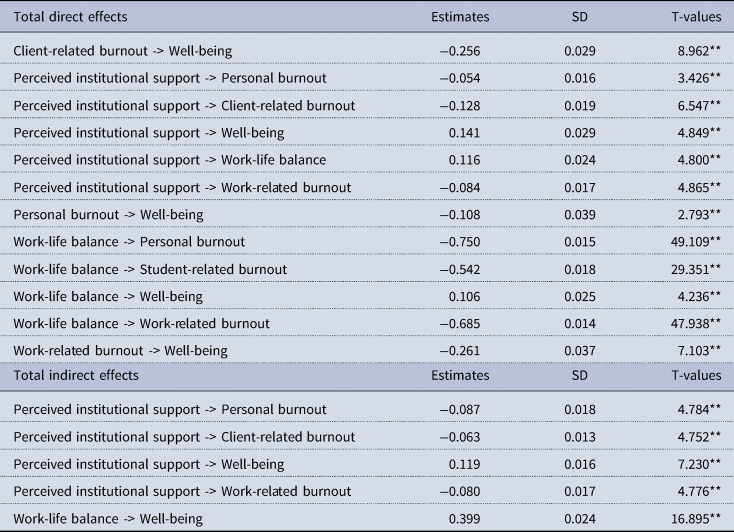
The direct effects of main independent variables on well-being as well as indirect effects of perceived institutional support and WLB are presented in Table 5
Direct and indirect effects.

Note: ** p < 0.001
.
The analysis confirmed not only the direct influence of perceived institutional support on WLB, burnout and subjective well-being, but also an indirect effect on subjective well-being with the mediation of WLB (β = .012, p = .001), personal (β = .009, p = .035), work-related (β = .022, p < .001), and client-related burnout (β = .033, p < .001).
SEM was run for more models, including demographic characteristics like gender, age, marital status, and a number of children (up to 16 years) as control variables, testing moderating effects. The model with gender, age and marital status showed a slightly better model fit than the final model (χ2 = 8,521.676, SRMR = .056, NFI = .867, RMS Theta = .103), but only marital status had a weak but significant influence on subjective well-being (β = .045, p = .024). No significant effect of the number of children under 16 years was observed.
Discussion
The main focus of this study was to answer the research question on how institutional support during the COVID-19 lockdown influenced the work and the subjective well-being of educators. Answering the main question, the findings illustrate that institutional support during the transition from direct to virtual teaching due to COVID-19 has a positive impact on the subjective well-being of educators (Hypothesis 3C). In relation to this issue, it should be highlighted that there is a lack of similar studies in this context. However, a study conducted by Rice (Reference Rice2006) before COVID-19, emphasized teachers have an important role in the support and success of students, in both traditional and online working. Therefore, our findings highlighting the positive impact on educators' work and well-being are very important in this changed environment. Online education should be based on a general strategy developed by the institution to which everyone is engaged and educators should be provided with support, sufficient resources, and enough time to put online working into practice. This recommendation is consistent with other recent literature in education and education management, for example, Anwer (Reference Anwer2020) emphasizes the role of the university, the needs of the faculty during COVID-19, and mechanisms to provide support. San-Martín et al. (Reference San-Martín, Jiménez, Rodríguez-Torrico and Piñeiro-Ibarra2020) highlight that institutional support is essential to reassure instructors of their role as online teachers.
Additionally, this research tested WLB and educator burnout and their relationship with institutional support and well-being. All the proposed hypotheses were supported. The findings revealed that working online during COVID-19 had negatively affected WLB of educators in Lithuania during the first lockdown in 2020. These findings support the results presented by Muldong, Garcia, and Gozum (Reference Muldong, Garcia and Gozum2021) and Anwer (Reference Anwer2020) and contradict the perspective of Palumbo, Mana, and Cavallone (Reference Palumbo, Mana and Cavallone2020) who argued that working from home gave flexibility and could positively influence WLB. The real situation highlighted additional demands for educators, which needed extra time and the flexibility of working from home was insufficient to maintain good WLB. Mostly, this was related to the lack of previous experience in virtual work and lack of institutional support highlighted by Kerres (Reference Kerres2020) and Sokal, Trudel, and Babb (Reference Sokal, Trudel and Babb2020). In relation to this problem, the findings show the received institutional support improved the WLB of educators (Hypothesis 3A) and WLB had a positive effect on well-being (Hypothesis 2B).
It was found that WLB decreased the burnout of educators (Hypothesis 2A). However, besides WLB, its influence on educator well-being and burnout other factors were important and influenced educators. As was noted before, stress influences burnout (Fabbro et al., Reference Fabbro, Fabbro, Capurso, D'Antoni and Crescentini2020; Kyriacou, Reference Kyriacou2001). When a teacher suffers burnout at work he or she could lose control of his or her professional and personal life. Some individuals might even be forced to consider leaving teaching. This problem has become even more significant during the COVID-19 pandemic. According to a recent study conducted by Niemi and Kousa (Reference Niemi and Kousa2020), educators agreed that working online required a different approach and skills than face-to-face teaching. Teachers have been worried about how they can work virtually, how they can create a very good study environment, and how they can help the student feel important and less isolated. Our results are consistent with those presented by Pressley (Reference Pressley2021), who found that teaching demands and administrative support correlate with educator burnout.
According to the survey results, each of three explored dimensions of educator burnout had a negative impact on their well-being confirming hypotheses 1A, 1B and 1C. These research findings are consistent with other studies of the education sector conducted before and during the COVID-19 pandemic by, for example, Herman et al. (Reference Herman, Prewett, Eddy, Savala and Reinke2020), Milfont et al. (Reference Milfont, Denny, Ameratunga, Robinson and Merry2008) and Geving (Reference Geving2007) and assume that teacher burnout and stress have a negative influence on the teacher's and the student's well-being.
Teachers arguably are the most important actors in the social construction of our educational communities. In summary, the transition by educators to online working was experienced creating problems with personal burnout, subjective well-being and negative work–life balance. Our findings, therefore, show that to improve stability and integrity the support of the institution is necessary particularly when educators and students are working online.
Practical implications
Management practice should be sensitive to the fact that educators are among the professions more sensitive to burnout and permanent stress due to problems with managing high workloads and work responsibilities. Thus, based on the concept of well-being, social support and JD-R theories, it is important to distinguish the quality of life, psychological balance, minimization of stressors, good working conditions, work–rest regime and therefore, to give institutional support and to provide the necessary resources in the way of instructional, technology, or emotional support during this unprecedented time.
Firstly, the importance of technical support, which should be provided by an institution, was identified. Availability of computers, essential software programs and high-quality internet access are necessary for teaching online in order to avoid obvious technical obstacles. Moreover, Purwanto et al. (Reference Purwanto, Asbari, Fahlevi, Mufid, Agistiawati, Cahyono and Suryani2020) noted additional costs for educators working from home, such as internet connection and electricity expenses. Secondly, in relation to technical support financial support, special budget or additional financial bonuses, which would cover better internet access and expenses related to a changed ‘office,’ when educators instead of using an office and class space use their home environment, could be provided. The third practical implication for institutional support to prevent educators from burnout and from a decision to change their profession focuses on human resources. There should be a sufficient number of employees, who can provide informational and educational support, offer diverse consultations and answer questions that educators face when working online. In addition, well-being plans with psychological support and consultations for educators should be provided if necessary. Finally, school administrators need to provide a supportive environment and instructional guidance to teachers from the top-down (Pressley, Reference Pressley2021). This includes clearly defined guidelines for teaching online, the development of digital competencies of educators and integration of innovations related to online teaching. In this case, educators can then see a long-lasting sense in their work online as well-being may also be affected by the lack of optimism about the future (Guest, Reference Guest2017). In this way, the overall quality of online education should increase. This development is consistent with global trends presented by the World Economic Forum (2020). It stated that even before COVID-19, there was already high growth and adoption in education technology, with global investments reaching US$18.66 billion in 2019. The forecast shows the overall market for online education to reach $350 Billion by 2025.
All the presented means could help educators to deal with different stressors challenging their work. This would facilitate decreasing work hours and would have a positive impact on work–life balance, reduce educator burnout and all together could have a positive impact on educator well-being.
Scientific contribution
We add to the knowledge of job demands-resources and organizational support theories contributing to the managerial psychology and education literature, by highlighting the importance of institutional support and resources received from an employer for educators, first, in the case of transition to virtual work and second, during a crisis period.
We contribute to educational studies in COVID-19 pandemic crisis, revealing the impact of institutional support on educator burnout. This study is novel for exploring the Copenhagen educator burnout inventory, since other studies conducted during the COVID-19 pandemic have used other instruments. Institutional support has a positive impact on every burnout dimension. Besides the fact that institutional support decreases work-related burnout, it also helps to reduce student-related and personal burnout. These findings are important and uphold the role of institutional support for teacher burnout adding to recent findings of Pressley (Reference Pressley2021), who identified that educator burnout does not depend on ethnicity, years of teaching experience, and instruction type of educators. Additionally, institutional support contributes to a better understanding of job demands-resources theory for educators in the COVID-19 context, showing that sufficient institutional support, as well as provided resources for educators, helps them to deal with job demands and to achieve their goals. Institutional support and sufficient resources have a positive impact on the WLB of educators, which helps to understand dimensions and changes to this phenomenon during COVID-19 thus contributing to WLB and the online teaching literature.
Additionally, we want to note, that in the case of Lithuania, this study is important because it focuses on a unique situation, which has never happened before in the country. Lithuania has not faced any war or revolution for 75 years after World War II. It is situated in a stable geographic position and does not suffer often from earthquakes, tornados, volcanoes, expanded fires or other natural disasters. Moreover, no health pandemic or other crises have happened in Lithuania that could affect all citizens in their personal and professional lives. Therefore, theoretical and practical insights on institutional support in one of the most affected sectors of the economy during unexpected crises are also important in this specific country.
Limitations
Firstly, convenience sampling was selected for this study. However, participants were from all regions of Lithuania. The most active were secondary school teachers in comparison with the academic staff of universities. Secondly, in this research, the results were not separated according to secondary, further and higher education teachers. However, besides different capabilities of institutional support, the general situation of all institutions on not knowing ‘how’ and not having previous experience teaching online could be highlighted. Additionally, respondents, who had either very positive or very negative experiences of working online, could have been more likely to take part in the study. However, a sample of 1,851 collected with a confidence level of 99% and a margin of error of 3% decreases this risk.
Moreover, we did not compare changes of well-being working physically and online but this wasn't an aim of this study. In this paper, we did not focus on the relation of well-being with marital status and the number of children of respondents. However, they were tested as a control variable. It was revealed that only marital status had a weak influence on subjective well-being, but not that the total number of children or number of children under 16 years had any impact. These relations and their reasons could be explored in more detail.
Further research directions
As we have mentioned above, we did not analyze in more depth the family status of educators and the impact of the number of their kindergarten and school-age children on their well-being, this could be expanded in a future study. In addition, the digital competence of educators could be explored in relation to work online and their WLB, burnout and well-being. Considering that educators feel high stress and face burnout, it is important to explore how they feel, how they prepare for their working day, and how they organize their spare time. Additionally, similar studies could be conducted in different countries to see cultural and institutional differences.
Looking at the COVID-19 pandemic's expansion and continuation, we could see that education continues to be online or a blended form between online and physical classes. Following the advice of Pressley (Reference Pressley2021) that future research needs to continue to explore the impact of the COVID-19 pandemic and the new demands on teachers during the 2020–2021 school year, we suggest conducting a longitudinal study to explore changes of work–life balance, burnout, and well-being of educators during this period, analyzing educators' adaptation to this protracted situation.
Vilmantė Kumpikaitė-Valiūnienė is a professor of Human Resource Management in the School of Economics and Business at the Kaunas University of Technology, Lithuania. She is a member of Digitalization Research group and a leader of the International Migration Research cluster. Her research interests include self-initiated expatriates, international migration, employees' well-being, work–life balance and modern training methods.
Jurga Duobienė is an associate professor in Human Resource Management and a member of Digitalization Research group in the School of Economics and Business, Kaunas University of Technology, Lithuania. Her research interests are in the fields of organizational development, business ethics, and entrepreneurship in the frame of digitalization.
Vilmantė Liubinienė is a professor at the Faculty of Social Sciences, Arts and Humanities and a member of the Digital Culture Communication and Media Research Group of the Kaunas University of Technology, Lithuania. Her research interests include media linguistics, localization and translation, media studies, digital culture and intercultural communication, a system of universal values.
Judita Kasperiūnienė is an associate professor in the Faculty of Informatics at Vytautas Magnus University, Lithuania. She is a member of a research group of Lifelong learning. Her research interests include technology-enhanced learning, self-regulated learning, disruptive innovations, qualitative research, social network analysis, AR/VR technologies, and brain–computer interfaces.
Ilona Tandzegolskienė is an associate professor in Educational Research Institute at Vytautas Magnus University, Lithuania. She is a member of a research group of Lifelong learning. Her research interests include higher education system and leadership, autonomous learning, career design, adult education, and research methods in social sciences.